Category Archives: Social issues

International Day of Peace, Sept. 21

International Day of Peace: Time to Act Is Now!

Happy International Day of Peace to us all!

Since 1981, the International Day of Peace (IDP) has been observed around the world on September 21st. The U.N. General Assembly declared in 1981, IDP as a day devoted to strengthening the ideals of peace, through observing 24 hours of non-violence and cease-fire. The ongoing wars in Ukraine, Sudan, Yemen, and elsewhere show us clearly that our world needs peace more than ever.

This year’s theme is Actions for Peace: Our Ambition for the #GlobalGoals. It calls us to get involved in actions that recognize our individual and collective responsibility to foster peace. Fostering peace will help us realize of the U.N. Sustainable Development Goals (SDGs) and achieving the Sustainable Development Goals will create a culture of peace for all.

The U.N. Secretary-General António Guterres recently said, “Peace is needed today more than ever. War and conflict are unleashing devastation, poverty, and hunger, and driving tens of millions of people from their homes. Climate chaos is all around. And even peaceful countries are gripped by gaping inequalities and political polarization.”

While the world is also observing the 75th Anniversary of the Universal Declaration of Human Rights as well as the Convention on the Prevention and Punishment of Genocide this year, IDP 2023 especially encourages all youth to be ambitious in their engagement as positive and constructive social agents, and to help us reach the SDGs and contribute to building sustainable peace. Together we can help to lead our world towards a greener, more equitable, just, and secure future for all.

The International Day of Peace was established in 1981, two decades later, in 2001, the General Assembly unanimously voted to designate the Day as a period of non-violence and cease-fire.

The Global Sustainable Development Report 2023

Since 2019, a progress report has been issued every four years. The latest 2023 Global Sustainable Development Report was issued on the 19th of Sept. at the 2023 SDG Summit which took place during the United Nations General Assembly session to follow-up and review the implementation of the 2030 Agenda for Sustainable Development and the 17 Sustainable Development Goals.

The 2023 Global Sustainable Development Report (GSDR) entitled: “Times of Crisis, Times of Change: Science for Accelerating Transformations to Sustainable Development” finds that at this critical juncture, midway to 2030, incremental and fragmented change is insufficient to achieve the Sustainable Development Goals (SDGs) in the remaining seven years. Implementation of the 2030 Agenda requires the active mobilization of political leadership and ambition for science-based transformations. This must be achieved globally—leaving no country, society or person behind. The report is an invitation to embrace transformations with the urgency needed to accelerate progress towards the SDGs.

Sustainable Development Goals (SDGs)

This year marks the mid-point in implementing the Sustainable Development Goals. The SDGs were defined to bring us closer to having more peaceful, just, and inclusive societies, free from fear and violence. But without the contribution of a wide range of actors including the 1.2 billion young people alive, the goals will not be achieved. So the U.N. invites us all to join the U.N. call to take action for peace: fight inequality, drive action on climate change, and promote and protect human rights.

The 17 SDGs, listed below in short, show the immense amount of work that is needed to bring peace and prosperity in our world.

  1. End Poverty: End poverty in the world in all its forms
  2. End Hunger: End hunger, achieve food security and improved nutrition and promote sustainable agriculture
  3. Health and Wellbeing: Ensure healthy lives and promote wellbeing for all at all ages
  4. Education: Ensure inclusive and equitable quality education and promote lifelong learning opportunities for all.
  5. Women and Girls: Achieve gender equality and empower all women and girls
  6. Water and Sanitation: Ensure availability and sustainable management of water and sanitation for all
  7. Sustainable Energy: Ensure access to affordable, reliable, sustainable and modern energy for all
  8. Economic Growth: Promote sustained, inclusive and sustainable economic growth, full and productive employment and decent work for all
  9. Improve Infrastructure: Build resilient infrastructure, promote inclusive and sustainable industrialization and foster innovation
  10. 10. Reduce Inequality: Reduce inequality within and among countries
  11. Habitat: Make cities and human settlements inclusive, safe, resilient and sustainable
  12. Sustainability: Ensure sustainable consumption and production patterns
  13. Climate Change: Take urgent action to combat climate change and its impacts
  14. Oceans and Marine Life: Conserve and sustainably use the oceans, seas and marine resources for sustainable development
  15. Preserve Ecosystems: Protect, restore and promote sustainable use of terrestrial ecosystems, sustainably manage forests, combat desertification, and halt and reverse land degradation and halt biodiversity loss
  16. Peace and Justice for All: Promote peaceful and inclusive societies for sustainable development, provide access to justice for all and build effective, accountable and inclusive institutions at all levels
  17. Global Partnerships: Strengthen the means of implementation and revitalize the Global Partnership for Sustainable Development

Sustainable development can only be achieved through a societal resolve, which can come through public education efforts. Educators, therefore, have an important role to play in achieving the SDGs by 2030! The value of education—in its broadest sense—cannot be underestimated.

Happy International Day of Peace to us all!

Compiled by Arun N. Toké, editor.

The Paralyzing Fear of Gun Violence

The Paralyzing Fear of Gun Violence*

A National Pandemic of The 21st Century

By Beatriz Lindemann, age 16, Florida

When I first heard the shrieks, I was in line to buy a set of pajamas at Victoria’s Secret with my nanny and godmother, Lizette. Then, suddenly, a stampede of people ran through the store.

“Get down!” someone screamed.

“We heard gunshots!” a woman yelled.

I dropped to the floor and grabbed Lizette’s hand. “¿Qué está pasando?” (“What is happening?”) I asked her. My heart was beating out of my chest.

She did not answer. We were both panicked. I wondered if the shooter was in the store.

An employee ran to a door in the back of the store. We followed her into a gray room filled with lockers and chairs. I stared at the door, waiting for someone to walk in. Was the shooter still in the mall? There was nowhere to go. Surely, if someone tried, they could get through the door. The employees listened to updates on their radios. My whole body began to shake as I processed what was going on.

Ten minutes later, the employees told us that the gates had shut in front of the store and that the police were beginning to search the mall. Relief.

Those were the scariest ten minutes of my life. I thought that I was going to die; I mentally prepared myself to have a gun pointed at me. Those ten minutes changed me.

We stayed in that back room for two hours as the police searched the mall. I was cold and shaking. I kept updating my phone until an hour and a half after the initial incident when the news reported that the shooter had gotten into an argument with someone he knew and shot three people in that mall—Aventura Mall in Miami. The report stated that the shooter had left immediately but did not report that thousands of people hid for hours.

This wasn’t my first experience with gun violence. When I was in the fifth grade, there was a mass shooting not too far from where I live in Miami at Marjory Stoneman Douglas High School in Parkland. Fourteen students and three teachers died at that school, a place where we should all be safe.

I had trouble imagining that fear and understanding that threat before that incident. In elementary school, lockdowns were a time to whisper and giggle with friends. After the Parkland shooting, though, no one spoke during lockdown drills. To this day, the air during these drills is tense and petrifying. No one is laughing. The threat is real. Too real.

After the shooting in the mall, I had panic attacks for weeks. I felt unsafe in public and did not want to be in large, commercial spaces. I was not in control, and that was difficult to accept. My experience did not compare to many others’ experiences with gun violence, yet I was rattled. I was 14, and I felt helpless.

Then, the Robb Elementary shooting in Uvalde, Texas, happened, and my resentment reached an all-time high. My stomach flipped when I read that Uvalde was the deadliest school shooting in a decade; 19 children and two teachers were killed. My heart ached as I thought of the parents who dropped their children off at school one morning and never got to see them again. They will never hug their babies again.

The more I read, the angrier I became. I shut my computer and screamed into my hands. When was it going to be enough? When was there going to be enough pain to cause change? How can politicians look in the mirror?

For the next couple of weeks, as more news came out about the shooting, my panic attacks continued. Parents and children who lost their friends that day were on the news. I felt their pain. Eleven-year-old Miah Cerillo covered herself in her dead friend’s blood to avoid being shot. She called 911 from her dead teacher’s phone. In what world is this acceptable?

I read articles that included the statements of politicians after the shooting. A Texan politician caught my attention. He did not offer solutions for protecting children but rather took the press opportunity to politicize the situation. He shared his opinion, which was that it was essential for Americans to have access to firearms. These politicians claim to be “pro-life,” advocating for the unborn but not the children already on Earth.

I have read the Constitution and the Bill of Rights in school. I understand why upholding the Constitution is necessary for our nation’s success and a well-functioning government. Still, I do not understand how a document written centuries ago can prohibit gun control for public safety. Banning all guns may not be the solution, but changing our policies has to be. We need to focus on who has access to firearms. Purchasing a gun in America is too easy. Pulling a trigger is too easy. Proper training is needed, as are background checks and mental health evaluations.

When will we depoliticize this human rights issue? Our country is divided, but to fix this, we must unite. This isn’t Democrats versus Republicans. It must be Americans against gun violence.

—Beatriz Lindemann, 16, Florida. Her stories have been published across various literary platforms, from Girls Write the World to the Women’s Media Center. She is a varsity rower and hopes to study journalism, political science, or law at university. Her unorthodox upbringing, raised by two gay dads, impacted her perception of the world and the power of writing.

*This essay by Beatriz was originally published by the Women’s Media Center on the WMC FBomb.

A Music Room of Our Own
A Music Room of Our Own

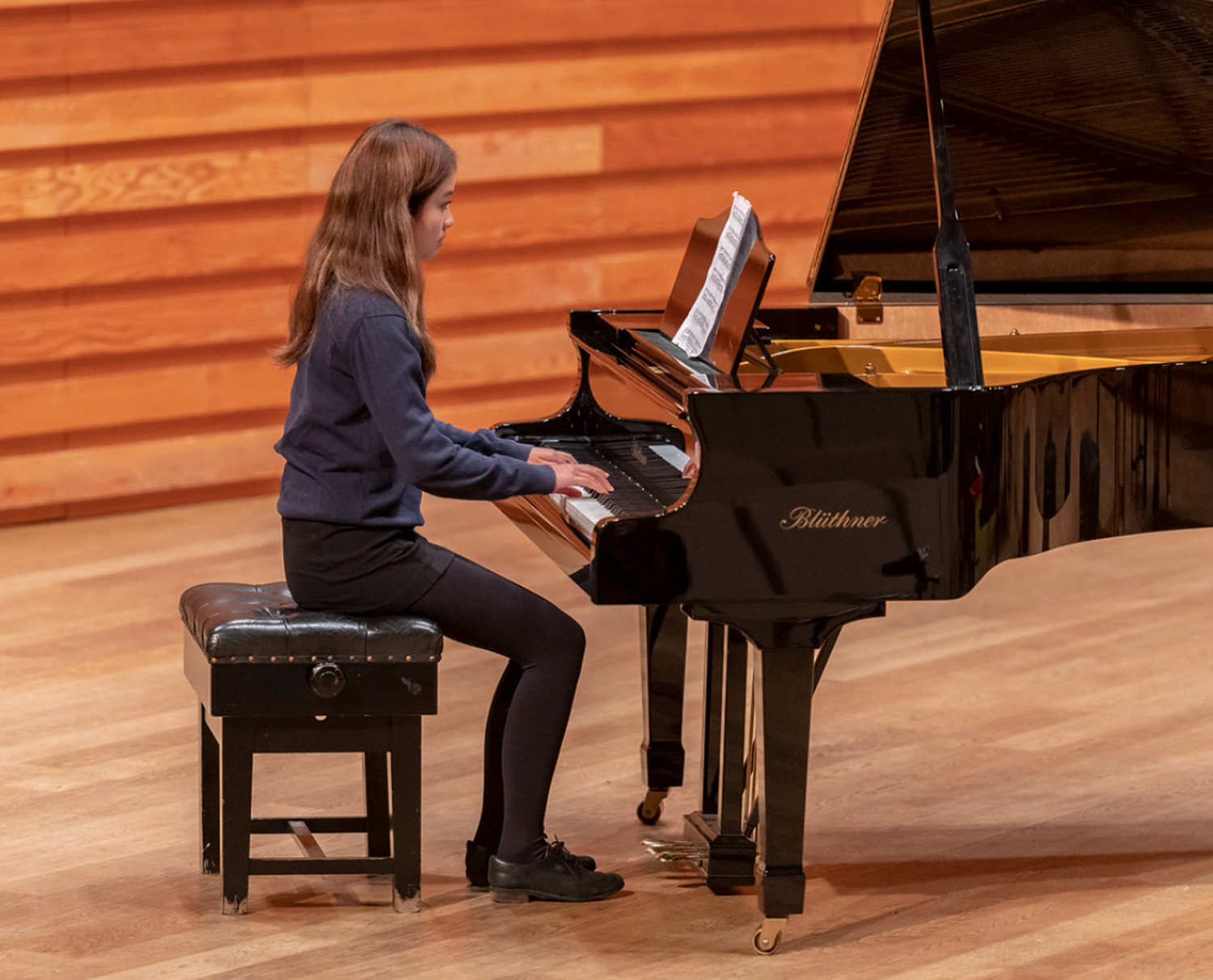
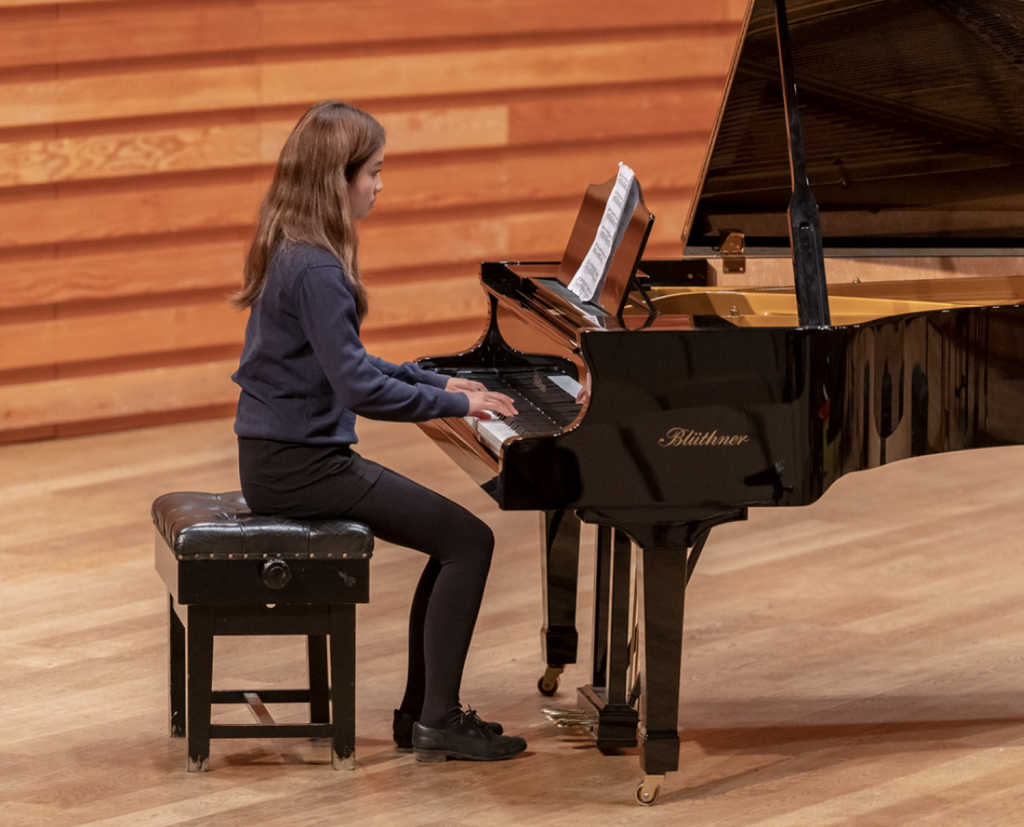
By Niki Zhang, 17, (photographed above) United Kingdom

Four years ago, as we sat in the practice room in which I had spent countless hours, my piano teacher, Ms. Li, handed me a thick navy volume. “The Well-Tempered Clavier” was written on its cover; beneath, in bold letters, “J.S. BACH”—a giant of Baroque music, progenitor of twenty-odd children, and, of course, a man.

I had no doubt about the brilliance of Bach’s music, but still I was not particularly happy about the assignment. Forcing a smile, I politely asked, careful not to offend, “Could I, perhaps, play anything other than Bach, Mozart and Chopin?” What surprised me was my teacher’s pause; the air in the room was tight and it was clear that Ms. Li was slightly taken aback by my comment.

“Not a problem,” she finally said. “What about Debussy? He was the father of impressionist music. Impressionism is quite feminine… I think you would like it.”

With slight indignation, I asked, “Why are there no female composers?” I was certain women impressionists existed, but I was disturbed to realize that I could not name a single one. To my surprise, Ms. Li seemed excited by my question, as if she had been waiting for it to be asked, and had many ideas ready for me. First, she gave me “D’un Jardin Clair” by Lili Boulanger, an elegantly dream-like yet stimulating piece. Then “Six Petite Pièces” by Charlotte Sohy. Then “Rêverie” by Germain Tailleferre. Why had I never heard of this wonderful music? Why has not the average concertgoer, or even the average pianist? The problem, I began to realize, was not the lack of women composers but the lack of recognition. I was determined to build a repertoire of the beautiful but neglected works of these forgotten composers.

I had only raised the question after playing the piano for eight years. In retrospect, I am surprised that as a woman it had not occurred to me earlier. Prior to that, I was ignorant about the subordinate or even absent position of women in the classical canon. Do not blame yourself if you cannot name any female composers, because historically there have been vanishingly few: only 2.2% of historical works were composed by women, according to the Donne Foundation.1

Even today, pieces by Beethoven and Brahms alone are performed about as often, worldwide, as pieces by all women composers combined.2

If women account for around half of the population, how could this possibly be? About a hundred years ago, author Virginia Woolf tried to answer much the same question in A Room of One’s Own.Though her subject was literature, not music, her arguments seem even more relevant to music. “A woman must have money and a room of her own if she is to write fiction,” Woolf famously wrote. Her insight is staggeringly simple—but like gender inequality in classical music, even simple things are not always obvious.

Woolf explains that, “Nothing is known about women before the eighteenth century.”Up to Woolf’s time, but particularly in the more distant past, role models, as we now call them, were few and far between, for writers or composers or really creative people of any type. The woman’s place was clearly in the domestic sphere; education was denied her, and her energies were allowed to be spent only on housework, not artwork. Lack of support and community would have made writing difficult. But imagine how much more impossible composition must have seemed, with the years of specialized training it required, followed by the large, expensive groups required to perform it. “Any woman born with a great gift in the sixteenth century would have certainly gone crazed, shot herself, or ended her days,”Woolf writes during her hypothetical discussion of “Judith Shakespeare,”William Shakespeare’s imaginary (and impossible) sister. Imagine how much truer that statement would be for Judith Byrd, Jennifer Gibbons, or Greta Handel.

The core of Woolf’s insight is materialist: creativity requires privacy, and privacy requires resources. Woolf emphasizes the need for material conditions in pursuing artistic desires, but these were “Out of question” for a woman “Unless her parents were exceptionally rich or very noble.”But it was not equality of opportunity and access to financial resources that was lacking, it was equality in having the liberty to be different, to express individuality, and to diverge from the standard of “greatness” which was defined in terms of the achievements by male composers.

In classical music, symphonies are traditionally equated with “greatness.” Smaller works are “minor.” If we had to illustrate what a “great” composer would look like, we would end up with dozens of portraits of high-status, European men. That is not to say that no efforts were made to change societal attitudes towards independence for women.

If Virginia Woolf wanted to consider the endeavours of a female composer to be recognised, she would not have had to look further than her close friend Dame Ethel Smyth. Smyth, who was about twenty years older than Woolf, fell in love with the writer, who described the experience as “Like being caught by a giant crab.”Smyth was a pioneer in the women’s suffrage movement, which became what was known as the first wave of feminism at the end of the nineteenth century. She met Woolf through the movement.

Smyth was the first female composer to have music performed at The Metropolitan Opera in New York. She fought alongside suffragette Emmeline Pankhurst in the “Votes for Women” campaign and wrote the official anthem of the Women’s Social and Political Union (WSPU).She often wrote music as E.M. Smyth to prevent her success from being hindered by patriarchal expectations. Smyth’s career was filled with operas, concertos and symphonies;10 she was not only a real influence on the suffrage movement but also inspired women and other underrepresented groups within classical music as a whole.

Woolf emphasises that women’s financial and educational disadvantages inhibited their creativity, and for musical composition, that is even more true. Classical music, more than literature or drama, requires extensive practical training and collaboration. It also requires a different kind of creativity, one that defies the traditional divisions, often mapped onto the genders, between sentiment and rationality—dramatised so effectively in Mr. and Mrs. Ramsay in Woolf’s To The Lighthouse. As Leah Broad explains in Quartet: How Four Women Changed the Musical World, making music in a male-dominated musical scene was different to more directly representative arts like painting and writing. Composing requires the “Ability to think both logically and emotionally… It was a talent considered beyond women’s reach.”11

Smyth rebelled against the roles that had been assigned to women in music. She demanded that her compositions be judged equally and in terms of merit, rather than of gender.12 She wanted to change the standard of “great” music, revise the image of the “great” composer and, by extension, subvert the default subordinate position of women. She broke societal standards of music by driving its political potential to the fullest, composing “The March of the Women.”13 It was later performed by suffragettes everywhere—at rallies, at meetings, and even in prisons.14 However, this came at a reputational cost. Smyth was aware that people saw her as difficult and uncompromising, and said, perhaps with a grin or perhaps with a sigh, that “The faults of people you are fond of are as precious as their virtues.”15 Broad argues that it is only because Smyth had these faults, especially her belligerence, that she was able to study music, let alone build a musical career.

However, Smyth is, like Woolf herself, an exception to the experience of most women in the late nineteenth and early twentieth centuries. She did not have the burden of raising a family, which would have been a significant obstacle. Even though her father was unsupportive of a career in composition, Smyth was fortunate to be born into a wealthy military family who supported her pursuit of music for leisure by performing in concert halls or for household entertainment.16

When women in Woolf’s day were encouraged to participate in music, it was often a way to elevate social status. The piano’s versatile nature and rapidly growing repertoire provided a perfect opportunity for women to make music, yet all too often, mastery of the instrument was merely seen as a way to render a woman a better housewife. Even for the women who had the leisure and resources to develop serious skills, becoming a professional was often not an option, even if they possessed a gift in composing or playing.

Publishing houses were similarly paternal, often refusing to publish women’s work.17 Composers therefore had two options: to copy their work by hand or to get it printed at their own expense. With many carrying the burdens of raising families, talented young women did not consider a career in classical music due to the discouraging climate in composition. Fanny Mendelssohn was discouraged by her brother, Felix Mendelssohn, from publishing her work because “She regulates her house, and neither thinks of the public nor of the musical world, nor even of music at all until her first duties are fulfilled.”18 In Woolf’s day, although the suffrage movement had allowed for women’s voices to be heard politically, they still struggled to be heard in concert halls. It is therefore probably not an accident that most successful female composers were raised in a musical environment where they could access and learn how to pursue music. Smyth, for example, was brought up as an Anglican and was exposed to music through singing hymns.19

Prejudiced attitudes have literally been built into the infrastructure of music. Even piano keyboards were designed in a way that did not accommodate women who, on average, have smaller hands.20 Though there is roughly a 50/50 split in gender in the world, the manufacturers continue to design instruments for the average male hand. This perpetuates the idea that one-size-fits-men applies to every single person, especially if the object is meant to be gender-neutral.

In my decade of playing the piano, it had never occurred to me that one of the reasons I had had to find alternative fingerings, use broken chords, or miss notes was simply because the piano I was playing (let alone the pieces themselves) had not been made for people like me. Female pianists experience gender bias not just in the concert hall, but literally when they touch the keyboard.

Smyth was composing and Woolf was writing in the 1920s. Since then, classical music has progressed from one “great” man to the next. In recent years, many more female composers as well as soloists and conductors have emerged. According to the 2022 Orchestra Repertoire Report conducted by the Institute for Composer Diversity (ISD), concerts featuring music by women composers and composers of color increased from 4.5% of all concerts in 2015 to 22.5% in 2022.21 But still too little of that music gets performed. More opportunities need to be on offer to allow people to learn, teach, and perform compositions by women. The question now, in a world that often congratulates itself for its progress, is no longer, “What has changed?” Rather, it’s important to ask, “What has not changed?”

Changing material conditions should, ideally, lead to changes in attitudes. Woolf understood though that the former always precedes the latter—that we cannot start talking about attitudes until the resources are there: people need to buy tickets, music needs to be commissioned and programmed and of course performed. Supporting female composers is not enough; institutions need to make an effort to stimulate an appreciation for their music. It would not hurt, either, if more women were appointed as administrators and board members.

In “The Pandora Guide to Women Composers,”22 Sophie Fuller writes, “Remembering and acknowledging (female composers’) many achievements can only enrich our understanding and bring us a clearer picture of the past.” The reason why music composed by women is not performed is not because they are not up to the standard but because only now are we discovering them. As we go forward, we need to make sure that independence and equality are distributed not just among elite white women. The Donne Foundation finds that of the 20,400 compositions scheduled by orchestras worldwide in the 2021-2022 season, only 7.7% of the works were written by women and, remarkably, 5.5%, or almost two-thirds, were by white women.23

Classical music is one of the only professions which actively discriminates against the living in favour of the dead; as such, it remains one of the purest bastions of the patriarchy left in our society, which, though not perfect, has changed appreciably since Woolf’s and Smyth’s day.24 There are thankfully many more women composers in the conversation today, from Jennifer Higdon to Joan Tower to Kaija Saariaho. This is progress. But it has taken a long time and we are still far from equality in terms of prestige, airtime, and frankly, ticket sales.

Four years after my encounter with Ms. Li, I performed “The March of the Women” in a school concert. Though a simple and straightforward piece, it brought on a flood of emotions, from hope to pride and the triumphant thrill of victory. I was in the position to take the powerful anthem sung behind bars, by a chorus of suffragettes whom Smyth conducted with a toothbrush, into my own hands on a grand piano in a recital hall with a supportive audience. It is a sign of how far we have yet to go that Smyth’s piece, once an anthem for political change, now feels like a call for change in the concert hall. “Scorned, spurned, naught have ye cared, / Raising your eyes to a wider morrow,” the anthem intones in a text by Cicely Hamilton. “March, March, many as one, / Shoulder to shoulder and friend to friend!”25 Solidarity among women and decisive, organized efforts to diversify repertoires and syllabuses will allow for more awareness of the involvement of women in music history, and ultimately fuller enfranchisement of women in the musical community.

—Niki Zhang, age 17, from Hong Kong, is a high school senior in the United Kingdom. She speaks English, Cantonese and Mandarin.

Niki adds: “This essay is really important to me because classical music (flute, piano, harp) has been a large part of my life since I was five, and like many other kids, was a hobby planted by my parents. As I grew older, I gained cultural awareness through the music I was playing, learning about the history and social changes in the environments I was stepping foot in, such as Ethyl Smyth, a composer and pioneer of the British Suffrage movement, and this is something I do not take for granted. I am deeply intrigued by the area of sociology and to be able to combine it with history and music in this essay, I could see the music world from a whole other perspective—much more than just playing notes on a keyboard but delving into the historical contributions and challenges women, in particular, faced as a result of fighting for recognition. My dream in the future is to continue playing diverse composers and spark these conversations, because only recently have we begun discovering and talking about them.” 


Foot Notes:

  1. Di Laccio, G. Equality & Diversity in Global Repertoire – Donne, Women in Music (2022), p.5.
    Available at: https://donne-uk.org/wp-content/uploads/2021/03/Donne-Report-2022.pdf
  1. Di Laccio, G. Equality & Diversity in Global Repertoire – Donne, Women in Music (2022), p.5.
    Available at: https://donne-uk.org/wp-content/uploads/2021/03/Donne-Report-2022.pdf
  1. Woolf, Virginia. 2014. A Room of One’s Own, 4
  2. Woolf, Virginia. 2014. A Room of One’s Own, 38
  3. Woolf, Virginia. 2014. A Room of One’s Own, 41
  4. Woolf, Virginia. 2014. A Room of One’s Own, 39
  5. Woolf, Virginia. 2014. A Room of One’s Own, 44
  6. Lumsden, R. (2015). “The Music Between Us”: Ethel Smyth, Emmeline Pankhurst, and “Possession.” Feminist Studies, 41(2), 335–370. https://doi.org/10.15767/feministstudies.41.2.335
  1. Millar, A. (2022) Critiqued, arrested, knighted: Knowing Dame Ethel Smyth, Museum of London.
    Available at: https://www.museumoflondon.org.uk/discover/dame-ethel-smyth-suffragette-music-composer-activist (Accessed: 02 July 2023).
  1. Walsh, K. (2022) Ethel Smyth’s Influence on the Women’s Suffrage Movement, The Classic Journal.
    Available at: https://theclassicjournal.uga.edu/index.php/2022/04/14/ethel-smyths-influence-on-the-womens-suffrage-movement/#_fn2 (Accessed: 02 July 2023).
  1. Broad, L. (2023) Quartet: How four women changed the musical world. London: Faber & Faber, p4
  2. Broad, L. (2023) Quartet: How four women changed the musical world. London: Faber & Faber, p5
  3. Smyth, Ethel. The March of the Women. The Woman’s Press, 1911.
  4. Broad, L. (2023) Quartet: How four women changed the musical world. London: Faber & Faber, 2
  5. Broad, L. (2023) Quartet: How four women changed the musical world. London: Faber & Faber
  6. Walsh, Keelin. “Ethel Smyth’s Influence on the Women’s Suffrage Movement | The Classic Journal.” The Classic Journal| a Journal of Undergraduate Writing and Research, from WIP at UGA, 14 Apr. 2022
  7. Broad, L. (2023) Quartet: How four women changed the musical world. London: Faber & Faber, p38
  8. Fanny Mendelssohn Hensel (2019) American Ballet Theatre. Available at: https://www.abt.org/people/fanny-mendelssohn-hensel/ (Accessed: 03 July 2023).
  9. Broad, L. (2023) Quartet: How four women changed the musical world. London: Faber & Faber.
  10. Perez, C.C. (2019) INVISIBLE WOMEN: Data bias in a world designed for men. Abrams Press.
  11. Deemer, R. and Meals, C. (2022) 2022 Orchestra Repertoire Report, ICD Repertoire Analysis. Available at: https://static1.squarespace.com/static/5b9ee971fcf7fd7add652207/t/62960a5d2a1998349128b94d/16540
  12. Fuller, S. (1995) The Pandora Guide to Women Composers: Britain and the United States, 1629-present. London: Pandora. 00223744/ICD_2022_ORCH_REPORT_MAY31.pdf.
  13. Di Laccio, G. Equality & Diversity in Global Repertoire – Donne, Women in Music (2022), p.5. Available at: https://donne-uk.org/wp-content/uploads/2021/03/Donne-Report-2022.pdf
  14. Fairouz, M. (2017) Women are great composers too, why aren’t they being heard?, NPR. Available at: https://www.npr.org/sections/deceptivecadence/2017/05/01/525930036/women-composers-not-being-heard
  15. Smyth, Ethel. The March of the Women. The Woman’s Press, 1911.


Works Cited

Broad, Leah. Quartet. Faber & Faber, 2023.

Di Laccio, Gabriella. “Equality & Diversity in Global Repertoire.” Donne, Women in Music, Sept. 2022, https://donne-uk.org/wp-content/uploads/2021/03/Donne-Report-2022.pdf.

Deemer, Rob, and Cory Meals. “Repertoire Analysis.” Institute for Composer Diversity, Institute for Composer Diversity, June 2022, https://www.composerdiversity.com/analysis.

Fairouz, Mohammed. “Women Are Great Composers Too, Why Aren’t They Being Heard?” NPR Music, NPR, 1 May 2017. https://www.npr.org/sections/deceptivecadence/2017/05/01/525930036/women-composers-not-being-heard.

Fuller, Sophie. The Pandora Guide to Women Composers. Harper San Francisco, 1994.

Laccio, Gabriella Di. “Ethel Smyth—a Firecracker in Munich—Donne, Women in Music.” Donne, Women in Music; https://www.facebook.com/DonneUK, 28 June 2021. https://donne-uk.org/ethel-smyth-a-firecracker-in-munich/.

Millar, Andrew. “Critiqued, Arrested, Knighted: Knowing Dame Ethel Smyth | Museum of London.” Museum of London, Museum of London, 21 June 2022, https://www.museumoflondon.org.uk/discover/dame-ethel-smyth-suffragette-music-composer-activist.

Scott, Britain, and Christiane Harrassowitz. “Beyond Beethoven and the Boyz: Women’s Music in Relation to History and Culture.” Music Educators Journal, no. 4, SAGE Publications, Mar. 2004, pp. 50–56. Cross-ref, doi:10.2307/3399999.

Staveley, Alice. “Marketing Virginia Woolf: Women, War, and Public Relations in ‘Three Guineas.’” Book History, Vol. 12, The Johns Hopkins University Press, pp. 295–339, doi:10.2307/40930548. Accessed 3 July 2023.

Walsh, Keelin. “Ethel Smyth’s Influence on the Women’s Suffrage Movement | The Classic Journal.” The Classic Journal | a Journal of Undergraduate Writing and Research, from WIP at UGA, 14 Apr. 2022, https://theclassicjournal.uga.edu/index.php/2022/04/14/ethel-smyths-influence-on-the-womens-suffrage-movement/#_fn2.

Smyth, Ethel. The March of the Women. The Woman’s Press, 1911.

Dear New Yorker

Dear New Yorker,

It’s a little weird how you are standing in the middle of Fifth Avenue. Anywhere else in the world your yellow shirt would help you stand out, but here, in this jungle of concrete, you run the risk of being camouflaged in a sea of yellow street cabs. I appreciate your confidence though, a trait one needs in order to be considered a New Yorker. And in the city that never sleeps, anything is possible. From the time of New Amsterdam on the southern tip of the island, New York has been a land of new possibilities, welcoming groups that were otherwise shunned from society. The first Jewish community in the new world stepped foot on the island in 1654, finding a refuge, a place where they could live in relative peace. Flash forward to the past two centuries and millions of immigrants have flooded through Ellis Island. Not all of them have stayed in New York, some moved throughout the country establishing roots in other communities, but one constant remains, each one got their start in this great city. Imagine the sight. Lady Liberty standing proud on the Hudson. Give me your tired and poor. So yes, anyone is welcome in New York as long as you are brave. Even you, an idiot who is standing in the middle of the road.

Love,

C.

“I have enjoyed all types of writing during my high school career, but specifically enjoy writing creative
nonfiction. This summer, I plan on attending a young writers workshop where I hope
to improve my storytelling skills and collaborate with some of the best young authors from
across the country and around the world. In college, I would like to major in English and
concentrate or minor in creative writing at an institution that values literary fields.”

A City of Thieves

A City of Thieves

“What we call casual poetry—verses written on kitchen napkins, often forgotten—reminds us that poems are a natural part of human expression… or at least, they should be. My hope is to capture the antagonistic nature of humanity in the 21st century. How does one capture such corruption on paper? The ethics of industries and modern work culture are major topics of debate. What good is individualism if it leads to the downfall of one’s well-being? Each poem is a cry from humanity. The pieces explore the lives of various people and their environments. Both a billionaire oil company CEO and a burned-out office worker have a connection to their environments. My hope is to preserve the fleeting present. Each poem follows how industrial, political, and economic changes have influenced humanity as a whole. The poems are meant to bring attention to the peculiarities… or struggles of various people.”

—Suprya Sarkar, 16, Connecticut.


It is May and I’m still jobless.

I thought this city was meant to give birth to dreams.

What dreams, they can only devise schemes.


I would rent out a place

But penny tosses and angry bosses consume my day.

I wonder if they truly hold up to their promises of Agony… obliteration. 


The pencil taps

Or the ticking of my twelve-dollar watch

Has room for little patience in their world.

I fantasize about what to say.


Like a parakeet reciting words to catch bait,

I revise my questions.
For how many times,

Who is to say?


They close the door on the poor man in white.

Goddammit,

A university degree

And I’m just as broke as that streety?  


My friends from home don’t bother to pick up the Phone.

Ring, Ring, oh shoot,

My phone bill is laying on the floor.


Why bother trying to restore the old?

A long-neglected Porsche,

Yeah, I think that’s who I am.


What is all this brooding for?

I am writing home

As if even my own mother remembers my name.

Don’t worry they say,

“You’ll get your own place someday!”

—Suprya Sarkar, age 16, originally from Bangladesh, now lives in Connecticut.

Mr. Liberation Theology

Mr. Liberation Theology


The house of sand you built at last.

Tell me, friend, do you think it will withstand a world so vast?


You wrecked sandcastles just to build signs seeking justice.

Children sleep out in the cold.

Oh heavens watching above, is this justice?


The blanket the child holds onto is an oasis.

Its warmth mimics that of a home so far away.

The desert was his home; a long-forgotten friend.

Every wind feeds him the false promise of freedom.


What do they know?

What do they know of the sun’s kiran* when mother would feed us šāy.*


USA!

Is that how they play?

The warplanes outnumber the birds.

Children close your eyes, they are fighting for pay.


You can not hide in this world.

You are solely bare, exposed, naked even!

What man was born with cloth? Point me to him and then I will abandon my home.


And though you can drink your coffee

So black, filling up the glass

That same coffee will stare you back.

Black is the oil you pull from a land so boundless.


Who is brave enough to claim the desert as his own?

You can not rule. You fool!

Many tried and failed to seize this land.

For centuries it stands, unbroken by your nuclear adornments.

For the Desert is a lion, no simple house cat.


He who dares to challenge shall be left broken in the end.

The pools of oil have all dried up;

Your thirst can never be quenched.


* Kiran: ray;    šāy: thick creamy top layer on boiled milk

By Suprya Sarkar, age 16, originally from Bangladesh, now lives in Connecticut. She adds:

“What we call casual poetry—verses written on kitchen napkins, often forgotten—reminds us that poems are a natural part of human expression… or at least, they should be. My hope is to capture the antagonistic nature of humanity in the 21st century. How does one capture such corruption on paper? The ethics of industries and modern work culture are major topics of debate. What good is individualism if it leads to the downfall of one’s well-being? Each poem is a cry from humanity. The pieces explore the lives of various people and their environments. Both a billionaire oil company CEO and a burned-out office worker have a connection to their environments. My hope is to preserve the fleeting present. Each poem follows how industrial, political, and economic changes have influenced humanity as a whole. The poems are meant to bring attention to the peculiarities… or struggles of various people.”


Stand OUT

Stand OUT

Smart
Smarter
Smartest
That’s all they care about in this test
Your Creativity doesn’t matter
Your Hardwork doesn’t matter
the Blood sweat and tears you put in doesn’t matter
It’s all about the score in the end
This toxic cycle of making us believe
Believe this is what we have to do to fit in
Fit in with society
Fit in with the crowd
Fit into the jigsaw puzzle
When you’re your very own work of art
For how long does this go on
For how long does this cycle go on
This cycle of blending us all together as one
Until we’re broken and bleeding pieces
Working together in blurred masses
Towards a goal that was never ours
Stop
Make it all stop
Stop making us believe we’re jigsaw pieces
Stop making us believe that we’ve got no choice
No voice
That we cannot be a counterpoise
That we’re nothing more than a mere small voice
Stop making us believe we aren’t our own masterpieces
Stop making us believe that we’ve got to fit in
When we were born to stand out

Likhita Makam is a 15-year-old Indo-American high school student living in India. She has been published in youth newspapers and literary magazines. She’s an avid reader and is up for a poetry discussion at all times. She hopes to inspire people of all ages with her words.

While the World was Fixated on the Folly of Billionaires

While the World was Fixated on the Folly of Billionaires

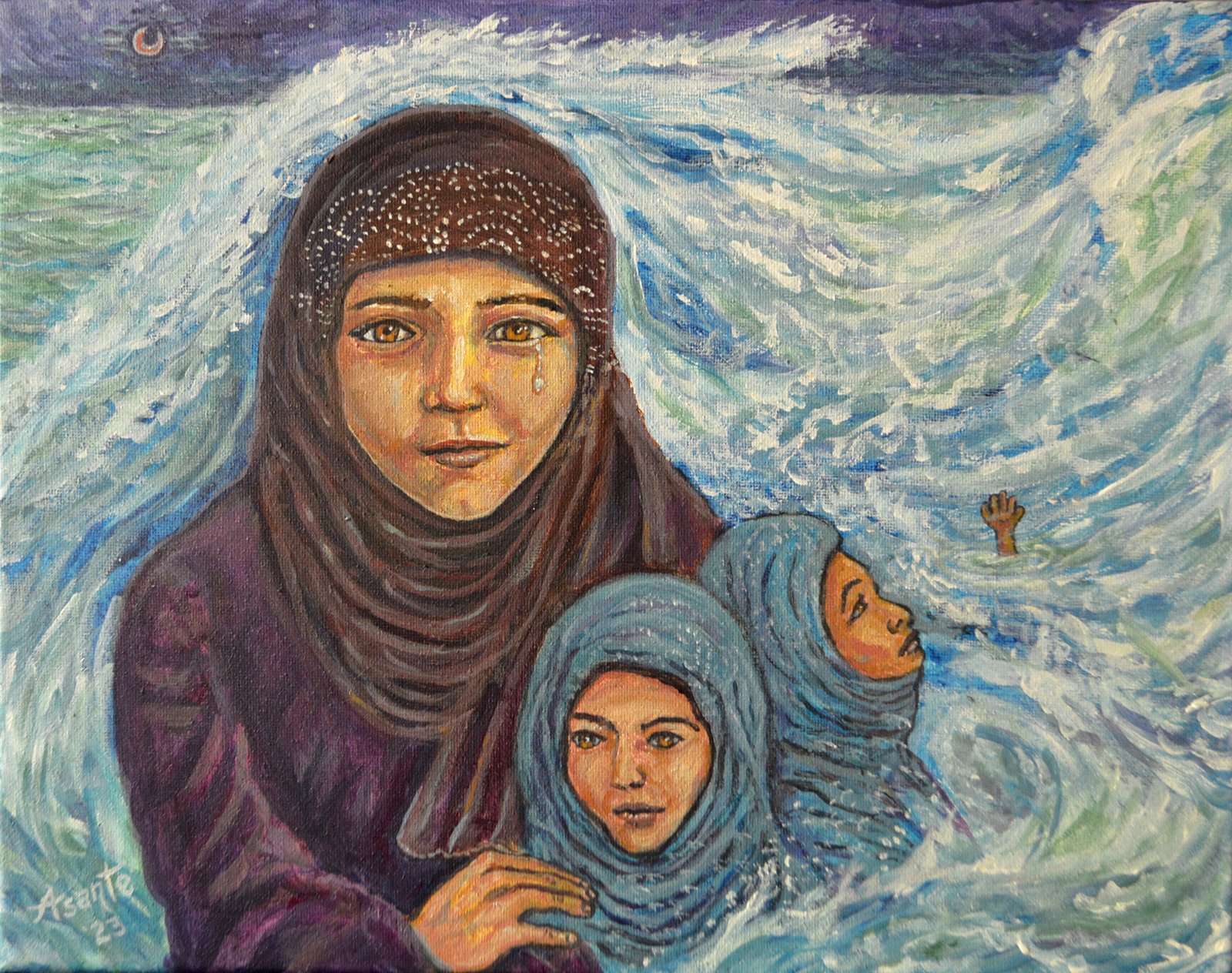
So many of us are mesmerized by the plight of billionaire folly, yet our society is turning a blind eye to the very real horrors of the world’s refugees, seeking survival. While the billionaire submersible was imploding last month reminding us all of the power of our oceans’ depths, and an oft-absent respect for the power of nature, a ship crowded with refugees sunk near the coast of Greece and as many as 700 women and children drowned. The officials in boats did nothing to help, they simply watched in the as the refugees drowned. So much of this world’s politics and cruelty are so reprehensible… so much cruelty when there could be compassionate sharing and life saving help! This new painting insisted on coming into the world. I cannot and art will not be silent on the insanity of this all!!!

You can read an insightful article by Amy Goodman & Denis Moynihan in Democracy Now! https://www.democracynow.org/2023/6/23/greece_migrant_shipwreck_media_coverage

Art and words by Asante Riverwind, artist, Eugene, Oregon.

Consumption

Consumption 

By Lucy Jones, age 15, Wales, U.K.

I wish to consume every piece of media that adorns the Earth
Every book, film, and song
Every day I panic, thinking about how little time I have
How little in my minuscule life I can truly consume
I wish to cry every tear and smile every smile
I wish to feel the most harrowing heartbreak and the most jovial joy
I wish to travel the world
I wish to play every game
I wish to meet every person 
In all my wishing, I never seem to take action
In all the endless possibilities, I take after none of them
In the end, all I do is wait
I wait for the right moment
Just the right book
Just the right film
Just the right person
When all I wish for is everything, I achieve nothing.

—Lucy Jones, Age 15, Wales, United Kingdom.


Army Recruiting in Schools Needs to Stop

Army Recruiting in Schools Needs to Stop

By Avah Keyhani, grade 8, California.

In 2016, more than 60 percent of military enlistments came from neighborhoods with a median household income between $38,345 and $80,912.[1] That means that there are more lower income families in the military, most likely because those families saw the military as a chance to help their economic standing. The truth is, if there was another way to lift families out of poverty, then the military’s recruitment rates would go down, and no one would be joining the military to get money for college or grad school. As it is, that’s exactly what they’re doing. They are using young people in lower income families and giving them a choice: join us and become a hero or live in poverty. Of course, the military kind of beats around the bush when it comes to murdering others and very possibly dying yourself. When you’re younger, you’re more impulsive and more easily persuaded, so the military preys on younger minds. That’s why military recruiters need to get out of schools and stop going after lower income families.

If a young person isn’t joining the military of their own free will, they shouldn’t be joining at all. The military doesn’t want college to be free because their recruitment relies on poorer people enlisting in exchange for funds for college. Many choose to be part of the military because of the promise of college ahead. Take that away, and their recruitment rates will drop (which is good). Common Dreams quotes a GOP lawmaker who Tweeted, “By forgiving such a wide swath of loans for borrowers, you are removing any leverage the Department of Defense maintained as one of the fastest and easiest ways of paying for higher education.” Does the lawmaker not realize he’s literally admitting that college degrees and crushing debt are being used as leverage? And that he’s saying that the military relies on young, poor people and threatens them with poverty? Commenting on this republican lawmaker, Our Wisconsin Revolution argued on Twitter, “The GOP is admitting that the military relies on poor young people to keep the war machine going, and that’s why they oppose canceling student debt…The price of a college degree should not be bloodshed or a lifetime of crippling debt.”

If someone wants to join the military because they enjoy dropping bombs on people, fine. But most people join to pay for a degree, or because of some advertisement. That’s wrong. People shouldn’t have to kill others to get a college degree. Nor should they have to live with debt. War has a terrible effect on the human mind and young people shouldn’t have to deal with that just to go to college or grad school.

The military targets lower income families. According to NNOMY “…Schools with a high proportion of low-income students serve as a magnet for the military. Take the example of two similarly sized high schools in two Hartford suburbs: Avon and Bloomfield. Army recruiters visited Avon High, where only 5 percent of students qualify for free or reduced-price lunch, four times during the 2011-12 school year. Yet at Bloomfield High, where nearly half the students qualify for such assistance, recruiters made more than 10 times as many visits.” That means that they spent more than forty days at Bloomfield high (that’s more than once a week!) and four days at Avon. They spent so much more time at the school where half of the kids needed help paying for their lunch, and barely any time at the school where five percent needed help. That’s blatantly obvious and disgusting. The military is exploiting people that come from lower income families because people who come from lower income families will have a harder time paying for college.

Kids shouldn’t be subjected to the kind of violence the military engages in, especially those who are under twenty-five and whose prefrontal cortexes are not fully developed. According to Heathline, “While many people have endured the hell of war and escaped unscathed, young people who experienced personal trauma before service are the most likely to develop lasting mental health issues after serving in combat.” Well, what kids are more likely to have experienced trauma? Poor kids, which is exactly the group the military is going after. Also, can you ‘endure the hell of war and escape unscathed?’ Can you watch people die, maybe some of your friends and others by your own hand, and go back to life like nothing happened? I don’t believe so, especially if your brain hasn’t fully developed.

According to inequality.org, “Research reveals numerous physical and mental health risks from joining the military at a young age—including higher rates of substance abuse, depression, PTSD, and suicide.” This is common knowledge, knowledge that the military surely has, so why are they continuing to recruit kids even though they know what may happen to them further down the line? It seems like the military purposely feeds on younger soldiers who don’t quite have the mental capacity yet to think ‘wait, why am I doing this?’ If this country really cared about the next generation, they would be helping the kids make a life for themselves rather than recruiting them into the military and exposing them to violence.

The military isn’t something you should be joining to get a degree. The right to education should be assured, not something that lower-income families will either have to go into debt for or be willing to kill people for. And with younger people, who agree to join the military on the promise of paid-for college, it severely attacks their mental and physical health. If the government cares more about being the biggest bully in the playground than caring about their own young people’s mental health, they have no business being the government.

Avah Keyhani, grade 8, California. She writes: “…I am a bilingual Iranian American who speaks Farsi and English. The most important things in my life are my family, friends, my books, and standing up for myself and my ideas. I would very much like to become a scientist and I have an interest in epidemiology. I was inspired to write my essay after reading about the amount of people who join the military at a young age and are scarred for life.”


[1]https://www.brookings.edu