Category Archives: Family and Community

The Knowing Smiles of the Devis

The Knowing Smiles of the Devis

By Anu Prabhala, Maryland

On the feminine divine, life’s transitions, and the strength we carry within

It was Navarathri, the nine-day Hindu festival celebrating Devi (Divine Mother or the feminine divine), and for the first time in years, I decided to light a lamp before the Devi’s altar in our home.
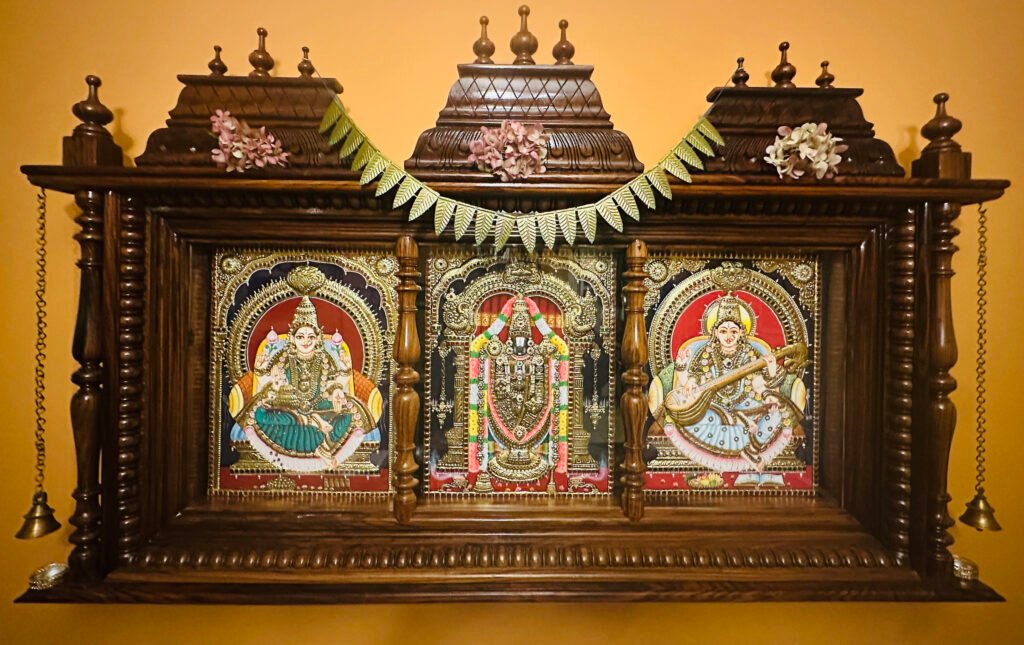
I usually light my lamp at the altar in the same room. But this year, something drew me toward our beautiful three-panel Tanjavur painting (see above), which has adorned our wall for ten years. Specially commissioned for us and shipped from Bengaluru, India, the painting shows Lakshmi, the goddess of spiritual wealth, on the left, and Saraswati, the goddess of knowledge, on the right.

As I lit the lamp, hoping the flame wouldn’t make the dainty bells dangling above it too hot, I found myself looking into their faces.

And something quite unexpected happened.

I felt compassion. Not so much for them as from them. Their gentle smiles and serene eyes seemed to hold a knowing understanding, almost as though they were saying, I know. I am here.

I had looked at these paintings countless times before. Why was I seeing them differently now?

Perhaps it had something to do with the transitions unfolding in my own life: an uncertain professional future; a book I had dreamed of writing for years finally taking shape; a son edging ever so close to the day when he would leave home and begin his own adventures; and my 88-year-old mother in India, with whom I’ve spent many wonderful years (and still yearn to spend much more time with).

So much to be grateful for, and yet so much to take in, anticipate, and occasionally worry about.

And here were these two women—goddesses, no less—looking back at me with expressions of such extraordinary tenderness.

I am hardly a scholar of Sanatana Dharma (a.k.a. Hinduism), and my knowledge of the many forms of the divine mother is limited. But at that moment, I wasn’t thinking about scriptures, symbolism, or theology.

I was thinking about the feminine divine. About the extraordinary capacity of women to absorb life’s uncertainties, to nurture, to persevere, to find strength when strength seems in short supply.

And about how comforting it was, for once, to feel that someone else was looking after me!

Women in the Seats of Power

In South India, during Navarathri, we worship three manifestations of the feminine divine: Durga, for her strength and courage; Lakshmi, for the material and spiritual wealth she represents; and Saraswati, for knowledge, wisdom, speech, and music.

How wonderful, I thought, to have women in the seats of power! Not political power, but something far more fundamental—the very source of strength, abundance, and knowledge.

And really, who’d be better than a woman to untangle a messy situation, knock some common sense into everyone involved, and steer things toward a happier outcome? 😉

But jokes aside, I began thinking about how much women take in.

We absorb other people’s anxieties, manage expectations, juggle responsibilities, hold families together, and somehow keep plowing ahead. We are mothers, daughters, wives, friends, professionals, caregivers—often several of these at once.

And somewhere amid all these roles, we must also find room for ourselves. For our own aspirations, disappointments, uncertainties, and dreams.

Perhaps that was why I felt so drawn to the Devis this year. I wasn’t looking at distant, impossibly perfect goddesses. I was beginning to recognize something of our own lives in what they represent.

Strength doesn’t always look like a tigress charging into battle. Although some of my oldest friends might disagree! Born on the second day of Navarathri, I was named Durga Annapurna. For decades, a group of friends, including my dear friend Bindi, have affectionately called me “Purni-Sherni”—Purni (total/complete?) the Tigress—for my reputation as a fierce go-getter. Bindi even gifted me a hand-painted tigress for one of my recent birthdays!

But lately, I have been discovering another kind of strength—one that is gentler and manifests more quietly. Sometimes it simply means getting up in the morning and carrying on, even when you aren’t quite sure what comes next.

And knowledge isn’t always about finding the right answer. Sometimes it is the wisdom to recognize that not everything needs to be resolved today—and to trust that we will find our way.

The Devis Among Us

During Navarahtri, I experienced another reminder of the feminine divine—this time, not in the gilded panels of a Tanjavur painting, but in a roomful of women gathered at my friend Manju’s home.
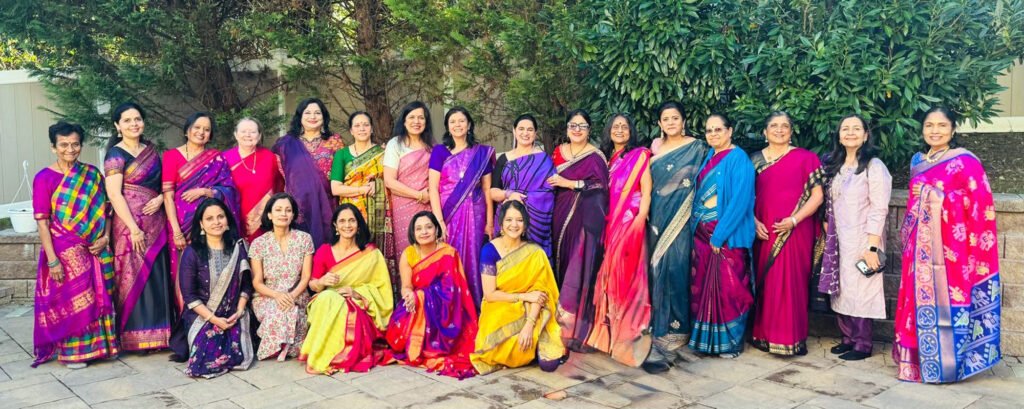
We sang bhajans (devotional songs) and chanted shlokas (sacred Sanskrit verses passed down over millennia that share eternal truth). We laughed, posed for pictures, ate sumptuous food, exchanged stories, gossiped a little (surely, the goddesses would forgive us!), and shared some of our worries and woes.

Manju explained the festival’s significance. Anju offered a Vedantic (from ancient Hindu scriptures) perspective. And Gabriela appeared resplendent in a sari, perhaps to the astonishment of her American husband and German family!

Wisdom, laughter, generosity, compassion, and strength filled that room. And, of course, plenty of good food.

As I looked around, I realized the Devis we worship aren’t so far removed from the women we are.

Each of us carries her own share of responsibilities, anxieties, hopes, disappointments, and dreams. Yet, for a few precious hours that evening, we set our responsibilities and worries aside. We were simply ourselves—women enjoying one another’s company, drawing strength from shared experiences, and finding joy in belonging.

But perhaps our evening had even offered us a kind of victory—over isolation, worries, and the little burdens that sometimes weigh down our spirits.

I arrived at Manju’s home to celebrate the Devis. I left feeling that I had spent the evening in their company.

And perhaps, in some small way, we had all rediscovered the Devis within ourselves.

These days, when I look at my Tanjavur painting (see the painting above), I still see those knowing smiles.

And I find myself smiling back.

—Anu Prabhala, originally from India lives in Maryland. She adds: “If these reflections resonate with you, subscribe to my weekly blog, Imperfectly Perfect, free at https://anuprabhala.substack.com/subscribe for more stories about life, its surprises, and the ways we learn to see.”

Note: The Navarathri festival was recently celebrated from Oct. 11-20; Oct. 20th being the Vijayadashami (or Dussehra). In 2027, Navarathri will be celebrated from Sept. 30th through Oct. 9th. On October 21st, the USPS released a new postal stamp to observe the annual five-day Hindu festival of lights, Diwali, which will be celebrated Nov. 7-11, 2026.
Could Forest Bathing Be One of Public Health’s Most Overlooked Tools?

Could Forest Bathing Be One of Public Health’s Most Overlooked Tools?

By Thom Hartmann, educator and commentator.

Scientists are discovering that spending time in forests may help prevent disease before treatment is ever needed…

Nature is powerful medicine. Multiple studies over the years have found that people in hospitals with windows overlooking nature recover and heal faster than those without. And I remember the years when Louise and I ran a community for abused kids that was out in the woods of rural New England, it always seemed that taking them on nature walks calmed them down more than anything else, including most of the meds.

Last month, a team of researchers from six countries published an argument in Communications Health that nature should be thought of as a therapeutic tool in and of itself, and should be available to everybody. They point out that worldwide anxiety is up 63 percent and depression up 26 percent just over the past 15 years, and argue that much of this is the result of what they call “nature deprivation.”

The solution, they recommend is something called “nature-based mental healthcare” or NBMHC, citing multiple studies showing the power of regular immersion in nature as a psychological tool every bit as important and effective (and sometimes more so) as pharmaceuticals.

Ralf Buckley, the lead author, points out that more than half of all doctor visits these days are now about some aspect of mental rather than physical health, but mental health gets roughly half of one percent of public health funding.

— A 2007 study found that “forest bathing”—a Japanese concept that’s taken hold around the world, basically standing in the forest and pausing to take it all in—measurably reduces levels of cortisol, the “stress hormone.”

— A 2010 study discovered that the anti-cancer immune system “killer cells” (NK cells) in our bloodstream jacked up by exposure to nature:

“…2-night/3-day trips to forest parks enhanced human NK activity, the number of NK cells, and intracellular anti-cancer proteins in lymphocytes, and that this increased NK activity lasted for more than 7 days after the trip in both male and female subjects.”

Follow-up research found that even a one-day trip to the forest similarly increased killer cell activity, helping prevent cancer in people for at least a week thereafter.

I’ve been drawn to nature my entire life, from exploring forests and a nearby stream as a kid to Louise and my weekend trips to Portland’s Forest Park to climb the foothills of the Tualatin mountains.

And it’s not just the physical activity; when “forest bathing” is compared to working out in a gym both produce physical improvements, but the psychologically positive effects of forest bathing far outstrip those of simple exercise.

Louise and I, however, live in a city with the largest urban park in the world with over 80 miles of trails in it. And we have a good enough income to afford a car to drive to it, something many people simply can’t do.

Pointing specifically to this imbalance in access to nature caused by financial status, the authors of that first study I mentioned argue that nations should start thinking of natural spaces as part of the panoply of psychotherapeutic tools available to society, rather than decorations or recreational opportunities for people who can afford to get to them (or pay for a park pass, like in many parts of America; here in Portland, Forest Park is free).

I wrote a while back about awe being the cheapest medicine we’ve got, but cheap isn’t the same thing as accessible. In the medical context, we spend a fortune on both physical and psychological tools to repair people, but nature is almost never (other than the hospital windows studies and changes in new hospital construction) considered as a therapy.

Buckley’s team calculated back in 2019 that national parks contribute upwards of five trillion dollars a year to the global economy through the mental health benefits to visitors alone; that’s roughly five hundred times what the world spends maintaining protected areas that, it turns out, can be so critical to improving mental health (with considerable side-benefits for physical health).

Nature, it turns out, is the cheapest, safest, best-tolerated intervention in the entire mental health toolkit, but has been quietly reclassified as, essentially, a consumer good, now only available to people who have a car, a weekend, and enough disposable income.

Teddy Roosevelt understood the importance of wilderness areas instinctively and intuitively, having used nature for years to treat his own asthma and “weak constitution.” It’s why he set aside over 230 million acres of wilderness as national parks, land that sadly today’s administration is trying to sell off to donor drilling and mining operations as fast as it can.

China, on the other hand, having examined this type of research and drawing on centuries of folk medicine pointing in the same direction, has, according to researchers, a “national health strategy includes nature-therapy infrastructure in 1200 forest reserves, to provide a billion person-hours per year.”

Nature should be available to everybody, and our urban planning and policies should make sure that we have wild spaces and public transportation cheap enough to get pretty much everybody to the wild spaces.

Let your state legislators and city council know, and put together a plan to get yourself into nature at least once a week!

Copyrighted by Thom Hartmann, educator and commentator. Thom has written many respected books. Reprinted with permission from The Wisdom School of August 5th, 2026 by Thom Hartmann. All articles are free and available to everyone in The Wisdom School: What it Means to be Human. Wisdom School is a reader-supported publication. To receive new posts and support Thom’s work, consider becoming a free or paid subscriber to The Wisdom School.

Share

What If Some of Our Depression Is Coming from the Grocery Store?

What If Some of Our Depression Is Coming from the Grocery Store?

No country should have to accept a food supply that makes its people sick and sad because that’s what’s most profitable, and the science is now on our side when we say so out loud.


Back in the late 1970s, when Louise and I were running a residential treatment program and school for abused and emotionally disturbed kids, we took the children off the standard institutional diet. Out went the dyes, the artificial flavors, the sugary cereals and the boxed dinners, and in came real (vegetarian) food cooked fresh every day from scratch.

While it’s impossible to know how big a factor that was (we were also on a remote forest-covered lake and had some great therapists), kids who were given up on as being incorrigible or uneducatable were soon ready for reintegration into the normal school system and a foster home.

While Ben Feingold told me diet was a huge factor in kids’ behavior, and we did a small study on salicylates in their diet that I published in 1980 in the Journal of Orthomolecular Psychiatry, I was always skeptical. Until now.

Last week, researchers at UC San Francisco published a small trial in JAMA Psychiatry that looked at what happened to people clinically diagnosed with depression stopped eating ultra-processed food (UPF). For four weeks they ate a diet that cut their UPF consumption by more than 85 percent.

And, sure enough, their depression eased with their depression eased, with moderate to large improvements showing up on three separate measures. Their anxiety scores got a little better, as well.

Similarly, in 2017 an Australian team led by Felice Jacka ran the SMILES trial, taking 67 people with moderate to severe depression and giving half of them coaching toward a Mediterranean-style diet (fresh foods, mostly vegetarian/pescatarian) while the other half got supportive counseling from trained professionals. After twelve weeks, 32 percent of the food group were in full remission from their depression, compared with of the the people who just got counseling.

Two years later, researchers at Macquarie University tried a three-week version of the same study with depressed university students. The students who cut back on processed food and ate more vegetables, fish and olive oil reported significantly less depression, and the improvement was still clinically evident a full three months later.

Then came the really big large-population studies, a gold standard in health science.

Harvard researchers followed almost 32,000 nurses for decades and found that the women eating the most ultra-processed foods had about a 50 percent higher risk of developing depression than those eating the least. (Of particular interest: artificial sweeteners stood out as the worst offenders.)

A massive review in The BMJ pulled together 45 separate analyses and tied these UPF foods to 32 different kinds of harm, with anxiety and other common mental disorders at the top of the list.

And just this week another British study looked at more than 46,000 people born around the end of postwar sugar rationing. Those who spent their first thousand days of life—from the womb to their second birthday—under sugar and meat rationing were less likely to be diagnosed with depression or anxiety as adults.

Why would a bag of potato chips or too many sodas slam into your mood with such impact? The UCSF team suspects the gut-brain connection.

Their idea is that the emulsifiers, preservatives and other industrial additives in these products wear down the gut’s protective lining, which sets off low-grade inflammation that travels through the whole body and triggers a freak-out (my term, not theirs) in the brain. Dr. Nyasha Chagwedera, who led the study, put it this way:

“Junky processing may harm your gut in ways that ripple up to your brain.”

Older cultures wouldn’t find any of this surprising. They were not just careful about what they ate, but had a story about every edible plant or animal in their world; it’s how both cultural and “safe-to-eat” information was transmitted from generation to generation. And it worked until we turned our food system over to the giant corporations and their “food scientists” to figure out how to make things more profitably.

As a result, today the CDC says fully 55 percent of the calories Americans eat now come from ultra-processed products, and for our kids it’s closer to a shocking 62 percent. We—and our kids—are up against some of the most well-paid scientists and greedy capitalists on the planet.

So try this: give yourself four weeks, the same stretch the UCSF volunteers got. Read the ingredient list on everything you buy, and if it’s got anything on the list that you wouldn’t find in your own kitchen, put it back. Cook simply, and notice how you feel in week one and again in week four. And if someone you love is struggling with depression or anxiety, pass this along and offer to do it with them.

No country should have to accept a food supply that makes its people sick and sad because that’s what’s most profitable, and the science is now on our side when we say so out loud.

By Thom Hartmann, educator and commentator. Thom has written many respected books. Reprinted with permission from The Wisdom School of October 7th, 2026 by Thom Hartmann. All articles are free and available to everyone in The Wisdom School: What it Means to be Human. Wisdom School is a reader-supported publication. To receive new posts and support Thom’s work, consider becoming a free or paid subscriber to The Wisdom School.

Share

The Lie Capitalism Told about Human Nature

The Forest Exposes the Lie Capitalism Told about Human Nature

By Thom Hartmann, educator and commentator

Walk into a piece of old growth Pacific Northwest forest, and something happens to you. The light goes liquid. The air thickens. The moss is six inches deep on every horizontal surface. The Doug firs go up two hundred feet without a branch and disappear into a canopy you can’t quite see. The fallen trees, what loggers used to call nurse logs, are slowly becoming the next forest, with seedlings already rooted in their soft, decaying bodies. And the silence isn’t really silence. It’s a different quality of attention than you can find anywhere else.

I’ve spent a lot of hours in those forests over the years. What strikes me, every time, is that the forest doesn’t feel like a place. It feels like someone. Or, more accurately, like many. A standing community of beings that knows you’re there before you know how you feel about being there.

For most of my life, science was telling me I was wrong about that. The official story, survival of the fittest, was that a forest is a kind of slow-motion gladiator pit, every tree fighting every other tree for sunlight and water and nutrients, and that the canopy I was walking under was the result of a few million years of relentless mutual exploitation. Whatever I was feeling under those firs was a poetic projection, not a fact about the forest.

In April, scientists from the Smithsonian Tropical Research Institute and the Forest GEO global research network published a paper in Nature that’s quietly demolishing that story.

The team examined nearly three million individual trees, across more than five thousand species, in seventeen forests spanning Asia, Africa, and the Americas, and they found that positive, supportive interactions between neighboring trees are at least as common as the competitive ones we were taught about in school, and that the closer a forest is to the equator, the more cooperative its tree-to-tree relationships tend to be.

“Most research has focused on competition and other negative interactions among trees,” the study’s co-author Matteo Detto said, “but trees can also help their neighbors in many ways. We find that these positive interactions are more common in tropical forests, adding another piece to the puzzle of understanding their remarkable diversity.”

This is on top of decades of research, by Suzanne Simard at the University of British Columbia and by many others, on the underground mycorrhizal networks (the so-called wood wide web) that connect tree roots through filaments of fungus, allowing them to swap carbon, water, nitrogen, and chemical defense signals across species lines.

Simard’s framework, including her concept of mother trees (older, larger trees that appear to act as hubs in the underground network), has been beautifully popularized in books like her own Finding the Mother Tree and Peter Wohlleben’s The Hidden Life of Trees, and has also, in fairness, been challenged by other ecologists who argue that some of the popular claims have run ahead of the data.

The careful version of the science, today, is this: forests are unmistakably interconnected through fungi and roots, carbon and signals do move among trees through those networks, big old trees do appear to play structural roles in the system, and the precise mechanisms of how, and how much, are still being worked out. What’s not in question, after the new Nature paper, is the larger frame. Forests are cooperative systems at least as much as they are competitive ones. They’re not gladiator pits. They’re communities.

This matters far beyond ecology, because for the last hundred and fifty years our entire economic worldview has been built on a stolen metaphor from biology. We took Darwin’s struggle for existence, ripped it out of its context, ignored the fact that he wrote at least as much about cooperation and mutualism as he did about competition, and built capitalism, libertarianism, and most of our public-policy frameworks on the assumption that competition is the law of nature.

We lectured each other about it for generations. We told the kids in our schools that the forest was red in tooth and claw. We told them the market was just an extension of the forest. We told them anyone who didn’t make it deserved their fate, because that was just how nature worked.

But nature doesn’t work that way. The Russian biologist Pyotr Kropotkin, observing wolves and birds and human peasant villages across Siberia in the 1880s, noticed this immediately and wrote his classic Mutual Aid to push back on the social-Darwinist misreading of his contemporary, Thomas Huxley.

Lynn Margulis, a century later, blew the whole story open with her work on endosymbiosis, demonstrating that the eukaryotic cell, the basic unit of every plant and animal on Earth, came into existence through cooperation between two ancient bacteria, not through competition.

And forest ecology is now arriving at the same place. The trees, it turns out, are not in business school. They’re in a long, patient, multi-species relationship with their neighbors, their fungi, their soil, their rain, their light, and the dead bodies of every tree that ever lived and fell among them.

I made a related argument decades ago in Last Hours of Ancient Sunlight. The whole basis of life on Earth is a single, vast, hundreds-of-millions-of-years-long cooperative project.

Photons from the sun cooperate with chlorophyll. Chlorophyll cooperates with carbon dioxide and water. The resulting sugars cooperate with mitochondria. Plants cooperate with fungi. Fungi cooperate with soil. Soil cooperates with microbes. Trees cooperate with other trees.

And for almost all of human history, every culture except the most recent one understood this implicitly. The forest was a relative. The river was a relative. We were not above the system. We were part of it, and our job was to maintain the relationships that kept it alive.

What does this mean for the rest of us in 2026, with a planet on fire and a civilization built on the wrong story? Three things, I think.

First, defend the old growth forests we have left. They aren’t interchangeable with tree plantations. A two-hundred-year-old Doug fir, with its underground mycorrhizal partners and the centuries of local relationships it has built, can’t be replaced by twenty saplings on a clearcut. Once those connections are severed, it can take centuries for the network to rebuild, if it can be rebuilt at all. There’s a reason indigenous land sovereignty consistently produces healthier forests than corporate or state management does. Indigenous knowledge has known this in its bones for thousands of years.

Second, change the story you tell yourself about how the world works. Adam Smith was wrong about the invisible hand being our deepest nature. The forest is the deeper truth. Cooperation, mutualism, kinship, and care are the substrate. Competition is real, but it sits inside the larger frame of cooperation, the way a jazz solo sits inside the band.

If you build a society on the metaphor of the forest instead of the metaphor of the market, you get a different country, with different schools, different hospitals, different elder care, different economics, and very different relationships between neighbors.

Third, find a real forest, an old one if you can, and sit in it for an hour with your phone face-down. Not to perform contemplation. Just to listen. The forest will teach you what cooperation actually feels like, in your body, with no theory required. You’ll feel small in the right way, and held in the right way, and you’ll come out of it remembering something the dominant culture spent a century trying to make you forget.

The new Nature paper is just the latest piece of the science finally catching up. The forest was never a battlefield. It’s a community we forgot we belonged to. And the very good news is that the community is still here, still patient, still willing to teach us, in the language of light and root and fungus, who we actually are.

If there’s an old growth forest within driving distance of you, go this month. If there’s a campaign to protect it, donate or volunteer. If your local government is making decisions about a nearby greenbelt or watershed or working forest, show up at the meeting and speak. And tell me in the comments where your forest is, and what it’s teaching you. We’re a wisdom school here, which means our forests, like our wisdom, belong to all of us.

By Thom Hartmann, educator and commentator. Thom has written many respected books. Reprinted with permission from The Wisdom School of June 10th, 2026 by Thom Hartmann. All articles are free and available to everyone in The Wisdom School: What it Means to be Human. To receive new posts you can become a free or paid subscriber of this reader-supported digital publication.

Vesak Celebrations

The Vesak Festival වෙසක් උත්සවය

By Saviru Bandara, age 11, Australia

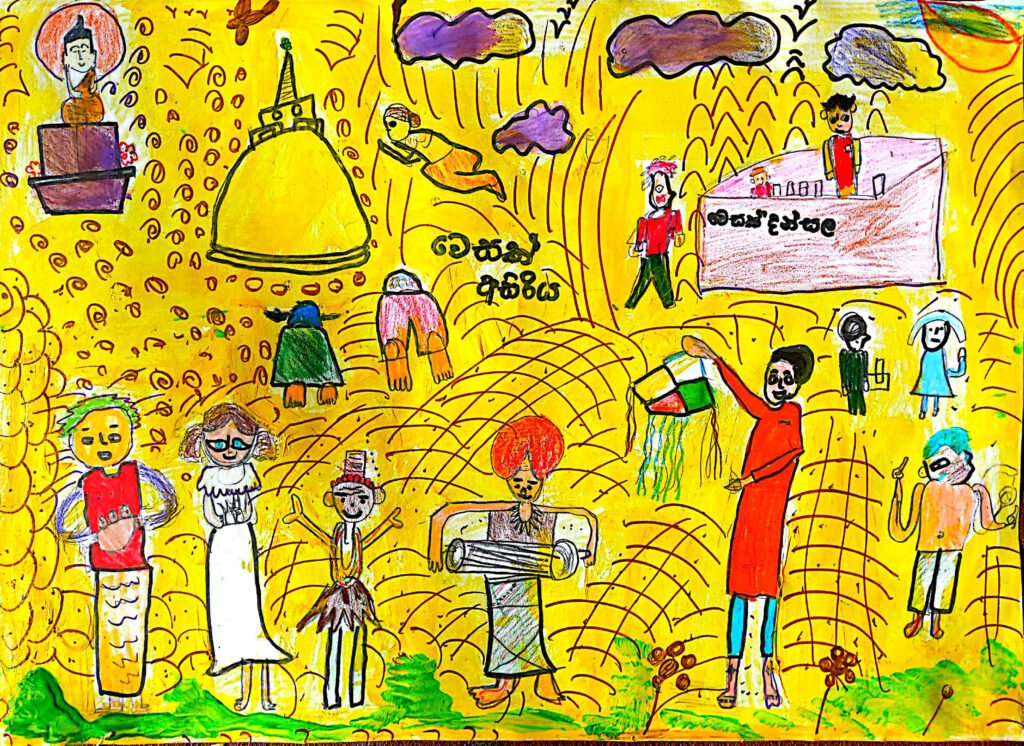
My Vesak themed artwork (see above) shows how I celebrate my culture as a Sri Lankan Buddhist (who lives in Australia) during the Vesak festival.

The Vesak Festival (වෙසක් උත්සවය) is the most important and sacred celebration for Buddhists around the world. It takes place on the full‑moon day in May and marks three significant events in the life of Lord Buddha: his birth, his enlightenment, and his passing away. In 1999, the United Nations officially recognized Vesak as an International Day, showing its importance as a symbol of peace for the whole world.

Vesak is celebrated annually by all Buddhists around the world. Despite cultural differences, the central purpose of the festival remains the same everywhere—to honour the Buddha’s teachings of compassion, peace, and wisdom.

Just a few days before Vesak, I make Vesak lanterns (called Vesak kudu, in Sinhalese, our native language from Sri Lanka) with my friends at our community language school in Australia. Normally, each child makes one Vesak lantern. Then adults take it to our Buddhist temple to hang it on Vesak morning. In the evening, our Vesak lanterns are lighted.

On the Vesak Day, we go to temple and observe sill. During Sil programme, a Buddhist monks talk to us about Buddha’s teachings. Also, they teach us how to meditate. So, our mind becomes more peaceful.

When we go to the temple in the morning to celebrate Vesak we take flowers, incense sticks, and oil or wax lamps. These items have symbolic meanings: flowers remind us of the beauty (and the impermanence) of life, incense represents purity, and lamps symbolize enlightenment. I like watering the Bodhi tree on the day (Buddha received the enlightenment while meditating under a Bodhi tree).

On Vesak Day, grown-ups and kids can join in the Vesak Perahia or Vesak parade. Traditional dancers, drummers, and performers and devotees take part in the procession. In Sri Lanka, elephants decorated with beautiful colourful costumes also take part in the parade.

In the evening at our temple, we participate in giving free food or Dansala to people. We offer free tea, coffee or herbal drinks for the devotees visiting the temple. This opportunity teaches us collective work as well as the importance of donating.

Beyond the celebrations, the heart of Vesak lies in its message. It reminds people to be kind, peaceful, and mindful in their daily lives. The festival encourages everyone, regardless of their religion or background, to practice good deeds and bring happiness to others.

Vesak is a festival that combines joy, reflection, and compassion. It celebrates the life and teachings of the Buddha while inspiring people to become more thoughtful and caring. Vesak continues to spread a message of harmony and kindness that is meaningful for people everywhere. Also, Vesak helps me to preserve my Sri Lankan culture in my new home as an immigrant in Australia.

If you visit Sri Lanka, during the month of May, you can see and enjoy all of the Vesak celebrations and traditions. The festival is being celebrated this year in Sri Lanka (as in many other countries of the world) on May 30th. Because many Asian cultures still follow lunar calendar, in some communities, it might also be celebrated on May 1st.

By Saviru Bandara, age 11 Australia.


To Be A Child

 To Be A Child

By Carin A.

In West Bank, April, 2026

To be a child, here, now, is to hear and feel the massive impact of the missile striking a nearby city, and to say with confidence that you are not afraid, and then to wet your bed every night, for the first time in years.

It is to find one hundred ways to play in the long hours you must stay inside. To chase the rubber ball through the living room, in your mind a vast soccer field, to score the winning goal.

To be a child, here, now, is to see the Israeli settlers drag your father out of the car when he is driving you to school, and then to watch as they beat him. It is to live knowing that at any moment, they can come.

To be a child, here, now, is to run out to the balcony when a missile is coming, shouting with glee, “Sarookh, sarookh!” and then to watch the rocket tracing a fiery trail through the night sky, arcing downwards until it explodes with a thunderclap that shakes you to your bones.

It is to feel the love of your grandfather, as he picks you up, smiling. It is to see the web of your family surround you, laughing and talking across the long dinner table.

It is to be woken by the sound of the army breaking down your door, and then to see them come into your bedroom, blindfold and zip tie you, and take you on the floor of their jeep to the detention center, where they beat and interrogate you. It is to remember your parents, standing in front of the house, helpless to protect you.

To be a child, here, now, is to jump up and down in excitement when you see your sister, proudly playing the drums in the colorful Scouts parade that makes its way down the narrow street, lined with ancient stone.

It is to have your preschool class interrupted by the sounds of men shouting, and shooting, as the Israeli military suddenly raids your refugee camp.

To be a child, here, now, is to rejoice as you run to play with your cousins in the playground you can visit only once a month—an indoor playground, because the few outside risk the rockets.

It is to look out of the car window to see the face of your uncle, as he is humiliated at the checkpoint. It is to see the assault rifles strapped across the shoulders of the soldiers, and to know that you must sit very, very still.

To be a child, here, now, is to hear the sirens begin in the nearby Israeli settlement, and to know that those children are being whisked away to safety. To be a child, here, now, is to know that there is no safety for you.

Carin A. is a Quaker Montessori educator who has worked with children in many communities across the globe. She holds an MA in Education, and has worked internationally as a teacher mentor and consultant. She is a board member of Healing to Hope, a US-based nonprofit that works to support the psycho-social well-being of Palestinian children in partnership with its Bethlehem-based sister organization, Anar. An occasional contributor to Skipping Stones and an advocate for nonviolence and children’s safety sent it to us for publication on her behalf. We share this writing with you on behalf of children caught in terrible wars and conflicts not of their own making. 

Chinese Americans of Historical Significance

May is Asian American, Native Hawaiian, Pacific Islander Month.

The first Asians documented in the Americas arrived in 1587, when Filipinos landed in California. In 1788, the first Native Hawaiian arrived on the continental United States, in Oregon. And, in 1900, Hawaii was annexed by the U.S. The Chinese, Japanese, Hawaiians, Indians, Koreans and other Asians have migrated to the United States over the last few centuries. Wikipedia has a great article on the history of Asians and Hawaiians that you may like to read. To observe the AAPIH Month, we are pleased to share a few writings by Fanny Wong of New York, focusing on some important Chinese personalities that have made significant contributions to our nation’s history. A few of these are:

Hong Yen Chang: The First Chinese Lawyer in the U.S.

Born To Be A Chef: Eileen Yin-Fei Lo

Polly Bemis: A Pioneer Chinese Woman in the Northwest

Hazel Lee, Chinese American Fighter Plane Pilot

King of the Soup Dumplings: Yang Bing-Yi

United States v. Wong Kim Ark

Discrimination Against Asians in the United States

Ten Times Better: George Lee, Ballet Dancer

By Fanny Wong, Chinese American Author, New York.

Young George Lee stood by himself, leaning against the fence in the playground. Other children ignored him in recess, just as they did in the classroom. He looked thoroughly Chinese, but they knew he had a Polish mother. Still, George was a happy child.

His father, Alexander, a circus acrobat, taught his young son how to do a headstand. Father and son were so proud when he finally nailed it. His mother, Stanislawa, a former ballerina, was George’s first ballet teacher. She insisted that George learn every pose, exercise and combination correctly. Not just correctly, but beautifully. George loved the lessons. He loved to dance. That’s why he was a happy child in spite of not having friends.

In 1941, when Japan occupied Hong Kong, where George was born and lived with his family, they fled to Shanghai. There he took dance lessons from Russian teachers. Dancing made him forget for a little while that his father had gone to western part of China to find work. At the age of 7, George was performing polkas and Russian dances in nightclubs to help support the family.

George was heart-broken when his father died in a traffic accident on his way back to Shanghai. Fearing the Communist takeover of Shanghai, mother and son evacuated to the Philippines and spent two years in a hot and humid refugee camp. His mother had to find a way to get out of there. She was able to contact a friend, who sponsored their immigration to the United States.

This friend not only changed their lives by being a sponsor, but he also set George on a path to a career in dance. He introduced him to the School of American Ballet, the prestigious ballet school in New York City. He received a full-scholarship, and in an advance dance class where all the students were White. Knowing how fortunate he was, he was never late for class and wished the classes lasted longer.

Balanchine, the principal and choreographer of the school, asked George what he could do. George did impressive splits, double turns and multiple turns. His dancing was masculine, graceful and joyful! Balanchine was impressed and gave him a role of “Tea” in the 1954 production of The Nutcracker. He was the first Asian dancer in the New York City Ballet. His costume—the Fu Manchu moutache, the queue and rice paddy, did not bother him. “Dancing is dancing,” he said.

But his dancing was being noticed. A New York Times critic observed, “George jumps wonderfully and exhibits some wonderful extensions in the Chinese dance.”

He was not asked to join NY City Ballet. At 5’ and 5”, he was told he was too short. He could do nothing about his height. However, his dancing caught the attention of Gene Kelly, a renowned dancer in film musicals. He cast George in the original production of “Flower Drum Song.” He did 600 performances, many in various cities. He was doing what he loved, and he was using ballet techniques in the Broadway shows.

Touring was tiring and the work was sporadic. There was too much traveling involved, and he had to stay in inexpensive hotels. As much as he loved to dance, he decided to learn a new trade. While performing in Las Vegas, Nevada in his mid-forties, he learned to be a casino dealer. He worked as a blackjack dealer for 40 years in different casinos after he retired from dance performances.

As the first Asian dancer at New York City Ballet, he led the way for the next generation of Asian ballet dancers who are becoming increasingly prominent in major dance companies. New York City Ballet features Chun Wai Chan (Chinese) and Mira Nadon (Indian and American) among others.

When they were moving to the U.S., his mother had told him that he must always remember that he would be seen as a Chinese person in White America, and so he’d better be ten times better. George never forgot that; he always tried to be his best both in school and in his work. He died at the age of 90 on April 20, 2025.

By Fanny Wong, Asian American author, New York. Her work has been featured numerous times in Skipping Stones over the years.

Fou Tsong: A Renowned Chinese Pianist

“I’m always a beginner, I’m always learning.”

By Fanny Wong, Chinese American Author, New York.

Fou Tsong, the renowned pianist, was born in 1934 in China. He was well-known for his sensitive interpretation of the compositions of Chopin, Debussy, Schubert and Mozart. Still, Chopin’s music was closest to his heart. 

At the age of 21, he was awarded the third place prize at the 1955 International Chopin Piano Competition held in Warsaw, Poland. He also won a special prize for his performance of a Chopin’s Mazurka.

How did a shy, quiet young man from China reach such heights?

Fou Tsong’s father, Fou Lei, used to tell him, “First, you must be a person, and then a musician, and then a pianist.”

Fou Lei was an intellectual who translated the complete works of the French author Balzac into Chinese. His strong and heartfelt opinions shaped his son. He provided the water, soil and nutrients for his son’s growth, down to the correct elbow positions at the edge of the dinner table. He thought that people, like trees, without good cultivation, could not thrive.

Fou Tsong, under his father’s supervision, was educated in the classical Chinese traditions and grew up under Chinese and Western cultural influences. His household was full of art and music with a large collection of records.  

His father noted his son’s love of piano and music, and him bought a piano. Fou Tsong began his music lessons at the age of 7. He later recalled, “When I was young, I enjoyed playing the piano so much I felt I was in paradise. A gift from heaven.”

Among his earliest teachers was Mario Paci, founder of the Shanghai Symphony Orchestra. After Paci’s death in 1947, Tsong studied mainly on his own.

In 1952, Tsong performed Beethovan’s Emperor Concerto with the Shanghai Philharmonic to great acclaim. The Chinese government was so proud that he had reached such prominence that it sent him at age 19, to international competitions in Bucharest, and then to Warsaw.   

At the Conservatory, his teachers praised that his playing was like a flowing stream, like a river. While he was studying in Warsaw on a scholarship preparing for the 1955 competition, Communists took over the government of China. This political change brought danger, turmoil and suffering to the nation. Fou Tsong was called back to China. He was instructed to writing a self-criticism and witnessed his father being branded as anti-Communism. He returned to Poland and graduated from the Warsaw Conservatory in December 1958. After what he had seen in China, he made a decision to defect—seeking a political asylum in London, England on Christmas Eve, in 1958. His career soared from his London base.

Fou Lei’s trouble increased with his son’s defection. The Red Guards from the Shanghai Conservatory hounded him. The Red Guards were primarily high school and college students mobilized by Chairman Mao Zedong to enforce his vision of Communist society. They targeted and harassed perceived intellectuals of traditional influence and bourgeois elements. Both his parents, under great duress from the Red Guard, committed suicide. His father was 58, mother 53. His heart broke when he learned of their deaths two months later.

In 1981, a volume of the letters from his father over the years was published. It was full of advice, encouragement and stern paternal love. The book “Fou Lei’s Family Letters,” collected by Fou Tsong’s brother, Fou Min, became a best seller in China.

* * *

A Few Quotes from Fou Lei’s Letters:

• 1954, evening of 18th and 19th of January.

“If one cannot see the larger picture, one is in the danger of thinking the sky is no bigger than it appears to be seen from the bottom of the well.”

• 1955, 26th of January.

“Dear Son, Had we ourselves been in the hall where you played, we would have been unable to control ourselves. Happy at the honor you’re bringing to our country. And happier you are giving joy to so many others through your music.”     

* * * 

Only a few of Fou Tsong’s letters to his father survived, likely because many were destroyed by the Chinese government.

In his later years, Fou Tsong played the piano for hours every day, even as his fingers grew frail. Whenever he was criticized for defecting and of being a traitor to his country, he would say, “It’s not that I was longing for the West. I was choosing freedom. There was no other choice.”

Fou Tsong died in London of Covid-19 in 2020 at the age of 86. He left us these words, “I’m always a beginner, I’m always learning.”

He is remembered for his sensitive ear for color and the elusive gift of melody. His music swirled, twisted and soared on wings of sound.

By Fanny Wong, Chinese American author, New York. Ms. Wong is a frequent contributor to Skipping Stones Magazine. Please also read Hong Yen Chang: The First Chinese Lawyer in the U.S. that Fanny wrote recently by clicking on the title.

Making A Difference: Taking Action

Making A Difference: Taking Action is a Choice 

And that Choice is Available to Us Every day

By Zoe Leitner, age 18, New Jersey.

I have a history of taking action. I believe that action is the most honest form of belief. Conviction means little unless it alters how we behave—what we build, what we interrupt, and what we refuse to ignore. Awareness is only a beginning; agency begins when we decide to respond.

My understanding of action began somewhere ordinary: the kitchen. For my mom and me, baking together, mostly chocolate, was routine, almost background noise. But in 2020, I realized that familiarity could be a tool for change. I started selling over 600 hot chocolate bombs in my community, raising more than $4,000 and reaching over 80 families. I didn’t do it to seek recognition, but in response to what I saw around me: needs that could be met, even in small ways.

The project worked not because of novelty, but because it was accessible. Participation didn’t require prior experience, complicated forms, or large commitments. Anyone could contribute in a meaningful way. It was easy to understand, easy to engage with, and immediately relevant to the people it aimed to serve. What mattered most was how the money was used afterward. Instead of deciding what organizations might need, I asked them. Jackets instead of cash. Food instead of flyers. Listening reshaped my understanding of service: meaningful help begins with attention, not assumption.

That lesson stayed with me. In 2023, I founded Chocolate4Charity, a nonprofit that channels my love of baking into meaningful impact. Through partnerships with Pink Jewels Boutique, David Chad Beauty Parlor, Nicole Nicosia Hair, and Smith & Company Gifts, we’ve sold over 800 boxes, raising nearly $10,000 for causes I care deeply about: $3,000 to the Mark Schonwetter Holocaust Education Foundation, $3,500 to the Montclair Animal Shelter, $1,000 to MIB Agents Pediatric Cancer Research, and 200 chocolate boxes donated to Comfort Zone Bereavement Camps.. Over 80 students have joined me in volunteering, packaging, and delivering chocolates, discovering firsthand how small actions ripple outward. Each box doesn’t just deliver chocolate; it gives people a chance to contribute, participate, and see the real impact of their efforts.

Chocolate is the vehicle, not the focus. Some causes reflect my family’s history. Supporting Holocaust education honors my great-grandparents, Holocaust survivors, and my grandparents, immigrants, whose experiences shaped my understanding of responsibility. Other causes reflect friendship, grief, and compassion, such as supporting a peer battling cancer, helping children navigate loss, and advocating for animal rights.

The most important measure of success is not the money raised but the number of people who participate. Many people want to help but hesitate because they do not know where to begin. Chocolate4Charity offers an accessible entry point through packaging chocolates, sharing a cause, or delivering donations. I have watched classmates who rarely speak up—over 80 in total—discover a sense of purpose simply by stepping into action. Real impact begins not with grand gestures but with invitations that inspire others to act.

In 2025, I was honored as a Top Upstander at an event organized by a library in Montclair, New Jersey, in collaboration with children’s book author Dr. Janice Cohn. The recognition was meaningful, but I do not see it as a title or an accolade. To me, being an Upstander is deliberate. It is the refusal to remain passive once you notice something that needs attention. It is the choice to respond, even when the right path is unclear or imperfect.

This understanding resonates with a message Dr. Janice Cohn often shares: “Light a tiny candle.” Action is not about being seen; it’s about aligning belief with our behavior. It is found in everyday decisions—listening, offering help, stepping forward when silence would be easier. That philosophy continues to guide my work with Chocolate4Charity and in other parts of my life.

Being an Upstander, like any meaningful action, is not a single moment. It’s a practice, a habit, and a commitment to notice what others might overlook. In that sense, recognition matters less than the choices that lead to it. Action remains its own reward.

Action began in a kitchen for me, with melted chocolate and a question I could not ignore: What will I do with what I see? That question has guided every choice I’ve made since that first chocolate, and to the moments when I have chosen to speak, listen, and act.

Meaningful change requires aligning belief with behavior, noticing what needs attention, and inviting others to work with you. Real impact is rarely sudden or dramatic. It is built from small, intentional acts that ripple outward, shaping communities, relationships, and lives in ways that are often invisible, yet enduring.

I truly believe taking action is a choice, and that choice is available to us every day. That’s where responsibility begins, and that’s where belief becomes real!

—Zoe Leitner, Age 18, New Jersey.

One Wrong Thing

One Wrong Thing

By Alexa Dunsche, age 13, New York.

Don’t be quiet at school
otherwise people won’t like you;

be kind
but don’t be too kind otherwise it’ll come off as desperate;

you have to keep up with your work
but don’t go too far ahead otherwise you are a “goody two shoes”;

you have to be yourself
but you also have to be what other people want you to be in order to fit in;

“Aren’t you the quiet kid in school?”

you have to be nice to everyone 
even if they don’t treat you right;

“I have to be quiet because if I stand up for myself,
I will get shut down”;

you have to be loud and proud
otherwise no one will hear you;

“You are doing everything wrong!”

you have to smile for the picture
even if where you are smiling is purgatory;

you have to keep your cards close to your chest
but not too close otherwise people will think you are hiding something;

you can’t dress in black otherwise people will think you are emo
but you can’t dress too colorful either, otherwise people will look at you
like a little kid;

you have to follow the trends
but you can’t be too invested in them because it’s not cool the next day;

“I’m trying!”

you have to stay and not cry
because if you do, they will get pleasure;

you have to be perfect.
you just have to be.

if you make one little mistake,
you’re a failure;

one bad mark
can damage your grade forever;

one misstep
can send you to the hospital with a cast on your leg;

one wrong move
and you lose the game;

one new friend
and you lose the whole friend group;

one public embarrassment
and no one can be seen with you;

one wrong thing
not the whole story

By Alexa Dunsche, age 13, grade 7, New York. Alexa adds: “This poem came from the pressure I feel to be perfect, and how one wrong move can feel like it ruins everything. In the moment, I felt like each mistake I made erased everything else. Writing this poem helped me realize it doesn’t have to be that way. One wrong thing can feel huge, but it doesn’t define who you are.”

Imagine…

Imagine…

“Just a tiny candle we lit. It wasn’t much. But it was something.”
                                     —Gary Svee, an editor at the Billings Gazette, 1994.

The quote above appears on the cover of the new edition of my book, The Christmas Menorahs: How A Town Fought Hate.

The book recounts the true story of the extraordinary 1993 holiday season in Billings, Montana, when the town took a united, courageous stand against hate and bigotry. The citizens of Billings were perplexed by the national attention their actions received. “Just a tiny candle we lit,” said Gary Svee, an editor at the Billings Gazette.

And yet…imagine how different our country (and the world) would be if people in every community just “lit a tiny candle” against hate and injustice.

Now imagine if the actions of all young people, who “lit a tiny candle” were recognized and honored.

At a time when the problems and challenges of young people today are routinely discussed, imagine if the actions of young people who have shown moral courage and compassion on behalf of others could be routinely highlighted.

In December 2025, my town library in Montclair, New Jersey, presented a special holiday event that celebrated some of Montclair’s young Upstanders and featured a reading of portions of The Christmas Menorahs, along with an excerpt from the acclaimed 1995 PBS documentary, Not In Our Town, which cinematically tells this story of how the people of Billings took a strong stand against hate and bigotry.

The book reading and film were meant to inspire the audience. But much inspiration came from hearing about the actions of the young people who were being honored.

What makes a child or adolescent an Upstander? Is it a dramatic, brave, morally courageous act? Is it less dramatic, quieter acts of compassion and kindness towards others in need, or can being a true Upstander encompass both—or either?

The research shows that when children and adolescents stand up for—and take actions to help—others in need, it can help them as well by enhancing their self-esteem, lowering their stress and anxiety, and even improving their academic performance.

That’s why it’s important for communities (whether those communities are schools, houses of worship, or towns) to recognize and honor young Upstanders. This could be for actions taken on behalf of other Americans or on behalf of people around the world.

My book, Freedom Pancakes For Ukraine, published in 2024, tells the story of a Ukrainian refugee boy, displaced by the current war in his country, and an American girl who wanted to find a way to help the Ukrainian children.

One of the reasons I wrote it was to encourage American children and adolescents to realize that they can counteract their feelings of helplessness when hearing about war and injustice by taking positive action and making a difference, however small they may think that difference is.

Time magazine recently named its 2025 “Kid of the Year.” The winner featured on its cover, Tejasvi Manoj, used her exceptional computer skills and her “on-site” experts—her parents—to create an extraordinary website, Shield Seniors, which will help protect countless seniors from consumer scams.

My dream is to have a national movement to encourage young people to stand up and help others. They don’t have to possess exceptional skills or expertise since every young person has the ability to help another human being in some way. They may not end up on the cover of Time magazine, but their actions should be recognized and honored.

During these difficult, divisive times, let’s encourage thousands of “tiny candles” to be lit by young people on behalf of those in need. It will be good for them, as well as for the people they stand up for, and thus help make our world a better place for all.

You may also be interested in the article I have written for young people, in Skipping Stones magazine about Upstanders.

Dr. Janice Cohn is a psychotherapist and children’s book author. She can be contacted at: janice@drjanicecohn.com.  The Christmas Menorahs: How A Town Fought Hate, this 30th Anniversary edition was a winner of the 2025 Skipping Stones Book Awards. You can read a review of the book here.