
Category Archives: Social issues

My Indian Memories

My Indian Memories

By Arjun Govindaraj, age 17, from Texas, currently studying in India.
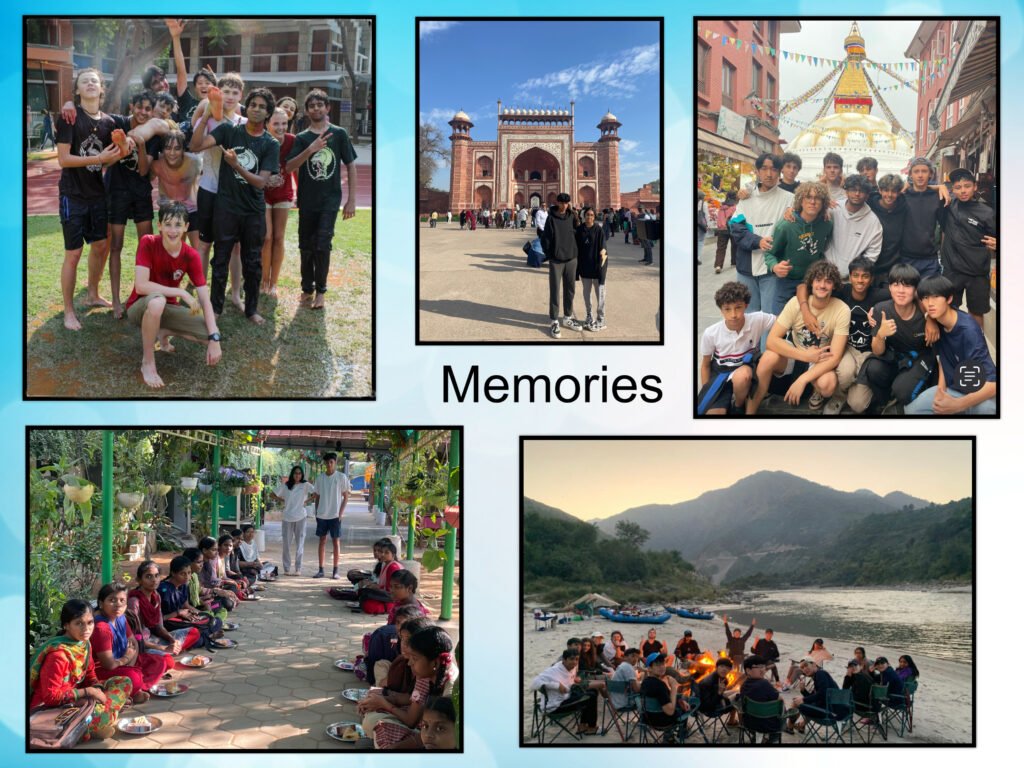
The first picture is of us celebrating Holi at school where we throw colors and water at each other and have fun. Holi is the Festival of Colors, a celebration that marks the arrival of spring. It is an occasion filled with laughter, music, and dance, where everyone, regardless of age, comes together to play with colors and enjoy festive food. Classmates and teachers share in the excitement, creating beautiful memories and promoting unity and love. Holi not only celebrates the beauty of diversity but also encourages forgiveness and the strengthening of bonds among people. We also celebrated Diwali, the Festival of Lights, symbolizing the victory of light over darkness and good over evil by dressing up in Indian clothes, sharing sweets, and participating in traditional games.

Second picture is of us visiting the Taj Mahal, located in Agra, India, built by Emperor Shah Jahan in memory of his wife, Mumtaz Mahal. Designated a UNESCO World Heritage Site, its stunning white marble architecture, carvings, and beautiful gardens attracts millions of visitors each year, and symbolizes the cultural heritage of India. We also explored the monuments of Delhi, the bustling streets of Mumbai, and the tranquil foothills of Dehradun with its cascading waterfalls. Exploring the streets of Coimbatore, we were amazed by the warmth of its people and the aromas of its bustling markets, while the ancient wonders of Mahabalipuram reminded us of a bygone era of art and architecture. Through these diverse experiences, we have come to cherish our rich culture and landscapes that make our world a truly remarkable place.

The third picture is of my team visiting Kathmandu, Nepal, for the South Asian Interscholastic Association (SAISA) soccer tournament. It was an incredible experience representing AISC against 11 member schools. The atmosphere of Kathmandu, with its rich culture and breathtaking landscapes, added to the excitement of the tournament. Throughout the events, I not only had the opportunity to showcase my skills and win medals but also learned invaluable team-building skills and the importance of fair play. Each match brought us closer as teammates, creating lasting friendships and unforgettable memories that extended beyond the games. The spirit of camaraderie and sportsmanship was truly inspiring, making this trip an enriching experience both on and off the field.

The fourth picture captures a heartfelt moment as we distribute school supplies and a meal to underprivileged children. Following the popular custom in India, they sit on the ground to share their meal, and their smiles of gratitude warmed our hearts as we handed out new backpacks filled with school supplies. In a country where overpopulation and poverty are pressing issues, we felt a profound sense of purpose in being able to contribute, even in a small way, to their education and well-being. This experience taught us invaluable lessons about empathy and compassion, reminding us of the importance of supporting one another and making a difference in the lives of those in need. Acts of service can build connections, bring hope, and inspire change.

The final picture is from our school trip, “Discover India,” which became one of the main highlights of my educational journey. These immersive week-long expeditions across India went beyond traditional classroom learning, offering a rich tapestry of experiences that allowed us to explore local cultures in depth. Each annual school excursion helped us develop essential teamwork and outdoor survival skills. From camping under starlit skies to navigating thrilling rafting/ surfing adventures, every journey nurtured resilience and adaptability while fostering a profound appreciation for the natural world. These unforgettable experiences shaped not just our knowledge but also our connections with one another and the environment.

Editor’s Note: Please also read Sustainable Shorelines by Arjun’s sister Maya, also published today!

About the Authors:
Arjun and Maya are 17-year-old twins at the American International School in Chennai, India. As USTA-ranked tennis players, they love sports and have won medals in South Asian Interscholastic Association competitions. Both serve as Student Ambassadors, bridging cultural gaps through orientation and wellness programs. Passionate about community service, they have both worked with various organizations. They also have co-founded the non-profit Mission BE A Resource, securing grants to support disadvantaged children. Arjun is a tech enthusiast with a love for outdoor adventures, while Maya enjoys helping elementary school teachers and expressing her creativity through art.
Still A Student?

Still A Student?

By Emra Woldearegay, originally from Ethiopia, now teaching in Missouri.

Here I am, still a student.
Oh, why, after so many decades?
Aren’t you tired? They ask
What’s the point, they ask.
You better start earning tons
because time’s running out.
But for whom? I ask.
How could time run out when
I’ve so much to learn
about things & skills that make me more adept.
Why should that matter
When what I love is asking questions,
I am curious, like the cat.
They jump on me, snarling like an angry cat
And declare-gleefully: “Curiosity killed the cat.”
I would rather be like the cat killed for curiosity
after living nine lives, learning, and relearning eight times.
NINE lives!
What a way to go; it is the best way.

By Emra Woldearegay, originally from Ethiopia, did her graduate studies at the University of Oregon. She is now teaching journalism in Missouri.

Waiting for a Madam President of the United States!

Waiting for a Madam President of the United States!

By Arun N. Toké, editor

Did you know that each and every one of the 46 Presidents of the United States, has been a male in its almost 250-year history since the Declaration of Independence? Since the founding of the nation on July 4th, 1776, not even one woman has been elected to the highest office of the land!

Ask your female classmates, neighbors, friends and family members, “Can a woman lead the country?” and listen to what they say. Likely, they will all say, “Women are equally capable as men to lead the nation.”

Across the globe, many dozens of nations—in Europe, Africa, Latin America, and Asia—have elected women as presidents or prime ministers to lead their countries during the last 65 years. Some of these countries have elected women leaders multiple times over the decades. Various countries like the United Kingdom, India, New Zealand, Germany, Norway, Denmark, Pakistan, Bangladesh, Sri Lanka, Rwanda, Central African Republic, Argentina, Costa Rica, Nicaragua, and Indonesia… the list is too long to include them all here! But unfortunately, the United States has not made the list so far!

Just recently, in October 2024, Mexico also joined the ranks of over 25 countries with women heads of their governments when Claudia Sheinbaum was sworn in as the first elected female President of the nation located just south of our border! Why haven’t we elected a woman to lead the United States of America yet?

Will the people of the United States choose to elect our first ever woman president this November? Many capable women leaders in other nations have shown clearly that women can lead as well as men, and sometimes even better.

Perhaps, you have studied the history of our country, and you know that women were not given even the basic rights to vote when the Constitution was first written. It allowed only landowning white males a right to vote. African Americans, and even the Indigenous People (who had lived here for generations) were not considered citizens of the country, and were not able to vote or run for any political office.

It was the 19th Amendment to the U.S. Constitution, adopted in the year 1920, after a decades-long suffrage movement led by women, that gave women the right to vote and thus help elect their representatives.

Interestingly, a number of European countries also enacted laws to give their women citizens a right to vote around the same time. Russia did so in 1917, Germany in 1919, and the United Kingdom began the process by granting women limited rights in 1918, and then full rights in 1928. Did you know that New Zealand became the first country to grant women voting rights in 1893? Nineteen other countries had also granted these rights to women before the United States did so in 1920. However, Switzerland did not grant women voting rights until 1971! In Asia, India granted some of its women the right to vote in 1935, while it was still a British colony. When India became an independent nation in 1947, the country’s constitution, adopted on January 26, 1950, gave its women full voting rights.

While the 13th, 14th, and 15th Amendments of the 1860s were enacted to bring full citizenship rights to non-whites and former slaves—primarily African Americans—it was not until the year 1965 as the Voting Rights Act was signed into law by President Johnson, that Blacks in the South gained meaningful access to the ballot box. Thus also including the African American women (who were left out in the 19th Amendment of the 1920)!

Unfortunately, the country still does not have a true democracy. Because we have an archaic system of “The Electoral College,” which gives disproportional power to small states in electing the President, at times, we have had presidents who did not get the most votes. For example, in the 2016 presidential election, even though Hillary Clinton received 2.9 million more votes than Donald Trump, she did not become the President because she lost the Electoral College. She came very close to becoming the first woman president of the country!

The U.S. Supreme Court Justices are appointed for a lifetime. And, they are not even elected by the people. Until recently, all of these justices were also male and white (Sandra Day O’Conner was the first woman to be appointed to the Supreme Court in 1981). They interpret the laws and decide what is constitutional and what is not. Here is an example worth noting: reproductive health rights for women.

In 2022, the “Roe v. Wade” decision, which had guaranteed national access to abortion for women for about 50 years was struck down by the Supreme Court. As a result, some states now have severely restricted women’s rights and have caused great harm to many women living there. Thanks to progressive leaders, Democratic states still have reasonable family planning options, including an abortion procedure, for families, couples, and women.

In 1917, Montana’s Jeanette Rankin became the first woman to serve as a Congressional Representative in the nation. Since then over 300 women have been elected to serve in the U.S. Congress or the Senate (the upper house). Ms. Kamala Harris became the first woman to serve as the United States Vice President in January 2021 after Sen. Joe Biden and his running mate, Kamala Harris (who had previously been elected as a U.S. Senator, and before that the Attorney General, of California) won the 2020 presidential elections.

In 2024, we have a precious opportunity to turn the page in our nation’s history by electing Ms. Kamala Harris as our next President. Who we elect as the President will shape the future of the nation (and even the whole world because of our tremendous global power). The implications of the choice we make as a nation are huge. We have serious issues facing us: the wars in Ukraine and the Middle East, the accelerating climate change crisis, and the nuclear weapons threat…

We need a truly capable leader who has a deeper understanding of the many complicated issues our nation (and our world) faces, and then lead us with fairness, kindness, and compassion to solve these pressing problems. Someone who knows and speaks the truth and works to bring the country together; someone who does not make hasty decisions based on short-term, selfish, or financial gains.

In 2024, our choice is clear, in my humble opinion.

—Arun N. Toké, editor.

The Empty Spot

The Empty Spot

By Leslie T. Fry, high school senior, New York.

They stuck us in Studio 8. At first glance, it looked in decent shape. The professional company never danced there so the floors were rosin-free, letting us pirouette with ease. The room also had gaping windows and a cavernous ceiling.

Mr. Vankan would implore the boys: “Look how much ceiling you still have! Jump so high you hit it!”

For us girls, the ceiling only helped us feel dainty. The studio’s wonky mirrors trapped us in our own private funhouse.

We all knew that the end-of-the-year performance was scheduled for two months from now, though the specific details of our dance remained unknown. In the other studios, the older girls already had started rehearsals. The soloists’ gracefulness took our breath away. I longed to be a soloist someday; I suspect we all did.

Mr. Vankan’s yellow notebook appeared more frequently as we got closer to the performance. He creased the spine before placing it open on top of the speaker.  We remembered that book from our audition. When that book came out, our PTSD returned, along with the insecurities of our 15-year-old selves. He circled around us as we danced, then stopped to stare at someone’s foot or head before jotting down his verdict. Our bodies felt sore, and we wanted to go home. Often, he would excuse us early, testing our commitment. We demonstrated our resilience by staying as long as he did.

A month before the performance, Mr. Vankan pulled out the dreaded notebook and studied his notes. He instructed the boys to leave early and then told us girls to stand in a line from shortest to tallest. Surprisingly, the boys left without hesitation, presumably sensing that he was in a particularly sadistic mood.

He assigned places, repeating, “Remember, these places are not set. I just want to see how it looks.”

For a week, Mr. Vankan moved us girls around as if playing chess. Under the touch-move rule, he would leave his finger on the piece until the last minute, convincing us that he was sure of his move, only to dash expectations with a “Nah, I don’t like it.”

Historically, we had been good at learning choreography, having danced from infancy, but we had questions.

When we asked him whether our arms should be up or down when we ran to the back, his puzzling response was, “Do whatever everyone else is doing.”

We smiled at him in disbelief, waiting for the punchline that never came.

He split us up into two sections, supposedly intending to give us equal practice time, though he never did. Instead, the second cast sat on the floor in extended splits for the last half hour of class.

Mr. Vankan yelled: “If you’re sitting on the ground, you better be doing something!”

Our hands marked the routine accurately, without ever breaking a sweat.

In one muggy session, all were surprised to find Ms. Robin teaching class because of Mr. Vankan’s unannounced trip to Germany. Previously, he had asserted we couldn’t skip any classes whatsoever. Many of us pushed through illness, and one of us even skipped a funeral of a close family member. Now, he had disappeared. After watching both casts, Ms. Robin clenched her teeth, forcing an unnatural smile.

“Uh, okay,” feigning a supportive tone. “Where are your arms supposed to be when you run to the back?”

We collectively shrugged, as if choreographed.

“What count do you enter in on?” she continued questioning.

No one knew.

* * *

A week later and two weeks before the performance, Mr. Vankan returned, tanned and well-rested. He didn’t bother to explain his absence and dove right into class.

“Noooooo, you run in on 5-6-7-8, not 3-4-5-6-7-8! Again! And Christa, Crystal, uh, whatever your name is, point those feet! You look like a clumsy duck!” Mr. Vankan mocked. It was her first day back from a week of dreadful coughing and sneezing.

Tears rolled down Christie’s cheek, despite her best efforts to hold them back. During the rest of the rehearsal, I watched her with the hope that she could hold in her emotions until arriving safely in the privacy of our changing room. Oblivious to Christie’s crying, Mr. Vankan pushed her harder and harder.

“Look at your extensions! What’s happened to you?” he blurted out.

We all knew that you usually try to sleep when sick, not stretch. It wasn’t fair, but there was nothing we could do. She had no clue about all of the changes that Ms. Robin had made. Neither did Mr. Vankan, who was fumbling with the speakers. Tchaikovsky blared from the speakers when Mr. Vankan confused the varispeed and volume knobs, making it impossible for us to verbally comfort Christie. Mr. Vankan was slow to adjust the volume and even slower to get back to the right tempo. The first cast started to dance with Mr. Vankan’s count. However, Christie seemed to dance to her own music.

“No, no!” Mr. Vankan exploded.

He stopped the music. A cluster of worry wrinkles formed on Christie’s forehead. Mr. Vankan sat in his chair, face buried in one hand and mumbled, “You know what . . . we don’t need you.”

Christie stared at him as if asking, “Are you serious?”

Mr. Vankan was entirely serious.

Looking down to hide her tears, she jogged over to the wall. I walked over to her and gave her a hug.

“It will be okay,” I whispered. “You’ll be fine.”

I let go of her. She looked at me with streams of tears trickling down from her red eyes, and she ran out of the room without being excused. I entered the changing room when I could. Her locker was open and empty. I smiled, at least on the inside. Someone was getting promoted to first cast.

* * *

Christie did not return the next day or ever again. In the corner of the studio where she set her bag, I set mine down. Her absence left a noticeable gap in the choreography.

“Does anyone know Christina’s part?” Mr. Vankan petitioned as he looked around the room.

My hand darted in the air before he finished his sentence. He nodded and motioned for me to fill the gap.

“If you see an empty space, that’s where you’re supposed to be,” he instructed, and that was all.

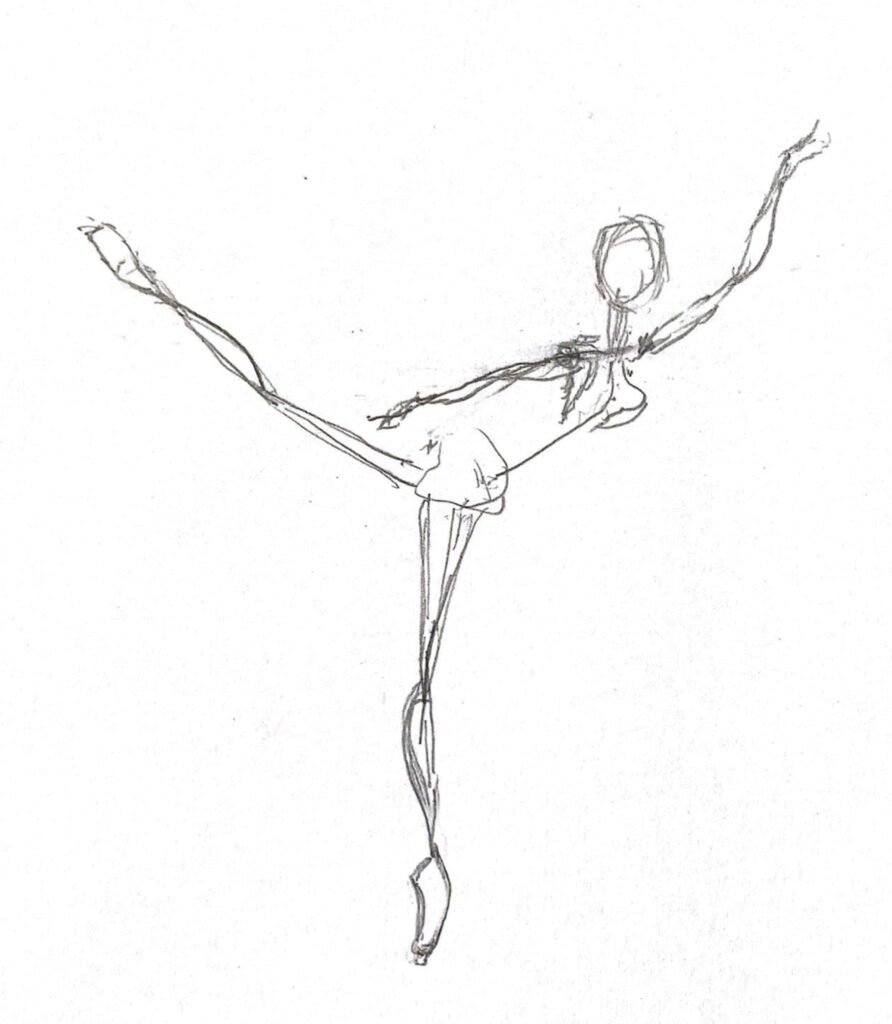
I didn’t need more, even though it was my first time dancing with the first cast. My head spun as I chased the empty spot, like a cat chasing a laser, not knowing where it would appear next. My spirit soared when I felt my arabesque turned out like never before. Renewed energy coursed through my veins as I stretched my legs through. I glowed with confidence. I didn’t even mind that Mr. Vankan was not watching me, just as long as he didn’t take out his yellow notebook. As I held my final pose with a sense of accomplishment, I caught my beaming smile in the mirror, attached to a body that I could not recognize as my own. It would take some getting used to, but I knew I was in the spot where I needed to be.

—Leslie T. Fry, high school senior. Leslie was born in Hong Kong, and she also has lived in The Hague and New York City. Leslie has been dancing seriously since the age of two. Apart from dance, she enjoys literature, art, math, psychology, and chemistry. In addition to English, Leslie studies Chinese, Dutch, French, and Latin. She plans to study behavioral neurochemistry at university and hopes to eventually become a neuropsychiatrist.

Between Gaza and Me

Between Gaza and Me

By Nada Alaloul, age 17, from Rafa, lives in Egypt.

Between all of these
Cold bodies,
Tired faces,
Busy minds
Lost people
There is Nada como yo
Between black and white there’s me
Between sun and moon, there’s a scream
Between hell and heaven, there’re my people under the rubble
Between death and life, there’s a missile
Between war and peace, there’s a border
Between freedom and shackles, there’s the whole world
Between tanks & planes, there’s my family
Between my family & me, there’s an endless cry
Between my happiness & sadness, there’s the news of my city
Between the present and the past, there’s a genocide.
Between death here, and death there
There’s a huge price
I have one heart with
Two separated souls
And I’m a ghost
And I’m completely alone.

I was at home
Now I’m missing my home
Suddenly
I lost my home
I was here and there
But Suddenly
I’m nowhere
My home was bombed
My friend was killed
My sister was scared
And my dad was missed
And all I’m doing here
Is just avoiding to be the
Favorite dish for my sadness
Cuz actually I’m a liar
A big liar
I’m drowning in heavy clouds of sadness
Afraid to confirm
That my happiness is sad
To be with me
My happiness is scared
To be bombed with me
My happiness fooled me
But at least I know
That I couldn’t know
That I’m not happy
Without my sadness
I couldn’t realize
That I want balance
Between black and white
Between my happiness and sadness
To stop being gray
Without my sadness.

So now
I’m under a sky that
Doesn’t target its people
I walk towards the sun but I’ll never be burned
Cuz my soul has been burned once
Before when I left Gaza
Alone

What about you, dear human?
Can you bring me the warmth of the sun?
Not the one over my head
Nor the Egyptian sun which
Burns my bones like
The missiles do against
The tents of my friends
I want the warmth of my family
I’m a ghost and
I’m completely alone

I’m blue, drowning in a
Gray ocean of the fog
Gray, the favorite color of the death in my city
The color that I used to see
Whenever I roam in my ghost city
The color that I used to feel
Whenever the measure between
Death and me is just a path

I have one heart
With two separated souls
I’m a ghost and I’m completely alone
I’m here and there
And suddenly
I’m nowhere
Como Nada como Yo.

By Alaloul, age 17, from Rafa, Palestine, currently lives in Egypt.

Ms. Lauren Marshall, a playwright, musical theater librettist/lyricist, director and teaching artist based in Washington state, adds: “Nada is a remarkable girl from Gaza, now living with relatives in Cairo, Egypt. She participated in the Gaza Heartbeat, a creative writing project that was sponsored by Palestine Charity Team (PCT) in Rafah, Gaza (Palestine), in 2022.

“Nada has a positive outlook despite all that has happened to her! She was evacuated from Gaza in April, 2024. But her family is still stranded in Gaza, displaced from their home, which has been destroyed during this senseless war. Nada, like all of Gaza’s children, has missed an entire year of school as the result of the war. During this time, she has read books, written short stories and poems, taught herself Spanish, taken a business course in Cairo, and volunteered with PCT!”


Being Split

Being Split
By Preston Young, age 10, New York.

Being Split by Preston Young, age 10, New York

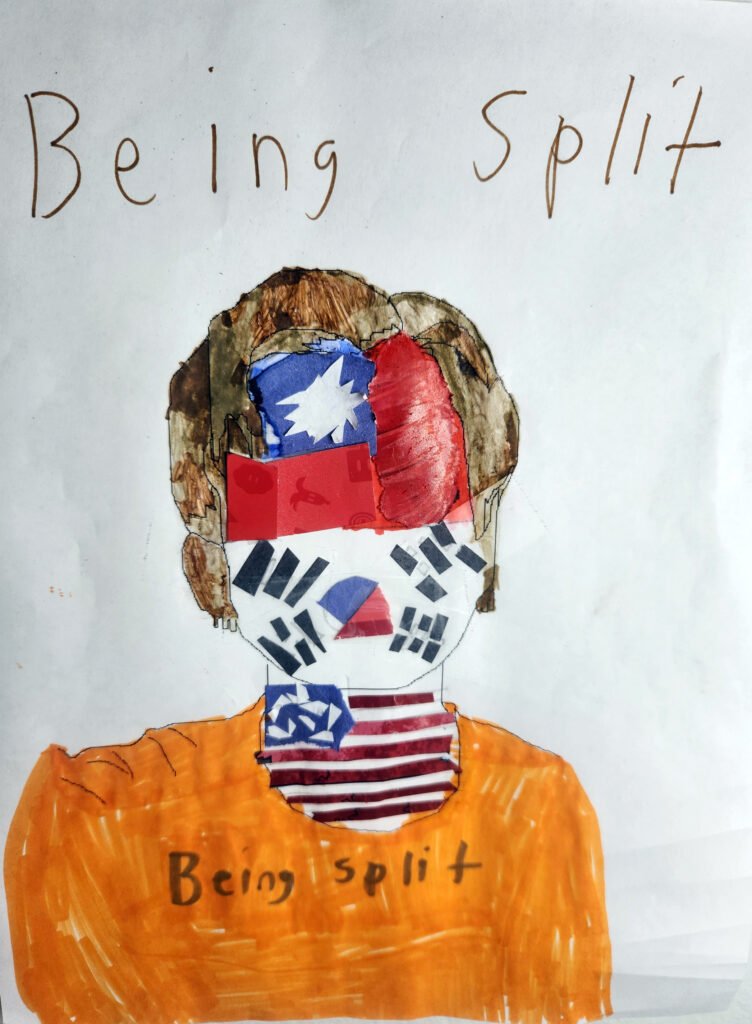
Illustration by Preston Young, 10, New York.

Being split,
Korean and Taiwanese,
I can’t process two different cultures,
It’s hard for me.

On Korean New Year,
I bow to elders and eat Duk Bok Ki (rice cakes).
On Chinese New Year,
I get red envelopes and eat dim sum with herbal tea.
I call my Korean grandparents Halmoni and Haraboji;
Ah ma, I call to my grandma who is Taiwanese.

The Taiwanese flag has red, white and blue.
The South Korean flag has those colors too.
The American flag has them too, oooh!

Being split,
Korean and Taiwanese,
Sometimes people don’t understand me.
When my friends talk about their one culture,
I want one of my other cultures to be unseen.

I try to tell my friends over and over;
I scream and I shout and whisper over their shoulder.
They never understand when I say,
 I am both Korean and Taiwanese!
They look confused and annoyed like fleas.

Sometimes I wonder if being Korean and Taiwanese is right for me.
I sit there and think until I can finally see,
I am special with being multicultural,
Being Korean, Taiwanese, and American,
Can all fit in my soul.

Being split,
Korean, Taiwanese, and American is hard.
But the three cultures,
Are forever in my heart!

By Preston Young, age 10, New York. Preston adds: “My mom is Korean and my dad is Taiwanese. I was born in the USA. I speak English but I am learning how to write, read and speak Korean because my friends at school can speak fluently, and I want to be able to communicate with them. My dream is to become an author and entertain kids. I was inspired to write this poem because when I am in school people always assume that I am full Korean or full Taiwanese. Sometimes people think I’m Chinese but I always correct them. I wanted to express how I feel and what that makes me feel like. I made a collage out of construction paper and some magazine clippings with markers to show my feelings about being split in three different cultures.”

“Looksmaxxing” and Toxic Beauty Standards

“Looksmaxxing” and Toxic Beauty Standards

By Colin Wu, high school junior, California.

Earlier this year, one of my close friends got very wrapped up in the looksmaxxing community, a growing online community that strives for the ideal body and flawless face. He started calling people out that he didn’t find attractive, bullying and fat-shaming them. He shunned and looked down on his peers who didn’t have the “perfect body”—6’ 0” tall, six-pack abs and huge biceps. The looksmaxxing community targets young males and females and influences their ideas about beauty in a toxic way. Looksmaxxers are part of an online community that has gotten inside our heads and inside our homes and it needs to be stopped before more people get hurt.

Social media has had a huge effect on younger people’s feelings about their appearance. In a New York Times op-ed titled, “Toxic Beauty Standards Can Be Passed Down”, Alexandra D’Amour writes, “There’s a nickname for tweens and teenagers who have been influenced by social media to get into skin care: Sephora Kids. Johanna Almstead, a fashion industry friend, tells me that in her local mothers group chat, nearly every mom had “Skincare, skincare, skincare!” on the holiday gift lists they were given—by their fifth graders.”

Younger children requesting skincare products as gifts is alarming. It suggests that they have a problem with their appearance and are using skincare to fix it. It also shows the influence social media has on the youth now, whereas, when I was in fifth grade, I wanted video games and Legos. D’Amour also says, “A recent video on TikTok that has garnered more than eight million views features a 28-year-old woman showing her “raw,” procedure-free face, meaning no Botox or fillers. As some women and girls cheered on her bravery, others were left horrified. “Praying I’ll never look like that,” one comment reads. This comment shows the ways in which social media has defined beauty for future generations. While sharing their “raw” face makes some people proud, others are disgusted by its imperfections.

Parents, who also contribute to the focus on skincare in young people, can make this situation better. D’Amour writes, “And yet, if a mother’s insecurity can fuel her daughter’s own self-loathing, a mother’s radical self-love might just protect and even heal her daughter from a toxic culture.” D’Amour believes the influence that parents can have on their children can be more positive than negative. Parents who are able to teach their kids to love their appearance may help their children stay away from bad communities. D’Amour says, “When I ask the few friends who haven’t gotten Botox why they haven’t, they tell me it’s because they love how their mothers are aging and how they embrace it. They don’t fear aging because their mothers don’t (or didn’t).” Older generations of mothers who are secure about their appearance influence younger generations by making them realize it’s best to accept and love themselves for who they are. Coming from a family in which no one had any kind of procedure, my parents and grandparents have taught me self-worth and have made me love myself for who I am.

People today are growing up in toxic cultures that lead them to accept unnatural beauty standards. D’Amour warns us that, “Gen Z-ers are being introduced to the idea of starting treatments early as preventive treatment. They are growing up in a culture of social media that promotes the endless pursuit of maintaining youth—and at home, some of them are watching their mothers reject aging with every injectable and serum they can find.” Gen Z-ers are still growing and many are still in puberty. By attempting to slow or stop the natural aging process, young people seek out treatments that could alter and change the way they look when they’re fully grown. While it can physically harm Gen Z-ers, the mental effects can also cause significant harm. They are oblivious to the ways in which buying treatments connects their self-worth to their beauty. The consequences of children being influenced by skincare culture could mirror the harm caused by previous toxic cultures. D’Amour points out that “The anti-aging craze comes with the same toxicity as diet culture does.” Diet culture influenced people to want to be skinnier. Anorexia was a large issue and resulted in many people hurting themselves to obtain the ideal body image. Similar to diet culture, the anti-aging culture puts pressure on young people to strive for unhealthy and unattainable beauty.

My friend was too invested in the looksmaxxing community. As he tried to achieve his ideal body image, his obsession led to him putting down and hurting others. While there are positive aspects of social media, these negative parts harm younger people who are vulnerable when it comes to their appearance. Even though my friend was putting others down, this community was also harming him, by ruining friendships. Some unlucky teens have to deal with crazy parents, who put their own insecurities on their children and reaffirm toxic cultures that enforce unrealistic beauty standards. Other teens can be affected in positive ways, if parents or role models teach them to accept themselves. In the future, if we want to feel good about ourselves, we must embrace our natural appearance and develop self-worth that is grounded in loving ourselves.

—Colin Wu, h.s. junior, California. Colin adds: “I am a Chinese and Burmese American, whose first language is English, and I am currently learning to speak and write Mandarin. My family, education, health, and religious beliefs are most important to me. I am very interested in environmental sciences and engineering. I was inspired to write this essay because of the harm this community has done to friends of mine.”

A Friend That Never Was

A Friend That Never Was

By maggie d., Washington.

Except for Erica and I
The playground was empty
And our laughter could be
Heard miles away
“Not it! Not it! You are it!”
She yelled
Beginning a game of tag

Seconds later
A white car arrived to
Pick her up
The driver was someone
I never saw before
“No matter,” I whispered
With a shrug
Resting my mind on
Tomorrow’s joy

But the next day’s gladness
Did not show
Angrily she blurted
“My Mom said you are a monkey
And I do not play with
Monkey girls!”

A bucketful of tears
Streamed down my cheeks
As I stared into an
Unfamiliar face at the
End of a fence
Making me wince
When she wrapped my hand
Around her light peach
Fingers and asked
“Will you be my friend?”

—maggie d., African American poet and educator, Washington.

The Presidency 

The Presidency 

There have been 45 presidents of the United States. The current one, number 46, has a similarity to all but one of his predecessors. They are all White, and all 46 are male. Asian Americans have been in the country since the 1800s, and have come nowhere close to the presidency. Could someone of Eastern Asian ethnicity ever become president of the United States?

Loyalty is an act of faith in which you do not betray or desert your cause no matter the circumstances. I believe most of the issues faced by Asian Americans are to do with loyalty. When using a search engine to research, the question, “Are Asian Americans loyal to the United States?” it distributes a plethora of discussion posts, disagreements, newspaper articles and more. For example, in a survey conducted by the Asian American Foundation of over 4,000 U.S. citizens, 32 percent agreed with: Asian Americans are more loyal to their perceived country of origin than to the U.S. I find this response disgusting and shocking. These questions and polls are not done on Irish Americans, Italian Americans, Norwegian Americans or African Americans; who whilst facing an uphill struggle in many areas, they would not be questioned if they are serving another country. Where does the questioning of  loyalty of this specific ethnic group come from? 

As an Asian American, I have not felt any urging for ongoing loyalty toward any country other than the U.S. In fact, Asian Americans have contributed to the United States as much as others. So what causes this unique form of discrimination? I believe one of these reasons is fear. For decades, the U.S. has been the world’s global superpower, with no country since the fall of the Soviet Union coming close. Over the course of recent years though, China has grown and empowered their economy, as well as modernized their military to the extent where there is a possibility of them overtaking the U.S. in a decade. Politicians, media pundits, and some American people are fearful of losing their global hegemony. I believe this fear has spilled into affecting Asian Americans citizens. The buildup of tension between China and the U.S has led to a buildup of tension against Chinese and other Eastern Asian ethnicity.

The coronavirus began November of 2019, and has only escalated this recurring issue. When the matter is brought up to classmates, all point directly to China as the one to blame. About 1.4 billion people populate the country of China, fingers pointed to every single one. During the coronavirus pandemic, the quantity of Asian American hate crimes increased rapidly. People of various Eastern Asian ethnicities were affected by this as well. The differences between Asian and American cultures itself is a leading cause, as we human beings tend to point fingers at those most different to us. For example, there is a mass of cuisine differences between Asians and Americans. Asian cuisine is based mostly on older type traditional recipes, including foods considered exotic to others. American cuisine is based highly on dishes from other ethnicities, although are home to modern dishes. 

In addition to these previous points, whilst all nations have fostered racism, The United States has had government policies introduced specifically pushing these racist policies. When schools were divided into white and black, Asian Americans found themselves questioning where they belong. Asian Americans were not mentioned in the laws themselves, as if they were forgotten and the law makers didn’t know they existed. This sense of idea of being an “other” or not being a part of the nation itself I believe still carries on to modern society.

In conclusion, I do not believe an Asian American could ever become president. As much as we as the Asian American community continue to integrate ourselves with the nation, humans will always find a way to exclude parts of our people and treat them as outsiders. Asian Americans are constantly challenged on our trustworthiness, loyalty, and dedication to this country. Attempts to prove ourselves feel disregarded by the same continuous subgroup of people. I truly hope to be proven wrong in my lifetime. 

Author’s Note:

            In the past few weeks, the political climate has changed. Vice President Kamala Harris has become the Democratic Party’s nominee for the President of the country. She is half African American, and half Indian. Despite this sudden change, I still stand by my previous assertion. My piece is focused on Eastern Asian ethnicities, and their uniquely questioned loyalty to the  nation. Kamala’s nomination is what I believe to be a step forward in our nation, due to her being female as well as a woman of color. However, due to the still-rising tensions with China, as well as the Coronavirus-19 pandemic, I still believe an East Asian American could not currently be elected the president.

—Abigail Lee, Age 12, Grade 7, Illinois. She writes: “I have a passion for writing. I enjoy reading realistic drama stories. I am socially conscious about Asian American discrimination in our country, in particular since the Coronavirus Pandemic. I am an Asian American, born as well as raised in Illinois. My essay focuses on my belief that an East Asian American could never become president due to racial discrimination.”


Embracing the Unknown

Embracing the Unknown

By Maggie D., Washington.

Her smile was as great
Big and beautiful as
A sunrise above the
Grand Canyon
Gripping the
Stars and Stripes
The Pledge of Allegiance
Was softly spoken
Without a hint of hesitation
Her human spirit
Held onto a future
Hope
Of making her free
From the tyranny
She once experienced
With a salute to her
Deepest desires of what
She was about to
Become

—Maggie D., retired educator and African American poet, Washington.