Category Archives: Multicultural

A Scallion Pancake Recipe Inspired by French and Asian Cuisines

A Scallion Pancake Recipe Inspired by French and Asian Cuisines

By Owen Lu, age 16, California

Introduction:

This pancake recipe is surprisingly simple and versatile, allowing for many variations by adjusting the portion size or adding other ingredients of your choice. The batter in the recipe resembles that of crepes, the traditional French pancakes. Chinese cuisine also contains many similar versions of this recipe, like Jian Bing(煎饼)and scallion pancakes. The dish I present here combines elements from these two cuisines.

The original pancake recipe (without additional ingredients) was passed on from my grandmother. The recipe stemmed from the hope to create an easier version of scallion pancakes; scallion pancakes are much more complicated to make as you have to carefully layer the dough to create a crisp exterior but maintain a soft interior. This pancake recipe produces a dish with similar ingredients but in a much simpler way.

I fused my dish with Chinese Jian Bing, which often contains crisps inside that provide a texture contrast. After some research, I found that the crisps can be easily made by shallow-frying, pre-made wonton wrappers.

I hope you have fun experimenting with this quick but tasty recipe!

Ingredients: You will need:

  • Wheat flour (type of flour doesn’t matter too much), 3 cups
  • Eggs, 2
  • Water, 3 cups
  • Green onions (finely chopped), ½ cup
  • Cilantro (finely chopped) ¼ cup
  • Salt
  • Pepper
  • Olive oil (type of oil doesn’t matter too much)
  • Chili Oil, Fermented Bean Curd (optional)
  • Wonton wrappers
  • Any other toppings / additions of your choice to wrap inside the pancake

DirectionsThis recipe produces around 5 servings.

  1. Add 3 cups of flour to a bowl.
  2. Crack 2 eggs into the bowl
  3. Add cold water slowly into the bowl by keeping the faucet barely open and taking the bowl out every 10 seconds or so to mix.
    1. Mix thoroughly—at first, as you add more water, you may notice “clumps” forming in the mixture. Be sure to continue stirring until these clumps mostly disappear.
    2. The purpose of adding the water slowly is to prevent these clumps from growing larger—it is hard to dissolve the clumps if you add too much water at once
    3. The consistency we are looking for at the end is in between the dough and soup. The exact amount of water needed for this recipe is hard to measure because we are adding it incrementally.
  4. Chop green onions and cilantro relatively finely and add them to the mixture. Chopping them too big may prevent them from properly incorporating into the batter. Chopping them too small may make them burn before the pancake is fully cooked yet.
  5. Add salt and any additional spices you wish to include. I often like to include a bit of spice, so I mixed chili oil and fermented bean curd and added this mixture to the batter. You may instead want to add additional ingredients, like onion, peppers, etc.
  6. After adding all the ingredients, be sure to mix thoroughly one last time.


To cook the pancakes: 

  1. Add oil to a nonstick pan on medium-low heat. Medium low heat guarantees that the pancake will not solidify before you finish spreading out the batter into a circular shape.
  2. Add a few spoons of the batter to the center of the pan and spread the batter out until it more or less fills up the pan and forms a circle.
  3. Turn the heat slightly up to medium or medium high so that the pancake can form a nice color on the outside.
  4. Flip the pancake when the other side develops a brown color; be careful! This process only takes around 1-2 minutes. If needed, flip the pancake around a few more times to fully cook it.
  5. Repeat steps 1-4 until you use up all your batter, making sure to adjust the heat according to the instructions. You may also need to add more oil before you begin cooking each pancake.

If you want to, you can stop here. However, if you want to add a few extra ingredients, please follow the steps below: 

  1. Take out your wonton wrappers and bring them to room temperature—if needed, you can defrost them using the microwave.
  2. Season the wonton wrappers with a touch of salt and pepper to give them some flavor
  3. Turn the heat up to medium-high
  4. In the same oil that you used to cook the pancakes (which should have developed some flavor by this point), place the wonton wrappers in.
  5. Carefully monitor the wonton wrappers and flip them over when the other side turns brown. With medium-high heat, this process takes only 15-25 seconds. I find it easiest to flip them over with a pair of chopsticks.
  6. Take the crisps out and let them dry on a towel.

About the author: Owen Lu, age 16, California, is currently a high school junior and is particularly interested in STEM subjects like physics and computer science. When he’s not solving problems, he enjoys playing the violin, sailing, and cooking.

Women in S.T.E.M. Contest Winners

We are pleased to share with you the four winning entries from the Soroptimist International of Eugene and Skipping Stones sponsored Women in S.T.E.M. Writing Contest held recently. The winners were recognized at an awards ceremony held in Eugene on March 8th, the International Women’s Day. You can also read these in our Spring 2023 issue.


New Year’s Resolution

New Year’s Resolution

By Vajra Vanukuri, age 11, grade 6, California.


Eleven-year-old Kristina shouted on the phone. Vera, her mother, packing lunches for her two children, heard the shouting and dashed to Kristina. Kristina gave her the phone. Kristina was talking to her father at his doctor’s office in Moscow, Russia. 

“Vlad, why is Kristina shouting?” began Vera in Russian.

“Vera, this afternoon I must attend a conference at her school. But I cannot be there. I have an important meeting.”

“How can you do this!” she asked.

“Why don’t you attend?” he replied.

“How can I go?”

“You are not going to a forest. You’ll be fine!”

“I know, but I can’t speak English properly. It’s an ironclad rule at her school.”

“You can manage. GO!”

She turned to Kristina, “Kristina, your father is busy. I will come instead of him.”

Kristina shouted, “Mother, you can’t speak English. How can you come to the conference? NO!” She plowed through her mother and ran sobbing. But Vera convinced Kristina. As there was no option, she agreed and left for school. 

Vera was depressed. She felt that if only she knew English, she could avoid such situations. But how is it possible for me to learn English while balancing so many tasks? Suddenly, she realized that Andrei was getting late, so she got him ready and walked him to school.

In the afternoon, Vera attended the conference at the school. All the teachers and staff were cordial to Vera. Kristina kept shushing her mother. All she said were phrases like, “You are embarrassing!”, “Stop talking!”, and “You do not know English!” Ignoring her daughter’s comments, Vera managed to keep her cool and finished the meeting. 

After delivering a cake to a customer Vera went home to start dinner. At home, she asked her mother-in-law where Kristina was. She said that Kristina had gone to study with her friends. While they were talking, Kristina walked in. 

Vera asked, “Why did you go out? You can study at home, you know!”

“I have doubts about English Literature. Can YOU clarify them?” Kristina said with an arrogant tone.

Vera went to the kitchen as she sobbed quietly. Everyone thinks that kids are innocent. Is this the definition of innocence—hurting parents with an inconsiderate tone?

At dinner, Vera explained Kristina’s deplorable behavior to Vlad. But he chuckled and said, “Well, if you knew English, Kristina would not have to suffer like this.” Then he added, “This food is delicious. At least you are good at something!”

That night, Vera was tossing and turning as she thought about her hurt feelings. Like father, like daughter. If my husband won’t respect me, then how can my children respect me? I must learn English. But how is it possible with all my responsibilities? 

*  *  *

As the months went, Vera’s nephew in London was engaged. One day, she got a call from her sister in England. Her sister pleaded Vera to come and help her with the wedding arrangements. 

Vera said, “Margarita, I’d love to come, but you know that I am balancing a tight schedule.” But as Margarita requested over and over again, Vera agreed. 

When Vera asked Vlad if they could go, Vlad said, “I could get a week off. I can come with the kids for the marriage. You could go now and help your sister.” 

Vera worried, but Vlad said that his mom would take care of the kids.

To get to London alone was a challenge for Vera. Finally, she arrived at her sister’s home. Margarita greeted her with a warm welcome. After two days, it was New Year’s Eve. Margarita hosted a party for the bride’s family. It was really boring for Vera because she could not understand their English conversation. Then, the topic about New Year’s Resolutions came. Vera heard the words but didn’t know what to say. So, she kept quiet. 
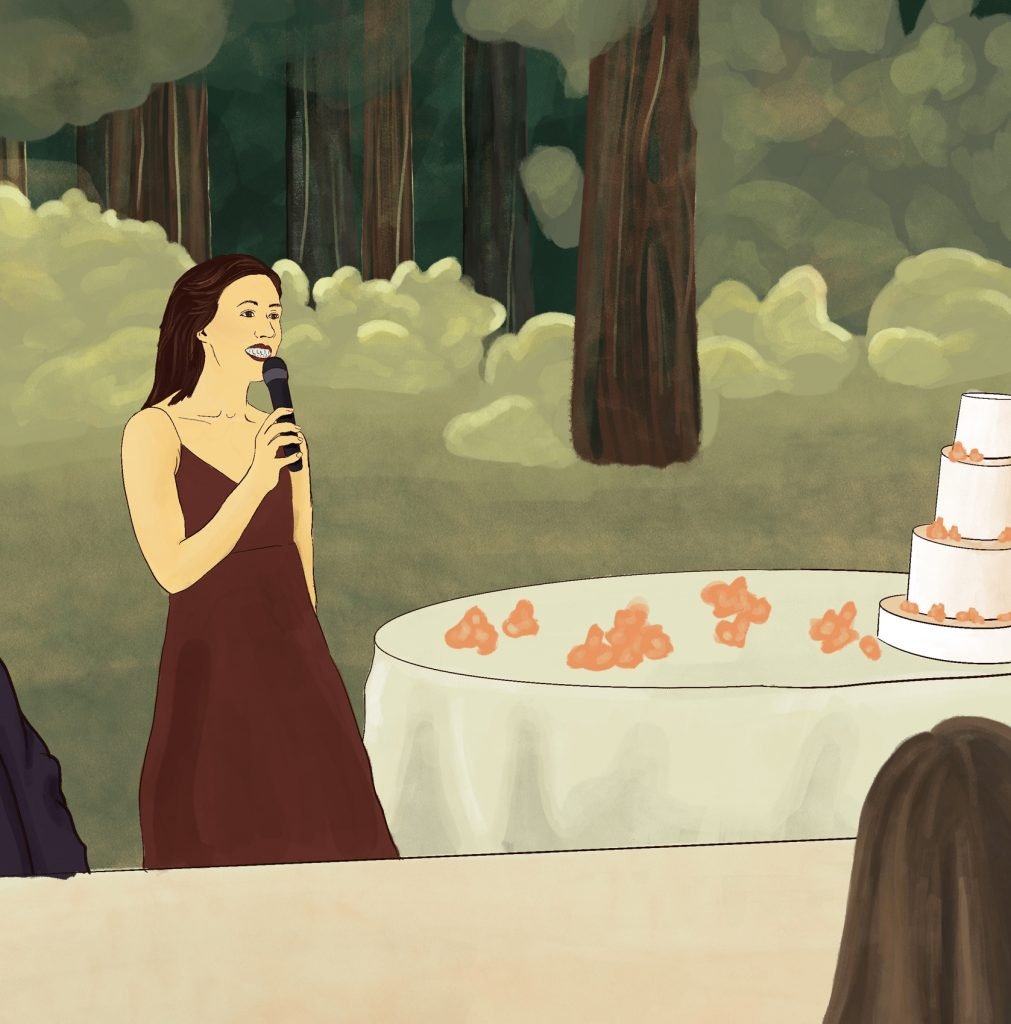


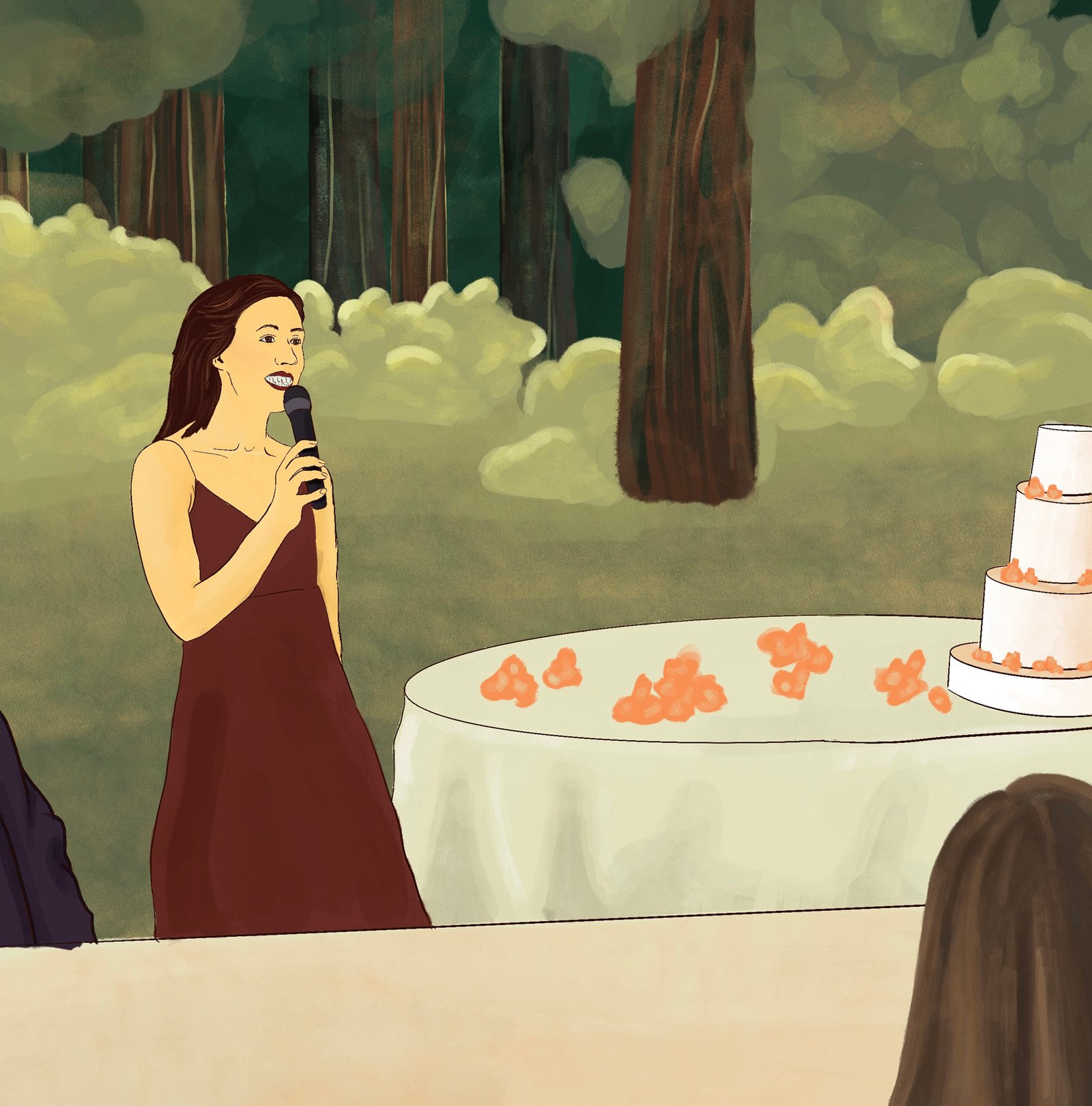
Illustration by Katherine Han, age 18, high school senior, Texas.

That night, she was thinking: Why can’t I make a resolution? What should it be? Then, an idea struck her head. I will learn English. All night, she tried to figure out how to learn English. 

The next day, she saw an advert from LCC, The London Language Center, on the TV. They offered English classes to newcomers. 

After her sister left, Vera called their number and gathered all the information. In the afternoon, when she went to the LLC, the receptionist said,

“The class is a four-week course; it starts in ten minutes. If you want, you can join it.” Vera paid the fee and sat in the class.

Vera didn’t tell anyone about this. Every day, she managed to attend the class when the family was away. She followed every single detail. While commuting, she’d read anything in English. She tried to communicate with her classmates in English. The instructor was impressed and encouraged her immensely. 

Sometimes, Vera shared her food with her classmates. They loved her cooking and appreciated her. One day, she told them of her small cooking business. The instructor said that she was an entrepreneur. Everyone clapped and cheered for Vera, and praised her. That made her very happy.

One day, Margarita’s daughter, Victoria, was coming back from college and saw Vera on the street. She asked her of her whereabouts. Vera explained the whole story and requested Victoria to keep it a secret. Victoria promised Vera that she’d help fulfill her New Year’s resolution. Vera received English movies from Victoria and watched them in free time. She used every single opportunity she could to immerse herself. 

Vera was extremely busy and tired with all the wedding preparations and her English classes. As the wedding approached, Vlad and the children came to England. Vera was happy to see her children but worried about attending her classes. Victoria noticed her stress and asked, “Why are you looking so worried?”

“How can I attend the classes when everyone is home?”

“How many days are left?”

“Three days!”

“Don’t worry. I’ll see what I can do to help.” 

The next day, Victoria went to LLC and arranged video classes for Vera. For the next two days, Vera attended her class in the bathroom! But the final test was on the actual wedding day. The test was a five-minute speech in English. If they did well, the students would receive a certificate of graduation. 

Vera decided she not to attend the test. At night, Victoria noticed her sadness. “What’s wrong?” asked Victoria.

“I can’t attend the test because of the wedding. This is the end of the line for me,” said Vera. 

That night, Victoria thought of an idea. Next morning, she called LLC and talked to the instructor. 

Everyone was running around with joy as they busily rushed to prepare for the big gathering. Depressed, Vera also got ready. As the wedding ceremony began, she saw her teacher and classmates in the hall.

During the dinner, it was time for family members to make toasts to the bride and the groom. After Margarita, Victoria encouraged Vera to say something. Everyone started encouraging her. Before she could speak, Vlad intervened, “My wife does not know English…” 

But Vera interrupted him, “Vlad, may I speak?” And before he could respond, she stood and started:

Meera … Kevin … Marriage is a beautiful thing. It is a special friendship between two people who are equal. Sometimes, couples don’t know how the other one feels. Family can never be judgmental. Family should never put you down, should never make you feel small. Family is the only one who will never laugh at your weaknesses. Family is the place where you will always get care and friendship. Meera and Kevin, I wish you all the best. Thank you.” 

After the speech, everyone gave a round of applause except Kristina and Vlad. They both felt shameful for having belittled Vera. 

The instructor stood and said, “Vera, you passed and have graduated from the four-week English course of LLC. Excellent job!”

“How is it possible?” Vera asked.

“Victoria convinced me to grade you here. It is a surprise for you,” the instructor said.

“Thank you, Victoria, for helping me fulfill my Resolution,” said Vera.

“I know you worked very hard for this. You are great!” said Victoria.

Kristina and Vlad went to Vera and apologized. Vera was so happy she had fulfilled her New Year’s Resolution. 

The family went back home to Moscow after a few days. Vera now feels, With determination, anything is possible.” 

—Vajra Vanukuri, age 11, grade 6, California. He adds: “I enjoy reading and I have a passion for writing stories. I like playing Soccer. I also practice Yoga, and Taekwondo, currently in the green belt. I aspire to be an environment and human rights lawyer when I grow up.

Illustration by Katherine Han, age 18, high school senior, Texas.
Pumpkin Cakes: A Traditional Chinese Breakfast

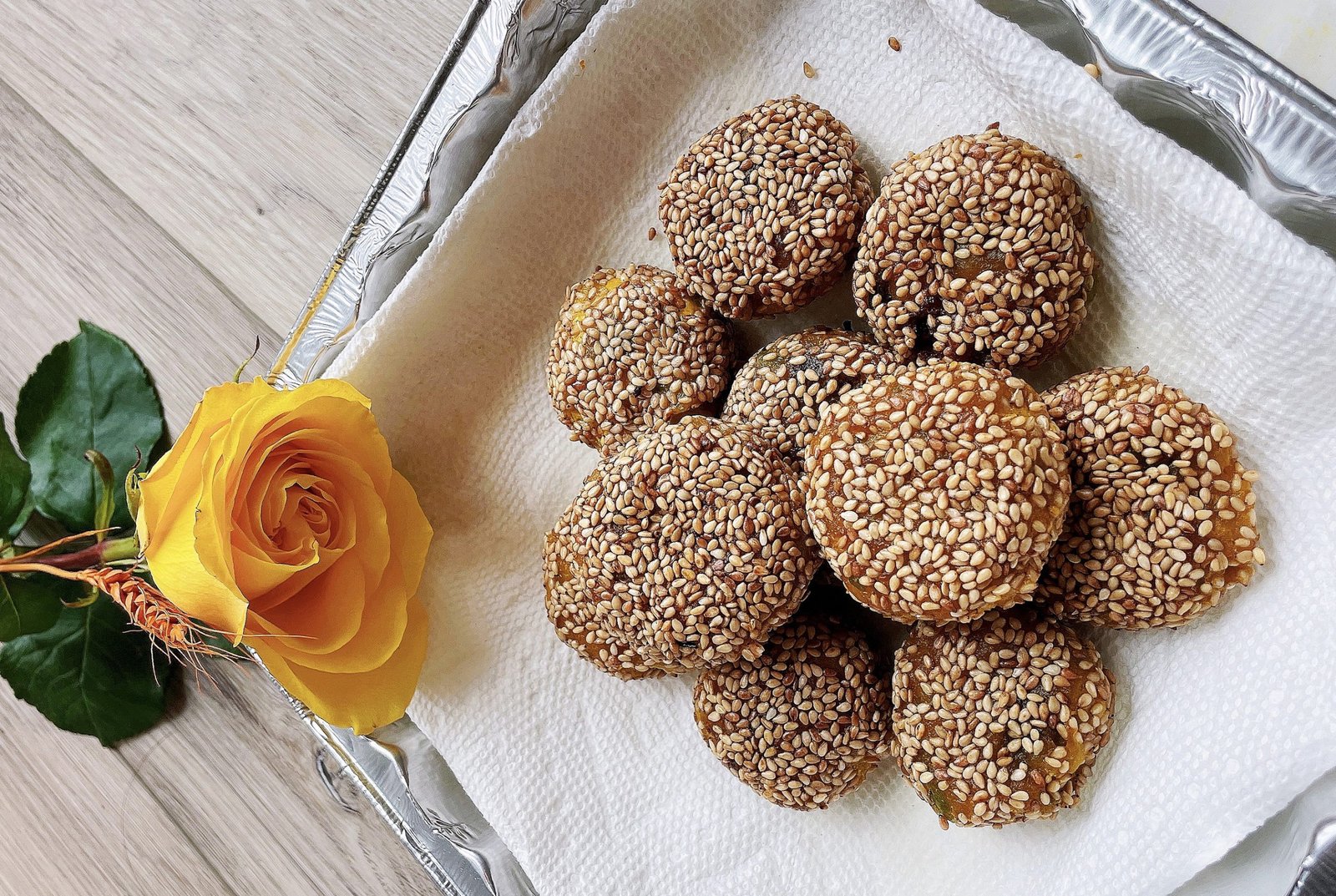
Traditional Chinese Pumpkin Pies (Cakes) Make a Perfect Chinese Breakfast (and a Delicious Dessert too).

To make the traditional Chinese breakfast of pumpkin cakes, you will need:

1/4 pumpkin, 2 tbsp sugar, 200g rice flour, red bean paste (optional), and white sesame seeds (optional). 

You will need to prepare the pumpkin first.

  1. Get rid of pumping seed and it’s inside fiber.
  2. Peel off pumpkin skin. 
  3. Slice into thin pieces ~3mm. Thinner pumpkin slices will reduce the time it takes to be cooked. 
  4. Boil the Water first and Steam it in a bowl for 10 min.
  5. After steaming, pour out water from the bowl if any.
  6. Will need to add 2 tbsp sugar and smash it until there are no pumpkin lumps left. 

Making the dough

  1. Add in 50g of the rice flour, and mix evenly. Repeat 4 times. Do not add-in all the flour at once.
  2. What we want is a rather soft dough. (If you have reach this texture, you don’t need to add exactly the same flour amount as I did; different pumpkin and flour will perform differently).

Making the pumpkin pie 

  1. Take approximately half a hand fist of dough. 
  2. And rub into a ball shape, then press over the dough making a round cake shape. 
  3. If you have red bean paste you can take a scoop of it and place it on the pie shaped dough and close it up and repeat step 2. If you are adding the paste make sure your pie shaped dough is thinner and bigger. Don’t add too much of the paste. 
  4. If you have a plate of white sesame, run both sides of the finished pie in the plate, you can press upon the pie softly allowing sesame to stick to the surface of the pie. 

Cooking the pie 

  1. Preheat the frying pan.
  2. Put in enough oil to cover the bottom of the frying pan.
  3. Add in the pie when oil is hot enough. 
  4. Cook the cakes on low medium heat. 
  5. After every one minute, flip the cake(s) over to the other side. Prevent overcooking on one side. 
  6. To test if it’s cooked. You press upon the pie (cake) and if its shape returns quickly it means it’s cooked. Normally it takes 2-4 minutes.

Pumpkin pie is full of nutrients and is very delicious. Chinese often have pumpkin pie as a dessert or breakfast. Pumpkin pie has the best taste the day it’s made, so please enjoy and finish them quickly after made. This recipe makes 5 to 8 pies; you can adjust the recipe proportionally for your family size!

Wendy Mou, age 16, California. Wendy is an active student who enjoys creative outlets including food. For example, baking is her preferred way to relax after school work and family chores. Since her childhood, she has always held respect for the natural ingredients that go into her food. Currently, she is in the process of starting a food science club at her school. She looks up to those unique recipe makers, and hopes to become one someday. 

The Navajo Code Talkers

THE NAVAJO CODE TALKERS

On July 26, 2001, President George W. Bush awarded the Congressional Gold Medal—the highest civilian medal Congress bestows—to the original 29 Navajo code talkers. Four of the five living code talkers and family members of the deceased code talkers attended the ceremony. These Native Americans had been successful in relaying secret military messages using Navajo words from nature during World War II that the Japanese were never able to decode. (1)

Sixty-five years earlier, the Navajos’ language ability was brought to the attention of the Marines by Philip Johnston. Johnston was aware the Japanese were easily breaking the American military codes. He was a missionary’s son who had grown up on a Navajo reservation. He knew that the Choctaw language had been successfully used to encode messages in WWI, which the Germans were unable to decipher. He realized that he Navajos’ unwritten language could also become an undecipherable code against the Japanese. (2)

Twenty-nine young Navajos were sworn into military duty. They trained at Camp Pendleton and then were tasked with developing an unbreakable code using their native language.  They developed an unwritten Navajo dictionary of military terms which were committed to memory.

The Navajos did not have words for military terms. Instead, these Native Americans used words of nature with which they were very familiar. The types of airplanes became names of birds. Think of a chicken hawk (GINI) diving for its prey. Does this bird make you think of a dive bomber? Have you ever watched an eagle

(ATSAH) pluck its food and then soar through the air with it? It acts much like a transport plane. Think of how a hummingbird (DA-HE-TIH-HI) flits in and out of the flowers. This action is similar to that of a fighter plane. (3)

The code talkers were able to transmit and decode the messages with incredible speed and accuracy. Some 400 code talkers eventually were deployed with the six Marine divisions. Thirteen of these Native Americans were killed in action.

When a code talker sent a message in his native language, the recipient would translate the message into English words. The first letter of each word then formed the message. When the Marines on Iwo Jima raised the flag on Mount Suribachi, the code talkers relayed the message in the Navajo code. Translated into English it read: “sheep-uncle-ram-ice-bear-ant-cat-horse-itch.” (SURIBACHI) (4)

The code talkers sent their messages over portable radios they carried in the field. Some of these messages identified planes. Other dispatches told pilots where to drop bombs. Many gave lists of needed supplies. The Navajos always found a way to make their language work for whatever code was needed for these messages.  Their language skills made a significant difference in the battles of Iwo Jima, Guadalcanal, Tarawa, and Peleilu. (5)

The code talkers’ efforts were so successful the unbreakable code was kept classified until 1968. A movie, Windtalkersreleased in 2002, chronicled the challenges and successes of these heroes. Ironically, the use of their language had previously been banned by the U.S. Government in an attempt to assimilate the Native Americans into the general population.                   `

Why was their language so successful as a code? Navajo was a little-known and little-used language. It was difficult for anyone to know the language other than a person brought up in the oral tradition of a Navajo.  They were very familiar with words from nature and readily changed military terms to well-known words.

The code talkers, with their remarkable Navajo language ability, were heroes in the South Pacific Islands, although it took over 60 years for this acknowledgement to be made public. Their heroic actions and patriotic sacrifices were finally recognized by a grateful nation.

By Annie Laura Smith, writer, Alabama. This article was first published by Ms. Smith in Kidz Chat.

November is the annual Native American Heritage Month, and it calls our attention to the culture, traditions, and achievements of the original inhabitants and of their descendants in the Americas. The official designation of November as National Native American Heritage Month in the U.S. was signed into law in 1990.

SIDEBARS

NAVAJO CODE TALKERS AIRPLANE TYPES* (6)

AIRPLANES

BIRDS

NAVAJO LANGUAGE

Bomber plane

Buzzard

JAY-SHO

Dive bomber

Chicken Hawk

GINI

Fighter plane

Hummingbird

DA-HE-THI-HI

Observation plane

Owl

NE-AS-JAH

Patrol plane

Crow

GA-GHI

Torpedo plane

Swallow

TAS-CHIZZIE

Transport plane`

Eagle

ATSAH


NAVAJO CODE TALKERS SHIP TYPES* (6)

SHIPS

ANIMALS/FISH/INSECTS

NAVAJO LANGUAGE

Battleship

Whale

LO-TSO                     

Cruiser

Small whale

LO-TSO-YAZZIE              

Destroyer

Shark

CA-LO                       

Mine sweeper

Beaver

CHA 

Mosquito boat

Mosquito 

TSE-E                       

SubmarineIron fish

BESH-LO

REFERENCES

1. Vogel, Steve, “For Navajos, an Award of Gratitude, Washington Post, July 27, 2001, p. B03.

2. “Navajo Code Talkers: World War II Fact Sheet” 

3. Rosenberg, Jennifer, “Navajo Code Talkers (Part 2)  

4. Lockard, Vicki8, “Code Talkers”   http://www.turtletrack.org/Issues00/Co06032000/CO_06000000_Codetalk.htm

5. Navajo code talkers of WWII.”  http://ks.essortment.com/navajocodetalk_rjxq.htm      

(6)  Navajo Code Talkers’ Dictionary,  http://groups.msn.com/WWIIHobiests/codetalkersguide.msnw

Making Peace in Corona

Making Peace in Corona

During 2020, when Corona struck and classes were split into pods and cast outdoors, where were you and what were you studying? 

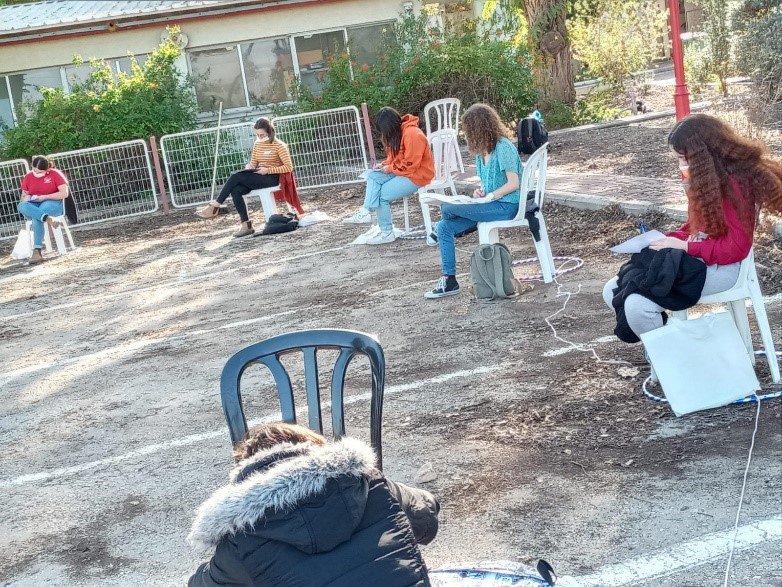
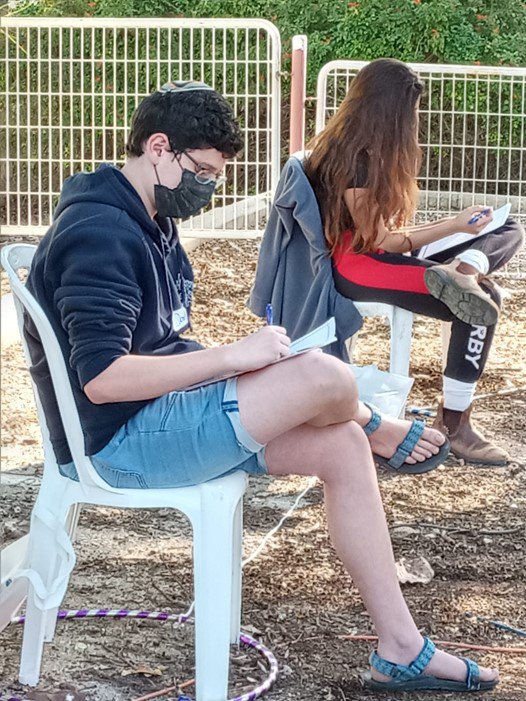
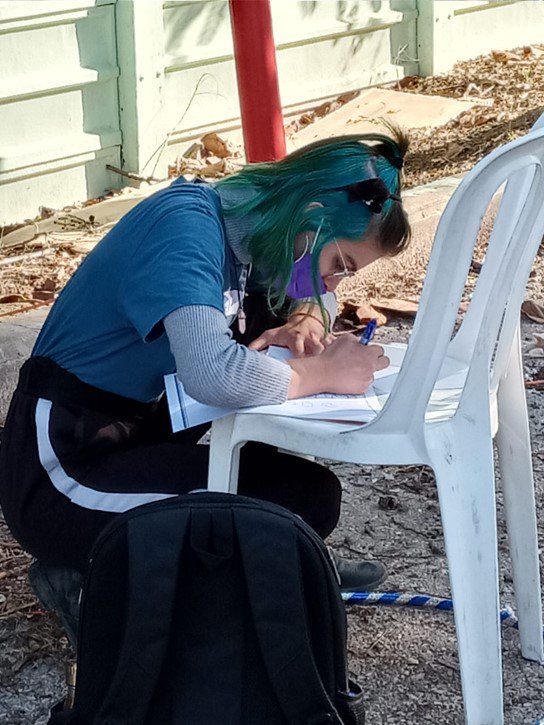
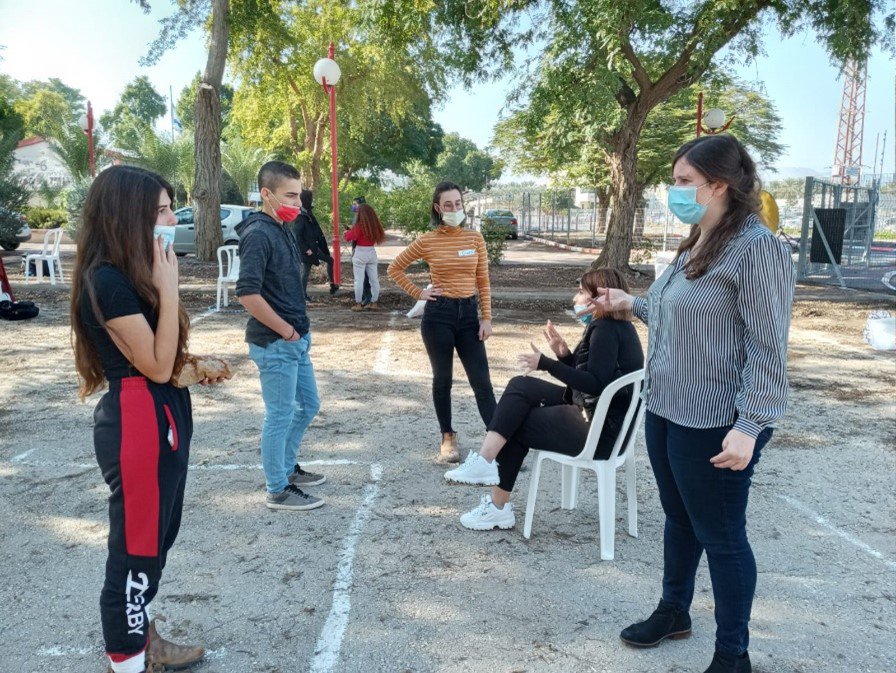
One group of students on a kibbutz in Northern Israel was learning how to make peace. Facilitated by the Jerusalem Peace Builders, fifteen teenagers with varying degrees of piercings, torn jeans and loud colors in their hair, sat in an enormous circle in the old staff parking-lot-turned-makeshift-classroom adapted for the pandemic. 

Jerusalem Peace Builders (JPB) is an interfaith organization that brings together youth from different backgrounds, from Jerusalem, Israel, Palestine, and the United States, to create meaningful encounters. The first session is held separately at each school so students can start to build important dialogue skills such as active listening and empathy before meeting each other. 

This workshop began by exploring personal identity. They asked questions like, ‘Who are you?’ ‘What makes you unique?’ Important questions for teens who are about to get to know kids seemingly so different from themselves.


Just before the lunch break, the group played a game. Sarah, one of the facilitators, a quiet, young woman with silky, dark hair and skin, and deep brown eyes, sat inside the circle. The other facilitator, Yardena, taller and chattier, asked the questions and recorded the answers on a portable white board.

Where was Sarah from? What languages did she speak? How much education did she have? What did she study? Was she married? Did she have kids? 

What kind of assumptions do we make about people upon meeting them?

At first glance, it was hard to peg Sarah. She was most definitely from the Middle East, but nothing about her appearance, her accent, or even her name, indicated whether she was more likely to be Arab or Jewish. 

As Yardena posed the questions, students’ answers spanned the spectrum. She was from Egypt, from France, from Jerusalem, or maybe Ashkelon. She spoke English, Hebrew, and maybe Arabic. Perhaps Italian. She was a teacher, a lawyer, or a social worker. 

Michael had been a student the year before in the ninth grade English-speakers club. Wild haired with thick glasses and fiercely competitive, English came easily to Michael and he was used to winning. When he attended his first Model UN last year, he walked away with second prize. “It’s easy,” he said after with a wink and a dismissive wave of his hands. “You just need to speak a lot and pretend you know what you’re talking about.”

Michael was sure he had this game. He pulled his teacher aside. “She’s Arab, right?” It made sense since it was a coexistence workshop and Yardena, Sarah’s partner, was clearly Jewish.

Still, Michael fell into all the traps: If she was Arab, she must be poorly educated. But she was so articulate, so she must be wealthy and worldly, with some foreign Arab Passport. Jordan? Egypt? Certainly not Palestinian.

When Sarah shared that she was in fact Palestinian, Michael’s face twisted. He didn’t always take kindly to being corrected, but there was no denying who she was. As it turned out, she was from East Jerusalem, and had no passport at all. 

“Well, that’s a choice,” Michael shot back. “East Jerusalem Palestinians don’t WANT Israeli passports because they don’t accept the State of Israel.”

“There are Palestinians like that,” Sarah conceded, “But many people like me want them so we can live a normal life. Unfortunately, the passports are not easy to get. After we apply for a passport, it can take years to receive an answer from the government, and then fewer than half of the requests are even approved. Without a passport, I’m not a citizen of any country. I’m not free to travel anywhere in the world.” 

Michael’s second assumption was also shattered. “Palestinians are the most educated Arab population in the world. Especially the women,” Sarah said.

“Really?” Michael raised his thick eyebrows till they reached his fluffy mop of hair.

Sarah’s smile was more conciliatory than cynical. “Well sure. We can’t travel and there aren’t so many jobs. What else do we have to do with our lives? So, we study.”

Michael didn’t speak again as Sarah answered the rest of their questions. She wasn’t married, no kids. She’d been studying physics, but when she got involved with JPB, she decided to dedicate her life to helping promote co-existence. She loved traveling to schools and meeting students with such different backgrounds than hers and sharing her story. 

During the break, several students stayed to chat with Sarah, foregoing their lunch and only free time. She patiently answered their questions and asked some of her own. The rest of the day the students continued to explore identity. They were asked to map out all the things that made them who they were and highlight those that defined them best. As they discovered, how they define themselves—dancer, student, good friend—changed depending on the day or the situation, or their stage of life. 

At the end of the session, students were asked to share something they were taking away from the day. When it came to Michael’s turn, the other kids stepped in close, eyebrows raised in anticipation of his witty, cynical remarks.

Michael glanced down and then looked at Sarah. He smiled and joined his hands together in a rare gesture of gratitude. “Today I learned that I don’t know everything, and that’s okay.”

The next day, three ninth graders were diagnosed with Corona and the whole school went home for what would be the next eight months. To the great dismay of both teachers and students, their first JPB workshop was their last. 

But Covid has taught us at least two important things. First, we’re all in this together. Second, we must constantly adapt to an ever-changing world. 

Sarah gave up her whole career path to pursue peace. And Michael was able in one day to rethink everything he believed about people. What have you learned in Covid? And how do you plan to use it to change the world?

       —Emily Singer, Israel. She adds: “I am a writer and English teacher in Northern Israel, where I have a special passion for bringing students together from different ethnic, religious and cultural backgrounds to help them appreciate diversity and develop important negotiation and peace-making skills… In 2018, I published my first children’s novel, “Gilgul I: Re-Dedication.”  

In Search of Cool

Summer is here

They say heat is good for

Tomatoes

And wiggling toes in warm

Sand

But ants are trying to tell us

Something

Diligently building mounds of

Dirt between cracks in

Sidewalks

It is going to be a scorcher

I think

I do not want to be a prisoner of

The Sun I hum

Left to find a place to hide from

The hurting burn

City shade is sparse

Do you hear the asphalt whispering

Beware of the sweltering black

Streets?

By maggie d., African American poet, Washington.

What Peace Is to Me

What Peace Is to Me by Paulette Ansari, Georgia.
 
Peace within is so many different things to each of us.
 
Peace is being able to sit in the grass reading a good book and not be devoured by insects.
 
Peace is being able to speak passionately about one’s life and not be labeled “angry black woman”.
 
Peace is being able to go to any public place in the U.S. (in the world even) and not have to worry about being treated badly or unfairly because you are a different race, creed, or religion or because you happen to be a woman.
 
Peace is having enough time to read a great book, knowing you won’t be disturbed.
 
Peace is knowing all is well with the people you love.
 
Peace is being able to laugh with others at yourself.
 
Peace is knowing God’s will for your life and walking in it.
 

Celebrate America Creative Writing Contest

Celebrate America Creative Writing Contest

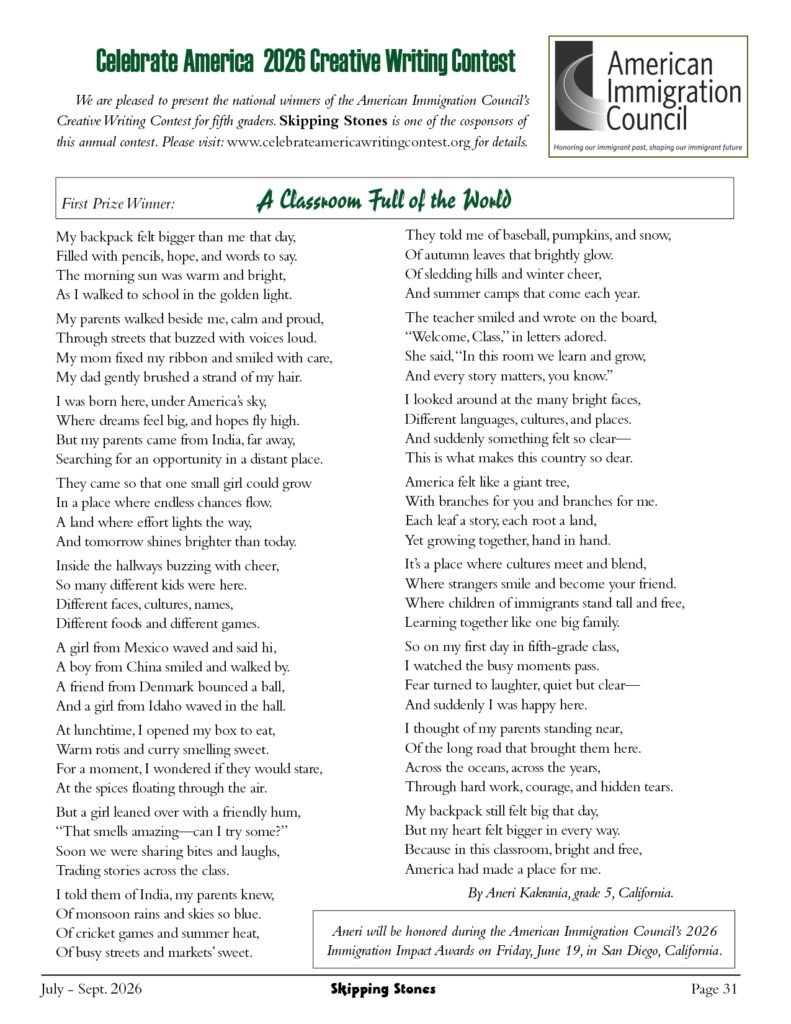
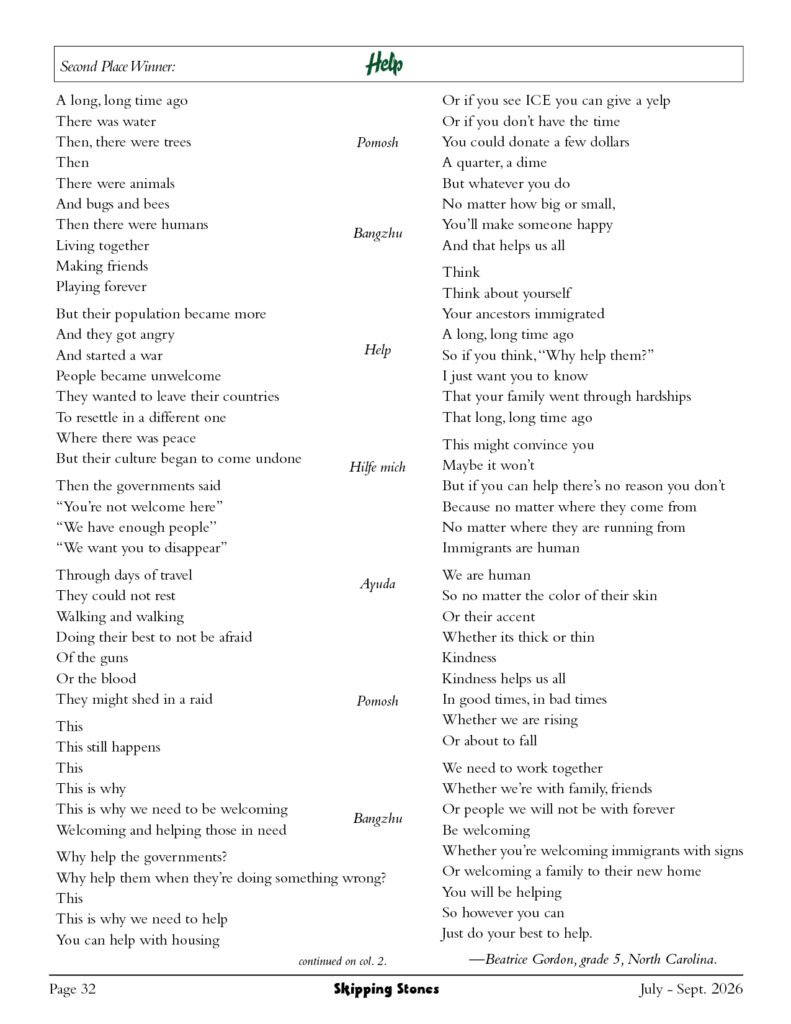
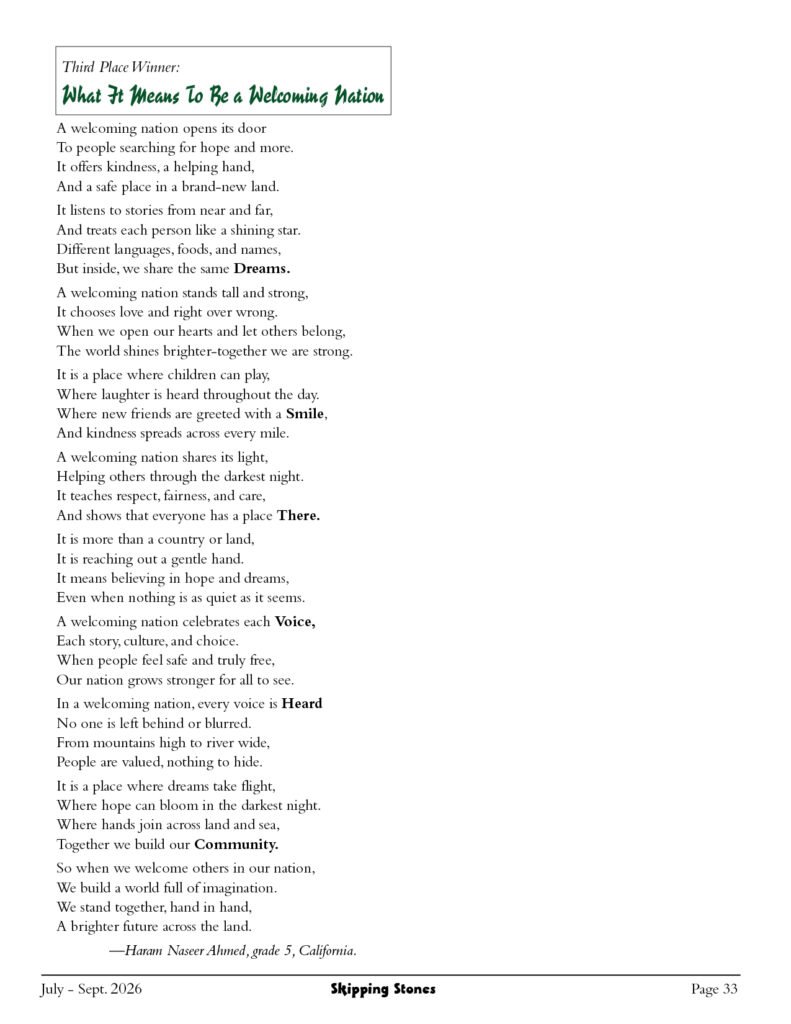
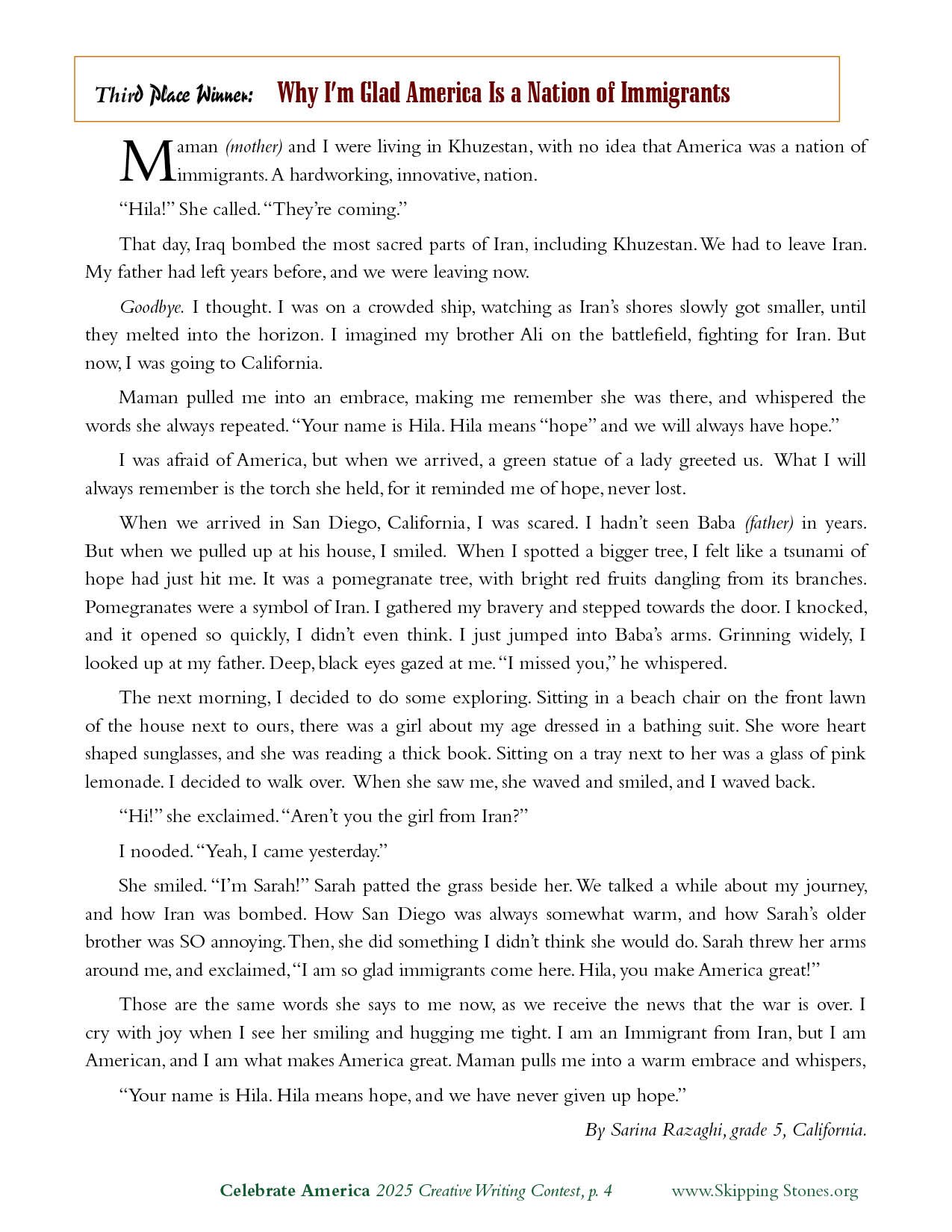
The Celebrate America Creative Writing Contest winners for 2026 have just been announced. The winning entries will be also published in our next Issue (to be available in July). The award winners will be recognized at the Immigration Impact Awards ceremony in San Diego, California being organized by the American Immigration Council (AIC) and American Immigration Lawyers Association (AILA) on June 19th evening. We are pleased to share with you the three winning entries below. (You can also download the file by clicking here):


Celebrate America Creative Writing Contest

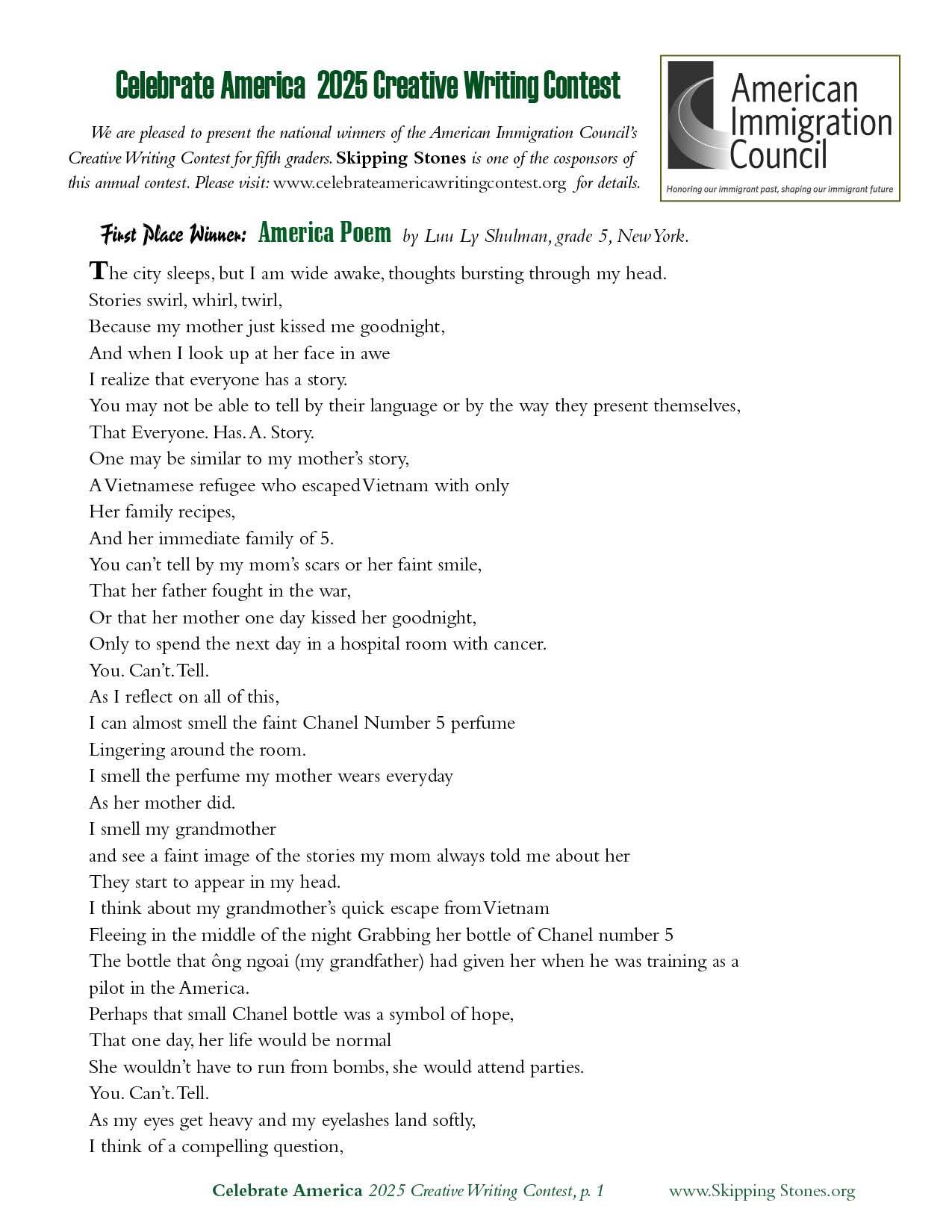
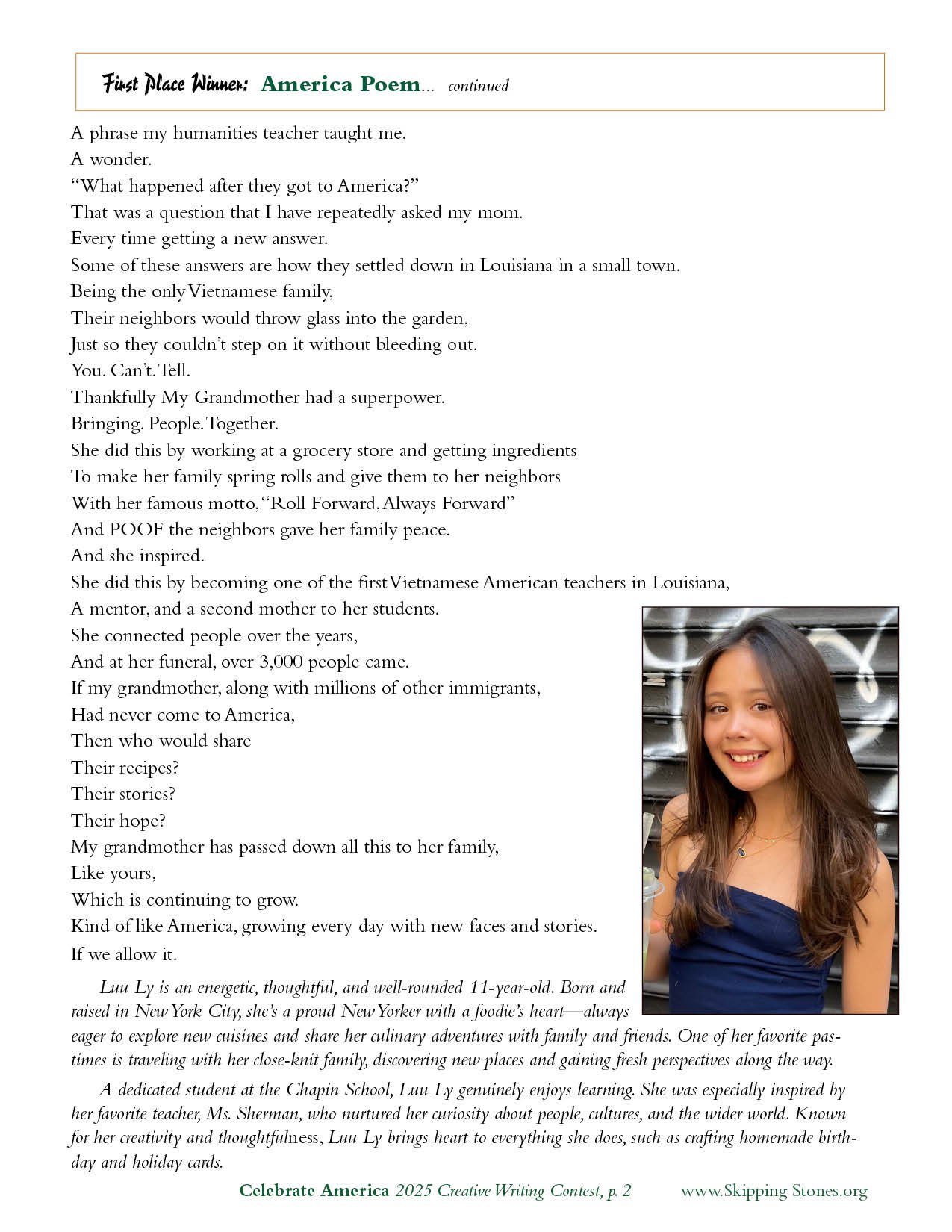
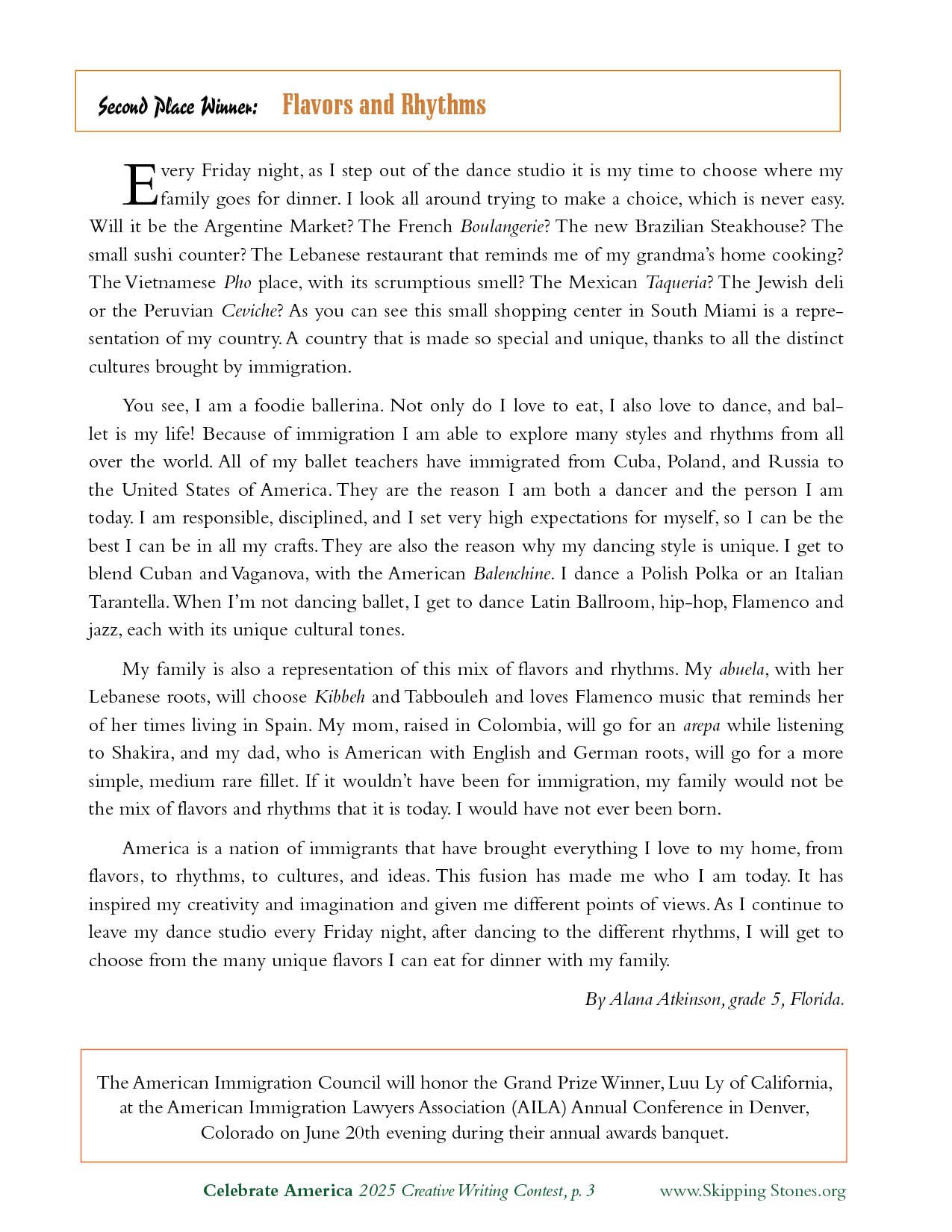
The Celebrate America Creative Writing Contest winners for 2025 have just been announced. The winning entries will be also published in our Awards Issue (to be available in late August). The award winners will be recognized at the Immigration Impact Awards ceremony in Denver, Colorado being organized by the American Immigration Council (AIC) and American Immigration Lawyers Association (AILA) on June 20th evening. We are pleased to share with you the three winning entries below. (You can also download the file by clicking here):

The 2024 Winners were announced on June 14th, 2024. They are:
First Place Winner:  Stories of Us

I sit
By the windowsill
Gazing outside.
Down, on the street, so many heads,
Each is unique.
Amidst the traffic and frantic honking,
I sense the presence of
Millions of others,
Just like me.

I contemplate
The journeys. Each of us—All of us have a story.
When mothers and fathers
Ventured far across the world,
Their sense of adventure leads
Them in search of a new life.

Then I think
About all the diverse people,
And a myriad of languages,
Some foreign to one, but familiar to another.
When I open my window,
I hear those languages harmonizing,
Merging together to form a chorus.

But not just any choir.
The symphony of every single person’s story,
A song where every note counts.
I think about the stories
That father would tell me.
About my father’s mother and
His migratory voyage.

My father’s trip to America,
With only 300 dollars in his suitcase,
And a brain.
I ponder about each and every one
of the people in my neighborhood
And I wonder
Why Father would be willing
To relinquish everything
To speak in a foreign tongue.

I think about his pride
In having dual nationalities.
About being able to keep his
traditions close to heart,
and embracing a new part of himself.
American.

Then my thoughts drift to school.
All of the different students,
Each of us with our own stories.
The accounts of our ancestors,
And all that they sacrificed.
For us.
For each and every one of us,
To be here.

At this moment.
Right now.
To be present,
Someone had to work hard.

Someone had to shed tears of exhaustion,
Leaving behind familiar joy and wonder,
Leaving behind family and friends,
To create new memories and stories
In one country,
Forming one grand story.
But this story
Isn’t just any story.
It is the story of us.
The U. S.
The story of the United States of America.

—Angela Du, grade 5, New York.

Second Place:  Sugar and Milk

I wake up to the sounds of unfamiliar voices in different languages. I raise the blinds and look out the window. I see people wearing bright clothes and intricate patterns. They stand out against the dull brick apartment building, like fall leaves against a gray sky. My mom comes in and abruptly says, “Don’t bother with them. We were here first.” I sit silently on my bed pondering about what she said.

Weeks pass. Curious, I go over to their apartment building and find a girl watering a tomato plant. I shyly say, “Hi. I’m from the apartment across the street. My name is Sula.” She quietly responds, “My name is Aminah.” She reaches towards the tomato plant and offers a tomato. I smile and put it in my pocket. Aminah waves goodbye and runs inside.
I run back home to give the tomato to my mom. She says, “Thank you,” and takes a bite. “This is the best tomato I’ve ever had. Where did you get this?” I hesitated a bit, then I said, “From Aminah.” “Who is Aminah?” She asks. Anxiously I say, “The new kid from across the street.” Before my Mom can say anything, I run upstairs.

Aminah and I start playing together over the summer. I think Mom is still unsure of Aminah and her family.

Tonight I wake up to loud sounds. I am scared. Mom comes running into my room and we run to the basement. The next morning, my mom says that there is a war going on and the safest place for us is right across the border in our neighboring country. We pack our clothes and hurry into a truck packed full of people. As we settle down, I see Aminah and her family in the corner. After a long and tough ride, we end up in a camp full of tents.

Mom and I are going from place to place in search of food and a job. A week later Mom finds a job at a small bakery owned by a family. The job doesn’t pay a lot, but enough to get food for both of us. Later that month, the family invites us for dinner at their house. It is a small house with two rooms and seven kids. I am eager to have a proper meal. My Mom thanks them for sharing the food they have, especially when we come from a different country. Then the host shares a Parsi legend that she had heard from her elders. She begins,

“In the seventh century, when Parsis emigrated to India, they were brought before local ruler, Rana, who presented them with a vessel “brimful” of milk to signify that the surrounding lands could not possibly accommodate any more people. The Parsi head responded by slipping some sugar into the milk to signify how the strangers would enrich the local community and dissolve into life like sugar dissolves in the milk, sweetening the society but not unsettling it.”
Mom bursts into tears.

—Ananya Siddabathuni, grade 5, Minnesota.

Third Place:  I See America

Through crashing waves and rocking ships,
I carry big wishes and high hopes for this new nation.
I see America, welcoming me with arms wide open,
Filling me with faith and showing me appreciation.

Leaving the green, white, and saffron flag waving in the breeze,
The concrete roof that once was over my head.
Still holding onto my traditions and beliefs,
While adapting to a different culture instead.

I am welcomed by classmates,
Welcomed by neighbors and teachers.
I soon feel connected with my community,
Regardless of my different nationality and different facial features.

When I get pushed down from inequity,
I get back up and stand strong.
I see America as a place of opportunity,
A place of liberty, and a place where nobody’s background
is wrong.

I will carry on our vows, generation to generation,
Longing for our customs to carry on, and never fade.
I hope that the new ages to come will learn that our heritage is something to be proud of,
And realize the righteous impact on America that
we immigrants have made.

For I am an immigrant from over the seas,
Proud of my heritage and values, I hold near and dear.
I am holder of two nationalities, first generation to see America,
And I hope to spread the joy of our culture here.

 —Caroline Keslinke, grade 5, Illinois.

The 2025 Creative Writing Contest
The American Immigration Lawyers Association holds this annual contest to challenge fifth graders across the country to reflect on and write about one of two themes: “Why I Am Glad America Is a Nation of Immigrants” or “What Does it Mean to be a Welcoming Nation?” Visit: www.celebrateamericawritingcontest.org


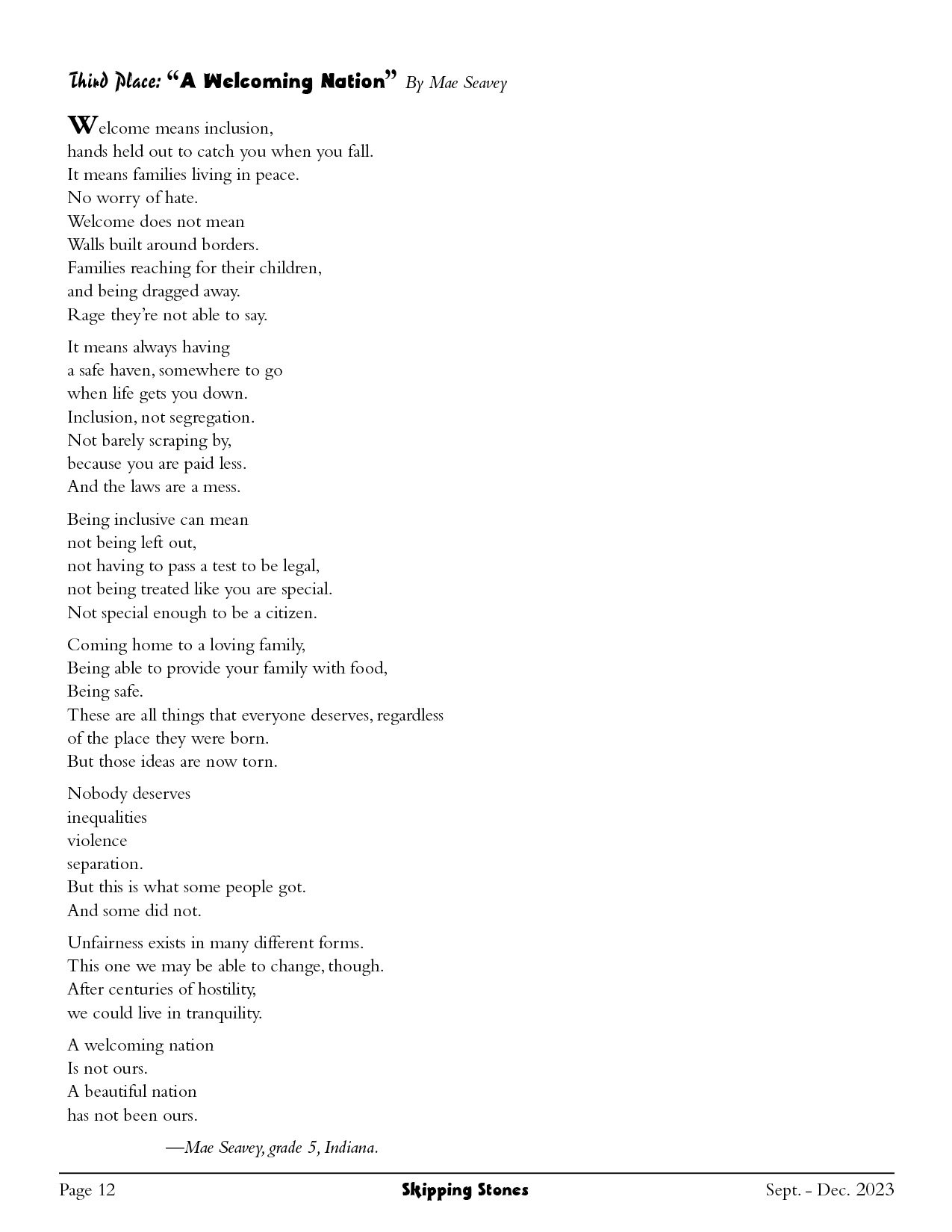
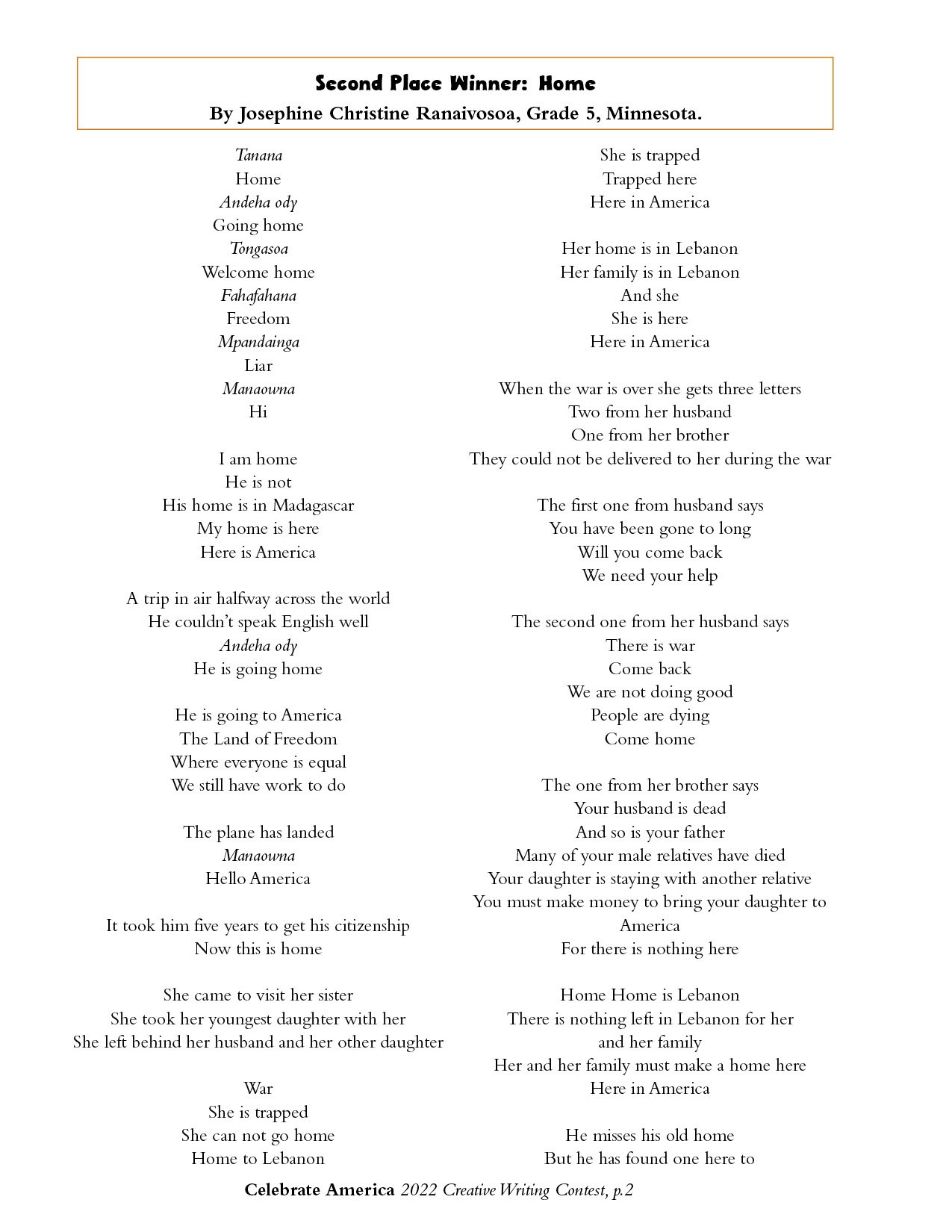
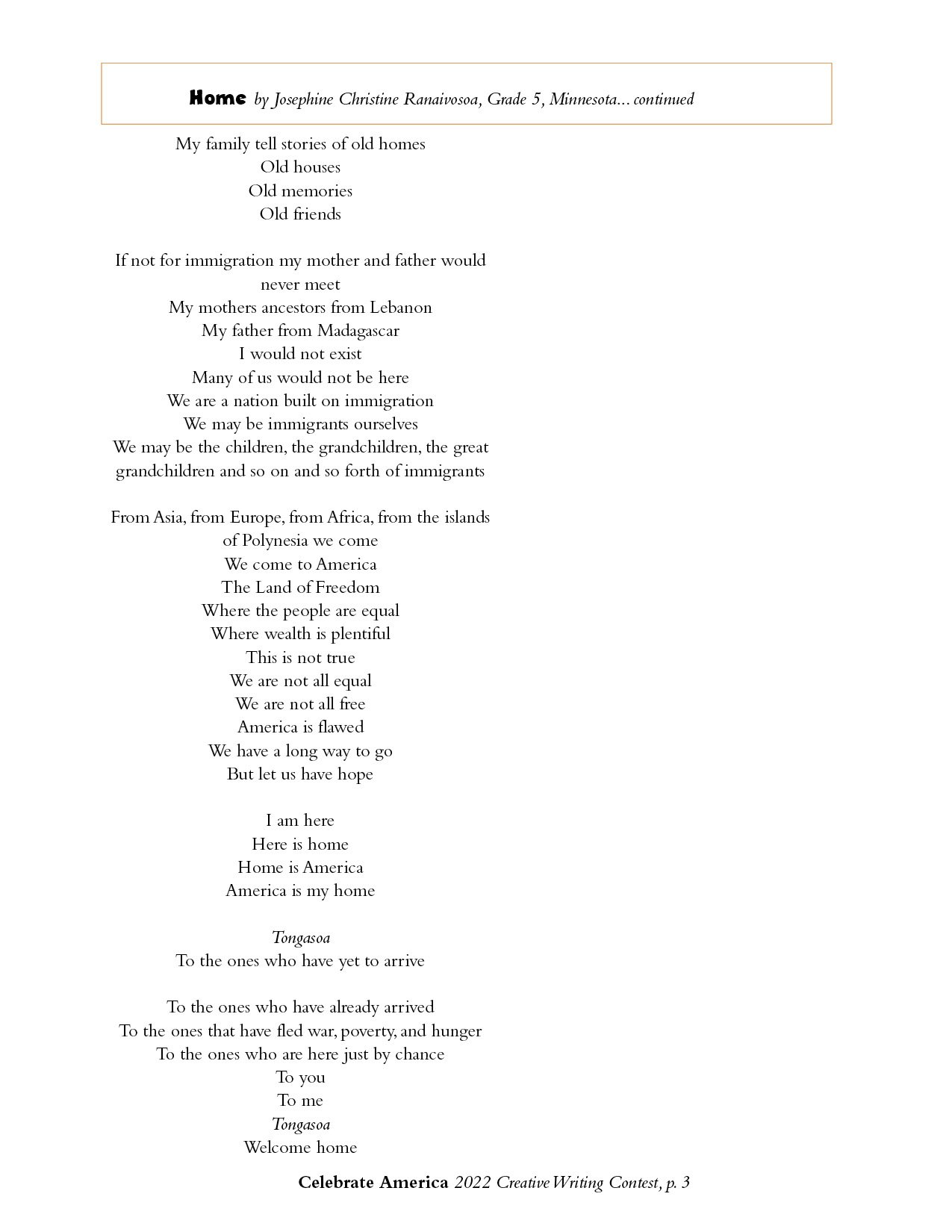
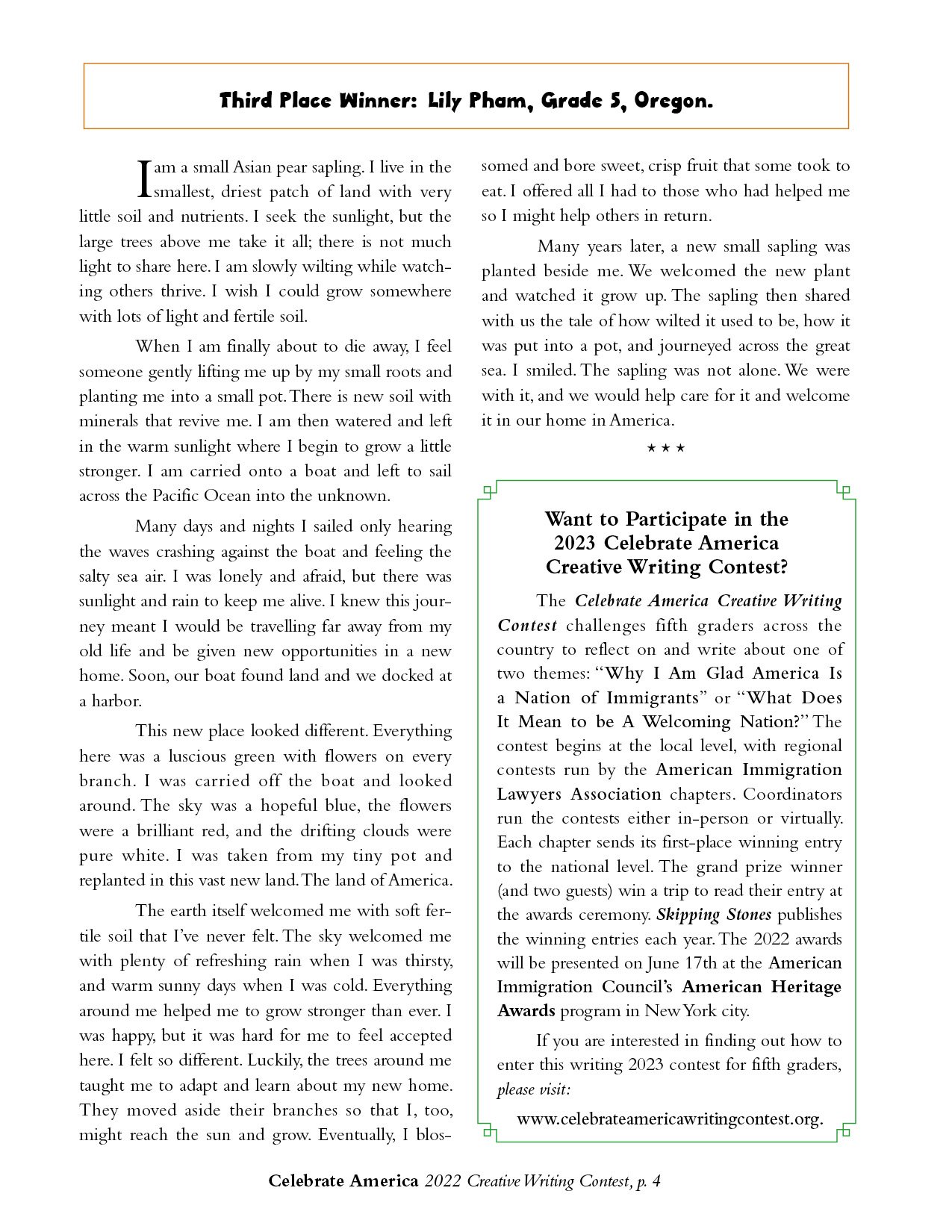
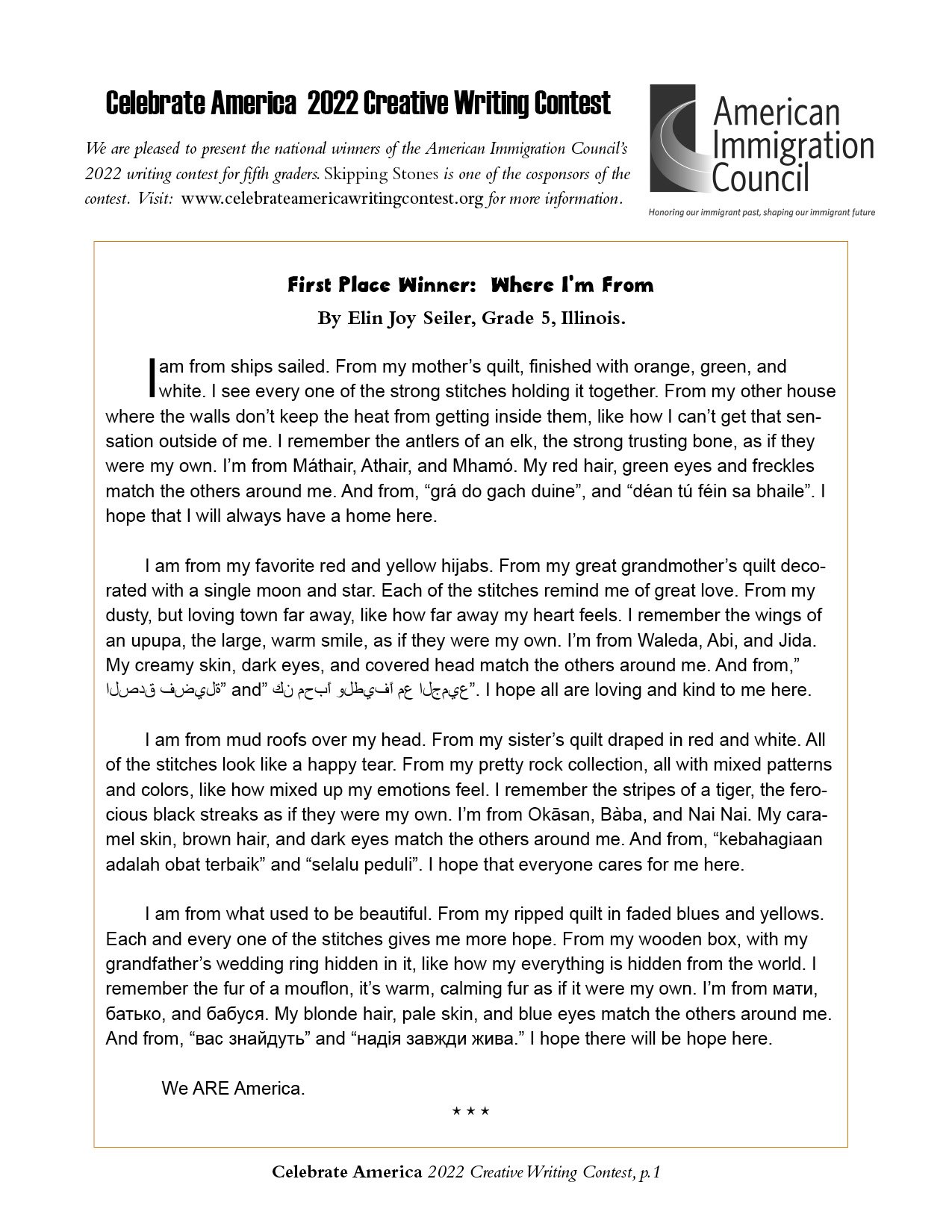
The Celebrate America Creative Writing Contest winners for 2023 were announced last week. They will be also published in our Awards Issue. You can download the three winning entries here.


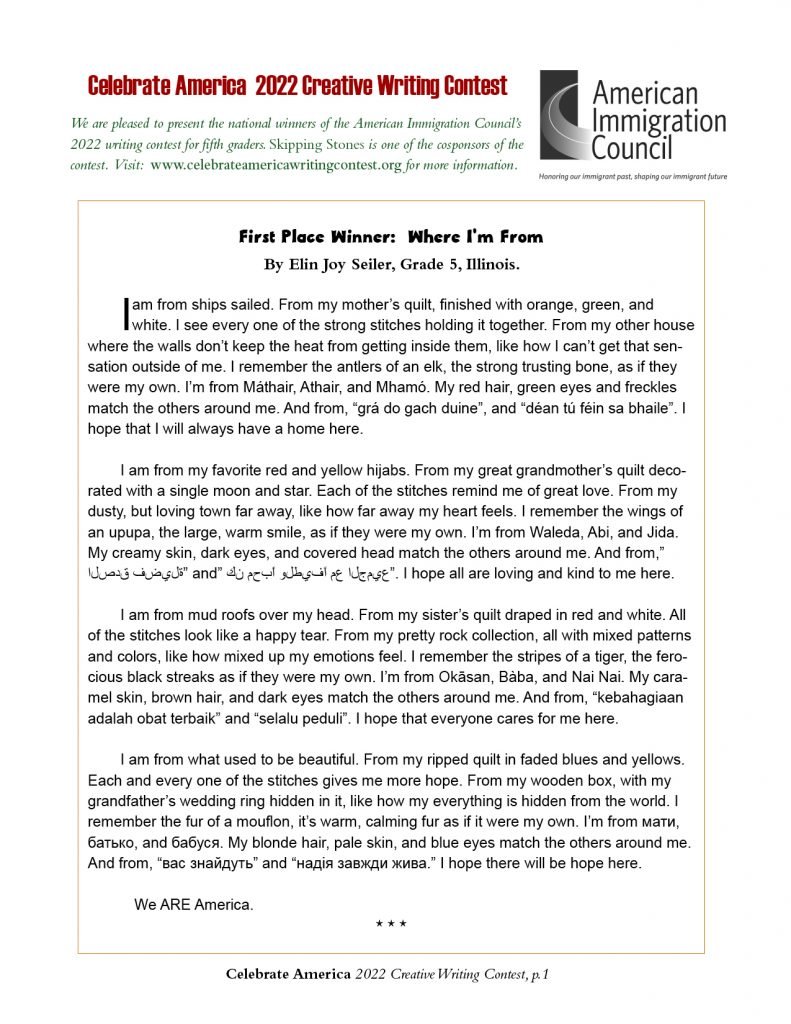
The Celebrate America Creative Writing Contest winners for 2022 have been published in our Awards Issue. You can download the winning entries here.

The Sweetest Treat

The Sweetest Treat

By Jacob Lockett, emerging author, Pennsylvania.

Roshni finished making her costume at five o’clock on Halloween night. Happy with her work, she ran downstairs.

“What do you think, Mama?” she asked. “I’m a khargosh.”

Mama turned from the stove, where she was cooking. “Wow!” she said. “You’re such a cute little bunny!”

Roshni giggled. “A cute little bunny that can jump really high!” she said, hopping around the room on spring shoes she had made herself.

Mama handed Roshni a pumpkin-shaped bucket. “Ready to trick-or-treat at school tonight?”

“Yep,” Roshni said. “I love getting candy!”

“Remember, you have time to go trick-or-treating at just one or two houses before going to school,” Mama said. “And I want you back by dinner.”

Roshni nodded excitedly.

Mama hugged her. “Get hopping. Halloween comes only once a year!”

With a spring in her step, Roshni bounced out the door and into the cool night air, her large bunny ears flopping this way and that. Kids ran around the street, dressed in fun costumes.

As Roshni hopped to school, she looked around her neighborhood, deciding which house to go trick-or-treating. A house with a ramp and a brightly lit pumpkin by the door caught her eyes. She remembered Mama telling her that a new family had moved in recently.

Curious to see what her new neighbors were like, she went over to the house and rang the bell.

The door opened.

“Trick or treat!” Roshni shouted.

A boy in a wheelchair appeared, a candy bowl sitting in his lap.

Roshni recognized him. He was DeAndre Lewis, the new kid at her school. He was in a different grade than Roshni, but she sometimes saw him in the hallway. He always seemed… lonely.

She waved. “Do you remember me from school? I’m Roshni.”

“Sure. I do remember,” DeAndre said, smiling. He rummaged around in the bowl, giving Roshni a Nougat Rocket Bar. “Super costume!”

Roshni blushed. “Thanks! I’m a khargosh—that’s the Hindi word for bunny.”

“That’s really cool,” he said.

“So, are you trick-or-treating?” Roshni asked.

DeAndre shook his head sadly. “My mom’s too sick with a cold to take me out tonight.”

Roshni gasped. She couldn’t imagine not going trick-or-treating. She looked at DeAndre’s sad face, and Mama’s words came back to her: Halloween comes only once a year…

“I can take you trick-or-treating,” she offered.

DeAndre’s eyes shone with hope. “Really? That would be wonderful! I’ll go ask Mom.”

DeAndre returned to the door with Mrs. Lewis. “You must be Roshni,” she said, sniffling. “Your mother told me so much about you at the store last week. DeAndre said you want to take him trick-or-treating with you.”

Roshni explained about their school’s Trick-or-Treat Fair and how there would be lots of treats, games, and contests for DeAndre to enjoy.

“Sounds like a good time!” Mrs. Lewis said. She turned to DeAndre. “Get your costume, honey. You can go have some Halloween fun with Roshni tonight.”

DeAndre’s face lit up just like the jack-o’-lantern that sat outside his door. He turned around and disappeared. He soon came outside wearing a superhero’s mask and a long cape.

“DeAndre, I want you back by seven,” Mrs. Lewis said. “Now, go have fun.”

The kharagosh and the superhero went off into the moonlit night. In no time at all, they arrived outside the school, which was covered with Halloween decorations. After DeAndre wheeled himself up the long entrance ramp, he and Roshni entered the cafeteria to the sound of spooky music and laughter.

They went around to different booths, collecting delicious treats from their teachers.

As Mrs. Garcia handed the kids each a pack of Licorice Lassos, DeAndre asked Roshni, “What are your favorite sweets?”

“I have so many!” she replied. “But I think my favorite would have to be galub jamuns. I make them with Mama for special occasions. They’re kinda like spongy—”

“Donut holes!” DeAndre finished.

“How did you know?” Roshni asked, surprised.

“I had one during Multicultural Day at my old school,” DeAndre explained. “It was one of the best things I’ve ever tasted. I make them with my mom now, too!”

They laughed, high-fiving.

After they were done trick-or-treating, Roshni entered the costume contest. After Roshni and the other contestants had displayed their outfits for the judges, Principal Jackson cleared his throat near the microphone. “And, the first prize goes to Roshni Kaur with her homemade bunny costume! Come on up!”

“Way to go!” DeAndre cheered loudly from the audience as Roshni hopped on stage to receive her blue ribbon.

DeAndre pointed at the haunted house in the corner of the cafeteria. “Let’s go in there.”

Roshni shivered. “I don’t know…”

“Have no fear!” DeAndre shouted, striking a pose. “I’ll protect you!”

“Ok,” Roshni said. “As long as you protect me, I won’t get scared.”

They went into the haunted house. Kids dressed as monsters jumped out from the shadows to try to frighten them. But every time they did, DeAndre would boom, “Back, you villains!” in his superhero voice. Roshni couldn’t stop smiling. Because of DeAndre, she didn’t get scared, not even once.

After they bobbed for apples, they sat at the snack table and drank pumpkin punch and talked about their favorite scary movies. All of Roshni’s favorites were DeAndre’s favorites, too!

Soon, Roshni checked her watch. She felt her heart drop. “It’s almost seven,” she said glumly. “Time for us to go home.”

“Aw,” DeAndre moaned, shaking his head sadly. “Do we have to?”

DeAndre guided his wheelchair down the school’s ramp and onto the sidewalk. He looked up at Roshni. “Thanks for taking me. I had a blast!”

“Sure,” she replied, swinging her bucket of candy as she hopped. “Halloween comes only once a year!”

“Do you… want to trade candy tomorrow?” he asked.

“Yes, we can do it at my house,” Roshni replied. “You can help me make gulab jamuns when we’re done at my home. Mama would love it.”

DeAndre giggled. “Great. But… don’t you only make gulab jamuns for special occasions?”

Roshni blushed. “I do,” she replied. “But you’re the special occasion.”

Now DeAndre was blushing, too!

On that Halloween night, Roshni had collected many sweet treats. But the sweetest one she had received was a new friend, DeAndre.

By Jacob Lockett, emerging author, Pennsylvania.