Dare I Say By Cassandra Martens Diaz, Mexican-Canadian, 17, Manitoba, Canada I do not pronounce it with familiarity I do not read it I do not spell it Dare I say I speak it at all Pepper burns my tongue I turn away from the heat I do not take the spice Dare I say I have a taste at all The Jalisco too small Tucked away, unused, unworn Body stiff, and still Dare I say I can dance at all Though in my blood Though in my citizenship It is not to be found in me Dare I say I am Spanish at all Y Me Atrevo a Decir por Cassandra Martens Diaz, 17, Manitoba, Canada No lo pronuncio fácilmente No lo puedo leer No lo puedo deletrear Y me atrevo a decir que lo hablo El ají quema mi lengua Prefiero alejarme del chile No tolero el picante Y me atrevo a decir que lo saboreo Mi traje de charra me queda chico Alzado, sin usarlo ni vestirlo Cuerpo rigido, e inmóvil Y me atrevo a decir que bailo A pesar que está en mí sangre A pesar que está en mí ciudadania No lo he podido encontrar en mí Y me atrevo a decir que soy LatinaCassandra adds: "My family immigrated to Canada from Chihuahua, Mexico when I was very young. Since I was raised in a country that was culturally very different from Mexico, I have always felt detached from my extended family because I lack a lot of the experiences that they’ve had. It is important to me that I continue to work on my Spanish and learn more about my mom's culture.. I am just beginning to submit my work for publication. I was inspired by Jessica Wang’s heartfelt story submission, Xiang Xiang, published by Skipping Stones."
Category Archives: Immigration Experience
Early Bilingual Education
Taking it One Baby Step at a Time: Why We Need Early Bilingual Education
By Michelle Lo, 17, New York.
If you’re like any typical American high school student, this is how your language-learning journey will go: you spend three years blazing through vocabulary and learning all of the tenses, grammar, and tones of the language, only to forget everything that you’ve learned by the time you’ve graduated (except for maybe how to ask to use the bathroom or where the library is).
Meanwhile, with the rise of globalization over the last century, bilingualism and multilingualism have become some of the most important skills to have as an individual. Some of the many benefits to bilingualism include a communication advantage in the world’s competitive job market, the ability to communicate and connect with people from a variety of social settings, and a wider global perspective. So, if being bilingual or multilingual is that important, how might we improve the way we teach language such that our students can actually become fluent in them?
The solution, as simple as it may be, is to have our students start early.
One of the clearest benefits to learning a new language early is that the younger you are, the easier it is to pick up the language. In a linguistic study done by a research team from Boston-based universities, researchers aimed to pinpoint the age at which our ability to learn a new language disappears through a short online grammar quiz. Individuals were asked about their age, language proficiency, and time studying English. The study concluded that children up to the age of 18 are proficient at learning a new language, while children up to the age of 10 can achieve the level of grammatical fluency of a native speaker. There are many reasons why children generally have an easier time learning a new language. Younger children are less fearful of making mistakes than adults and teenagers, a hurdle that one must overcome in learning a new language. Certain brain structures in children also make this process of language learning easier. One study conducted by researchers at UCLA observed rapid growth in the parts of the brain that are responsible for developing language skills between the ages 6 and 13, but a sharp decline in growth after age 13.
Contrary to what some may believe about bilingualism, learning a second language during a person’s most formative years will not affect their ability to speak their primary one nor will it confuse a child. As a matter of fact, numerous scientific studies have concluded that being multilingual can offer numerous cognitive and intellectual benefits for children. A 2004 study by psychologists Ellen Bialystok and Michelle Martin-Rhee found that the brains of bilingual children had better executive functioning than those of their monolingual peers. This meant that bilingual children were better at planning, solving problems, etc., which stemmed from their ability to switch from one language to the other. Various studies have also proven that bilingualism can lead to higher intellectual performance and higher creativity.
Yet, despite the overwhelming evidence supporting early language learning, the U.S. is falling significantly behind other countries in foreign language learning. As the American Councils for International Education reported in 2017, out of all 50 states and the District of Columbia, only 20% of K-12 students are enrolled in foreign language classes, compared to the European median average of 92% thanks to the national-level mandates for foreign language education. In addition, many European students begin to take foreign language classes from the ages 6 to 9, whereas most American students begin in their high school years. Unlike many European nations, many states lack requirements regarding foreign language education or the age at which students should start in place, causing more lag for American students.
In order to make up for this lag, we need to start taking steps in emphasizing foreign language education, beginning in early childhood. That could mean implementing a more standardized system in the state where all students can begin to get some exposure to foreign languages from kindergarten. We could also expand dual language programs, one of the many great ways early childhood foreign language education can tap into a child’s language learning potential. Although dual language programs vary in form, most are designed to teach students in two languages in order to foster bilingualism and biliteracy. Usually, one half of the instructional day is taught in a foreign language and the other half in English. Many of these dual language classes are immersive. For example, children are encouraged to learn through play, song, and social interactions with their peers, which, over time, can help to foster their interests in learning the language and culture. These programs are great for English-learners and native English-speakers alike. For English-learning students, a bilingual classroom allows them to build friendships with their native English-speaking peers, a relationship that would not have been possible if it wasn’t for their mutual understanding of each other’s languages. For native English speakers, sharing the classroom with non-native speakers and immigrant students will help normalize the diversity in languages and cultures in the classroom.
If we expect our coming generations to build a future that is diverse and multicultural, we need to first construct the foundation: an improved and earlier foreign language education system for all students. Students, teachers, administrators, families, and change-makers of any form can all contribute to this cause by recognizing this need and advocating for better early bilingual education, whether that be writing to your local representatives or spreading awareness within your community. That way, we’ll just be one baby step closer to a truly globalized future.
—Michelle Lo, 16, New York. She adds: “I’m an American-born-Chinese, or ABC, that has always been interested in language and culture. Growing up, I spoke only Chinese as a young child but after rigorously studying only English during my childhood years, I lost my ability to speak Chinese. This is something that I deeply regret as I felt that it created a barrier between me and my culture. As a result, I hope to spread awareness about the importance of bilingualism in our multicultural society to prevent cases like mine from happening.”
Sources:
American Councils for International Education, 2017, The National K-12 Foreign Language Enrollment Survey Report, www.americancouncils.org/sites/default/files/FLE-report-June17.pdf.
“Benefits of Learning a Second Language at an Early Age: Ertheo Education & Sport.” Benefits of Learning a Second Language as a Child | Ertheo Education & Sport, 10 June 2020, www.ertheo.com/blog/en/learning-a-second-language/.
Bhattacharjee, Yudhijit. “Why Bilinguals Are Smarter.” The New York Times, The New York Times, 17 Mar. 2012, www.nytimes.com/2012/03/18/opinion/sunday/the-benefits-of-bilingualism.html.
Devlin, Kat. “Most European Students Are Learning a Foreign Language in School While Americans Lag.” Pew Research Center, Pew Research Center, 6 Aug. 2018, www.pewresearch.org/fact-tank/2018/08/06/most-european-students-are-learning-a-foreign-language-in-school-while-americans-lag/.
Smith, Dana G. “At What Age Does Our Ability to Learn a New Language Like a Native Speaker Disappear?” Scientific American, Scientific American, 4 May 2018, www.scientificamerican.com/article/at-what-age-does-our-ability-to-learn-a-new-language-like-a-native-speaker-disappear/.
Talukder, Gargi, et al. “Brain Development Study May Provide Some Help for Educators.” Brain Connection, 9 Dec. 2016, brainconnection.brainhq.com/2000/09/20/brain-development-study-may-provide-some-hel
Umama, Khujista. Personal Interview. 18 Dec. 2020.
Zhang, Jingyu. Personal Interview. 16 Dec. 2020.
Mother’s Daughter
“The way you cut your meat reflects the way you live.” –Confucius
If Confucius was right, then my mother lived delicately, treading a tightrope as thin as the slices of her twice cooked pork.
When she ate her first American hamburger, she had complained.“Ai ya. Why is the meat so big? With a hulking piece of meat like this no wonder they all in debt. Americans cannot save.”
She told me this while I minced the pork for our dumplings and she rolled the dough. “Thinner, Jian Yang. We are not the barbaric Americans.”
She didn’t intend it, but with those words, the knife I held slashed across my life like the cuts across the pork. In that moment I told myself I am not a barbaric American because I am not an American. My narrative became a relic of my mother’s, two sides of the same page, her side’s ink still impressed on mine.
For five years after that, I remained scared of knives, and my mother cut my meat for me.
“You are what you eat.” –American proverb
“Is that dog food?”
“It can’t be, because Ling Ling doesn’t feed dogs, she eats them.”
That day I went home in tears and asked my mother to pack me a sandwich. I showed her what the pale kids kept inside of their princess lunchboxes—spongy white bread around ham and cheese, a cereal bar, an apple.
“Ah yes, I make for you.”
The next day I found a pork bun in my backpack. I held the baked dough and took a bite. I tasted pork marinated with soy sauce and chives. As I chewed, I hoped the hujiaobing could pass off as a hamburger.
“Ling Ling is eating dog food again.”
“Does that make Ling Ling a dog?”
The day after, there was steamed bun inside my backpack with barbecue pork and black pepper. I looked once at the pearl knot before throwing out the chasiubao. I didn’t eat my lunch the day after, or the day after.
If you are what you eat, I thought, I don’t want to eat Chinese anymore.
And so my transformation began. Everyday at lunch I’d throw out the delicacy my mother had packed. Everyday at dinner I’d pick at my rice while staring at the woman across from me, pockmarked yellow on her cheeks and creased valleys in her forehead. My greatest wish was not to turn out like her.
I thought I had actualized my wish when my skin began to turn translucent from skipping meals. I thought I was becoming white. I started eating nothing altogether, and I became nothing.
Once my mother scolded me for not eating. “Jian Yang, you look like ghost. Eat your noodles and you become yellow again.”
I can’t remember most of what happened next. I remember my tongue, poised like a knife, uttering some ugly sounding words I barely understood. I remember wanting to make her bleed with my words, one cut for each bite of dog food I had endured. I remember pretending she could seep out red on a cutting board, bleeding until we were left colorless.“Chink.”
“He who takes medicine and neglects diet wastes the skills of the physician.” —Chinese adage
My mother doesn’t cook anymore. Instead, she lays on a red-blanketed bamboo mat in a room brimming verdant. On her desk, an incongruous collection of terracotta cups, holding qi-rectifying rhubarb and shen-calming wolfberry.
The doctor said her condition is too fragile to eat. Strong flavors could disturb her gut, and I should instead blend basic nutrients for her to drink. I promptly replied that he was a fool.
The first time I cooked for her, she was coming back from the hospital. When I saw her, face of mountains reduced to ash, I dropped the plate. She asked what was wrong with me. I told her that my greatest wish was never to turn out like her. She told me that she had shared the same wish.
“You must turn out better than me,” she said.
We ate my meal, pork buns ribbed in ginger, in silence.
“Fashion is in Europe, living is in America, but eating is in China.” —Chinese adage
I saw this scribbled against a dusty window to a grocery store in Chinatown. I don’t know why they say living is in America, because this country killed my mother. She died four months after the pork bun meal—inevitable, the doctor said. The nail salon she labored nine hours a day at had used illegally toxic polishes for years. While she scrubbed counters and coughed chemicals, her liver simply gave out. It was a miracle that she lived as long as she did.
My mother was a failure of an immigrant in most aspects. She stood at the Angel Island bridge seeking freedom, yet each day she beat herself an ocean back, until her vision became a mirage on the horizon. By imagining walls of white supremacy and shadowy businessmen, she trapped herself in a prison of her own making. She never found freedom because she never made it off that bridge.
I live in America, though. For lunch I go out for drinks with my roommates. We catch up on Grey’s Anatomy and someone invites me to a frat party later, which I only pretend to consider.
For dinner I stay home and cut my own meat, a piece for Brooklyn, a piece for Chinatown, for eating, for living. One piece for Jane Young, amateur journalist and cup-pong champion, one piece for Jian Yang, aspiring princess haunted by the paleness of memory. They are the decussations of a third-person America, carved apart by my mother into island pieces long before I realized that action had shattered me.
And so, I reassemble. I take the pieces, toss in a million chili peppers, and sauté in an ocean of soy sauce until they become one and the same.
By Samantha Liu, 16, New Jersey. She adds:“Mother’s Daughter” parallels my two clashing heritages. Having been raised speaking and reading Mandarin Chinese, I was expected to fulfill all the Confucius-esque dreams of my Chinese immigrant mother, whom I ended up resenting more than anything. Through the symbol of food, my story explores my struggle to reconcile these beliefs as I learned to define myself—as Chinese-American, as heterogeneous as food itself.”
Xiāng Xiāng
By Jessica Wang, 16, New York.
I have two names. One I use everyday while the other I keep stowed inside me, locked behind the bars of my lips and the breath of my tongue.
My caged name is actually quite pretty. It means aroma. Not a smelly one, but a homey, warm odor, like the scent of fresh laundry or the steam that bubbles off chicken soup.
Sometimes I say my name to myself, just to see if it’s still there. It’s strangely pronounced and forces my tongue to touch the roof of my mouth and oftentimes I stumble over the loopy syllables. I only say it in the dark; face mushed between two pillows and huddled under layers of blankets, just in case it tries to make a run for it.
I’m afraid of my name.
It’s odd because you’re not supposed to fear a name. Can you imagine if every Tim, Tom, and Harry were afraid of his name? That would be a strange world indeed.
I’m afraid of my name because it’s cursed. It doesn’t belong here, on this soil or in this strange body that I try to call “American”. If I were to let my name go from its cage, past my lips, people would stare and know that I too don’t belong here. They would ask me what my name means and I would explain that directly translated it means “nice smell”. And then they would laugh at the absurdness and wonder what the silly Chinese were thinking. Naming a child after a smell? What would be next? A girl named after the taste of a lemon?
If I said my name, it would betray me, reveal me as an outsider. It had done it before and would do it again. So I betray my name first. I betray it by wearing colored contact lenses and trying to look Caucasian. I betray it by buying creams to hide the yellowness of my skin. I betray it by waking up every day and wishing my name wasn’t there, that instead of two names I only had one, one free name.
I dye my hair blonde one day, just to see what it would be like to have yellow curls and pretty hair. The dye stung my scalp and smelled like bleach and acid and nothing homey or warm at all. I am not an outsider. I tell myself as I brush my new beautiful hair. I am not an outsider. I am not an outsider. I am not an outsider. The words taste funny on my tongue.
My mother no longer calls me by my caged name. She used to, back when I didn’t understand what the word “foreigner” meant and my worst fear was getting an apple instead of cookies during snack time. I remember she used to say it in a certain way, curling her pink tongue and rolling the syllables off neatly. But she stopped after I asked her what the word “slit-eyes” meant. Now she calls me “Je-ssi-ca,” the name neatly printed on my birth certificate, my official name, the free name. She named me after the actor Jessica Simpson because she’s pretty and Caucasian and has blonde hair. The name is easy to pronounce and flows off the tongue smoothly, the American tongue that is.
My second name “Je-ssi-ca” does wonders. It helps me chain up my foreign name and even add a couple more locks, determined to snuff it out. And it works. I can no longer hold chopsticks properly or handle the spices of traditional dishes. When I try to speak the language my ancestors once spoke, my thick American accent pokes through and slurs together the vowels and syllables. It’s American-Chinese my grandma would murmur and shake her head at how far her heritage has fallen. I am no longer the little girl who listened to her stories about the immortal monkey king and his magical staff. She does not know who I am. I am foreign to her.
I have successfully locked up my name.
But even without saying my name, it still betrays me. People still look at me like I’m an outsider even though I was born here, even though I speak English perfectly, even though I betray a part of myself everyday just to please them.
And no matter how much cream I scrub into my skin, no matter how much I try to hide the dark brown in my eyes, they keep staring.
But I like my caged name. I think it’s pretty, even prettier than light hair and blue contact lenses. It reminds me of steamed dumplings and curved mandarin letters and red paper lanterns with gold embroidered on the edges. And when I say my chicken soup-fresh laundry-oddly pronounced-laughable name. I feel good. The syllables punctuate the air daringly and challenge the world around. When I whisper the letters, my name is free and so am I.
It’s true that my caged name doesn’t quite fit me. I can’t write or read mandarin and my pronunciation is terrible. But it’s still a piece of me, just like my skin and my eyes. I can’t just scrub it off, mask it, or even lock it up. At the end of the day my caged name is mine. All its dents, curves, and ridges are mine. It’s oddly pronounced, and it’s mine. It is me, and I am mine. My culture. My ethnicity. Me.
I don’t want to lock myself up anymore.
By Jessica Wang,16, New York, United States.
“My piece is about the period in my life when I went through a lot of self-hatred because of the way I looked. I hated being Chinese because it meant that I looked very different from my peers. I remember sometimes I would even buy whitening creams and dye my hair in order to try and fit in. I should have realized that instead of trying to please others I should have learned to accept myself for who I am.”
A Chinese-American Pioneer for Suffrage
Mabel Ping-Hua Lee: A Chinese-American Pioneer for Suffrage
By Fanny Wong, New York.
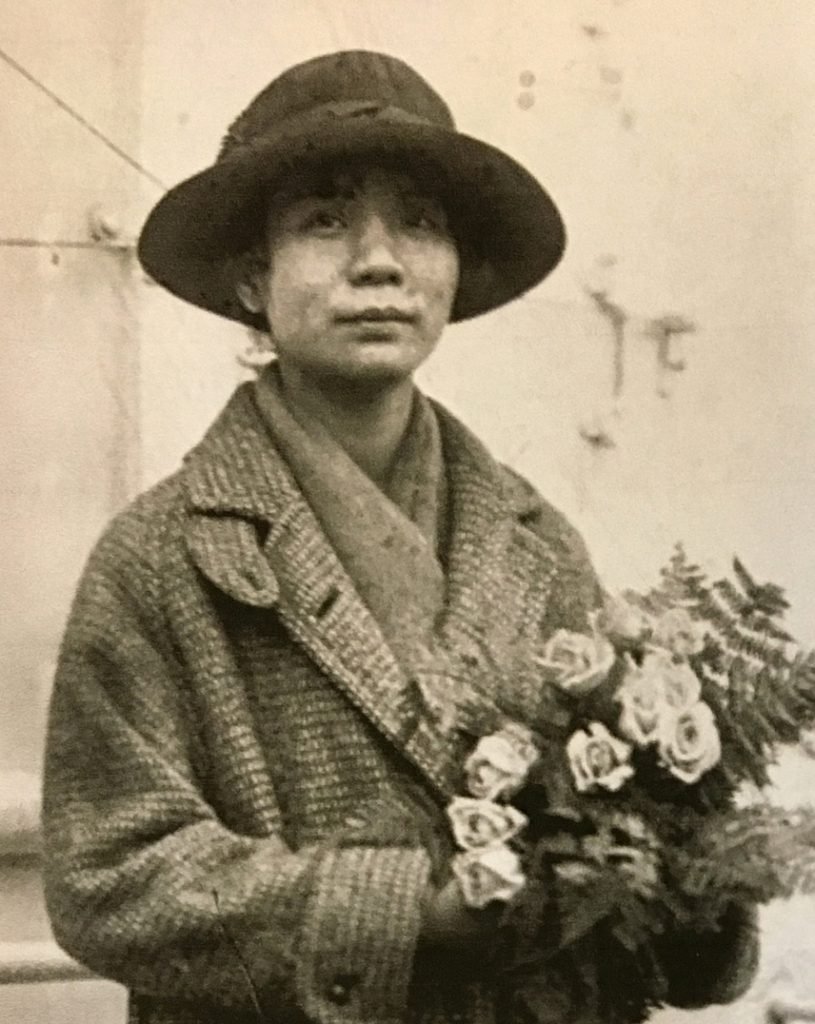
Photo: Mabel Ping-Hua Lee.
from the archives of the public library in Arlington, Virginia
On July 25th 2018, a post office in New York City’s Chinatown was named Mabel Lee Memorial Post Office. It is an honor that Mabel did not anticipate, but it was richly deserved.
Mabel Lee is not well known today, but in 1912, a New York Times article recognized her as a suffragist. It reported “Ten thousand strong, the army of those who believe in the cause of woman’s suffrage marched up Fifth Avenue at sundown yesterday in a parade the like of which New York never knew before.” On May 4th 1912, what a sight it was to see a sixteen-year-old Chinese girl on a white horse, wearing a sash with “Votes for Women” printed on it. Starting from Greenwich Village, she led a parade of 10,000 suffragists!
Mabel’s father, a missionary pastor from China, had moved to the United States when she was four years old. Living with her mother and grandmother in China, Mabel studied in a missionary school and became proficient in English. She was an excellent student and in 1905, at the age of nine, a scholarship landed her in the United States to attend school. She and her mother were reunited with her father, who was the pastor of the Baptist Chinese Mission in New York’s Chinatown. At that time, Chinatown was a new community. According to the census of 1910, there were only 5,266 people of Chinese descent in the city of New York.
Mabel’s father was active in the community and greatly influenced his daughter. Even at a young age, Mable’s Baptist faith infused in her a desire to improve the lives of women and girls. In her teenage years, she became involved in the suffragist movement, knowing full well she could not vote. The Chinese Exclusion Act of 1882 prohibited Chinese immigrants from becoming citizens. Nevertheless, she threw herself energetically into the suffragists’ cause.
Excelling in English, Latin, and mathematics, Mabel was a brilliant student in high school at the Erasmus Hall in Brooklyn. She attended Barnard College, founded for women only because the nearby Columbia University did not admit women at the time. She wrote articles about feminism and suffrage in The Chinese Students’ Monthly magazine, understanding that the poor treatment of women was holding China back and represented a kind of backwardness.
Mabel’s essay “The Meaning of Women Suffrage” promoted the importance of voting rights and equal opportunities to women. Her speech “The Submerged Half” was an urgent plea to the Chinese Community to promote girls’ education and women’s rights. From the call to the general public and specifically to the Chinese immigrant community, she was indefatigable and resourceful.
As an Asian woman, Mabel broke another barrier. In 1921, she was the first to earn a Ph.D. in Economics from the previously all male Columbia University.
Mabel was ready to return to China to start a girls’ school. That had always been her dream. In March 1923, she sailed to France to study European economics to prepare herself better. In one of her letters, Mabel said, “I do thank God for the United States which gave me wonderful development and such a keen insight into the realms of knowledge. I feel that my life must be devoted to helping my people in China.”
But that was not to be. Her father died the following November and she returned to New York to take up his work at the Baptist mission. The community and the mission depended on her. She became the director of the First Chinese Baptist Church, devoting the rest of her life to the small church and community service center. The center improved the life of the community by offering a health clinic, a kindergarten, vocational training and English classes. Undoubtedly, she influenced the growing population of children and families in New York’s Chinatown.
In 1920 the 19th amendment was passed, giving women the right to vote, but the privilege did not extend to Asian or Black women. It wasn’t until 1943 that Chinese persons were permitted to become naturalized citizens with voting rights. The Voting Rights Act of 1965 finally gave voting rights to Black women, 95 years after Black men were able to vote.
What made Mabel spend time, energy, and actions for women’s rights to vote when she herself couldn’t vote? Her religious faith and her nationalistic vision for China suffused her convictions and actions. In her speech “The Submerged Half” she noted “The welfare of China and possibly its existence as an independent nation depended on rendering tardy justice to its womankind.” Her next statement applied to the United States as well. “For no nation can ever make real and lasting progress in civilization unless its women are following close to its men if not actually abreast of them.”
Mabel died in 1966 in obscurity. It is not known whether she ever became a US citizen or if she voted in the US. In the 100th anniversary of the 19th Amendment, she and other less known pioneering suffragists are getting the recognition and celebration they deserve.
Self Discovery
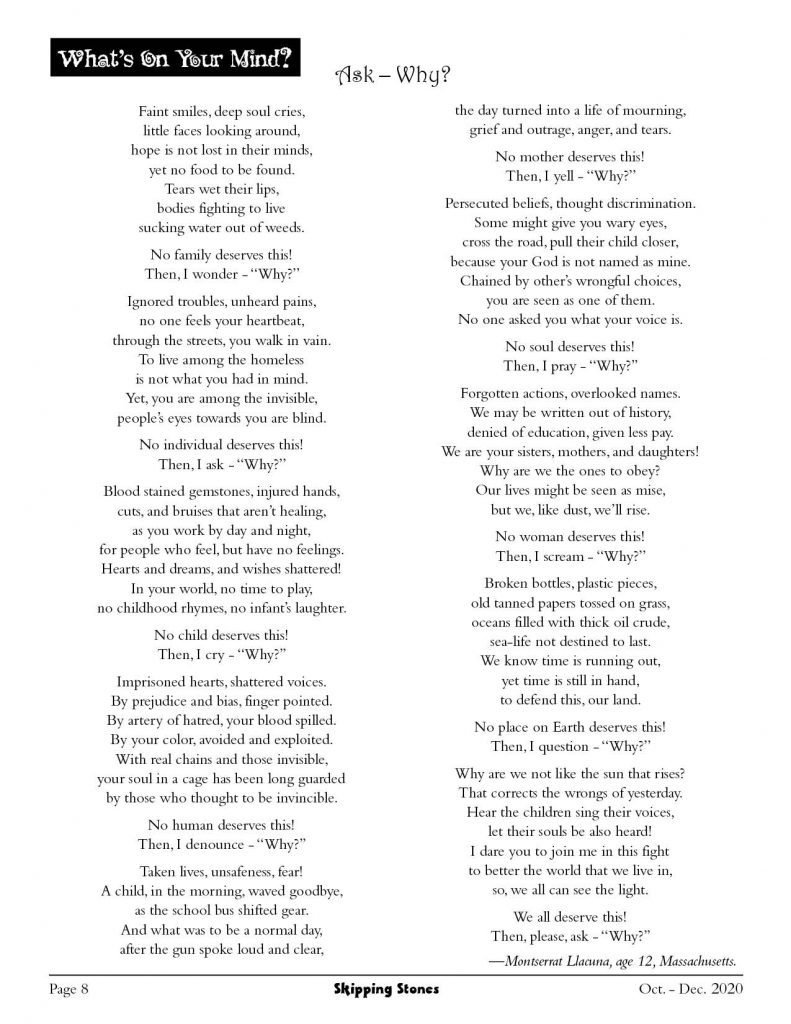
What’s On Your Mind?: Ask – Why?
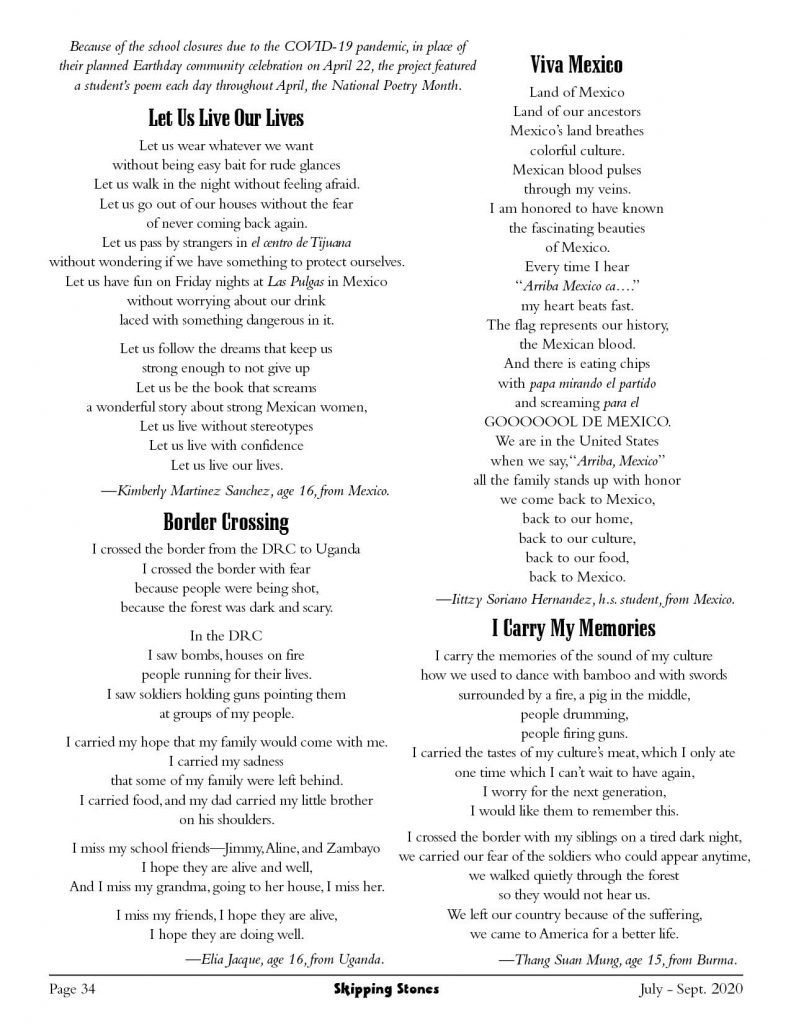
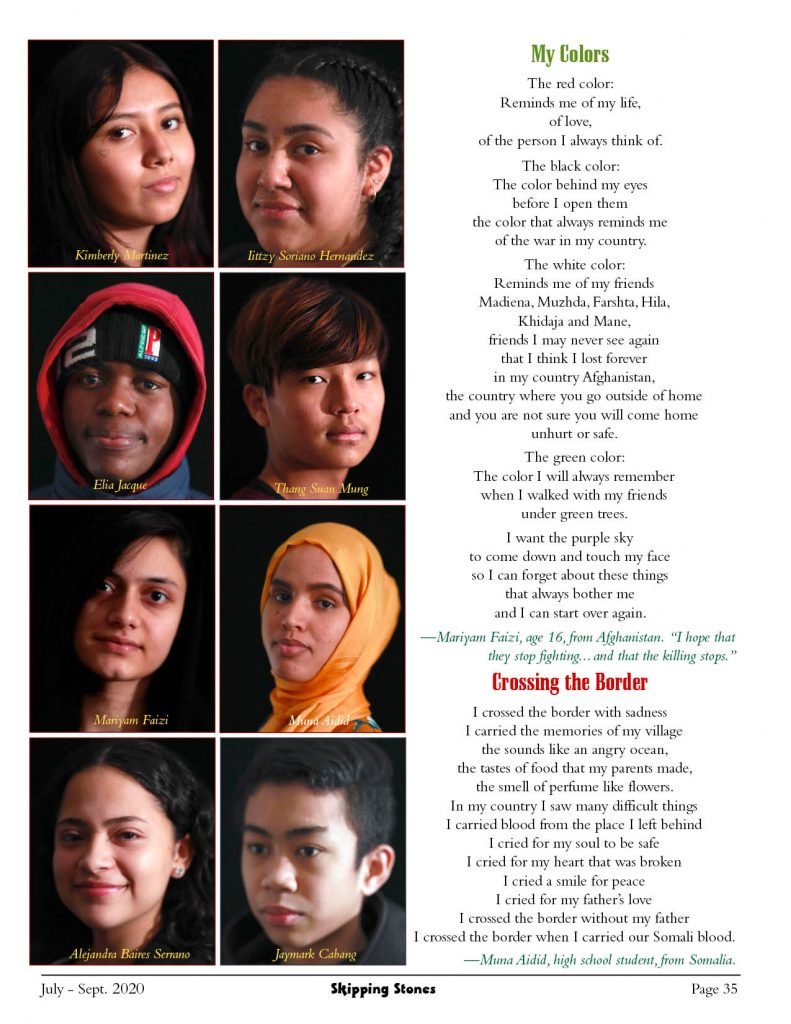
Stories of Arrivals : Refugee & Immigrant Youth Voices

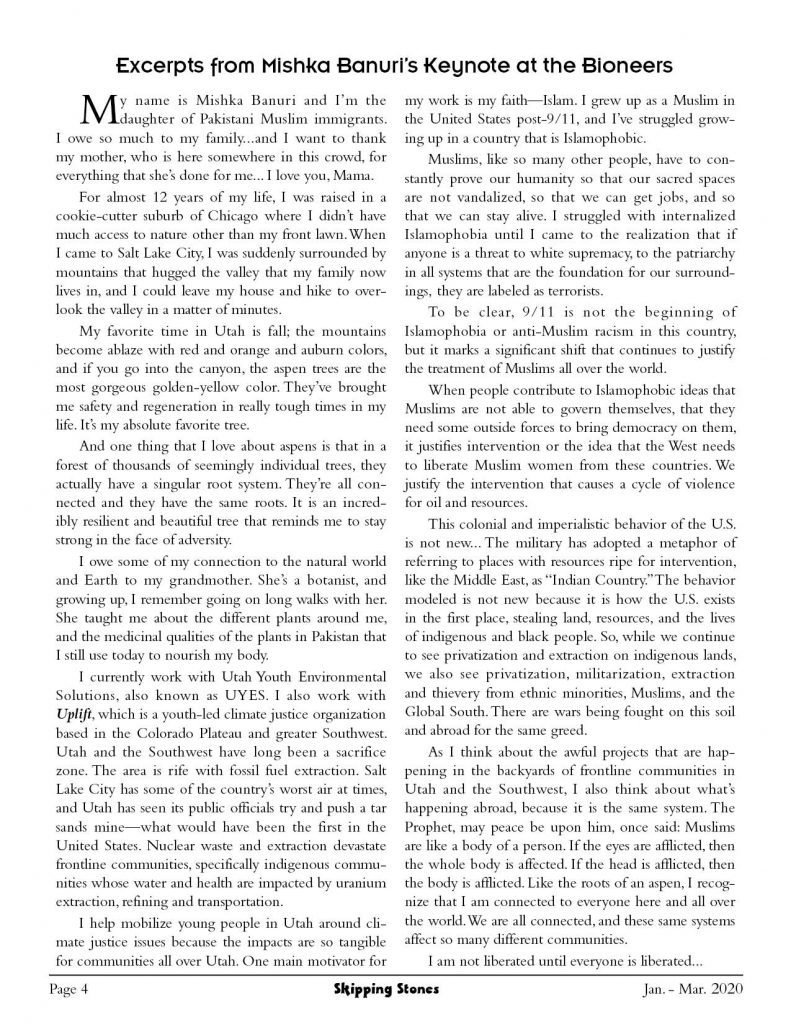
Excerpts from Mishka Banuri’s Keynote at the Bioneers
Ramón’s Lucky Toothache