Category Archives: Immigration Experience

New Year’s Resolution

New Year’s Resolution

By Vajra Vanukuri, age 11, grade 6, California.


Eleven-year-old Kristina shouted on the phone. Vera, her mother, packing lunches for her two children, heard the shouting and dashed to Kristina. Kristina gave her the phone. Kristina was talking to her father at his doctor’s office in Moscow, Russia. 

“Vlad, why is Kristina shouting?” began Vera in Russian.

“Vera, this afternoon I must attend a conference at her school. But I cannot be there. I have an important meeting.”

“How can you do this!” she asked.

“Why don’t you attend?” he replied.

“How can I go?”

“You are not going to a forest. You’ll be fine!”

“I know, but I can’t speak English properly. It’s an ironclad rule at her school.”

“You can manage. GO!”

She turned to Kristina, “Kristina, your father is busy. I will come instead of him.”

Kristina shouted, “Mother, you can’t speak English. How can you come to the conference? NO!” She plowed through her mother and ran sobbing. But Vera convinced Kristina. As there was no option, she agreed and left for school. 

Vera was depressed. She felt that if only she knew English, she could avoid such situations. But how is it possible for me to learn English while balancing so many tasks? Suddenly, she realized that Andrei was getting late, so she got him ready and walked him to school.

In the afternoon, Vera attended the conference at the school. All the teachers and staff were cordial to Vera. Kristina kept shushing her mother. All she said were phrases like, “You are embarrassing!”, “Stop talking!”, and “You do not know English!” Ignoring her daughter’s comments, Vera managed to keep her cool and finished the meeting. 

After delivering a cake to a customer Vera went home to start dinner. At home, she asked her mother-in-law where Kristina was. She said that Kristina had gone to study with her friends. While they were talking, Kristina walked in. 

Vera asked, “Why did you go out? You can study at home, you know!”

“I have doubts about English Literature. Can YOU clarify them?” Kristina said with an arrogant tone.

Vera went to the kitchen as she sobbed quietly. Everyone thinks that kids are innocent. Is this the definition of innocence—hurting parents with an inconsiderate tone?

At dinner, Vera explained Kristina’s deplorable behavior to Vlad. But he chuckled and said, “Well, if you knew English, Kristina would not have to suffer like this.” Then he added, “This food is delicious. At least you are good at something!”

That night, Vera was tossing and turning as she thought about her hurt feelings. Like father, like daughter. If my husband won’t respect me, then how can my children respect me? I must learn English. But how is it possible with all my responsibilities? 

*  *  *

As the months went, Vera’s nephew in London was engaged. One day, she got a call from her sister in England. Her sister pleaded Vera to come and help her with the wedding arrangements. 

Vera said, “Margarita, I’d love to come, but you know that I am balancing a tight schedule.” But as Margarita requested over and over again, Vera agreed. 

When Vera asked Vlad if they could go, Vlad said, “I could get a week off. I can come with the kids for the marriage. You could go now and help your sister.” 

Vera worried, but Vlad said that his mom would take care of the kids.

To get to London alone was a challenge for Vera. Finally, she arrived at her sister’s home. Margarita greeted her with a warm welcome. After two days, it was New Year’s Eve. Margarita hosted a party for the bride’s family. It was really boring for Vera because she could not understand their English conversation. Then, the topic about New Year’s Resolutions came. Vera heard the words but didn’t know what to say. So, she kept quiet. 
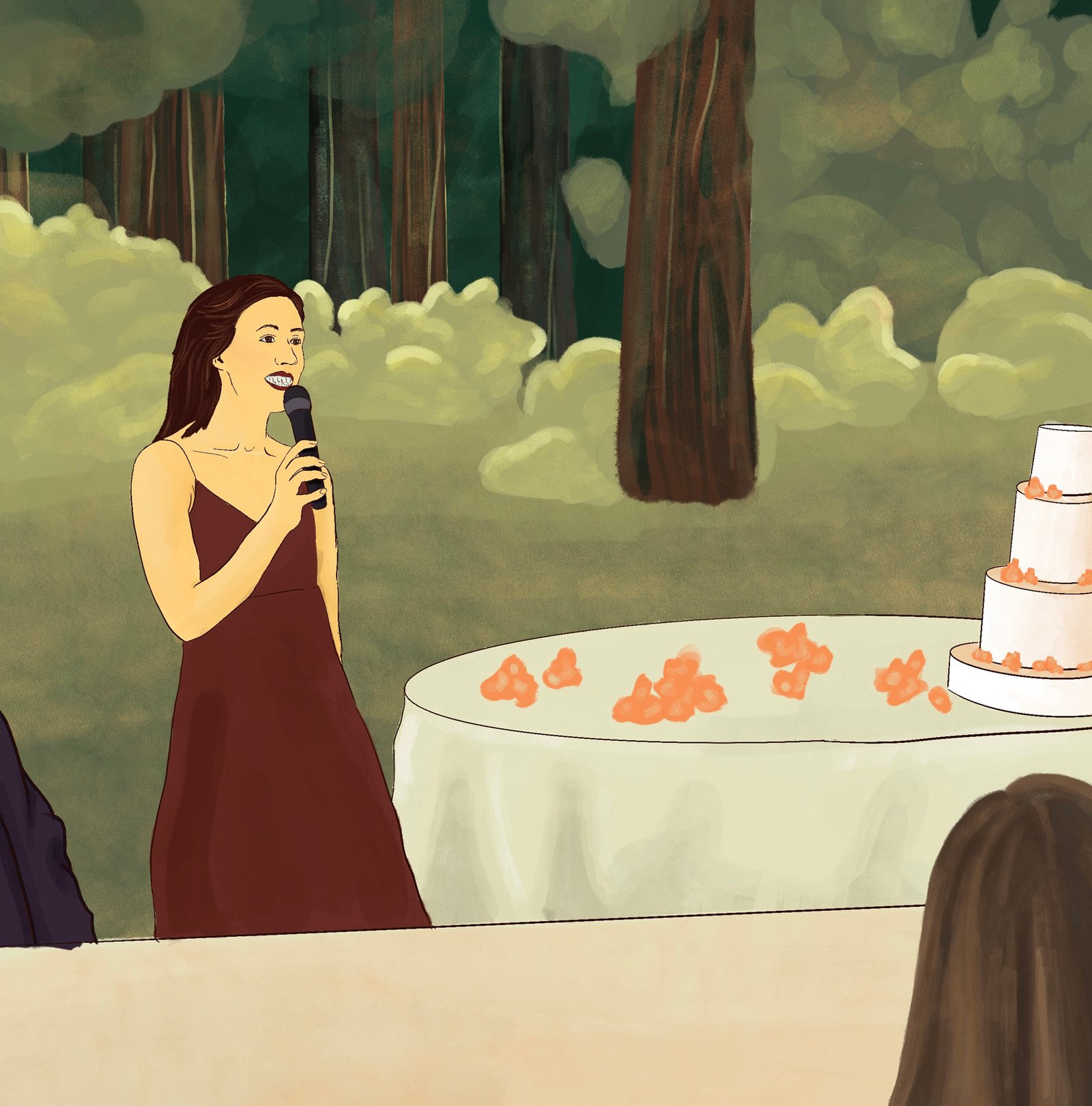


Illustration by Katherine Han, age 18, high school senior, Texas.
That night, she was thinking: Why can’t I make a resolution? What should it be? Then, an idea struck her head. I will learn English. All night, she tried to figure out how to learn English. 

The next day, she saw an advert from LCC, The London Language Center, on the TV. They offered English classes to newcomers. 

After her sister left, Vera called their number and gathered all the information. In the afternoon, when she went to the LLC, the receptionist said,

“The class is a four-week course; it starts in ten minutes. If you want, you can join it.” Vera paid the fee and sat in the class.

Vera didn’t tell anyone about this. Every day, she managed to attend the class when the family was away. She followed every single detail. While commuting, she’d read anything in English. She tried to communicate with her classmates in English. The instructor was impressed and encouraged her immensely. 

Sometimes, Vera shared her food with her classmates. They loved her cooking and appreciated her. One day, she told them of her small cooking business. The instructor said that she was an entrepreneur. Everyone clapped and cheered for Vera, and praised her. That made her very happy.

One day, Margarita’s daughter, Victoria, was coming back from college and saw Vera on the street. She asked her of her whereabouts. Vera explained the whole story and requested Victoria to keep it a secret. Victoria promised Vera that she’d help fulfill her New Year’s resolution. Vera received English movies from Victoria and watched them in free time. She used every single opportunity she could to immerse herself. 

Vera was extremely busy and tired with all the wedding preparations and her English classes. As the wedding approached, Vlad and the children came to England. Vera was happy to see her children but worried about attending her classes. Victoria noticed her stress and asked, “Why are you looking so worried?”

“How can I attend the classes when everyone is home?”

“How many days are left?”

“Three days!”

“Don’t worry. I’ll see what I can do to help.” 

The next day, Victoria went to LLC and arranged video classes for Vera. For the next two days, Vera attended her class in the bathroom! But the final test was on the actual wedding day. The test was a five-minute speech in English. If they did well, the students would receive a certificate of graduation. 

Vera decided she not to attend the test. At night, Victoria noticed her sadness. “What’s wrong?” asked Victoria.

“I can’t attend the test because of the wedding. This is the end of the line for me,” said Vera. 

That night, Victoria thought of an idea. Next morning, she called LLC and talked to the instructor. 

Everyone was running around with joy as they busily rushed to prepare for the big gathering. Depressed, Vera also got ready. As the wedding ceremony began, she saw her teacher and classmates in the hall.

During the dinner, it was time for family members to make toasts to the bride and the groom. After Margarita, Victoria encouraged Vera to say something. Everyone started encouraging her. Before she could speak, Vlad intervened, “My wife does not know English…” 

But Vera interrupted him, “Vlad, may I speak?” And before he could respond, she stood and started:

Meera … Kevin … Marriage is a beautiful thing. It is a special friendship between two people who are equal. Sometimes, couples don’t know how the other one feels. Family can never be judgmental. Family should never put you down, should never make you feel small. Family is the only one who will never laugh at your weaknesses. Family is the place where you will always get care and friendship. Meera and Kevin, I wish you all the best. Thank you.” 

After the speech, everyone gave a round of applause except Kristina and Vlad. They both felt shameful for having belittled Vera. 

The instructor stood and said, “Vera, you passed and have graduated from the four-week English course of LLC. Excellent job!”

“How is it possible?” Vera asked.

“Victoria convinced me to grade you here. It is a surprise for you,” the instructor said.

“Thank you, Victoria, for helping me fulfill my Resolution,” said Vera.

“I know you worked very hard for this. You are great!” said Victoria.

Kristina and Vlad went to Vera and apologized. Vera was so happy she had fulfilled her New Year’s Resolution. 

The family went back home to Moscow after a few days. Vera now feels, With determination, anything is possible.” 

—Vajra Vanukuri, age 11, grade 6, California. He adds: “I enjoy reading and I have a passion for writing stories. I like playing Soccer. I also practice Yoga, and Taekwondo, currently in the green belt. I aspire to be an environment and human rights lawyer when I grow up.

Illustration by Katherine Han, age 18, high school senior, Texas.
Celebrate America Creative Writing Contest

Celebrate America Creative Writing Contest

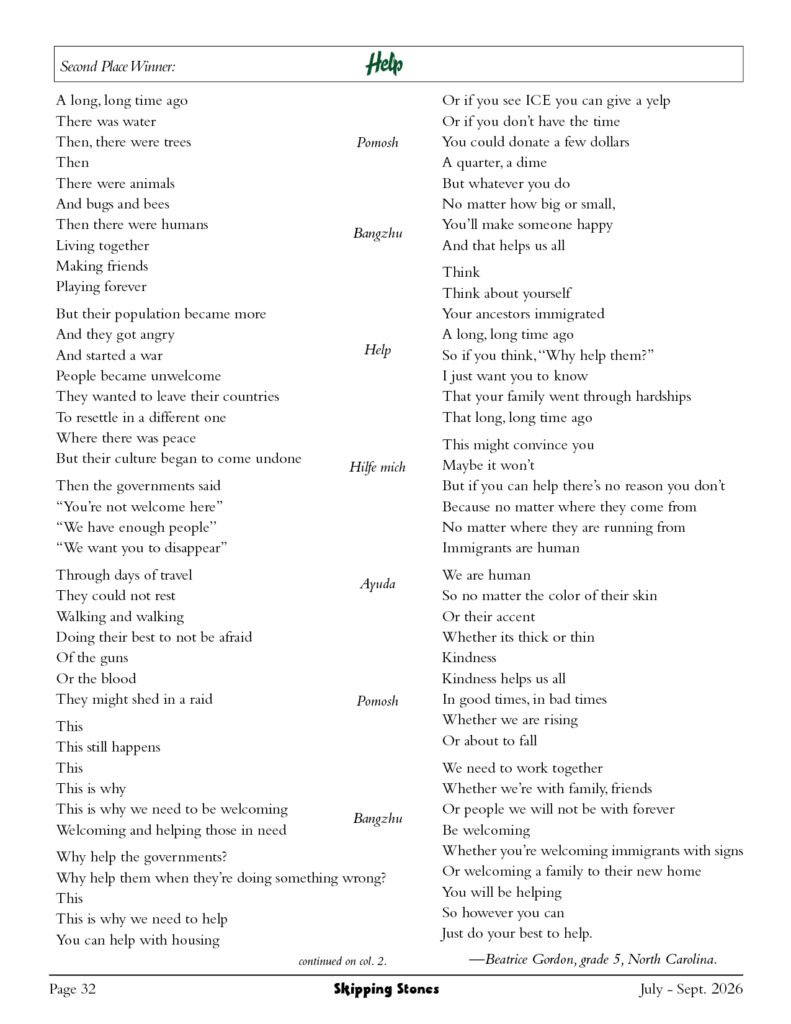
The Celebrate America Creative Writing Contest winners for 2026 have just been announced. The winning entries will be also published in our next Issue (to be available in July). The award winners will be recognized at the Immigration Impact Awards ceremony in San Diego, California being organized by the American Immigration Council (AIC) and American Immigration Lawyers Association (AILA) on June 19th evening. We are pleased to share with you the three winning entries below. (You can also download the file by clicking here):


Celebrate America Creative Writing Contest

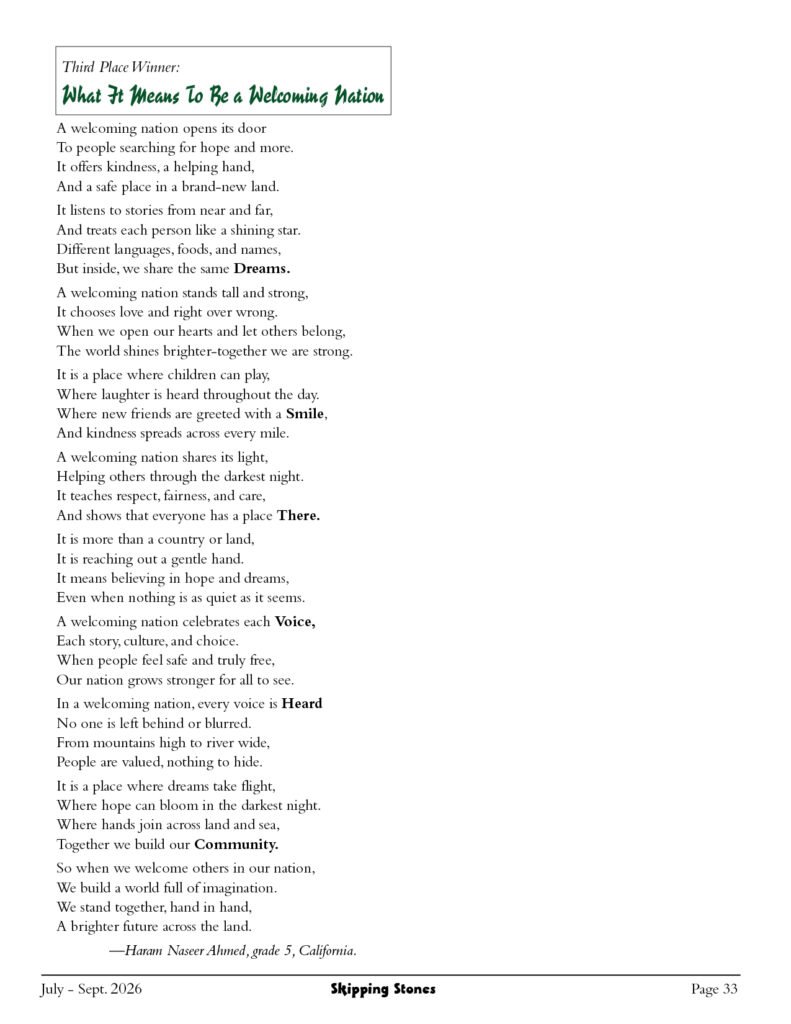
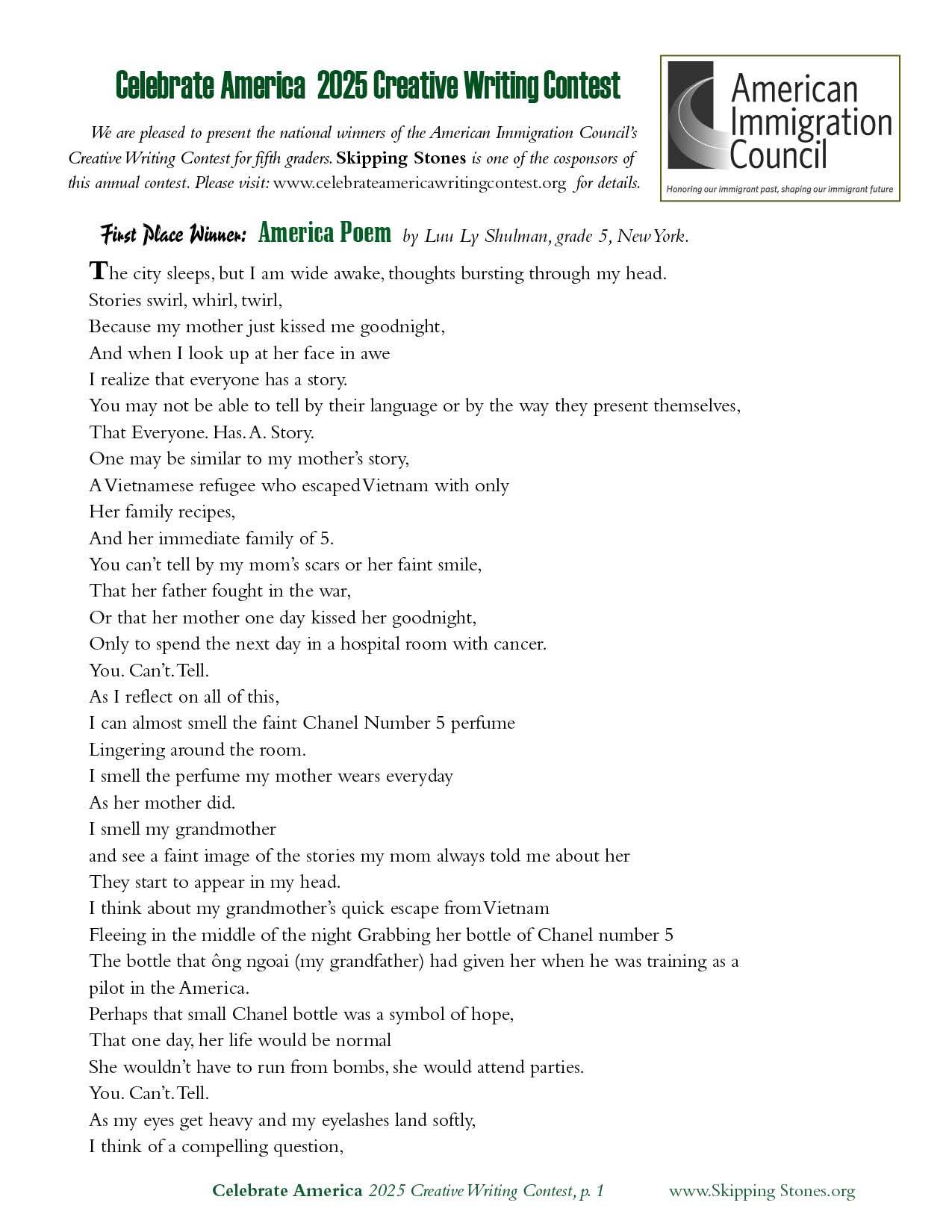
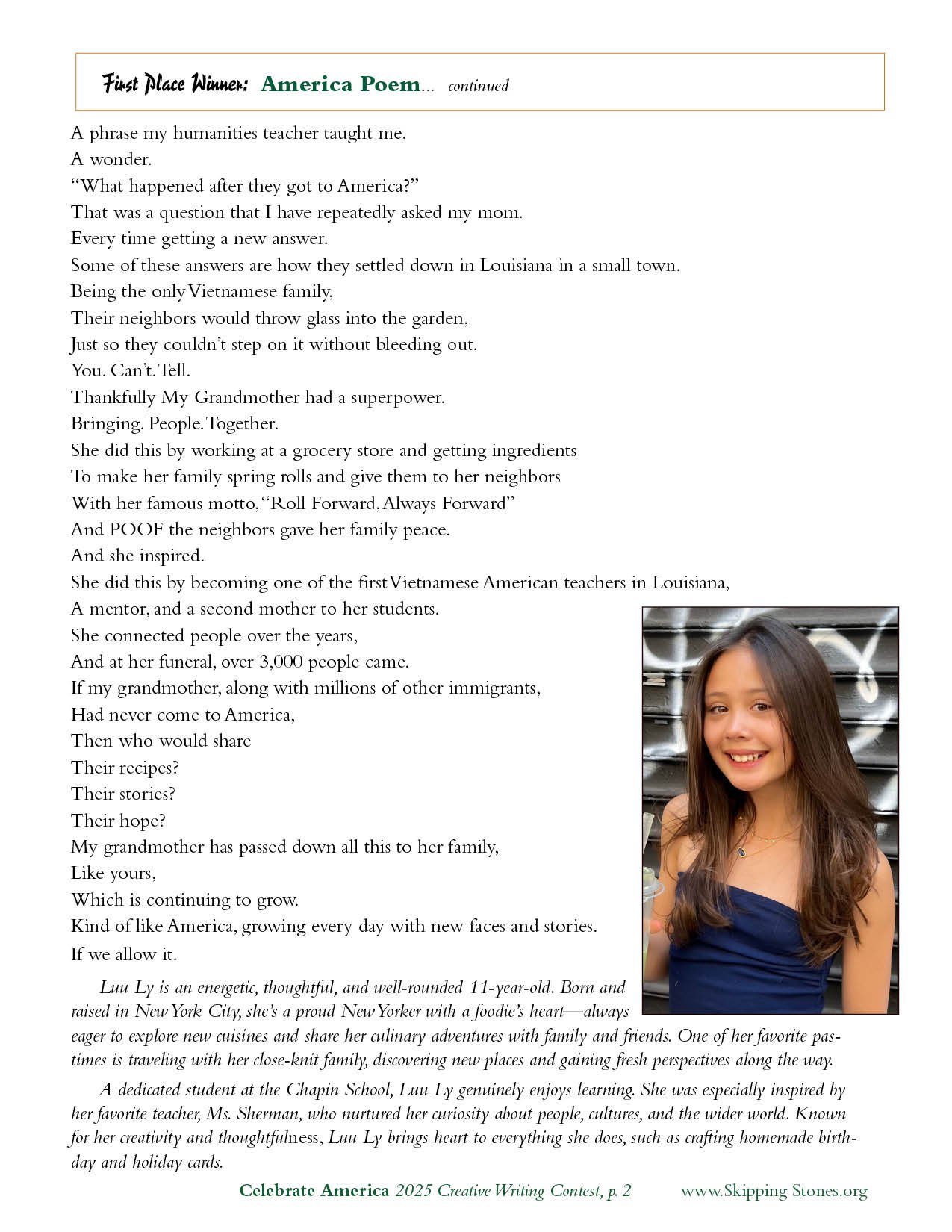
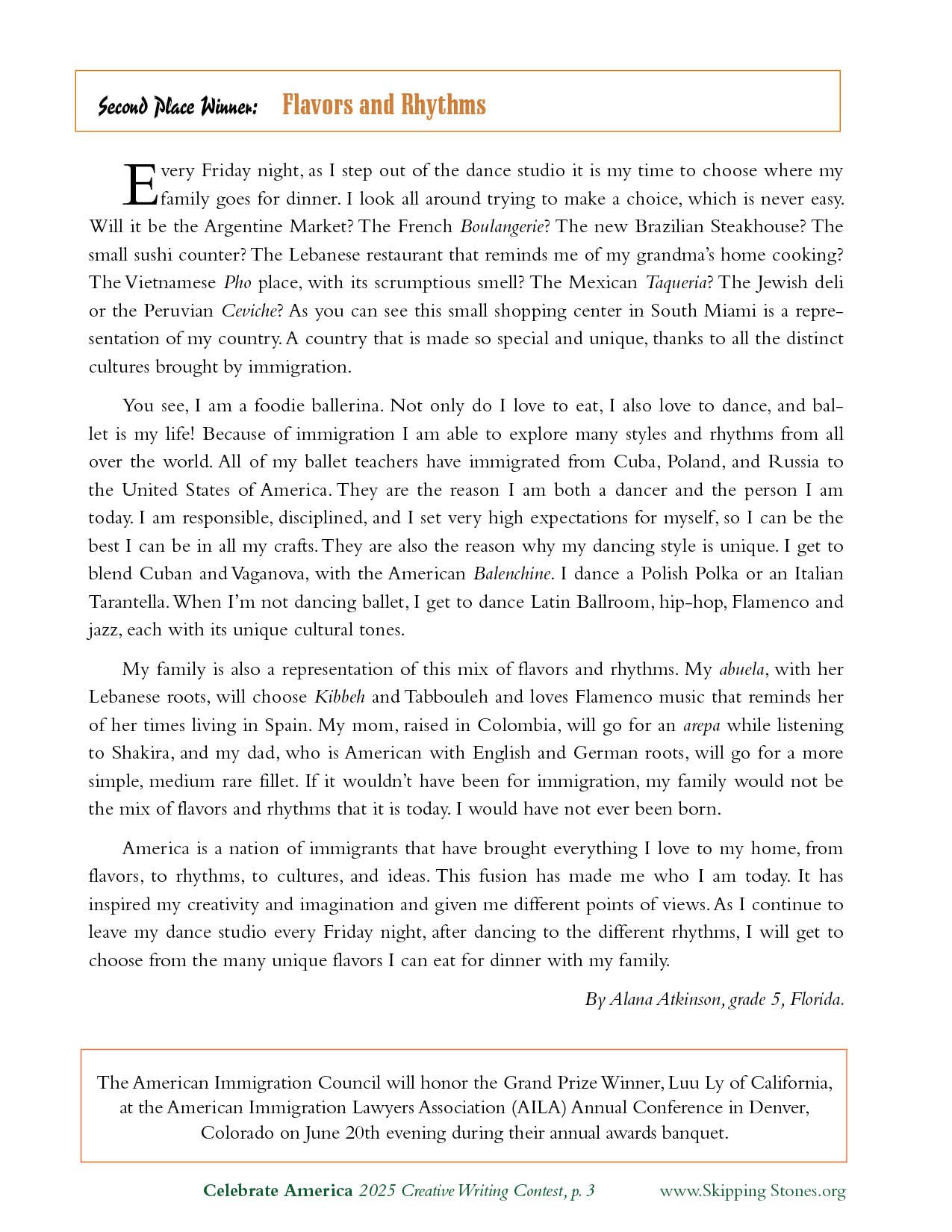
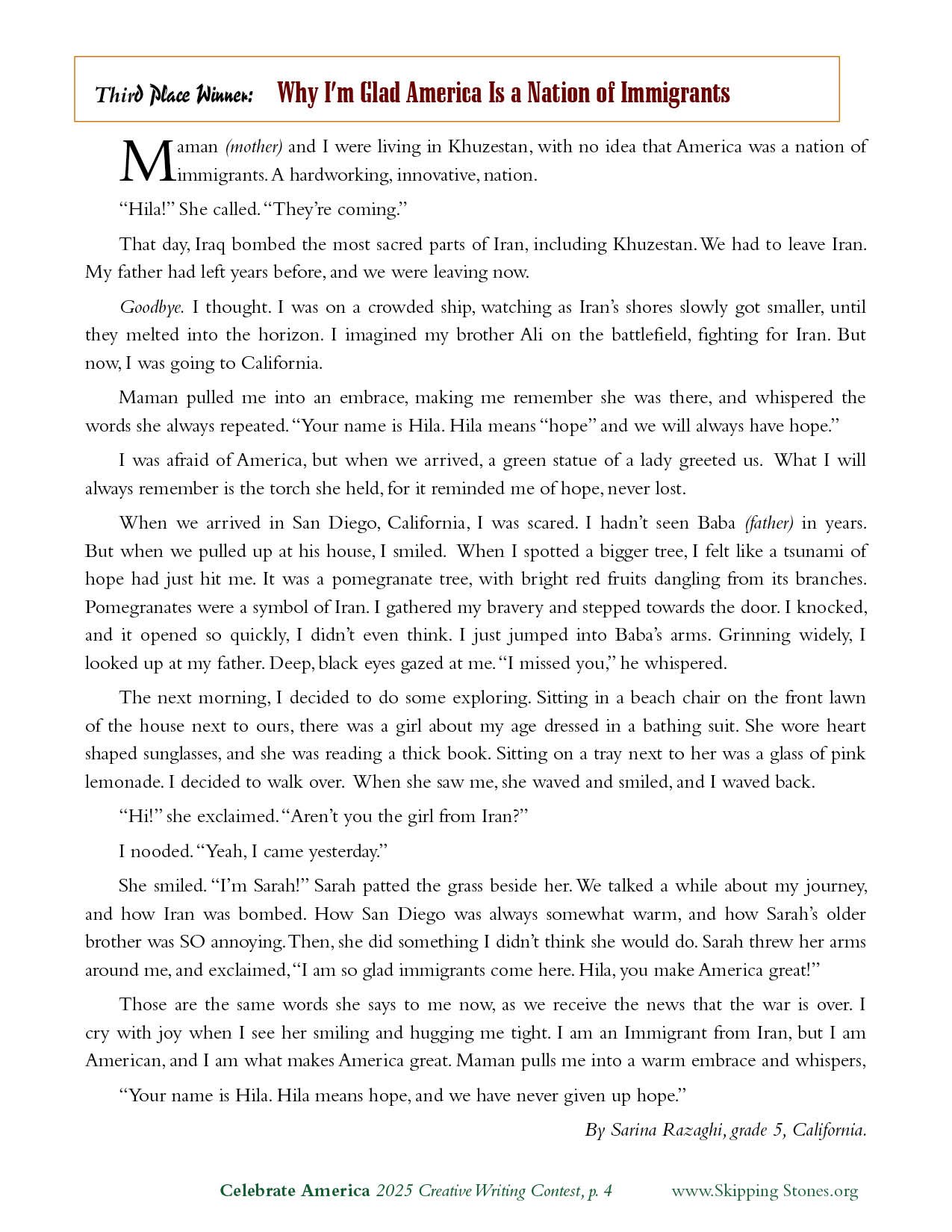
The Celebrate America Creative Writing Contest winners for 2025 have just been announced. The winning entries will be also published in our Awards Issue (to be available in late August). The award winners will be recognized at the Immigration Impact Awards ceremony in Denver, Colorado being organized by the American Immigration Council (AIC) and American Immigration Lawyers Association (AILA) on June 20th evening. We are pleased to share with you the three winning entries below. (You can also download the file by clicking here):

The 2024 Winners were announced on June 14th, 2024. They are:
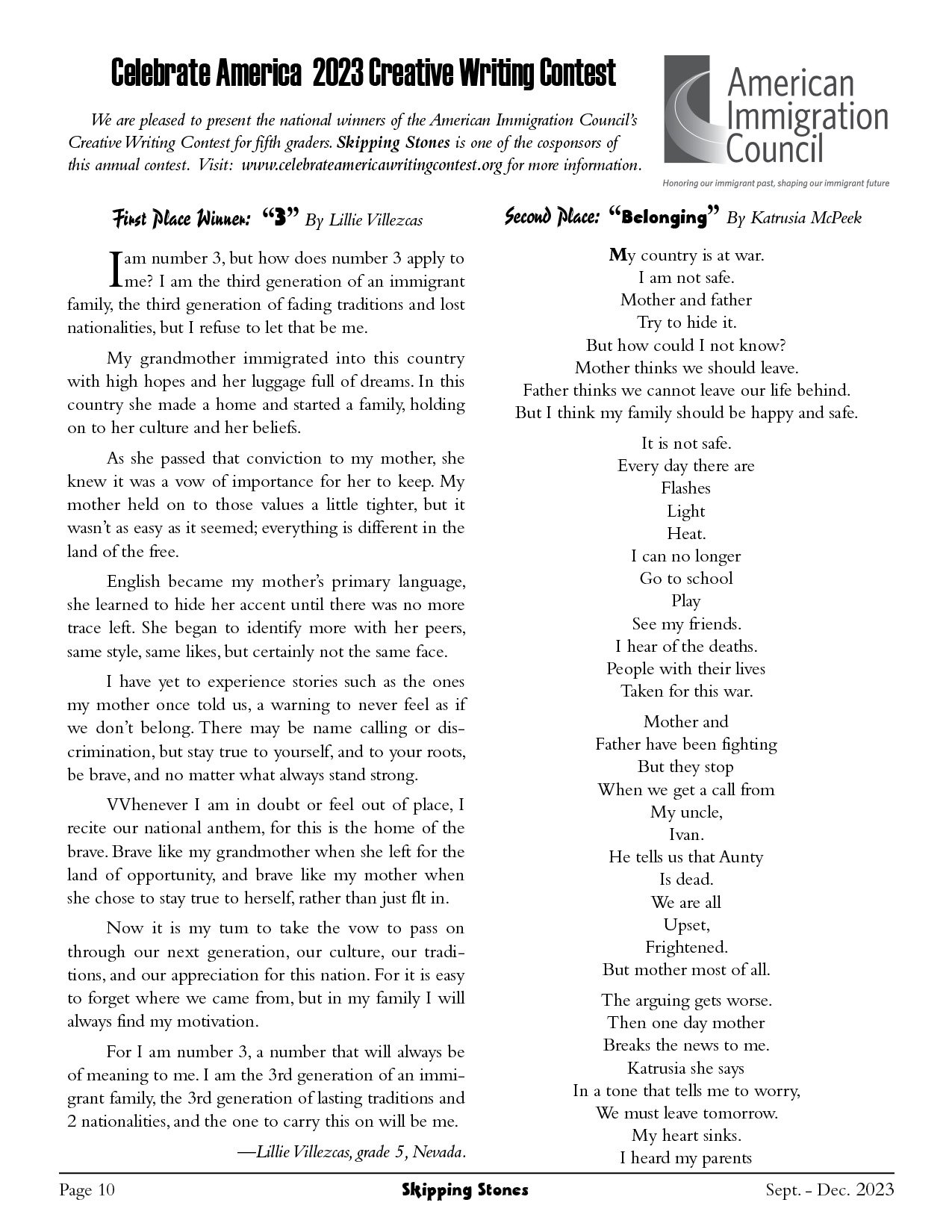
First Place Winner:  Stories of Us

I sit
By the windowsill
Gazing outside.
Down, on the street, so many heads,
Each is unique.
Amidst the traffic and frantic honking,
I sense the presence of
Millions of others,
Just like me.

I contemplate
The journeys. Each of us—All of us have a story.
When mothers and fathers
Ventured far across the world,
Their sense of adventure leads
Them in search of a new life.

Then I think
About all the diverse people,
And a myriad of languages,
Some foreign to one, but familiar to another.
When I open my window,
I hear those languages harmonizing,
Merging together to form a chorus.

But not just any choir.
The symphony of every single person’s story,
A song where every note counts.
I think about the stories
That father would tell me.
About my father’s mother and
His migratory voyage.

My father’s trip to America,
With only 300 dollars in his suitcase,
And a brain.
I ponder about each and every one
of the people in my neighborhood
And I wonder
Why Father would be willing
To relinquish everything
To speak in a foreign tongue.

I think about his pride
In having dual nationalities.
About being able to keep his
traditions close to heart,
and embracing a new part of himself.
American.

Then my thoughts drift to school.
All of the different students,
Each of us with our own stories.
The accounts of our ancestors,
And all that they sacrificed.
For us.
For each and every one of us,
To be here.

At this moment.
Right now.
To be present,
Someone had to work hard.

Someone had to shed tears of exhaustion,
Leaving behind familiar joy and wonder,
Leaving behind family and friends,
To create new memories and stories
In one country,
Forming one grand story.
But this story
Isn’t just any story.
It is the story of us.
The U. S.
The story of the United States of America.

—Angela Du, grade 5, New York.

Second Place:  Sugar and Milk

I wake up to the sounds of unfamiliar voices in different languages. I raise the blinds and look out the window. I see people wearing bright clothes and intricate patterns. They stand out against the dull brick apartment building, like fall leaves against a gray sky. My mom comes in and abruptly says, “Don’t bother with them. We were here first.” I sit silently on my bed pondering about what she said.

Weeks pass. Curious, I go over to their apartment building and find a girl watering a tomato plant. I shyly say, “Hi. I’m from the apartment across the street. My name is Sula.” She quietly responds, “My name is Aminah.” She reaches towards the tomato plant and offers a tomato. I smile and put it in my pocket. Aminah waves goodbye and runs inside.
I run back home to give the tomato to my mom. She says, “Thank you,” and takes a bite. “This is the best tomato I’ve ever had. Where did you get this?” I hesitated a bit, then I said, “From Aminah.” “Who is Aminah?” She asks. Anxiously I say, “The new kid from across the street.” Before my Mom can say anything, I run upstairs.

Aminah and I start playing together over the summer. I think Mom is still unsure of Aminah and her family.

Tonight I wake up to loud sounds. I am scared. Mom comes running into my room and we run to the basement. The next morning, my mom says that there is a war going on and the safest place for us is right across the border in our neighboring country. We pack our clothes and hurry into a truck packed full of people. As we settle down, I see Aminah and her family in the corner. After a long and tough ride, we end up in a camp full of tents.

Mom and I are going from place to place in search of food and a job. A week later Mom finds a job at a small bakery owned by a family. The job doesn’t pay a lot, but enough to get food for both of us. Later that month, the family invites us for dinner at their house. It is a small house with two rooms and seven kids. I am eager to have a proper meal. My Mom thanks them for sharing the food they have, especially when we come from a different country. Then the host shares a Parsi legend that she had heard from her elders. She begins,

“In the seventh century, when Parsis emigrated to India, they were brought before local ruler, Rana, who presented them with a vessel “brimful” of milk to signify that the surrounding lands could not possibly accommodate any more people. The Parsi head responded by slipping some sugar into the milk to signify how the strangers would enrich the local community and dissolve into life like sugar dissolves in the milk, sweetening the society but not unsettling it.”
Mom bursts into tears.

—Ananya Siddabathuni, grade 5, Minnesota.

Third Place:  I See America

Through crashing waves and rocking ships,
I carry big wishes and high hopes for this new nation.
I see America, welcoming me with arms wide open,
Filling me with faith and showing me appreciation.

Leaving the green, white, and saffron flag waving in the breeze,
The concrete roof that once was over my head.
Still holding onto my traditions and beliefs,
While adapting to a different culture instead.

I am welcomed by classmates,
Welcomed by neighbors and teachers.
I soon feel connected with my community,
Regardless of my different nationality and different facial features.

When I get pushed down from inequity,
I get back up and stand strong.
I see America as a place of opportunity,
A place of liberty, and a place where nobody’s background
is wrong.

I will carry on our vows, generation to generation,
Longing for our customs to carry on, and never fade.
I hope that the new ages to come will learn that our heritage is something to be proud of,
And realize the righteous impact on America that
we immigrants have made.

For I am an immigrant from over the seas,
Proud of my heritage and values, I hold near and dear.
I am holder of two nationalities, first generation to see America,
And I hope to spread the joy of our culture here.

 —Caroline Keslinke, grade 5, Illinois.

The 2025 Creative Writing Contest
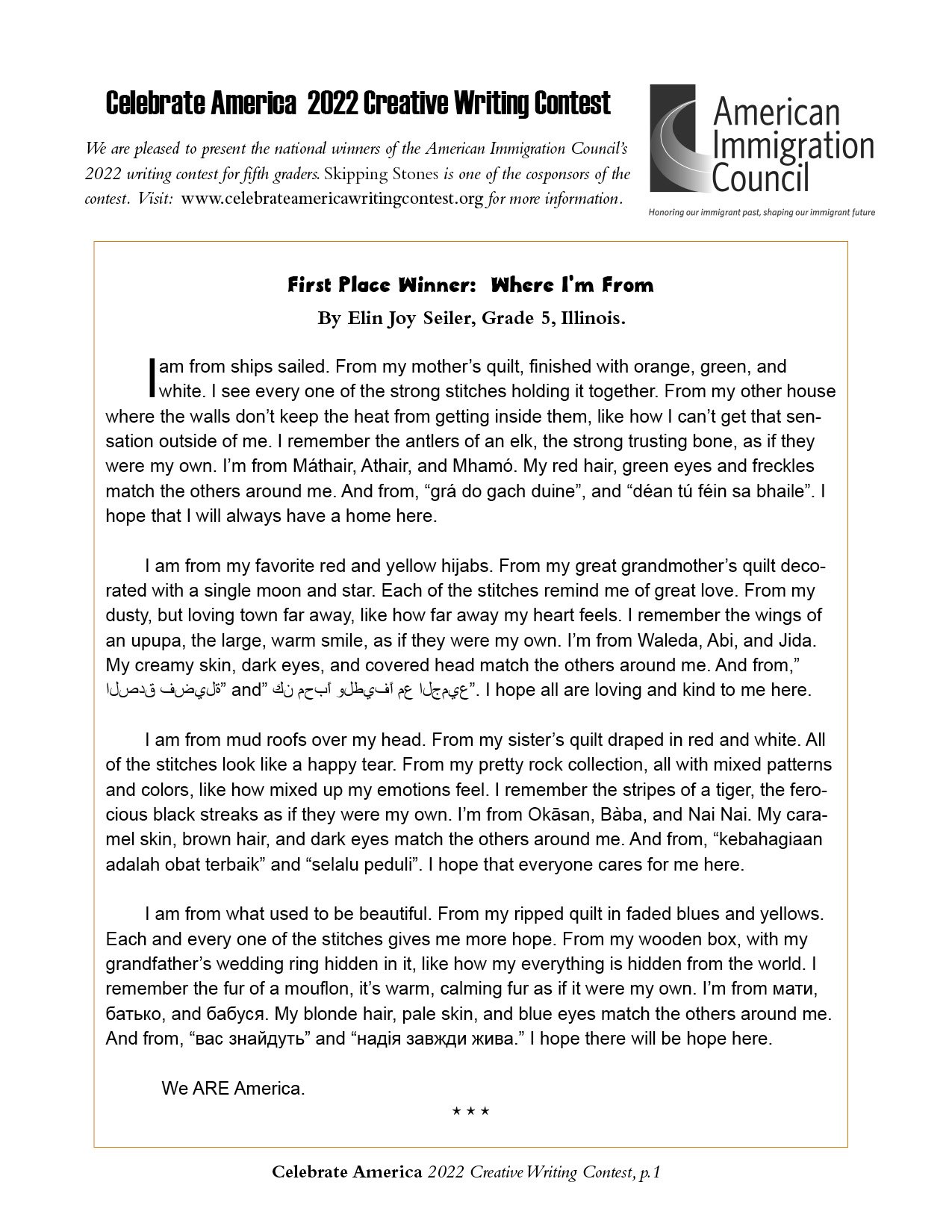
The American Immigration Lawyers Association holds this annual contest to challenge fifth graders across the country to reflect on and write about one of two themes: “Why I Am Glad America Is a Nation of Immigrants” or “What Does it Mean to be a Welcoming Nation?” Visit: www.celebrateamericawritingcontest.org


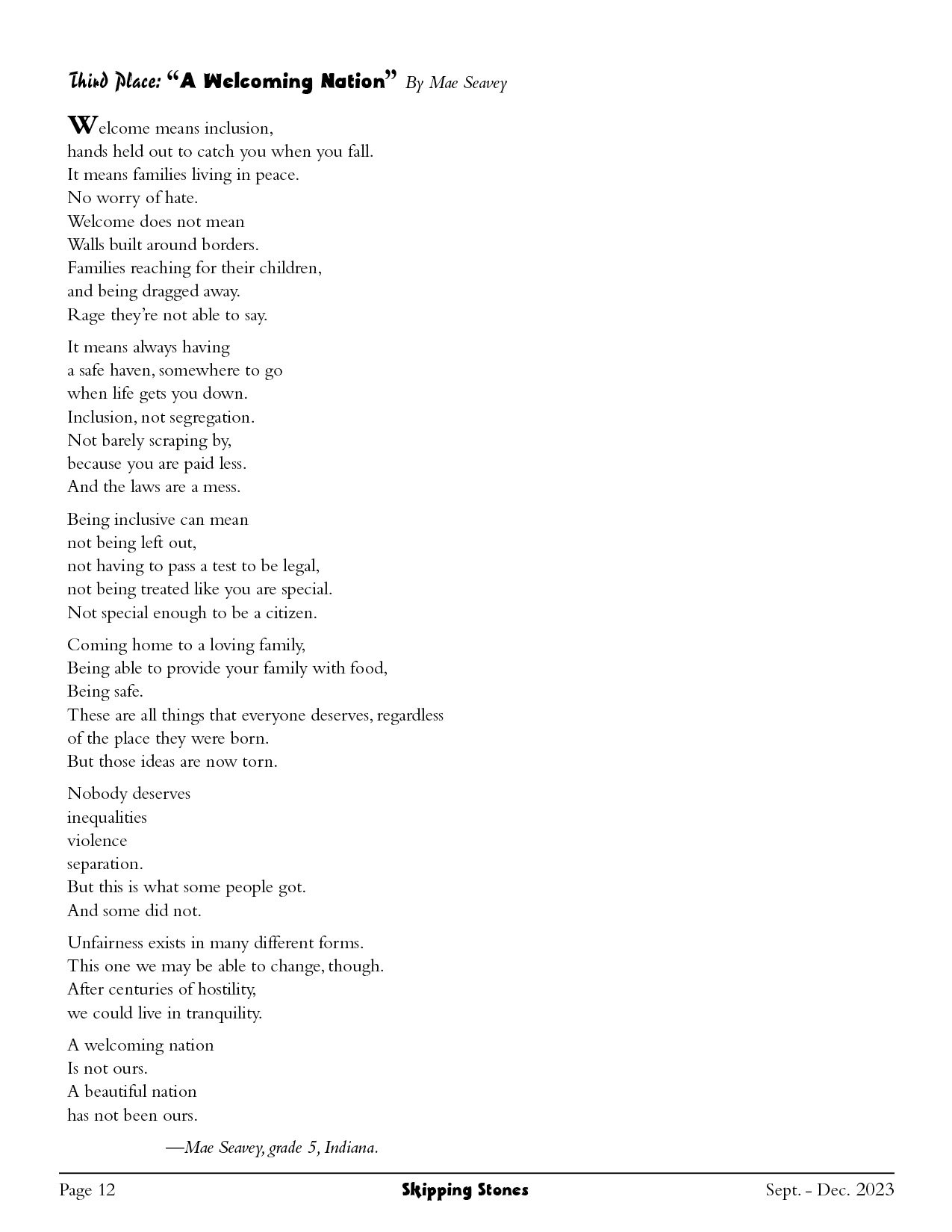
The Celebrate America Creative Writing Contest winners for 2023 were announced last week. They will be also published in our Awards Issue. You can download the three winning entries here.


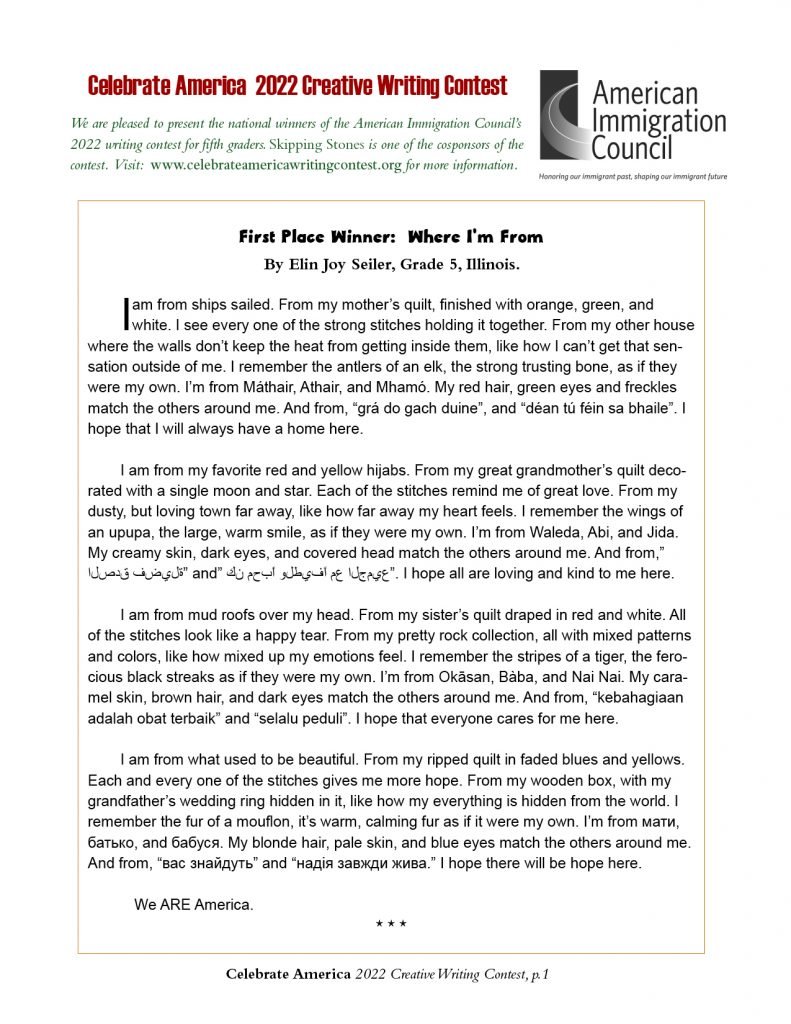
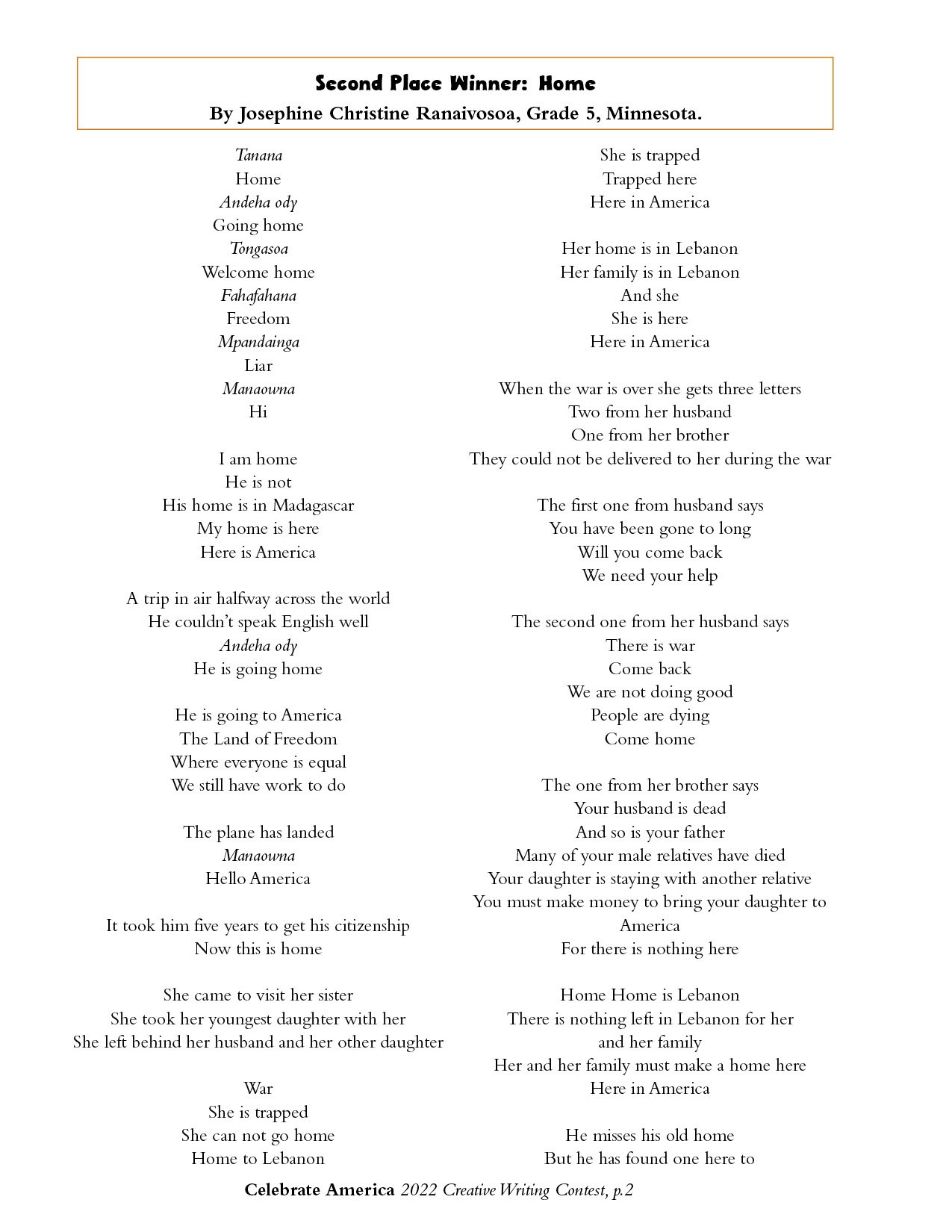
The Celebrate America Creative Writing Contest winners for 2022 have been published in our Awards Issue. You can download the winning entries here.

The Internment of Japanese Americans During WWII

The Internment of Japanese Americans During WWII

By Fanny Wong, Chinese American author, New York.

The United States is a nation of immigrants. Japanese immigrants started to arrive on the Hawaiian Islands in the 1860s to work in the sugarcane fields. Later, many moved to the West Coast of the U.S. mainland to work as farmers and fishermen. By 1911, over 400,000 Japanese men and women had immigrated to the U.S. 

At the beginning of the 20th century, the Japanese were portrayed as the enemy of the American worker, just as Chinese immigrants were decades before. The Japanese farmers were the envy of white farmers who did not use as many labor-intensive methods and were less productive.

On December 7, 1941, the Japanese planes attacked Pearl Harbor. Navy ships were destroyed and many American servicemen died. On the West Coast, the government immediately began rounding up Japanese newspaper editors, community leaders and labor organizers. Their families were not told the reason or where the men were taken.  

The entire Japanese American population within 100 miles of the West Coast and Hawaii was considered dangerous, possibly spying for Japan. An 8 p.m. curfew and a five-mile travel limit were imposed on all persons of Japanese origin. On February 19, 1942, President Franklin Roosevelt signed Executive Order 9066, sending the Japanese and Japanese Americans to ten hastily built internment camps in Arizona, Arkansas, California, Colorado, Idaho, Texas, Utah, and Wyoming.   

The Japanese were shocked beyond belief. Two-thirds of the 120,000 internees were American citizens, born in the U.S. They were forced to sell or abandon most of their possessions, houses, cars, boats and land. Their possessions, including precious farmland, were sold at a bargain to white farmers. They had only a few days to pack and could bring only what they could carry. 

The camps were located where the weather was very hot in the summer and cold in the winter. The barracks were shoddily built, covered with tarpaper on the outside. Only canvas cots, a light bulb and a potbelly stove for winter warmth were supplied. Each family had to build its own plain furniture such as a table, chairs and shelves. There was no insulation. Dust and wind blew in through the cracks of wood that had not aged properly and shrank. Four families in small rooms shared one barrack. Within each room, blankets and sheets could be hung to provide some privacy. 

There was no way to escape these prisons. Barbed wires surrounded the camps. Armed guards surveyed from watchtowers. Life was regimented.There were lines for meals, the shower, the toilets and the laundry in communal buildings.  

In the beginning years, the food was American, such as hot dogs, stew, potatoes, liver and cow tongue, which the Japanese were not used to. Later, they grew their vegetables and even made tofu, soy sauce and noodles. Rice was added to the menu. The government spent only thirty cents a day per person on food.  

The internees were put to work with very low wages, from $8 to $19 a month. The camps needed cooks, office and field workers, food servers and construction workers. But many were bored. To relieve boredom, the internees organized outdoor sports for adults and youngsters. Baseball was a favorite pastime for spectators as well. Primitive baseball fields were leveled, rocks and stones removed. There were a variety of other activities, including movies, talent shows and holiday celebrations. 

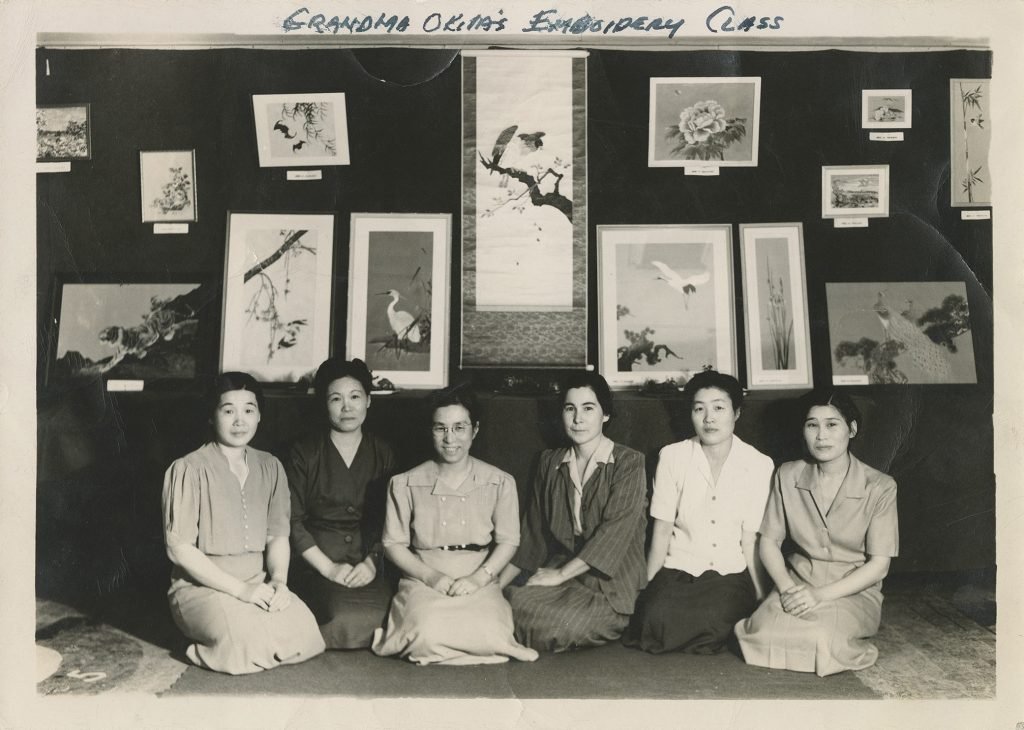
Grandma Okita’s Embroidery Class, Minidoka Concentration Camp. Photo: Courtesy of Japanese American Museum of Oregon, Portland, Oregon. Permission from JAMO required for further reproduction.

The internees were stoic about the experience, often repeating “Shikata ga nai” meaning you can’t change it. They tried to make their lives as pleasant as possible. They ordered fabric from catalogs to make curtains and tablecloths. Paper flowers decorated the rooms. They created tiny gardens in front of the barracks and even small ponds to make their bleak surroundings acceptable. They created handicrafts from dead trees, wood and material found around the camps. Painters, both professional and amateur, recorded the daily activities of the camp in their artwork. Art lifted the spirits of the internees. Their acts of beautifying their surroundings were something the government and the prison guards could not take away from them.  

Some 17,000 children under the age of ten were among the internees and more were born in the camps. Schools were organized for the children from kindergarten to high school. Used textbooks were sent from nearby schools. Most of the teachers were Japanese, although there were some white teachers who had better living quarters. 

In some households, family closeness was a casualty. Children witnessed their parents’ loss of control in their lives. The parents lamented that the children would rather eat with their friends at the mess halls. Teenagers became more rebellious as many of their peers did in the outside world. But in their abnormal lives, the strain was more severe.

Still, the internees were patriotic. They made camouflage nets, bandages for the war, donated money for the Red Cross, and collected metal for recycling.

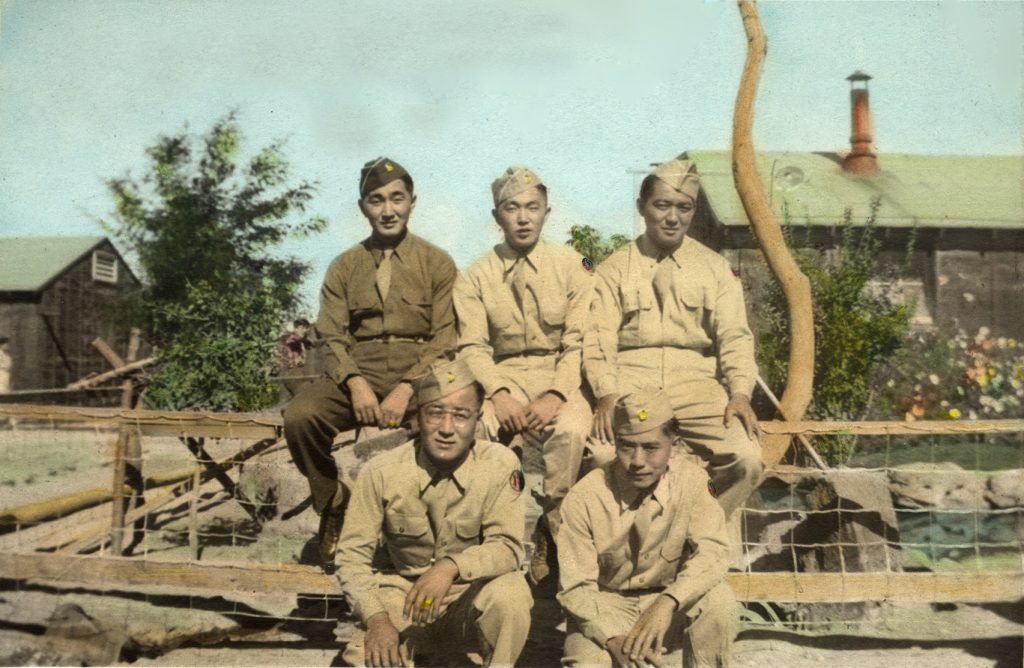
Nisei Veterans of the 442nd RCT, Minidoka Concentration Camp. Photo: Courtesy of Japanese American Museum of Oregon, Portland, Oregon. Permission from JAMO required for further reproduction.

Beginning in February 1943, citizens of Japanese descent were permitted to enlist in the Army and Navy. Many young men joined the 442nd Regimental Combat Team (RCT) that was comprised of all Japanese American soldiers and fought valiantly in Europe. This regiment was the most decorated unit in the army. They operated in some of the most dangerous battles, and therefore, had the highest casualty rates (9,000 dead or wounded). They put their life in danger for the country even though their parents and relatives were in the internment camps. When the soldiers were wounded, when they were released after treatment, they would be sent right back to the internment camps. 

Towards the end of war, the government began releasing large numbers of the internees. The internment camps were empty by the end of 1945, and the last one closed in March 1946. Most Japanese Americans did not return to their hometowns because there was nothing to return to. Those that did return had a difficult time finding work and accommodations. A small number chose to go back to Japan. Each released person was given just $25 and a bus ticket to start their new life.

At the end of the war, no American Japanese were found to be spying for Japan. Later research proved that some American officials were guilty of falsifying reports that were used as the basis for the government’s internment decision.

In 1988, President Ronald Reagan signed a legislation apologizing for the internment on behalf of the U.S. government. In 1990, the first letters of apology signed by President George Bush were mailed. Surviving interned Americans and their heirs received $20,000 compensation for each individual. For many, the apology and the check came too late—they had lived a very difficult life, and many of them had already died. 

After the 9-11 attack by Muslim terrorists, fear mongering and Islamophobia depicted Muslim as dangerous to Americans just as the Japanese were demonized after the Pearl Harbor attack. The anti-Muslim sentiments being expressed in the country led the Japanese American community to publicly state that the horrible injustice done to them in WWII must not be repeated. It continues to raise its voice whenever an ethnic group is unjustifiably targeted. 

By Fanny Wong, Chinese American author, New York.

Editor’s Note: May is celebrated as the Asian American and Pacific Islander Heritage Month in the country. 

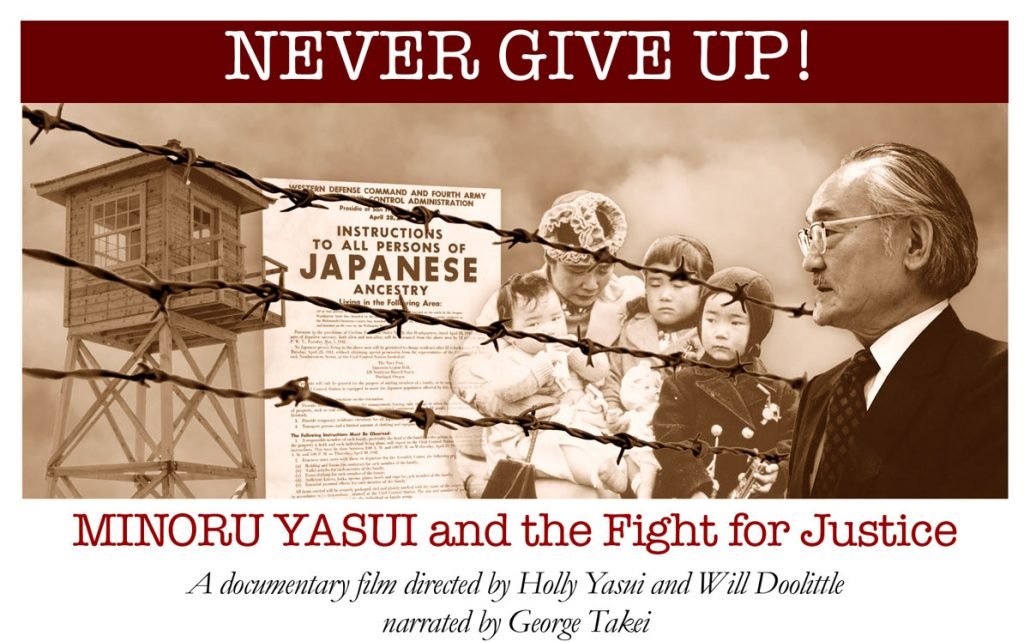
Never Give Up is an award-winning documentary that teaches about the discrimination faced by the Japanese American community and the issues described in the above article. You can get details from the website: www.minoruyasuifilm.org

Preparing for Your Life as a Minority

By Skipping Stones Staff

Students of color often face many difficult and discriminatory situations throughout their lives. Whether it’s at school or in social situations, when applying to jobs, or in their careers, it is an unfortunate truth that people still display biases about skin color, race, national origins, looks, etc. This affects how they treat others. Although it might seem scary or daunting as a minority to face unfair treatments based on prejudice, bias, and ignorance, knowing how to deal with these situations can help you deftly navigate out of them in effective ways.

In order to prepare for the real life issues that you may face as a minority, it is important to think about the kinds of situations where your ethnicity may play a role. Social situations are a common place where this can occur. Say you are an Indian-American and with a group of people where someone asks if you are a doctor or computer engineer. You would likely be fed up with having to deal with such stereotypes, and you might be tempted to react with anger. However, this will likely not help you. Confrontation might even serve to reinforce stereotypes people have about different ethnic groups, as unfair as that is.

When navigating these kinds of conversations, it is important to differentiate between people who are simply ignorant about racial issues but don’t harbor ill-intentions, and people who purposefully act and say discriminatory things. Telling the difference between these two types can go a long way into protecting yourself and ensuring you effectively navigate racial conversations. If someone says something out of ignorance rather than ill-intention, you can help educate them. With the example of career stereotypes, you could explain to them that while doctors and computer engineers are common jobs among Indian-Americans in the United States, that ethnic group doesn’t always act as a single unit. It is made up of so many different people, just like Caucasians, Chinese-Americans, and other ethnic groups. Each person is different, and can have different career goals. However, if someone intentionally tries to discriminate against you, the sad reality is that trying to engage with them directly will generally not help the situation. That is why it is so important for others, perhaps bystanders or people of different ethnic backgrounds than yours, to step in and stand up against such stereotypes and discrimination.

When dealing with those without racist intentions, having patience is key, as is an awareness of why people think the way they do. Some people who make ignorant racial comments do so because they didn’t have exposure to people of different backgrounds. Perhaps they lived in rural areas and didn’t get to interact with many Asians, Hispanics, or African Americans, for example. It is easy to have twisted notions about other ethnicities when you never interact with them yourself. Of course, this is no excuse for racist words or actions, but understanding why some people might be prejudiced can help effectively navigate difficult situations.

Social situations are not the only place this prejudice can manifest though. If you are a minority, you may sometimes find bias or a lack of respect from people in the workplace. One issue in workplaces is something called affinity bias, where people prefer to connect with others who share similar interests, experiences and backgrounds. Therefore, if you work for an organization where most people are of a different racial background than you, you may feel excluded (because others may tend to socialize together). To help reduce this you can show when you do have similar experiences or interests as them. If you share common hobbies, or play similar games in your free time, these can be points of common ground to build upon.

This kind of bias can also manifest in the hiring process itself, and is incredibly unfair to minority candidates. A recruiter or hiring team may subconsciously connect with applicants who are similar to them or had similar upbringings. On the surface, a white recruiter may not think they have much in common with a minority candidate, due to different upbringings, cultural values, etc. To overcome this, you again must put in extra work to show how you do connect with the recruiter or manager, in addition to showing your skillset. Many U.S. businesses and organizations are run by older, white employees who may not have received a ton of cultural exposure, or may not have taken cultural competency training, and therefore they may show a lack of respect for minority candidates. They may repeatedly display stereotypes or lack of cultural understanding, or mispronounce non-American names, for example. This is a well-documented phenomenon but many times this is unintentional, so it is a good opportunity to (politely) correct them, if they mispronounce your name.

However, both bias and a general lack of respect towards minorities can take a toll on you mentally if you constantly have to deal with these types of racial issues. To cope with this kind of stress it can be useful to talk to other people in similar situations and see if they have similar experiences. It can also be helpful to have a support group of friends and family who will listen and empathize with what you are going through.

As an Asian American, my experiences with bias and prejudice will likely be different than those who have different backgrounds, including those who are African Americans, Hispanics, Native Americans, or from other ethnic groups. Skipping Stones is interested in hearing your perspectives, to the extent you feel comfortable. Do you have experience dealing with bigotry or discrimination? How do you deal with those kinds of situations? We invite you to share your experiences as other readers may find your stories useful and helpful in dealing with such issues in their lives. It could show us all that we are not alone in feeling discriminated against or stereotyped.

Festival of Mid-Autumn Moon

 By Chiu-yi Rachel Ngai, 16, Arkansas.
 Lanterns bloom like flowers, the light and colour of crowded city streets. 
 Folded paper, a slinky of patterns,
 Dancing as the candle flame flickers a pattern silhouette. 
 There are plastic lanterns these days, thick and rubbery with a strange smell,
 Lit up with a mini LED bulb. 
 They come in all shapes and sizes, pop culture and cartoon designs.
 Mickey Mouse, Power Rangers, Doraemon. 
 I remember my cousin had an Elsa once, a matching pair with her Anna-toting sister. 
 We met with mooncakes under a full moon,
 Lotus paste sticky sweet, salted egg yolk seawater respite. 
 Our ancestors looked up at the same moon, and now we stand in their light— 
 A product of their mistakes and triumphs.  
 We stand tall, a proud new generation, 
 Eager to take on the world outside our Hong Kong,
 Not knowing how much our bubble would change in the years that watched us grow. 
  
 I was fourteen when I left on a fifteen hour flight to the United States, 
 Creating a half-globe’s distance within my heart. 
 I write this at sixteen, a full lifetime for so many before me, a full lifetime for still too many. 
 Arkansas is American Southern, dry and green and different and not a bad place to be— 
 And yet I remain a daughter of the Asian East— 
 My bones do not feel like they belong. 
  
 I sat under the ever-present moon last Mid-Autumn, my second in the States,
 Eating mooncakes gifted by my art teacher, the only other Chinese person I know in the area. 
 I look up to the sky, to the stars my cousins do not see, the stars drowned by neon light—
 I look up to the sky, to the moon my family looked at thirteen hours ago, the moon my ancestors saw a woman’s story in.
 The moon keeps me close to home.  

By Chiu-yi Rachel Ngai, 16, Arkansas. She adds: "I grew up in the bustling streets of Hong Kong. I moved to the U.S.
when I was fourteen in order to get a better education. I am fluent in English and Cantonese. I can understand Mandarin/ 
Putonghua better than I can speak it. I am working on overcoming my internalized racism towards myself for being Chinese, 
and I decided to submit to Skipping Stones as part of my journey towards accepting myself and finding pride and 
joy in my cultural identity."

Poems by Sophie Rodriguez

For all the Toledos

Darkness and suffering 

Sadness and fear live in the streets

Some of my own never get an opportunity 

To be scientists

To reach the planets 

But light lies ahead 

It surrounds us 

Sometimes physically around a neighborhood

Dry to those who cannot see

But full of soul and dreams 

Who I Am on the Inside

On the inside I am     

Strong Super-cali-frigi-listic Sophie                              

On the inside I am the     

Brave beautiful Believer                                        

On the inside I am one

Respectful Resilient Rodriguez

On the inside I am a

Passionate Peaceful Protester

On the inside I am a

Caring Creative Kind Community

On the inside I am the

Heavenly Hopeful Huasteca

On the inside I am the

Meritorious Motivated Mexica

A Mindful Marvel Miracle

Who are you on the inside?

By Sophie Rodriguez, age 9, Huasteca and Mexican American, Illinois. The poems were entered for the 2021 Youth Awards Program.

Taiwanese Food

By Camille Chen, age 10, Asian American, California.

I eat, sleep, and speak Taiwanese culture every day. Not a day goes by without my speaking Taiwanese or eating Asian food. My parents moved from Taiwan to America before they had me. Their childhoods were very different though, because my dad had to travel with his family because of his dad’s job. My mom experienced the art of Asian foods, and learned how to cook Asian food from her mom, her grandma, and other elder family members. 

I think that to be in an Asian family, it is a necessity to be able to at least cook some egg-fried rice. There are so many people out there that make such simple things the wrong way. You wouldn’t know how many videos are on YouTube with Asians looking at other people cooking Asian food and correcting them. Also, I think that Asian food allows you to really freestyle/improvise. For example, one of the dishes that my mom makes is Udon. Even though Udon is a Japanese type of noodle dish, you can cook it on the pan and mix it with pork and vegetables, and it is so enjoyable! 

Taiwanese food is very unique compared toEuropean food. You need a lot of effort to make it,  and learn about it. For instance, egg-fried rice can be extremely easy to make, but if you want someone to taste it and immediately love it, you need wok hay to make the flavor scrumptious when you are chewing the rice. The wok hay gives the rice a special flavor as if it’s cooked right under charcoal with a big fire underneath it. I consider the Wok as one of the wonders of Asian culture! It is so special and when you use it to cook anything, you can sense the heat and unique smells. The garnish adds even more flavors and makes it even better. But, you also need the correct garnishing. Egg-fried rice garnished with green onions is a classic, and adding cabbage with it is nice, but you don’t want a salad-like vegetable to go with your rice! The tiny details make Taiwanese food extremely difficult, but if you trust the process, it is all worth it in the end. However, egg-fried rice is just square one. Taiwanese food also includes soups with strong flavors or soups that can actually help your health! 

One soup that’s healthy and delicious is ginger soup. Usually, my mother adds cooked chicken to make the soup less boring. My mother also adds rice to make it more child-friendly. The real stuff about it is the special cooking wine. And a pinch of garlic. That makes the whole house smell like heaven. When I taste the soup, first I detect the rice. The rice has no flavor on it’s own, but since it’s been in the soup for some time, it tastes like the soup. Its texture is sort of al dente and the chicken is no different. When I eat the chicken, it has the flavor of the soup and tastes wonderful. The garlic is so soft that you can eat it without thinking it tastes weird. You won’t even notice you’ve eaten garlic. Underneath the base of the soup, I taste the ginger combined with the cooking wine, but it isn’t overpowering. Soy sauce is added as well. The rice, chicken, and the stock together make a wonderful homey ginger soup. The best thing is that each quantity is about equal, so you won’t have to waste anything. Once it’s on the table, we finish it all and stay full for a long time. 

Taiwanese food is important to me because I feel it brings culture and tradition. For example, dumplings, a very common and well-liked dish, are shaped so that they look like bars of gold; so when Chinese New Year comes along, people make or buy dumplings to eat in hopes of getting more money in the new year! The dumplings are a symbol of wealth. 

Zong Zhe, another very popular Asian food, also has a long history behind it. Once, a man named Chu Yuan was hired as an advisor of the King. After a long time, he became an extremely wise advisor and everyone saw him as a good person. But then, one day when Chu Yuan was giving the king advice, the King disagreed with him. This made Chu Yuan so sad that he thought he was unfit to serve. So, he drowned himself in a lake. Everyone felt sad that such a good person would die, so they wrapped up the rice in leaves to prevent all the fish and shrimp from eating up Chu Yuan’s body. This rice wrapped in leaves soon became known as Zong Zhe. Nowadays, people eat Zong Zhe at the Dragon Festival. I feel like this is an important and somewhat heartwarming story. It’s pretty entertaining to see others’ reactions to the story of Zong Zhe. 

When my grandpa was young, his family didn’t have much money. He didn’t have shoes to wear, no toys to play with, and they rarely had meat on the table. But when Chinese New Year came along, his family mixed flour and water together to make a certain type of dough and pinched it into shapes of butterflies and flowers. The point is, just because my grandpa’s family was poor, his mom still did her best to keep the tradition going on, and also wanted the kids to have =>p.17 Taiwanese Food continued from p. 16

fun moments in their childhood. So when he was in the hospital, he remembered all of these fun moments and savored them. 

Taiwanese culture and food are very important to me. I know many of these stories by heart; they were told to me by my family. I hope that one day I will be able to cook our traditional food and share our culture and history with the next generation. My family keeps the Taiwanese traditions going.

By Camille Chen, age 10, Asian American, California. This was selected as a Noteworthy Entry in our 2021 Youth Honor Awards program.

Sit by Me

By Sonia Mehta, age 17, Russian-Indian heritage, Ohio.

“Excuse me. Is this seat taken?”

Anika glances up to see pleading eyes.

“Sorry,” Anika says, looking past the girl. “Our friend asked us to save the seat.” She resumes her lunch.

The newcomer leaves. From the corner of her eye, Anika watches the new girl navigate through the crowded cafeteria. Two noisy upper classmates jostle her to the side. Anika clenches her fork. They keep walking as though the girl is invisible. The newcomer chooses an unoccupied table in the corner and sits. Anika’s chest tightens. She takes a deep breath. No relief.

“Anika, you’re mean,” Cynthia says.

“Her name’s Darsha,” Meghan adds from across the table.

“Who?” Anika feigns.

“The new student,” Cynthia replies.

“Oh, I don’t know her.”

Meghan pushes her thick glasses to the top of her broad freckled nose. “Is she from the same part of India as you?” She tugs at her thin red hair.

“No. Different region.”

“She looks a little like you, Anika. But darker.” Cynthia twists her wavy chestnut hair around her plump index finger.

Anika feels a guilty pleasure hearing these words. The desire for lighter complexions in parts of India is a poorly kept secret. The classified section of the India Today newspaper is filled with matrimonial ads. Prospective brides are described as having ‘wheatish’ or ‘cream’ complexions. The defining characteristic of men is ‘successful.’

“I feel bad for her,” Meghan says.

“Someone should talk to her,” Cynthia adds.

Anika knows this means someone else. The friends look at Darsha. She is short and thin. Her long black hair glistens with coconut oil. It is pulled back into a messy ponytail, exaggerating the roundness of her face. She wears denim pants that are a size too large and a dull green t-shirt. Darsha stares at her plate, playing with uneaten food.

Anika rakes her fingers through her freshly straightened caramel-tinted hair. It accentuates her heart-shaped face. She tugs on the collar of her cropped Brandy Melville shirt.

“We can’t associate,” Meghan says, “or we’ll be losers too.”

Anika considers protesting but does not. She has ascended the school hierarchy to the level of blending in. She can live with that.

Three years ago a girl from India entered a classroom. She prepared for life in the States by watching every movie available to her in Surat, India. She expected to be introduced to the class by her new teacher. Such was the custom in her country. Instead, she was directed to an empty seat.

Within minutes, an American girl raised her nose and sniffed loudly. Other students mimicked the action: a pack of hyenas catching the scent of a prey. They soon triangulated the smell to the backpack under the newcomer’s desk. Disapproving looks followed. Her mother’s khichdi sat in the plastic container. It was the least spicy and malodorous dish she knew to pack for lunch.

After class, she rushed to the restroom and dumped the lentil dish. Next period she made the mistake of answering a question about Alexander Hamilton. She did not know that her thick accent sounded like marbles had been placed on her tongue, “Hamilton was a veddy (very) important patriot. He reeelly (really) cared about a strong federal government.”

A boy jeered, ”Did he reeelly?”

Snickers followed. She never volunteered another answer.

The worst introduction happened in the cafeteria. The room, the size of a football field, buzzed with a slow-moving current of American teens. Each table pre-filled with students laughing and gossiping. Their backs turned to her–a phalanx of shields. She found a corner table and sat alone. She stared relentlessly at her watch, willing the minute hand to move faster.

From her left, sunlight came through a window and separated into a rainbow on the wall. She pretended the colors were a palette of paint. She imagined dipping her brush in the red and produced her grandmother’s beet pickle. The cinnamon-anise smell touched her nostrils. A smear of green brought her Auntie’s fried elephant leaf paatra. Was that the scent of coriander? With a dash of orange, her mouth watered with the sweet cardamom-flavored jalebi.

She felt better looking at the rainbow. It was her color palette . Colors were a part of her life. She used to toss the powdered dyes at her cousins during the Holi Festival every year. The colors transformed them into living canvases.

“Earth to Anika,” Meghan says.

“What?” she mumbles, coming back to the present.

“I said, time for fifth period.”

Anika glances at Darsha’s now vacant seat. She tries imagining the new girl leaving alone. Instead. Anika sees a girl from Surat who once filled the emptiness in her heart with colors dancing on a wall. Anika has recognized the aching loneliness in another but has chosen silence. She leaves with her friends.

The next day, Anika joins her two friends at their usual table.

“Did you hear about Darsha?” Cynthia asks.

Anika looks up from her phone.

“She dropped out,” Cynthia continues.

“So soon?” Meghan says.

Anika’s stomach knots. She stares at the seat Darsha was in yesterday. Empty. That deserted table used to be hers. Her eyes drift to the window. It’s sunny outside, and a rainbow flickers through. My color palette , Anika remembers.

“Does anyone know why she quit?” she asks.

“Probably hated being a loser,” Cynthia answers.

“Where did she go?”

“I guess where she came from. Where was that again?”

“Somewhere else,” Anika whispers.

I wish you had stayed, Darsha. I should have shared my color palette. I could have. She looks again at the rainbow. It flickers merrily, unmoved by her thoughts.

A single cloud rolls in. Its shadow obscures the colors.

—Sonia Mehta, age 17, Russian Indian heritage, Ohio. The story is being published as one of the Noteworthy Entries of our 2021 Youth Honor Awards program. The story was also published by Telling Room earlier this summer.

Poems and Photos from the Bhalukhali Rohingya Refugee Camp, Bangladesh

By Mohammed Faisal, 19, Bhalukhali Rohingya Refugee Camp, Bangladesh.

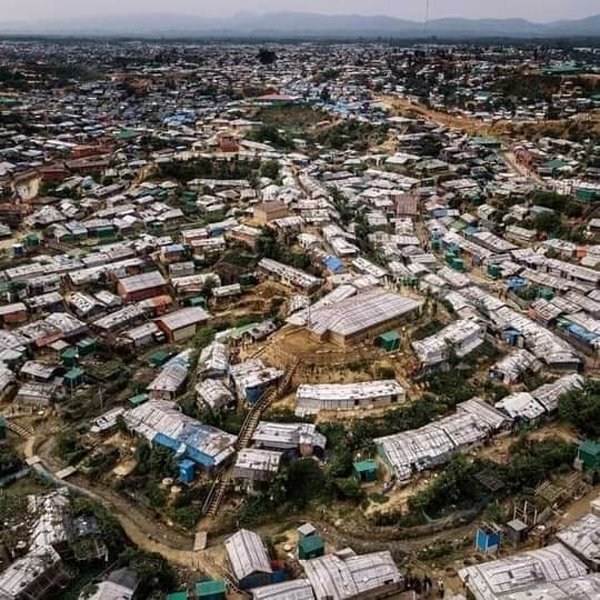
I’m Mohammed Faisal, a young Rohingya poet, living in the world’s largest refugee camp. We, Rohingya, fled from our country Myanmar in 2017 due to the forcible displacement of our civilian population. We were brutalized by the Myanmar military, and we were taken to the Bangladesh refugee camp where we still continue to face so many difficult obstacles in order to survive. We have struggled, and have also established a massive tent village. Unfortunately, there is not enough space in our tents, and we continue to have to downsize. Our family members continue to change with all the various circumstances that are also changing. We feel suffocated, and our parents, children, aunts, and relatives all have to stay together and sleep together in a very small tent shelter. There are not any playgrounds for children to play in, and children are not able to receive the formal education that they deserve. We are all flying around like birds in a cage, and we are not comfortable at all.

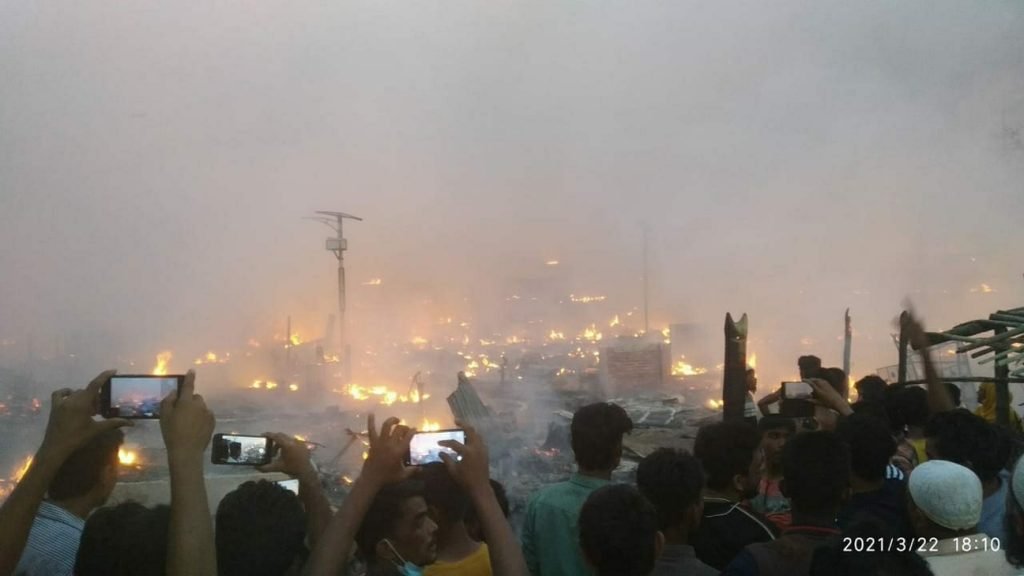
On Friday, March 22, 2021, a massive fire decimated thousands of our shelters here at the Bhalukhali camp. The fire was incredibly violent and killed hundreds of people including infants. Unfortunately, the people here were not able to escape from the camp, because the government of Bangladesh has created a fence all along the camp’s border, which is why so many people were not able escape the violent fire. There are still so many people who are without shelters and homes. I have also seen people sleeping on the ground wrapped in plastic blankets. This is a short introduction to the people I love, the Rohingya, and is also an introduction to our current state of affairs. I hope the Rohingya stories will live on in your awareness.

 The Fence by Faisal Justin
  
 When the fire caught our shelters 
 some people weren’t able to come out.
  
 They burned in the fire,
 couldn’t see their way out. 
  
 Many people could not climb the fence;
 they had to stay in this cage.
  
 There is no freedom in this burning cage,
 suffocated by heat. The fire leaps. 
  
 O, my government! 
 O, dear Bangladesh! 
  
 You are the thousands, rescued and displaced. 
 You are the kind-hearted. Take down this fence, this place. 
  
 Hundreds of lives ruined by this fence--we do not understand. 
 You eliminate words. You eliminate language.
  
 No End to My Sadness by Faisal Justin
  
 Many years of my life have disappeared from view
 Life continues, full of sorrow. I remain here, in the same position 
 My eyes, full of tears, at times, even oceans 
 My body becomes thinner, day after day
  
 Don't feel well wherever I go 
 This moment only makes me ache 
 The world is not the world, in my imagination 
 The sunny day looks like a cloudy day 
 My face even looks gloomy. 
  
 I have visited several places 
 Searching for peacefulness 
 The more I wander, the more morose I feel 
 Every second reminds me of one thing-- 
 Which remains my country 
 And which I hold in my warm heart . 
 Life feels as if it is falling, full of aching, full of sadness.  

Erwin: A Holocaust Survivor

By Maggie Satterthwaite, age 16, European American, Massachusetts.

MUNKACS, CZECHOSLOVAKIA, MAY 1944. The German soldiers trampled, raided, and forced his family out of their house and onto a train, which led most of them to their death. This was the moment when World War II confronted Erwin Forley and his family. They watched flames swallow their IDs, while simultaneously feeling their own lives burn to nothing. The happy life that Forely knew as a Czechoslovakian teenager was stolen from him, and soon enough his existence would mean nothing more than a tattoo marking A-9957 on his arm.

Mr. Forely, 92, tells his story to reflect on and share his experiences during the Holocaust, but also to warn today’s society about what may happen if we continue to choose violence over peace and hatred over love.

Before the Nazis arrived in his town, life was normal. For most of his childhood, there was no sign of anti-Semitism or war.

“Life was good. We had parties, we went swimming, we went ice-skating, and we had normal lives… until the end,” says Forley. “Until they took us.”

Forely grew up in Czechoslovakia with a loving and honest family—his father, mother, brother, sister, grandparents, and eight uncles and aunts. By the end of the war in 1945, there were only three survivors in his family—his sister, mother, and himself.

After their capture, Forely’s family was sent off to a ghetto, where they survived off of little food for three weeks. Then, already weak, they were thrown into cattle cars, where one hundred other people were crammed, and were shipped to Auschwitz. At the concentration camp his grandparents and young brother, deemed useless, were sent to a gas chamber. The father of a girl Forely had known in the ghetto told him to “take good care of my daughter,” as he was not optimistic that he would survive.

Forely and his father remained together, but they had to hide their relationship. If an SS (Schutzstaffel in German, meaning Protection Squadron) guard knew that two men were family, one would be beaten to make the other suffer. To avoid this, Forely called his father by his name.

Although he was not beaten in front of his father, he was often threatened with attacks from German Shepherds. These vicious dogs were used by the SS guards for their ability to maim or kill prisoners who misbehaved.

Because Forely and his father were farmers, they continued to work as farmers in Auschwitz for six months. In many ways, this work on the farm saved their lives at first, as they had a purpose in providing for Germany. Although it helped them avoid the gas chambers, it was still extremely dangerous and took place in brutal conditions. Forely, for instance, was hurt while cutting trees and had to go to the hospital, getting separated from his father.

Later, his father was taken to another camp, where he eventually died of hunger.

Just days after Forely was treated for his injury, the Russians liberated Auschwitz on January 27, 1945.

Erwin Forely was free.

Today he says, “I have faith. I am a believer, and that is why I survived.” He explains that his hope and resilience saved his life.

Once Forely left his worst memories behind and reentered life outside of the camp, he found his way back to his childhood home in Munkacs. However, a Russian captain had occupied the house. Forely explained that he used to live there and asked if he could enter his home to move some furniture. The Russian approved.

Inside, Forely pulled out a pair of earrings his father had given his father, earrings he had hidden before being sent to the camp. The earrings were also survivors of WWII, and they now belong to Forely’s granddaughter.

Later, Forely rang the doorbell to his house again, but this time his mother and sister opened the door. Previously unaware that they had survived and returned, he was grateful to reunite with his only living family members. Together they moved around Europe, and Forely went on to study textile engineering at university.

One day, they received a special package. It was from Forely’s uncle, who was in New York. He sent them papers, and soon enough they were on a long journey to America.

Although he would always hate every German his age or older, Forely was able to be positive and optimistic when beginning his new life in New York.

“I didn’t feel out of place,” claims Forely. He was happy in America and felt welcomed.

Forely was once surrounded by death. Now, however, he lives contentedly with his wife of 67 years, with whom he has children and grandchildren.

“She is always helping me. She is my light,” says Forely, as he mentions his wife.

Seventy-five years ago, the only light that Erwin Forely saw was from deadly flames. Now, he sees it instead in the warm, kind faces of his family.

By Maggie Satterthwaite, age 16, European American, Massachusetts.