Tag Archives: women

The Knowing Smiles of the Devis

The Knowing Smiles of the Devis

By Anu Prabhala, Maryland

On the feminine divine, life’s transitions, and the strength we carry within

It was Navarathri, the nine-day Hindu festival celebrating Devi (Divine Mother or the feminine divine), and for the first time in years, I decided to light a lamp before the Devi’s altar in our home.
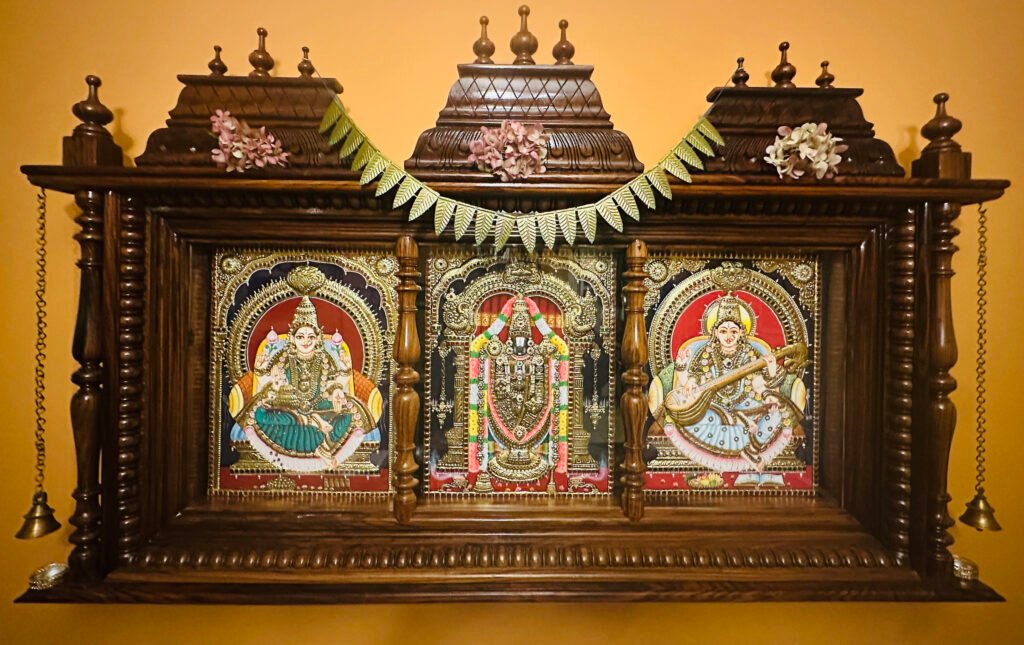
I usually light my lamp at the altar in the same room. But this year, something drew me toward our beautiful three-panel Tanjavur painting (see above), which has adorned our wall for ten years. Specially commissioned for us and shipped from Bengaluru, India, the painting shows Lakshmi, the goddess of spiritual wealth, on the left, and Saraswati, the goddess of knowledge, on the right.

As I lit the lamp, hoping the flame wouldn’t make the dainty bells dangling above it too hot, I found myself looking into their faces.

And something quite unexpected happened.

I felt compassion. Not so much for them as from them. Their gentle smiles and serene eyes seemed to hold a knowing understanding, almost as though they were saying, I know. I am here.

I had looked at these paintings countless times before. Why was I seeing them differently now?

Perhaps it had something to do with the transitions unfolding in my own life: an uncertain professional future; a book I had dreamed of writing for years finally taking shape; a son edging ever so close to the day when he would leave home and begin his own adventures; and my 88-year-old mother in India, with whom I’ve spent many wonderful years (and still yearn to spend much more time with).

So much to be grateful for, and yet so much to take in, anticipate, and occasionally worry about.

And here were these two women—goddesses, no less—looking back at me with expressions of such extraordinary tenderness.

I am hardly a scholar of Sanatana Dharma (a.k.a. Hinduism), and my knowledge of the many forms of the divine mother is limited. But at that moment, I wasn’t thinking about scriptures, symbolism, or theology.

I was thinking about the feminine divine. About the extraordinary capacity of women to absorb life’s uncertainties, to nurture, to persevere, to find strength when strength seems in short supply.

And about how comforting it was, for once, to feel that someone else was looking after me!

Women in the Seats of Power

In South India, during Navarathri, we worship three manifestations of the feminine divine: Durga, for her strength and courage; Lakshmi, for the material and spiritual wealth she represents; and Saraswati, for knowledge, wisdom, speech, and music.

How wonderful, I thought, to have women in the seats of power! Not political power, but something far more fundamental—the very source of strength, abundance, and knowledge.

And really, who’d be better than a woman to untangle a messy situation, knock some common sense into everyone involved, and steer things toward a happier outcome? 😉

But jokes aside, I began thinking about how much women take in.

We absorb other people’s anxieties, manage expectations, juggle responsibilities, hold families together, and somehow keep plowing ahead. We are mothers, daughters, wives, friends, professionals, caregivers—often several of these at once.

And somewhere amid all these roles, we must also find room for ourselves. For our own aspirations, disappointments, uncertainties, and dreams.

Perhaps that was why I felt so drawn to the Devis this year. I wasn’t looking at distant, impossibly perfect goddesses. I was beginning to recognize something of our own lives in what they represent.

Strength doesn’t always look like a tigress charging into battle. Although some of my oldest friends might disagree! Born on the second day of Navarathri, I was named Durga Annapurna. For decades, a group of friends, including my dear friend Bindi, have affectionately called me “Purni-Sherni”—Purni (total/complete?) the Tigress—for my reputation as a fierce go-getter. Bindi even gifted me a hand-painted tigress for one of my recent birthdays!

But lately, I have been discovering another kind of strength—one that is gentler and manifests more quietly. Sometimes it simply means getting up in the morning and carrying on, even when you aren’t quite sure what comes next.

And knowledge isn’t always about finding the right answer. Sometimes it is the wisdom to recognize that not everything needs to be resolved today—and to trust that we will find our way.

The Devis Among Us

During Navarahtri, I experienced another reminder of the feminine divine—this time, not in the gilded panels of a Tanjavur painting, but in a roomful of women gathered at my friend Manju’s home.
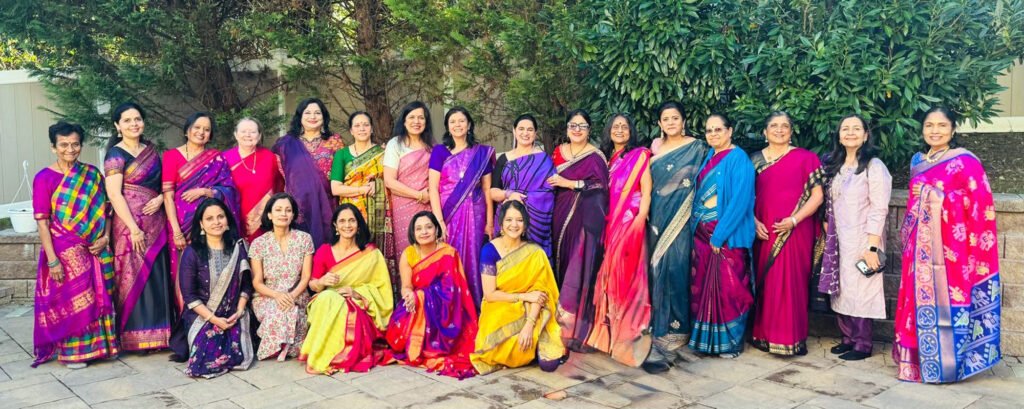
We sang bhajans (devotional songs) and chanted shlokas (sacred Sanskrit verses passed down over millennia that share eternal truth). We laughed, posed for pictures, ate sumptuous food, exchanged stories, gossiped a little (surely, the goddesses would forgive us!), and shared some of our worries and woes.

Manju explained the festival’s significance. Anju offered a Vedantic (from ancient Hindu scriptures) perspective. And Gabriela appeared resplendent in a sari, perhaps to the astonishment of her American husband and German family!

Wisdom, laughter, generosity, compassion, and strength filled that room. And, of course, plenty of good food.

As I looked around, I realized the Devis we worship aren’t so far removed from the women we are.

Each of us carries her own share of responsibilities, anxieties, hopes, disappointments, and dreams. Yet, for a few precious hours that evening, we set our responsibilities and worries aside. We were simply ourselves—women enjoying one another’s company, drawing strength from shared experiences, and finding joy in belonging.

But perhaps our evening had even offered us a kind of victory—over isolation, worries, and the little burdens that sometimes weigh down our spirits.

I arrived at Manju’s home to celebrate the Devis. I left feeling that I had spent the evening in their company.

And perhaps, in some small way, we had all rediscovered the Devis within ourselves.

These days, when I look at my Tanjavur painting (see the painting above), I still see those knowing smiles.

And I find myself smiling back.

—Anu Prabhala, originally from India lives in Maryland. She adds: “If these reflections resonate with you, subscribe to my weekly blog, Imperfectly Perfect, free at https://anuprabhala.substack.com/subscribe for more stories about life, its surprises, and the ways we learn to see.”

Note: The Navarathri festival was recently celebrated from Oct. 11-20; Oct. 20th being the Vijayadashami (or Dussehra). In 2027, Navarathri will be celebrated from Sept. 30th through Oct. 9th. On October 21st, the USPS released a new postal stamp to observe the annual five-day Hindu festival of lights, Diwali, which will be celebrated Nov. 7-11, 2026.
A S.T.E.M. Woman from India

A S.T.E.M. Woman from India

By Saroj Pathak, originally from India, now lives in California.

My 50 years of professional life have been a series of challenges, failures, triumphs, and also a few shattered glass ceilings. I would like to share my experiences and describe some of the twists and turns, and the choices I made.

I grew up in Indore, Central India. We were six siblings growing up in a middle-class family. In the 1960s, my high school, St. Raphael H.S., did not offer math major to girls! I was exceptional in Math and wanted to pursue my passion. My father talked to Mrs. Jagdale, who was the head of a small public school nearby. Mrs. Jagdale, an early Women’s Rights pioneer, said, “If our girls want to take math, we have to start math classes.”

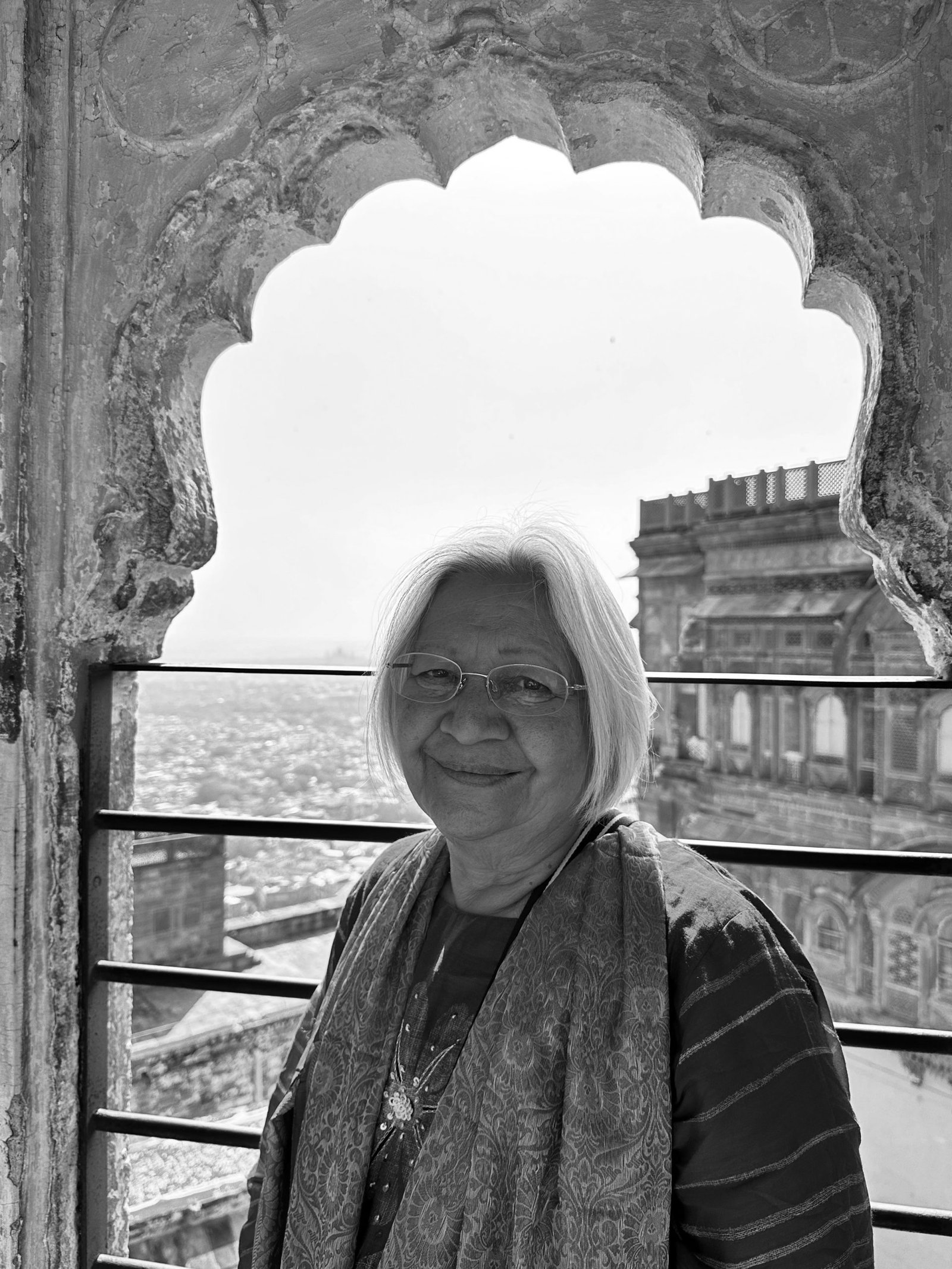
Now retired, Saroj Pathak Recently Visited the Historic Site of Mandu, near the city of Indore, Madhya Pradesh (Autumn 2023)

So my sister and I moved to Mrs. Jagdale’s school. In the nurturing environment of this small school, I ranked third in the state’s high school board examinations, an exceptional achievement!

From 1965 to 1969, I attended S.G.S.I.T.S., the only engineering college in Indore (M.P.). There were only five female students in the entire college. We had to fight for a small private bathroom and a tiny women’s room. I excelled in my chosen field of Electronics and Electrical Engineering and held the first rank in all branches of engineering throughout the four years. I was like a sponge; I absorbed everything offered. There was so much to learn from all my professors.

As graduation approached, I started looking for options for further studies. My parents were liberal but still would not send their daughter away for higher education out of state. And, I didn’t have the audacity to argue.

Dr. Dasgupta, the head of the college, recognizing my potential, and created an opportunity for me to pursue higher education in collaboration with the prestigious Indian Institute of Technology (I.I.T.) at Bombay (now, Mumbai), while working as a lecturer at G.S.I.T.S. in the Electronics Department. While satisfying my drive to excel, this enabled me to live at home. I taught for three years while completing my Master’s degree in Engineering in Control Systems from I.I.T. Although this experience was challenging, I wanted more.

I reached for a moonshot and applied for and was awarded a Rotary International Scholarship to study abroad. It was an easy decision to select University of California at Berkeley for further studies. I dared to dive head-on into the unknown, knowing only one person in America; a graduate student who had graduated from S.G.S.I.T.S. a few years ahead.

It was shocking for me to realize that I was the ONLY female student in the graduate school of electrical engineering, even at this prestigious university. The students and the professors were friendly and treated me with the utmost respect and kindness.

After graduating from U. C. Berkeley with a Master’s in Electrical Engineering and Computer Science, I worked as a semiconductor design and development engineer at American Microsystems in the Silicon Valley of California. When I came in for the job interview, the manager and engineers were shocked to see a female candidate. Women engineers were rare.

The Silicon Valley was full of type-A men, hungry for fame and wealth. It was a norm to “pull all-nighters.” All the engineers were transplants from somewhere else, and without family obligations; we worked hard and played harder. We created a family regardless of skin color or gender. We were on an endorphin high from the success of our innovations.

From 1975 to 1983, I worked with a small group of engineers at Intel Corporation; that’s where we invented and produced the first ‘non-volatile’ memory chips. These were the first chips that retained data (information) after unplugging the power supply. This was revolutionary! We published international papers, had numerous patents, and enjoyed the glory of success. I was a manager by this time and always felt respected and valued. My opinions counted, and I had the center seat at the table.

In 1983, I was offered a job at a Startup company to set up a non-volatile product line. My initial response was NO. I had an eight-month-old son and a three-year-old daughter. I was unwilling to work long hours. Since the company’s CEO wouldn’t take NO for an answer, we negotiated. I agreed to join the company, understanding that I could go home at 5 p.m. every day. The company provided flexibility, and I used my professional judgment to balance work and family needs.

Two years later, the room was packed with engineers from around the world when I presented a research paper on the First High-Speed Non-Volatile Memory at the International Solid-State Circuits Conference (ISSCC). My children sat in the front row. By then, I was confident and assertive enough to invite my children without asking.

When a Vice President position opened up, I did not consider it because I knew it meant working very long hours, and I did not want to sacrifice time with my children. Later, when the children were older and busy with school activities, I accepted a position as Director of a multinational research and development group in a different company. Most often, I was the only woman in the room where the decisions were made. Yet I also attended most of the swim meets, music lessons, cross-country running events and other activities with my children.

After 45 years in business, I decided to follow my lifelong goal of helping the younger generation in STEM field. I am passionate about the accessibility of primary science education to all children. To that end, I have started a non-profit that teaches science fundamentals to children of all socioeconomic statuses. I mentor through Stanford Mentorship Connections and other non-profit organizations. I am also the president of a local Kiwanis club whose mission is the education and well-being of children.

Advice to My Younger Self:

* Enjoy the ride. The trailblazing path is littered with obstacles, but there is no greater joy than facing challenges and finding solutions.

* Discover your core values and be true to them. Define your goals on your terms. Do not let others decide who you should become. Sort through the clutter of cultural baggage and embrace that which gives you joy.

* Be like a river flowing constantly towards the ocean, soft and flexible, but always focused on the destination. Change directions, detour if necessary, or carve a new valley, but keep flowing towards your goal.

* Be confident. You are stronger than you feel, smarter than you think, and braver than you know. Use any fear as motivation to be successful. That fear will then turn into confidence.”

* Educate yourself and acquire indispensable skills.

* Take chances. Inventions are just a step away from failure. Become comfortable with failure and learn from it.

* Dare to shatter glass ceilings, even if that means cuts and bruises. The pain of cuts and bruises is the price you pay to help your daughters and granddaughters.

* Most importantly, find a mentor. Find several mentors. Surround yourself with your cheerleaders. Find inspiration from the life stories of the pioneers who paved the path before you. From mythological women to recent ones, our (Indian) history is full of women who advanced humanity through their ingenuity, courage, and persistence.

* Be a mentor. You are standing on the shoulders of giants. Later, you can offer your shoulders to those following you.

* Be ready to choose. Most successful people have made difficult choices to get there.

* Find a supportive spouse. Sheryl Sandberg, author of “Lean In” and ex-CTO of Facebook, said, “The single most crucial decision you will make in your life is whom you marry, for this will determine the rest of your life.” She was talking to graduates of Harvard Law School.

* “Start the conversation before committing to marriage, not after.” Did you know that the Supreme Court Justice Ruth Bader Ginsburg credited her husband for her success?

In Conclusion, as a young adult in STEM fields, I would like you to be brave, explore, and take chances. Show up daily, sit at the table, and speak up in a firm, clear and compassionate voice. Act like the fate of humanity depends on you because it does.

—Saroj Pathak, originally from India, lives in California. She shared this advice with engineering students at her Alma mater in Indore, India, in November 2023.

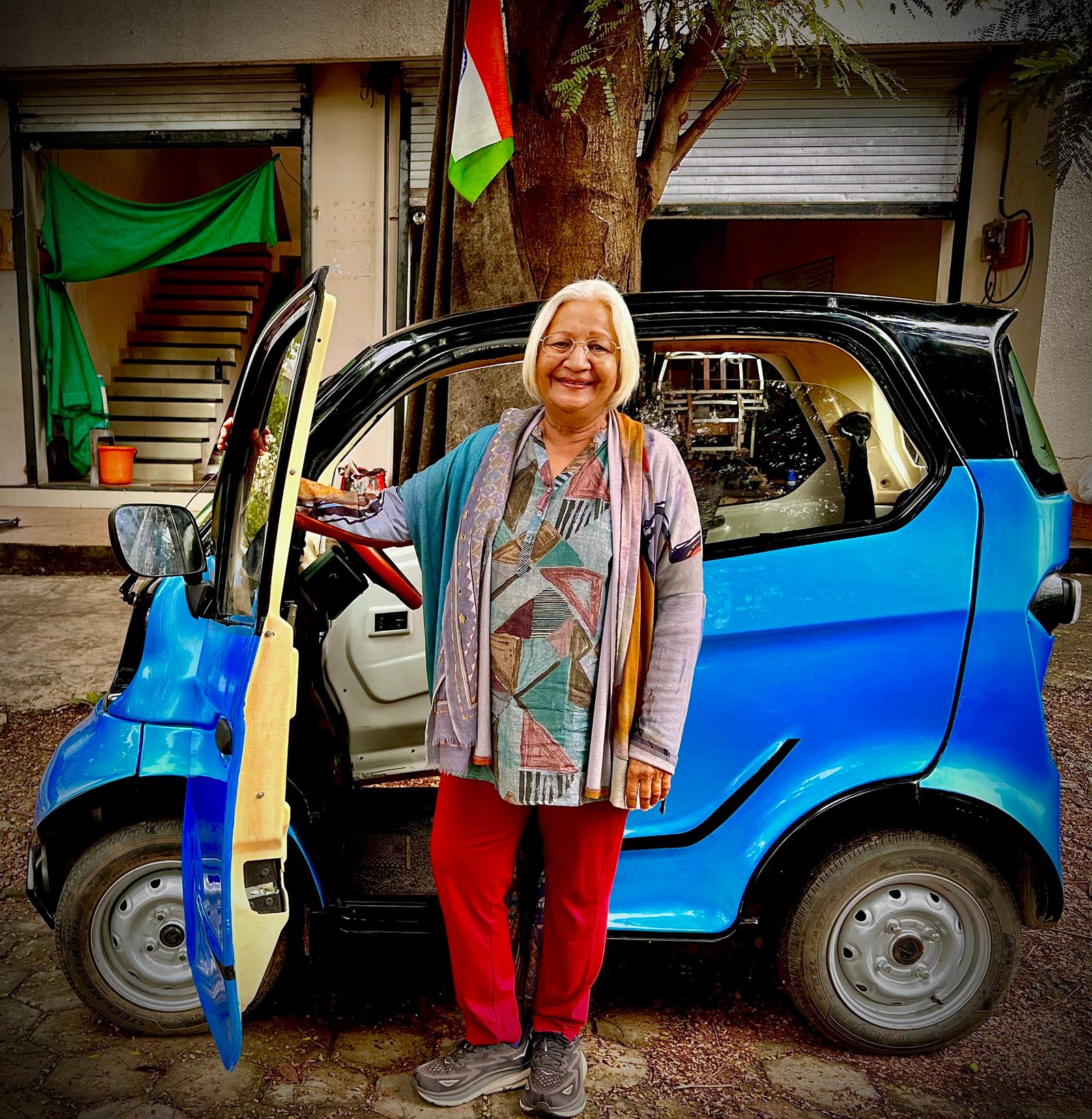
Photo: Saroj in Indore, Nov. 2023.

A Chinese-American Pioneer for Suffrage

Mabel Ping-Hua Lee: A Chinese-American Pioneer for Suffrage

By Fanny Wong, New York.

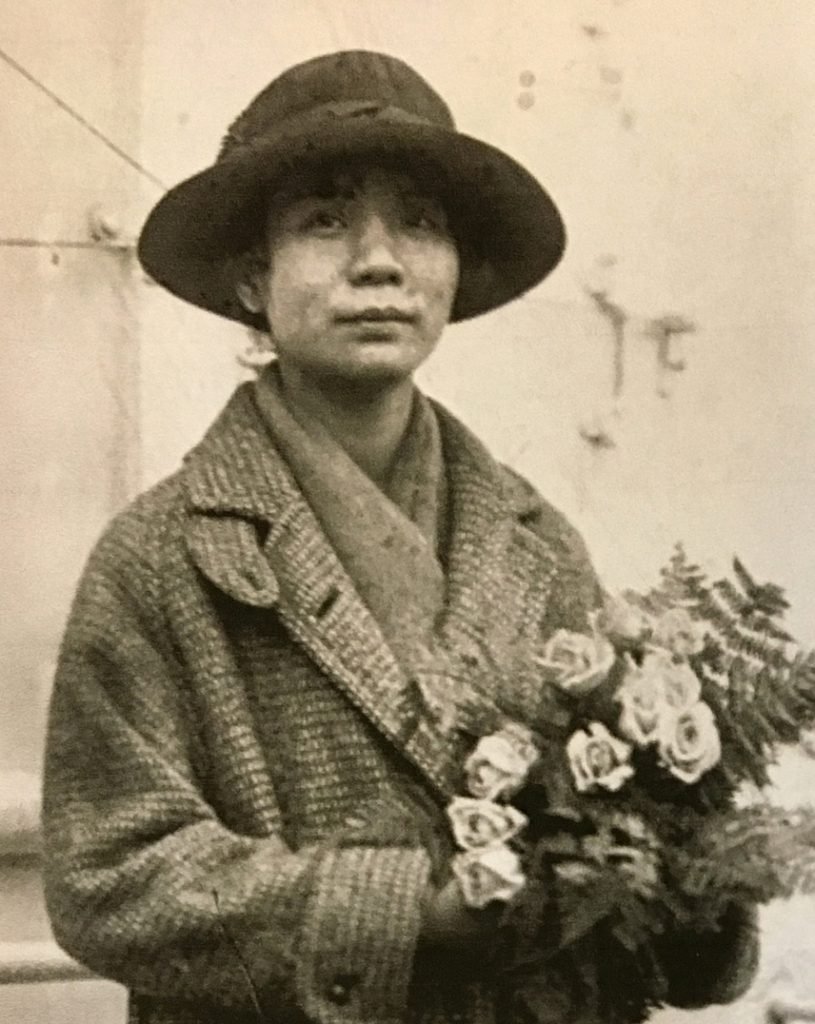
Mabel Ping-Hua Lee
Photo: Mabel Ping-Hua Lee.

from the archives of the public library in Arlington, Virginia

On July 25th 2018, a post office in New York City’s Chinatown was named Mabel Lee Memorial Post Office. It is an honor that Mabel did not anticipate, but it was richly deserved.

Mabel Lee is not well known today, but in 1912, a New York Times article recognized her as a suffragist. It reported “Ten thousand strong, the army of those who believe in the cause of woman’s suffrage marched up Fifth Avenue at sundown yesterday in a parade the like of which New York never knew before.”  On May 4th 1912, what a sight it was to see a sixteen-year-old Chinese girl on a white horse, wearing a sash with “Votes for Women” printed on it. Starting from Greenwich Village, she led a parade of 10,000 suffragists!

Mabel’s father, a missionary pastor from China, had moved to the United States when she was four years old. Living with her mother and grandmother in China, Mabel studied in a missionary school and became proficient in English. She was an excellent student and in 1905, at the age of nine, a scholarship landed her in the United States to attend school. She and her mother were reunited with her father, who was the pastor of the Baptist Chinese Mission in New York’s Chinatown.  At that time, Chinatown was a new community. According to the census of 1910, there were only 5,266 people of Chinese descent in the city of New York.

Mabel’s father was active in the community and greatly influenced his daughter.  Even at a young age, Mable’s Baptist faith infused in her a desire to improve the lives of women and girls. In her teenage years, she became involved in the suffragist movement, knowing full well she could not vote. The Chinese Exclusion Act of 1882 prohibited Chinese immigrants from becoming citizens. Nevertheless, she threw herself energetically into the suffragists’ cause.

Excelling in English, Latin, and mathematics, Mabel was a brilliant student in high school at the Erasmus Hall in Brooklyn. She attended Barnard College, founded for women only because the nearby Columbia University did not admit women at the time. She wrote articles about feminism and suffrage in The Chinese Students’ Monthly magazine, understanding that the poor treatment of women was holding China back and represented a kind of backwardness. 

Mabel’s essay “The Meaning of Women Suffrage” promoted the importance of voting rights and equal opportunities to women. Her speech “The Submerged Half” was an urgent plea to the Chinese Community to promote girls’ education and women’s rights. From the call to the general public and specifically to the Chinese immigrant community, she was indefatigable and resourceful.

As an Asian woman, Mabel broke another barrier. In 1921, she was the first to earn a Ph.D. in Economics from the previously all male Columbia University.  

Mabel was ready to return to China to start a girls’ school. That had always been her dream. In March 1923, she sailed to France to study European economics to prepare herself better. In one of her letters, Mabel said, “I do thank God for the United States which gave me wonderful development and such a keen insight into the realms of knowledge. I feel that my life must be devoted to helping my people in China.”

But that was not to be. Her father died the following November and she returned to New York to take up his work at the Baptist mission. The community and the mission depended on her. She became the director of the First Chinese Baptist Church, devoting the rest of her life to the small church and community service center. The center improved the life of the community by offering a health clinic, a kindergarten, vocational training and English classes. Undoubtedly, she influenced the growing population of children and families in New York’s Chinatown.  

In 1920 the 19th amendment was passed, giving women the right to vote, but the privilege did not extend to Asian or Black women. It wasn’t until 1943 that Chinese persons were permitted to become naturalized citizens with voting rights. The Voting Rights Act of 1965 finally gave voting rights to Black women, 95 years after Black men were able to vote.

What made Mabel spend time, energy, and actions for women’s rights to vote when she herself couldn’t vote? Her religious faith and her nationalistic vision for China suffused her convictions and actions. In her speech “The Submerged Half” she noted “The welfare of China and possibly its existence as an independent nation depended on rendering tardy justice to its womankind.” Her next statement applied to the United States as well. “For no nation can ever make real and lasting progress in civilization unless its women are following close to its men if not actually abreast of them.”

Mabel died in 1966 in obscurity. It is not known whether she ever became a US citizen or if she voted in the US. In the 100th anniversary of the 19th Amendment, she and other less known pioneering suffragists are getting the recognition and celebration they deserve.