Category Archives: Family and Community

On Being An Upstander

On Being An Upstander

A lot has been written and discussed about the problems and challenges that many of you face as you try to navigate a difficult, complex world.

But in my view, there hasn’t been nearly enough focus on those of you who—despite your challenges—have taken a stand to make the world a better place by courageously combating hate, bigotry, and bullying, and showing kindness and compassion toward others.

I’m Dr. Janice Cohn, a psychotherapist and book author, who writes about “Upstanders” of all ages, people who have shown exceptional moral courage. A number of young Upstanders were honored at our local public library in Montclair, New Jersey, this past December, in a moving celebration called “The Courage to Care.” The event’s title acknowledged that it’s not always easy to take a stand on behalf of what’s right or to extend a hand of kindness and compassion toward others. Often, it’s easier to do nothing. But many young people in my town (as I’m sure is true in your town) decided to take action. For example:

Twelfth grader Zoe Leitner started a non-profit, Chocolate for Charity, that raised thousands of dollars for a local woman’s shelter, a bereavement camp, Holocaust education, and more.

Seventh grader Wells went out of his way to make a new student to our country feel welcomed by bringing him into his friend group and inviting him in their daily outings.

When eleventh grader Anna learned that SNAP benefits for families would be suspended, she organized a food drive at her school, made posters to publicize it, and delivered the collected food to a local food pantry.

Now think about what you might do, or what other young people could do. How might you stand up for others too? And how can you help to spread the word about the importance of Upstanders?

Please take a look at my article, Imagine… on the Skipping Stones website and see if that gives you any ideas.

Dr. Janice Cohn can be reached at janice@drjanicecohn.com  Dr. Cohn has authored several books, including The Christmas Menorahs: How A Town Fought Hate (this 30th Anniversary edition was a winner of the 2025 Skipping Stones Book Awards. You can read a review of the book here).


A Longing for Unity in a Fractured Time

A Longing for Unity in a Fractured Time

A meaningful encounter with Swami Vivekananda in Chicago
By Anu Prabhala, Maryland.

With everything unfolding in our nation and across the world, I found myself longing—almost aching—for a message of unity. I have never encountered that idea expressed more beautifully or more boldly than in Swami Vivekananda’s address at the World Parliament of Religions in Chicago in 1893.

What he offered was not a soft call for tolerance, but a radical reimagining of unity itself: unity across religions, yes—but also between science and philosophy, reason and faith, intellect and intuition. His words dissolved borders we insist on keeping rigid—between belief systems, nations, even between what we call perfection and imperfection—revealing them instead as expressions of a single, indivisible truth.

At the heart of his message was a simple yet demanding idea: happiness does not arise from narrowing identity, but from expanding it. As Vivekananda put it, “Happiness comes best from universal consciousness.” And to reach that expansiveness, he insisted, we must loosen our grip on the anxious, isolated self: “To gain universal individuality, this miserable little-person individuality must go.”

More than a century later, the address endures—not only for its philosophical clarity, but for its quiet poetry and moral courage.
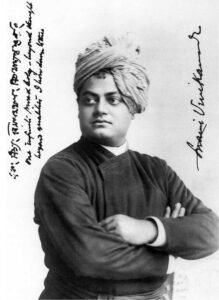
Photo: Swami Vivekananda in Chicago, 1893 (handwritten words say, “one infinite pure and holy—beyond thought beyond qualities I bow down to thee”). Credit: The Art Institute of Chicago.

When Two Worlds Quietly Merged:
I felt the full weight of that courage standing in Fullerton Hall at the Art Institute of Chicago, where Swami Vivekananda delivered his world-altering address—just one floor below George Seurat’s Sunday Afternoon on the Island of La Grande Jatte, one of my favorite paintings of all time. In that moment, two long-standing currents of my life converged: my love of art, particularly French painting, and my grounding in Vedanta, a philosophy that feels like a pair of well-worn jeans: real, practical, comforting, and quietly accepting.

Art and philosophy, France and India, my adopted country and my birthplace—under one roof, they did not compete. They conversed.

That is what happens, I have learned, when we allow the world to shape us: the Self expands to make room for more of humanity, not less.

Humble Rooms, World-Altering Ideas:
The room itself was modest—neither grand nor theatrical. Its restraint felt fitting. History reminds us repeatedly that transformative ideas rarely announce themselves with spectacle. Mahatma Gandhi, a failed lawyer, reshaped a nation. Franz Kafka, an anxious bureaucrat, altered world literature. John Harrison, a self-taught carpenter, solved the longitude problem that changed navigation forever.
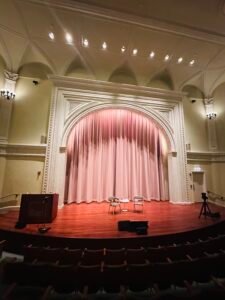
Photo: Fullerton Hall’s podium, where Swami Vivekananda delivered his address in 1893.

And Swami Vivekananda—a nearly penniless, 30-year-old monk from India—arrived in America after a long sea voyage to speak at what was then a radical gathering: a Western, Christian, male-dominated Parliament of Religions. His courage lay not just in showing up, but in declaring—without apology—that no single tradition owned the truth.

As he told the audience plainly, “If anyone here hopes that his unity will come by the triumph of any one of the religions and the destruction of the others, to him I say, ‘Brother, yours is an impossible hope.’”

Plurality as Sacred Truth:
For Swami Vivekananda, the universe’s beauty lay precisely in its plurality—in many paths converging toward one reality. He captured this vision with enduring grace:

“As the different streams, having their sources in different places, all mingle their waters in the sea… so the different paths which men take all lead to Thee.”

In a world increasingly fractured by certainty and fear, his tone feels almost maternal—firm, reassuring, deeply confident in the human spirit. From his very first words—“Brothers and sisters of America”—he transformed a formal assembly into a human family, drawing a standing ovation that lasted nearly two minutes.

Unity, for him, was not sentimental. It was a moral necessity.

He explained this idea through an image as simple as it was profound: a seed planted in the earth. Surrounded by soil, air, and water, the seed does not become any one of them. It grows according to its own law—assimilating what it needs while remaining true to its nature. So too, he argued, with religion, each tradition must grow in its own way, enriched by others, yet never erased by them. It was this insistence on growth and individuality rather than imitation that gave his words such enduring force.

A Childhood Trained in Coexistence:
His message resonated deeply with my own upbringing in Dadar Parsi Colony in Mumbai, where a Zoroastrian agiary, Hindu temples, and a mosque existed within a few hundred feet of one another. You prayed to your own gods, and then, as children, we came together to play. Coexistence required no explanation.

That innocence was shaken during the Hindu–Muslim riots of the 1990s, when curfews confined us indoors for weeks and fear fractured neighborhoods that had once lived generously with difference. It was my first encounter with how easily love for the divine can be manipulated into division.

That is why Vivekananda’s message feels so urgent today. He reminded the world that faith is not defined by labels, but by a deeply human plea for meaning, reassurance, and strength in moments of vulnerability. Faith, in that sense, speaks a universal language.

He said, “So long as there is such a thing as weakness in the human heart, so long as there is a cry going out of the heart of man in his very weakness, there shall be a faith in God.”

What he seemed to suggest was that true faith is not defined by religious labels at all, but by a deeply human plea—for meaning, for strength, for reassurance in moments of vulnerability. In that sense, faith speaks a universal language, capable of being heard by many names. 

Not Belief, but Becoming:
Vivekananda also offered a quiet corrective: religion, he argued, is not about struggling to believe doctrines, but about realizing truth—about being and becoming. What mattered was not the form of God one worshipped, but the character one cultivated. Did faith enlarge the heart? Did it make room for others? Did it foster harmony?

In his vision, religion was not about believing in God. It was about becoming more fully human—again and again, with tolerance and acceptance at the center of the effort.

Perhaps that is why his words endure. In a fractured world, Vivekananda reminds us that unity is not an idea to defend, but a way of being to practice—and that only through a serene soul can we truly see the beauty of the world, and our place within it.

Let us learn to see beauty in unity. It is the only way humanity sustains itself.

Meaningfully yours,
Anu Prabhala

PS: Swami Vivekananda delivered a series of six speeches between September 11 -27, 1893 at the World Parliament of Religions in Chicago. Read a transcript of all six speeches here. Here’s an audio recording of his first speech (~28 minutes) delivered on September 11th, 1893.

Bio: Anu Prabhala is a senior consulting writer at the World Bank and a former French instructor who has spent her career working with nonprofit organizations in international development. Inspired by Vedanta, her personal writing explores travel and cross-cultural encounters as pathways to understanding beauty, wisdom, and our shared humanity.

This article, reprinted with permission from Anu’s Substack, Imperfectly Perfect, is part of a chapter from her forthcoming travel memoir, Imperfectly Perfect: Love Letters to the World | A Travel Memoir of Beauty, Scars, and the Human Spirit. To stay informed on the publication of the book, you can subscribe to Anu’s Substack at https://imperfectlyperfect.substack.com/subscribe (Subscription is free; choose “no pledge”). 

A New Year’s Message, 2026

Amma’s New Year Message for 2026

Amma, the world-renowned spiritual teacher and a humanitarian leader from India, shared her thoughts on the current state of humanity as we welcome the new year. Her talk attended by several thousand residents and international visitors at her center in Kerala (South India) was broadcast live on YouTube. She included many illuminating stories and sublime points to help us grow spiritually, and to make our lives better. To conclude her remarks she urged everyone to follow these 12 suggestions, if we are serious about improving ourselves, our family life, and our the world. While she spoke in her native tongue of Malayalam, it was simultaneously translated in several European and Indian languages. We are pleased to share her suggestions (exhortations) with a few minor edits. 

—editor

1. Since time cannot be postponed or carried forward into the future, use it with the utmost care. Create a daily routine and adhere to it as much as possible, with discipline.

2. Write down your personal weaknesses and negative habits on paper. Dedicate one specific day each week to consciously work on overcoming each of them.

3. Strive to be more mature and refined today—at least in one aspect of life—than you were yesterday.

4. Spend a little time each day cultivating awareness of nature. In your imagination, embrace and love all of creation.

5. Awaken the selfless love within you. Let love express itself through you every day. Care for at least one plant with devotion each and every day. 

6. When praise or blame, victory or defeat comes your way, reflect deeply and remind yourself that your true Self transcends all of these.

7. Nurture the virtue of forgiveness. Generously forgive the mistakes of others—and learn to forget them as well. This will help both you and your relationships with others. 

8. Every day, devote at least a short period to performing your actions with complete awareness and presence.

9. Use all natural resources with mindfulness and care. In life, place greater emphasis on what you have been able to give, rather than on what you have received.

10. Cultivate humility and simplicity. Respect the opinions of others and move forward through cooperation and mutual understanding.

11. Meditate on the form of your Guru—your spiritual teacher (if you don’t have one, you can meditate on supreme consciousness or the flame of a candlelight)  for sometime each day. Then remain silent for a while, resting your attention in your own true nature.

12. Cultivate an attitude of gratitude for the blessings you have received in life. Also, learn to accept personal responsibility for your mistakes, sufferings, and losses—what could you have done differently to avoid them?

What we need is not a mind that revels in the little, but a mind that seeks the sublime. Awaken. Elevate yourself. And uplift others as well.

In A Winter Wonderland

In A Winter Wonderland

The winter is here, and there is snow.
I hope for a white Christmas this year.
It’s freezing; the temperature is low.
I want to go outside, but “No, no, no!”
I forgot my jacket, “Oh dear!”
The winter’s here, and there’s snow.
Through the windows I see Christmas trees that glow.
Now is the time of good wishes and cheer.
It’s freezing; the temperature is low.
The winter’s here, and there’s snow.
Sitting inside with hot chocolate, watching a holiday show.
For me, winter is nothing to fear.

By Neila Ebadian, age 11, Washington.

Augusta’s Final Dance

Augusta’s Final Dance

By Avi Sogani, age 12, California.

I sat glued to our TV on a cool California April morning beside my dad.
Almost hundred years of traditions live at Augusta National, where the Masters first began.
The aroma of freshly cut grass wafts on the gentle breeze,
as the fairways and the undulating greens shine under the perfect morning light of this splendid day.

He steps onto the final tee, holding onto his lead,
just a few swings away from winning the legendary green jacket.
His tee shot flies past the spectators,
before diving sharply into a steep bunker.

Golf is unpredictable like that, with frustration looming at every turn,
but this golfer just breathes, returns to his process, and refuses to give up.
Even in the toughest situations, he can find a way out.
He requires patience, determination, and a deep belief that he can do this.

He hits his shot over the deceiving water hazard, landing it five feet from the pin,
as the audience applauds feverishly.

His putt drips into the cup as he hoists his clenched fist in the air.
The crowd erupts like a volcano,
and he wins the tournament.

Moments like this make this aggravating game something unforgettable.

He shakes hands with the dejected runner-up,
whose quiet eyes ask the question
every golfer knows:
what could have been?

I know that feeling very well.
Next time I am out on the course, I will remind myself to be more like Rory.

By Avi Sogani, age 12, California. He writes: “I am sharing my poem that reflects my passion for the game of golf… I spend most of my weekends either playing golf in local tournaments, reading golf books, or following it on television. Watching the Masters tournament with my dad is a yearly tradition I cherish very much. This poem tries to capture the emotions I experience both on and off the course.

“I am hoping the readers walk away remembering that even the best players in the world may make mistakes in big moments. What matters is to continue to believe in yourself, stay focused and disciplined to reach your goals in life.”

From Gauls to Gummies: The International History Olympiad in Paris

From Gauls to Gummies:
A Week of History, Friendship, and Growth
at the International History Olympiad in Paris

“Education is not the filling of a pail, but the lighting of a fire.”
—William Butler Yeats.

By Sahil Prasad, grade 10, Maryland.


More Than Buzzers and Scoreboards
When you hear the words “Quiz Olympiad”, most people imagine fierce competition, flashing buzzers, and rooms filled with the silence of anticipation. And they wouldn’t be wrong. A lot of that happened at the 2025 International History Olympiad (IHO) held in Paris, France, from July 20th to 26th. The amount of time and studying that goes into preparing for the Olympiad is unparalleled. I dove into the timelines of French history, art, and literature from the Gauls living in Roman-era France to the quirks surrounding the policies of the current President Macron, not to mention the enormously confusing list of kings sharing the name “Louis.” I studied the paintings of Jacques-Louis David and the classics of stellar novelists like Flaubert and Sartre. The International History Olympiad was unlike any competition I had ever taken part in.

I started academic competitions all the way back in third grade when I played at my local History Bee and joined my school’s It’s Academic Quizbowl Club run by Dr. and Mrs. Seifter who started the club as an avenue for young kids in my area to get into Quizbowl, a sport that, as you can imagine, is quite a jump from the history we were learning at school (it wasn’t even called history until Middle School). 

Preparing for Paris
The Olympiad is run by International Academic Competitions (IAC), a company founded by David Madden (who was a Jeopardy! champion with a 19-day winning streak).

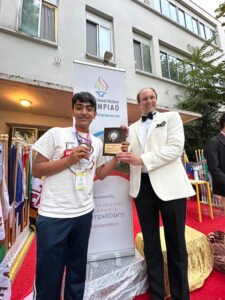
Moi and IHO Director and Former Jeopardy Champion David Madden awarded me my plaque; the top 20 players at the 2025 International History Olympiad received one.

IAC has held many Olympiads in the past. In fact, the 2025 Olympiad was my third time in the ring. This time, they had selected Paris, France as the host city for the competition. The event was held at the École Jeannine Manuel, a large school campus in Paris that could fit all the 400 plus students from many nations that came for the Olympiad. The school is right in the middle of the bustling heap that is Paris with falafel shops, pizza parlors, Thai restaurants, and Indian restaurants—a truly international setting that perfectly complemented this global Olympiad.

When Rivals Became Friends
The 2025 International History Olympiad certainly had all the stressful aspects: tense moments, tight scores, and many incredibly sharp competitors from all over the world. But over the years, for me, it has become something far more meaningful: it was an avenue where I could connect with my friends from all over the world and have fun as much with knowledge exchanges as playing games, while also competing at a prestigious and international level. It’s where I made some of the best friendships of my life.

The Olympiad brought together students from over 30 countries. For a week, we competed in a variety of events from the International History Bee World Championships (an individual buzzer-based history quiz competition) and the Art History Bee to Table Combined (an event dividing half the available points between table tennis games and history questions). Some of my most memorable moments included buzzing in on the Mask of Nefertiti, an Egyptian artwork I ignorantly perceived as “not famous enough” until it won me a crucial round in the Ancient History Bee and my buzz that earned me a silver medal in the Art History Bee, namely, answering with the correct answer of “Ophelia” (thanks Taylor), that I recognized from her position in the water from the famous John Millais painting.

The competition was fierce, but most of the time, the environment was far from tense. Between rounds, laughter echoed in the halls of École Jeannine Manuel. Students from different continents swapped stories about their schools, their countries, and their favorite historical figures. In one instance, we’d be debating who would win the overall championship and immediately switch to debating whether Haribo sour gummies were better plain or in the mix-and-match bags with marshmallows. It was in these moments that I realized the true essence of the Olympiad: it wasn’t about defeating others, but discovering what connects us all, our shared love of history and what matters most, the fact that we are all young adults!

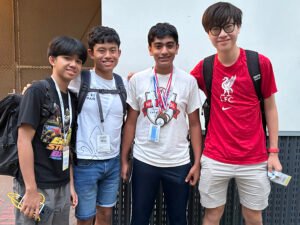
My competitors quickly became my friends. We shared strategies before events, encouraged one another during tough rounds, and celebrated together when the medals were announced. I still remember standing with players from Canada, the Philippines, and Singapore as we compared scores after a particularly close History Bee, the sense of mutual respect was clear, even in the face of competition. 

          With my friends/competitors from the Philippines

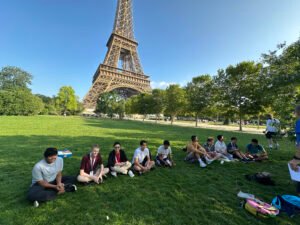
I distinctly remember the French History Bee held under the gaze of the Eiffel Tower, we were running around, playing tag, and simultaneously discussing our favorite figures in French History before the soon to be competitive match. This drastic contrast between a game of tag and an international-level academic competition event separated by mere minutes can only be found at the International History Olympiad.                           

Finalists of the French History Bee waiting to buzz to win under the Eiffel Tower

When I won two silver medals and one bronze for Maryland, it was certainly a proud moment, but what I remember most vividly is the sense of belonging. The Olympiad taught me that true success isn’t measured solely in rankings or medals but in the experiences that stay with you. Competing against some of the brightest young minds in the world challenged me to think more deeply and work harder. The knowledge I gained while preparing—and the opportunity to compete on that stage—felt like a gold medal in itself.

One of my favorite parts of the Olympiad was how it blended fun with intellectual challenge. Each day, after intense competition, we got to participate in cultural excursions and light-hearted events that let us unwind and connect beyond the game. I particularly remember my visit to the Père Lachaise cemetery on the outskirts of the city with my mother and fellow competitors. I felt a sense of gratitude toward figures like Honoré de Balzac and Félix Faure, and many of the other historical figures about whom I was knowledgeable about and hence got me to Paris in the first place to compete and won me many of the medals I returned home with.

A Community I’ll Carry Forward
The International History Olympiad wasn’t just a competition; it was a reminder that knowledge can bridge cultures and unite people from across the globe. It showed me that while history may be made up of countless conflicts and divisions, studying it together and competing can bring out the best human connections. And as I returned home from Paris, with memories of laughter and moments of triumph, I realized that the real victory was not in winning medals, but in finding a community that celebrates curiosity, fun, and knowledge. 

I can’t wait to return to the next International History Olympiad in 2027. It will be my last one as a high school student. I know these memories will last me a lifetime!

###

The International History Olympiad is held every two years, and will next take place in Summer 2027, likely in Berlin (Germany), London (UK), or Lisbon (Portugal). To learn more about the Olympiad as well as the annual National History Bee, please visit www.historyolympiad.com and www.iacompetitions.com/our-competitions. For questions about the Olympiad or any other IAC events, please contact International Academic Competitions’ Executive Director David Madden at david@iacompetitions.com.

Sahil Prasad, grade 10, Maryland, has published a number of articles in Skipping Stones.

Four Poems by Mayank Yadav

Mother

Mother is the one who cares for me
She keeps me safe, like a big tree.
Her smile is soft, her heart is kind
She always has me on her mind.

SHE teaches me what is good and what’s bad
She is always with me when I’m sad.
God says he can’t be everywhere
So he gave me a mom who always cares and shares
Who helps me grow, layer by layer.

She is important because she loves me everyday
She teaches me what’s right in a simple way.
Sure, She scolds me a little
But she’s always with me when I’m ill.

You are useless if your mom becomes sad because of you
Mom is like a diamond, always cherish and know her value.

By Mayank Yadav, age 12, Jharkhand, India.

Student life

Student life is not easy at all,
Sometimes we rise, sometimes we fall.
We smile outside and try to be strong,
But inside we feel something is wrong.

We study hard day and night,
Still grades decide if we are “right.”
We get tired but don’t give up,
We keep trying and keep growing up.

Some days we feel happy and bright,
Some days we cry alone at night.
YET every day teaches us something new—
How to be brave, and how to push through.

Student life has pain and fear,
But also hope that keeps our heads above water.
One day all our hard work will matter,
And the world will see how far we can soar.

By Mayank Yadav, age 12, Jharkand, India.

A Middle-Class Family

We don’t have gold or cars so wide,
But we have love and joy inside.
Papa works hard from morning till night,
Mummy’s care makes everything right

School bag old, but dreams so high,
Wishing stars in a small sky.
We save, we share, we sometimes wait,
Still smile together, call it fate.

No big house or fancy ride,
But strong hearts walk side by side.
Festivals simple, but full of cheer,
Happiness grows when all are near.

We may not be rich in money or fame,
But middle-class love is never lame!

By Mayank Yadav, age 12, Jharkand, India.

Under the Water

Under the water, deep and wide,
Fish and turtles swim and glide.
Crabs walk slowly on the sand,
Jellyfish move like a magic band.
Octopus hides behind a rock,
Starfish sleeps near a sea-shell clock.
Dolphins jump and play all day,
In the ocean, far away.

Waves above and calm below,
Under the sea, the magic flows.
Seahorses float, so small and sweet,
Tiny shells lie near their feet.
Bright blue fish go zip and zoom,
Dancing gently in ocean’s room.
Come with me, let’s take a ride,
To the sea world, deep inside!

By Mayank Yadav, age 12, Jharkand, India. He lives in the Province of Jharkhand, in an extended family—with his father (Ranjan), mother (Kumari Sangita), older sister (Shreya Ranjan), grandfather (Kedarnath), and grandmother (Bina Devi).

In Defense of Dirt: Rewilding Our Children

In Defense of Dirt: Rewilding Our Children
Before their Bodies Forget

 From Finnish forest floors to Michigan creek beds, the science is clear:
real dirt is medicine, memory, and the immune system’s original teacher

By Thom Hartmann, author, speaker, activist, and educator

I grew up on the edge of Lansing, Michigan, with a stream just down the road and woods that felt like a secret frontier. We all did: the neighborhood kids, barefoot in the damp grass after rain, boots mucked up with creek-silt, hands scrubbed raw from climbing fallen logs and digging in the undergrowth. Getting in the dirt was part of childhood. We didn’t ask permission from microbes.

So when I read the recent report in The Guardian about Finnish nursery experiments transforming children’s health by simply letting them play in real soil, sand, leaves and forest-floor, I felt the past crash into the present and I knew again that the story of our species and our health lies in that innocent, messy contact.

In Finland, at a daycare center in Lahti (north of Helsinki), the researchers from the Natural Resources Institute of Finland adopted a radical experiment: rip out the asphalt, dig into the soil, roll out a live carpet of forest-floor moss and blueberry bushes, build compost heaps for children to feed, invite the kids to play, dig, muddle, get their hands in it.

The result, in a two-year study of three- to five-year-olds, was striking: children in the “rewilded” yards had fewer disease-causing skin bacteria (like Streptococcus) and showed stronger immune regulation (increased T-regulatory cells) within weeks. Gut microbiomes were healthier, inflammatory-associated Clostridium levels dropped.

This is the antithesis of today’s “modern” societal perspective on childhood and nature.

On the one hand, we have the modern obsession with pristine, sanitized lives: rubber-surfaced playgrounds, plastic mats, antibacterial everything. On the other, there’s the simple fact that our inner biology, our immune systems, our gut and skin microbiomes, were forged in the wild: the wild of forest floors, streams, soils, plants, bugs.

As I argued in my earlier essay “It’s All One Thing – The Story of the Worms” here in Wisdom School, our estrangement from that substrate is the seed of auto-immune disorders, of chronic inflammation, and a body that’s forgotten it’s actually part of nature.

In Michigan I was lucky: the woods and stream were mine for the exploring. I remember fingers crawling over moist logs, the smell of leaves turning, the damp cold run-off water slipping under my boots. I didn’t know at the time that those experiences were more than play: they were calibration.

They were training my immune system, teaching my skin and gut to know what nature looked like and smelled like and felt like. To know that dirt is not an enemy. And those childhood experiences are probably why I’ve never been troubled by autoimmune disorders or asthma.

So let’s call this what it is: a radical restoration. Not of some exotic wilderness, but of our lost contact with the natural microbial terrains that co-evolved with our species. The Finnish results are more than a Kindergarten trend; they’re a signal of what our children—and we all—are missing.

Here are some of the stakes:

  • When kids play in dirt rich with soil microbes, their immune system steps into a healthier balance: fewer disease-causing bacteria on the skin surface, greater regulation of internal immune responses.

  • The “outer layer” of biodiversity—soil, plants, forest floor—directly influences the “inner layer” of biodiversity in our bodies, our skin, gut, and airways. This is co-evolved, not incidental.

  • The modern shift away from exposure—to “sterile” play surfaces, indoor confinement, sanitized surfaces—may appear benign, but it’s been quietly shaping the epidemic rise of allergies, auto-immune disorders, and inflammatory diseases that both disturb the quality of life and can shorten lifespan itself.

  • This is not just personal wellness: it’s ecological and societal. The health of children, the immune burdens we carry, the resilience of future generations: all of this ties back to whether we let the next generation touch the living earth.

  • In the Finnish classroom yard they said: “We’re moving the action from inside to outside. We want to show the children nature so they learn about it.”

That sentence is packed. Show the children nature. Let them learn through contact, through play, through mess. Not as a museum piece, not as a “nature corridor” behind a fence, but as the ground they run on, dig in, climb across, whose bugs and fungus mix with theirs.

So, I want to issue a personal call to you—if you have children, nieces, nephews—or if you’re planning for grandchildren—or if you’re simply human, who used to feel the dirt under your fingernails and the creek cold on your shins—do this: Let the next generation get messy.

Plant a compost heap. Bring real soil into the sandbox. Create a border of moss and stones. Let the rain puddle, let the bugs crawl, let the children burrow. Let the forest floor not be exotic but ordinary.

I remember that stream down the road from the house I grew up in, the woods on the edge of Lansing, the sticky Michigan clay, the little fish, frogs, and crawdads under rocks, the mud mixing into water. I remember coming home with smudged socks, grass stains and a face kissed by sap.

I didn’t know at the time that I was feeding my immune system. I simply knew I was alive and it was a thrill.

We’ve forgotten that aliveness. Our culture has prized immaculateness, separation from the “dirty” wild, the exclusion of microbes like we exclude strangers. Yet the wildness is in us. The soil is in us. We’re made of the same living matrix as the tree roots and the beetles and the moss. Broken contact with that matrix isn’t harmless: it’s a literal loss.

In the wise old words I referenced in “It’s All One Thing”: “When we remove ourselves from that web of life, we do so at our own peril.”

The Finnish story is not just cute or scientific: it’s urgent. Rebuild our contact with the living earth. Let children scoop sand and soil, let them bury their hands, let them build mud-cakes like Aurora in Finland’s day-care. Laugh as they smear soil on their faces. It’s not chaos: it’s calibration.

Yes, modernization has brought us many gifts. Clean water. Sanitation. Vaccines. But modernization taken too far, with too much separation from our biological roots, leaves us with immune systems that misfire, bodies that mistake harmless soil microbes for threats, children who never taste actual dirt. The Finnish experiment is clear: get back to the soil, get back to the forest floor, get back to the messy, ordinary earth.

And the earth—our living earth—benefits too. More forest-floor carpets. More compost heaps. More kids playing outside, fewer rubber mats, fewer sterile boxes. We begin to treat biodiversity as not just glamorous (rainforests, coral reefs) but local (yard patches, old tree stumps, rain puddles). We begin to remember that our health is tied to the health of that biodiversity.

So my invitation to you: On your next weekend, find a patch of ground the kids (or you!) can mess with. Dig into it. Feel the soil. Let a leaf rot into the compost. Let worms do their work. Let the world pull you back. Because we’re not apart from nature: we are nature. And when we pretend otherwise, we hurt ourselves and the world around us.

It’s time to stop treating microbes as abstract threats or invisible villains. They are—and have always been—our companions, our allies, our ancestral family. The Finnish children’s laughter in the sandy forest-floor yard is our ancient laughter too.

Let’s dig in.

—Thom Hartmann, educator and commentator, is the author of many respected books. Reprinted with permission. To receive new Wisdom School posts you can become a free or paid subscriber of this reader-supported digital publication, The Wisdom School: What It Means To Be Human. All Wisdom School articles are free and available to everyone. Copyright by Thom Hartmann, 2025.

The Humane Hoax

The Humane Hoax: Animal Industry’s Labels and Lies

By Hope Bohanec, author and activist, Oregon

As consumers become aware of the animal agriculture industry’s cruelty and environmental impact, clever industry marketers adapt with “humane” labels, small-scale tall tales, and other feel-good falsehoods. The term “humane hoax” is defined as new language and labels in animal product marketing that convey a false narrative of humane treatment and sustainable management of farmed animal operations. The marketing language and euphemistic labels tell a story of a supposed distinction from conventional animal products. But the reality on the ground, in the manure pits, during the mechanical milking, and inside the terrifying slaughterhouse, is fundamentally unchanged, despite promises to consumers of something new. Humanewashing and greenwashing are becoming more prevalent and pervasive than ever.

Also encompassed in the concept of the humane hoax is the new trend of people attempting to “do-it-yourself” with backyard farmed animal raising and slaughtering, generally with good intentions, but all too often, with cruel consequences. It has never been more important to educate people on the truth behind the industry lies, and people are hungry for the truth.

Overview:

In the time since I wrote the first book on the subject of the humane hoax, called The Ultimate Betrayal: Is There Happy Meat?, consumer awareness of the suffering of farmed animals has grown exponentially and so has the “alternative” animal product industry. “Cage-free,” “Certified Humane,” and other comforting labels are no longer elusive—dusty items only seen in the back corners of health food stores. They are now as common and numerous as cattle on a feedlot, spotted in common places like Walmart and your local coffee shop. In 2010, eggs labeled cage-free were a mere four percent of the market; that had risen to sixteen percent by 2017. The industry predicts that to meet consumer demand, cage-free production will be seventy-five percent of the market by 2026.

It is a hopeful sign that consumers are demanding better treatment for animals, but the actual difference in the life and death experience for a cow or a chicken with humane labeling is sadly minimal. I have done extensive research on this issue, interviewed numerous stakeholders, and personally visited multiple animal operations, and concluded that these unregulated labels mean very little, if anything at all, for the animal’s experience. I have examined this particular area of farmed animal advocacy, having written the first, and one of the only books on the topic, and having been professionally involved in the field for over two decades. I found, for example, that comparing hens confined in battery cages to those in cage-free barns bodes only slight improvements and those differences can vary widely from farm to farm.

Animal activists have time and again exposed the horrors of egg-laying hens crammed tightly in battery cages, with only the space comparable to a crowded elevator to live in. In response, the shrewd marketers representing the egg industry have distorted the story, altered the labels, and changed consumers’ conceptions. Instead of rejecting the inherent cruelty of commercial egg production, shoppers have been deceived by the fictitious choice of a seemingly “humane” alternative of “cage-free”—but the reality for the birds, however, is bleak.

The difference in the experience of a bird in a conventionally managed operation versus a cage-free one is negligible. Despite the optimistic label, most chickens in cage-free egg facilities still live in miserable overcrowded conditions in massive windowless buildings. Their eyes and throats burn from the ammonia gas released from their accumulated waste. They never feel the sun on their wings or experience a simple satisfying dust bath. Irrespective of any label, all the chickens still go to a brutal slaughter at a very young age. We must not let the deception of “new” marketing eclipse the fundamental cruelty of animal agriculture. The perception invoked by the “cage-free” label—that the birds are now living a good life—is a decidedly false one, a mirage created by the interaction of euphemisms and consumer hopes in the absence of accurate information.

As animal agribusiness attempts to wash the blood off its hands with a new fabrication of fresh farming methods, consumers, activists, and other caring people must educate themselves about the new narratives that the industry continues to weave. This anthology features a range of knowledgeable authors who are at the forefront of this marketing shift, chronicling every aspect with in-depth analyses and intellectual rigor. Among other topics, the book explores how so-called alternative animal agriculture intersects with feminism, affects the environment, is represented in the media, and impacts human and non-human communities alike.

On Contributors to the Anthology:

This anthology has an impressive list of contributing writers who are a diverse assortment of activists, academics, authors, and campaigners. They range from radical protesters to educating advocates to professional scholars in the academy. Of the seventeen expert contributors, eight are published authors, five leaders of advocacy organizations, eight have Ph.D. degrees, and three have masters. What they all share is a forward-thinking vision and common concerns with animal agriculture’s marketing shift from big to small, from industrial to local.

The Humane Hoax contains essays by noted animal rights and environmentalism figures like Carol Adams, Robert Grillo, Sailesh Rao, Karen Davis, and Christopher “Soul” Eubanks. Some of the contributors have done extensive peer-reviewed research on the subject while others have been working with farmed animal advocacy for decades thinking deeply about this issue. Still others are rescuing farmed animals directly from local and small-scale farms, witnessing first-hand the undeniable suffering that is commonplace in animal farming.

The Humane Hoax: Essays Exposing the Myth of Happy Meat, Humane Dairy, and Ethical Eggs; edited by Hope Bohanec. The book is available as a paperback and also as an e-book from Lantern Publishing & Media; lanternpm.org.

The Silent Conversation Between You and Your Bones

The Silent Conversation Between You and Your Bones

Every Impact Is a Message: Stay Alive, Stay Strong, Stay in Motion

 By Thom Hartmann, Wisdom School

As Louise and I have aged (our 54th wedding anniversary is in two weeks), we’ve noticed that one of the biggest challenges is keeping our posture straight and our bones from getting brittle. There’s science behind this challenge, and it gives us all suggestions for “keeping young.” 

Bone is one of the few tissues in the human body that remains alive and dynamic from birth to death. It’s not the rigid, inert structure most people imagine when they think of skeletons. In fact, it’s constantly growing, dying, dissolving, and rebuilding itself through a delicate dance between two main kinds of cells—osteoblasts and osteoclasts. 

This balance is what keeps us upright, protects our organs, and allows our muscles to move us through life. But as we get older, the harmony between building and breaking begins to shift, and the results can be devastating. Understanding how that process happens—and how we might slow or reverse it—is one of the quiet frontiers of aging science.

Bone is built primarily by osteoblasts, the construction workers of our skeleton. They take raw materials—calcium, phosphate, and collagen—and create new bone matrix. This matrix starts out soft, like scaffolding, then mineralizes into the hard tissue we recognize as bone. Opposing them are osteoclasts, which act more like demolition crews. They dissolve old or damaged bone so it can be replaced. 

In a healthy adult, these two systems are in balance: every bit of bone that’s broken down is replaced by new bone. But that balance depends on a complex interplay of hormones, mechanical stress, and nutrients that becomes harder to maintain with age.

When we’re young, our bodies prioritize growth and repair. Hormones like growth hormone, estrogen, and testosterone all signal bone-building cells to stay active and reproduce. Even the act of moving—walking, climbing stairs, carrying groceries—tells our bones to stay strong. 

Osteoblasts thrive on impact; they literally sense mechanical stress and respond by building more bone where it’s needed. That’s why astronauts lose bone density in zero gravity and bedridden patients lose it quickly in immobilized limbs. Bones are designed for stress. They grow from it, adapt to it, and depend on it.

But aging quietly changes the equation. By the time most people reach their 40s or 50s, osteoblasts start slowing down while osteoclasts keep right on working. Estrogen and testosterone, which protect against bone loss, begin to drop. In women, the sharp decline in estrogen during menopause often leads to an acceleration of bone loss so dramatic it can reach one to two percent per year. 

The result is a net thinning of the bones that can culminate in osteopenia or osteoporosis. What’s more, osteoblasts themselves become less responsive to mechanical stress and less efficient at mineralizing new bone, while their numbers dwindle with each passing decade.

Yet, there’s another layer to this story that is both hopeful and cautionary. Bone cells are not fixed in number; they arise from progenitor cells—stem-like precursors in the bone marrow and periosteum (the thin tissue surrounding bones). These progenitor cells can, under the right conditions, become new osteoblasts. 

Exercise, especially high-impact weight-bearing exercise, stimulates their differentiation. Nutrients like vitamin D, calcium, and magnesium fuel the process. Even exposure to sunlight, through its effect on vitamin D synthesis, plays a critical role in signaling these cells to mature. In a very real sense, every step we take outdoors in the sunshine is a small act of bone regeneration.

On the other hand, disuse and a sedentary lifestyle send the opposite message. When bones aren’t stressed, the progenitor cells shift toward becoming fat cells instead of bone cells, and osteoclasts take over the stage. 

This explains why modern sedentary living, coupled with diets low in essential minerals, has created an epidemic of bone fragility even among people who think of themselves as healthy. 

It also explains why impact—whether from walking, jumping, or resistance training—isn’t just good for muscle tone; it’s a direct message to your bones to stay alive.

There’s a growing body of research exploring how bone regeneration might be enhanced as we age. Some of it focuses on pharmacological ways to stimulate osteoblast activity or block osteoclast overactivity, like the bisphosphonate drugs or parathyroid hormone analogs now used for osteoporosis. Others look at stem cell therapies that could replenish the aging pool of bone-forming cells. 

But many of the most effective tools we already possess are natural. Regular resistance training, adequate protein intake, and maintaining proper levels of vitamin D and K2 can have profound effects on bone density. The simple act of impact—bones striking the ground, muscles tugging on tendons, joints bearing weight—remains the single most powerful way to keep bones young.

The idea that bone “knows” when it’s being used and responds accordingly is one of nature’s most elegant feedback loops. It means that our skeleton is not a fixed thing but a living organ that senses and adapts to our behavior. 

When we stop moving, bones interpret it as a signal that they’re no longer needed and begin to fade away. When we challenge them, they thicken, harden, and renew themselves. Even in old age, this feedback loop can be reawakened, though the gains are slower and more fragile than in youth.

In the larger metaphor of life, bone regeneration is a quiet but powerful reminder of resilience. Every day, millions of microscopic breaks form in our skeleton, and every day they are healed. It’s a never-ending cycle of destruction and renewal that mirrors our emotional and spiritual lives. The same principle applies: stress and impact, handled well, make us stronger. Avoiding stress entirely—physical or emotional—leads to a kind of decay. Growth comes from the right kind of pressure.

So while supplements and science continue to explore the biochemical angles of bone regeneration, the most profound lesson may be a behavioral one. Move every day. Load your bones. Walk, climb, stretch, lift, push. 

Feel the impact of your feet on the ground, because your bones are listening. They respond to every signal of life you send them, even late into old age. They want to grow. They’re built to grow. But they require our participation—the literal weight of our will—to keep doing it. 

In the end, strong bones are not just the foundation of our physical structure but the embodiment of our relationship with gravity, effort, and resilience itself.

—Thom Hartmann, educator and commentator, is the author of many respected books. Reprinted with permission. To receive new posts you can become a free or paid subscriber of this reader-supported digital publication, The Wisdom School: What it Means to be Human, where all articles are free and available to everyone. Copyright: Thom Hartmann, 2025.