Category Archives: Asian American

Hazel Lee, Chinese American Fighter Plane Pilot

Hazel Lee, Chinese American Fighter Plane Pilot

By Fanny Wong, New York

Race you to the corner!” Hazel challenged the boys.

The boys groaned, but maybe, just maybe, they could beat her this time.

They didn’t. Beaten again by this scrawny young girl. She also played handball and cards with them. Guess who won?

Hazel’s parents, immigrants from China, met and married in Portland, Oregon. Hazel, the third of eight children, lived with her family in Portland’s Chinatown. It was the only community the Chinese were allowed. The children went to Chinese school on Saturdays to learn to their language and culture.

Hazel was good at writing and speaking Chinese, but a traditional Chinese girl she wasn’t. Her voice was too loud, her laughter too boisterous. She was handy and fixed things around the house. Not ladylike at all.

When Hazel was a teenager, a friend took her up in a biplane at an air show. Her eyes danced, face flushed, and her heart raced with excitement as the plane lifted off. The rumbling motor and whirring propellers were music to her ears. She was as free as a bird high up in the sky. Hazel’s dream soared with the plane. She knew she belonged in the cockpit of a plane.

Now that she had a dream, she had to find a way to make it come true.      

First, she had to find a job after graduating from high school in 1930. The only job she could find was as an elevator operator in Liebes department store in downtown Portland. Up and down she took customers from floor to floor. She stuck to the boring job her job to save money for flying lessons.

Hazel’s parents turned pale when she enrolled in a flight school in 1931. It was not what a woman did. It was not what a young Chinese woman did. What would the Chinese community think of their daughter!

“You’re not afraid of the water, you’re not afraid of the wind!” her mother lamented. It was her way of saying Hazel was not scared of anything. Eventually, her parents let her try something different, be someone different from what the Chinese community expected of her.

Hazel went through the same training as the men at the Chinese Aviation School in Portland. The mind-boggling controls, dials and levers did not intimidate her. She lived for the moment when the plane swooped like a swallow over sea and land. The higher the plane soared, the freer she was.

Hazel passed all the flight tests in a year and received her pilot license in 1932. At that time, only one percent of American pilots were women. In those days, people thought a woman should not fly a plane. How could a woman handle an emergency? Too emotional! Too nervous! And whoever heard of a Chinese female pilot? Hazel couldn’t find a pilot job.

In response to Japanese aggression against China in 1932, Hazel journeyed to China, hoping to join the Chinese Air Force. But again, she was frustrated that it did not accept women pilots. In the end, she settled in Canton and flew for a private airline.      

After returning to the United States in 1938, Hazel waited for years before she could prove herself. In 1942, during WWII, when male pilots fought overseas, the military needed more pilots at home. Some 25,000 women applied for the program. In 1943, with 35 hours of flying time and a medical exam, Hazel was one of 1097 women pilots accepted by the new Women Airforce Service Pilots Program (WASP) to prove their skills.

Like the other trainees, Hazel had to pay her way to Sweetwater, Texas for training. Their pay was $259 a month, with no benefits. She was among the select few and the only Chinese. For six months, in the dusty and hot Avenger Airfield, she endured sand in her hair, snakes and spiders even indoors. But she learned to fly different military airplanes, parachuting and making emergency landings. She studied all the parts of the plane, rudder bar, stick and struts. When she learned to take apart the engine and put it back together, she was as proud as if she had won a trophy.

One time, Hazel’s instructor made an unexpected loop. Her seat belt did not work properly. She fell out and parachuted safely. On the ground, she dragged the parachute behind her all the way back to the airfield. The incident didn’t faze her.

Another time, Hazel’s plane’s engine cut out in mid-flight. She made an emergency landing in a wheat field in Kansas. A farmer chased her, thinking the Japanese had invaded Kansas. She convinced him that she was flying in a U.S. flight program. Hazel knew no matter how American she was she would be looked at differently. But this incident did not discourage her. No, she might look like the enemy, but she was thoroughly American.

Easy-going Hazel made many friends. At 31, she was eight to ten years older than the rest of her classmates. They soon forgot she looked different, that she was the only Chinese they knew. Her calm, fearless piloting skills impressed them. They loved her irrepressible sense of fun, as when she wrote their nicknames in Chinese on their planes with lipstick. Her personality bubbled over like a pot of soup. Her friends knew she was nearby when they heard her laugh, “Heeyah! Heeyah!”

Although Hazel graduated from the WASP program in 1943, the U. S. Government did not allow women in combat roles at the time. Instead, being one of the best graduates, she was chosen for Pursuit School at Brownsville, Texas. There, she trained with 134 other graduates to fly fighter planes, such as the Pursuit and the P-51 Mustang, high powered single-engine jet planes. After the training, she delivered the new planes from factories to airfields all over the North America. If anything was wrong with them, she was among the first to know.

Hazel accepted dangerous missions, such as flying in open cockpit planes in the winter, shivering in many layers of clothing. Another dangerous job was flying a plane that served as a “tow.” A large target sleeve was attached behind her plane for gunners to practice shooting from the ground. She cringed when bullets whizzed by the cockpit, but she kept flying these dangerous flights. Sometimes, after the practice flight, she found holes in the tail of the plane.

Hazel crisscrossed the country in wartime to deliver planes that would be used in combat. She flew seven days a week, bone-tired, but proud of her non-combat role in wartime and took every challenge in strides.

As Hazel zoomed cross the sky, she wished her Chinese community could see her in an unconventional job, and doing it well!

On Thanksgiving Day, 1944, Hazel delivered a plane-a P-36 King Cobra from Niagara Falls, New York to Great Falls, Montana. As her lane approached the airfield, a plane above her lost radio control reception. The pilot did not know the position of Hazel’s plane. The two planes collided and burst into flames. The other pilot had non-life-threatening injuries., but Hazel died of her wounds two days later.

Because the WASPs flew military planes as civilians, they received no military benefits. Hazel’s family had to pay for her remains to be shipped home. After resistance from the River View Cemetery in Portland to bury a Chinese person there, Hazel’s family sought help from an Oregon senator, who appealed to the White House. The cemetery relented and Hazel was buried in a gentle grassy slope. Her grave marker was a polished slab of red granite with a winged diamond etched above her name, a symbol of the silver WASP wings pinned on the uniforms of American women who flew in WWII.

In 2004, the State of Oregon inducted Hazel into the Aviation Hall of Honor. Hazel and the other WASP pilots would not be recognized with military status until 1979. In 2009, President Obama awarded surviving and deceased pilots the Congressional Gold Medals.

Comfortable in a career dominated by men, Hazel not only lived her dream but proved a woman could fly a fighter plane as well as any man. She didn’t expect to make history. As the first Chinese American women to fly for the U. S. military, she was doing what she loved, for a country she loved.  

—Fanny Wong, Chinese American Author, New York. She is a frequent contributor to Skipping Stones Magazine.

HHR’s 2024 Essay, Art & Multimedia Contest Winners

Hindus for Human Rights and Skipping Stones announce the
2024 Essay, Art & Multimedia Contest Winners!

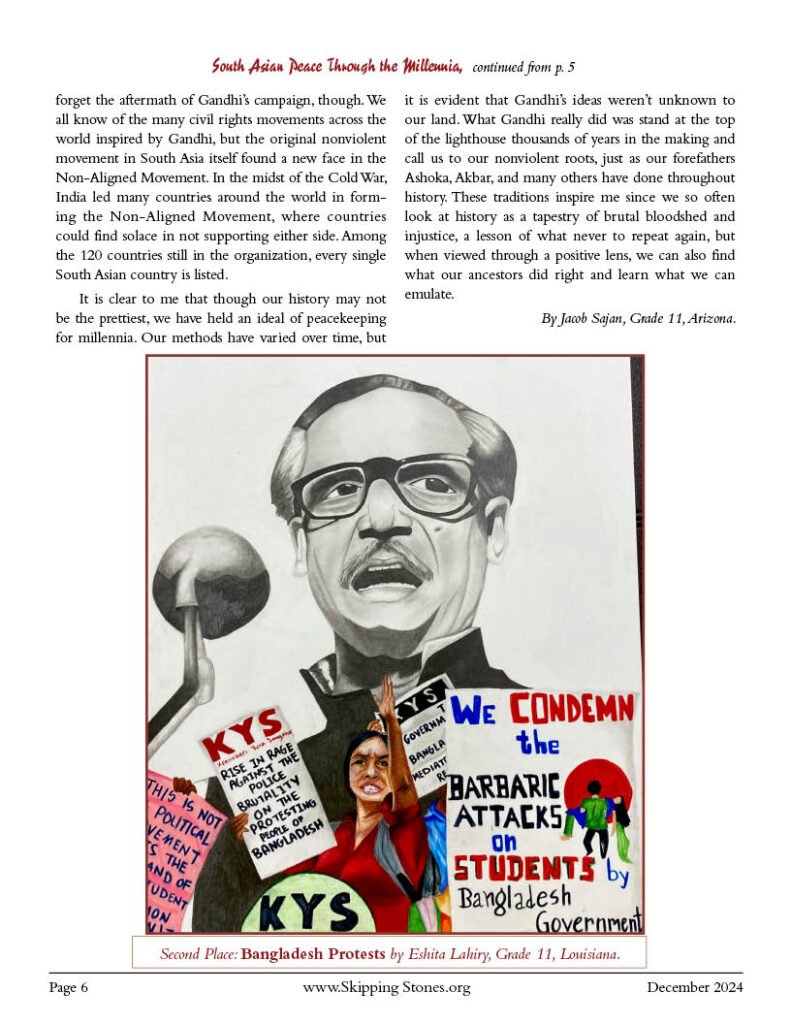
This year’s contest invited students in grades 6-12 to explore the inspiring traditions of peacemaking in South Asia and its diaspora. We asked young writers and artists to reflect on the question, “As a South Asian, what traditions of peacemaking do you find inspiring?”

Violence and conflict have long been a part of South Asian and South Asian diaspora history, literature, and storytelling, but so have different versions of peacemaking. The contest invited students to take inspiration from any South Asian history, literature, poetry, peace activists, or peace movements that focus on concepts or ways to address peace, justice, and democracy.

The contest received a diverse array of essays, artwork, and multimedia submissions showcasing a wide range of South Asian histories, movements, and traditions that advocate for harmony, justice, and democracy. These submissions were heartfelt, creative, and thought-provoking, demonstrating the power of young voices in envisioning a more peaceful world.

Our Hearty Congratulations to all the winners!

Essay Winners:
* 1st Place: “With Andal Comes Grace” by Lekha Kolli, grade 12, Virginia.
* 2nd Place: Anti-Sikh Riots and Ongoing Traditions of Peacemaking by Ira Tiwari, grade 11, Illinois.
* 3rd Place: “South Asian Peace Through the Millennia” by Jacob Sajan, grade 11, Arizona.

Art & Multimedia Winners:
* 1st Place: Narrated Bharatanatyam Performance by Deekshitha Jayaprakash, grade, 11 Minnesota. (Please click on the link to view the performance!)
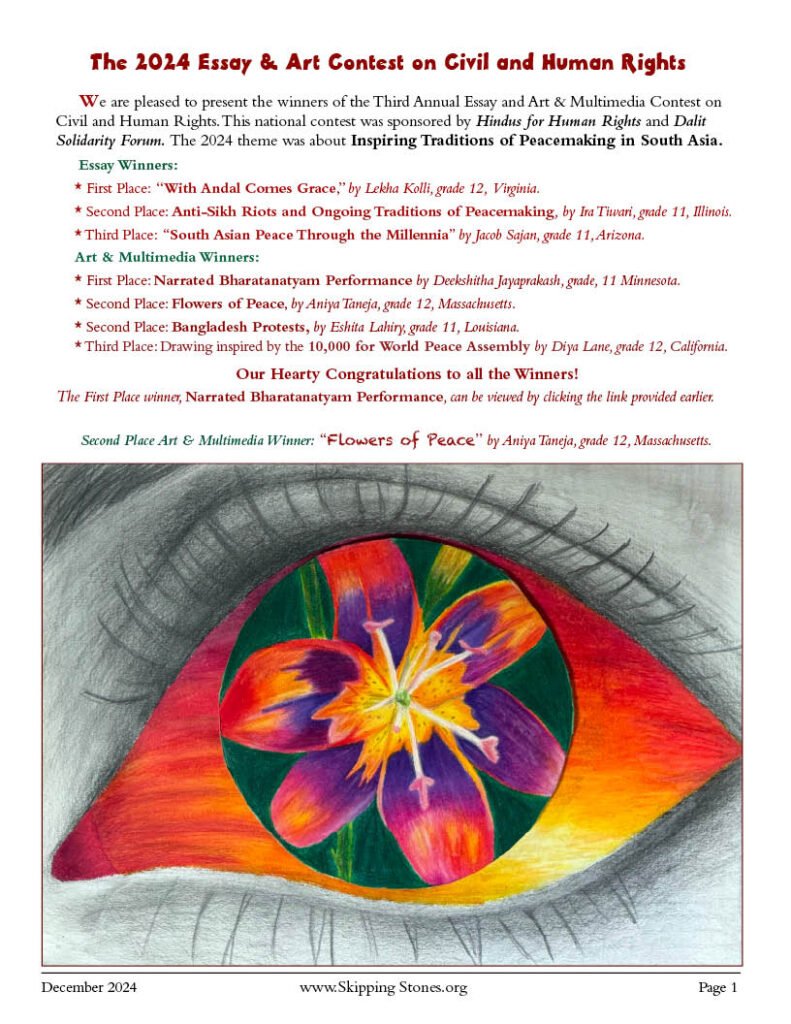
* 2nd Place: Flowers of Peace Illustration by Aniya Taneja, grade 12, Massachusetts.
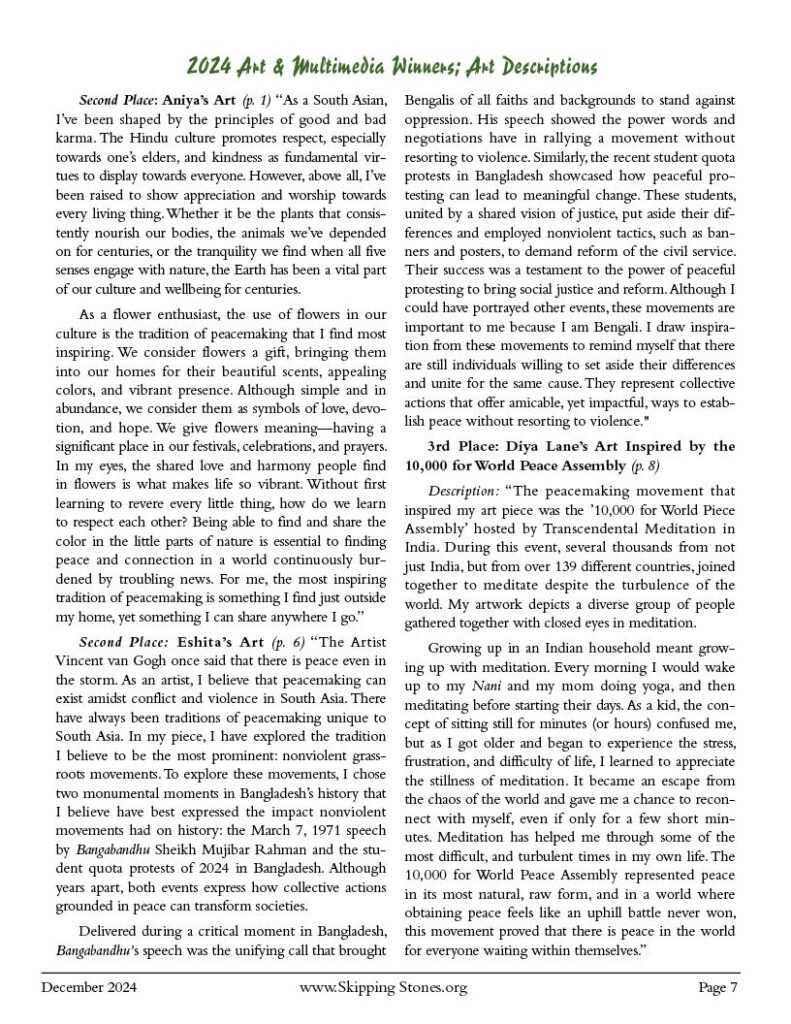
* 2nd Place: Bangladesh Protests by Eshita Lahiry, grade 11, Louisiana.
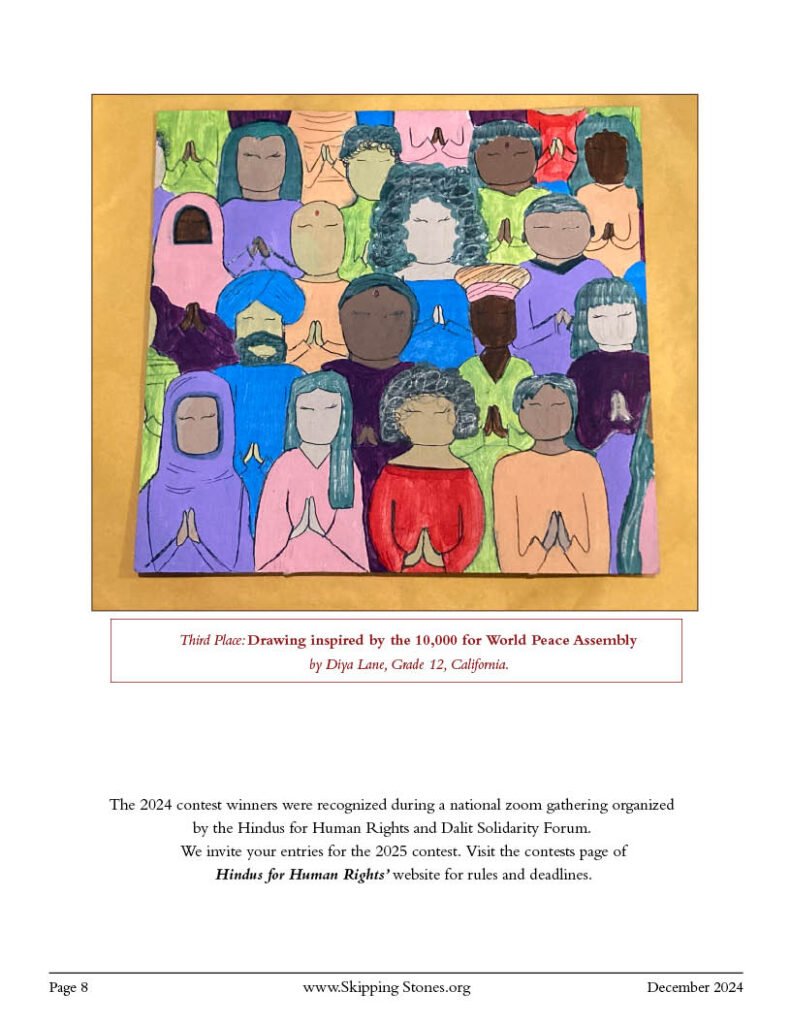
* 3rd Place: Drawing inspired by the 10,000 for World Peace Assembly by Diya Lane, grade 12, California.

Download the Winning Entries (This is a 5 MB file) by clicking here!


The Power of Veganism

The Power of Veganism: On the Vegan Way of Living

By Prof. Joanne Kong, author and speaker, Virginia

This is a slightly condensed transcript of a powerful presentation made by author and speaker, Joanne Kong, to a gathering of Eugene Veg Education Network (EVEN) on May 24, 2024.
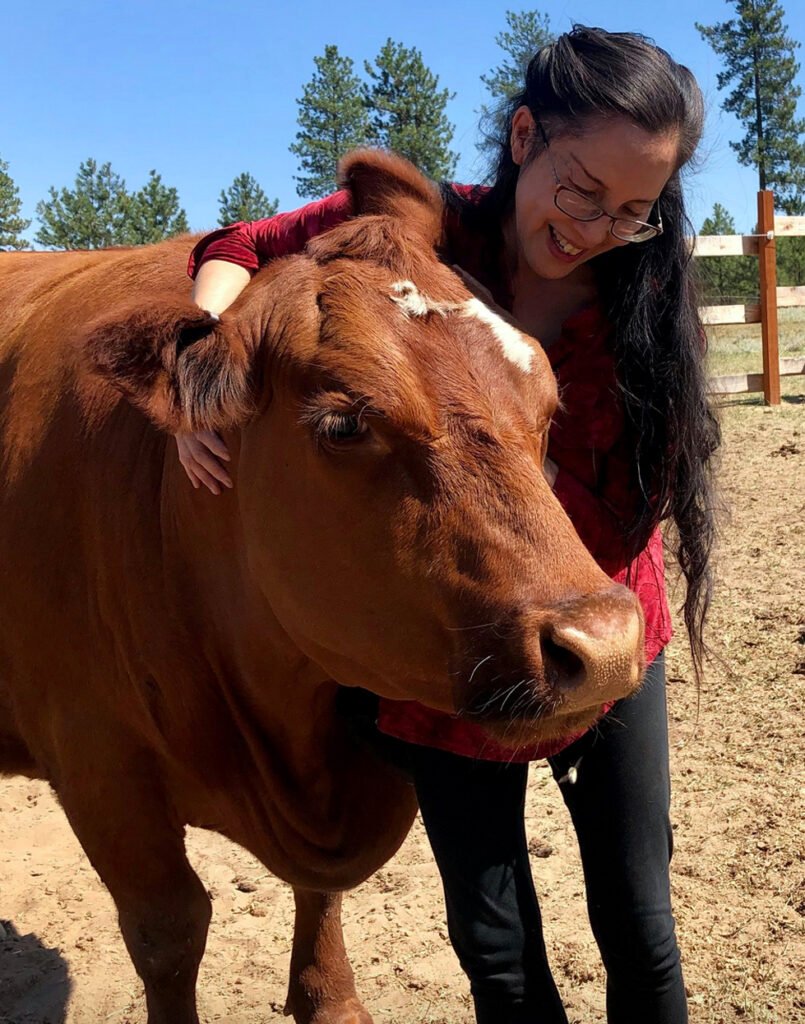
Prof. Joanne Kong with Olive, at River’s Wish Animal Sanctuary in Spokane, Washington

We are dealing with many challenges at present. Some of them affect our very existence—climate change and its effects all around us—increasing numbers of catastrophic weather events, rising temperatures, losses in the natural world, and the looming danger of rising sea levels. And with the COVID-19 pandemic (that we went through for a few years), out of necessity, drastic changes to our daily habits and livelihoods caused us to re-examine the ways in which we interact with others. We still live under social tensions, racial divisions and harmful political divisiveness. No wonder we feel powerless; unable to change these circumstances. We feel as if the problems are too big for us to solve, and that we can’t make a difference.

How do we heal the world? How do we rise above these serious problems, and find strength, as well as inner peace?

I believe that we have arrived at crossroads in our lives, where the choices we make WILL determine our shared destiny. I’m not minimizing or discounting humankind’s extraordinary achievements. But I want to say that the threats to our sustainability are very real, and affect many spheres of our existence—physical, mental, emotional and spiritual, and also our Earth, and other beings with whom we share this planet.

I suggest that a VEGAN lifestyle offers a way to heal.

Food We Eat:

Plant-based eating has been identified as a definite, top trend in recent years. That’s evident in just a casual trip to the grocery store! Veganism is one of the fastest-growing movements today. While physical health is certainly a primary reason why many people decide to go plant-based, I want to point out that veganism has unique power to impact so many aspects of our lives. I hope that you will gain deeper insights into your own values and what are some of the influences that have shaped your food choices, whether you consume animals or not. I wish to discuss aspects of our food consumption in relation to the Natural World, Our Perceptions in Regards to other animals, our own Physical Health, and the State of our Mindfulness and Spirituality.

Over the course of humanity’s existence, there has emerged a growing loss, of the sense of just how deeply connected we are to the natural world. COVID-19 was like a spiritual “alarm bell” that we have reached a state of disconnection, with human influence reaching its point of greatest damage upon the planet. The growing risk of zoonotic diseases is directly linked to the widespread environmental damage caused by us human beings, which has brought us into increased contact with wildlife. As David Quammen, author of Spillover: Animal Infections and the Next Pandemic, writes: “We invade tropical forests and other wild landscapes, which harbor so many species of animals and plants—and within those creatures, SO many unknown viruses…. We disrupt ecosystems, and we shake viruses loose from their natural hosts. When that happens, they need a new host. Often, we are it.”

Dr. Anthony Fauci says: “It boggles my mind, how when we have so many diseases that emanate out of that unusual human-to-animal interface, that we don’t just shut it down.” We hear about animal wet markets, but that is only the tip of the iceberg. Industrial factory farms, spreading around the world and accounting for more than 98% of animals killed for food in the USA, are a global health threat.

Dr. Michael Greger, infectious disease specialist, has been sounding the alarm on pandemics for over a decade. He likens each animal to a test tube, capable of brewing up the next new virus. “When we overcrowd animals by the thousands, in cramped football-field-size sheds, to lie beak to beak or snout to snout, and there’s stress crippling their immune systems, and there’s ammonia from the decomposing waste burning their lungs, and there’s a lack of fresh air and sunlight—put all these factors together and you have a perfect-storm environment for the emergence and spread of disease.”

At least 75% of emerging infectious diseases can be traced to animals, and the escalating rise of antibiotic-resistant bacteria in factory farms is already a global menace. If we remain complacent and fail to see COVID-19 as a wake-up call to rapidly move away from industrialized animal agriculture, it will only be a matter of time before more, potentially deadlier pathogens arise.

Environmental damage is occurring on a vast scale—through fossil fuel extraction, mining, drilling, logging, construction, urbanization, and most destructive of all, the livestock industry. As Peter Singer, philosopher at Princeton University and author of the groundbreaking book, Animal Liberation, has noted, “The kind of secret source of greenhouse gas emissions that no politicians are talking about at the moment are the emissions that come from the livestock industry.” While cutting emissions from energy and transportation, and making a decisive shift away from fossil fuels to renewable and alternative energies are vitally necessary, this will NOT be enough to successfully combat climate change, especially in light of projections that global meat consumption could rise as much as 75% by 2050 due to population growth, urbanization and rising incomes.

Livestock production currently accounts for at least 51% of anthropogenic greenhouse gases; that’s 4 times the amount of emissions from all modes of transportation combined, worldwide. The one major global initiative that will have more rapid and greater impact is to bring about planetary healing through a profound transformation of our food production systems, in particular, by ending the mass killing of animals for food. This must be nothing less than a broad-scale intervention for the health of our planet. Ilmi Granoff, Director of Sustainable Finance at ClimateWorks Foundation, said: “Forget cars. Forget coal. The fastest way to address climate change would be to dramatically reduce the amount of meat people eat.”

We can cut our carbon footprint in half, just by going vegan.

In one of the most comprehensive studies showing the connections between food consumption and the environment, a research team (headed by Dr. Marco Springmann at the University of Oxford, in 2018) concluded that reductions in meat consumption of 75 to 90% in Western countries would be necessary to avoid the ravaging impacts of climate change. Furthermore, it’s startling to realize just how massively inefficient our current food production systems ARE—meat and dairy industries are enormously water-intensive, accounting for at least a third of global water usage. Almost 80% of the Earth’s usable agricultural land is dedicated to livestock, yet the resulting yield is less than 20% of all calories produced, worldwide.

Why this disparity? Farmed animals eat huge amounts of food over their short lifespans. At least 70% of that energy is lost, through the animal’s metabolism and waste. We become SECONDARY consumers of those plants. It is far more efficient to gain nutrition from the source, and eat plants directly! If we made a decisive global move towards plant-based foods instead of growing massive amounts of feed for animals, we actually wouldn’t have to grow as many crops, and could free up over 70% of the earth’s arable land that is dedicated to raising livestock in the US.

Large-scale deforestation, for grazing land and growing livestock feed, not only increases the risk of infectious disease spread; the staggering loss of biodiversity Impacts the survivability of all living beings. Animal agriculture is the Number One cause of Species and Habitat loss. We have ushered in the Sixth Mass Extinction, with up to one million animal and plant species facing extinction; more than at any other time in our history. It’s no wonder that our era has been labelled as the Anthropocene, for it is HUMAN activity that has become the dominant force upon climate and the environment.

Scientist Ron Milo and others note that 60% of all mammals on Earth now consist of Livestock, and only 4% are wild animals. And 70% of all birds are Poultry. Humanity accounts for just a tiny 0.01% of all the Biomass on Earth—that includes all animal and plant life and bacteria, yet we’ve destroyed 83% of wild mammals, and half of plant life.

Did you know that the animal agriculture industry is directly tied to world hunger? Nearly half of global feed crops go to animals raised for food, instead of to the people who need them the most. Did you know, only 6% of soybeans grown in the world actually get used to feed human population!

A decisive shift towards plant-based foods could make it possible to sustainably feed a global population expected to reach close to 10 billion by 2050.

Professor and Scientist Peter Smith at the University of Aberdeen says: “We know food choices are very personal, and that behavior change can be difficult to encourage, but the evidence is now unequivocal—we need to change our diets if we are to have a sustainable future. The fact that it will also make us healthier makes it a no-brainer.”

In considering our relationships to other beings, it is helpful to look at historical and cultural contexts, to see what shaped our perceptions throughout the centuries. Our path of human culture has followed a long trajectory, from our early existence as nomadic hunter-gatherers to the growth of tribal and agrarian societies.

We know that the origins of animal agriculture in human culture can be traced back to roughly 10 to 12,000 years ago. Prior to that, we existed as foragers—nomadic, opportunistic eaters—gathering, hunting, and scavenging for food. We co-existed with animals in a complex web of life, highly observant of their unique abilities and behaviors, and fascinated by the powers they seemed to hold. As our culture developed, a shift in this relationship began to take place. Along with a rise in population, people began to abandon nomadic lifestyles, seeking and settling in places where food, shelter, and land for growing crops were available. Agriculture slowly took hold, as did the concept of ownership, not only of land, but also of animals, beginning with cattle, sheep and goats.

This marked a critical change in our perceptions of animals; we began seeing them not as kindred spirits, but as commodities, objects, even tools for our use. The ultimate rise of urbanization and consumerism which shaped the foundations of our modern culture, served only to reinforce this view of animals—that they are units of production within industries whose sole goals are efficiency and profit.

This perception has become internalized in society’s daily customs. Cultural inertia is a powerful force; it’s a part of human nature to resist change, and it’s often much easier to just stay with what has been established and accepted as the status quo. It’s a kind of subconscious acceptance—everyone else is doing it, so it must be right! We derive this sense of security, stability and even validation from continuing the habits we grew up with. This is especially the case with our food habits, for what we eat is a matter of daily personal choices that can be grounded deeply in family and cultural traditions. I want to make it clear that my views are in no way intended to be judgmental, or to lay guilt.

I often ask, “Were any of you here BORN vegan?” And as you might expect, usually no one raises their hand. Through no fault of our own, most of us, including me, were born into a meat-eating culture, one that dominates and exploits animals. That is the simple reality. Only when I learned about factory farming (as a graduate student in college), did it hit home that our society as a whole has grown further and further away from seeing other living beings as our equals. We grew to hold onto, even if subconsciously, a false belief that consuming animals is necessary for good health, and that there is some kind of hierarchical food chain that requires us to eat them, despite our clearly-herbivorous physiology. We have created a set of beliefs, an egocentric view that humans are superior to other animals, that it is acceptable to abuse and kill them for our own needs, pleasure and profit.

Some believe this all ties into an anxiety about our own mortality.

Anthropologist Ernest Becker wrote, “Mortality is connected to the natural, animal side of [human] existence; and so man reaches beyond and away from that side. So much so that he tries to deny it completely. As soon as man reached new historical forms of power, he turned against the animals with whom he had previously identified—with a vengeance, as we now see, because the animals embodied what man feared most, a nameless and faceless death.”

Writer Michael Mountain says, “The terrible irony in our behavior is that it is our very efforts to raise ourselves above our fellow animals that are, in fact, bringing about our demise. The more we seek “progress”—building an industrial civilization through which we strive to take dominion over nature and its cycles of life and death—the more we are playing into our very worst nightmare: not just death, but now mass extinction. We are part of nature, and life becomes a lot more comfortable when we stop trying to defend ourselves against it. While we may never be able to dissolve our existential terror altogether, we can gain comfort by embracing the world of nature rather than constantly trying to transcend it. That means acknowledging that we are animals, just like all the other animals. And it means ceasing to exploit them as commodities, in our quest for immortality.”

On HEALTH:

Part of the irony of our exploitation and dominance over animals is how using them as a food source has impacted our health, all over the globe. Yes, it is true that early man adopted meat eating when it was necessary for survival, as nomadic, opportunistic eaters. But today, for most of the world’s population, it is not a necessity to eat animals in order to survive. Our typical Western diet is responsible for over 70% of health issues. These include our so-called “diseases of affluence,” heart disease (leading cause of death in the world), hypertension, diabetes, and cancer. And obesity rates are rising globally.

In the US, it’s called the Standard American Diet, or SAD. A 2015 landmark report by the World Health Organization (WHO) classifies processed meat as carcinogenic, and red meat (that’s consumption of cows, pigs, goats and sheep) as a probable carcinogen. And it’s not only the pandemic risk associated with using animals as a food source; meat carries the highest contamination risk for foodborne illness—salmonella, E. Coli and campylobacter. The chronic diseases and conditions associated with an animal-centric diet are among the leading causes of deaths worldwide, both in developing countries and industrialized nations. Globally, consumption of meat has more than doubled in the past 20 years.

However, there is a growing awareness that plant foods are the key to maintaining optimum health, and preventing, even reversing, diseases. One of the most proactive, powerful things we can do to maintain our health is to increase our intake of plant-based foods. We know that countries with the greatest intake of plant foods HAVE the lowest incidences of disease. What are the benefits? Fruits, vegetables, whole grains, nuts and seeds—offer a wide range of nutrients that include the all-important fiber, antioxidants that protect against cell damage, and thousands of phytochemicals that support good health and boost our immune systems. We’re starting to see a real shift towards a new model of healthcare, with the emphasis on PREVENTING disease through nutrition.

There are many physicians taking active roles in promoting the vegan lifestyle. A few of these include Dr. Michael Greger, Dr. Neal Barnard, and Dr. Michael Klaper. Unbelievably, the study of nutrition is not standard curriculum in a large percentage of medical schools. The Journal of Human Nutrition and Dietetics found that most medical students have only an average of 11 hours of nutrition training.

Dr. Kim Williams, past president of the American College of Cardiology, went vegan for HIS own health reasons, and now recommends a plant-based diet for his patients. He says: “There are two kinds of cardiologists—vegans, and those who haven’t read the data.” He also says: “I don’t mind dying. I just don’t want it to be MY fault!”

You are what you eat! It is really no wonder that eating animals and their products are tied to so many physical problems, as we are ingesting THEIR negative states of pain and suffering.

On Spirituality and Consciousness:

I believe that ALL life is energy, and all matter IS a manifestation of vibrating energy. Negative vibrations are heavy and low, resulting from stress or fear, and we know that in such instances the hormone Cortisol is released. So the negative energy carried by the animal upon its death thus transfers into OUR bodies upon consuming them. In fact, comparative studies have shown that mothers who ate a greater percentage of meat vs plant foods during pregnancy gave birth to children who grew up with significantly higher blood pressure, compared to moms who ate primarily plant-based. The energies of everything we consume enter ALL levels of our being—the physical, mental, emotional, and spiritual.

Abbott George Burker, of the Light of the Spirit Monastery in New Mexico, puts it this way: “When the energies within us are positive, they produce harmonious states of mind and behavior. But when the energies are negative, they move in a random and chaotic manner and produce negative states of mind and, consequently, negative behavior. Moreover, these toxic energies can also manifest as physical illnesses or defects. Substances that are toxic to the body–such as meat, alcohol, nicotine, and drugs–are toxic on the inner levels as well, and their ingestion poisons all our bodies…”

For many, turning away from consuming animals and animal products, whether a gradual process or an overnight decision, is something that at its deepest level becomes a reflection of spiritual values. This is even true of those who initially go vegan for health or environmental reasons; once they are no longer are taking part in another being’s suffering through their food habits, their openness and capacity for kindness naturally expands. For some, going vegan leads to a spiritual awakening, for others, it’s the reverse.

If we define Spirituality as: “The quality of being concerned with the human spirit or soul as opposed to material or physical things, we can see that veganism opens up that part of us that touches on our emotional, mindful, and spiritual lives.

There is a greater sense of connection to Nature and all life; seeing we are all One, seeing ourselves in others, that we are all expressions of the same Divine Source. I call this aspect COMPASSIONATE ONENESS. To me, ANIMALS, human or non-human, are deeply interconnected because we EQUALLY share in this oneness—we are all conscious, and we are all aware. Think of all the ways all animals are alike, in what it means to be a sentient being! The desire to live free from pain, seeking adequate nourishment and shelter, freely engaging in unique ways of social interaction and communication. We protect and raise our young, care for one another, we breathe, we all can experience pain, fear and joy. Other Animals, they are unique as WE are unique, and I feel we should not abuse them, exploit them, treat them like property or commodities, and then subject them to the ultimate suffering which is the loss of their lives. You can’t quantify scientifically what consciousness is, but you see the life force in every animal, whether dog, cat, pig or cow.

Veganism thus widens our circle of empathy, sensitivity and our INNATE compassion. Modern industrialized animal agriculture IS the greatest amount of suffering and violence taking place on our planet today, happening every second of every day, yearly exceeding the sum of human deaths by at least 2,000 times over. It is also the greatest area of society’s cognitive dissonance, a situation in which our decisions or behaviors are in conflict with our core values or beliefs. Case in point: most people continue to eat meat, even though on some level they know that meat production entails unnecessary suffering, violence and death. In order to avoid the mental and emotional conflict of this inconsistency, they avoid bringing the issue to the forefront of their conscious awareness. This avoidance is perfectly exemplified in what is probably the most common response when you try to tell people about factory farms—what do they say? “Don’t tell me; I don’t want to think about it!” By distancing themselves from the conflict, this allows them to eat meat without a sense of guilt or complicity. People want to protect their sense of self; they don’t want to see themselves as enablers of such horrific violence, and they’re able to do so by distancing and disconnecting themselves from that reality. Certainly, the ingrained acceptance of food habits is a strong factor, reinforced by marketing messages. The industry employs misleading feel-good labels, like “cage-free,” “free-range” “natural,” “humane certified,” and “grass-fed,” falsely implying that consideration is given to the welfare of the animals. But any industry whose main goal is to profit from the slaughter of innocent animals can never be humane.

There is also the invisibility of meat production. How many of us know where factory farms are located? As a result, the immense suffering that happens behinds their walls remains largely hidden, and most of us have become desensitized to the ongoing violence that IS a part of our everyday lives as consumers. On the path of becoming plant-based, it is a transformative shift in our identity, when we no longer consume food that was borne of violence. It’ a raising of our vibration level and expanding our sense of unconditional love.

Veganism can be a part of our spiritual journeys—moving beyond material desires or temporary taste pleasures.

I invite you to consider a new perspective, one that you may have not thought of. We give serious thought to many of our choices every day, but what distinguishes meal choices from many others, is that it can involve another living being. Writer Mark Hawthorne puts it best when he says, “A person’s “right” to eat whatever they want ends where another’s life begins.” In the relatively SHORT amount of time it takes to eat a meal, your choice is an opportunity to give your capacities for compassion deepest consideration. You may ask yourself, “Does the taste I enjoy from eating this animal, justifies what it went through, to become my food?”

For many of us, one of the aspects of Spirituality is: Seeking inner peace, that center of calm within us. It’s about knowing that our individual actions, and how we express Love in the world, build a powerful energy that shapes the world around us. This can be immensely powerful, and sometimes we get messages that arise from our inner self or subconscious mind. The following is a quote from vegan activist Gwenna Hunter. She lives in Los Angeles, and actually created the city’s first vegan food bank!

“I dreamed once that I was flying in the sky overlooking a beautiful bright green pasture. I noticed a beautiful cow looking up at me. Our eyes connected and when they did it was like I flew inside of her and became one with this cow. I was the cow. We merged and I felt her joy. Her sorrow. Her grief. Her love. Her excitement. Her joy. Giving birth to children. Loving her children. Enjoying companionship and her love for humans. I emerged from the dream in shock, knowing what I experienced had to be real but of course I questioned it. I was crying uncontrollably because what I felt more than anything was their immense capacity to love. It was a love that was pure and kind and gentle and sweet. It was unconditional. But how could a cow be capable of this? After all weren’t they put here for us? As I cried and sat up in my bed I suddenly felt a physical warmth on my chest right where my heart resides. I took my right hand and put it on the warm spot and I was paralyzed with the most beautiful feeling of tranquility and complete peace. I also want to share another dream I had—another experience that was beyond the normal limits of reality. I found myself in a different space and time, and I was standing outside of a slaughterhouse where there were cows and pigs standing in line waiting for their turn to be slaughtered. I instantly had a telepathic connection with them and I knew that they had full awareness of what was going to happen. I began crying and yelling at them, telling them to stop reincarnating back to this planet and to not come back to earth because we keep killing them and hurting them. All of a sudden one of the pigs turned to me and spoke to me in the most powerful male voice and said, ‘We will keep coming back again and again until you all get it right. We love you all that much. Our suffering gives some of your lives purpose.’ He then sent an impulse of his love to my heart and it was so incredibly pure and beautiful. This impulse let me know that it’s not just us trying to save them but they are also saving us.”

One of the aspects of becoming more spiritually aware through our food choices can manifest in the desire to be of service, to make the world a better place. For myself, my journey as a vegan is about filling every waking moment of my life with the highest good and intentions that I can put out into the world, towards ALL beings. It is about AHIMSA—non-violence—to do no harm. I can best describe it as feeling more in the flow of just how sacred all life and Nature are. Our times, more than ever, call for our innate gifts of kindness, empathy, and seeing ourselves in every other living being, to create a more peaceful world.

I would like to end with a quote by Albert Einstein:

“A human being is part of a whole, called by us the Universe, a part limited in time and space. We experience thoughts and feelings, as something separated from the rest, a kind of optical delusion of his our consciousness. This delusion is a kind of prison for us. Our task must be to free ourselves from this prison by widening our circles of compassion to embrace all living creatures and the whole of nature in its beauty. The true value of a human being is determined by the measure and the sense in which they have obtained liberation from the self. We shall require a substantially new manner of thinking if humanity is to survive.”

About the Author:
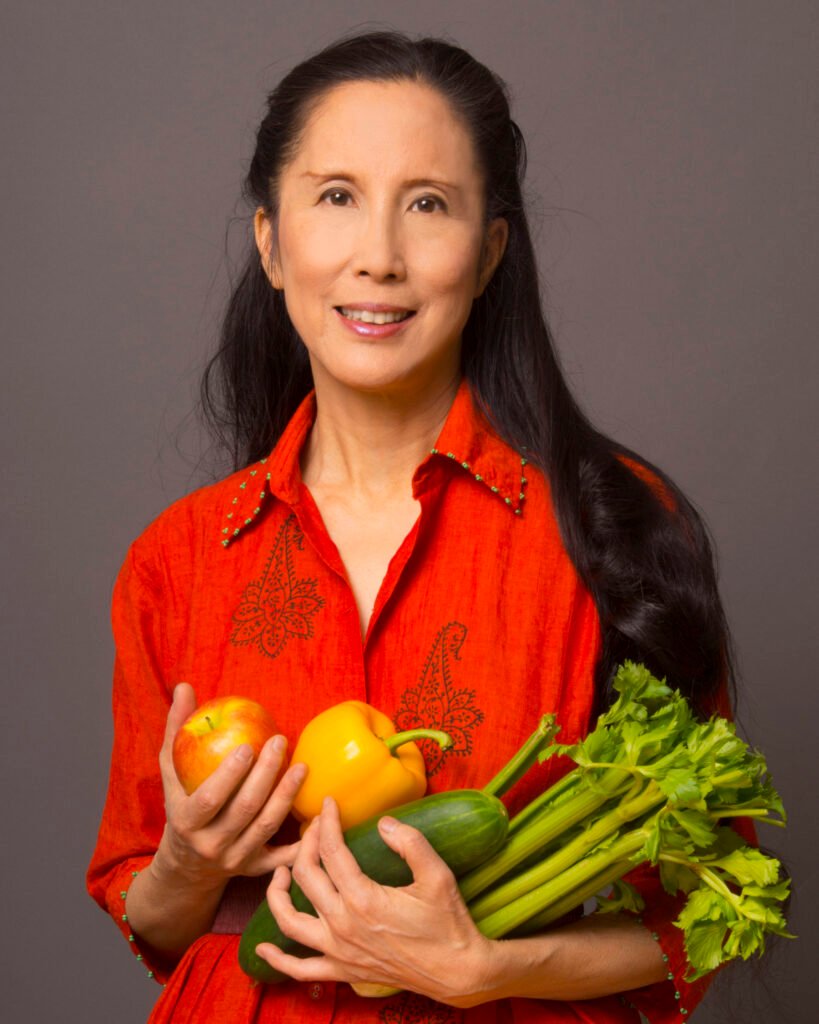
Dr. Joanne Kong, D.M.A., has been praised as one of the most compelling advocates for plant-based nutrition today, centered ethically in raising awareness that greater compassion for animals and our planet is vitally necessary for transformative growth and positive world change. Her TEDx talk, The Power of Plant-Based Eating, has over one million views on YouTube. Her vegan advocacy has been recognized around the world with international talks in Italy, Spain, Germany, Norway, Canada, and a three-week, 10-city tour of India. Dr. Kong is the editor of Vegan Voices: Essays by Inspiring Changemakers (Lantern Publishing & Media, 2021) featuring 50 vegan advocates from around the world, is the author of If You’ve Ever Loved an Animal, Go Vegan, and was profiled in the book, Legends of Change, about vegan women impacting the world. She appears in the major documentary Eating Our Way to Extinction and the upcoming documentary, Taking Note. 

Dr. Kong is a critically acclaimed, award-winning classical pianist on the music faculty at the University of Richmond, and draws upon a diversity of skills as a musician, writer, speaker, and creative artist in her advocacy activities. She performs and speaks in a duo known as Vegan Virtuosi with fellow animal advocate Christoph Wagner. Find further information about her on the websites www.vegansmakeadifference.com and www.joannekongmusic.com.

A Mother’s Destiny

A Mother’s Destiny

By Anzhi “Angie” Feng, age 9, from Vancouver/Toronto, Canada.


On the day you were born
At that misty cold hour
I saw your pink little toes
And your skin as pale as flour

I cradled you in my arms
As I slowly weep
Your soft dark hair touched my arms
As you fell asleep

From that day on
I watched you grow
From six o’clock to nine
And as you drifted off in bed
I realized the destiny of mine

Years pass in the blink of an eye
You are now seven
Your thick black hair comes to your waist
Just wait till you’re eleven

I cry in bed every night
Each day as you get older
Soon for a present
Instead of a doll
You’ll want a computer

That day comes way too soon
Time to say goodbye
You’re going off into the world
To find your new life

As you drive off into the night
I know that I’ve done well
And all the time we’ve had together
Is just another story to tell

By Anzhi “Angie” Feng, age 9, from Vancouver/Toronto, Canada.

Sustainable Shorelines: Keeping our Beaches Clean

Sustainable Shorelines: Keeping our Beaches Clean

By Maya Govindaraj, age 17, from Texas, is currently studying in Chennai, India.

Plastic is Destroying our World!

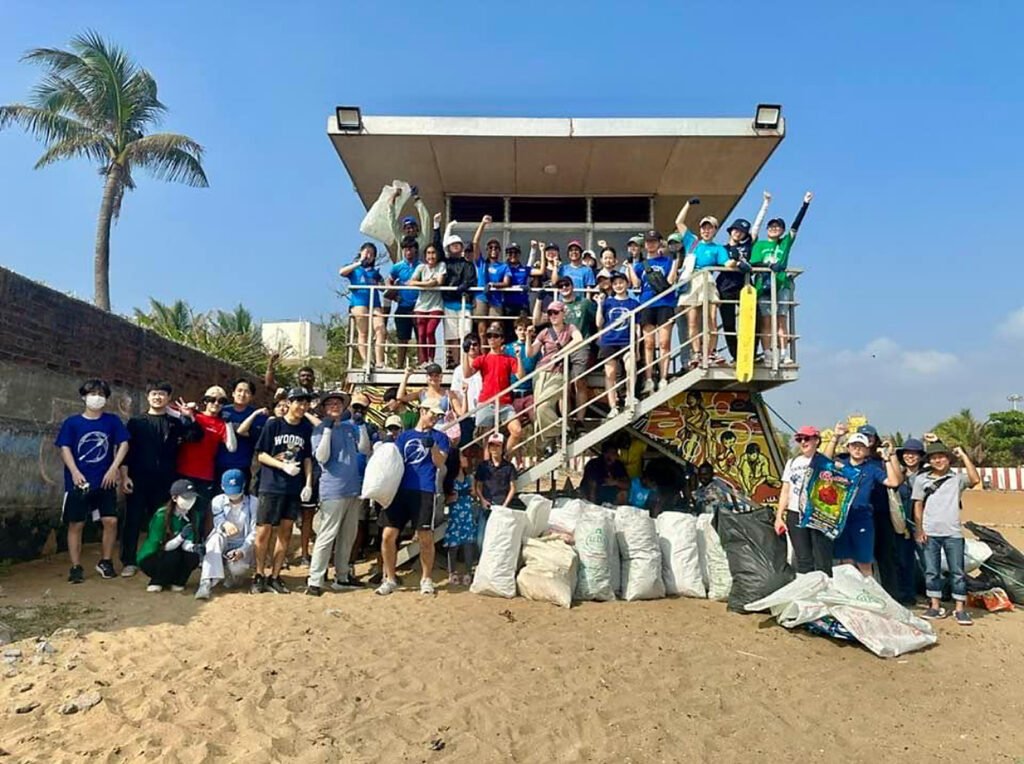
Beaches are vital ecosystems that support diverse marine life. However, the beauty of beaches is increasingly threatened by pollution, littering, and unsustainable human activities. According to global health experts, “Ocean pollution is posing threats to human health that are great and growing. It is causing disease, disability, and premature death in countries around the world today.” My journey from the beaches of Galveston, Texas, to the shores of Chennai, India, brought me face to face with the complexities of beach cleanliness. By participating in a local beach cleanup event, I gained insight into the challenges facing beach conservation efforts. Galveston beach in Texas is known for its wide stretches of sand, warm water, and opportunities for activities like swimming, and sunbathing. Chennai, on the other hand, is a coastal city in India, situated along the Bay of Bengal with beaches stretching for several kilometers and known for its lively atmosphere, with vendors selling snacks and toys, and locals enjoying various activities like kite flying and cricket. While efforts are being made to maintain cleanliness along the Galveston beaches by local authorities; in Chennai, cleanliness efforts on beaches have faced challenges. Although local authorities and environmental groups are trying to address cleanliness issues it is difficult due to high population density, inadequate waste management, and limited public awareness and participation in conservation efforts.

Participating in a Beach Clean-up Event

By conducting an online survey among Chennai residents who frequent the beach, I was able to gather valuable insights regarding their attitudes and behaviors toward littering and beach cleanliness. Although the survey demographics skewed towards 68% female respondents, with the majority holding at least a high school or higher education degree, a unanimous consensus emerged among them. They emphasized the importance of maintaining beach cleanliness to protect marine life, reduce health risks, preserve the natural beauty of the shoreline, and promote tourism. They advocated for proper waste disposal in designated bins, the use of reusable items over disposables, educational projects to raise awareness, and active participation in organized beach clean-up efforts. According to respondents, the primary factors contributing to litter accumulation include irresponsible behavior, entrenched cultural attitudes towards littering, inadequate provision of waste bins, and insufficient efforts by authorities to address cleaning needs.

Beaches are valuable natural assets that deserve our protection and stewardship. By adopting responsible behavior, supporting local initiatives, raising awareness, and advocating for policy changes we should all play a part in keeping beaches clean to ensure improved health and well-being and their preservation for future generations.

Footnotes:

  1. Texas Disposal Systems. “Ocean Pollution: Causes, Effects, Prevention | TDS.” Texas Disposal Systems, 2 Feb. 2024, www.texasdisposal.com/blog/ocean-pollution-causes-effects-and-prevention.
  2. Landrigan, P J, et al. “Human Health and Ocean Pollution.” Annals of Global Health, vol. 86, no. 1, 2020, p. 151, doi:10.5334/aogh.2831.
  3. “Beach Cleanups, MarineBio Conservation Society.” MarineBio Conservation Society, www.marinebio.org/conservation/ocean-dumping/beach-cleanups.

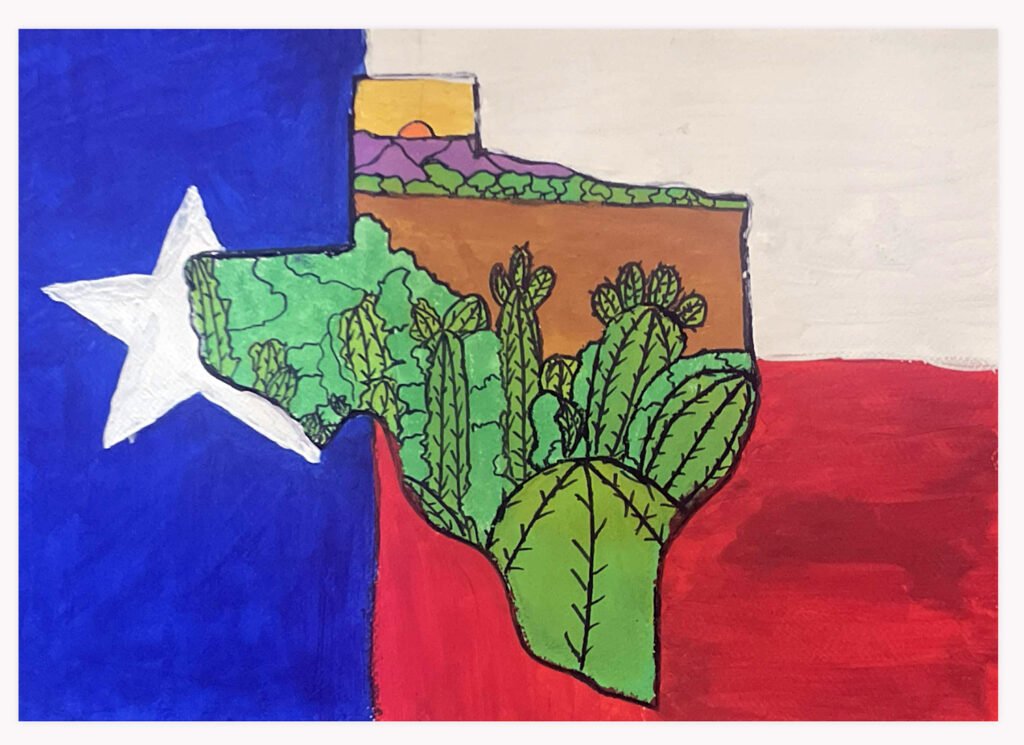
    Texas, the Lone Star State. By Maya Govindaraj, age 17.

    Editor’s Note: Please also read the article, My Indian Memories by Maya’s brother Arjun, also published today!

    About the Authors:
    Arjun and Maya are 17-year-old twins at the American International School in Chennai, India. As USTA-ranked tennis players, they love sports and have won medals in South Asian Interscholastic Association competitions. Both serve as Student Ambassadors, bridging cultural gaps through orientation and wellness programs. Passionate about community service, they have both worked with various organizations. They also have co-founded the non-profit Mission BE A Resource, securing grants to support disadvantaged children. Arjun is a tech enthusiast with a love for outdoor adventures, while Maya enjoys helping elementary school teachers and expressing her creativity through art.

My Indian Memories

My Indian Memories

By Arjun Govindaraj, age 17, from Texas, currently studying in India.

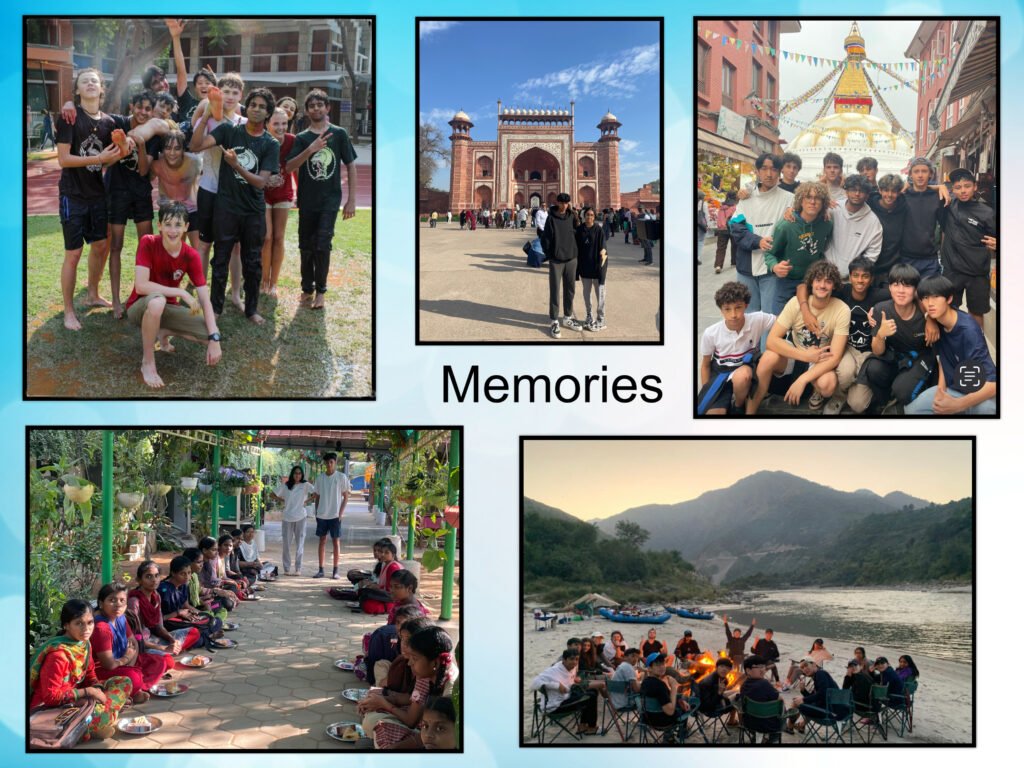
The first picture is of us celebrating Holi at school where we throw colors and water at each other and have fun. Holi is the Festival of Colors, a celebration that marks the arrival of spring. It is an occasion filled with laughter, music, and dance, where everyone, regardless of age, comes together to play with colors and enjoy festive food. Classmates and teachers share in the excitement, creating beautiful memories and promoting unity and love. Holi not only celebrates the beauty of diversity but also encourages forgiveness and the strengthening of bonds among people. We also celebrated Diwali, the Festival of Lights, symbolizing the victory of light over darkness and good over evil by dressing up in Indian clothes, sharing sweets, and participating in traditional games.

Second picture is of us visiting the Taj Mahal, located in Agra, India, built by Emperor Shah Jahan in memory of his wife, Mumtaz Mahal. Designated a UNESCO World Heritage Site, its stunning white marble architecture, carvings, and beautiful gardens attracts millions of visitors each year, and symbolizes the cultural heritage of India. We also explored the monuments of Delhi, the bustling streets of Mumbai, and the tranquil foothills of Dehradun with its cascading waterfalls. Exploring the streets of Coimbatore, we were amazed by the warmth of its people and the aromas of its bustling markets, while the ancient wonders of Mahabalipuram reminded us of a bygone era of art and architecture. Through these diverse experiences, we have come to cherish our rich culture and landscapes that make our world a truly remarkable place.

The third picture is of my team visiting Kathmandu, Nepal, for the South Asian Interscholastic Association (SAISA) soccer tournament. It was an incredible experience representing AISC against 11 member schools. The atmosphere of Kathmandu, with its rich culture and breathtaking landscapes, added to the excitement of the tournament. Throughout the events, I not only had the opportunity to showcase my skills and win medals but also learned invaluable team-building skills and the importance of fair play. Each match brought us closer as teammates, creating lasting friendships and unforgettable memories that extended beyond the games. The spirit of camaraderie and sportsmanship was truly inspiring, making this trip an enriching experience both on and off the field.

The fourth picture captures a heartfelt moment as we distribute school supplies and a meal to underprivileged children. Following the popular custom in India, they sit on the ground to share their meal, and their smiles of gratitude warmed our hearts as we handed out new backpacks filled with school supplies. In a country where overpopulation and poverty are pressing issues, we felt a profound sense of purpose in being able to contribute, even in a small way, to their education and well-being. This experience taught us invaluable lessons about empathy and compassion, reminding us of the importance of supporting one another and making a difference in the lives of those in need. Acts of service can build connections, bring hope, and inspire change.

The final picture is from our school trip, “Discover India,” which became one of the main highlights of my educational journey. These immersive week-long expeditions across India went beyond traditional classroom learning, offering a rich tapestry of experiences that allowed us to explore local cultures in depth. Each annual school excursion helped us develop essential teamwork and outdoor survival skills. From camping under starlit skies to navigating thrilling rafting/ surfing adventures, every journey nurtured resilience and adaptability while fostering a profound appreciation for the natural world. These unforgettable experiences shaped not just our knowledge but also our connections with one another and the environment.

Editor’s Note: Please also read Sustainable Shorelines by Arjun’s sister Maya, also published today!

About the Authors:
Arjun and Maya are 17-year-old twins at the American International School in Chennai, India. As USTA-ranked tennis players, they love sports and have won medals in South Asian Interscholastic Association competitions. Both serve as Student Ambassadors, bridging cultural gaps through orientation and wellness programs. Passionate about community service, they have both worked with various organizations. They also have co-founded the non-profit Mission BE A Resource, securing grants to support disadvantaged children. Arjun is a tech enthusiast with a love for outdoor adventures, while Maya enjoys helping elementary school teachers and expressing her creativity through art.

Memories of Dumplings

Memories of Dumplings

By Julia Qi, educator, Nevada.

I remember a time when steaming dishes of dumplings were laid out before me on the dining table. I was five years old, and a bowl of Chinese vinegar with two drops of sesame oil sat under my nose, eagerly awaiting the three hot dumplings that my grandma would soon drop in.

She’d always break the dumplings in half for me so my little fingers could navigate my chopsticks, and that day, I was the pride and joy of my family for devouring a total of nine dumplings.

That was the last time I remembered looking at a plate of dumplings without fear—at least until recently.

Somewhere along the way, food transformed into something I avoided. Any plate became a conversion of fat-protein-carbs in my eyes. The rich fat on decadent, red-braised pork belly remained untouched on my plate, and even my mom’s delicious stir-fried dishes were secretly rinsed off in the sink before I’d attempt to pick away at them. Passing by bakeries consumed me with conflict for the rest of the day because they looked so, so delicious. I wanted a taste so bad, but no, I couldn’t.

What my family saw as a “glow-up” before college was, in reality, my refusal to cook with salt or oil. I limited myself to raw foods for weeks and pretended I had simply outgrown my love for my childhood favorite foods. Steering clear of soup dumplings, BBQ skewers, and hearty pots of Chinese stew, I opted instead for bland salads and spinach smoothies.

The restriction ate away at me as I started college. I refused to eat before drinking water to “avoid” the calories. Despite the arrays of dishes in the dining halls, I spent 90% of my time at the salad bar, and the rest of the time lurking in the dessert section mustering the occasional courage to nibble a cookie. The additional walking in New York City resulted in me rapidly losing weight my first semester, which, as I anticipated, was celebrated not only by my peers, but also by my family.

My mother’s beauty was hard to miss. She’s a slender petite woman with voluminous curly hair, big bright eyes, and her classy fashion choices were always a topic of envy. She taught me the meaning of strength, independence, and courage as I saw her create the life she wanted for us in America. When she bought her first house in 2019 after 13 years of moving here, those walls represented something only immigrant parents can really understand. Her words were, “I just wanted to give you a home.” What she meant was, this is something that is finally ours. In a place where we had to start over, we had something that finally belonged to us.

My mom imparted many invaluable lessons growing up, but our culture also taught us that a woman’s beauty is paramount. Despite her exhaustion our first few years in the states from working consecutive night shifts and still managing to get up in time to wake me, cook breakfast, and take me to school, my mom maintained her elegant appearance. She always reminded me that as immigrants, we must pay extra attention to how we looked; we shouldn’t give anyone a reason to look down at us. My naturally tan complexion contradicted the porcelain-white Chinese beauty standard, and the fixation on my appearance naturally grew towards my weight as I got older. While genetically slender, my mom and her three sisters dreadfully feared weight gain. As I rounded out my teenage years, comments about my weight, what I was eating, and what I was wearing gradually took up a dangerous amount of space in my head.

Eating disorders are addictions. You’re stuck in a cycle, and even though you know it’s bad for you, you don’t know how to stop. Years of restriction led to an overwhelming preoccupation with food, which manifested in binging, then overcompensating by purging. The painful details of my four-year struggle with bulimia are oddly blurry, numbed by a filter of shame as I walked around hiding this part of me that I despised but couldn’t let go.

In a culture where famine was still a childhood memory for many, food was not meant to be wasted. Food was nourishment, and the idea of intentionally restricting or purging would have been absurd to those like my grandparents who grew up in the countryside and never had enough to eat for their four little girls. Northeastern Chinese stews were hearty, crafted to keep hunger at bay. Buns and baos were designed to fill you up for hours. My actions were completely at odds with what I was taught, which is likely why I wouldn’t touch my favorite foods for years, at least without bringing it back up.

This past March, I visited my family in China for the first time in six years. There was a stillness unlike earlier springs. The winter chill overstayed its welcome, seemingly in response to my grandpa’s passing just a few weeks prior.

My grandpa always requested peanuts with his dumplings, sometimes a Tsingtao beer, if my grandma allowed it. He liked sauerkraut or chive filling, since meat was hard on his dentures, which made clicking sounds when he chewed. This time around, we bought giant sauerkraut dumplings from the morning market made of purple forbidden rice. My grandma still broke them in half for me, except only one giant dumpling could fit in my bowl. This time, I couldn’t eat nine, but I ate until I was full, and over the memories of my grandpa’s clicking and the warmth of my belly filling up, I found solace.

—Julia Qi, received her undergraduate degree a few years ago, Nevada.

“half, whole”

“half, whole”

By Alyson Henderson, age 16, Connecticut.
 
 
i have always been

two halves stitched together
half this, half that,
never wholly me
always half in, half out
not belonging to either
instead, i am two parts,
conflicting, like puzzle pieces
that don’t match,
forced together anyways
not one whole,
just bad stitching
the parts that don’t fit
hide under the paint,
cracked and chipped
not hiding much at all

they like to ask
if i am this half or that half,
but i say and, not or
and maybe they won’t understand
but i am always this half
and that half,
these halves are just me,
whole

By Alyson Henderson, age 16, high school junior, Connecticut. She adds: “I have been reading and writing for as long as I can remember, and it’s through reading and writing that I learned about other people’s cultures and identities as well as my own. My dad is white and American, and my mom is Korean and immigrated when she was young. For a long time, I’ve been exploring my own identity through writing, particularly my identity as a biracial person. I often feel like I have to choose between being Asian and being white, and I can’t identify as both. However, by ignoring either part of my identity, I am ignoring so much of my life. The way I see it, choosing one half of my identity is being dishonest with myself about who I am. My poem, “half, whole” explores the struggle of never feeling fully accepted as either “half” of myself, and how I have accepted that I don’t have to be put in one box and discard parts of myself for others’ comfort.”

Waiting for a Madam President of the United States!

Waiting for a Madam President of the United States!

By Arun N. Toké, editor

Did you know that each and every one of the 46 Presidents of the United States, has been a male in its almost 250-year history since the Declaration of Independence? Since the founding of the nation on July 4th, 1776, not even one woman has been elected to the highest office of the land!

Ask your female classmates, neighbors, friends and family members, “Can a woman lead the country?” and listen to what they say. Likely, they will all say, “Women are equally capable as men to lead the nation.”

Across the globe, many dozens of nations—in Europe, Africa, Latin America, and Asia—have elected women as presidents or prime ministers to lead their countries during the last 65 years. Some of these countries have elected women leaders multiple times over the decades. Various countries like the United Kingdom, India, New Zealand, Germany, Norway, Denmark, Pakistan, Bangladesh, Sri Lanka, Rwanda, Central African Republic, Argentina, Costa Rica, Nicaragua, and Indonesia… the list is too long to include them all here! But unfortunately, the United States has not made the list so far!

Just recently, in October 2024, Mexico also joined the ranks of over 25 countries with women heads of their governments when Claudia Sheinbaum was sworn in as the first elected female President of the nation located just south of our border! Why haven’t we elected a woman to lead the United States of America yet?

Will the people of the United States choose to elect our first ever woman president this November? Many capable women leaders in other nations have shown clearly that women can lead as well as men, and sometimes even better.

Perhaps, you have studied the history of our country, and you know that women were not given even the basic rights to vote when the Constitution was first written. It allowed only landowning white males a right to vote. African Americans, and even the Indigenous People (who had lived here for generations) were not considered citizens of the country, and were not able to vote or run for any political office.

It was the 19th Amendment to the U.S. Constitution, adopted in the year 1920, after a decades-long suffrage movement led by women, that gave women the right to vote and thus help elect their representatives.

Interestingly, a number of European countries also enacted laws to give their women citizens a right to vote around the same time. Russia did so in 1917, Germany in 1919, and the United Kingdom began the process by granting women limited rights in 1918, and then full rights in 1928. Did you know that New Zealand became the first country to grant women voting rights in 1893? Nineteen other countries had also granted these rights to women before the United States did so in 1920. However, Switzerland did not grant women voting rights until 1971! In Asia, India granted some of its women the right to vote in 1935, while it was still a British colony. When India became an independent nation in 1947, the country’s constitution, adopted on January 26, 1950, gave its women full voting rights.

While the 13th, 14th, and 15th Amendments of the 1860s were enacted to bring full citizenship rights to non-whites and former slaves—primarily African Americans—it was not until the year 1965 as the Voting Rights Act was signed into law by President Johnson, that Blacks in the South gained meaningful access to the ballot box. Thus also including the African American women (who were left out in the 19th Amendment of the 1920)!

Unfortunately, the country still does not have a true democracy. Because we have an archaic system of “The Electoral College,” which gives disproportional power to small states in electing the President, at times, we have had presidents who did not get the most votes. For example, in the 2016 presidential election, even though Hillary Clinton received 2.9 million more votes than Donald Trump, she did not become the President because she lost the Electoral College. She came very close to becoming the first woman president of the country!

The U.S. Supreme Court Justices are appointed for a lifetime. And, they are not even elected by the people. Until recently, all of these justices were also male and white (Sandra Day O’Conner was the first woman to be appointed to the Supreme Court in 1981). They interpret the laws and decide what is constitutional and what is not. Here is an example worth noting: reproductive health rights for women.

In 2022, the “Roe v. Wade” decision, which had guaranteed national access to abortion for women for about 50 years was struck down by the Supreme Court. As a result, some states now have severely restricted women’s rights and have caused great harm to many women living there. Thanks to progressive leaders, Democratic states still have reasonable family planning options, including an abortion procedure, for families, couples, and women.

In 1917, Montana’s Jeanette Rankin became the first woman to serve as a Congressional Representative in the nation. Since then over 300 women have been elected to serve in the U.S. Congress or the Senate (the upper house). Ms. Kamala Harris became the first woman to serve as the United States Vice President in January 2021 after Sen. Joe Biden and his running mate, Kamala Harris (who had previously been elected as a U.S. Senator, and before that the Attorney General, of California) won the 2020 presidential elections.

In 2024, we have a precious opportunity to turn the page in our nation’s history by electing Ms. Kamala Harris as our next President. Who we elect as the President will shape the future of the nation (and even the whole world because of our tremendous global power). The implications of the choice we make as a nation are huge. We have serious issues facing us: the wars in Ukraine and the Middle East, the accelerating climate change crisis, and the nuclear weapons threat…

We need a truly capable leader who has a deeper understanding of the many complicated issues our nation (and our world) faces, and then lead us with fairness, kindness, and compassion to solve these pressing problems. Someone who knows and speaks the truth and works to bring the country together; someone who does not make hasty decisions based on short-term, selfish, or financial gains.

In 2024, our choice is clear, in my humble opinion.

—Arun N. Toké, editor.

Born To Be A Chef: Eileen Yin-Fei Lo

Born To Be A Chef: Eileen Yin-Fei Lo

The Woman Who Taught America How to Cook Real Chinese Food

By Fanny Wong, author, New York.

Standing on the kitchen stool, Yin-Fei could barely see the wok on the stove. Who would expect a five-year-old to cook with a wok and a spatula?

It was Ah Po, Yin-Fei’s grandmother!

“Just the right age to learn cooking,” Ah Po said. “And never have a short temper or use bad words when you are in the kitchen.” She then pointed to a paper image of Jo Kwan, the Kitchen God, and added, “You want Jo Kwan to think well of this family.”

Baba, Yin-Fei’s father, instructed her, “Eat first with your eyes, then with your mind, then with your nose, and finally, with your mouth.”

Luk Gu Jeh, her aunt, was another teacher of hers. “With patience and practice, you can create something that brings happiness and miles of satisfaction,” she told her.

With a family like hers, Yin-Fei was born to be a chef.

Yin-Fei’s skills grew with Ah Po’s instructions.

“Chop the choy sum properly.”

“Stir the fish mixture in one direction to make it stick together.”

“Pour the hot peanut oil and soy sauce on the steamed fish.”

For Yin-Fei, the learning was easy, but finding the joy in cooking was hard.

Too much time cutting and dicing.

Too much time waiting for the oil to be hot enough to stir-fry.

Too much time waiting for the meat to be tender in the braising pot.

But then Ah Po’s birthday changed everything for her.

Yin-Fei was to contribute one dish for Ah Po’s birthday. She picked the White Cut Chicken recipe because in her Chinese culture, a chicken was always cooked for special occasions.

Yin-Fei placed the whole chicken breast side up in seasoned boiling water and covered the pot. When the water returned to a boil, she lowered the heat to simmer, turned the chicken and let it simmer again. She had to time the cooking just right, and allow the chicken to rest in the pot to finish the cooking. Otherwise, the chicken would be overcooked or undercooked.

Yin-Fei lifted the chicken from the pot. She prepared a dipping sauce of soy sauce and ginger. It looked perfect, but did it taste perfect?  

Yin-Fei watched Luk Gu Jeh cut the chicken into bite-sized pieces with a cleaver. Ah Po, surrounded by her family at the table full of many delicious dishes, chose to eat the chicken first. She took a bite, closed her eyes, and chewed it slowly.

Yin-Fei held her breath and waited for Ah Po to finish swallowing.

“Hm….” Ah Po opened her eyes that crinkled with a wide smile and commented, “That was the best chicken I ever had.”

Everyone at the table loved the chicken! Not a single piece was left over! An eleven-year-old girl had made her loved ones happy with her cooking skills! From that moment on, making delicious dishes was her gift to others in the family, a way of showing her love and respect.

Now, she was eager to learn more from Ah Po. She learned that what people ate had to be balanced within their bodies.

Foods such as fish and most vegetables brought them coolness.

Foods such as most meats and some fruits brought their bodies heat.

The combination of these two types of food brought balance and good health to the body.

Yin-Fei learned to cook balanced meals for good taste and good health.

But life was not balanced in their village of Sun Tak. To escape the repressive government in China, 12-year-old Yin-Fei fled with her family to Hong Kong. There, she continued to improve her cooking skills by learning from her aunt. She also learned English in night school and picked an English name for herself—Eileen.

When she was 21, she met an American journalist named Fred Ferretti, and they fell in love and soon married. They moved to New York City. And that was when Yin-Fei’s life took another turn!

Her new in-laws brought her to a Chinese restaurant.

“What is this? This omelet is like an overdone pancake covered with a brown sauce,” she remarked.

“This is egg foo yung, our favorite Chinese dish,” her in-laws said.

From that moment, Yin-Fei had a mission! She wanted to teach Americans how to make good-tasting, authentic Chinese food.

First, she gave her friends Chinese cooking lessons at her home.

“You must write a book!” her friends said.

And she did. Eleven books in all! Each book taught readers how to cook traditional Chinese food at home.

She also taught at cooking schools and appeared in cooking demonstrations on television.

And when a renowned chef invited Yin-Fei to create a dim sum menu for his restaurant and teach his cooks, that’s exactly what she did. She took charge of his cooks!

“No, no, no, do it this way, let me show you.”

If she felt a Chinese restaurant was not up to her standards, she was not shy to say to the chef, “Make it this way, don’t Americanize your food!”

Yin-Fei had found a new passion. She wanted to teach others about how to make good Chinese food.

“Always learn, learn, learn, and never take a short-cut in cooking,” Eileen Yin-Fei Lo told her students. “The food you cook shows your love and respect.”

Yin-Fei became a great chef and a teacher who taught Americans how to cook authentic Chinese food. Born and raised near Canton, the capital of Guandong Province, Cantonese cooking was her specialty.

She taught at The New School in New York City and beyond—from Singapore to Helsinki. Cooking shows on television invited her to demonstrate how to make authentic dishes. She won two International Association of Culinary Professional Awards. Many Chinese food writers that came after her still think of her as the foremost Chinese expert chef.

Yin-Fei passed away at age 85 in 2022, leaving a delectable and mouth-watering legacy.

By Fanny Wong, Asian American author, New York. Fanny has written often on multicultural interest topics and been published in Skipping Stones frequently.