Category Archives: Asian American

American Born Taiwanese

American Born Taiwanese

By Alyssa Huang, age 15, freshman, California

I have two identities, as reflected in my name. My first name originates from the West and contains Greek, English, and Irish roots. It means “rational thinker” and “prospering flower.” By contrast, my last name comes from the Far East. It means “yellow” in Mandarin—an imperial color that symbolizes beauty and balance. When pronounced in Mandarin, my last name flows off the tongue, like a gentle breeze blowing over green meadows in warm sunlight. However, in America, its symbolism and beauty become completely lost. The Phonetic English pronunciation of my last name, “Hawaaaang”, steam rolls over its naturally melodious tone and sounds like a rusty bell, jarring and dissonant.

Crunch. Textured rocks smash across the Earth’s pavement. Every second graders’ hands enthusiastically create “skin colored paints” from chocolate brown and cream-colored rocks. All but mine. I squint and scrutinize the creek bed, searching desperately for tan-yellow rocks that match my skin color. None exist, so I settle on a cocoa-colored rock and forcefully grind it into paint to fulfill the mandatory assignment: a self portrait made using “rock paint.” Later that afternoon, classmates bustle around the classroom taping up their masterpieces. I find myself encircled by a perfectly-matching array of smiling, white-faced portraits. After struggling to find a space on the wall, I hide my solemn-faced, dark-skinned image in the corner. That summer, I avoid the sun, duck behind shadows, and slather on thick white sunscreen to protect my delicate, thin skin. But my complexion remains yellow and tanned. Nothing changes.

For two years, I coexist with my school classmates as a foreigner. When fourth grade finally ends, I feel relieved and ready for my anticipated summer vacation— visiting my grandparents in Washington DC. “Nai Nai!” I shout as I run into Grandma’s warm, outstretched arms. As she envelopes me in her unconditional love, a calm peace washes over my small frame. I tilt my head back to admire Nai Nai’s dark brown, almond-shaped eyes. They appear kind and gentle, strong and wise. I notice my own reflection in her eyes, sigh deeply, and entwine my fingers with Nai Nai’s, creating a seamless blend of golden-brown. Later that day, Nai Nai ushers me to visit her friends. “Let me introduce you to my Garden Group,” she says. We approach an elderly circle of Taiwanese ladies who peer at me curiously and ask, “Ni shi shei?” (Who are you?)  Nai Nai responds, “Wo de sun nu.” (My granddaughter). I survey the wise elders, who share my ancestry and heritage, and feel emboldened. Having spent the year learning Mandarin as my World Language, I prepare to show off. ”Knee howe, woe jiow Huwang Leeshawn,” I enunciate slowly, trying to capture the correct tones. The women’s happy, squinting eyes grow big and round. “Ta bu jiang guo yu?” (She doesn’t speak Mandarin?), Nai Nai rescues me and responds in fluent Mandarin, “Ta shi mei guo shen de.” (She is American-born). The women nod politely, but look away to conceal their disappointment. To them, I am an American foreigner. Not Taiwanese enough.

In the fall of sixth grade, Social Emotional Learning class begins to address the previously taboo topics of race and ethnicity. At my table, two Minority students describe hateful words and years of feeling like outcasts. I empathize with their pain and begin sharing my own story, but they cut me off. “You don’t know anything about racism!” they exclaim. A statement, not a question. “You’re Asian, so you’ve never experienced discrimination in your life!” My jaw drops, but no words emerge. I feel so paralyzed that I cannot muster a response. “Asian racism doesn’t exist,” they announce, then walk away, leaving me isolated yet again. Later that afternoon, I greet a new Asian classmate before entering my advisory. She complains about her “Asian Tiger Mother’s tough expectations.” “My mom can be tough, too,” I comment, trying to empathize. The Asian classmate suddenly steps away from me. “What do you mean? You’re not….” she hesitates before pursing her lips. “I’m not what?” I ask. “Well,” she stammers, “You’re not really…. Never mind, you don’t get it.” We stand side-by-side in awkward silence. My classmate never completes her sentence aloud, but her facial expression is clairvoyant, for I have encountered this scenario before. My classmate speaks Mandarin at home, whereas I speak English. In her eyes, I am a fake Asian, or a “Twinkie”—someone who is yellow (Asian) on the outside but intrinsically white (American) on the inside. I pull my hoodie over my head and walk towards the carpool circle.

Eighth grade ends, and summer finally arrives. For the first time since COVID, I attend summer camp—a week-long Taiwanese cultural camp called Taiwanese American Next Generation (TANG). While unpacking my clothes in my dormitory room, I hear a hollow knock at the wooden entryway. The door swings open, and my assigned roommate steps into our shared space. My eyes widen because it feels like I am staring at a mirror. Like me, she dons an NBA athletic T-shirt and Nike basketball sliders ; a crooked ponytail keeps her long, black hair away from her sun-tanned face. “I’m Audrey,” she announces, then offers me a fist pump. For the next half an hour, my New Jersey-born “ABC” roommate and I speak in excited tones, sharing stories about our families as we walk towards the camp’s opening ceremony. Once at the auditorium, a speaker begins addressing all two hundred campers in Mandarin. I glance sideways at Audrey and notice her head tilt in a confused manner. Creased lines appear on both our golden-skinned foreheads. “Do you understand this?” she giggles, “Because I don’t!”

Immediately, I smile. “Me neither,” I reply.

—Alyssa Huang, age 15, freshman, California. She adds: “My name is Alyssa… I am a Taiwanese-American.

“California is typically thought of as a melting pot of cultures, but I grew up in an overwhelming homogeneous Caucasian neighborhood. When asked about my nationality, well-meaning neighbors have shockingly confused Taiwan with Thailand, or insisted that Taiwan is the same thing as China (The People’s Republic of China). (But, it’s not). 

“As a child, I felt embarrassed about my ethnicity and dark colored skin. It was a huge relief to me when middle school arrived, and new Asian students enrolled in my sixth grade classroom. However, those new students were fluent in Mandarin, and I found myself being teased for choosing to take Mandarin as my “foreign language.” 

“The first time I ever felt truly accepted was at Taiwanese American Next Generation (TANG). TANG is a week-long, multi-generational, Taiwanese cultural camp that I attend with my brother, cousins, parents, and grandparents. We engage in fun Taiwanese games, listen to Taiwanese speakers like Arthur Chu (an eleven-time Jeopardy! winner), and learn about Taiwanese culture. At TANG, we share an appreciation for Taiwanese food and also a deep value of family, relationships, and community. TANG openly welcomes non-Taiwanese (my co-campers include Indian, Haitian, European, and Korean-Americans). I love that Taiwanese culture is warm, welcoming, and inclusive.

“Nowadays, I confidently bring Taiwanese pineapple cakes to social events and gladly compare cultures with my European, Latino, Indian, and Persian friends. I recognize that building an inclusive community requires honesty, insight, and sharing. It’s important for me to listen to my peers, but also contribute my part. I’m finally able to share about myself and my background—because I’m finally proud of my Taiwanese-American heritage.”
Poetry for Mother’s Day

Poetry for Mother’s Day

By Xiyuan Cheng, age 9, California.

We are pleased to share three poems for the Mother’s Day
(This year, it is being celebrated in the U.S. on Sunday, May 11th).
Happy Mother’s Day to you all!
—Editors

1.  When God Created Mothers

When God created mothers,
all lovely as can be,
he made one extra special,
and saved her just for me.

2.  My Heart is Gold

Your heart is silver, and my heart is gold.
You are so beautiful, it’s more than I can behold.
Your wonderful, so the legend is told.
Your heart is half, and so is mine.
Together are half-hearts shall combine.

3.  Mother’s Day End

Mother’s Day will always end,
but my mom will always be my best friend.
Our relationship might bend,
but we always know it will mend.

By Xiyuan Cheng, Age 9, California. Xiyuan has been writing since the age of eight, and her collection of six poems, Poetry for Mother’s Day, explores the themes of love, imagination, and appreciation for mothers. The three poems selected above reflect both her emotional sensitivity and growing creativity. Xiyuan is now 11 years old.

The Birth of the First Human

The Birth of the First Human

By Diponkar Chanda, originally from Bangladesh, Canada.

“While the story is not based on any specific folktale or myth from Bangladesh, it is inspired by the cultural storytelling style I grew up with—where themes of transformation, nature, and divine connection are often present. It is an original piece, drawn from imagination and shaped by a sense of spiritual curiosity.”

Long, long ago, trees of every kind embraced the soil, animals wandered freely through the wild, countless birds flew across the sky, and endless varieties of fish swam in the oceans. Insects crawled, flies glided—everything was alive and moving.
But one thing was missing.
There were no humans—nowhere in the world.

Yet, there were shadows. Shadows of many shapes, colors, and sizes. Small ones, tall ones, and those in between. They came in uncountable forms—silent, formless, and dreamless. Though they moved, they had no desires. Though they existed, they felt nothing.

But among them was one curious shadow.
He longed for more.

One day, he rose into the sky and reached the gates of heaven. There, he stood before God.
“What is it you seek?” God asked.
“I want to feel the world,” the shadow replied. “I want to be alive.”

God raised a glowing hand.

“I want to see,” said the shadow.
So God gave him eyes.

“I want to hear.”
God gave him ears.

“I want to taste.”
God gave him a tongue.

“I want to smell.”
God gave him a nose.

“I want to touch.”
And so God gave him skin—and with it, arms and legs—so he could walk and hold, run and rest.

In that moment, the shadow became the first human—alive with five senses and the gift of wonder.

With this miraculous transformation, the Earth itself stirred with change.
From that first human, more humans came—walking in sunlight and dreaming under moonlight.
And the world was never the same again.

—Diponkar Chanda is an emerging writer based in Toronto, Canada. Originally from Bangladesh, he writes stories and poetry that bridge cultures, languages, and imagination. English is not his first language, and he brings the rhythm and depth of his native Bengali into his storytelling. This is his first submission to a North American children’s publication.

Holi: Chaotic Colours

Holi: Chaotic Colours*

By Elaine Elizabeth Jinto, age 14, India.

the scorching sun, burns out
all the bitter feelings as we
gather at the small maidan,**
at the end of our
busy street, a maidan which
is dusty, dirty, dry just
like how we feel after,
the chaotic year we had

the oldest clothes in each
household are donned today by
all, showcasing the chaotic year
that has just gone by

then we drench each other
with fresh water, washing away
all the pain, worries, grief
and sorrow, that has stuck
to us like the burrs
In the grass in our
little maidan, washing away the
last, chaotic year we had

then we grin, feeling much
better and get our Holi,
powdered colors and throw it
at each other and after
we are done with our
simple game, our clothes are
a riot of colour, and we
Are ready for the chaotic
year we will be having.

Elaine Elizabeth Jinto, age 14, India. She adds: “I am originally from the Indian state of Kerala, but I was born and raised in Bengaluru, Karnataka, and I am going to 9th grade next year. I can speak Malayalam, Tamil, Hindi, and Kannada, along with English. I started writing in 3rd grade, beginning with a poem about a playground… I serve as the Editor-in-chief of our school magazine… I understand the impact writing has when it comes to spreading the right messages.

“…my poem is about the Holi festival in India. It is one of my favorite festivals, and it is a time when friends and foes enjoy splashing color and water on each other. It is a time of joy and new beginnings. I love playing Holi with my friends and family and eating pani puri at the end of the day. The poem is 29 lines long and has a challenging restraint. Each line has exactly 5 words.

“I love writing and reading about everyday things that I can relate to. I generally do not follow a strict form in my poems, because I get more room for creativity… Through my poems and prose, I like to give voices to those silent and mundane events that play a huge role in our everyday lives… I am so happy I am getting a chance to share them with the rest of the world.”

Editor’s Notes:
The festival of Holi celebrates the triumph of good over evil and it marks the arrival of spring and the end of winter in India. This year, it was celebrated on March 12th and 13th.
* In India, English words are generally written using British spellings; colour in place of color (in America), for example.
** Maidan: an open space in a city or neighborhood, usually it’s a bare or grassy ground, and it is used for sports, games or large gatherings.

“Rift” & “Anticipation”, Two Poems

By Gabriel Cheng, age 16, New York.

1. Rift

Beyond the horizon,
the sun begins its descent
into darkness. From my boat,
an off-white wooden petal floating
on the summer-calm Winnipeg,
I breathe in the forsaken festival.
Unshackled by night, swirling
mixtures of maroon and black
frolic in the sky, like children of the sun
set free. Slowly,
the hero of this requiem creeps up,
its luminescence pale and misty.
Then the stars, tarnished and enigmatic,
arrive, disrupting their lives
to reach the moon, everything
attempting to rivet a frayed bond.

I am an outcast in my home
shrouded by inanimate shadows and feign,
witnessing from afar a tale of sorrow
for what could have been,
Kites mingling above star-kissed hills,
fingers clasped with another’s under
a candle-lit table, the laughter of children
orbiting the room like Earth orbits the sun.

As the ceremony comes to an end,
my body tilts with the breath of the sea,
another wandering soul exhumed
on a boat drifting towards and away.

2.  Anticipation

I wake up to my alarm, groggily, fumble for the snooze button,
My heart racing from the jolt. As the blaring ceases

I rub off relics of the night, expecting clarity, only to be greeted
by flurries of light cast from the window-framed sky.

The door creaks as I stumble out of the shadows and into a man-made ravine,
the corridor dividing the subconscious as the sky does heaven.

I enter the kitchen and grab a naked piece of toast. I pop it in the oven,
watching expressions crease along the crusted ridges of its face.

With each bite comes the nostalgia of emptiness sunken deep
inside and lurking within the cavities of my stomach.

I shove the remaining sliver in my mouth and swallow.

The futility hisses in my ears like an engine and something
pounds in my chest fiercely, trying to escape. But I don’t.

I descend the winding stairs leading to the blue expanse,
walk down the asphalt weathered by a trillion steps.

I search for a raindrop, a signal I’m heading down the right path.
I look to the sky and wait,

a moment of silence
anticipating its touch.

—By Gabriel Cheng, age 16, New York. He adds:
“I am a multilingual Asian-American teenager. Poetry and prose have always been my passion, driving me to become an editor-in-chief for my school’s award-winning literature and art magazine, as well as news editor for our campus newspaper. Through both of these positions, I have cultivated a desire to spread my knowledge and to teach others. Outside of school, I’ve built on this commitment to cultural access by tutoring English to Ukrainian children, and then teaching chess after the language lessons.”

A Stronger, Happier Self through Teen Friendships

A Stronger, Happier Self through Teen Friendships

By Kayla C., California.

One Sunday last spring, my friends and I gathered at my house to work on the poster and decide the food for a cultural food festival at my school. We blasted music on our devices, screaming, laughing, and joking—having the time of our lives. Jolie kept slipping on the floor, causing us to all laugh, so I got her some slippers (she still tripped.) After Jolie came out of the bathroom, Elle knelt and proposed to her with a toy flower, and got rejected. (Elle married Leyla instead.) Later, we went for ice cream and drowned it in sprinkles. It was fun to spend time together and work on a project we all cared about. We could easily engage in conversation and have fun while doing so. Friendships like these make us feel wanted, supported, and free to be who we are. Teenage friendships are vital because they can help you become a better person.

Teens talk more about their social life with friends than their parents. They see them nearly every day at school, online, and outside of school. Teens spend more time going and being at school than they do at home. School is where teens make the most friends and their social life revolves around. The result is that they see their friends more than their family, allowing them to understand better and deepen their bonds. Teens and their friends’ type of humor, experiences, and age all affect how they interact with one another, so they feel more comfortable talking to one friend versus another based on how much they trust them. In the article, Having A Best Friend In Your Teenage Years Could Benefit You For Life, Chen writes, “…unwavering support acts as a kind of protective buffer against insults to your self-worth or feelings of depression. That can be especially beneficial during adolescence, a formative period when peer feedback has extra gravity.” (https://www.npr.org).

When someone requires reassurance and company, their friends act as supportive and protective beings that help them re-assess their self-esteem. The result is that teens feel more confident in themselves and trust their friends to be there for them when needed. They develop more trust in them and feel they can rely on them when they’re struggling, so teens often talk about their problems with their friends rather than family.

We need close friendships in middle and high school because quality friendships can help develop your self-confidence over time. “The significance of adolescent friendships seems to lie not in the number of friends a person has, but in the strength of a close friendship. Popularity isn’t important; it’s the true knowing and being known by another person that provides a teen with critical life skills that will serve him well for years to come.” (https://www.arnoldpalmerhospital.com).

A friendship is more important in quality than quantity. If you were to pick between having more friends but not as close versus only one friend whom you are very close to, it’s an obvious choice. Friends help teens realize they are recognized and loved for who they are and understand and accept their differences. “When the researchers evaluated the participants at the conclusion of the study, the ones who had close, emotional links showed improvement in their levels of anxiety, depression, and self-worth. In other words, they reported less depression and anxiety and more self-worth at 25 than they had at 15 and 16.”

Friends with close bonds lasted for not only a long time but helped both re-evaluate and boost their self-worth and confidence. The links they’ve formed kept them connected, allowing them to build trust and help each other through difficult times. Emotional support can guide a happier life and continued virtuous friendships. All that said, the question remains: how do we make the kind of friendships that change our lives for the better?

The most important part of having healthy, long-lasting friendships is effort. You must put in the work for the friendship to thrive because this is your friendship with your friends. Around Christmastime, my friend, Akhila, gave gifts to our whole friend group as a way to say, “Hey, I appreciate you, thank you for being my friend and making my day better every day.” It showed us that she cares, and it makes us feel happy when we’re in her presence. Each gift was different—she knew what we liked and spent her own time finding a gift for us. She paid attention to the little facts about us and found a gift that related to our interests or hobbies.

When it comes to friendships, race, gender, or cultural background don’t necessarily play a significant role in whom you can become friends with. As long as you find someone enjoyable, and comfortable and safe to be around, that’s considered a friend. One of my friends came out last year, and our friend group all accepted and supported them for who they are. Even our classmates outside of the friend group accepted them. To keep any friendships or relationships alive, you need to make sure everyone is cared for, and show that you are making an effort to sustain the friendship.

One of the greatest gifts in my life is my friends. They support me when I’m feeling low, are fun to have around and feel comfortable around me. During our teenage years, we grow more distant from our parents and feel more self-aware. Having good friends we can rely on can help us later in life because we will have less stress, anxiety, and increased confidence. Friends are important in our lives because they can encourage us to be our best selves.

—Kayla C., California. She adds: “… I can speak primarily English and Chinese. The most important aspects of my life are my friends, family, my pet, and the moments I share with them. I hope to live a fulfilling, but also simplistic lifestyle in the future. The people around me who look down on teen friendships and believe they can ruin relationships with your parents inspired me to write this piece.”

A Simple Act of Kindness

A Simple Act of Kindness

By Maya and Arjun Govindaraj, both aged 17, Chennai, India.


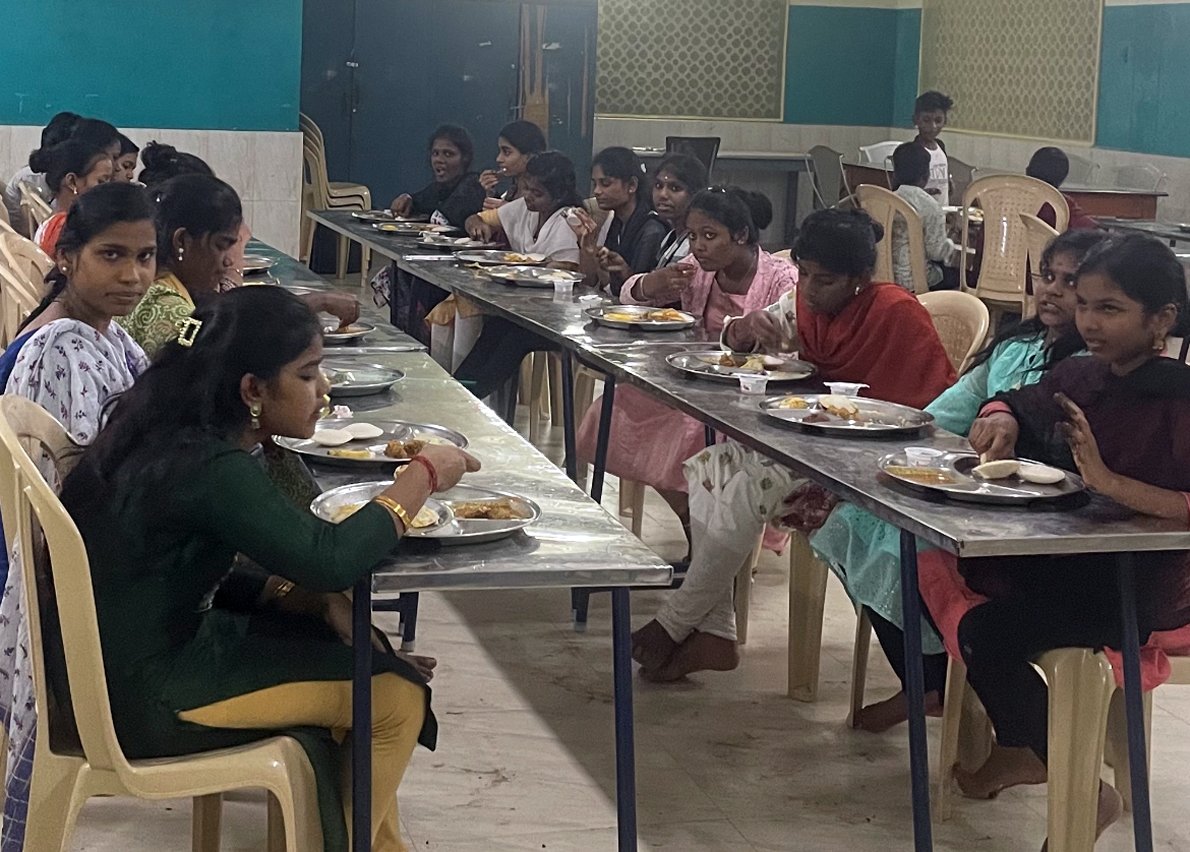
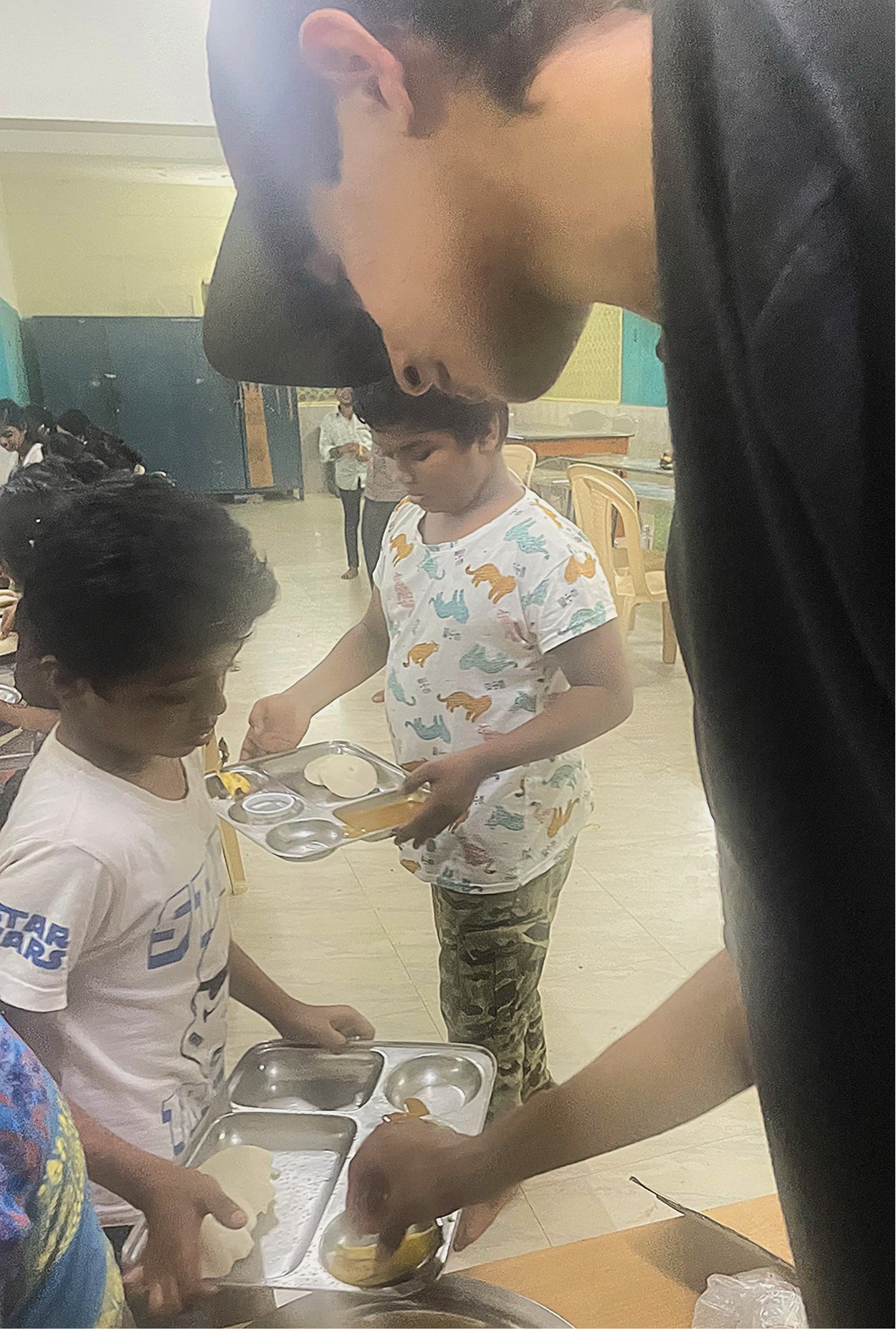
Our dad grew up in Chennai, India. He has always told us stories about how he struggled to reach great heights. When we were leaving the children’s home after serving dinner, we will never forget the way he looked at those kids with tears in his eyes and said in Tamil, the local language, “Study hard and you can be very successful someday.”

India is the second most populated country in the world with some 158 million children below the age of six. There are 30 million orphaned and abandoned children and according to figures published by SERUDS*, and the numbers have increased since 2020. Majority of these children are girls because they are considered a ‘burden’ in their communities. Less than 1% of the abandoned children are in childcare institutions, 91% of which are run by non-government organizations. Many end up living on the streets, begging for food, or are forced into child labor.

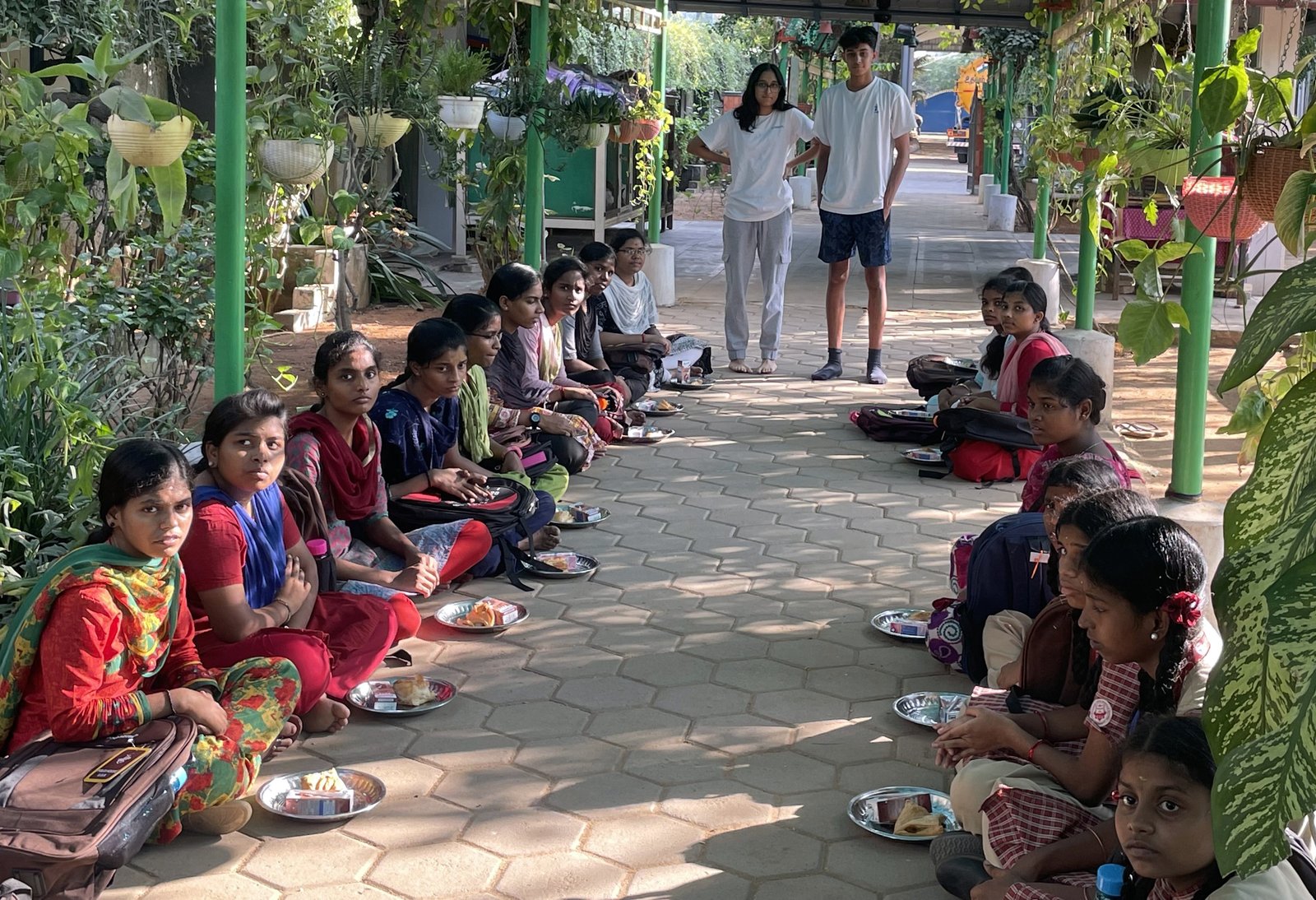
Our interest in community service started in Pre-K when we packed shoe boxes during Christmas, to send to kids in developing countries. Our parents always encouraged us to help people in need and took us to volunteer during school holidays. We moved to Chennai from Houston, Texas in January 2023 so my mom could care for her elderly parents, and during our time here, we have witnessed firsthand the harsh realities of poverty.

Our school involves us in many service activities that teach us about environmental and social issues and the value of collaboration, social awareness, respect, and empathy. We were able to interact with our host community through the Discovery Program and volunteer through the Seva (service) Program. Although we come from different backgrounds, teaching the local underprivileged children, and playing with them after school we developed a bond with them and realized how happy they were to spend time with us. All children need is unconditional love, opportunities to play and learn, and a sense of belonging.

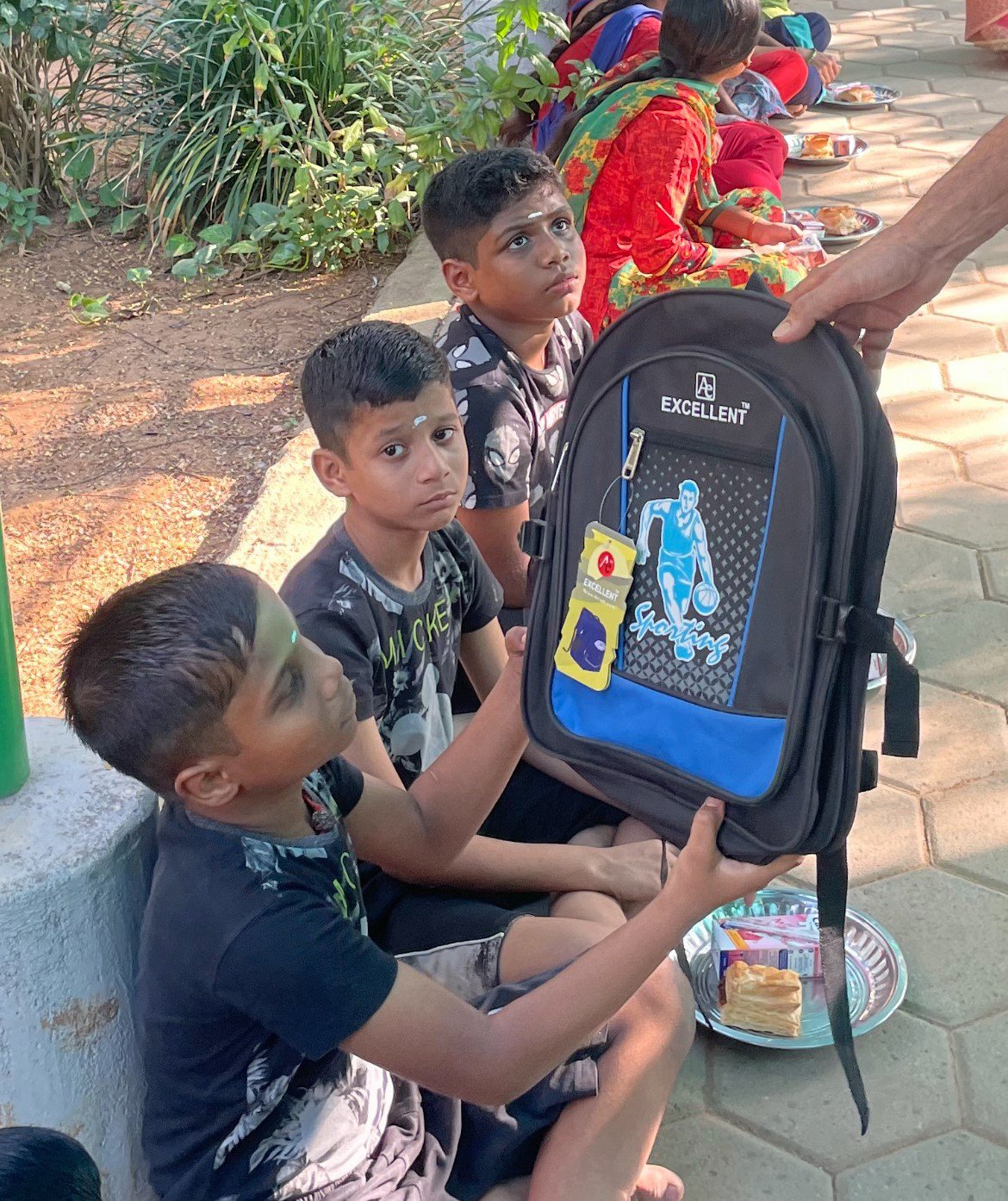
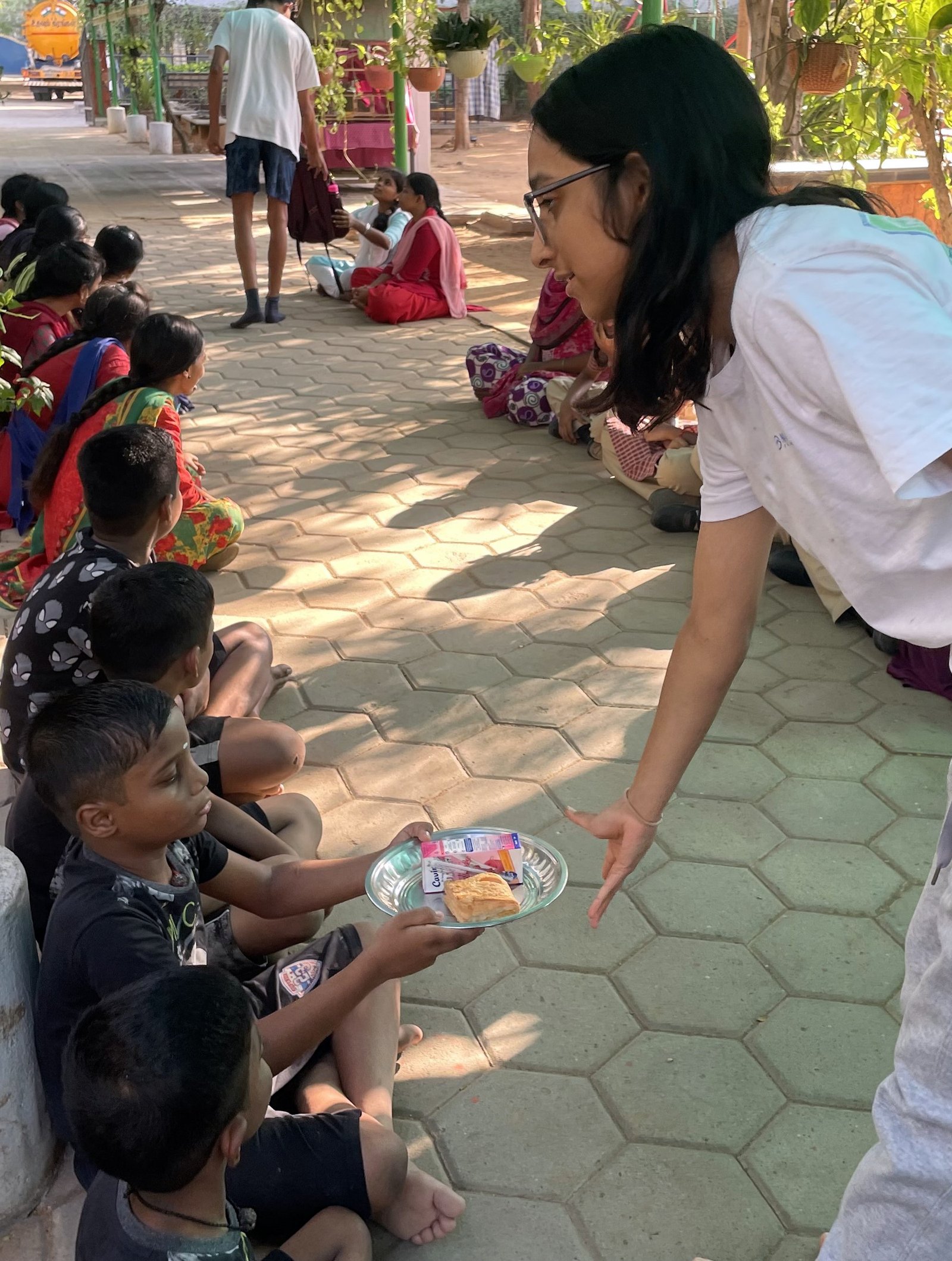
Seeing the amount of poverty that’s around us, and learning about the challenges these kids face in accessing a healthy meal and a good education inspired us to do something to show them that we do care. So, we bought backpacks, filled them with school supplies and gave them to 20 orphaned children along with evening snacks. We also served dinner to 60 children in a children’s home.

What we did were simple acts of kindness, but like Mother Teresa (the famous Nobel Peace Prize winning nun who lived and worked in and around Kolkata, India) had said, “We know only too well that what we are doing is nothing more than a drop in the ocean. But if the drop were not there, the ocean would be missing something.” To see the kids living alone without the love of parents and companionship of siblings is heartbreaking. Spending time with them we came to realize the privileges we take for granted and how fortunate we are to have a loving and caring family that meets all our needs.

The joy reflected in their eyes on receiving a simple backpack and the smile on seeing a small cup of ice cream made our hearts swell with pride, and although they have nothing, they were kind enough to offer us in return the power of their collective prayers as thanks.

We will be heading back to Houston, Texas soon, but what we have learned and experienced in the past two years in Chennai, will forever be etched in our minds, and we hope to continue to visit these children and share with them what we can.

As tech savvy Gen Z’s, it is our duty to use the power of social media to tell the stories of these children and to initiate global dialogues around the issues they face so we can find them the resources to face challenges and bounce back from adversity to fulfill their dreams of a better tomorrow.

* https://serudsindia.org/orphans-the-forgotten-children-of-india/ (From Sai Educational Rural & Urban Development Society, SERUDS) https://serudsindia.org 

—Maya and Arjun Govindaraj are Indian American siblings, both aged 17, and from Texas. They are currently studying at the American International School in Chennai, Tamil Nadu in South India.

Why I Hate Writing Essays

Why I Hate Writing Essays

By Neel Archis-Manish, age 17, Michigan.

It’s the fault of a rigid and purely grade-based public education system. I’m talking about why in today’s world, writings in schools have become a series of boring, formulative, information-stacked essays instead of genuine pieces of creations. I’m not blaming the public school teachers who simply mean well and are horribly underpaid. No, I blame historical education practices.

As a fourth year high school student in the US, I have written many essays in my ELA classes that respond to a specific prompt, include quoted sources, and require annotations on the side. All this basic system does is it makes me hate writing. I hate to say it, but it’s true.

I used to LOVE writing. I wrote poetry (it wasn’t great) and short stories (it was a laughing matter) and started writing my biography several times (I swear I’m going to get past Chapter 1 some day). But no matter how bad it all was, at least writing it didn’t kill my soul a little bit every time.

Language is a powerful tool that can be used to build empires and destroy them. Words are mightier than the sword not because nobody uses swords anymore, but because humans have the right to use words freely. High schoolers are so worried about their Grammarly scores and the 11:59 PM deadline that they often forget the importance of being present as a writer in their writings.

Quoted sources from all across the internet are great, and so are annotations. But neither helps an individual grow as an individual writer. The ‘classics’ we read in our English classes today weren’t classified as classics because they contained a well-researched bibliography, they were titled ‘classics’ because they were written from the deepest emotions from a true heart.

Formality kills humanity. Sure, you could decide to put on a fancy shirt and a suit and a tie and act like a functioning human being to charm yourself into some high-paying corporate job that covers dental insurance, but then what’s the difference between you and a slightly good-looking robot? Feelings are what humans have been doing best since the dawn of time. Let’s not forget our origins.

Love, respect, kindness, greed, envy, jealousy, selfishness, selflessness, humility, humanity, power, hunger, disgust, fear, sadness, anxiety, awkwardness, joy, pride, shame, disappointment, calmness, rage, confusions, desire, and so many more HUMAN emotions and feelings the world possesses. Why are adults teaching kids to bury all of them deep inside and instead turn to writing informative 2000-word essays about a global issue that then students pretend to care about for the sake of getting an A on a summative assessment?

I used to spend hours and hours reading books of mystery, fantasy, and historical fiction. I loved the feeling of being lost in a world where the real words ceased to exist. I loved the feeling of having to imagine, to create, and to be surprised. I used to come up with my own characters when reading stories about people. I used to make up landscapes and roam across Rome and Romania. I don’t do that anymore.

Writing based on information as opposed to human nature has killed the excited kid inside of me that once upon a time lived happily ever after. I’ve stopped reading books for fun. I’ve stopped being excited to enter a library and find a good book and open it in the middle and smell the smell of the fresh paper. I’ve stopped scribbling terrible poetry and weird short stories and unfinished memoirs on scraps of paper.

I once wanted to be one of those writers who wrote the first line of the first chapter of their first hit book on a napkin in a small bistro in a corner of a small town. I don’t want to do that anymore. Now, I just want to turn in my essay before 11:59 PM on the day of the submission deadline.

—Neel Archis-Manish, age 17, Michigan. He adds:

I was raised in Pune, Maharashtra, India in a house with two decent parents (they’re great!), a sister whom I hate passionately (it’s just a sibling relationship: I would give her my kidney, but not my phone charger), and a loving grandmother who’s cooking is, in one word, divine.

Growing up, I went to a Marathi-Medium school and learned Marathi (my mother tongue), Hindi, and English. When I was 15, my dad was fortunate to get an inter-company transfer. So in the midst of the Covid-19 Pandemic, our family relocated to Michigan in the United States of America.

I am currently enrolled at a good public school where I am able to make my Indian ancestors happy by performing well in academics, all while doing what I now love most: theatre. I am now the President of our school’s Drama Club. I participate (act, student direct, and head publicity and programs) in three productions each year, write and perform for our social justice theatre troupe, and have won numerous awards by doing forensics (competitive public speaking). Life is good.

I LOVE comedy. I have watched and re-watched and re-re-watched a ton of comedy sitcoms and TV shows. If you’re looking for someone to understand and laugh with you on niche Saturday Night Live references, I am your guy. Laughter is simply the best medicine, even when you’re not ill.

Currently, I’m looking at colleges and thinking about what I want to do. I’m at a point where ‘what do you want to be when you grow up’ is a legitimate question and not what an adult uses as an ice-breaker when talking to a child. Anyway, I’m fairly certain that I want to become a Secondary English Educator. Which led me to look into writing and publishing opportunities.

My Mom’s Frying Pan

My Mom’s Frying Pan

By Aadya Agarwal, grade 8, New Jersey.

They asked my mom, “What inspires you, Ms. Anne?”
Pat came her reply, “It sure is my frying pan.”
Her crisp reply left them confounded.
After all, she clearly left the Sun and the Moon grounded.

My mom was sure of her inspiration.
And this is what she offered as her explanation.

“Frying pan might look like a plain Jane tool.
But look! how, its emptiness itself makes it useful.
It tells me that nothing really belongs to you.
You are just a medium to pass things through.
You must clean yourself of the smallest residue.
So that you are ready to receive something new.”

“Frying pan has taught me to choose to be humble.
Go through and show up after every rough and tumble.
Seasoning through slow and high heating.
Strengthening through scratches and beating.
And not to suffer from any self-pity.
Be assured that you are where you are meant to be.”

Mom further said, “For me, frying pan is an unsung beauty,
That creates complex dishes through its simplicity,
And keeps my family fed by doing its duty.”

By Aadya Agarwal, grade 8, Princeton Day School, Princeton, New Jersey.

Art by Leicie Tonouchi, Age 14, Hawaii

Art by Leicie Tonouchi, Age 14, Hawaii

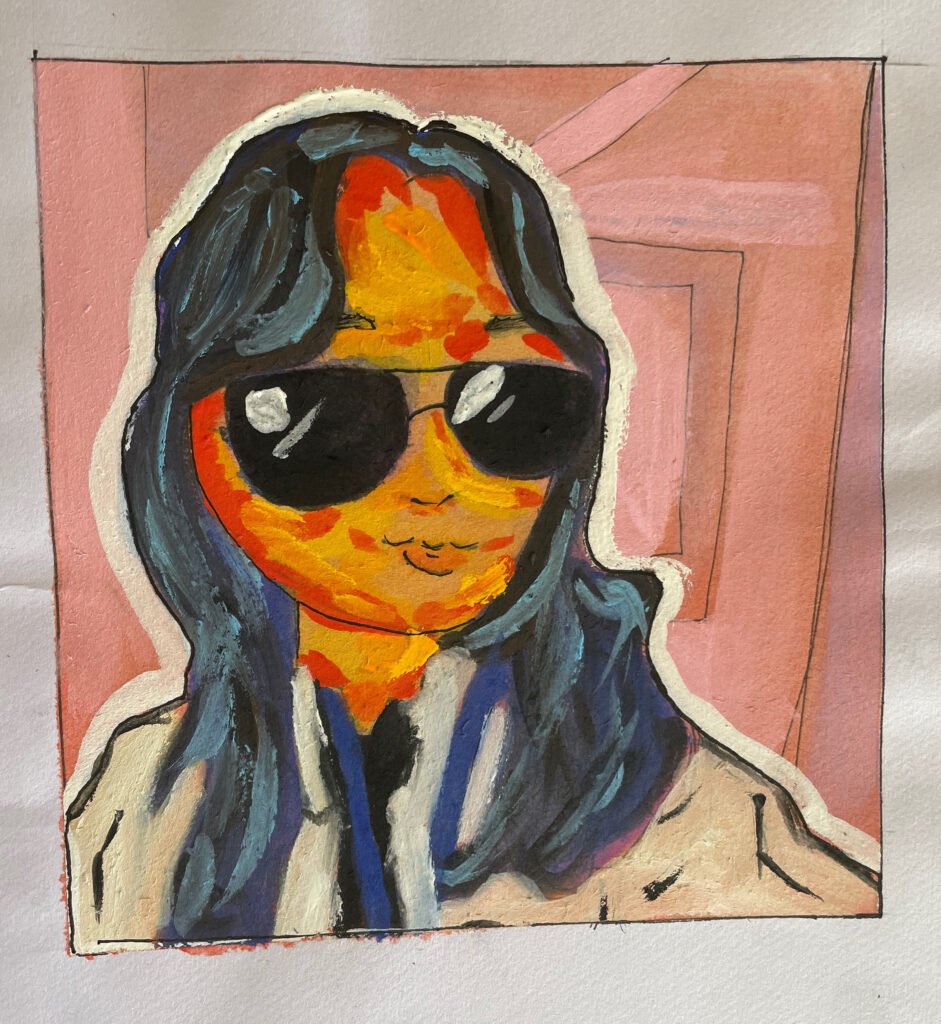
“Keila is too cool for school. I painted Keila in ink and gouache.”

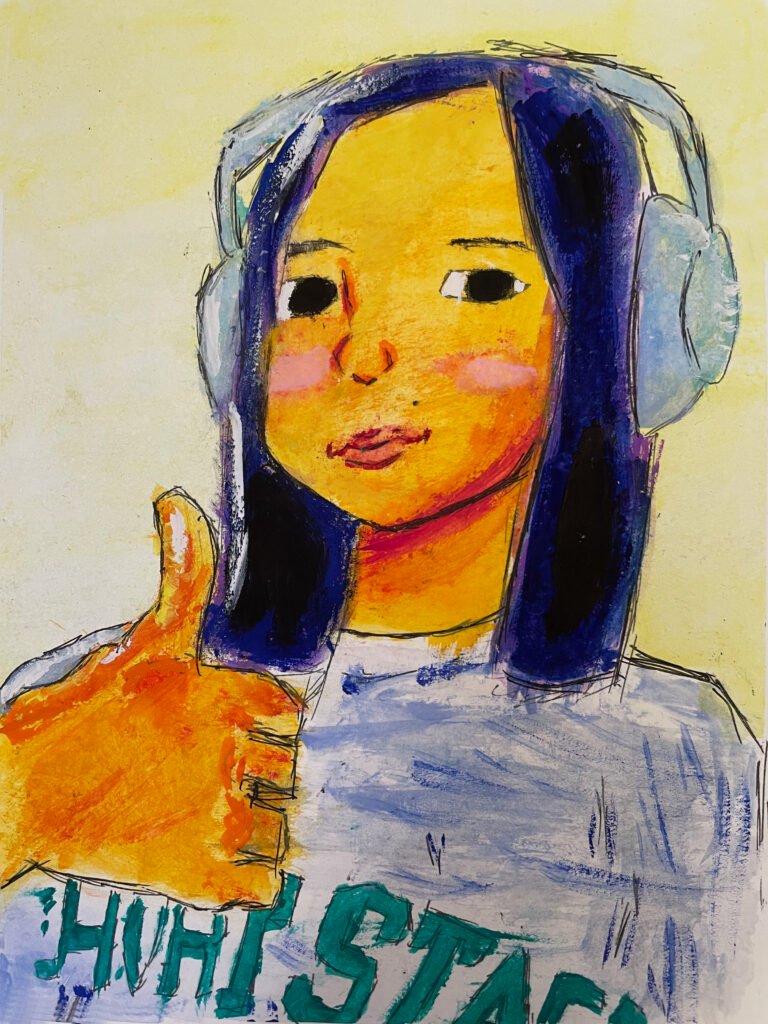
“Cassie has positive vibes. I painted Cassie in ink and gouache.”

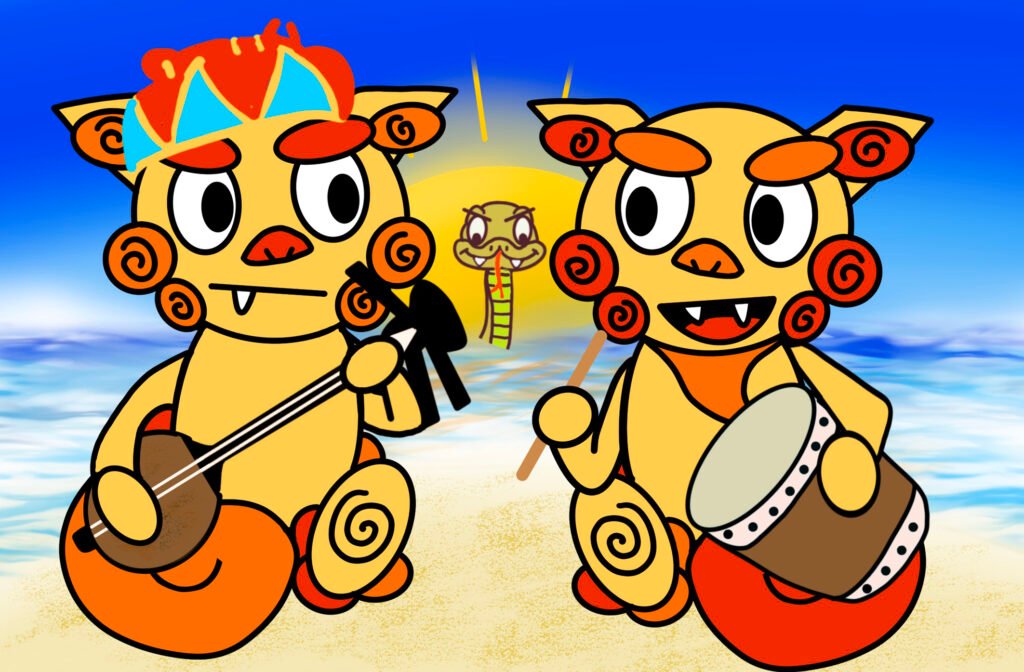
“This is my interpretation of the classical Okinawan story called “The Legend of the Shisa.” I drew this digitally using Procreate.”

The Legend of the Shisa

Retold by Leicie Tonouchi, Age 14, Hawaii.

A long time ago in Okinawa, Japan, the villagers were partying at the beach when out of nowhere they saw something big—a serpent from the sea!

The serpent began to terrorize the village. One of the villagers looked at the Shisa (Okinawan lion dog) statue and prayed for help and miraculously the Shisa statue became alive! The Shisa battled the serpent and chased it back into the ocean. The villagers cheered as their homes had been saved. When everyone was safe, the Shisa turned back into a statue again. This is why in every home in Okinawa, people have two Shisa statues in each household. A male Shisa with an open mouth to scare away the evil spirits and a female Shisa with a closed mouth to keep in the good energy.