
The Lure of the Extraordinary Peacock
       by Prachi Kothari, age 11, Mumbai, India

A blue glow
That makes everyone say “Ooo”
The peacock’s feathers when spread look like they give to the ground, blue light
Which brings to the watchers, a charming smile
When the wet rain with the ground together clap
This scene is extraordinary, incredible, fab
The peacock starts dancing exceptionally arresting
We feel around us an ecstasy fencing
Golden green rays emit from their feathers
That we can’t stop to gather
For perceiving this wondrous sight
It would be marvelous if it could take a sky-high flight
When looking at it, our eyes pounce out and magically stop
The peacock is so magnificent from bottom to top.
If it comes dancing on the road
Everything from cars to people would be on hold
It spreads out its wings with valor
In us, we need to imbibe that gleaming color.

We should not just sit and perch on the tree
Do something outstanding that makes everyone feel glee
Animals should be given importance and cared
Do not let them become extinct and rare.
Increase the number of animals and birds
Build national parks and sanctuaries where they can freely and happily run
Store the beautiful sights of the peacock in your mind and heart
So that these pleasant sights keep coming repeatedly and ever last.


Prachi Kothari is a 11-yr-old author and has published several books in her series, "The Lightning Bulbs of My Heart".
She lives in Mumbai, India, and she is a blogger. You can visit her site: exemplaryprachi.blogspot.com. She is one of the
youngest podcasters and runs her show, 'Extraordinary World On Earth' where she spreads excellent awareness of the
environment. She is a YouTuber at 'Prachi Kothari' where she recites many of her poems.
She enjoys writing and hopes to create a better world for all.
Category Archives: Asia
Festival of Mid-Autumn Moon
By Chiu-yi Rachel Ngai, 16, Arkansas.
 Lanterns bloom like flowers, the light and colour of crowded city streets.
 Folded paper, a slinky of patterns,
 Dancing as the candle flame flickers a pattern silhouette.
 There are plastic lanterns these days, thick and rubbery with a strange smell,
 Lit up with a mini LED bulb.
 They come in all shapes and sizes, pop culture and cartoon designs.
 Mickey Mouse, Power Rangers, Doraemon.
 I remember my cousin had an Elsa once, a matching pair with her Anna-toting sister.
 We met with mooncakes under a full moon,
 Lotus paste sticky sweet, salted egg yolk seawater respite.
 Our ancestors looked up at the same moon, and now we stand in their light—
 A product of their mistakes and triumphs.
 We stand tall, a proud new generation,
 Eager to take on the world outside our Hong Kong,
 Not knowing how much our bubble would change in the years that watched us grow.

 I was fourteen when I left on a fifteen hour flight to the United States,
 Creating a half-globe’s distance within my heart.
 I write this at sixteen, a full lifetime for so many before me, a full lifetime for still too many.
 Arkansas is American Southern, dry and green and different and not a bad place to be—
 And yet I remain a daughter of the Asian East—
 My bones do not feel like they belong.

 I sat under the ever-present moon last Mid-Autumn, my second in the States,
 Eating mooncakes gifted by my art teacher, the only other Chinese person I know in the area.
 I look up to the sky, to the stars my cousins do not see, the stars drowned by neon light—
 I look up to the sky, to the moon my family looked at thirteen hours ago, the moon my ancestors saw a woman’s story in.
 The moon keeps me close to home.

By Chiu-yi Rachel Ngai, 16, Arkansas. She adds: "I grew up in the bustling streets of Hong Kong. I moved to the U.S.
when I was fourteen in order to get a better education. I am fluent in English and Cantonese. I can understand Mandarin/
Putonghua better than I can speak it. I am working on overcoming my internalized racism towards myself for being Chinese,
and I decided to submit to Skipping Stones as part of my journey towards accepting myself and finding pride and
joy in my cultural identity."
Our Awareness of Zoom Fatigue
By Ryan Kim, age 16, Seoul, South Korea.
The rampant spread of COVID-19 caught even the experts by surprise. Without even direct contact, by simply being in the same room together, many became helplessly vulnerable to the pandemic. In order to mitigate the spread of the virus, we all had to adapt to a new norm. As the lockdown dragged on, we became more dependent on video conferencing platforms than ever before. Applications such as Zoom have boomed over the last year, providing an alternative solution for activities that once require face-to-face interactions. Many expect that these platforms can replace the traditional interaction where physical presence was once required. Despite all the positive aspects of Zoom and similar platforms, we need to understand that these platforms are viable alternatives we have only in the context of the pandemic. They should not and can not permanently replace the traditional human-to-human interaction.
Despite the Zoom overload, the term “Zoom fatigue” is not familiar to many. In February of this year, Stanford University researchers uncovered a new phenomenon called “Zoom fatigue.” The unnatural close-ups of the face and the simultaneous view of others and self are unnatural to the human brain causing psychological overload and fatigue. Because of how Zoom became the new normal of our life, we have been inconspicuous of how dominant and fatiguing the effects are to us. Many are unaware of the feelings of exhaustion after repeated exposure to video-conferencing apps.
In this new reality, as students are Zoom’s dominant users, they are the ones that are significantly burdened with Zoom fatigue. In virtual school, every day seems quotidian and senseless, slowly yet rapidly draining the most pivotal time of our lives. The small chatter among friends before class, walking down the hallway in between classes, and even the three-dimensional experience of being surrounded by other peers seem trivial and inconsequential until they are removed. They are a big part of the mental and psychological breaks available to students as we engage in learning.
Institutions expecting students to follow along in the virtual setting with the same effectiveness and focus as the offline is similar to expecting a runner to run the same distance and pace while carrying a weight on his back. In these challenging times, there are no perfect solutions. I am not bashing platforms such as Zoom, nor am I suggesting that we should not have virtual classes. However, we do need to be aware and mindful of the new challenges we face in these alternatives. We must treasure the little things we did not notice until they became no longer available to us. Virtual interactions should not replace physical interactions. And most importantly, Zoom fatigue is not an excuse.
By Ryan Kim, age 16, Seoul, South Korea. He entered this article for the 2021 Youth Honor Awards program.
Work Cited:
University, Stanford. “Four Causes for ‘Zoom Fatigue’ and Their Solutions.” Stanford News, 1 Mar. 2021, news.stanford.edu/2021/02/23/four-causes-zoom-fatigue-solutions/.
Singer, Natasha. “Online Schools Are Here to Stay, Even After the Pandemic.” The New York Times, The New York Times, 11 Apr. 2021, www.nytimes.com/2021/04/11/technology/remote-learning-online-school.html?searchResultPosition=6.
Taiwanese Food
By Camille Chen, age 10, Asian American, California.
I eat, sleep, and speak Taiwanese culture every day. Not a day goes by without my speaking Taiwanese or eating Asian food. My parents moved from Taiwan to America before they had me. Their childhoods were very different though, because my dad had to travel with his family because of his dad’s job. My mom experienced the art of Asian foods, and learned how to cook Asian food from her mom, her grandma, and other elder family members.
I think that to be in an Asian family, it is a necessity to be able to at least cook some egg-fried rice. There are so many people out there that make such simple things the wrong way. You wouldn’t know how many videos are on YouTube with Asians looking at other people cooking Asian food and correcting them. Also, I think that Asian food allows you to really freestyle/improvise. For example, one of the dishes that my mom makes is Udon. Even though Udon is a Japanese type of noodle dish, you can cook it on the pan and mix it with pork and vegetables, and it is so enjoyable!
Taiwanese food is very unique compared toEuropean food. You need a lot of effort to make it, and learn about it. For instance, egg-fried rice can be extremely easy to make, but if you want someone to taste it and immediately love it, you need wok hay to make the flavor scrumptious when you are chewing the rice. The wok hay gives the rice a special flavor as if it’s cooked right under charcoal with a big fire underneath it. I consider the Wok as one of the wonders of Asian culture! It is so special and when you use it to cook anything, you can sense the heat and unique smells. The garnish adds even more flavors and makes it even better. But, you also need the correct garnishing. Egg-fried rice garnished with green onions is a classic, and adding cabbage with it is nice, but you don’t want a salad-like vegetable to go with your rice! The tiny details make Taiwanese food extremely difficult, but if you trust the process, it is all worth it in the end. However, egg-fried rice is just square one. Taiwanese food also includes soups with strong flavors or soups that can actually help your health!
One soup that’s healthy and delicious is ginger soup. Usually, my mother adds cooked chicken to make the soup less boring. My mother also adds rice to make it more child-friendly. The real stuff about it is the special cooking wine. And a pinch of garlic. That makes the whole house smell like heaven. When I taste the soup, first I detect the rice. The rice has no flavor on it’s own, but since it’s been in the soup for some time, it tastes like the soup. Its texture is sort of al dente and the chicken is no different. When I eat the chicken, it has the flavor of the soup and tastes wonderful. The garlic is so soft that you can eat it without thinking it tastes weird. You won’t even notice you’ve eaten garlic. Underneath the base of the soup, I taste the ginger combined with the cooking wine, but it isn’t overpowering. Soy sauce is added as well. The rice, chicken, and the stock together make a wonderful homey ginger soup. The best thing is that each quantity is about equal, so you won’t have to waste anything. Once it’s on the table, we finish it all and stay full for a long time.
Taiwanese food is important to me because I feel it brings culture and tradition. For example, dumplings, a very common and well-liked dish, are shaped so that they look like bars of gold; so when Chinese New Year comes along, people make or buy dumplings to eat in hopes of getting more money in the new year! The dumplings are a symbol of wealth.
Zong Zhe, another very popular Asian food, also has a long history behind it. Once, a man named Chu Yuan was hired as an advisor of the King. After a long time, he became an extremely wise advisor and everyone saw him as a good person. But then, one day when Chu Yuan was giving the king advice, the King disagreed with him. This made Chu Yuan so sad that he thought he was unfit to serve. So, he drowned himself in a lake. Everyone felt sad that such a good person would die, so they wrapped up the rice in leaves to prevent all the fish and shrimp from eating up Chu Yuan’s body. This rice wrapped in leaves soon became known as Zong Zhe. Nowadays, people eat Zong Zhe at the Dragon Festival. I feel like this is an important and somewhat heartwarming story. It’s pretty entertaining to see others’ reactions to the story of Zong Zhe.
When my grandpa was young, his family didn’t have much money. He didn’t have shoes to wear, no toys to play with, and they rarely had meat on the table. But when Chinese New Year came along, his family mixed flour and water together to make a certain type of dough and pinched it into shapes of butterflies and flowers. The point is, just because my grandpa’s family was poor, his mom still did her best to keep the tradition going on, and also wanted the kids to have =>p.17 Taiwanese Food continued from p. 16
fun moments in their childhood. So when he was in the hospital, he remembered all of these fun moments and savored them.
Taiwanese culture and food are very important to me. I know many of these stories by heart; they were told to me by my family. I hope that one day I will be able to cook our traditional food and share our culture and history with the next generation. My family keeps the Taiwanese traditions going.
By Camille Chen, age 10, Asian American, California. This was selected as a Noteworthy Entry in our 2021 Youth Honor Awards program.
A New Home
James was lying on the back seat of the car with his feet outstretched. He looked at his mother through the rearview mirror to see if she was watching, and then he peeked through the zipper on his bag to check on his phone. The phone was at seven percent–James was pleased that his tactics had worked. He had set his screen brightness to the maximum and turned on his mobile flashlight when he had gotten into the car at school.
“Mom, my phone died already. It was like fifty percent when I got in the car!”
“Give me the phone.” James’ mom snatched it from his hands and inspected it. “How did the battery die so quickly?”
“I don’t know! Why can’t you just buy me a new phone?”
“I bought this for you a week ago and you’re telling me you already need a new one? We’ll deal with this later; for now, let’s just get going.”
“But Mom, I need my phone for school tomorrow and all the Apple shops close at seven.”
“I can always buy you a flip phone or give you your dad’s old one.”
“But Mom, I need…”
“Not now, James.”
Impatiently, James tossed his phone onto the seat beside him. The real reason he wanted a new phone was that it had gotten scratched in his bag, but now he might be stuck with his dad’s old phone.
Instead of turning the car back on, James’ mom pulled the key out of the ignition.
“Why’d we stop?”
“The streets are too narrow. We’ll get out here, travel by foot. The apartment is over there,” she said.
James looked around. Unlike downtown Seoul, the streets were dark and the sidewalks were empty. The usually smooth pavement in the road was severely cracked and gray.
“Mom, why aren’t we going home?” he asked.
“I already told you. Weren’t you listening? We’re going to look at a few homes and hopefully make a deposit on one.”
“We already have a home. Why are we buying a house in this filthy neighborhood?”
James already knew exactly why his mom was trying to buy a house. He was only hoping that she would realize how ridiculous the whole idea sounded. She had explained how Korea’s taxes were unreasonably high but that because of a loophole, families could save a little bit on their taxes by adding a second address and pretending to live separately.
With an irritated sigh, James got out of the car and dragged his feet through the streets. A sudden movement caught him by surprise. On the other side of the tall gate he was passing through, he saw a young boy staring right back at him. James took a few steps back. The boy was wearing sandals and two t-shirts in the middle of a cold winter afternoon.
“Hello,” said the boy quietly. He awkwardly scratched his left ear and continued staring.
James had never engaged in a conversation with someone so poor. He was unsure what to say, so he remained silent. After a few seconds, James turned away and ran to catch up with his mom.
Entering the building, the first thing he noticed was the lack of an elevator. Wasn’t this apartment supposed to be on the third floor? As he pulled himself up the stairs with a scowl on his face, James could smell a different odor on every floor. A strong smell of cats on one floor, then burnt plastics on the next.
The stairs opened directly onto the roof. All there was to see up here were a few empty flower pots and a greasy grill.
“Why are we on the roof? Where’s the third floor?”
“This is it. This is our home.”
“The roof? The roof is our home?”
“There it is over there. Isn’t it cute?”
James looked doubtfully at his mom’s face, checking to see if she was cracking a joke, but she seemed to be completely serious. Was she delusional? Then James noticed the small shack in the center of the roof. He walked over to it and cranked open the rusty door that had drooped and embedded itself into the floor. Inside, there was barely enough room for a mattress and a sink. Behind it was a separate, even tinier room with a toilet and a showerhead attached above.
“How do you expect anyone to live here?”
“Well, we won’t really be living here. We’re just here to see what we’re buying.”
Right as James was about to exit the shack, he accidentally kicked a can of cola. The can was nearly empty and only a few drops spilled out.
“Do people live here?” he asked.
“This has been a home to many people. The most recent people living here were a couple, and they were fine.”
James tried to imagine how people in his neighborhood could endure living in such a small and wretched home. He remembered the foul smells coming from the floors below and wondered what the conditions were like on those levels. The buildings to the right and left–an entire landscape of old, deteriorating apartments–were all homes to people without the chance to enjoy anything that he had.
After not even four minutes in their new home, James and his mom decided to stroll back to the car. After all, there wasn’t much to look at. When he reached the car, he paused and looked over his shoulder. He had hoped the boy from earlier would still be there, but he seemed to have gone back inside to avoid the cold weather. After taking off his goose-fur jacket, James gently hung it over the boy’s fence.
James’ mom was focused on her phone screen. “Hurry, Apple stores close at seven!” she said.
“What?”
“Didn’t you say you needed a new phone?”
“No, my phone’s working again,” James said as he shivered and stepped back into the car.
By Ace Yeom, age 15, Seoul, South Korea. This was selected as one of the Noteworthy Entries in our 2021 Youth Honor Awards program.
Girl Meets Belief
By Ishita Shukla, 16, India.
In 1425 CE, Joan of Arc, a 13-year-old girl, believed that she heard the voice of God telling her to drive the English out of France. Consequently, she was tried for witchcraft and heresy in 1431 CE, at the age of 19.
Crazy, right? But what if she wasn’t crazy and deeply believed in something? The greatest thinkers of the world believed in some concepts so strongly that it changed the world. Different people have faith in different things. And that’s ok; 7% of the world population are convinced Atheists. But that doesn’t mean they don’t have faith in other people, in a better world, in the mysteries of the universe. Some blindly trust a higher power, and others have faith in their morals and actions. I believe in people, and their confidence in a higher power, which makes me feel safer.
However, it is hard to develop strong credence, not just in ourselves but in the ancient and immortal God. People take years to search for their passions, the ideologies worth for them to fight for. In this complex world, with new innovations, evolving dogmas, surprising tenets, it is hard to maintain our faith in a person or thing because we don’t always get what we desire and blame it on the higher power rather than our actions. It is a constant struggle where we are never sure of the outcome.
So why is it easy for some than others? I am still searching for an answer. I believe many abandon faith when circumstances are difficult and answers are slow in coming. Learning to trust takes practice because faith isn’t maintained when we fail to see the reality behind our higher power and morals. Faith requires a vision; faith requires seeing with spiritual eyes.
“For we live by faith, not by sight.” (2 Corinthians 5:7 NIV).
And of course, it also requires the perky “p” twins, perseverance, and patience.
Ah, and this leads to a question. We have all walked through life long enough, our blissfully empty heads. But what do you believe in? What is your calling? Who do you blindly trust? What ideologies are worth fighting for?
No one has enough power to force you into believing something, but it is much harder to introspect ourselves.

By Ishita Shukla, 16, India. She adds: “I am an aspiring writer from Hyderabad, India. I write to express myself, my views on topics that are so common that they are rarely talked about for e.g. fears, belief system, etc. My dream is to do research in economics while continuing my love for writing and reading. Writing is a very cathartic activity for me. I pour all my insecurities, my passions onto the paper.”
Haenyeo, the Sea Women of Korea
By Fanny Wong, New York.
Orange pumpkin-like buoys bob in the water off the island of Jeju, 55 miles off the tip of the South Korea peninsula. Baskets attached to them wait for their owners. The sea women, in groups of ten or more rise to the surface and make a distinctive whistle…“Hoowi, hoowi!” It’s an ancient technique to expel carbon dioxide from their lungs and to alert one another of their presence. They’ve been under water for 30 seconds or longer. It’s time to breathe. Everyone is accounted for. No accidental death today.
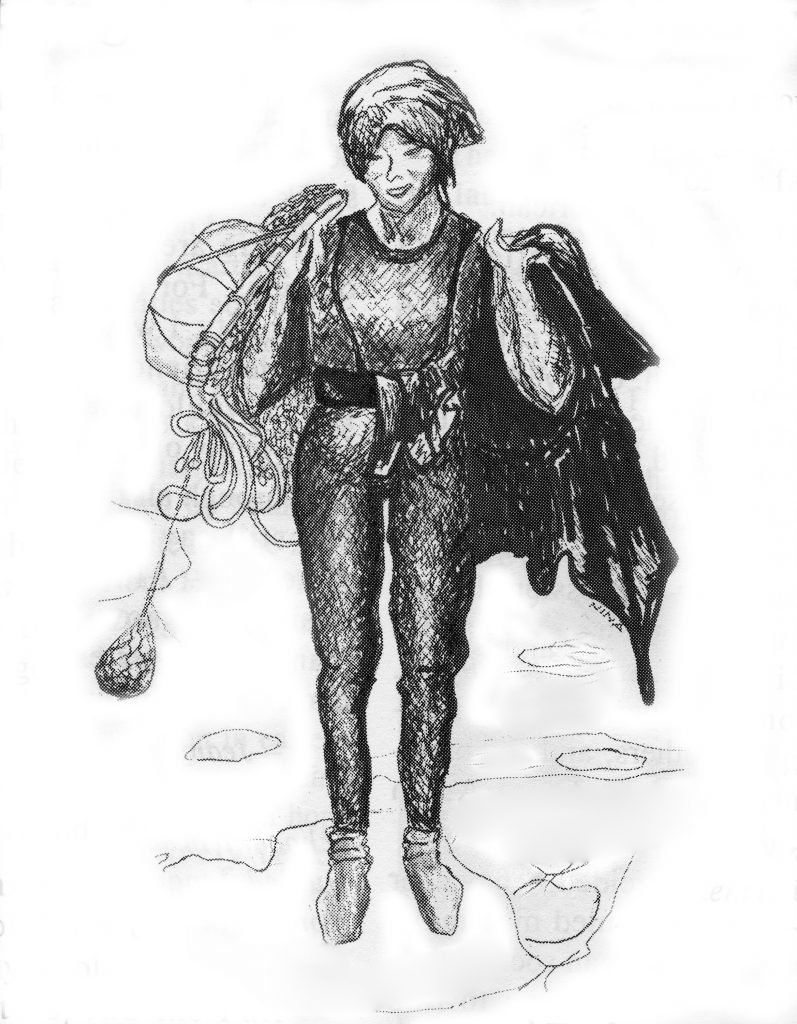
The women wade ashore or climb onto a waiting boat, hauling their baskets of the day’s underwater harvest. They take off their old-fashioned headlight-shaped scuba masks to reveal lined and weathered faces. These women are old! Who are they? What do they do underwater?
For hundreds of years, the sea women, known as the haenyeo, dive as deep as forty feet to harvest seaweed, sea urchins, sea cucumbers, octopus, shellfish and abalone from the ocean floor. They free dive without an oxygen tank, equipped only with fins, gloves, and a belt of lead weights to assist diving. They use different simple tools; such as a small harpoon for piercing fish, a sickle for collecting seaweed, a long hoe for prying abalone of rocks.
Jeju is a 700 square miles island of volcanic rock and soil, off the southwestern coast of southwest Korea. It has a beautiful coastline and is listed on UNESCO’s World Nature Heritage. Windy and rocky, there isn’t much land for productive farming, except for mandarin orange farms. But the sea provides an alternative farm.
Life of the haenyeo is hard. They harvest from five to seven hours a day, about 18 days per month, depending on the weather and tide conditions. It was only in the 1970s that the government subsidized wetsuits, which protect them from the cold water. The women used to dive in loose cotton clothing and could stay in the water up to an hour during the winter months. They had to sit by a fire to dry off before jumping back into the water. Wearing wet suits, now they can earn more by staying longer in the water, and to dive into old age.
Underwater is a dangerous place to make a living. The divers must be careful not to push too far for that prized abalone. Deprived of oxygen, a diver can suffer a heart attack. She must know when to have enough breath to come up slowly, and perhaps give up a precious find stuck under a rock. One side effect of longer dives is decompression sickness. They also contend with dangers, such as jellyfish, poor weather, big fish and even an occasional shark.
Most of the divers are old, with the oldest in their eighties, and even nineties. The average age is seventy. These elderly women learn from a young age to understand water pressure, oxygen level in their lungs and resurfacing distance. The girls as young as eleven start to learn to dive in shallow water, then in more challenging depths. Some women have dived all through pregnancy and given birth on a boat! This job used to be handed down from mother to daughter, but now, the young women prefer a more comfortable life in the island’s two cities or on the mainland. From more than 14,000 in the 1970s, there are fewer than 2500 haenyeo today. Some women abandoned the dangerous sea diving in old age. They and the ones who died were not replaced.
The haenyeo culture relies on cooperation and hierarchy. The beginners and the older women belong to the bottom level of divers, the hagun. The middle level junggun diver can hold her breath between 40 seconds to a minute. The top-level sangun diver can work the most difficult areas, dive deepest and may be able to hold her breath up to two minutes. The more experienced offer their guidance to the less experienced. It can take a new diver five years to be fully competent.
The women generally sell their catch through a fishery cooperative in each village. There are about 100 cooperatives. Each cooperative has its own regulations about the boundary of the fishing ground, qualification and catching methods. When a problem arises, the haenyeo get together in a form of town hall meeting to make decisions everyone understands and accepts. The community spirit is strong. Before and after a day’s work, they change their cloths in the traditional bulteok, an open-air circle marked by a 4 feet high stones wall, with a fire in the center. Recently built bulteoks are cement buildings with showers and heated dressing rooms. They chat about personal matters and issues related to work. The conversation is affectionate and warm.
A diver earns about the equivalent U.S. $12,500 a year. That’s not a lot of money for their hard work. A second job farming on small plots of land supplement their income. But they are proud to be their families’ providers. With no education, the women had little choice but follow their mothers’ footsteps. Now, they want their children and grandchildren to get a good education, even to go to a university.
Where are then men? Some elderly husbands wait on shore for their wives to return. They help lug the heavy loads onto land, help weigh and sort the catch. It wasn’t always this way. Men from Jeju harvested shellfish as far back as 1460, as mentioned in a court document. Why the change? One explanation is that in the 17th century, the men were taken away to fight Korea’s foreign wars. Another explanation is that women’s body fat enabled them to endure the cold water better. Diving for seafood became exclusively female and remains so today.
There is some stigma attached to their work. In modern South Korea, women are generally prized for being delicate. The divers are anything but delicate. They have grit, physical and mental stamina. They talk loudly on land because the build-up of air pressure in their ears means that noises are muffled. Not lady-like at all!
But, the haenyeo has gained respect in their efforts to protect the marine ecosystem. They are marine specialist by experience. Knowing the cycle of marine life, they do not over harvest. For example, abalone and conch are caught from October to June, sea urchins from May to July and sea slugs during the winter season. They don’t take anything under-sized. Even different seaweeds are harvested at specific times of the year. They are lauded for their eco-friendly methods and community involvement in managing their practices.
Normally in South Korea, men dominate, but not in Jeju. For centuries, they had high status and independence in their community. They are the breadwinners, take care of the children and make household decisions. In the male-dominated culture, they were modern before their time. Even today, when many elderly South Koreans over 65 are poor, these elderly women’s financial independence is remarkable.
The haenyeo’s legacy is not just economic. It’s social. It’s cultural. Every February in the lunar calendar, the haenyeo hold a ceremony in honor of the God of the wind, Yeongdeung. He visits Jeju Island on the first day of February. In mid-February, they send a small straw boat loaded with offerings out to sea to accompany him as he departs Jeju for the year. The women pray to the God, believing that he helps them hold their breath underwater and to keep them safe. They also pray at shrines.
Interest in the haenyeo has grown. In 2006, the Haenyeo Museum opened. It explains the history and culture through models of their traditional homes; displays boats, tools, masks and diving wear. Underwater photographers published books about them. In 2015, the Jeju government began to help pay for their accident and medical insurance. In 2016, UNESCO awarded the divers a Cultural Heritage of Humanity designation, recognition they long deserved.
But the haenyeo themselves are pessimistic about the future. Tourism is increasing and generates more revenue than the diving catch. With few young women willing to go into the profession, the culture will eventually die out. Moreover, they witness the effect of climate change in the ocean. Pollution is reducing the amount of and quality of edible sea life.
How can the haenyeo tradition be preserved in the age of modernity? Modifications can make life of the haenyeo easier and more attractive to the next generation, just as the wetsuits made a lot of difference. Perhaps something mechanical can help them lug the heavy baskets of wet seaweed and algae onto shore. A full basket of seaweed can weigh as much as 65 pounds. Better medical intervention can prevent and lessen the physical toil to their bodies. Some of the ailments include headaches, tinnitus, digestive problems and increased risk of strokes.
Meanwhile these tough women who ride motorcycles to get around remain graceful underwater ballerinas in the silence of the deep. They continue to be Jeju’s most valued treasures.
By Fanny Wong, Asian American author, New York.
Poems and Photos from the Bhalukhali Rohingya Refugee Camp, Bangladesh
By Mohammed Faisal, 19, Bhalukhali Rohingya Refugee Camp, Bangladesh.
I’m Mohammed Faisal, a young Rohingya poet, living in the world’s largest refugee camp. We, Rohingya, fled from our country Myanmar in 2017 due to the forcible displacement of our civilian population. We were brutalized by the Myanmar military, and we were taken to the Bangladesh refugee camp where we still continue to face so many difficult obstacles in order to survive. We have struggled, and have also established a massive tent village. Unfortunately, there is not enough space in our tents, and we continue to have to downsize. Our family members continue to change with all the various circumstances that are also changing. We feel suffocated, and our parents, children, aunts, and relatives all have to stay together and sleep together in a very small tent shelter. There are not any playgrounds for children to play in, and children are not able to receive the formal education that they deserve. We are all flying around like birds in a cage, and we are not comfortable at all.
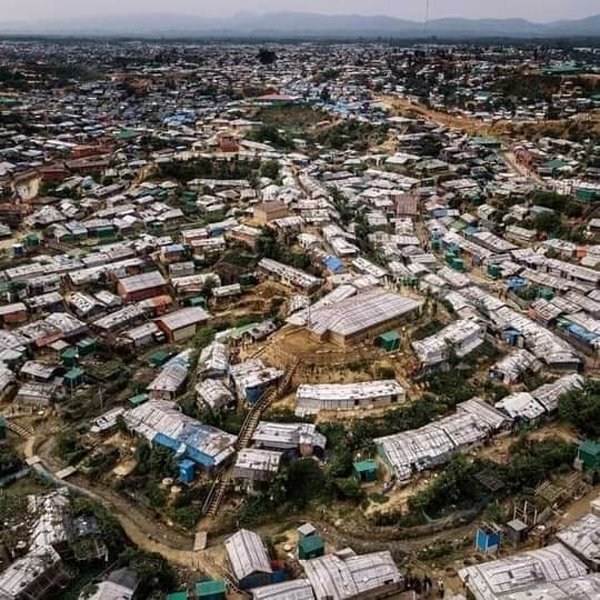
Bhalukhali Refugee Camp 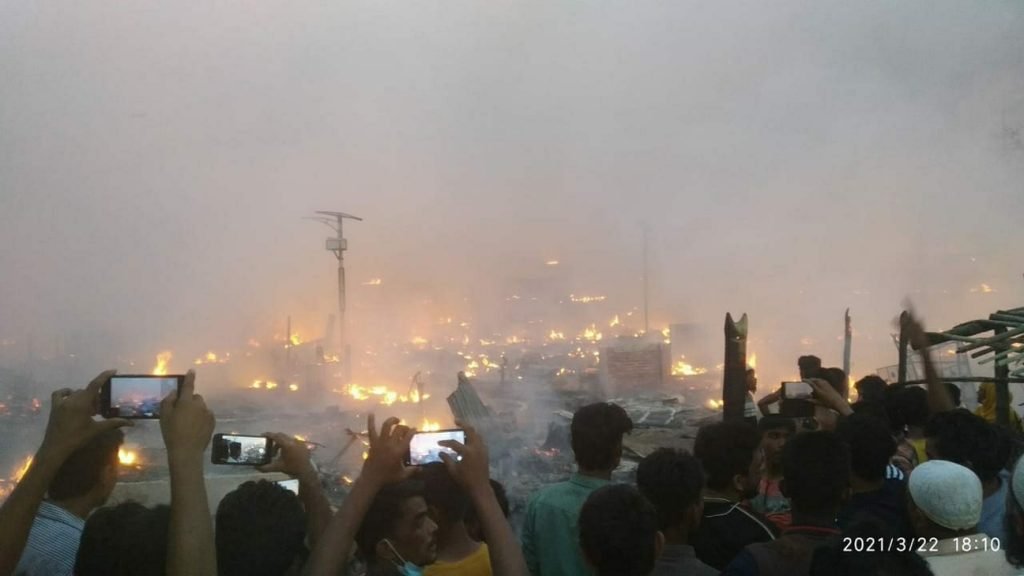
Fire at the Bhalukhali Refugee Camp
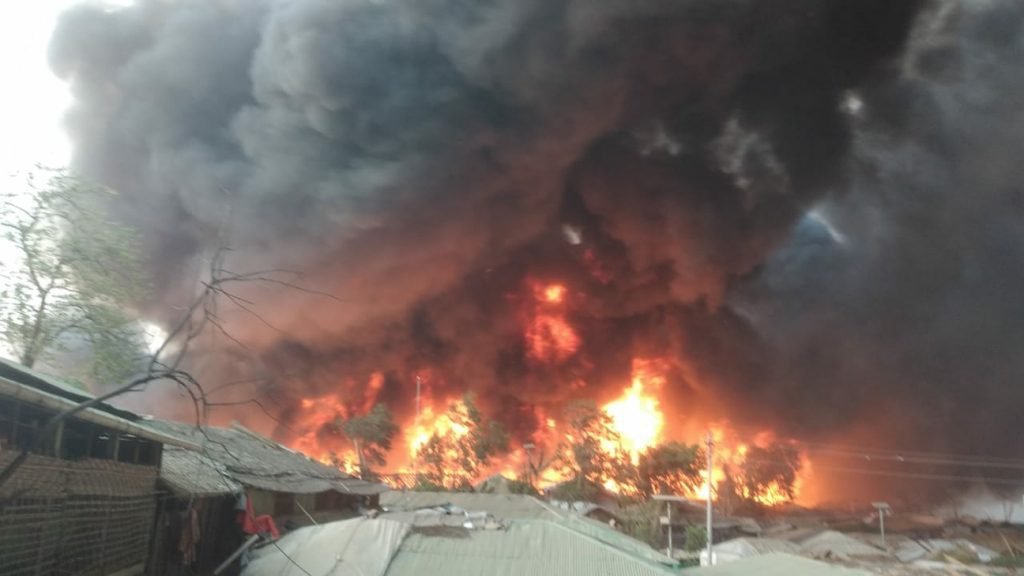
Fire at the Bhalukhali Refugee Camp 
Mohammed Faisal, age 19, Bangladesh.
On Friday, March 22, 2021, a massive fire decimated thousands of our shelters here at the Bhalukhali camp. The fire was incredibly violent and killed hundreds of people including infants. Unfortunately, the people here were not able to escape from the camp, because the government of Bangladesh has created a fence all along the camp’s border, which is why so many people were not able escape the violent fire. There are still so many people who are without shelters and homes. I have also seen people sleeping on the ground wrapped in plastic blankets. This is a short introduction to the people I love, the Rohingya, and is also an introduction to our current state of affairs. I hope the Rohingya stories will live on in your awareness.
 The Fence by Faisal Justin

 When the fire caught our shelters
 some people weren’t able to come out.

 They burned in the fire,
 couldn’t see their way out.

 Many people could not climb the fence;
 they had to stay in this cage.

 There is no freedom in this burning cage,
 suffocated by heat. The fire leaps.

 O, my government!
 O, dear Bangladesh!

 You are the thousands, rescued and displaced.
 You are the kind-hearted. Take down this fence, this place.

 Hundreds of lives ruined by this fence--we do not understand.
 You eliminate words. You eliminate language.

 No End to My Sadness by Faisal Justin

 Many years of my life have disappeared from view
 Life continues, full of sorrow. I remain here, in the same position
 My eyes, full of tears, at times, even oceans
 My body becomes thinner, day after day

 Don't feel well wherever I go
 This moment only makes me ache
 The world is not the world, in my imagination
 The sunny day looks like a cloudy day
 My face even looks gloomy.

 I have visited several places
 Searching for peacefulness
 The more I wander, the more morose I feel
 Every second reminds me of one thing--
 Which remains my country
 And which I hold in my warm heart .
 Life feels as if it is falling, full of aching, full of sadness.
A Journey Behind the Walls
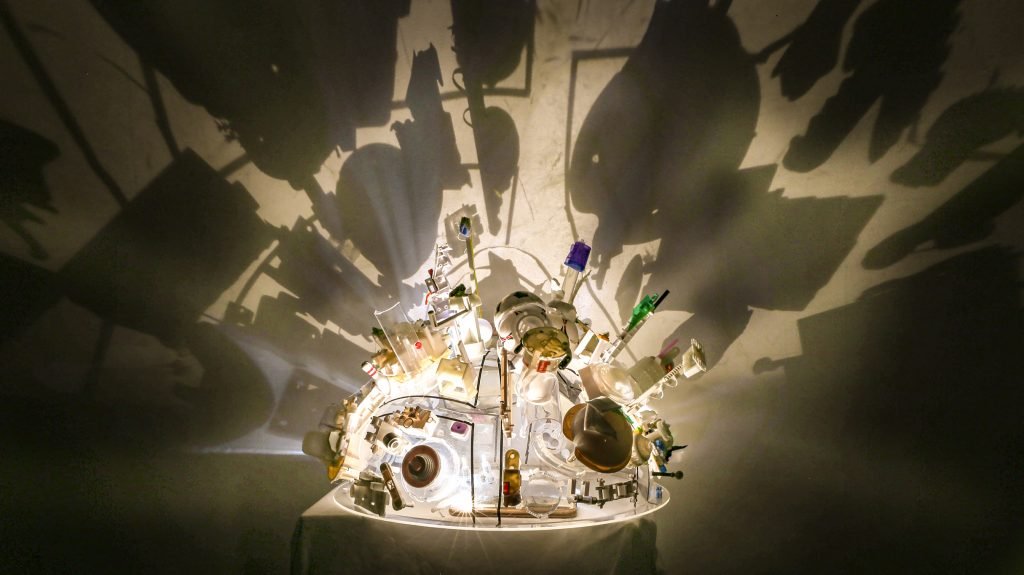
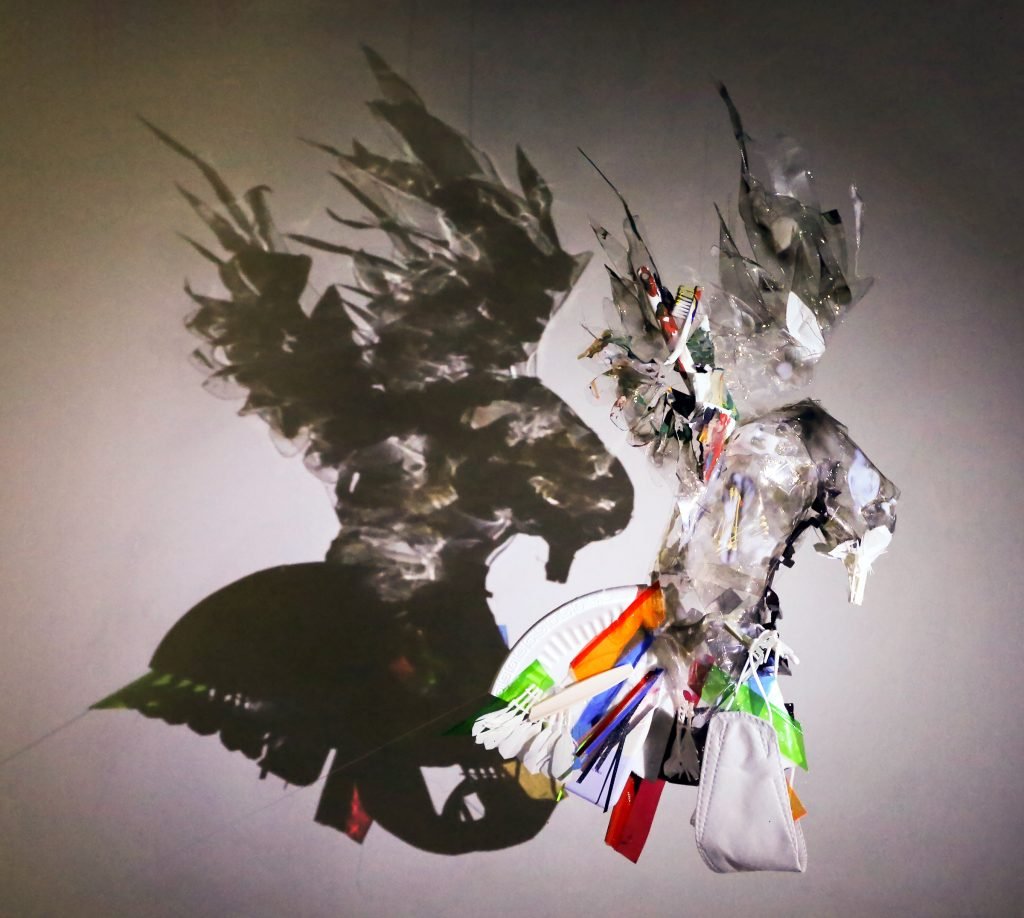
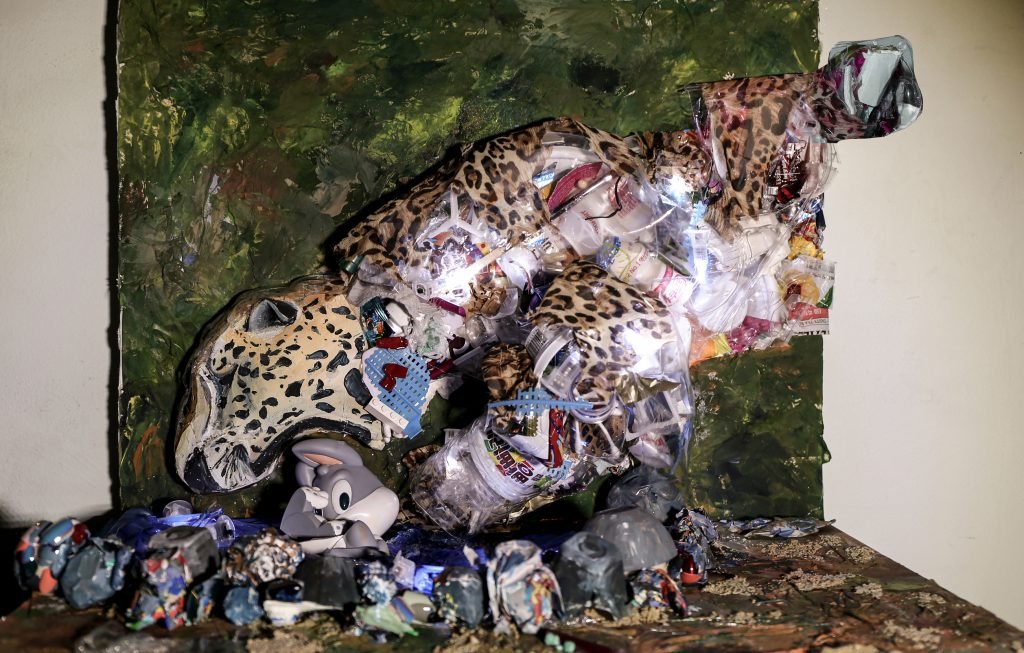
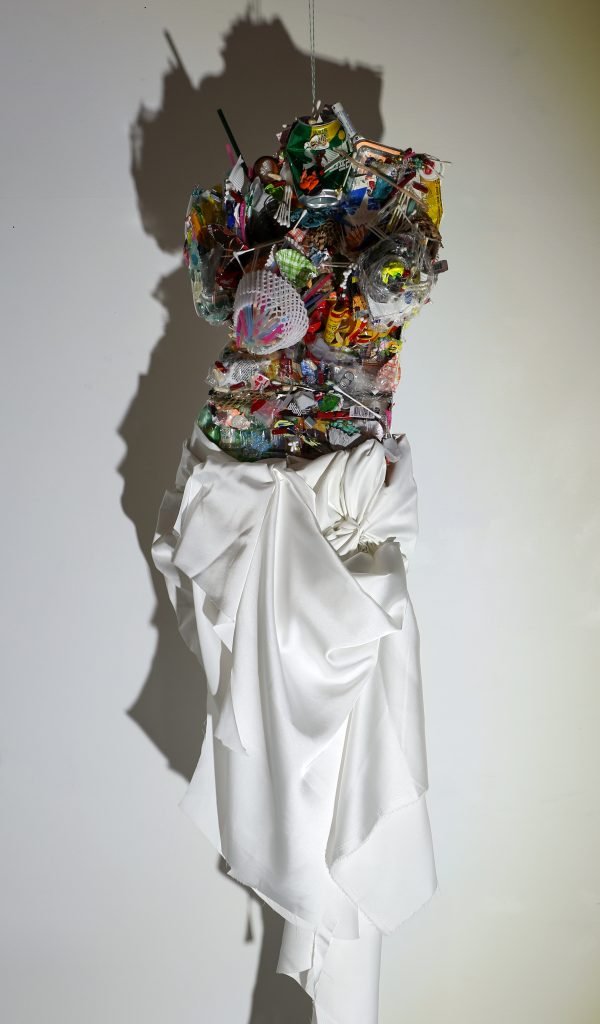
Venus by Eileen Kim, age 17, South Korea 
Eileen Kim, age 17, Seoul, South Korea
A Journey Behind Walls
In recent years, the search for graffiti has taken up a big portion of my time. Within the monotony of my school routine, finding tags and art hidden in building corners or behind walls was akin to a treasure hunt. I have often taken pictures of the latest artworks I found and saved them in my photo album as if they were pieces of a collection. As an artist, I feel inspired to create my own signature style and to learn more about the interesting world of graffiti.
But, growing up in South Korea has reminded me of the impermanence of the culture here. I’ve often observed buildings being demolished and supplanted by newer, shinier structures. Stores I would visit frequently would suddenly close down, and the art that I once cherished would no longer exist. It’s unfortunate that we are so busy moving forward at a fast pace that we can’t appreciate the creations around us. Society doesn’t provide ideal conditions for graffiti in terms of conservation.
On top of the ever-changing nature of Korean street art, COVID-19 has made it even more challenging to explore as frequently as I had in the past. However, last month, I found the perfect opportunity to revisit the childlike wonder I have felt while observing graffiti. While browsing the internet, I came across tickets for URBAN BREAK Art Asia, a three-day fair showcasing street artists.
At the fair, it was almost as if time suspended, and the pandemic didn’t exist. I was surprised to see that people from all walks of life came to see the show, from teenagers donning denim bucket hats to older professionals in their weekend attire. Despite everyone wearing masks, the individuality was compelling and echoed Korean life exactly as it is—one of constant sounds, smells, and colors intermingling. The exhibit echoed the cacophony that citizens experience in their daily routine. I distinctly remember one artist playing the piano in his booth, surrounded by paintings of traditional Korean houses. Meanwhile, an underground rapper signed autographs for his fans a few booths down.
There were numerous exhilarating artists that caught my attention, but the one who stood out the most to me, personally, was a female artist named Junkhouse. Toward the end of the show, I recognized a familiar artwork hers that I’ve seen numerous times on a building during my walks home from school. Luckily, I was able to contact Junkhouse after the show, and she was more than happy to share her thought processes with me.
As Junkhouse compared graffiti in Korea to that in foreign countries, she confirmed that South Korea’s tendency of getting rid of old buildings rapidly prevents street artists from experimenting with their artwork and freely using the city as their own sketchbooks. Furthermore, with the law being strict in terms of interfering with property, young artists move further away from the traditional street art culture. Younger generation artists would rather choose social media as a way of presenting their work and connecting to the greater public.
As she spoke of her free-spirited artistic process, where she draws organic shapes onto existing structures, my mind kept going back to a recurring thought: there is always room for freedom within constraint. There exists a certain, and often justified, stereotype of Korean art as being highly elite and institutionalized. Proprietary gallery owners are often part of a closeted establishment that promote lucrative art forms, such as porcelain from the Goryeo Dynasty or paintings by artists within their inner circles. But unlike traditional art galleries holding the key to the next generation of artists, some people are ready to break the mold and directly communicate with the audience themselves—even teenagers like me.
As I reflected on my own conversation with Junkhouse and on the vibrancy of the works at the art fair, I felt encouraged to challenge my own perceptions. In a rapidly modernizing country like Korea, what would finally allow graffiti art to soar to its highest potential? As for me, what are some preconceived notions and existing barriers that prevent me from reaching my maximum potential?
The answers to both questions are yet to be found, but I am slowly on my way to discovering them. In the meantime, I have added forty new pieces of art to my virtual graffiti collection, which I can browse freely from home. These pieces serve as a reminder to seek freedom even amidst the busy days that lie ahead.
By Eileen Kim, age 17, high school junior in Seoul, South Korea. She adds:
“I am an active artist and writer who enjoys learning about the intersection of culture and the environment. Born in the United States but raised in Korea, I am a bilingual Korean and English speaker with the privilege of examining different perspectives. My interest in environmental conservation, particularly in reducing the use of plastic, has led me on many exciting journeys. Recently, using my art skills, knowledge, and love for the environment, I designed environmentally friendly, reusable masks. My ultimate goal is to create a sustainable system for the future in populated cities, such as Seoul and New York.
As an artist, I am also highly invested in the emergence of street art. In search of works from creative peers my age, I came across your magazine and felt the courage to submit some of my works. “A Journey Behind the Walls” details the street art culture in South Korea and how our strict society has led to a creative underground movement. Though street art is forced to take on a more limited form in Korea compared to other cities like New York or London, it is surprisingly pervasive and thought provoking.
I have also attached my original artworks, “Bird,” “City,’ “Cheetah,” and “Venus.” The recurring theme of these works is the impact of the climate crisis on the ecosystem, from animals and humans to the environment itself. My essay and art attempts to relate to the universal longing of community, freedom and change.”
Lessons
Lessons
By Bhagyashree Prabhutendolkar, age 16, Mumbai, INDIA

if only I could go back in time
and whisper to my younger self,
i would ask her to calm down
before dipping toes into adulthood,
telling her it would sometimes
feel like growing up around venom
and you would shatter
when the demons would spin
pretty lies for your pretty self,
but you mustn’t drown in their tales,
for purity flows through your veins
and the venom can’t touch your bare skin,
it will turn to ashes dear.
you deserve to catch the stars
and reach the sky;
and you mustn’t love anyone else,
than your dear dreams that make you survive
you have a reason to live, a passion to die for,
never betray them who make you smile
in the worst days of calamity
and help you rise from nothing,
for they are your dreams
just breathe.

By Bhagyashree Prabhutendolkar, age 16, Mumbai, INDIA. Bhagyashree is a high school journalist, public speaker,
poet and a recipient of 'The Hindustan Times Scholarship Award.' When not writing, she likes to paint the whispers
of nature on paper to accompany her poems. She aspires to pursue a career in media and creative writing.