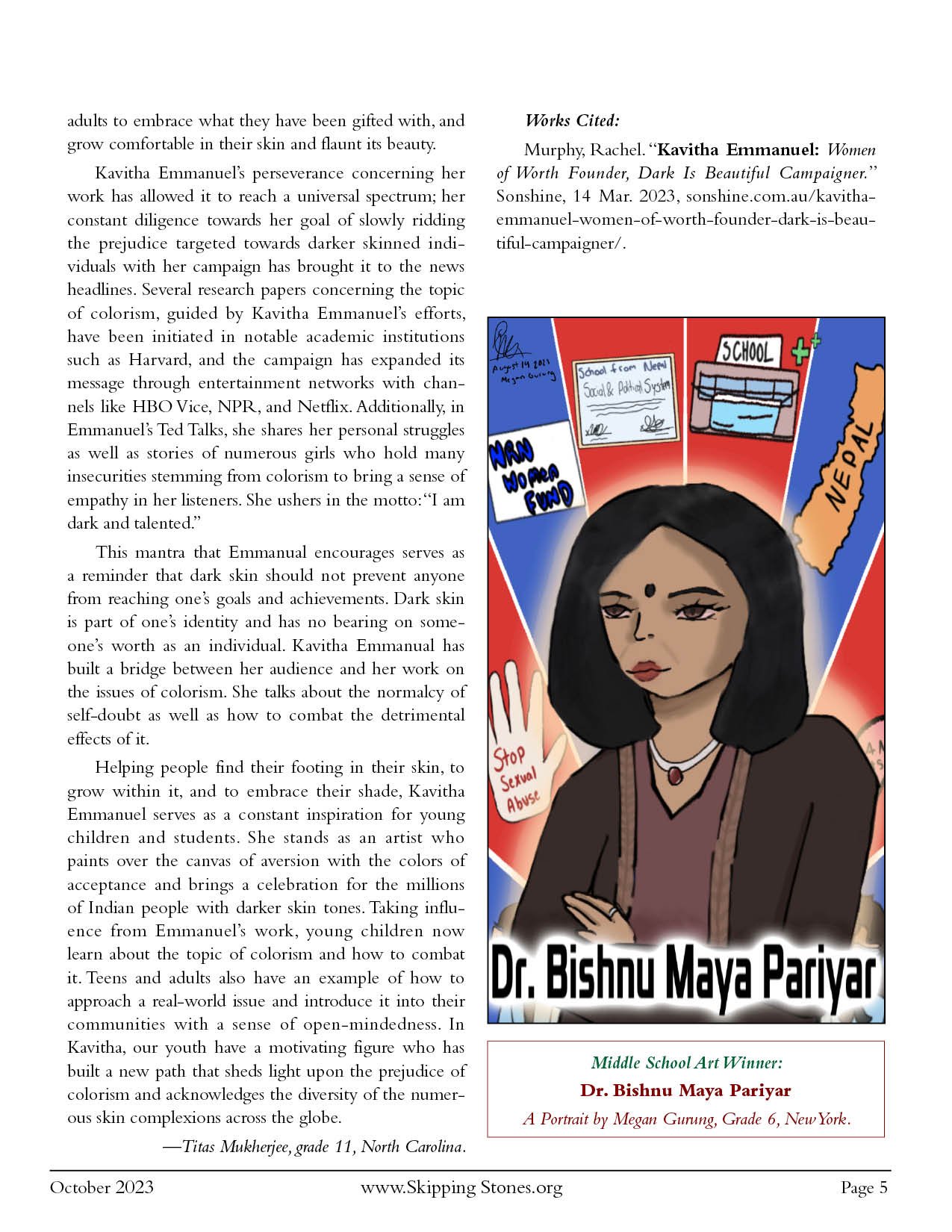
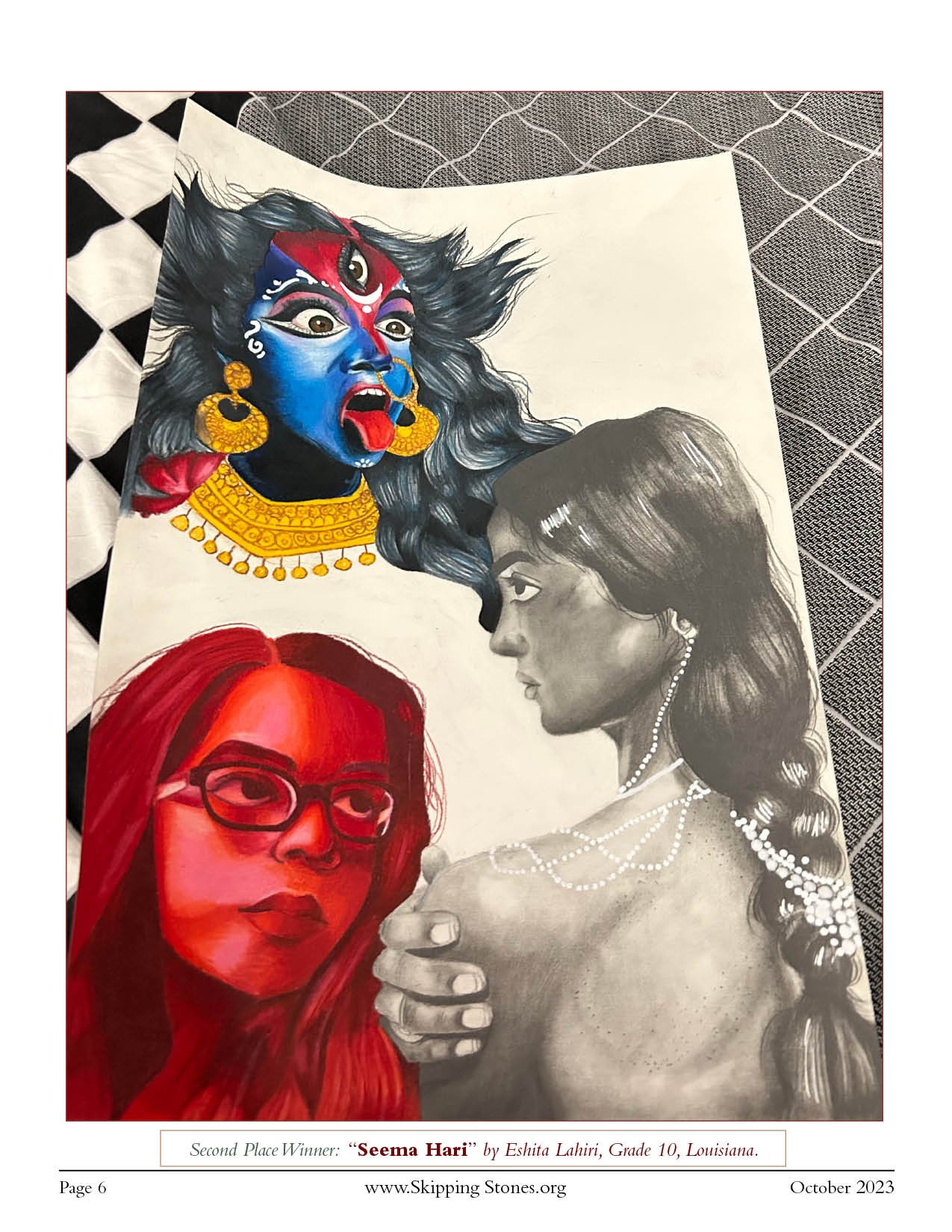
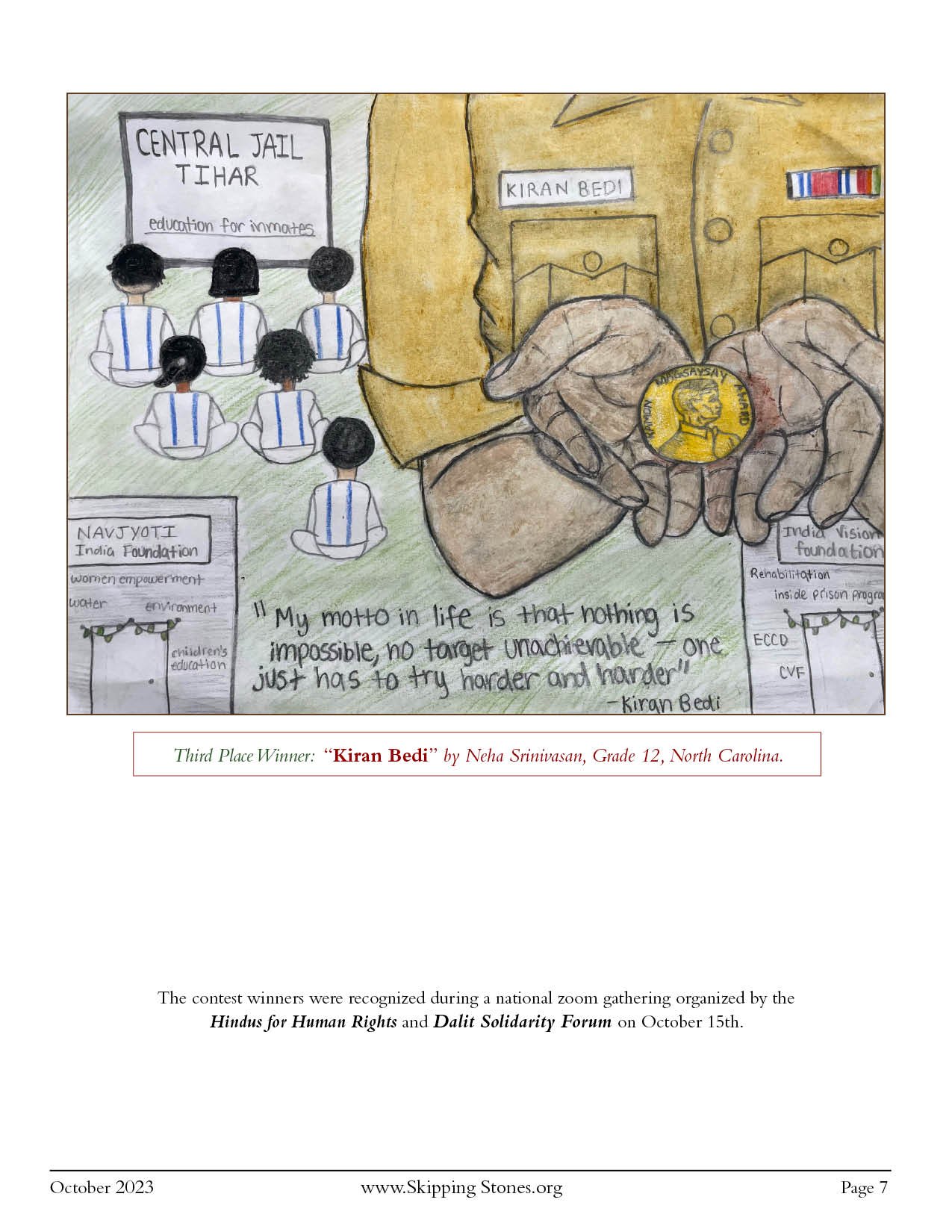

By Aniket Dewangen, grade 10, India.
The bougainvillea flowers whistled with the wind. Each of them withered away as two stayed by the coarse and flaky mahogany tree.
My childhood
The image of the god was pleasant and heartwarming. He held a brass flute adorned with a flower and a bead. The arched legs crossed against the drapery of the Dhoti1 and his lips touched the edge of the flute. His gaze was drawn downward to the majestic instrument. Its amygdaloid-like face and beaten-blue complexion were elegant and defined by a sharp jaw. A majestic peacock flower hung above the satiny hair at the crown of his head. The ace-shaped, indigo-colored splotch in the middle was covered by a flurry of green strands that flowed in a rhythm. The Lord Krishna stood there elegantly, displaying a natural aura of benevolence. Next to the defined blue edges was the goddess of devotion and tenderness, Radha. The two gods stood serenely in the centre of the ashram.2 The terracotta figures seemed to be emphasized in the minds of the people standing before me. Two Pandits3 walked towards the idols. They were wearing angharkas (a short coat-like scarf around the stomach). They marched around and began to proceed with the pooja.4 I looked back and scanned the long queue. The line’s shape curled almost like a racetrack. We all soon congregated, pushing forward to get a greater view of the two idols in the spotlight. I couldn’t see much. I just saw the shoulders of men who were agitated. My father, who limped through the crowd was in front. He had polio, and an orthotic device was attached to his legs. He began to walk in discomfort without any space left.
“Are you okay?” My father looked at me. He looked in agony, yet he powered through the line, which was like a Dandi march.5 Paa (father) was a kindhearted man, or at least I thought so, for the majority of my life. Soon the line began to compress, and I could sense the aroma of Rabri and Malpua.6 The glistening white substance dazzled with a pinch of cardamom on top. It was my favorite. My mother standing behind me kept her soft hands on my shoulders as we moved slowly through the long queue. The brass-plated bell rang at a fast tempo and the procession began. The chimes cut the air and rang through my ears. Soon I started to sense that we had come to the beginning of the line. My mother took me in her arms, and I could finally have a better view of the luminescent and vibrant colors. Both the terracotta figures were covered in tinsel. The pandits approached the idols and began to swerve a copper plate that contained an incandescent flame in one of the lamps. The intricate and mesmerizing designs on the bell and the plate were astonishing. The Pandits began to pour a white substance over lord Krishna. The idols were soaked in the thin badam milk.8 The low-pitched sound began to omit and amplify in the chamber. The Chappan Bhog9 had begun. The Chappan Bhog was a tradition during the festival of Janmashtami10 where the graceful gods were lavishly fed. The Pandits sang a harmonious tune and began to pour different things over the idols. I never understood why this happened. My mother told me that the gods were never fed, and this festival would fulfill them. The myriad of assorted foods made my mouth water.
“Now beta,11 ask for what you want most and fold your hands looking up at the terracotta idol,” my mother said in a haste. My hands joined together and pressed against the warm surface of my palms. I closed my eyes. The one wish and the one thing that I sought the most was barely even related to me. “Dear god, since you have had a wonderful meal, it wouldn’t be rude to ask you this small request. Please keep my parents happy, they seem to fight a lot. I want them to be happy and complement each other.” My eyes slowly opened and a hue of blue covered my vision. The voices that were once muffled began to ring in my ears. The same flame came close to me by the copper plate. The Pandit approached me. I leaned forward and raised my hands underneath the fire that rippled diagonally in the presence of oxygen. The Pandit then smiled and took a red-colored pigment mixed with water. He dipped his thumb in the color and put the tilak12 on the center of my forehead as I pulled my hair back. The Pandit took a few rice grains and stuck it at the same red line. Soon after, my focus quickly shifted from the pooja to the prasad.13 The prasad was a small token that was a blessing from the gods. Taking it from one hand was disrespectful, so I layered them both underneath. A green powder-like brittle was poured into my hand. It looked like earthy soil in my hand with other assorted colors sprouting. I dumped it all in my mouth, and the sweet powder dissolved.
We exited the ashram and my father smiled at me. I hugged them both, yet they had some repulsion against each other, like two magnetic poles. I noticed it instantly, but I didn’t understand what caused this tension.
Vexed – pandora’s box
I climbed up the staircase; drops of sweat poured down my body and made my hair oily. I removed my socks and speckles of grass rained down on the entrance mat. I realized a deafening noise was coming from the inside. The voice was stentorian, like the roar of a lion. I looked down at the marbled tiles aligned next to each other like a tessellation. I stepped inside, and the voice was even louder. In the kitchen, there were the sounds of a pressure cooker that emitted a blaze of steam and gas. In the other room was the sound of my mother, whose voice quickly changed from loud to timid. She began to pule and cry querulously. I quietly put my heavy bag in the room and decided not to make her aware of my arrival. I sat by the curb of my bed and silently listened to the conversation. They began to spit out insults in Hindi and the very blunt manner made me cover my ears. The walls became thin like paper, almost turning into the translucent matter. I pulled my kambal,14 over my head. I couldn’t bear to hear my mother sob and weep over the phone. Instantly I began to connect the pieces and realized who she was talking to.
I spent the entire day sitting on the bed. The call had stopped, and she had begun to snivel. I imagined her facial expression and the tone of his voice. “What could have made her cry so much?” I thought in my head as I concentrated on a single point on my cupboard. The scenarios flooded my brain. I began to become more and more anxious about finding out the mere truth. The teary-eyed face emerged from the aperture in the wall. She was perplexed and baffled by my sudden appearance and sat beside me.
“It will all be okay.” The vague statement did not assure me that she was doing fine. Instead, I began to get even more worried. As Maa left my room, I pulled out my drawer and began to nibble on a childhood snack. The packet of sweets besides my belongings would usually be saved after dinner. But at that moment I needed something to relieve the inexpressible pain. I put the hard candy, shaped like a mango in my mouth. The explosion of flavour tingled my mouth with a stiff numbness. The sour hard candy shifted its position from left to right in my mouth, coating it with the orange dye. I leaned on the headboard of the bed and didn’t do anything for the next few minutes.
Paa opened the door. I heard the creak and began to peek from the edge to see his face with a rictus. It emitted a smoldering look that was bold and quite masculine. He put his belongings by the sofa in the hall and called out my name. A sudden sense of anxiety penetrated my skull. I came out, put my hands behind my hips, and sat down on the greyish-white sofa. The conversation started normally and then was weighed down by emotions. I had not anticipated this moment, and I had begun to link the fact that money was a problem at home. Yet this was not even close to my prediction. Instead, I had learned of the disunion of the two pillars in my life. My world collapsed into a black void, and I sat there still in a vegetative manner for the next few minutes. The Pandora’s box had been opened, and I became enraged at this classified information which was unraveled.
The second petal beside the pinker one, began to hold on to the stem with a thread. Almost beginning to detach.
The contrasting white chair
It was PTM (Parent-Teacher Meeting) day. I walked by the person who made me ripe for the harvest. We both stepped inside the room where Mr. Girinath, my math teacher, welcomed us. He wore a checkered T-shirt and had a Vandyke beard with sleek metallic glasses. The three seats were next to each other. I wasn’t nervous about meeting my teachers, but I was bothered by one thing. It lingered in the back of my mind. My sore eyes were filled with gunk. While walking to the meeting, I was tired and pretended to be elated. The teacher began to lecture me about my poor attention span and my slipping grades in class. It didn’t matter to me. At that point, I just looked at the corresponding chair. The virgin white appalled me with its emptiness. I began to stare at it. My skin flaked like the scales of a viper. Soon my focus was disrupted by a concerned look on my mother’s face. She was quite upset with my academic performance. I was then continually lectured about my grades. I didn’t seem to care. I stepped out of the room. My attention was diverted to the other children. Their faces were lit up with ecstatic expressions. I noticed that both their pillars helped in upholding the integrity of their life. That one other pillar that was supposed to be upholding me had vanished. My mother’s sari15 revealed my face, and its fabric emitted a powerful aura. I was beholden to her and grateful because she raised me even when everything seemed to collapse. I hugged her tightly, grasping her back as a tear rolled down my cheeks.
“I love you Maa,16” I murmured softly.
The mahogany tree stood there alone. The singular petal tarried in like an anchor.
By Aniket Dewangen, grade 10, India. He adds: “My roots have stemmed from the streets of Haryana, and I speak Hindi at home despite being born in the United states. Yet apart from this, I actively enjoy photography and art. I like capturing numerous moments, people and cultures through my Camera, and explore my artistic capabilities with the help of a brush and canvas. A large part of my childhood was seemingly rough and I went through many hardships, but my hobbies and passions made up and brought me relaxation even in distress. This all taught me one thing to stay stronger and push through anything that was to come my way.”
Foot Notes:
|
1 Dhoti: A white cloth garment with a border, worn in an Indian traditional manner 2 Ashram: A hermitage 3 Pandit: A Hindu scholar 4 pooja: A Hindu ritual of worshipping god 5 Dandi march: Mahatma Gandhi’s famous Salt March—nonviolent civil disobedience in 1930 during the British Colonial Indian rule 6 Rabri and Malpua: Traditional Indian sweet dish made with milk, sugar and condiments 7 Aarthi: A ritual ceremony of waving a lighted lamp during prayers 8 Badam : Almond 9 Chappan Bhog: Offering of 56 food items to Lord Krishna on his birthday (Janmashtami) 10 Janmashtami: Lord Krishna’s birthday festival, usually in August or September 11 Beta: Endearing term for son in the Hindi language 12 Tilak: A mark worn by Hindus on their forehead, especially during festivals 13 prasad: Food that is offered to gods 14 Kambal: A blanket or comforter 15 Sari: A traditional garment worn by women in India; it’s a long, colorful cloth decorated with various designs. 16. Maa: Mother. |
Based on a Jataka Tale
By Christina G. Waldman, New York
The Lord of Jataka strode pensively up and down his marble-floored chamber, stroking his short, stubby beard. Any minute now Sahbasad, his most trusted advisor, would come through the curtained doorway. Perhaps then his troubled mind would find relief.
He had not been Lord of Jataka long. Indeed, it had only been six months since his father had sent him to this far-away city to try to restore it to its former prosperity. True, six months was not long, but there was much reason for despair.
He had wanted to make Jataka the shining star of all his father’s cities. Yet, he feared, it was nothing more than a laughingstock.
“My Lord.” Sahbasad peered through the velvet curtain.
“Sahbasad.” The king’s face brightened at the sight of his friend. “Come, sit here beside me and dispel the gloom from this room. Tell me, have you made your way among the common folk as I asked you to do these past weeks?”
“Yes, my Lord.”
“Good. And what have you learned?”
Sahbasad took a deep breath. “Your Highness, I fear you will not like what I have to say.”
“Out with it, Sahbasad. I must know.”
“Very well, then. None of your plans for improvement are being carried out. The libraries and museums you have commissioned to be built exist only on paper. The lovely gardens you and I designed have no gardeners to tend them. The statues of great men and women you ordered to be carved sit unformed in blocks of marble. Oh, my Lord, it is indeed pitiful!”
“And what do the people do, then?” cried the Lord. “The farmers—surely they must be harvesting their crops so there will be food for the winter?”
“My Lord, I’m afraid no crops were planted,” said Sahbasad.
The Lord grew alarmed. “This is worse than I thought. What is this evil that has paralyzed my people?”
“No one will speak of it.”
The king’s sharp glance pierced Sahbasad. “But you must speak of it. We grew up together, before fate called us to different roles. I trust no one as much as I trust you. Now tell me, what is it the people fear so?”
Sahbasad began boldly but ended in a whisper: “Though none dare say his name, it is the—the—King of Maragor.”
“The King of Maragor!” exclaimed the Lord. “What do you know of him?”
“It is said he is very evil, a king of darkness, who will bring to naught any good the people try to accomplish. Instead of venturing out to work for their bread, they cling to the little they have, scraping their grain barrels for one last measure of porridge. They fear that Maragor will send his villainous horsemen to trample any field they plant.”
The Lord fumed. “Sahbasad, I want you to take whatever men, horses, and provisions you need, and travel to the Kingdom of Maragor. Find out all you can about him: how he lives, what he eats, what music he likes, whom he trusts—everything! Take one hundred witnesses with you. When you find him, tell him that I, the Lord of Jataka, am not afraid to say his name.”
Sahbasad trembled. “Must I, Lord?” Knowing the answer, he rose and was gone.
Ten years passed. The Lord of Jataka’s people had not prospered. More and more, the Lord shut himself up in his palace, for it hurt him to see how they suffered. Though children were hungry, most farmers still refused to till the soil, for why plant what Maragor’s horsemen would only destroy?
Finally, one day, as the Lord strode up and down with worry, a visitor was announced.
“Sahbasad! At last you have returned, my friend. We are both grizzled and gray. Come, sit here beside me. Tell me about Maragor.”
“My Lord,” Sahbasad began reluctantly. “What I have to say will surprise you. I hope it will not anger you.”
“What is it, Sahbasad?”
Sahbasad bowed his head. “I have not found him.”
“What!” cried the Lord.
“It is true. My men and I have searched for ten long years, but we never found him. In fact, I am certain he does not even exist.”
“Oh! Perhaps you found his villainous horsemen?”
“Not a trace.”
“Then, my people have been deceived.”
“It appears so, my Lord,” said Sahbasad.
The Lord’s brow furrowed in thought. Then he slowly smiled. “Sahbasad, were you afraid to undertake this mission?”
“Oh, yes.” Sahbasad shuddered.
“But, now you have learned that what you feared was not real.”
“It appears so, my Lord,” said Sahbasad, with a slight smile.
The Lord jumped to his feet excitedly. “Sahbasad, would you swear to what you’ve just told me?”
Sahbasad handed the king a parchment scroll. “I, and a thousand witnesses have done so.”
“A thousand!”
“Yes, they are all standing in your courtyard,” said Sahbasad.
The Lord hastened to his window. Sure enough, his courtyard was filled with people.
“Sahbasad,” said the Lord, “take up pen and parchment. Write these words to my people:
“Make copies of this proclamation and post them on every pillar in the land. But first, my faithful friend, kneel before me.”
Sahbasad knelt, amazed. The Lord touched his shoulder and knighted him, saying, “No, Sahbasad, you have not failed. By your valor and devotion, you have succeeded. You have proven this fearsome phantom-king to be made of thin air. You have thrown back the veil of darkness and opened the door to a sunlit garden of possibility. From now on we are truly brothers. Go.”
With tears in his eyes, Sahbasad rose, embraced his king, and set out to proclaim his message of hope.
—Christie Waldman grew up in a small town in Illinois. She first wanted to be a published writer when she was seven years old. Her short story for children, “Something to Look Forward To,” can be read online at Ember: A Journal of Luminous Things (Oct. 2021).
https://read.emberjournal.org/christina-g-waldman/something-to-look-forward-to/
Author’s Note:
The source for this story was Josephine Saint-Hilaire, “Parable of the King of Maragor,” first published in English in her book, On Eastern Crossroads: Legends and Prophecies of Asia (New York: Frederick A. Stokes Co., 1930). © The Agni Yoga Society, New York.
http://agniyoga.org/ay_en/On-Eastern-Crossroads.php
By Fanny Wong, New York
In 1872, on a pier in Portland, Oregon, an eighteen-year-old Chinese girl waited. She had been smuggled to America, far away from her village in China.
My father was so poor he sold me for two bags of seeds for the next planting!
The girl closed her eyes and saw the image of bamboo that grew near her old home.
I am like a bamboo. A bamboo bends in the wind. I will bend but not break.
“Gong Heng!” A Chinese man called out.
The girl’s eyes flew open.
“I’m taking you to your master in Warren, Idaho,” said the man.
For nine days, the man led the pack train of mules on mountainous trails to the mining town. For nine days, Gong Heng gazed in wonder at the majestic Northwest wilderness. It helped soothe her worries.
What’s going to happen to me?
In Warren, the mules plodded down a rutted street to a saloon. A stranger hoisted the girl from the mule and announced to the people around, “This is Polly.”
Gong Heng wondered who they were talking about. Soon, she realized that Polly was her new name in this strange new land.
I was born in the year of the ox. I am stubborn and hard working. I will survive and I will go home.
Polly’s owner was an old Chinese man.He put her to work in the saloon. Men came to gawk at the one Chinese girl in town, and stayed to drink and play cards. She served drinks, cleaned tables, and swept floors. Her presence made her master’s saloon different from the others in town, including the one next door, owned by kind Charlie Bemis.
Sometimes Charlie heard trouble brewing in her master’s saloon. He would march over to break up a fight and stay to talk to the cheerful young girl who worked so hard and always had a smile on her face.
Soon Polly, a fast learner, could understand and speak some English.
One night, Polly swept the saloon after the last customer had left. Something on the floor caught her eye. It glittered. It gleamed. It was a gold nugget. She slipped it into her pocket.
A miner must have dropped it when he paid for his drinks with gold dust or a nugget.I may find some more.
On rare nights, she did spy gold dust, flakes and even nuggets. Even though she knew it would take years to scrounge enough gold to buy her freedom, there was hope on the saloon floor.
Month after month passed. Polly was always doing something to save money to buy her freedom. Charlie taught her how to work with gold. Polly made trinkets out of nuggets and sold them. She learned to make bread, stew, sauerkraut, fruit preserves, and other foods the miners liked.
“I learn right along,” she said to Charlie, pointing to her head.
Then everything changed. Polly’s master died. The girl who had been sold for two bags of seeds was now a free woman.
What’s going to happen to me?
Polly had a big decision to make.
Should I buy passage back to China with my money? A Chinese friend wrote letters for me but I haven’t received any answer from my parents. Have they forgotten me? Where do I belong?
Even though there was a lot of discrimination against Chinese people in America, life in China for a young woman from a poor family was even worse. Polly made up her mind to stay. But what would she do? Where would she live?
At that time, a Chinese person could not buy property. Charlie could, with Polly’s money. He bought a boarding house for her. Before long, Polly’s boarding house was a popular place for people who passed through or miners who stayed longer. She was a good listener to their tales of woe and troubles.
Soon, Polly had woes of her own. Mining towns were violent places. Charlie got shot in the cheek.
“Will he make it?” Polly’s voice shook.
“I’m sorry, Polly. I’ve done all I could,” the doctor said. “Just make him comfortable till the end.”
It was then that Polly realized Charlie meant more to her than just a friend.
“Charlie won’t die. You see, I take care of him.”
Week after week, Polly nursed Charlie back to health. She packed herbs over the wound. She made nutritious soups to help him get strong. With Charlie’s recovery, Polly gained respect from the community for her loyalty and nursing skill.
Everyone in Warren knew Polly. Women were few and they were generally not respected. But this Chinese woman was trustworthy, kind and cheerful.
Charlie and Polly were married after his recovery. Soon after, Charlie took her by boat eighteen miles up the Salmon River. The land Charlie wanted to buy at the bottom of the canyon was flat enough to make a homestead.
“Well, what do you think?” Charlie asked.
“I love this wild place,” Polly said. “Need hard work.”
With her blessing, Polly and Charlie became the first to settle by the Salmon River. They kept chickens, a dog, a cow, and a few horses. Using farming skills learned from her childhood in China, she nurtured the soil and coaxed cabbage, beans, corn, and fruit trees to grow strong and bountiful.
Polly hauled water from the river. She fed the animals. She chopped wood. Although life was not easy on this rugged patch of land, she was content. The babble of the river and the wildlife around her soothed her.
Charlie and Polly lived an isolated life until Peter Klinkhammer and Charlie Shepp settled across the river. The new neighbors became best friends. They took Polly’s produce as well as their own to Warren to sell and buy necessities, such as coffee, soap, thread and fishing gear.
She made friends with prospectors who passed her homestead. “I feed you a good meal.”
This five-foot tall Chinese pioneer, brown and wrinkled from the sun and age, became a folk legend. Journalists and visitors traveled to see this feisty woman who told them her improbable life story.
One day, in the summer of her 28th year on their homestead, Polly was fishing on the banks of the river.
Fire! She saw smoke licking out the upstairs window of the room where Charlie was bedridden. Her heart raced as fast as her feet to save Charlie.
“Hurry, Peter!” she shouted to her neighbor as he crossed the river on a boat. Peter and Polly carried Charlie down the stairs through the smoke.
After the fire, Charlie and Polly stayed with the neighbors. Sadly, Charlie died several months later. Lost in grief, Polly again wondered. What’s going to happen to me?
She closed her eyes and saw the image of the bamboo that grew in her village.
I am like a bamboo. A bamboo is strong and it bends in the wind. I will bend but not break!
“Can you build me a small cabin right where the old one was?” Polly asked her neighbors.
“American soil in my fingernails; here to stay.”
Polly’s neighbors built her a small cabin on the same spot of the burned home. She lived there alone for ten years, a pioneer to the end.
Polly had found her place in the world in the wilderness of the Northwest. A girl who was sold for two bags of seeds became a pioneer woman!
Author’s Note:
Gong Heng was born in China in 1853. Her farming family was rich enough that Gong Heng’s feet were bound. At that time, foot binding was still practiced in China. Women with small feet were thought be feminine. Girls as young as five or six, from well-to-do families, had bindings on their feet to prevent them from growing. It was a painful process and the feet became grossly deformed.
When Gong Heng’s family fell into hard times, her mother released the binding so the girl could help in farming. Her feet were already deformed and never grew to full size. As a result, her gait was an unusual rolling one.
During the late 19thcentury, many Chinese women were brought to the United States, mostly against their will. Gong Heng was one of them. When she was a young teenager, a prolonged drought ruined the harvests, and the countryside was overrun by bandits. In desperation, her family sold her to a group of bandits for two bags of seeds for the next planting. She was their slave until she was sold to a woman who smuggled her to the United States.
A Chinese man in Warren, Idaho, probably bought Gong Heng sight unseen through a middleman. Now known as Polly in Warren, she was very resourceful and hard working. She learned the cooking styles and customs of White folks. She was renowned for her kindness and nursing skills. To the White residents and miners of Warren, Polly was an eyeopener. They were accustomed to the poor Chinese miners who lived in shacks in another part of the town. Polly was feisty, cheerful and intelligent. Unlike the dancing girls in the saloons, she was a woman they respected.
Still, America didn’t seem like home to her until her husband, Charlie Bemis, bought a small piece of land by the Salmon River in 1922. It was there that Polly became a pioneer woman, living off the land and making it a home.
At the age of 80, Polly suffered a stroke. Her neighbors took her to a hospital in Grangeville 87 miles away. But she died and was buried in Grangeville. Fifty-four years later, her remains were exhumed and reburied next to her home on the Salmon River.
Polly never could become a citizen of the United States, even by marriage. In 1943, ten years after her death, the law that denied naturalization to Chinese immigrants was repealed.
At the time of her death, she was well-known in Idaho. Journalists wrote about her. Polly’s restored cabin is now listed in the National Register of Historic Places, and she was inducted into the Idaho Hall of Fame in 1996. Her belongings are displayed in the Idaho State Museum. Polly had become a legend.
Bibliography
Elsensohn, M. Alfreda, Idaho Chinese Lore, Idaho Corporation Of Benedictine Sisters Cottonwood, Idaho. 1993
Wegars, Priscilla, Polly Bemis, Caxton Press, Caldwell, Idaho. 2020
http://americansall.org/legacy-story-individual/polly-bemis (accessed 2-9-2021)
“What we call casual poetry—verses written on kitchen napkins, often forgotten—reminds us that poems are a natural part of human expression… or at least, they should be. My hope is to capture the antagonistic nature of humanity in the 21st century. How does one capture such corruption on paper? The ethics of industries and modern work culture are major topics of debate. What good is individualism if it leads to the downfall of one’s well-being? Each poem is a cry from humanity. The pieces explore the lives of various people and their environments. Both a billionaire oil company CEO and a burned-out office worker have a connection to their environments. My hope is to preserve the fleeting present. Each poem follows how industrial, political, and economic changes have influenced humanity as a whole. The poems are meant to bring attention to the peculiarities… or struggles of various people.”
—Suprya Sarkar, 16, Connecticut.
It is May and I’m still jobless.
I thought this city was meant to give birth to dreams.
What dreams, they can only devise schemes.
I would rent out a place
But penny tosses and angry bosses consume my day.
I wonder if they truly hold up to their promises of Agony… obliteration.
The pencil taps
Or the ticking of my twelve-dollar watch
Has room for little patience in their world.
I fantasize about what to say.
Like a parakeet reciting words to catch bait,
I revise my questions.
For how many times,
Who is to say?
They close the door on the poor man in white.
Goddammit,
A university degree
And I’m just as broke as that streety?
My friends from home don’t bother to pick up the Phone.
Ring, Ring, oh shoot,
My phone bill is laying on the floor.
Why bother trying to restore the old?
A long-neglected Porsche,
Yeah, I think that’s who I am.
What is all this brooding for?
I am writing home
As if even my own mother remembers my name.
Don’t worry they say,
“You’ll get your own place someday!”
—Suprya Sarkar, age 16, originally from Bangladesh, now lives in Connecticut.
The house of sand you built at last.
Tell me, friend, do you think it will withstand a world so vast?
You wrecked sandcastles just to build signs seeking justice.
Children sleep out in the cold.
Oh heavens watching above, is this justice?
The blanket the child holds onto is an oasis.
Its warmth mimics that of a home so far away.
The desert was his home; a long-forgotten friend.
Every wind feeds him the false promise of freedom.
What do they know?
What do they know of the sun’s kiran* when mother would feed us šāy.*
USA!
Is that how they play?
The warplanes outnumber the birds.
Children close your eyes, they are fighting for pay.
You can not hide in this world.
You are solely bare, exposed, naked even!
What man was born with cloth? Point me to him and then I will abandon my home.
And though you can drink your coffee
So black, filling up the glass
That same coffee will stare you back.
Black is the oil you pull from a land so boundless.
Who is brave enough to claim the desert as his own?
You can not rule. You fool!
Many tried and failed to seize this land.
For centuries it stands, unbroken by your nuclear adornments.
For the Desert is a lion, no simple house cat.
He who dares to challenge shall be left broken in the end.
The pools of oil have all dried up;
Your thirst can never be quenched.
* Kiran: ray; šāy: thick creamy top layer on boiled milk
By Suprya Sarkar, age 16, originally from Bangladesh, now lives in Connecticut. She adds:
“What we call casual poetry—verses written on kitchen napkins, often forgotten—reminds us that poems are a natural part of human expression… or at least, they should be. My hope is to capture the antagonistic nature of humanity in the 21st century. How does one capture such corruption on paper? The ethics of industries and modern work culture are major topics of debate. What good is individualism if it leads to the downfall of one’s well-being? Each poem is a cry from humanity. The pieces explore the lives of various people and their environments. Both a billionaire oil company CEO and a burned-out office worker have a connection to their environments. My hope is to preserve the fleeting present. Each poem follows how industrial, political, and economic changes have influenced humanity as a whole. The poems are meant to bring attention to the peculiarities… or struggles of various people.”
By Amritha Purohit, age 15, New York.
The crisis in Afghanistan was something I had always known about, lingering in the back of my mind or through news stories floating through the halls of my already noisy house. It was just another emergency in the world, something that needed to be taken care of, but perhaps not by me. I’m a highschooler living in New York. Most of what was happening on the other side of the planet didn’t seem to have that much to do with me. Earlier this year, Sunita Viswanathintroduced me to ABAAD, the Afghan Women Forward. She is my parents’ close friend, and has known me since I was little. She spoke about it to me in passing, not as something she was hoping to involve me in, but to let me know what was happening in her life. I pressed, and soon found myself interning there. I had always thought that trying to make a real difference halfway across the world from would be almost impossible, but I was wrong. A few weeks ago I had the privilege of participating in a video call with children from Afghanistan whose lives have been impacted by the Taliban takeover. Here are a few of their stories:
In August 2021, the Taliban issued an order preventing girls from attending secondary school, citing pretexts ranging from wanting to review the uniform to curriculum issues. This meant an immediate stop for many young girls seeking an education past sixth grade. Krishma is an 11-year-old girl who would have been in the 7th grade had she not been prevented from attending school. She was forced to stop going to school last year. Everyday, when her second-grade brother comes home, he shares what he learned that day. They often work together to learn to spell tricky words in the hopes that Krishma can continue her education. She wants to become a doctor and a teacher when she grows up, but in her current circumstances, it would be impossible for her to even complete high school. Her message to the world is to educate yourself and to always help others.
Hasinat, age 10, is another Afghan girl who can no longer go to school, but for a different reason. She cannot go to school because of her family’s financial situation. Her parents could no longer afford to pay rent on their house, and were forced to move to another province without a school. Now, the only way for Hasinat to continue her education is by moving back to the old province, and that is financially infeasible for her family.
Aside from education, Hasinat’s life has been devastated in other ways due to her family’s extreme poverty. She hasn’t had her favorite food, Chablis Kabob, in over two years because her family cannot afford the ingredients. Her mother is sick, and the family cannot afford to buy medicine. Hasinat helps around the house to ease her burden. She hopes to become a Quran teacher when she grows up, and share her love of the Quran with the world.
Sadaf is a 10-year-old girl in the fourth grade. She has a large family—ten members in all—and when she is bored she often makes pillow forts with her younger sisters. She has dreams of being a doctor. Sadaf is one of many Afghan children facing extreme poverty right now. Her diet mainly consists of tea, bread, carrots and shola,a kind of cheap rice. Her mother is very sick, and her family doesn’t have enough money to take her to the hospital. They can’t afford medicine, and many people in her family are chronically ill. No one in her family has a salaried job, and her mother often worries she will not have enough money to feed her kids. Like Hasinat, Sadaf hasn’t been able to eat her favorite food, a kabob, in almost three years.
Samir and his sister, Marwa, both don’t have national ID cards. This means that they cannot do a lot of things they would normally be able to, like going to school. Marwa is not yet in sixth grade. Only men can get ID cards, and so their mother cannot help them. They also can’t afford to buy supplies needed to attend school. They also don’t have any kind of toys, so Samir and Marwa often race their siblings for fun. Marwa loves shawarma, but ate it for the last time four years ago.
Farhad is 11-years-old and in fourth grade. He, like Samir and Marwa, does not have any toys, so he too races his 7-year-old brother for fun. He wants to become a teacher when he grows up, despite extreme poverty and lack of resources.
Aryan is 12, and is in the third grade. Like many others, his family faces extreme poverty. Most of his meals mirror Sadaf’s and consist of shola, and when they cannot even buy that, they turn to bread and tea. The Taliban have decreed that if a student does not have books for the school, they can’t be in school. Aryan’s family cannot pay for books, and has been forced to stop his education. He also has mobility issues, and is always fidgeting. To fill up his time that he’d be in school, Aryan uses a slingshot to aim at bottles. His greatest wish is to own a car and a bicycle, and to be able to go places.
The situation in Afghanistan has become worse. As the rest of the world turns their back on these children, it’s important that we don’t as well. With donations, ABAAD plans to help children get access to education, to get proper medicine, to have a chance to eat their favorite foods for the first time in years. With a donation to Aabad your family will not only be helping Afghan children and families with basic needs, but also showing that change is possible, even in the midst of a crisis.
By Amritha Purohit, age 15, New York.
By Fatimah Habibi, age 18, Connecticut.
To observe and experience so many terrible things at such a young age had a lasting effect on me. When my brother was kidnapped, I was just seven years old. I may not have known as much at the time because I was so young, but when I saw my family, I knew something wasn’t right. Everyone at home cried for a week, and it appeared as though someone had passed away. He was discovered by the police after the week was over, and they took him to the station. As he saw our family when he got home, he started crying. My parents were crying as well. It “felt like I had been gone forever,” he said. After that, life became more difficult for everyone in my family; we were unable to attend school for almost six months and no longer could leave the house. As long as we stayed in Afghanistan, there was no easy moment. For the protection of my brothers and ourselves, we were forced to make the decision to leave our homeland. Every time I watched my brother or other children playing in the park or outside, I wanted to join them and have fun just like they did. I was happy to hear of my family’s decision since I had always thought that once we left Afghanistan, I would be allowed to play freely in the park like they did without anyone objecting.
I was around age nine when we moved to India, and it was quite traumatic and terrible to leave my entire family behind. It was a good feeling of freedom, but I also faced a lot of challenges like at first, it was very hard for me to learn their language, culture, food, and the most important and shocking thing was their religion (Hinduism).
It was my first time to see a lot of people of different colors and different beliefs. This was something totally new for me. However, on the other hand, I felt as though I had started a new life. I could do whatever I wanted without anyone bothering me. I attended school there fearlessly and learned a lot, including Hindi, English, and a ton of other things. There, I knew what exactly life is and how it felt to be a free woman.
I made a lot of friends, and had a normal childhood. I was really satisfied in India, and I lived there for almost three years. However, after spending three years in India we went back to my country to see my uncles, aunts, and grandfather. We stayed about a month in Afghanistan, and when we tried to go back to India, sadly, my Grandfather passed away. We were unable to go back, so we stayed in Afghanistan. There were no easy moments as we stayed in Afghanistan again, especially for me. I was used to wearing whatever I wanted and going outside whenever I wanted; but in Afghanistan, I couldn’t do any of that which was very hard for me. Going to school with fear and then returning home and spending the entire day at home is not simple.
For our freedom and education, we had to leave Afghanistan once again. We traveled to Turkey and stayed there for a year. I was very tired of being forced to move from one country to another and didn’t want to do it again until we came to the United States.
I experienced a lot of difficulties. People treated us differently because we were strangers, which obviously had a big impact on our mental health. I don’t know why, but as I went outside, the people looked weird. But after a year, I began to get used to it. We lived in Turkey for two years before coming to America. At first, I had the impression that because we were immigrants, everyone would treat us differently, the school and people would be like in Turkey. After a few months, I started going to school and there were really nice, respectable people there. I have come to the conclusion that everyone is the same, regardless of their origin or belief. Everyone follows the same process. In the years that followed, I finally understood how to live and now I feel very free.
The United States offered me and my family a chance at a brighter future. We were able to take advantage of the many opportunities available to us, from education to employment. I was able to pursue my studies at a good high school with plans to attend college and study what I want. My journey from Afghanistan to the United States was not only a physical one, but also a mental and emotional one. I had to learn how to cope with the new culture, language, and people I encountered in my new home. I also had to learn how to adjust to the freedom and independence that I was granted—the freedom and independence that I did not have in my country.
My experience as an immigrant in the United States has been an enlightening one. I have been able to gain an appreciation for a culture different from my own and to gain an understanding of the difficulties that come with the process of acclimating to a new environment. I have also been able to gain a greater sense of appreciation for the many freedoms and opportunities available to me here. I may have left my homeland behind, but I will never forget the strength and courage it took to make such a big move. I will always carry with me the lessons I learned, and the experiences I had during my journey from Afghanistan to the United States. Finally, I have arrived at the place I had planned for myself. I am able to live independently and attend school. I have the opportunity to pursue my dreams in the U.S. and make them come true. I’m a senior in high school now, and intend to go to university to pursue a career that I hope to have and love in the future.
By Fatimah Habibi, age 18, h.s. senior, Connecticut.
Fatimah adds: “I was born and raised in Afghanistan. My cultural background is Afghan and I was raised in a household that placed a strong emphasis on our cultural traditions and customs. One of the traditions that is most important to me is the celebration of Eid al-Fitr, which marks the end of Ramadan. During this holiday, my family and I gather together to pray, give gifts, and share meals. It is a time for us to feel connected to our culture and to pass on our traditions to future generations.
I was also taught about the history and values of my culture, which has had a big impact on my worldview and how I approach life. For instance, the importance of family and community is something that is very important to me and something that I try to incorporate into my daily actions. My cultural background and traditions have played a significant role in shaping who I am and have given me a sense of belonging and connection to my heritage.
The most popular and my favorite dish in my country is called Qabili palau. This is how we make it.
Ingredients:
Recipe:
Editor’s Note: If you are a vegetarian, like many people are in India, you can choose to skip the meat—lamb or beef, etc. The rice pilaf dish will still be very tasty.
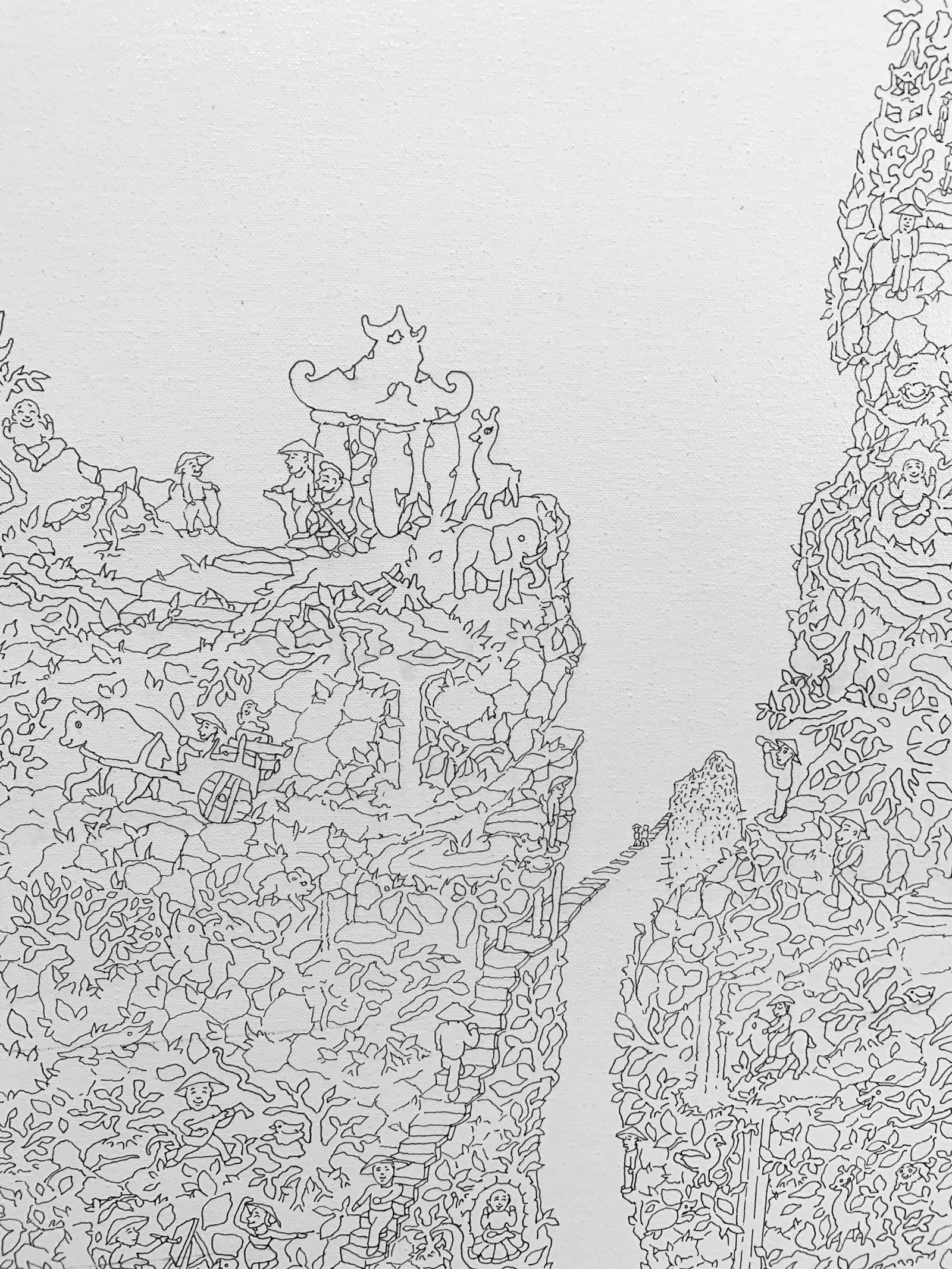
Our friend, artist Jon Bush of Massachusetts, invites the artist in you to color this landscape to your liking. Get out your crayons or color pencils and pens to bring to life the landscape in living color of your choice. What different things do you seen in this scene? As you begin to color, you may find many things that you may have missed in your first look. You will need to print out the image before you begin to color. Try different schemes. Have fun. —Editor
Patbingsu With A Twist
By Nina Choi Zaldivar, age 14, Illinois
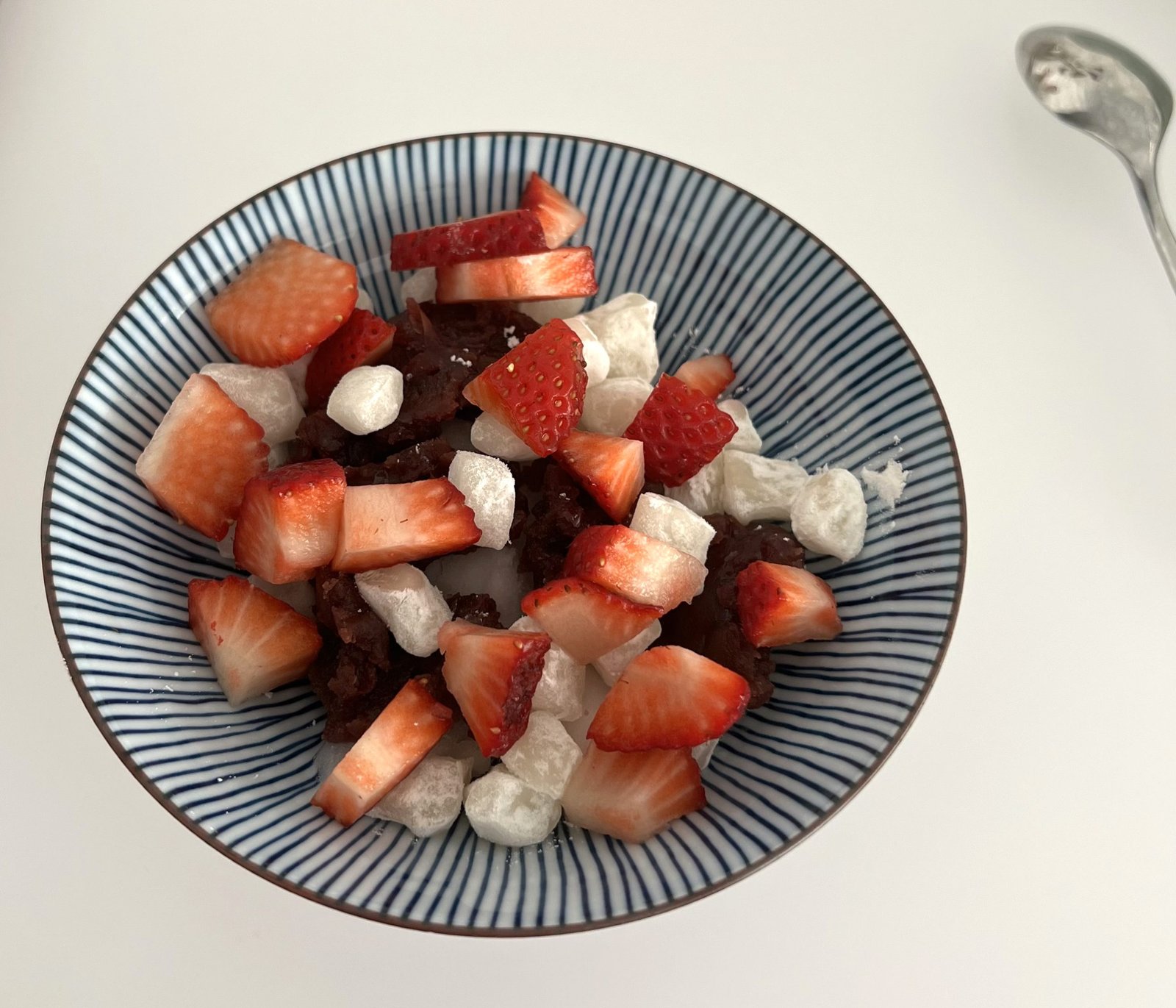
“I am a fourteen year old high school freshman living in Chicago, Illinois. Half Korean and half Argentinian, I love connecting to the cuisines of both of my cultures. I wrote the attached piece, Patbingsu, inspired by my desire to explore my cultural identity through food, specifically, delicious desserts!”
During middle school, my cousin Audrey and I figure skated at a suburban North Shore camp where most of the coaches and skaters were white. We slept over at our Korean grandparents’ house for a shorter commute to camp, where our grandparents cherished every moment with us, their lovely granddaughters. My grandmother expressed her love through her Korean cooking: kalguksu (noodles with beef broth), bulgogi(sweetened beef), fishcakes, chapchae (sweet sesame glass noodles), chapssaltteok (rice cake with sweet red bean paste), and my favorite, patbingsu.
Patbingsu, pronounced pot-bing-soo, is a summertime red bean shaved ice dessert. “Pat” means red bean in Korean, and “bingsu” is the shaved ice part. Most bingsusare made with shaved ice, but my grandparents introduced an American touch of lemon-flavored Italian ice, which adds a light, citrusy note. On top of the ice, you layer a sweet, earthy, and creamy red bean paste and a variety of fruits—my favorite are grapes and strawberries, which add a crunchy texture. Finally, you sprinkle soft, chewy mini rainbow mochi among the fruit on top. The harmony of lemon ice melting with the red bean paste turns into a symphony with a bite of strawberry and mochi.
Every morning our grandparents fed us a Korean breakfast and our grandpa drove us to the skating rink, our Korean lunches wrapped securely in our rolling ice skating bags, where we were met by a chilly blast of air. During lunch, our friends pulled out peanut butter and jelly sandwiches with a Capri Sun, while I opened my bulgogialong with rice and gim (dried seaweed).
The pungent smell traveled across the table, the conversation skipping a beat while my friends noticed the difference. I felt humiliated, and then guilty about my embarrassment because I was betraying my Korean-ness. Ashamed of feeling ashamed, I quietly ate my bulgogi and rejoined the conversation about Taylor Swift’s Reputation Tour.
At the end of each day of skating, I’d collapse at my grandparents’ kitchen counter where my grandmother greeted me in her floral blouse with faded pastel slippers, having lovingly prepared chopped fruit for patbingsu. “Muhguh chigoom!” she’d command—Eat now!—as she handed me a clear, square floral bowl full of freshly assembled patbingsu.Relieved to be home, I’d take the cold treat to the backyard where I’d devour the tangy and sweet patbingsu. My devoted grandmother never denied my request for a second serving, even though it was always smaller than the first.
My life consists of two worlds: the traditional Korean world, and the mainstream American one. Whenever I taste patbingsu, I am transported to the summers of my middle school, smelling the sweetness of the breeze in my grandparents’ backyard, enjoying the flavors of the lemon Italian ice melting into the red bean paste. Patbingsu is my place of comfort and security where I can be unconditionally accepted as both Korean and American.
Recipe for Patbingsu with Italian Ice (makes 1-2 servings)
This refreshing patbingsu recipe with lemon italian ice is courtesy of the Choi grandparents. For the fruit, I recommend fruits that are ripe and in season. I prefer using a variety: grapes, strawberries, watermelon, kiwi, and blueberries.
Ingredients:
⅓ cup lemon Italian Ice
¼ cup sweetened red bean paste
¼ cup fresh fruit
1 ½ tablespoon mini mochi (sweet rice cake)
Instructions:
