Author Archives:

Readers Respond!

October 12, 2025
I just wanted to say how truly grateful we are—both Youtao and our family. We deeply appreciate this beautiful feature on the Skipping Stones website. Seeing his interview and paintings presented with such care means so much to us.
I’m touched by your dedication to young people around the world. Skipping Stones provides such a wonderful space for youth to connect, share, and learn from one another. It inspires passion for literature and the arts, nurtures creativity and curiosity, and reminds us of the profound power of words and art to connect and uplift the human spirit.
I’m so happy that Youtao can be part of this warm, creative family and contribute in his own small way. It means a lot to see him immersed in what he loves, growing and learning through this meaningful community.
Thank you again for all that you and your team do to encourage and nurture young voices everywhere. We’ll be sharing the feature with our friends, relatives, and Youtao’s school community. It’s a joy to know that his work will also appear in the upcoming print issue. We are really looking forward to it!
With heartfelt gratitude,
              —Jiaen Cao (Youtao Cao’s mother), Japan.


Sept. 4, 2025
This was our first week of school, and I just wanted to let you know that we have received the copies of the magazine, and everything has been distributed to students. This edition is really lovely. The students appreciate it as they enjoy reading the variety of stories, articles, and poetry. 
Thank you again for allowing children around the world to share their unique perspectives.
           —Yolanda Toni, teacher, Illinois.


March 24, 2025
Thank you for being a voice of hope, love, and compassion. My mail is full of pleas for my money and time; but never the glow I feel when I find Skipping Stones in the stack of mail. I am blessed to have met you. If there is a way I might promote your work, please do tell me. Keep it up, write on.
               —Cindy Kokis, Eugene, Oregon.


Dec. 29, 2024
We pleased to share this letter by Mrs. Patricia Onorato of Connecticut. She adds in her email, “Skipping Stones has been—and remains—such an exciting, enjoyable part of our family’s reading over many years. We look forward to new issues and perusing your wonderful website!”


Dec. 6, 2024
Just wanted to add a note of appreciation and admiration for the last issue on 2024 Awards. Of course, I want to read each and every book, but also mention how inspiring it is to see what young people can do when they combine their hearts’ longings and experiences with their skills!! Thank you for providing this sharing place!
             —Kathy Beckwith, author and educator, Oregon.


August 30, 2024
It’s a great joy for our daughter Jessie to receive recognition from professional editors. We read through the magazine (Volume 36, issue no. 2) and felt how much endeavors you and you team devoted into it. We really love the content, seeing so many peers excel in different ways.
Great appreciation for you and your team!
             —Liping Chen (Jessie’s mom), British Columbia, Canada.


April 15, 2024
Dear Arun, what a marvelous issue of Skipping Stones (Vol. 36, no. 1). You do such an outstanding job of making known children’s perception, intelligence and amazing capacity to do good. I deeply honor you for your vision and your hard work!
              —Stephanie Tsuchida, art teacher, Oregon.


March 28, 2024

Sufyana was so happy and delighted to receive the Skipping Stones issue in the mail; thank you so much for making the effort to reach out and to send the contributor copies, they will be treasured! The array of thoughtful and beautifully written and genuine writing in Skipping Stones really impressed us!
Yesterday, Sufyana received in the mail an incredible gift of books, and she, her middle sister Aydina, and youngest sister Wilaya were overjoyed! That was such an unexpected blessing and surprise, and they began reading them right away. Thank you so much for these wonderful books!
             —Saleela S., Sufyana Johnson and family, Maryland.


March 14, 2024

Thank you so much for publishing my article (see Vol. 36, no. 1, pages 22-23), “Student Poems of Hope, Faith, and Love.”
Your publication is inspiring students, teachers, administrators, and parents across the country and around the world. There is a lot of heartfelt work, love, and dedication put into the children’s poetry and prose. The artworks—especially on the last page (p. 35), and also the back cover—are beautiful and emotionally strong and send a powerful message of courage to your readers.
And congratulations to Austin Liu for “Girl with Dukhu” front cover. I can’t say enough about the painting. This is museum quality artwork.
I’m always amazed by how much “great stuff” is packed into 36 pages. This is a credit to you and all the effort to create a fantastic magazine. After you finish reading it, you walk away feeling really good about the creativity, self-expression, and power of passionate communication.
Thanks again.
With kind regards,
            —Jeffrey Pflaum, (now retired) teacher, educator, New York.
P.S. “Peace Within, Peace in Our World.” Yes! (see Vol. 36, no. 1, page 18).


November 22, 2023
Thank you, Arun, for all the work that goes into producing this most wonderful magazine for children of the world!
            
—Cynthia Lewis-Berry, Oregon.


November 2, 2023
Thank you so much!! We are very happy to have my daughter Parnian’s first paper published in Skipping Stones. This will definitely be her life-time fuel tank to pursue her dreams one by one and use obstacles as stepping stones and jump forward like Skipping Stones!
I am honored to express my gratitude by saying that your organization has been and will be a life-changing center.
On behalf of Parnian, please thank your colleagues who made this happen. I truly believe it is an inclusively rich source of love, inspiration, and courage for anyone who visits your platform.
Good Job, Skipping Stones Team!
               —Dr. Ali Derahvasht, University of Malaya, Malaysia.


October 27, 2023
Dear Arun,
Our prayers are the best gift we can give for peace around the world. Yes, it is rather discouraging and I find that there’s only so much news I can watch on TV or hear over the radio.    
I visit your website periodically, and I am so impressed with the caliber of writing and artwork submissions posted from youngsters around the world. And it’s always a joyous occasion to receive the latest print issue in the post to hold and read. And afterwards I share the print issue with two young readers in Kodiak, Alaska. ¡Mil gracias, Arun!
With gratitude and kind regards,
            —Katacha Diaz, Peruvian American author, Oregon.


October 26, 2023
Greetings Arun,
Something I wanted to share with you; I commend you on your work with Skipping Stones. It really is a lovely venue for young writers and artists worldwide. I feel honored that I am part of it.
And as I work on reducing the stigma of mental illness, and quitting smoking, you work on creating understanding of, and between, all young people. With empathy and compassion. And there is great wisdom in all of this. We all have so much in common. In reality, each of us are branches from the same tree. And that tree is love.
So as we travel on this wandering path together, may we enjoy the simple things. And know that our children hold the hope for an even better future. I say this because my higher power—my friends and family—has given me such wonderful gifts to choose from. And there is no time for self pity. This I have learned from the children of Skipping Stones.
A slow day is a time waiting to be filled with joy. Life certainly gives us some hard lessons. Yet still we persevere. The gift is truly in the giving. And, when I give to Skipping Stones I feel happy.
Shalom,
            —Jon Bush, artist and author, Massachusetts.


Dear Arun,

If I may comment on the latest issue of Skipping stones, Vol. 35, no.1, March-August 2023:
What a spectacular display of visual and literary art! The presentations on the printed pages draws a person into reading the outstanding articles that provides one with “page turning” insights of different cultures.
           —Margaret dingus, M.A.


Dear Arun,

The Sept. – Dec. 2021 edition of Skipping Stones is the best ever. It is superb. So many of the writings brought tears to my eyes. I wish you could put out other printed editions—say once or twice a year.
Thank you for your masterful work.
           —Dr. Irwin Noparstak, Oregon.


Dear Arun,

What a joy to receive the latest print issue of Skipping Stones.  I am so grateful to be reading the Sept. – Dec. 2021 issue filled with outstanding writing, illustrations and photography from young contributors around the world.  Thank you to the editorial team!
I am pleased to make another 2021 donation in support of Skipping Stones. 
            —Katacha Diaz, Peruvian American author, Oregon.


Dear Arun,

I hope you know how much I value your work. For many years Skipping Stones has been a wonderful part of my life.
Through all of my adventures through the literary world I can honestly say I’ve never seen a magazine as open and diverse as Skipping Stones, and that is all thanks to you. It has beautiful art and intriguing stories by young people from all over the world. I have learned so much about different cultures through Skipping Stones.
Truly the children are our future. May we guide them in peace as you do. Encourage them to greatness. Support their dreams. Believe in them. What we invest now will surely be returned a thousand fold to coming generations.
When we plant the seed of hope and nourish it, that is the way to health. And when it becomes a great big tree we can say, “That was a good deed I did that day.”
Best wishes,
             —Jon Bush, artist and author, Massachusetts.

The Talk: Bridging the Gap Between Parents and Teens

By Jacky Chen, h.s. senior, New York

On a hot, cloudless July afternoon in 2017, a 13-year-old Chinese American boy ran away from home and jumped in front of an oncoming subway train at the East Broadway station in New York City. He was pronounced dead at the scene, leaving his elder brother and mother devastated.

To many, this is just another suicide incident on the news, but not for me because he and I were close friends in elementary school. I later learned that tense familial relationships and unbearable expectations were the underlying reasons behind his decision to cut his life short. Even after more than four years, I often find myself coming back to this incident, wondering if there was anything that could’ve been done to prevent it.

Despite a growing number of mental health awareness organizations, poor mental health rates are rising. According to the CDC’s Youth Risk Behavior Survey, in 2019, over 36% of high school students in America experienced feelings of depression and hopelessness. More alarmingly, the attempted suicide rate increased by 41% compared to a decade prior, reaching 8.9%. Exacerbated by the COVID-19 pandemic, this rate has only continued to climb in the past few months. A CDC report shows that, in 2020, there was a 24% increase in mental health ER visits for children ages 5 through 11, and more than a 30% increase for those between 12 and 17 years old.

Poor mental health plagues today’s youth, and one of the biggest barriers to improving it is teenagers’ reluctance to admit their struggles to family members, friends, and teachers out of embarrassment. While nonprofit organizations and schools must continue to provide their services and resources, parents must take on a more active role in their child’s mental wellness to address this pressing issue and the social stigma that surrounds it.

With significant worsening in mental health rates in the past decade, we need to address an important question. What might be some of the underlying causes? Firstly, in an increasingly digital world, teenagers are exposed to technology and social media more frequently and at a younger age. According to a report from Common Sense Media, kids between 8-12 years old average nearly six hours of screen time a day and up to well over nine hours for teens. This constant exposure establishes a social norm that adolescents are constantly trying to meet, a stressor that induces low self-esteem and feelings of depression and loneliness. The topic of pop culture also has social implications. A study conducted at the Pew Research Center states that around three-in-ten teens feel pressured to look good (29%) and to fit in socially (28%). Twenty-one percent of teens list extracurricular activities and being good at sports as stressors.

Perhaps more significant is academic stress. Sixty-one percent of teens cite obtaining good grades as their top stressor, and those who attend high-achieving, competitive high schools are the most susceptible. As a student at a high-achieving high school, I can attest to this. The competitive peer culture at school takes a toll on not just my mental well-being, but on that of my peers, too.

Being aware of a child’s mental well-being is a parent’s responsibility. There are many ways parents can get involved. It’s important to first establish a respectful and trusting line of communication where teenagers can receive the support they need. Multiple individuals need to be identified as a source of support in case one overlooks signs of depression.

There are also numerous online resources available at any moment like Find Your Words, which both parents and adolescents can use. From de-stressing activities to coping advice, these resources provide great guidance. Parents should educate their children about the suicide prevention hotline (800-273-8255) and encourage them to frequently take mental health self-evaluations. From local school councils to nonprofit organizations like the National Alliance on Mental Illness, fighting mental health is a collective effort. It’s through collaboration and confrontation that we can change the stigma surrounding adolescent mental health, and it’s time for parents to take the lead.

By Jacky Chen, h.s. senior, New York.
When Spring Comes

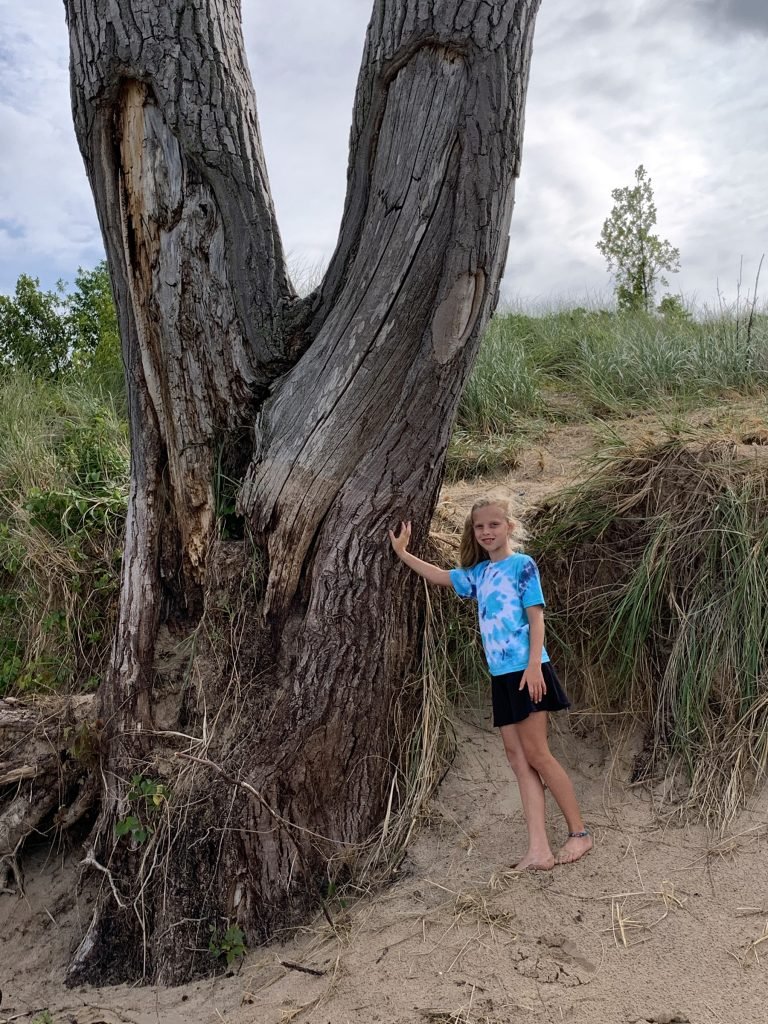
By Robyn Bjorkman, age 10, Michigan.

When the snow starts melt,

And the grass comes into view,

People are in a happy mood.

Day by day, the temperature will rise,

And there will be more sunshine,

More people will be out,

Enjoying the season,

For there will be many reasons.

There’s no more snow,

On the roads,

You can finally ride your bike.

Warm enough to unzip your coat,

But chilly enough when the wind blows.

Pleasant enough for when you see the birds again,

But fingertips turn cold when you aren’t wearing mittens.

When Spring comes, we get Spring Fever,

And folks don’t want it to be muddy either.

But there can be lots of great things,

Like when you (again) hear the birds sing,

And when you can ride your bike,

And get as dirty as you like.                                                                                                                                    

Poem by Robyn Bjorkman, age 10, Michigan.  Robyn like to go on adventures, write stories and create songs, and read. She hope to keep on writing.  

Six Rivers, Many Peoples, One Tree

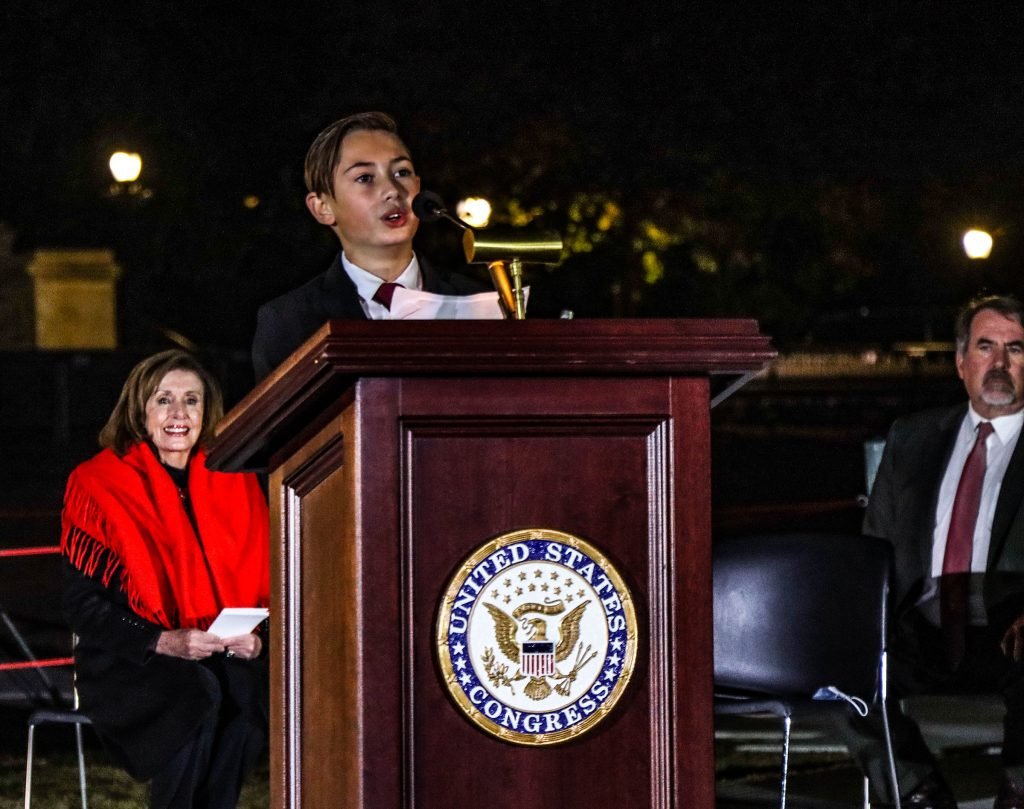
Michael Mavris, grade 5, Reading his Poem at the 2021 Capitol Christmas Tree Lighting Ceremony.
Photo credit: James Edward Mills
.

This year Michael Mavris, a fifth grader from Del Norte, California who won a poetry contest about the U.S. Capitol Christmas Tree, got the honors of flipping the switch that officially illuminated the tree. For over 50 years the USDA Forest Service’s Christmas gift to the nation, the U.S. Capitol Christmas Tree, has inspired the imagination of millions. Standing elegantly at the base of Capitol Hill on the West Lawn the massive tree fondly referred to as the People’s Tree is harvested from a different forest every year. This year the Six Rivers National Forest in California had the honors of delivering the 84-foot tall fir tree they named “Sugar Bear.”

The evening ceremony also included comments from the Speaker of the House of Representatives, Nancy Pelosi, and other members of the California delegation in Congress along with the new Chief of the Forest Service, Randy Moore.

We are proud to share Michael’s poem below.

Six Rivers, Many Peoples, One Tree

By Michael Mavris, grade 5, California.

What does the theme “Six Rivers, Many Peoples, One Tree” mean to me?

As I ponder the question presented here, I consider where I am living-literally in the heart of the Six Rivers National Forest.

Here, tucked deep within the Northwestern corner of California is a remote land, whose majesty comes not from achievements of humankind, but rather nature itself.

Six mighty rivers criss-cross this rugged land. From the Smith and Klamath rivers in the north, stretching over to the Eel and the Mad, meeting the Van Duzen and the Trinity in the South, all of our rivers, amongst the cleanest in the world, represent life itself.

Like the First Peoples who have lived here since time immemorial, these rivers overcome every obstacle to ultimately reach their goal of becoming one with the Pacific Ocean.

Is this done by an exhibition of power or a show of strength?

No.

It is accomplished by sheer persistence. The indominable spirit of never giving up which is representative of this land and the Peoples that live here.

From the great tribes: the Yurok, Tolowa, Karuk, Wiyot, Chimariko, Nongatl, Hupa, and Wailaki, we are taught to commune and truly be one with nature. This ethos teaches us to view rugged lands, secluded forests, and fierce weather patterns, as something genuinely beautiful.

Such is the story of the White Fir, also known as Abies Concalor, whose beginnings trace back to a single seed. From this humble seed,dropped onto Mother Earth in a remote region the process begins.Nurtured by the fertile soil, which the Six Rivers saturates throughout the year and, against all apparent odds, not only confronts the weather but embraces it. The young tree emerges proudly upward towards the shining sun.

From this great forest, we bring you the majestic White Fir, to be the Capitol Christmas tree. As the lights are strung and the ornaments placed, we, the People who live in the tree’s symbolic shadow, hope that its beauty and grandeur provide a beacon to America and a reminder on this Christmas, that all things are possible.

Michael Mavris, 5th grade student, Del Norte County Unified School District, California.

Preparing for Your Life as a Minority

By Skipping Stones Staff

Students of color often face many difficult and discriminatory situations throughout their lives. Whether it’s at school or in social situations, when applying to jobs, or in their careers, it is an unfortunate truth that people still display biases about skin color, race, national origins, looks, etc. This affects how they treat others. Although it might seem scary or daunting as a minority to face unfair treatments based on prejudice, bias, and ignorance, knowing how to deal with these situations can help you deftly navigate out of them in effective ways.

In order to prepare for the real life issues that you may face as a minority, it is important to think about the kinds of situations where your ethnicity may play a role. Social situations are a common place where this can occur. Say you are an Indian-American and with a group of people where someone asks if you are a doctor or computer engineer. You would likely be fed up with having to deal with such stereotypes, and you might be tempted to react with anger. However, this will likely not help you. Confrontation might even serve to reinforce stereotypes people have about different ethnic groups, as unfair as that is.

When navigating these kinds of conversations, it is important to differentiate between people who are simply ignorant about racial issues but don’t harbor ill-intentions, and people who purposefully act and say discriminatory things. Telling the difference between these two types can go a long way into protecting yourself and ensuring you effectively navigate racial conversations. If someone says something out of ignorance rather than ill-intention, you can help educate them. With the example of career stereotypes, you could explain to them that while doctors and computer engineers are common jobs among Indian-Americans in the United States, that ethnic group doesn’t always act as a single unit. It is made up of so many different people, just like Caucasians, Chinese-Americans, and other ethnic groups. Each person is different, and can have different career goals. However, if someone intentionally tries to discriminate against you, the sad reality is that trying to engage with them directly will generally not help the situation. That is why it is so important for others, perhaps bystanders or people of different ethnic backgrounds than yours, to step in and stand up against such stereotypes and discrimination.

When dealing with those without racist intentions, having patience is key, as is an awareness of why people think the way they do. Some people who make ignorant racial comments do so because they didn’t have exposure to people of different backgrounds. Perhaps they lived in rural areas and didn’t get to interact with many Asians, Hispanics, or African Americans, for example. It is easy to have twisted notions about other ethnicities when you never interact with them yourself. Of course, this is no excuse for racist words or actions, but understanding why some people might be prejudiced can help effectively navigate difficult situations.

Social situations are not the only place this prejudice can manifest though. If you are a minority, you may sometimes find bias or a lack of respect from people in the workplace. One issue in workplaces is something called affinity bias, where people prefer to connect with others who share similar interests, experiences and backgrounds. Therefore, if you work for an organization where most people are of a different racial background than you, you may feel excluded (because others may tend to socialize together). To help reduce this you can show when you do have similar experiences or interests as them. If you share common hobbies, or play similar games in your free time, these can be points of common ground to build upon.

This kind of bias can also manifest in the hiring process itself, and is incredibly unfair to minority candidates. A recruiter or hiring team may subconsciously connect with applicants who are similar to them or had similar upbringings. On the surface, a white recruiter may not think they have much in common with a minority candidate, due to different upbringings, cultural values, etc. To overcome this, you again must put in extra work to show how you do connect with the recruiter or manager, in addition to showing your skillset. Many U.S. businesses and organizations are run by older, white employees who may not have received a ton of cultural exposure, or may not have taken cultural competency training, and therefore they may show a lack of respect for minority candidates. They may repeatedly display stereotypes or lack of cultural understanding, or mispronounce non-American names, for example. This is a well-documented phenomenon but many times this is unintentional, so it is a good opportunity to (politely) correct them, if they mispronounce your name.

However, both bias and a general lack of respect towards minorities can take a toll on you mentally if you constantly have to deal with these types of racial issues. To cope with this kind of stress it can be useful to talk to other people in similar situations and see if they have similar experiences. It can also be helpful to have a support group of friends and family who will listen and empathize with what you are going through.

As an Asian American, my experiences with bias and prejudice will likely be different than those who have different backgrounds, including those who are African Americans, Hispanics, Native Americans, or from other ethnic groups. Skipping Stones is interested in hearing your perspectives, to the extent you feel comfortable. Do you have experience dealing with bigotry or discrimination? How do you deal with those kinds of situations? We invite you to share your experiences as other readers may find your stories useful and helpful in dealing with such issues in their lives. It could show us all that we are not alone in feeling discriminated against or stereotyped.

180 Days

I believe in taking the risk to experience new things to grow because you cannot grow in an environment that you have always known. Growing up, you are taught and influenced by your parental figures. Whether that means they are giving you advice, showing you how to perform a task, or you pick up the traits that they project. For most of us, this is the kind of environment we have for 18 years. After 18 years, we can decide whether or not we start a whole new chapter of our lives—leaving the place and people we call home. The more I sit and ponder on this, the more fear it induces in me.

When I turned 17, I started to worry about my future, which turned into me being able to understand myself more deeply. I became aware of the kind of people with whom I want to be surrounded, what I want to do as I continue my education, how I want to make every little part of my life have purpose, and how I want to experience everything possible. It sounds cheesy, I know, but this next chapter of life is romanticized for a reason.

I decided that for me to make those desires possible, I needed to venture out of the superficial bubble that I call home. Over time, I figured out that this was going to be vastly harder than I imagined. I was not ready to leave the people that I love. I was afraid that if I left, I would leave their hearts too. Will I ever be ready to take that risk?

I believe we need to take risks. If we don’t, we are left wondering what the outcome would have been. I do not want to keep looking back on the past, asking myself those questions. I want to be present. I’ve decided that taking this risk, this risk of leaving my loved ones so soon, is the best thing I could possibly do for myself. Not because I need to get away from those people, but because I know that there is a considerable amount of wisdom I can gain from letting other people into my bubble. I am especially so sure of leaving because I know my home town is not where I want to be forever. I know there is a whole world out there for me to see and experience. Therefore, I am not going to limit myself to just one environment.

The idea of a new environment is not just moving geographically. It is also about what kind of culture you are putting yourself into. It is clear that when living in a small town versus a city, your lifestyle is different. Different types of connections, commutes, events, and people. When living in a typical small town where everybody knows everybody, you are more of a community. Everyone, for the most part, has the same views, hobbies, and lifestyle. This can be beneficial because you are more united and it can be a really easy environment to live in for that reason. Whereas living in a city, you are exposed to more than what you could imagine.

In a setting with diverse lifestyles, beliefs, and interests, it can be harder for people to thrive. However, I believe that is where you can learn the most. Personally, I feel that I have learned more from the people around me than I have in school. I am not talking about the stuff you learn like y=mx+b. I am talking about knowledge of cultures and the people around us, how to make deeper connections with one another, unheard of places to vacation, issues of the world, how and why someone’s definition of success is different from the other, and so on.

Going outside of an environment you have always known can allow you to work towards your fullest potential. This can be overwhelming and scary to think about or process. While leaving loved ones and a comfortable bubble is hard, you would not want to look back on the past when you are old and question your life. With this belief of mine, I hope to become the person I have created an image of in my mind. I hope to reach my potential and walk with the wisdom of the world.

Claire Emery, Missouri.

By Claire Emery, 18, Missouri. Claire writes pieces about connections with others, inner peace, and goals. She is continuously discovering self-improvement and steps she can take to truly know herself. Claire grew up in a smallish town and considers herself to be an empathetic person where she tries to put herself in the shoes of the situation.

Wanted: Diversity in the Environmental & Earth Sciences Field

By Skipping Stones Staff

Over the past few years, there has been a growing consensus that in many western countries like the United States, the earth sciences and the environmental movement have a severe lack of diversity, both in terms of students studying these fields academically, and in the workforce. According to the National Science Foundation, African Americans, Native Americans, and Hispanics make up just about 14% of earth science undergraduate majors, even though they comprised more than 30% of the overall US population at the time of the study. This disparity continues as students enter the workforce. For example, African Americans make up 14.2% of the overall US population, but only 1.3% of geologists are black. When many people think of a geologist, they often picture an older white male roaming around the mountains. Based on Bureau of Labor statistics (74.9% of geologists are male), this image is actually often on point. Clearly these earth science related fields have a serious problem with diversity, and as a minority who worked and studied in the earth sciences for number of years, I have seen the unfortunate consequences this issue has had.

There are several reasons why it is essential to have more diversity in the earth and environmental sciences. Many environmental issues and natural hazards, from factory pollution to hurricanes, disproportionately affect minority communities. The devastation after Hurricane Katrina in 2005 is a prime example of this, when there was particular damage to black-majority neighborhoods in New Orleans. Black communities and other minority groups in the United States often live closer to large polluting chemical plants, waste treatment facilities, and other areas that are potential environmental hazards. Since people who work in environmental fields often make decisions regarding these kinds of environmental issues, it is essential to have representation from minority communities, especially if they are disproportionately affected by them.

Many teachers and professors may recognize this issue, but often approach it in the wrong way. They may think that simply showing minority students why fields like environmental science or geology are worthwhile, is enough to convince them to pursue these fields in their careers. In reality, diversifying these fields and their respective workforce takes a much more nuanced and systematic approach.

In both of my colleges and the university, all of my geology professors were white, but the larger issue was that they did not understand what is was like to be a minority student. Many professors are simply not aware of the obstacles minorities need to overcome, such racial bias in job hiring, or social exclusion in the outdoors. White, affluent professors likely have different upbringings than most minority students, and as a result, the differing perspectives may result in friction if a professor expects a minority student to learn and perform in the same way that he or she did as a student.

In reality, minority students face a multitude of obstacles, and even if they are extremely smart and hard-working, they may have different priorities than the professors did when those professors were in school. Partly because my parents did not grow up in the United States, they were not able to provide me with the same level of financial education as many other parents provide. However, when I tried to take a financial literacy class to learn these subjects myself, my academic advisor did not sign off on it, because she wanted me to focus on a geophysics class that would “be more relevant for my thesis.” She might have gotten education on financial literacy from her relatives when she grew up, because they had lived in this country for generations and knew the in’s and out’s of U.S. tax system, buying houses, etc., but I did not learn that at home. This is just another example of how many minorities— especially first generation minorities, in this case—are at a disadvantage compared to their peers.

This can be the case in many academic fields but the lack of diversity among the people teaching earth sciences stands out, because it means almost none of the professors have the same experiences as the minority students they teach. At least in other fields, like physics or computer science, there may be a more diverse faculty who understands what it is like to be a minority student.

There was even a time when one of my geology professors taught us how a mineral called orthoclase, which has a whitish-pink hue, “was the color of our skin,” because it was similar to the skin color of Caucasian people. Implying that we should refer to mineral color based on the skin color of white people creates a Caucasian-centric method of analyzing geologic features, and unfortunately many geology textbooks use these types of references.

In order to solve the diversity issue, it is essential to understand the structural factors that have historically led many minorities away from environmental sciences and even the outdoors in general. Many young people who end up studying or working in the environmental field become interested in the outdoors from an early age. Sometimes they do this by practicing sports like skiing, rock climbing, or mountain biking, to name a few. Some of these sports require a lot of out of pocket expenses. Rock climbing, for example requires harnesses, ropes, carabiners, helmets, and climbing shoes, which all add up in cost. People in lower socioeconomic classes often don’t have the extra funds to pay for this kind of gear, and many (but not all) minority groups unfortunately tend to have fewer resources. Thus being able to frequently enjoy the outdoors may be a luxury for some.

So how can we address this lack of diversity? One solution is for elementary, middle, and high schools to help kids gain an appreciation for the outdoors by taking them on field trips to nearby outdoor sites, hiking trails, etc., to ensure students from all backgrounds get to experience the outdoors and have the desire to protect these lands. True, schools often lack the funds to even fully fund their regular activities, so adding outdoor opportunities to the curriculum may be more difficult. Some private efforts exist to encourage minorities to explore the outdoors through group outings, but these efforts often have limited reach.

It seems that the best way to encourage minorities to study and work in the environmental sciences is to change the culture around these fields and the outdoors. This starts with every person who regularly enjoys the outdoors or the environmental sciences. For example, if you go on hikes regularly and have friends who haven’t had the opportunities to, maybe ask them if they want to come with you. If you’re a professor, continue to understand how your students have different backgrounds than you, and how that might shift their priorities. Small acts like these can build up in making the outdoors a more inclusive space, and doing this may have a far greater effort than just academic outreach.

—Skipping Stones Staff

References:

https://www.zippia.com/geologist-jobs/demographics/

https://www.americangeosciences.org/geoscience-currents/diversity-geosciences

Gone Bananas

By Connie Salmon, bilingual author, originally from Puerto Rico, lives in Connecticut.

You put it in your cereal. You eat it with peanut butter and bread. You eat it with ice cream in a special dish. But have you ever wondered where your banana came from?

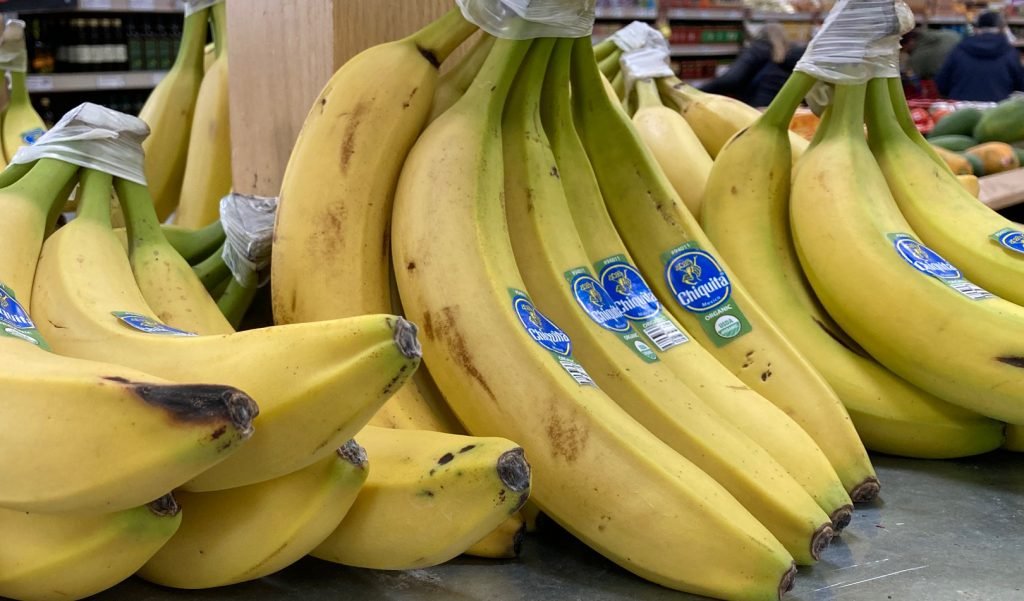
Bananas for Sale in a Grocery Store

Many people think that bananas grow on a tree. The truth is that they grow on an herbaceous (herb) plant. It’s leaves sprout from the ground and wrap around each other very tightly, forming the stem. Large purplish red buds push through the center of the stem and later form smaller purplish flowers that grow into bananas. The banana got its name from the Arabic word for finger, banan. A single banana is called a finger.

Bananas most likely came from South East Asia, about 7,000 years ago. Then they were taken to Arabia, and later to the Middle East and Africa. They were transplanted to the Canary Islands. From there, the Spanish brought bananas to the New World, after the voyages of Christopher Columbus.

Bananas grow in plantations in countries with a tropical climate. Leading exporters of bananas to the US are Columbia, Ecuador, Costa Rica, the Dominican Republic and West Africa.

The banana is America’s favorite fruit. There are 500 different types of bananas. The most popular one in the US is the Cavendish.

If the bananas are going to be harvested the traditional way, they are sprayed with pesticides (chemicals to get rid of insects) at the plantation. Then the farmers add fertilizers (artificial nutrients) to the soil to help the crop grow.

If the bananas are to be harvested organically, natural fertilizers like manure and seaweed are used. Insect predators and barriers are used to prevent pests. For example, crushed eggshells or pistachio nut shells prevent slugs and snails. The plants are weeded by hand or mulch is used to prevent weeds.

Farmers tie banana plants to long poles for support and cover them in large, plastic bags to protect them from insects and birds. The clear plastic lets light reach the leaves, allowing the fruit to mature.

Nine to twelve months after planting, the fruit is ready to be harvested. The bananas grow in large bunches. These are broken down into smaller groups. 10 to12 bananas are called a cluster, 4 to 6 are a hand, and each individual banana is a finger.

There are many steps to the harvesting (gathering) of the bananas. They are picked while still green to prevent them from spoiling while being shipped. A worker called a cutter cuts down the plant with a machete. Another worker, a backer catches the plant as it falls into a large cushion on the backer’s shoulder, to prevent the fruit from bruising. The backer attaches the bunch to one of the overhead cables that run between rows of plants. The moving cables bring the bananas to the packing shed, located in the plantation.

The bananas are washed in large tanks of cold water. The water removes most of the chemicals from the fruit. It also lowers the temperature of the bananas, which are still warm from the tropical heat in the field.

Inspectors then examine the bananas, to make sure they are of good enough quality to export. Once they pass inspection, the bananas are carefully packed into boxes, so they don’t bump against each other and bruise.

Boxes of bananas are loaded into huge, refrigerated ships or reefers, to prevent the bananas from ripening any further, putting the bananas “to sleep.”

Once the reefers arrive at their destination, they dock at food terminals. They are then inspected for insects, snakes and other tropical pests (spiders sometimes hide in banana leaves).

Then the fruit ripens in special rooms for 3 to 8 days. Ethylene gas, which is produced naturally by all fruit, is pumped through the ripening rooms to speed up the process. The temperature is lowered as days pass, so the bananas don’t over-ripen before they are loaded onto refrigerated trucks and brought to the market to sell.  

The banana has at last made its long journey to you. The next time you are in the supermarket with Mom, you can pick out a hand or a finger of bananas and tell her all about them.    

Sidebar: TOP EXPORTERS OF BANANAS TO THE UNITED STATES

The banana is the most traded fruit in the world. Bananas started to be traded internationally by the end of the 1300’s. Today they are grown in over 150 countries.

There is an organization called Banana Link in Latin American countries like Ecuador, Honduras, Columbia, Costa Rica, Guatemala and Nicaragua. It campaigns for fair and ethical trade practices for banana (and pineapple) plantation workers. In a largely hostile work environment for trade unions, there is a high level of violence and repression.

There is also a failure of health and safety standards, that causes much devastation of human health and natural environments, due to the use of toxic chemicals in banana production.

Banana Link fights for the dignity of workers (both men and women) and trade union rights. Trade unions try their best for workers to have better wages and benefits as well as better working conditions.

Bananas and plantains are a staple food in many tropical countries and play a major role in food security for many households.

TOP EXPORTERS:

ECUADOR:  US $3,68 millions in exports. Total Banana production: 6.28 million metric tons.

THE PHILIPPINES:  US $1,608 million in exports. Total production: 8.4 million metric tons

COSTA RICA:  US $1,083 million. Total Banana production: 2.27 million metric tons

COLUMBIA:  US $990 million. Total Banana production: 3.7 million metric tons

GUATEMALA:  US $956 million. Total Banana production: 3.8 million metric tons

Other smaller banana exporting nations include countries like Nicaragua, Panama, Honduras, Mexico, Dominican Republic, and Ivory Coast.

Sources for the Information:

“How bananas are Grown, Banana Link”  www.bananalink.org.uk

Encyclopedia Brittanica.com:  “Banana (Description, History, Cultivation, Nomenclature)”

By Connie Salmon, bilingual author, originally from Puerto Rico, now lives in Connecticut.

Longing to Leave

By maggie d. , African American poet, Washington.

Frost and snow puzzles me

Hailing from Sudan

Icicles and sleet

Billowing clouds holding no

Heat

Makes me weep

For sandy dust sweeping

Across tan dunes 

Never ruining my shoes

With muddy slush of melted snow

Oh

Without constant sun

Running for fun

Getting drenched by rain

Has made me aim

For returning to Wad Madani

Leaving behind winter

Without a whimper

I will laugh again with 

Sunglasses on to watch

Camels parade upon dirt roads

But I suppose it will take awhile

For Alab to say

“Goodbye Sigh-beria!”

By Maggie d., Washington.