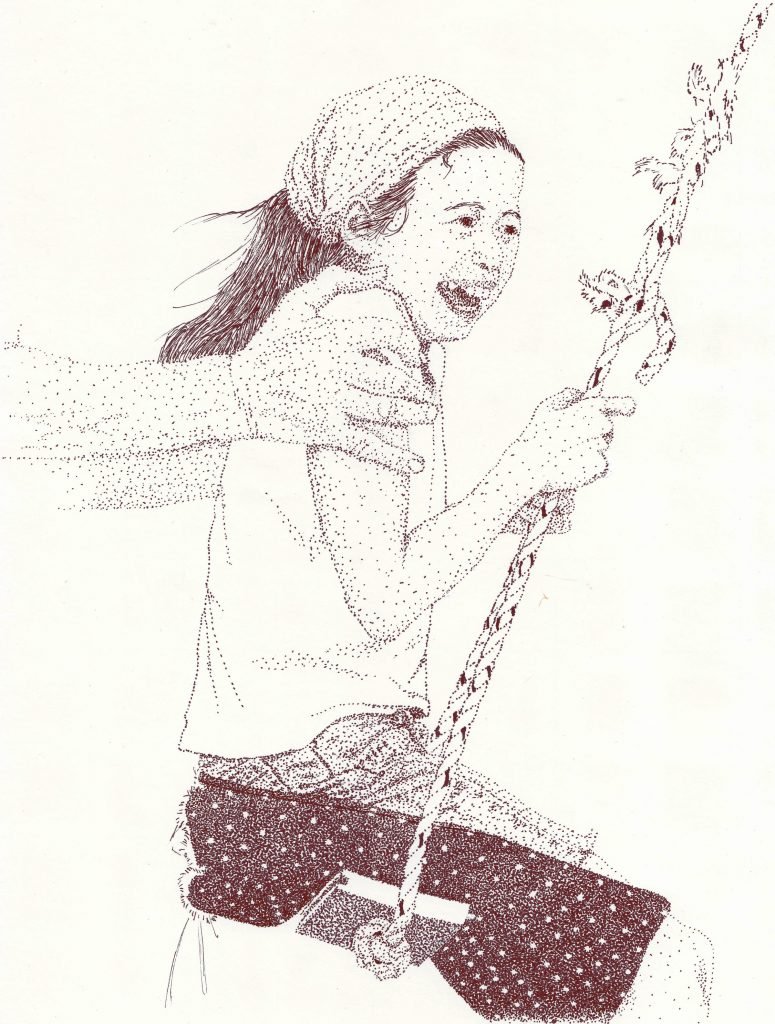
The Swing

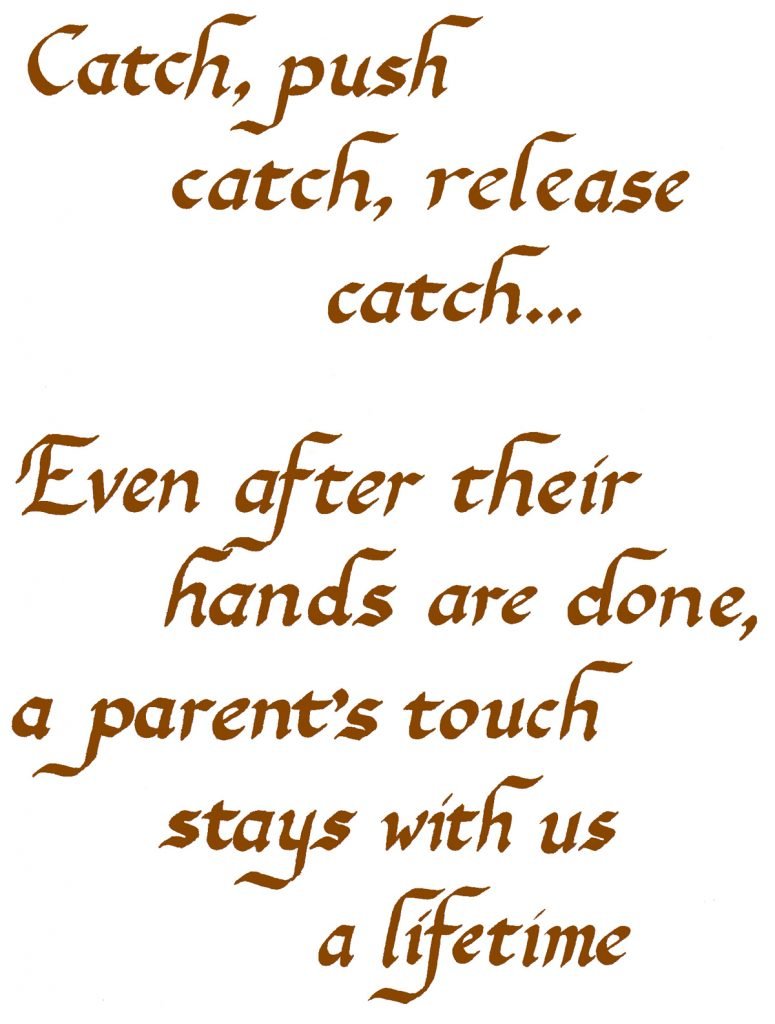
Life is a journey.
“Standing at the many crossroads of life, my decisions would add up, changing my life and being. Fortunately, my friends and family have often been on hand to support and guide me through the toughest decisions and transitions. When it comes to art, I draw upon memories for inspiration and create with a strong sense of appreciation for the significant others and cross-cultural influences in my life. In this sense, my works are a collection of nostalgic thoughts, emotions, and experiences, as I look back on my life and hone in on influential fragments of time and space that have come together to define me as a human being.”
Jaeyeon is a fine artist who works to claim spaces for the public to engage with art without difficulty. Her work often revolves around detailed paintings, installation art and sculptures, which become a place for social engagement and visual communication.
—Jaeyeon Kim, 19, was born in South Korea, and came to the U.S. as an international student at the age of 15. She currently studies at the Parsons School of Design in New York.
1. CrossRoad Korea
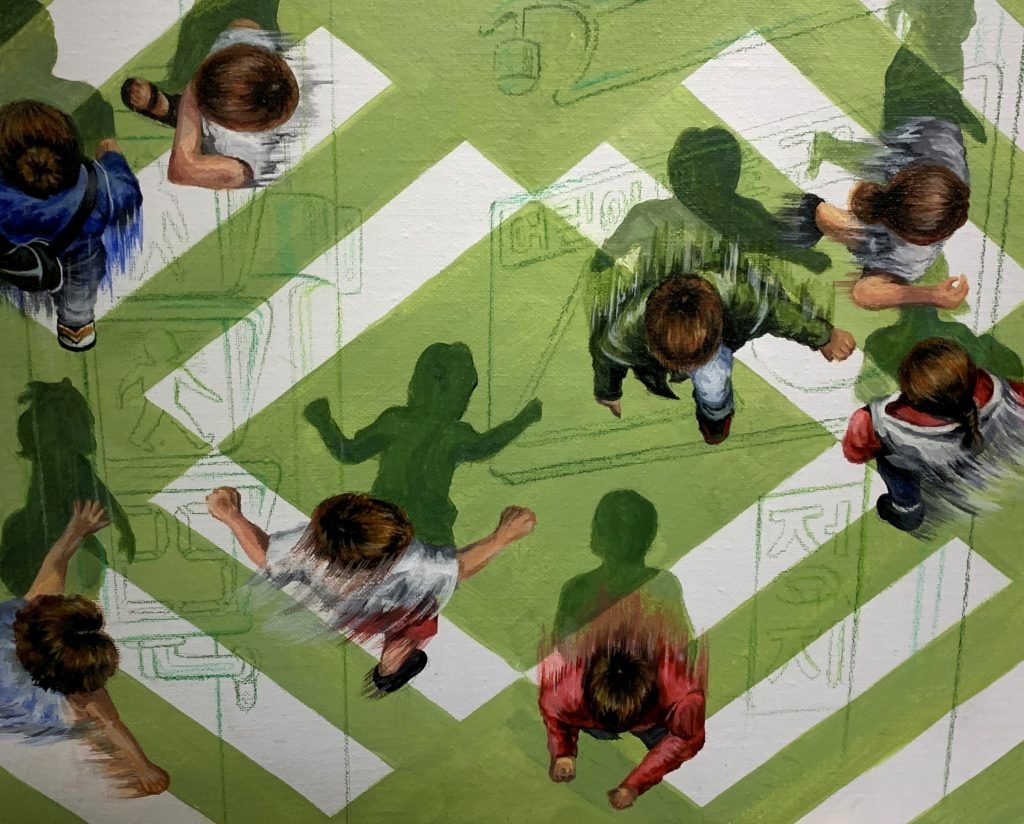
Seoul, where I was born, is a big city. There are many cars and people at the crosswalk. When I saw a crosswalk, its ‘X’ shape reminded me of our society. Our community is connected like the shape of ‘X’ and also has a system like a red/green light. Also, everyone has a different destination in life.
2. Subway Korea
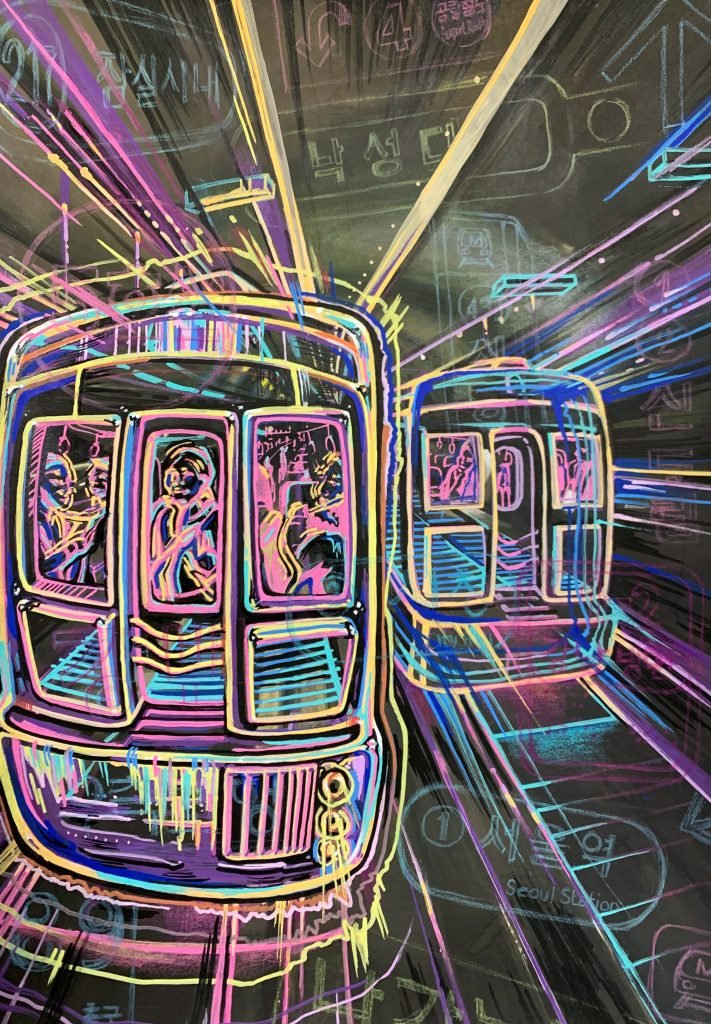
In Korea, the subway is the lifeblood of the city, as in other countries. Many people go to the heart of the city by subway, and it is always crowded. Koreans liken these crowds to the appearance of ‘beansprouts’ which have to grow in a dense environment and survive well in it. I capture a scene of the subway and its passengers. People in the subway have various backgrounds–different ages, genders, occupations, attires, and emotions. Most people feel tired but, well, there is a will to live today.
3. Identities
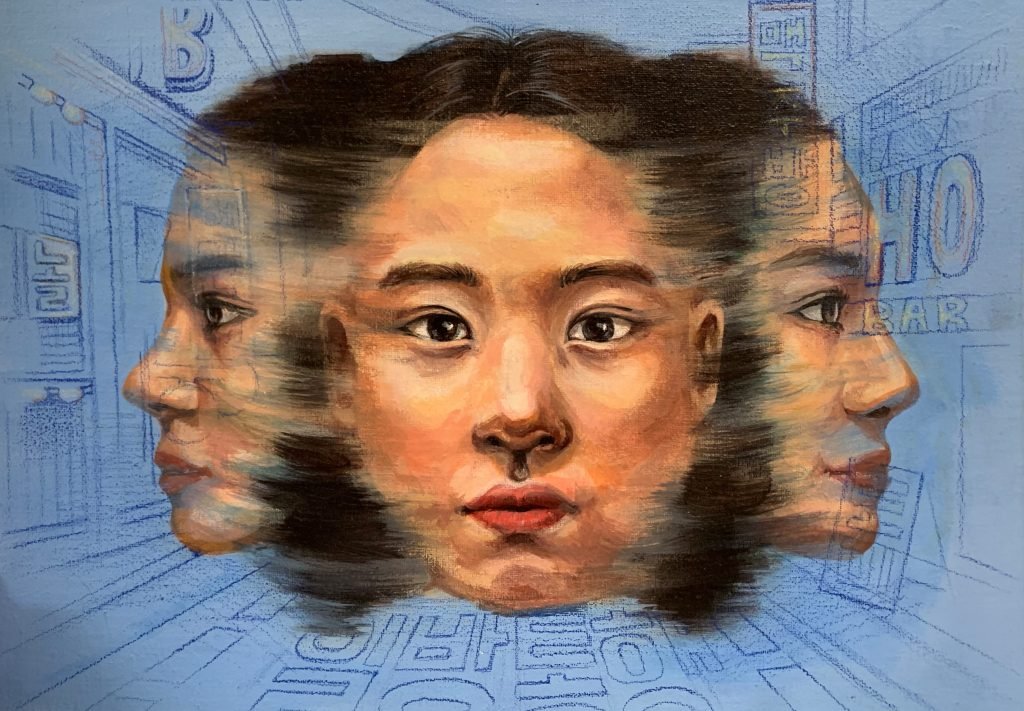
There are many identities within us. Regardless of age, from a girl to a lady, there are various images of women in one person, based on the situation and culture.
—Art and writing by Jaeyeon Kim, 19, was born in South Korea, and came to the U.S. as an international student at the age of 15. She currently studies at the Parsons School of Design in New York.
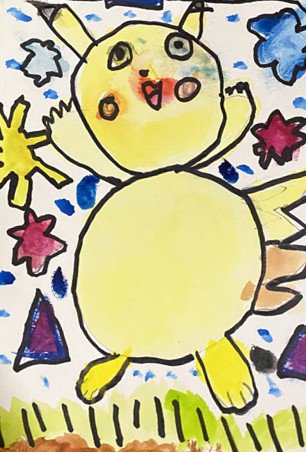
Art by Tory Won, age 7. Tory is now attending an elementary school, and she loves her family, puppy, and all animals.
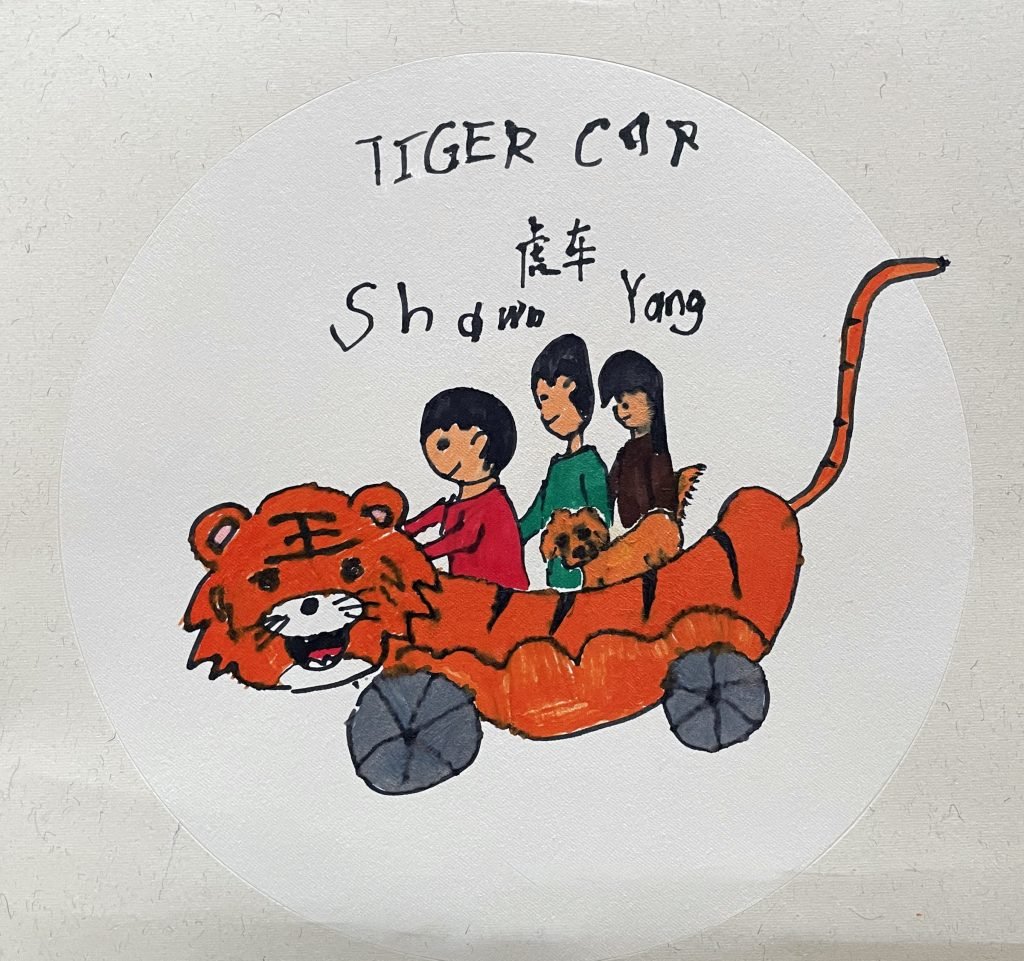
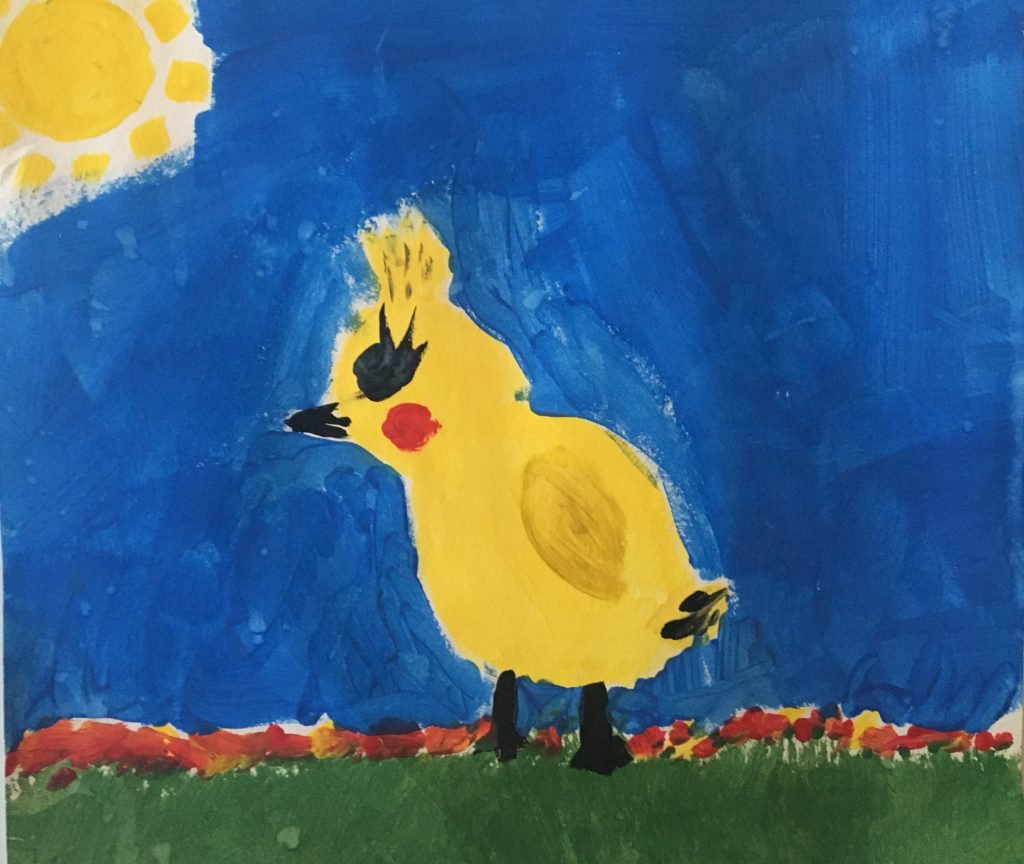
the candle
as the cold flame dances
and onto the patient wick
lilies bloom anew
by Grace Coleman, age 15, California.
a broken earth
slipping on plastic
the earth now grows wires as vines
straws sprout, what are trees?
by Grace Coleman, age 15, California.
By Bella Melardi, Grade 11, Ontario, Cananda
Information is resistance. It will open our eyes. Awareness is change. The first step to solving a problem is acknowledging there is one. Let the existence of the climate crisis sink in. This is a reality check. Get out of your own heads. Snap out of it.
People’s lives are at stake. Climate change doesn’t affect everyone equally. People in power and people with privilege will not feel Mother Nature’s wrath the way minorities do. People will use their wealth and privilege as ‘band aids’ to block out destruction.
You can already see the effect that pollution is having on minorities in Canada. McGill Daily states, “In October 2020, over 250 Neskantaga residents were evacuated and transferred to a hotel in Thunder Bay after “an oily sheen was found in the Neskantaga water reservoir;” “high levels of hydrocarbons” were discovered in the water after testing.” The chemicals we created are destroying communities. They are festering in our waterways like tumors, spreading disease.
This destruction can also be seen through the construction of Line 3. Line 3 is a pipeline expansion that was just completed in September 2021. This pipeline will transport almost a million barrels of toxic tar sand oil per day from Alberta to Wisconsin. An oil spill would mean damage to coastal communities (near Lake Superior) and the wildlife, such as salmon and orca . StopLine3.org states, “Line 3 would violate the treaty rights of Anishinaabe peoples and nations in its path wild rice is a centerpiece of Anishinaabe culture, it grows in numerous watersheds Line 3 seeks to cross. It’s well past time to end the legacy of theft from and destruction of Indigenous peoples and territories.”
It is disgusting that our government allowed this pipeline to be built. They choose oil over preserving life! The people in power have to wake up! We have to find a new renewable resource. We have to act now. Researchers have found that we’ll likely cross the threshold for dangerous warming between 2027 and 2042. In 2042, I will only be 35 years old.
If you leave it up to my generation, it will be too late. We must all do better. Urge your elected officials to remove Line 3. Urge them to create a plan to invest in solar, wind or hydropower. We must switch to a renewable resource now! Increase the carbon tax. Instead of using tax dollars to invest in Line 3, the government should have used them to benefit the future of society. The Canadian government has to make stopping climate change a priority.
I want to help stop this but I feel so powerless. Corporations value making money over the future of their children. They value making money over minorities’ lives. Capitalism has caused people to become so consumed with greed. They are putting lives at stake. Mother Nature is bleeding. Humans are tearing out her skin and cutting her flesh. The earth is coughing up ash and choking on our greed. When will the earth’s heart give out?
This is my final plea to the people in power. You are selfish. You are killing us. You have already ruined the lives of countless Indigenous communities. You may not be affected by climate change right now but Indigenous people are. My generation will be. Our futures will rise up in flames. I don’t understand why you can be so selfish? Was it worth it? I hope you’re happy. You are exchanging lives for dollars. I hope it’s worth it.
We have to end the cycle of greed and suffering. Information is resistance. Open your eyes. Awareness is change. Use this awareness to get out of your own heads. Remove the shackles of greed that are binding you to your destructive choices. Think of the world around you. Here is a reality check.
Snap out of it.
Bibliography
Canada, Environment and Climate Change. “Government of Canada.” Canada.ca, Gouvernement Du Canada, 3 Mar. 2021, https://www.canada.ca/en/environment-climate-change/services/environmental-indicators/progress-towards-canada-greenhouse-gas-emissions-reduction-target.html
Board, Editorial, and Editorial Board. “Neskantaga First Nation Still Doesn’t Have Clean Water.” The McGill Daily, 22 Jan. 2021, https://www.mcgilldaily.com/2021/01/neskantaga-first-nation-still-doesnt-have-clean-water/
You have probably been asked, “What do you want to be when you grow up?” quite a few times.
How many times has your answer changed over the years?
Most of you who haven’t graduated high school yet probably haven’t been exposed to the variety of career types that you could choose, but people still expect you to answer their question. The rush to choose a career doesn’t just appear in casual conversations. It also manifests in the way our education system is set up, often forcing you to choose a career path without experiencing real world jobs. If you choose to go to college, you are often required to pick a major just a year or two in, but does this mean you are locking in your whole future career based on a few college classes you took?
In general, the major you choose in college has a substantial impact on your future career path, but I think the idea of choosing a career before fully experiencing it is not always a recipe for satisfaction in life. While students can experience some aspects of a few careers through job shadowing or internships while they are in school, opportunities to see what different types of real-world career paths are like are limited.
Looking back on college, there are several things I wish I knew in order to better set myself up for success afterwards. You might find something useful among these things
#1. Many jobs are very different from the way in which related academic subjects are taught in school.
One thing I wish I knew is how studying a subject in school does not always prepare you to work in that field. For example, many geology majors who take non-academic jobs after college, work in the environmental consulting field, where instead of applying what they have learned about tectonics or landscape formation, they might end up analyzing chemical contamination near factories or chemical plants. This happens to be the kind of work I did after college, but unfortunately, none of my professors in college or graduate school told me how different that work would be from what I learned in school. In fact, most of the work I did for my job were things I never even came across in school.
This disparity between ‘textbook knowledge’ from studying a subject and the way real world jobs are set up is not limited to geology and environmental sciences. As an example, many math majors end up working as accountants after finishing school. While they might utilize their analytical skills to do bookkeeping or prepare financial documents, it is a far cry from the differential equations or linear algebra that brought many of them to the subject in the first place.
Schools and colleges should spend more time not only introducing students to new academic subjects, but also showing how that knowledge could be applied in the various jobs/careers. That would be beneficial for students as future workers and also help keep them more engaged in classes because they would see the tangible utility of what is being taught.
Of course, not everyone attends a four-year college. Some might attend community college, or go to trade or vocational schools to become electricians, plumbers, technicians, etc. Others might work in a family business or start their own business. These are all valid options; we all have different goals in life, and each option could lead to happiness and success. Those who do attend college often pick a major based on whether they like a certain academic topic. This leads to the second thing I wish I knew.
# 2. It is important to see first hand what kind of job you want to get.
Because real world jobs can be very different from academic subjects, it is important to understand where you want your college degree to take you and what kind of job you want it to lead to. If you don’t know that as a student, that is okay, but I’d suggest you try to watch a few people who work in the field in which you want to major. If you can, talk with them, ask them questions or even see what they do on a day-to-day basis. That way, you’d know what you are getting into and aren’t surprised when you get there as an actual employee. Teachers often focus on teaching purely academic subject matter, but I think it is a disservice to students to not prepare them for jobs in the real world. However, since this is the case, it is up to you to prepare yourself for what you may find.
# 3. If you major in a certain field and later find out that it’s not what you thought it would be, or don’t want to work in that area anymore, there are ways to change your career.
You don’t always need to go back to school for additional training in order to switch career fields. You can focus on the transferable skills that you gained from the field you majored in, and use that to find jobs where those skills may be needed. For example, if you majored in physics, but later decide not to work in that area, you still have quantitative experience in handling real world data and uncertainties. These skills lend themselves to a career in finance, for example, where you could apply the same concepts but in a different way. However, this idea of transferable skills is not always emphasized in schools.
Since educational institutions don’t always emphasize how to be happy in a job after school, it is up to you, the student, to learn the skills you need for a career that makes you feel rewarded or happy. Sometimes, the work we end up doing may not be the same as the subject we studied or the field in which we trained. We needn’t feel obligated to stay working in a field we don’t like just because we majored in it. There are always other opportunities to use the skills we learned, and use them as stepping stones to acquire new ones.
By Skipping Stones Staff
Micromegas: A Different Kind of Science Fiction
By Sahil Prasad, Grade 6, Maryland.
The legendary scientist Isaac Newton once said, “If I have seen further than others, it is by standing upon the shoulders of giants.”[1] What if I told you that the famous 18th century French philosopher Voltaire, one of Newton’s contemporaries and admirers, literally turned that quote into reality in his fun, yet philosophical book Micromegas. Micromegas is a science fiction novella about the namesake brilliant giant from Sirius and his adventures across the Milky Way with his friend, a secretary from Saturn. The uniqueness of the book is sure to make you laugh as well as think deeply about life.
You would think that a novella about a giant and his friend traveling the galaxy would be a picturesque science fiction book. However, Micromegas is just as philosophical as it is a science fiction book. In the book, Micromegas embarks on the galactic journey not only to explore, but to gain knowledge in a quest driven by curiosity. When Micromegas was talking to the Saturnian, he shared “… I have not seen any who only desire what they truly need…” when the Saturnian was complaining about his “short life” of 15,000 years. As you can see, this revelation supports the philosophical nature of Micromegas’ journey. That statement also fits in with a teaching from the Bhagavad Gita, anIndian spiritual textwhich explains that suffering comes from wants and desires. During Micromegas’ conversation with the Saturnian, he reveals the reason for his journey, “I do not want to be pleased, I want to be taught.” This quote reveals Micromegas’ humbleness, which is a frequent theme in the book. It is this humbleness of Micromegas that makes him ready to learn.
Along with philosophy, Voltaire added yet another element of surprise to Micromegas—satire. Voltaire lived his life in a period called the Enlightenment, which supported reason and the mental prowess of man. However, Voltaire believed that the thinkers of the time should equally appreciate both, philosophy and science. Voltaire included satirical elements in Micromegas to support his perspective on the Enlightenment. For one, Micromegas specifically called out Wicar Durham, a scientist during the Enlightenment for claiming to have seen the universe and said that his description of the universe was false. Voltaire also ridiculed the great mathematician Blaise Pascal by saying that he only completed 32 of Euclid’s propositions (a phenomenal feat) while Micromegas completed 50 of the propositions and Voltaire even stated that Pascal, “…became a fairly mediocre geometer.” There is a also brief reference to the futility of war and the excessive casualties that result from leaders fighting to own territories that they may never even see in their lifetime: “… and almost none of these animals the mutually kill themselves have never seen the animals for which they kill.” In most of his books, Voltaire included these subtle, but harsh satirical elements and he even ended up with an arrest warrant because he satirized Louis XIV! Throughout the book, Voltaire also uses humor to make his work more engaging and take the sharp bite off of his satire.
Our children’s science fiction novella also features the greatest scientist of all times, Sir Isaac Newton himself! Newton is omnipresent in Micromegas—whether you are talking about his quote on giants which influenced Micromegas’ publication or the plethora of references to Newton in the novella. Voltaire was exiled to England because of his quarrel with Chevalier de Rohan, a well-known French nobleman and courtier of Louis XIV. Voltaire fell in love with the works of Newton while in London. Further, Voltaire’s love interest, the Marquise du Châtelet, translated Newton’s critical work, Principia Mathematica into French. The trial that sentenced Micromegas to 800 years of exile was based on the trial Newton faced because of his revolutionary ideals. Micromegas, the character, and Newton both faced the wrath of religious figures during their trials—Newton faced the church of England and Micromegas faced the mufti of Sirius for defending bugs against fleas in a scientific paper. Micromegas has a very innovative spirit and it comes into play when this giant cuts his fingernail to make a funnel to enable him to talk to the tiny humans he meets on Earth. This could represent the innovative personality of Newton when he discovered the three laws of motion and gravity while observing animals on his farmstead.
As you can see, Micromegas is more than a fantasy novel, it’s a contemplation of life. If you are humble, humorous, and open minded like Micromegas, you can journey through life overcoming obstacles and attaining knowledge.
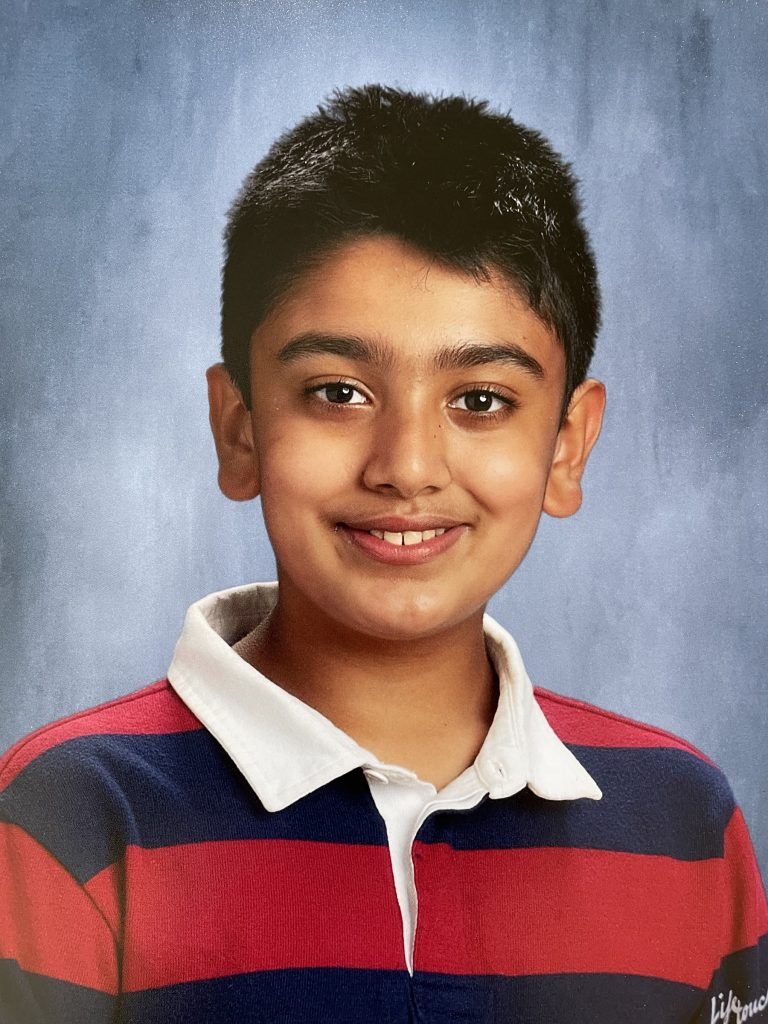
By Sahil Prasad, Grade 6, Maryland. Sahil adds: “Micromegas will appeal to your readers because of the exciting, profound, and silly elements of the book. It can be read by people of all ages and you are sure to have a different perspective every time you finish the book.”
###
Edition information:
Micromegas, CreateSpace Independent Publishing Platform, 2016. ISBN: 978-1533107763
[1] From a letter sent by Sir Issac Newton to the polymath Robert Hooke in 1675.
October 12, 2025
I just wanted to say how truly grateful we are—both Youtao and our family. We deeply appreciate this beautiful feature on the Skipping Stones website. Seeing his interview and paintings presented with such care means so much to us.
I’m touched by your dedication to young people around the world. Skipping Stones provides such a wonderful space for youth to connect, share, and learn from one another. It inspires passion for literature and the arts, nurtures creativity and curiosity, and reminds us of the profound power of words and art to connect and uplift the human spirit.
I’m so happy that Youtao can be part of this warm, creative family and contribute in his own small way. It means a lot to see him immersed in what he loves, growing and learning through this meaningful community.
Thank you again for all that you and your team do to encourage and nurture young voices everywhere. We’ll be sharing the feature with our friends, relatives, and Youtao’s school community. It’s a joy to know that his work will also appear in the upcoming print issue. We are really looking forward to it!
With heartfelt gratitude,
—Jiaen Cao (Youtao Cao’s mother), Japan.
Sept. 4, 2025
This was our first week of school, and I just wanted to let you know that we have received the copies of the magazine, and everything has been distributed to students. This edition is really lovely. The students appreciate it as they enjoy reading the variety of stories, articles, and poetry.
Thank you again for allowing children around the world to share their unique perspectives.
—Yolanda Toni, teacher, Illinois.
March 24, 2025
Thank you for being a voice of hope, love, and compassion. My mail is full of pleas for my money and time; but never the glow I feel when I find Skipping Stones in the stack of mail. I am blessed to have met you. If there is a way I might promote your work, please do tell me. Keep it up, write on.
—Cindy Kokis, Eugene, Oregon.
Dec. 29, 2024
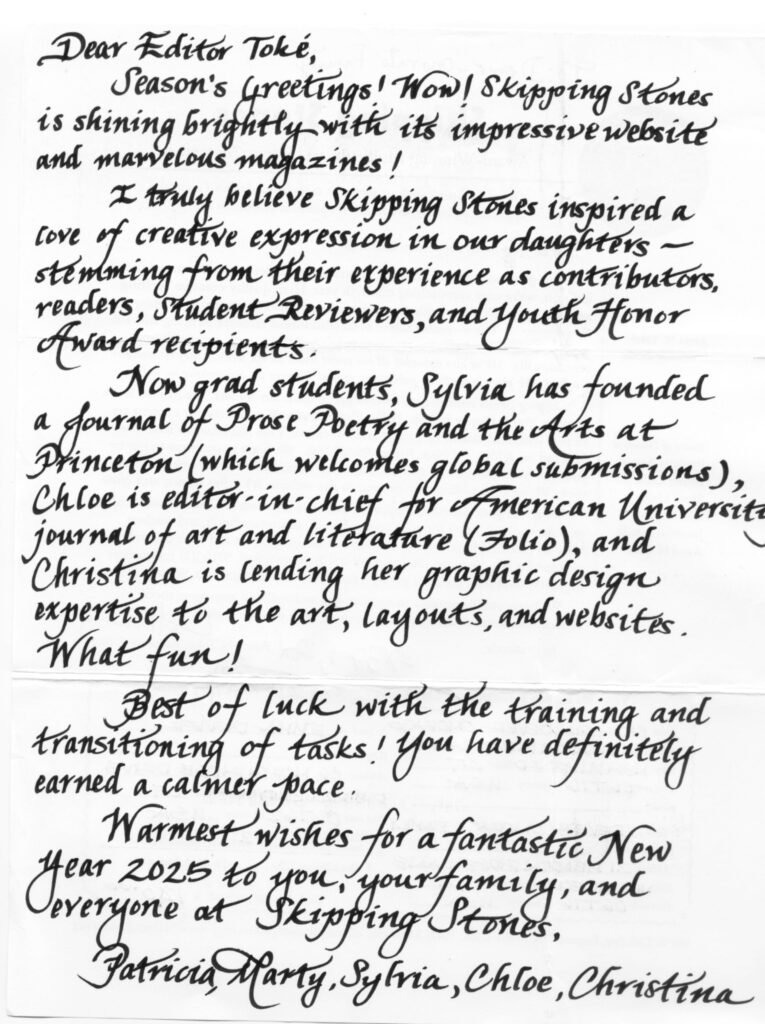
We pleased to share this letter by Mrs. Patricia Onorato of Connecticut. She adds in her email, “Skipping Stones has been—and remains—such an exciting, enjoyable part of our family’s reading over many years. We look forward to new issues and perusing your wonderful website!”
Dec. 6, 2024
Just wanted to add a note of appreciation and admiration for the last issue on 2024 Awards. Of course, I want to read each and every book, but also mention how inspiring it is to see what young people can do when they combine their hearts’ longings and experiences with their skills!! Thank you for providing this sharing place!
—Kathy Beckwith, author and educator, Oregon.
August 30, 2024
It’s a great joy for our daughter Jessie to receive recognition from professional editors. We read through the magazine (Volume 36, issue no. 2) and felt how much endeavors you and you team devoted into it. We really love the content, seeing so many peers excel in different ways.
Great appreciation for you and your team!
—Liping Chen (Jessie’s mom), British Columbia, Canada.
April 15, 2024
Dear Arun, what a marvelous issue of Skipping Stones (Vol. 36, no. 1). You do such an outstanding job of making known children’s perception, intelligence and amazing capacity to do good. I deeply honor you for your vision and your hard work!
—Stephanie Tsuchida, art teacher, Oregon.
Sufyana was so happy and delighted to receive the Skipping Stones issue in the mail; thank you so much for making the effort to reach out and to send the contributor copies, they will be treasured! The array of thoughtful and beautifully written and genuine writing in Skipping Stones really impressed us!
Yesterday, Sufyana received in the mail an incredible gift of books, and she, her middle sister Aydina, and youngest sister Wilaya were overjoyed! That was such an unexpected blessing and surprise, and they began reading them right away. Thank you so much for these wonderful books!
—Saleela S., Sufyana Johnson and family, Maryland.
March 14, 2024
Thank you so much for publishing my article (see Vol. 36, no. 1, pages 22-23), “Student Poems of Hope, Faith, and Love.”
Your publication is inspiring students, teachers, administrators, and parents across the country and around the world. There is a lot of heartfelt work, love, and dedication put into the children’s poetry and prose. The artworks—especially on the last page (p. 35), and also the back cover—are beautiful and emotionally strong and send a powerful message of courage to your readers.
And congratulations to Austin Liu for “Girl with Dukhu” front cover. I can’t say enough about the painting. This is museum quality artwork.
I’m always amazed by how much “great stuff” is packed into 36 pages. This is a credit to you and all the effort to create a fantastic magazine. After you finish reading it, you walk away feeling really good about the creativity, self-expression, and power of passionate communication.
Thanks again.
With kind regards,
—Jeffrey Pflaum, (now retired) teacher, educator, New York.
P.S. “Peace Within, Peace in Our World.” Yes! (see Vol. 36, no. 1, page 18).
November 22, 2023
Thank you, Arun, for all the work that goes into producing this most wonderful magazine for children of the world!
—Cynthia Lewis-Berry, Oregon.
November 2, 2023
Thank you so much!! We are very happy to have my daughter Parnian’s first paper published in Skipping Stones. This will definitely be her life-time fuel tank to pursue her dreams one by one and use obstacles as stepping stones and jump forward like Skipping Stones!
I am honored to express my gratitude by saying that your organization has been and will be a life-changing center.
On behalf of Parnian, please thank your colleagues who made this happen. I truly believe it is an inclusively rich source of love, inspiration, and courage for anyone who visits your platform.
Good Job, Skipping Stones Team!
—Dr. Ali Derahvasht, University of Malaya, Malaysia.
October 27, 2023
Dear Arun,
Our prayers are the best gift we can give for peace around the world. Yes, it is rather discouraging and I find that there’s only so much news I can watch on TV or hear over the radio.
I visit your website periodically, and I am so impressed with the caliber of writing and artwork submissions posted from youngsters around the world. And it’s always a joyous occasion to receive the latest print issue in the post to hold and read. And afterwards I share the print issue with two young readers in Kodiak, Alaska. ¡Mil gracias, Arun!
With gratitude and kind regards,
—Katacha Diaz, Peruvian American author, Oregon.
October 26, 2023
Greetings Arun,
Something I wanted to share with you; I commend you on your work with Skipping Stones. It really is a lovely venue for young writers and artists worldwide. I feel honored that I am part of it.
And as I work on reducing the stigma of mental illness, and quitting smoking, you work on creating understanding of, and between, all young people. With empathy and compassion. And there is great wisdom in all of this. We all have so much in common. In reality, each of us are branches from the same tree. And that tree is love.
So as we travel on this wandering path together, may we enjoy the simple things. And know that our children hold the hope for an even better future. I say this because my higher power—my friends and family—has given me such wonderful gifts to choose from. And there is no time for self pity. This I have learned from the children of Skipping Stones.
A slow day is a time waiting to be filled with joy. Life certainly gives us some hard lessons. Yet still we persevere. The gift is truly in the giving. And, when I give to Skipping Stones I feel happy.
Shalom,
—Jon Bush, artist and author, Massachusetts.
Dear Arun,
If I may comment on the latest issue of Skipping stones, Vol. 35, no.1, March-August 2023:
What a spectacular display of visual and literary art! The presentations on the printed pages draws a person into reading the outstanding articles that provides one with “page turning” insights of different cultures.
—Margaret dingus, M.A.
Dear Arun,
The Sept. – Dec. 2021 edition of Skipping Stones is the best ever. It is superb. So many of the writings brought tears to my eyes. I wish you could put out other printed editions—say once or twice a year.
Thank you for your masterful work.
—Dr. Irwin Noparstak, Oregon.
Dear Arun,
What a joy to receive the latest print issue of Skipping Stones. I am so grateful to be reading the Sept. – Dec. 2021 issue filled with outstanding writing, illustrations and photography from young contributors around the world. Thank you to the editorial team!
I am pleased to make another 2021 donation in support of Skipping Stones.
—Katacha Diaz, Peruvian American author, Oregon.
Dear Arun,
I hope you know how much I value your work. For many years Skipping Stones has been a wonderful part of my life.
Through all of my adventures through the literary world I can honestly say I’ve never seen a magazine as open and diverse as Skipping Stones, and that is all thanks to you. It has beautiful art and intriguing stories by young people from all over the world. I have learned so much about different cultures through Skipping Stones.
Truly the children are our future. May we guide them in peace as you do. Encourage them to greatness. Support their dreams. Believe in them. What we invest now will surely be returned a thousand fold to coming generations.
When we plant the seed of hope and nourish it, that is the way to health. And when it becomes a great big tree we can say, “That was a good deed I did that day.”
Best wishes,
—Jon Bush, artist and author, Massachusetts.