Author Archives:

The Internment of Japanese Americans During WWII

The Internment of Japanese Americans During WWII

By Fanny Wong, Chinese American author, New York.

The United States is a nation of immigrants. Japanese immigrants started to arrive on the Hawaiian Islands in the 1860s to work in the sugarcane fields. Later, many moved to the West Coast of the U.S. mainland to work as farmers and fishermen. By 1911, over 400,000 Japanese men and women had immigrated to the U.S. 

At the beginning of the 20th century, the Japanese were portrayed as the enemy of the American worker, just as Chinese immigrants were decades before. The Japanese farmers were the envy of white farmers who did not use as many labor-intensive methods and were less productive.

On December 7, 1941, the Japanese planes attacked Pearl Harbor. Navy ships were destroyed and many American servicemen died. On the West Coast, the government immediately began rounding up Japanese newspaper editors, community leaders and labor organizers. Their families were not told the reason or where the men were taken.  

The entire Japanese American population within 100 miles of the West Coast and Hawaii was considered dangerous, possibly spying for Japan. An 8 p.m. curfew and a five-mile travel limit were imposed on all persons of Japanese origin. On February 19, 1942, President Franklin Roosevelt signed Executive Order 9066, sending the Japanese and Japanese Americans to ten hastily built internment camps in Arizona, Arkansas, California, Colorado, Idaho, Texas, Utah, and Wyoming.   

The Japanese were shocked beyond belief. Two-thirds of the 120,000 internees were American citizens, born in the U.S. They were forced to sell or abandon most of their possessions, houses, cars, boats and land. Their possessions, including precious farmland, were sold at a bargain to white farmers. They had only a few days to pack and could bring only what they could carry. 

The camps were located where the weather was very hot in the summer and cold in the winter. The barracks were shoddily built, covered with tarpaper on the outside. Only canvas cots, a light bulb and a potbelly stove for winter warmth were supplied. Each family had to build its own plain furniture such as a table, chairs and shelves. There was no insulation. Dust and wind blew in through the cracks of wood that had not aged properly and shrank. Four families in small rooms shared one barrack. Within each room, blankets and sheets could be hung to provide some privacy. 

There was no way to escape these prisons. Barbed wires surrounded the camps. Armed guards surveyed from watchtowers. Life was regimented.There were lines for meals, the shower, the toilets and the laundry in communal buildings.  

In the beginning years, the food was American, such as hot dogs, stew, potatoes, liver and cow tongue, which the Japanese were not used to. Later, they grew their vegetables and even made tofu, soy sauce and noodles. Rice was added to the menu. The government spent only thirty cents a day per person on food.  

The internees were put to work with very low wages, from $8 to $19 a month. The camps needed cooks, office and field workers, food servers and construction workers. But many were bored. To relieve boredom, the internees organized outdoor sports for adults and youngsters. Baseball was a favorite pastime for spectators as well. Primitive baseball fields were leveled, rocks and stones removed. There were a variety of other activities, including movies, talent shows and holiday celebrations. 
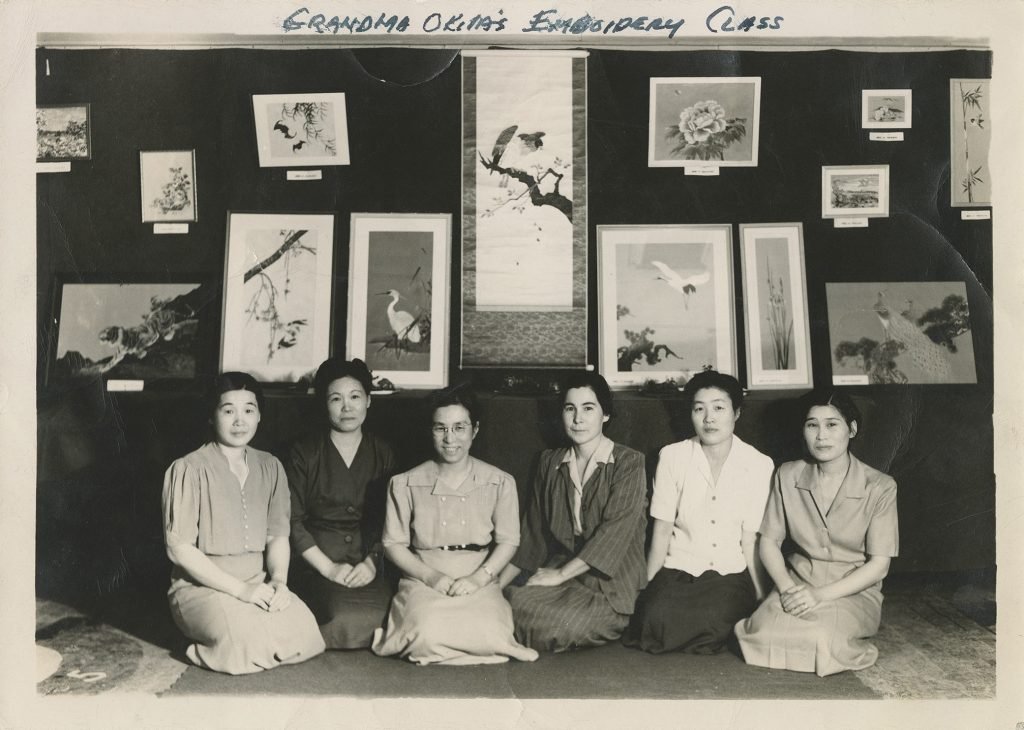
Grandma Okita’s Embroidery Class, Minidoka Concentration Camp. Photo: Courtesy of Japanese American Museum of Oregon, Portland, Oregon. Permission from JAMO required for further reproduction.

The internees were stoic about the experience, often repeating “Shikata ga nai” meaning you can’t change it. They tried to make their lives as pleasant as possible. They ordered fabric from catalogs to make curtains and tablecloths. Paper flowers decorated the rooms. They created tiny gardens in front of the barracks and even small ponds to make their bleak surroundings acceptable. They created handicrafts from dead trees, wood and material found around the camps. Painters, both professional and amateur, recorded the daily activities of the camp in their artwork. Art lifted the spirits of the internees. Their acts of beautifying their surroundings were something the government and the prison guards could not take away from them.  

Some 17,000 children under the age of ten were among the internees and more were born in the camps. Schools were organized for the children from kindergarten to high school. Used textbooks were sent from nearby schools. Most of the teachers were Japanese, although there were some white teachers who had better living quarters. 

In some households, family closeness was a casualty. Children witnessed their parents’ loss of control in their lives. The parents lamented that the children would rather eat with their friends at the mess halls. Teenagers became more rebellious as many of their peers did in the outside world. But in their abnormal lives, the strain was more severe.

Still, the internees were patriotic. They made camouflage nets, bandages for the war, donated money for the Red Cross, and collected metal for recycling.
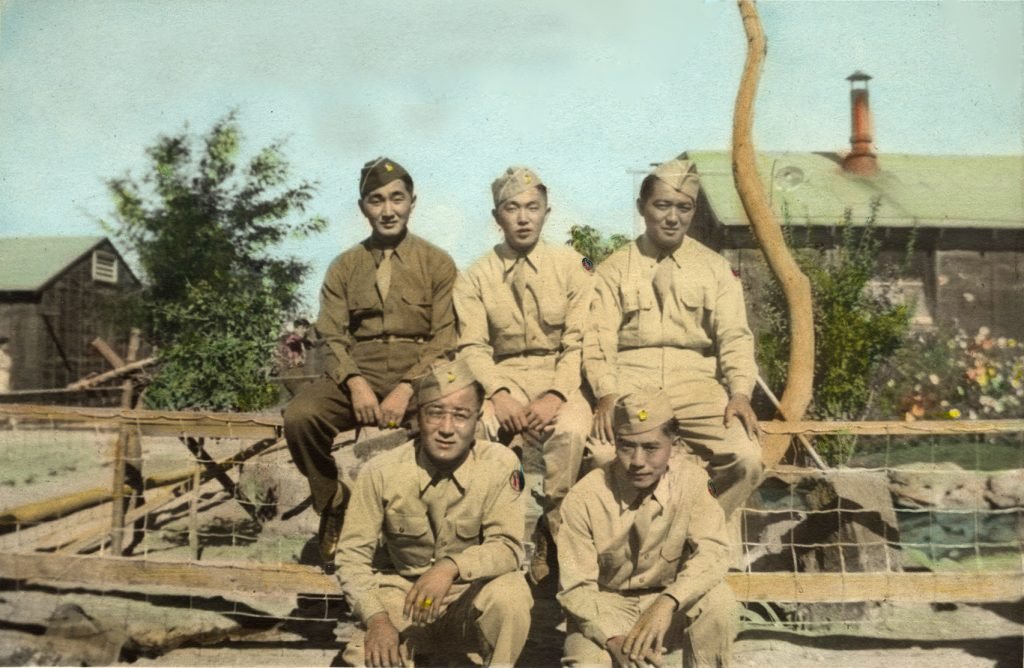
Nisei Veterans of the 442nd RCT, Minidoka Concentration Camp. Photo: Courtesy of Japanese American Museum of Oregon, Portland, Oregon. Permission from JAMO required for further reproduction.

Beginning in February 1943, citizens of Japanese descent were permitted to enlist in the Army and Navy. Many young men joined the 442nd Regimental Combat Team (RCT) that was comprised of all Japanese American soldiers and fought valiantly in Europe. This regiment was the most decorated unit in the army. They operated in some of the most dangerous battles, and therefore, had the highest casualty rates (9,000 dead or wounded). They put their life in danger for the country even though their parents and relatives were in the internment camps. When the soldiers were wounded, when they were released after treatment, they would be sent right back to the internment camps. 

Towards the end of war, the government began releasing large numbers of the internees. The internment camps were empty by the end of 1945, and the last one closed in March 1946. Most Japanese Americans did not return to their hometowns because there was nothing to return to. Those that did return had a difficult time finding work and accommodations. A small number chose to go back to Japan. Each released person was given just $25 and a bus ticket to start their new life.

At the end of the war, no American Japanese were found to be spying for Japan. Later research proved that some American officials were guilty of falsifying reports that were used as the basis for the government’s internment decision.

In 1988, President Ronald Reagan signed a legislation apologizing for the internment on behalf of the U.S. government. In 1990, the first letters of apology signed by President George Bush were mailed. Surviving interned Americans and their heirs received $20,000 compensation for each individual. For many, the apology and the check came too late—they had lived a very difficult life, and many of them had already died. 

After the 9-11 attack by Muslim terrorists, fear mongering and Islamophobia depicted Muslim as dangerous to Americans just as the Japanese were demonized after the Pearl Harbor attack. The anti-Muslim sentiments being expressed in the country led the Japanese American community to publicly state that the horrible injustice done to them in WWII must not be repeated. It continues to raise its voice whenever an ethnic group is unjustifiably targeted. 

By Fanny Wong, Chinese American author, New York.

Editor’s Note: May is celebrated as the Asian American and Pacific Islander Heritage Month in the country. 
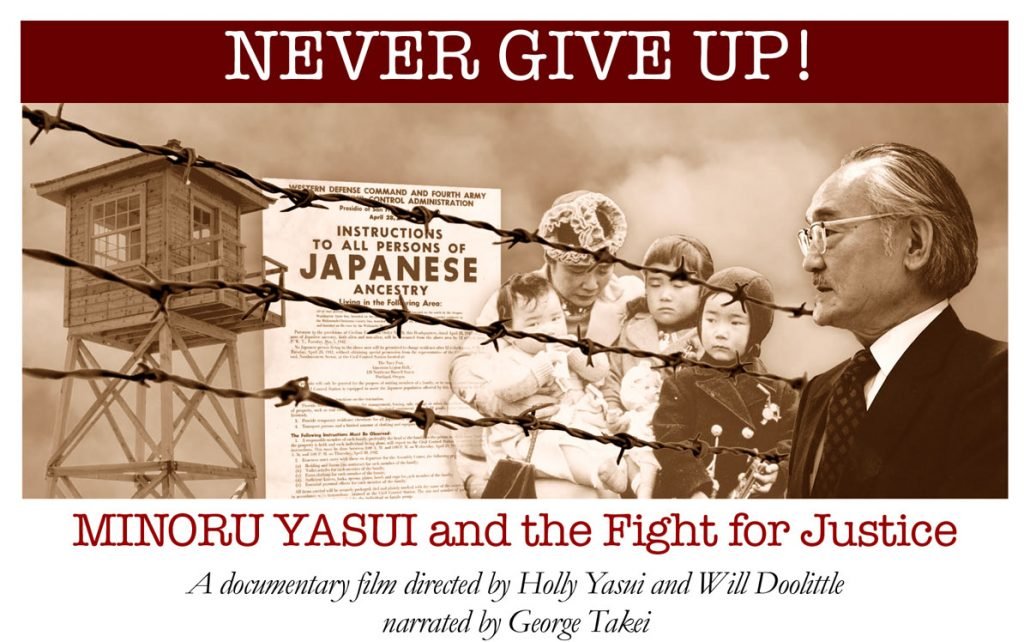
Never Give Up is an award-winning documentary that teaches about the discrimination faced by the Japanese American community and the issues described in the above article. You can get details from the website: www.minoruyasuifilm.org

Kaleidoscope of Freedom

“After learning about the war in Ukraine, I was immediately worried about my grandfather and his wife, who live in Ukraine. At first, I felt that there was little I could do to help the Ukrainian people. But then I realized how art can be an important tool to show support for Ukraine during their fight to protect their land and homes from invaders. In my digital artwork ‘Kaleidoscope of Freedom,’ the center is the Ukrainian flag surrounded by the flags of countries that stand with Ukraine. It expresses the message that the people of Ukraine are not alone in the fight for their land and freedom.”

By Camille Campbell, Age 17, Arizona. Also see Camille’s poem COLORS OF UKRAINE and art published earlier on this website. She adds: “I’ve printed over 5,000 stickers with my art for rallies in Arizona, California and New York. The digital art is based on my silk art (the Ukrainian painting technique) and conveys the message that many countries of the world support Ukraine.” The donations that people make at these rallies support the Ukraine cause.


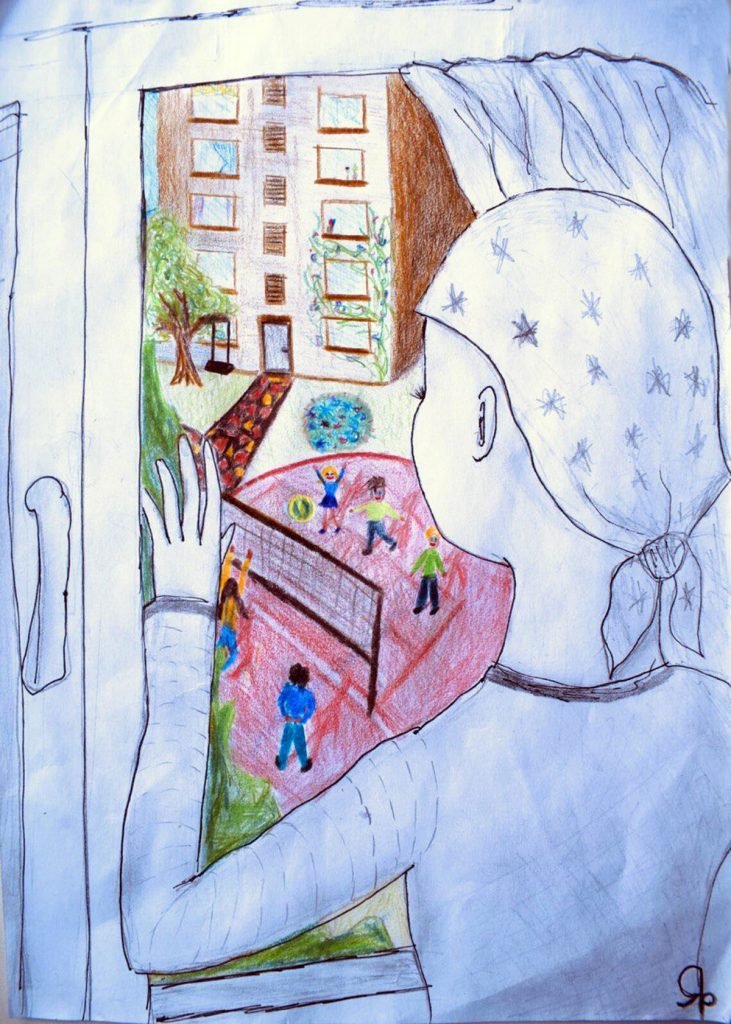
The Most Precious Gift

By Yarynka Yarosh, age 15, grade 9, Kyiv, Ukraine.

Standing near the window in her room, Christine cried quietly. She had long ago learned to wail silently so that no one would hear. Especially Mom. Or maybe she had just spent all her loud tears. Sometimes, after a series of such noiseless sobs, her pillow was too wet to sleep upon. Now those silent, salty streams were there once more, flowing down her cheeks, sprinkling her favorite violet raglan. 

Down there, in the yard, her friends are playing volleyball. Olenka serves the ball to Max, he hurls it over the net at Slavko, but Slavko palms the ball back skillfully. Twins Marusya and Oles` back him up closely. The whole team was there, except Christine!

The last time, they had played together was at the start of November, before the first snow. Then came that long and cold winter when Christine fell ill. Now, all the danger was past her, but she still couldn’t play. So every single day she just stood at her window, hidden behind the curtain and watched the exciting game. Her friends shouted for her every time they went out, but she rejected all invitations. She had no difficulty running. No, there was another reason—she just couldn’t confide in them. 

Christine sighed and sat on her bed, burying her head into her hands. Not a single hair under her fingers.

Last year had changed Christine’s life radically, ruining plans, dreams. The hospital room, IV`s, doctors, that awful laser lamp, endless chemos were again flickering before her eyes. Christine had no wish to replay all those dreadful months in her head, so she shook her head like she used to do before all that when she still had her beautiful hair. Oh, she was so proud of it! She had the longest hair in her year! And now she has nothing, but plenty of unpleasant thoughts scurrying in her head, like a scattered jigsaw puzzle. Christine was so full of self-pity that she started to cry again. After all this, she had learned to bear physical pain, but not the absence of her chestnut curls.

Oh, how she wanted to run with the “Volley Sixth” again, but…

Christine didn’t want her friends to see her without hair—anything but that! Her pals still had no idea that she was now bald—her parents bought her a wig so that no one would ever know.

Illustration by Yarynka Yarosh, age 15, grade 9, Kyiv, Ukraine

Christine got up and returned to the window. The field was now ringing with laughter—Slavko had just returned the ball in an unusual manner, locking his fingers in a weird knot. Christine poked her head out of her hidey-hole behind a curtain and imagined herself running over the field with her friends. There she is, taking a pass from Slavko, then feeding the ball out to Olenka and running for it just in time to catch a master shoot from Oles`, and then…

Everybody at the field was suddenly staring at her, at her window. Five confused faces. Absent-mindedly Christine scratched her head and suddenly the chills went up her spine… She had forgotten to put her wig on! She usually went about the flat without her fake hair and watched the game from behind the curtain. Today, however, she got so carried away she completely forgot to mind the “danger zone”.

Realizing that her friends saw her baldness the girl yelped and hid her face in her hands. Then she darted away from the window, fell on her bed, and burst into tears. Tomorrow’s her birthday and all the members of “Volley Sixth” were planning to visit—that was the most tragic thing of all!

Her Mom came into the room, alarmed.

“I`m the only bald person in my class! No, in the whole school, in the whole city!” cried Christine loudly, like the moment she was told about her diagnosis. “I don’t want any party on my birthday!” 

Mom hugged her tenderly. “But your hair will grow back, for sure, my skylark,” she soothed. 

“I can’t speak to them normally, knowing they saw me bald!” 

“If they are really and truly your friends, that should mean nothing to them,” she responded. 

But does she really have… true friends?

That night Christine had a beautiful dream. 

“Come on, Christine, serve it! That’s my girl!” shouted Slavko. 

“It’s so good to play volleyball with my friends!” Christine was rejoicing, serving the ball on the other half of the field. Suddenly, she saw it hurtling towards her. She wanted to break it, but her knees quaked and felt like cotton…

Somebody touched her shoulder very softly. Christine opened her eyes and instantly squeezed them tightly shut, hiding from the tickling morning light… Mom and Dad were standing near her bed, smiling and holding a present. So she had only dreamt about the game, how sad!

“Ding-dong,” rang the entry phone in a while. Christine quickly slipped her wig on. 

And there they were! Olenka, Slavko, Maxim, Oles` and Marusya. They had come empty-handed, and for some reason, were all wearing hats. 

 “Well, as agreed! On the count of three,” cried Slavko. “One, two, three!”

“Happy birthday!” And they swept off their hats as one.

They all had clean-shaven their heads! 

And they hugged the birthday girl, all at once.

That was the best birthday party Christine ever had! 

After the birthday treats, “Volley Sixth,” now fully complete, went to the sports ground before Christine`s window. Now Christine had difficulty identifying her friends on the field, she still hadn’t got over their new hairstyles. 

Then she remembered her dream. Now she couldn’t recall whether she had her curls there or not. Not that it had any importance now. She was quite happy without her hair now, for she had true friends.

By Yarynka Yarosh, age 15, studies in grade 9, Kyiv, Ukraine.

Yarynka writes, “I like painting, playing piano, reading, speaking with my family about anything, writing poetry, and stories, of course. I’m from Ukraine, and I want peace in the whole world, and for ourselves.

“On the 9th of March, we were forced to leave our home city, beautiful Kyiv (because of the Russian invasion)… Now my family and I are in a safe place, and I’m so thankful to God that we are still alive! But my grandparents are still in Kyiv. Please, pray for them!

“I was really surprised, when I read your email (of acceptance). I’m thankful for your positive response. You made me happy and gave me more confidence and hope 🙂 Ukraine needs your prayers, we feel your emotional support.”

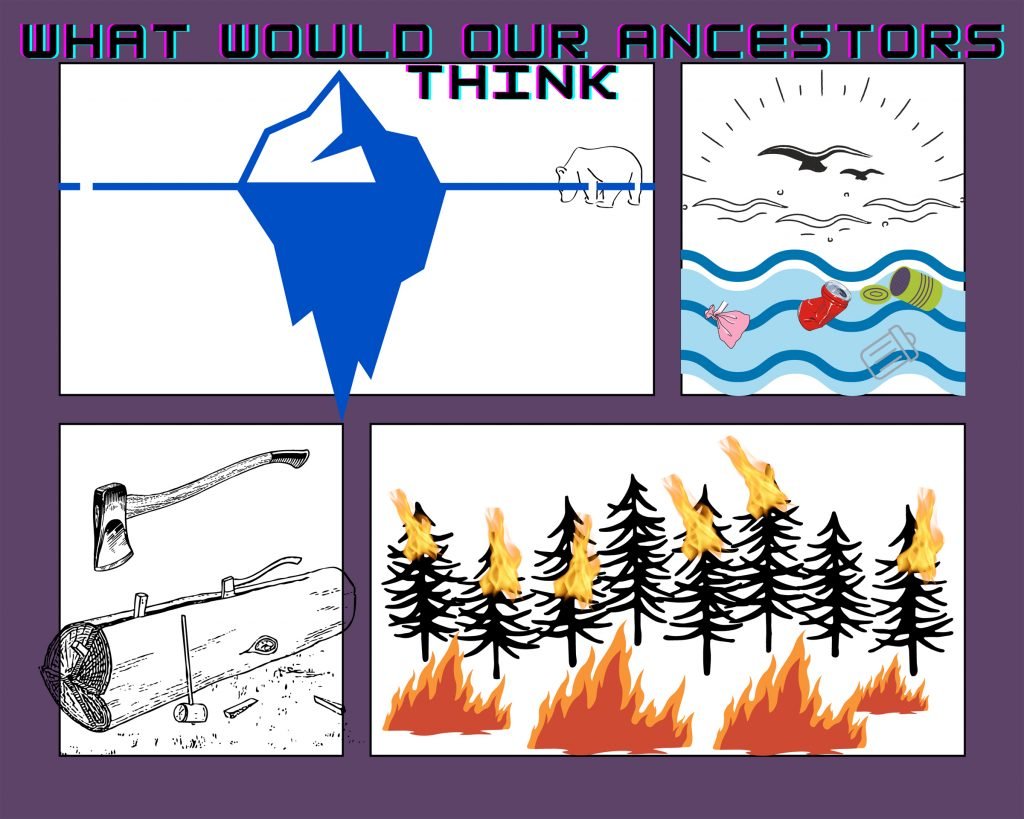
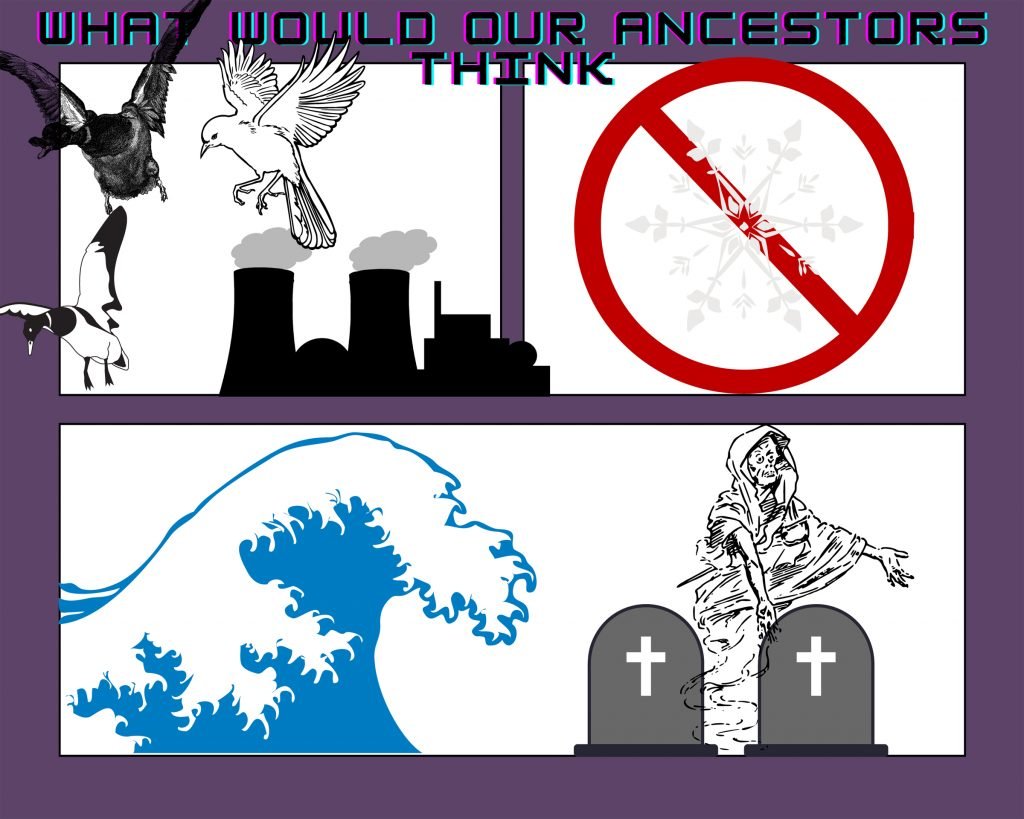
What Would Our Ancestors Think

Art and Poem by Daniel Liu, age 16, New York.

There is constant talk

Of the world ending in three days

Or is it four years, or five decades, but definitely when

the polar bears start swimming to New York

The sea groans and rumbles

As waves upon waves of human trash clog her up

She sniffles amidst the crushing silence

Sea snot collects on her waves

History starts to crumble

Our oldest trees cut down

Nature groans and shakes

In a futile effort to stop the abuse

The planet prepares itself for destruction

The pain is unlike anything she has ever experienced before

Crops shrivel up in the infernos that run rampant across the landscape           

Such displays are necessary to attract humanity’s short attention span

Animals feel nature’s anguish

They flee North

Until they cannot go any further

More lives snuffed out by humanity’s greed

The most vulnerable of the population suffer

Heat waves overwhelm the wounded, elderly, and sick

Surely we did not mean to wage warfare on the defenseless

But it is only a matter of time before conditions deteriorate further

Schoolchildren sullenly trudge across the parched land

The sky turns black as clouds suddenly gather

They look up, hopeful for the touch of the fabled snowflake

Warm rain drizzles, then the omnipresent sun returns 

In some places floods wash away human remains

Our ancestors disturbed by Nature’s wrath

They weep as they behold the desolate world around them

For the fate of the next generation

Art and Poem by Daniel Liu, age 16, New York.

Daniel Liu adds: “I am a sixteen year old writer that lives in New York. I am very passionate about the issue of climate change, as it is an enduring issue that grows ever larger with each generation and is deserving of attention from all of society. These poems are a testament to the various consequences of climate change in every aspect of society, from agriculture to insurance. To this extent, I hope that these poems are enough to inspire a sense of alarm for the Earth’s future, but just as importantly, hope that humanity can unify in order to reverse the ecological damage that has been done. It is in times of great crisis that innovation and change are at their peak, and humanity’s resilience is shown through our uplifting moments.”

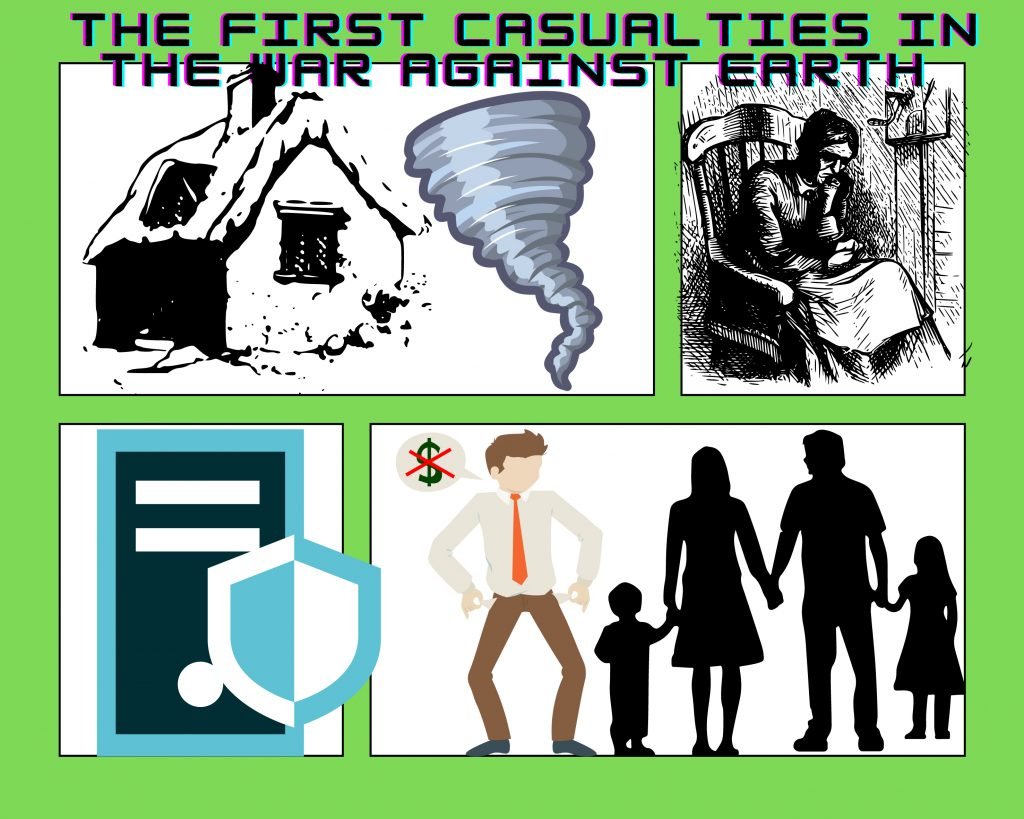
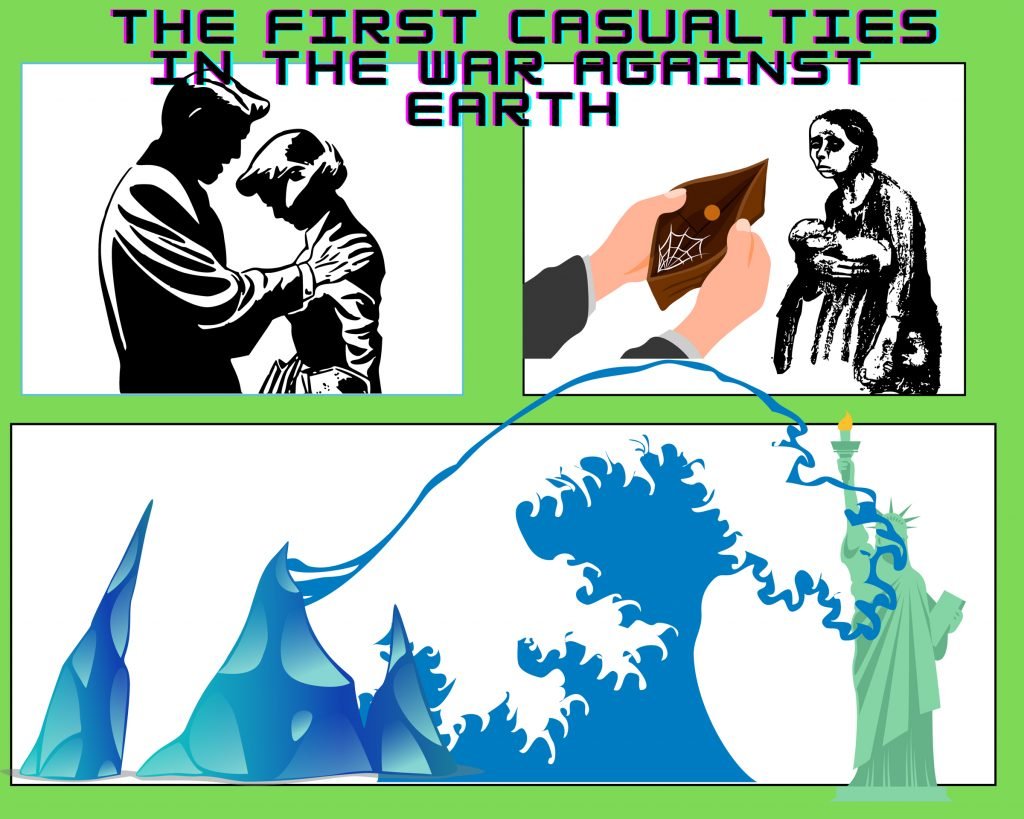
The First Casualties in the War Against Earth

Art and poem by Daniel Liu, age 16, New York.

Wind blows from the four corners of the earth

With the roar of a thousand lions

The house stands in the aftermath

Partially caved in

The family laments their loss

Mother Nature will not be denied

Ink pens scratch on paper

Now their fate is in the hands of companies

Premiums and deductibles

The economic jargon of insurance

When it is time to cover damages

They cringe and make excuses

The desperate family feels the vicious sting of betrayal

When Insurance blacklists the entire zip code

Businessmen reassure themselves of their morality

Accepting this debt will only cause their bankruptcy

But what of

The newborn baby, still fresh from the womb

The elderly grandparents, who have worked decades to afford the house

The first casualties of the consequences of the war humans wage on the planet

How long must the injustice go on

How many icebergs must melt

The gushing stream of the Earth’s blood

Will overwhelm us if change is not forthcoming

Art and poem by Daniel Liu, age 16, New York.

Daniel Liu adds:

“I am a sixteen year old writer that lives in New York. I am very passionate about the issue of climate change, as it is an enduring issue that grows ever larger with each generation and is deserving of attention from all of society. These poems are a testament to the various consequences of climate change in every aspect of society, from agriculture to insurance. To this extent, I hope that these poems are enough to inspire a sense of alarm for the Earth’s future, but just as importantly, hope that humanity can unify in order to reverse the ecological damage that has been done. It is in times of great crisis that innovation and change are at their peak, and humanity’s resilience is shown through our uplifting moments.”

Threats, Not Peace!

By Delaney Sheldon, age 14, grade 8, Virginia


Threats, not peace
Threats of creating what we fear most—a Third World tragedy
Threats of cutting the strings that connect us all together
Threats of destroying people’s land
People’s territory

Forget about peace
Why doesn’t peace ever show up?
Why is humanity always one step from falling off the steepest cliff?
Why do we sabotage ourselves and ruin others?
Why does publicity break us down? 

Fake news
Exaggerated news
REAL news
This news is very real
This news disrupts all peace that ever could be

So, what are we supposed to do?
Fight?
That’s not peace
Do we cut them off from the world?
And risk getting cut off too?
Definitely, not peace

Why should we even save them?
What have they done for us? 
If we throw the lifesaver to them in the deep water 
We could drown instead, sink straight to the bottom

But humans should save each other
Give them air
Bring them to the surface
Save them from their greatest fears

It’s our job as human beings
To let our humanity show
And to try to have peace on Earth
Because peace unites us all as one

Should LGBTQ+ Be Taught in Schools?

By: Lucille Amato, age 11, New Jersey.

Imagine that a young girl, with a normal life, has just come out as a part of the LGBTQ+ community to her classmates. That girl’s life has just changed because she has discovered something new about herself, but the needed support from her peers is nowhere to be seen. The classmates who don’t understand, give her weird looks, the classmates that do, sit in silence. Even the teacher is confused because that teacher was never taught about what LGBTQ+ means. Because of all this, the girl who expected support from her friends is left in awkward silence, feeling like she isn’t normal. LGBTQ+ is a community of people who have a gender or sexuality that is different from what people think of as normal. Plenty of people know this but a lot are unaware. This leads us to the question, should LGBTQ+ be taught in schools? Yes, definitely! There would be less bullying and happier students that are more prepared for the real world if we teach LGBTQ+ in schools!

My first reason is that there would be less bullying if kids learn that being LGBTQ+ is normal at a young age. According to StopBullying.gov 32% of bullying is directed towards kids that are a part of the LGBTQ+ community. Kids make fun of what they don’t understand so if they already know about LGBTQ+ then much less bullying would take place. If less bullying took place, it could also lead to better student grades and attendance rates. Because of school bullying, kids get anxiety which causes a lot of stress. All this stress can lead to lower grades. Also these LGBTQ+ bullies can cause kids to fake sickness or stay home just to avoid school. School should be a safe place to learn and have fun, and a student should never have to wake up with fear of going there.

Another reason is that if we teach LGBTQ+ in schools, it helps kids come out of their shells faster which makes students feel more comfortable, not just in school, but anywhere! Many kids suffer from wondering about their genders and not knowing can cause a lot of stress. Some students know that they are not comfortable with their assigned gender from birth, but they don’t know what that means. Thoughts such as “Do I like being a he/him or should I be a she/her or a they/them or maybe none of them? I don’t understand all of these pronouns!” go through some students’ heads every day. If it was taught in school they could understand more and know that they have support from teachers and their peers. Also it could make it so much easier for a kid to come out if their peers already knew what LGBTQ+ means. A kid shouldn’t be forced to keep explaining what their pronouns mean or what their sexuality means. If kids already knew then all these questions wouldn’t have to be asked.

Lastly, LGBTQ+ should be normalized so students can be more prepared. When a kid is young they are more impressionable so it’s best to normalize the LGBTQ+ community at elementary school ages. For example, most kids grow up with “boy” and “girl” being the only two genders and only boys and girls date each other, but when they grow up into the real world, they are going to be very surprised
There are many pronouns people can use and anybody can date anybody. Schools are meant to teach students and prepare them for the real world so normalizing the community should be one of the
priorities.

Although some religions might go against the LGBTQ+ community, kids have the right to learn about it. I know certain religions state that a member of the religion cannot be a part of the LGBTQ+ community but that doesn’t mean they can’t support it. Of course schools should never force someone to do anything that goes against their religion, but learning and supporting the LGBTQ+ community doesn’t make you a part of it. Also if parents truly refuse to let their children learn about LGBTQ+ for religious reasons they can always put them in a private or religious school. Even if religion is the reason a few parents wouldn’t want their child learning about the LGBTQ+ community, that’s not an excuse not to teach it. When it’s taught you will have happier students who are bullied less and are more prepared for the real world.

This community is constantly growing and more and more people are feeling comfortable with expressing their true colors. The world is changing so, don’t you think it’s time schools changed too? Schools would benefit so much from teaching students about the LGBTQ+ . If you also believe that schools would benefit from less bullying and happier students who are more prepared for the LGBTQ+ filled world, then spread the word! LGBTQ+ should be taught in schools!

You can visit https://www.hmhco.com/blog/ways-to-support-lgbtq- students-to-feel-safe-in-school for more information.

By Lucille Amato, 11, New Jersey.

Lucille is an AFAB (Assigned Female At Birth) who identifies as non binary and uses they/them pronoun.

The Irreversible Apocalypse

By Fathima Nazer Karakkadan, h.s. sophomore from India, living in Kingdom of Saudi Arabia

There’s a certain tragic enchantment in crumbling bridges

A prominent result of our actions.

A beauty in empty swings and abandoned parks,

Of unattended grass and dusty books.

The world listens to no one,

Each day is a reminder of how mortal we are,

Truly insignificant in the course of happenings

The sun combusts red now,

A revengeful fire,

Calling the attention of the ignorant beings of then,

Who did not care.

Taps don’t drip water anymore, there are no tides,

But constant sobbing of the hopeless

And the sons who used to drink to their sins.

Writings of good and evil

On morality and wicked

Have all been torn away

By vicious forces at hand.

Desperate prayers are not a remedy

For the annihilating moon

And the constant danger

Of our benighted neglect.

By Fathima Nazer Karakkadan, a high school sophomore student from India, living in the Kingdom of Saudi Arabia.

Postscript: Fathima adds:

“To me, the biggest mystery in this world is its end. This is in no way a light topic, but everything must come to an end, and that includes our universe. And what better way to analyze it than to imagine it? ‘The Irreversible Apocalypse’ are my predictions on the course of events when the sun will combust, the sky will split and the world ceases to be. Those days are most probably filled with regret and remorse and indignant human beings who have no choice. When the world retaliates for what we’ve done to it, how could we ever stand a chance?”

Celebrating Women’s History

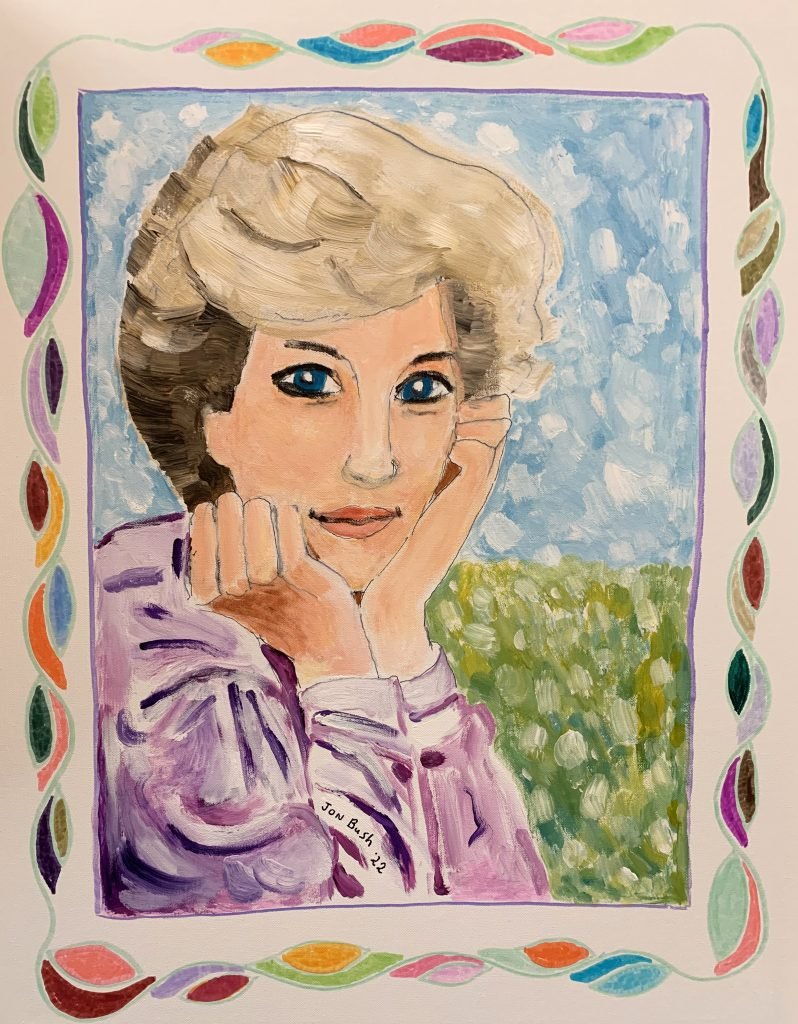
Princess Diana (1961-1997)

Princess Diana (1961-1997). Portrait by Jon Bush, Massachusetts.

“Carry out a random act of kindness, with no expectation of reward, safe in the knowledge that one day someone might do the same for you.”

—Diana, Princess of Wales (1961-1997). She was a member of the British Royal Family and mother of Prince William and Prince Harry. Her kindness, activism and position made her an international icon.


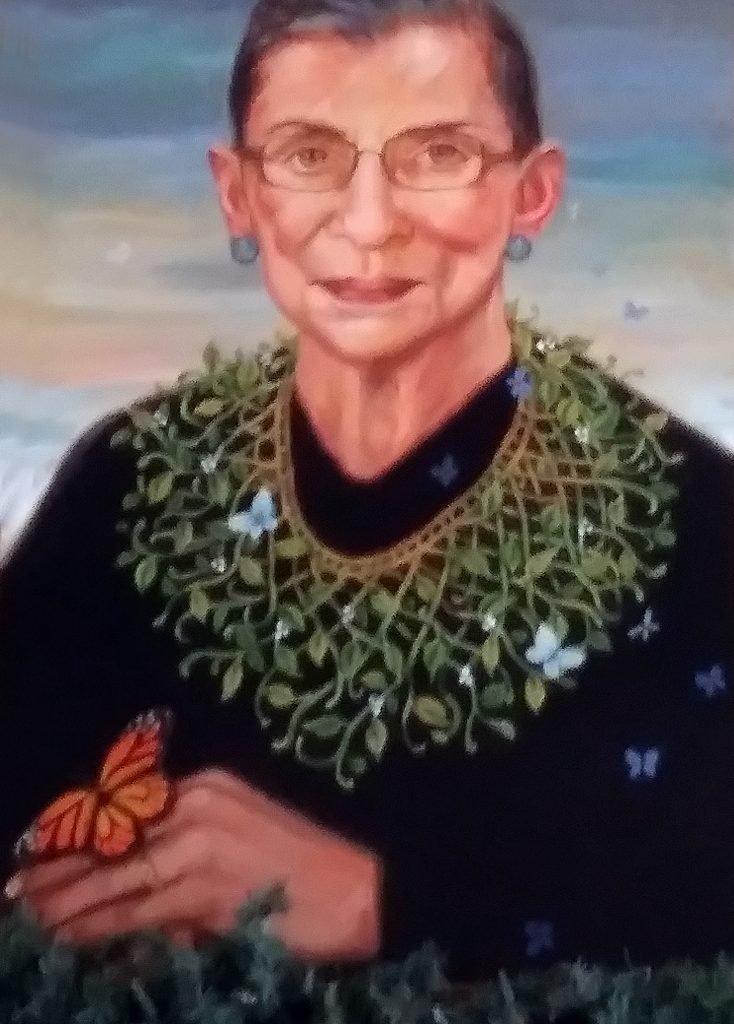
Justice Ruth Bader Ginsburg

Portrait of Justice Ruth Bader Ginsberg by artist Alix Mosieur of Loraine, Oregon.
Ruth Bader Ginsburg (1933-2020) served as an associate justice of the U. S. Supreme Court for 27 years. She was appointed by President Clinton and became the second woman to serve in this important judicial capacity after Sandra Day O’Connor. Justice Ginsburg was a well-known champion of gender equality and women’s rights. She died on September 18th, 2020, at the age of 87, after her battle with pancreatic cancer. You might like to watch RBG (2018), a documentary about her life. 

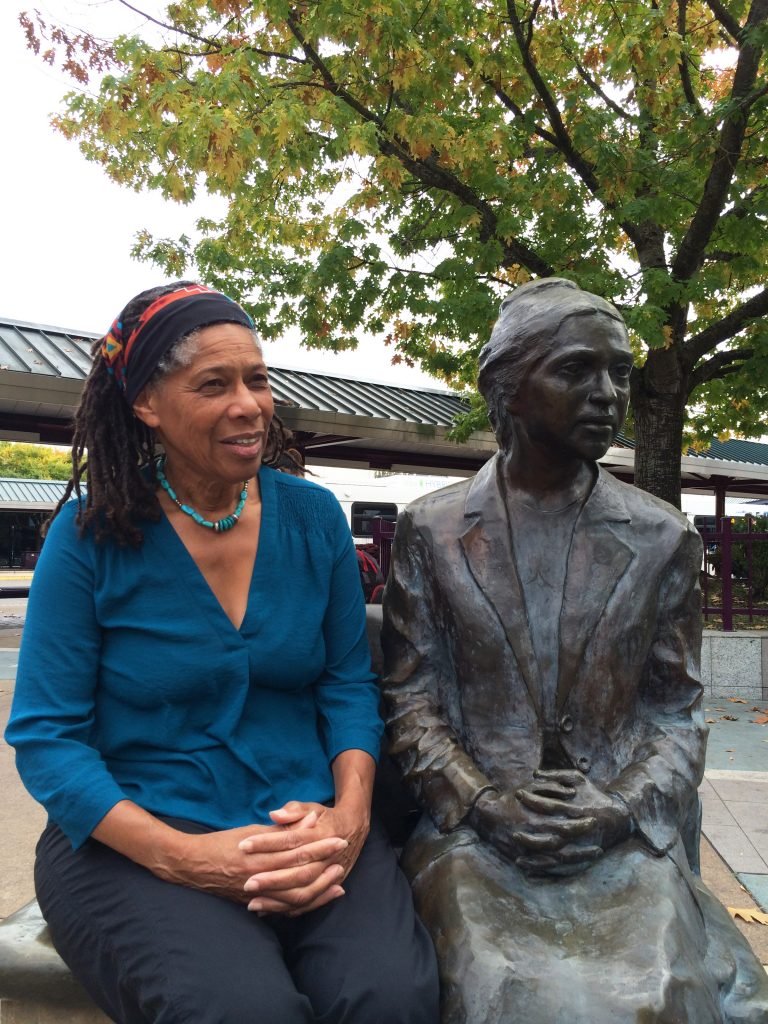
Rosa Parks (Feb. 4, 1913 – Oct. 24, 2005)

Dr. Jean Moule (sitting next to Rosa’s statue outside the Eugene LTD Bus Station, above) writes in her Skipping Stones magazine (April – May 2015) column, “Rosa Parks (Feb. 4, 1913 – Oct. 24, 2005) has become a symbol of the Civil Rights Movement and an international icon. She is an image of one lone person taking a stance that made a very big difference. She was sitting in a part of the bus that allowed Colored (African American) people unless it was needed for a White rider. When she was asked to move back to make room for a White passenger she would not. Rosa was 42 years old at the time and she was no more tired than anyone would be after a long day of work.

Rosa said, “I did not want to be mistreated, I did not want to be deprived of a seat that I had paid for. It was just time… there was opportunity for me to take a stand to express the way I felt about being treated in that manner. I had not planned to get arrested. I had plenty to do without having to end up in jail. But when I had to face that decision, I didn’t hesitate to do so because I felt that we had endured that too long. The more we gave in, the more we complied with that kind of treatment, the more oppressive it became.”

You can read Professor Jean Moule’s Nana Jean Columns in her latest book, Seeking Warmth and Light. FMI moulej@oregonstate.edu.

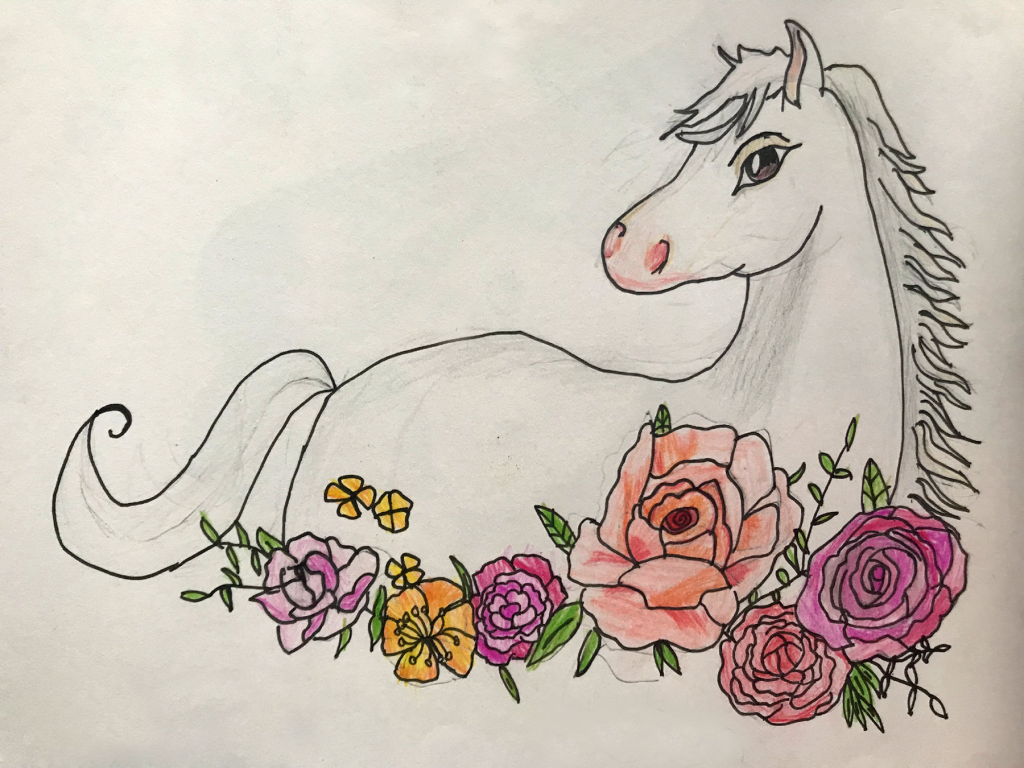
Horse Dream

“Horse Dream” by Tang Li, age 9, Florida.

Tang Li was born in the United States, and she speaks and learns to write in English, Mandarin, and French. She has had one-year horseback riding experience She is very fond of riding and taking care of horses, and she misses those good old days. She wants to be a veterinarian in the future; her dream hasn’t changed since she was four years old. 

In Tang’s realistic fiction, Horse Dream, she used the main character Molly to realize her dream, by choosing an ideal location and a dream horse to ride. She began her creative writing by introducing Molly: “Hi. My name is Molly. I am ten years old and was born in Paris, Texas. Yes! It may sound crazy and this Paris even has an Eiffel Tower, just like the one in France. But this Eiffel Tower has a gigantic cowboy hat! My house is just a few blocks away from the Eiffel Tower.

“I have always dreamed of being a cowgirl. Horses are such beautiful animals! I begged mom and dad to sign me up for horseback riding lessons… In school, my favorite part was recess because I got to swing high up on the swings and to see the horse pasture on the other side of the school wall. My favorite horse was a horse named Fiona. She is a brown quarterback horse with a white mark shaped like a rhombus between her eyes. I always hoped to ride on Fiona someday.”