Author Archives:
Celebrate America Creative Writing Contest
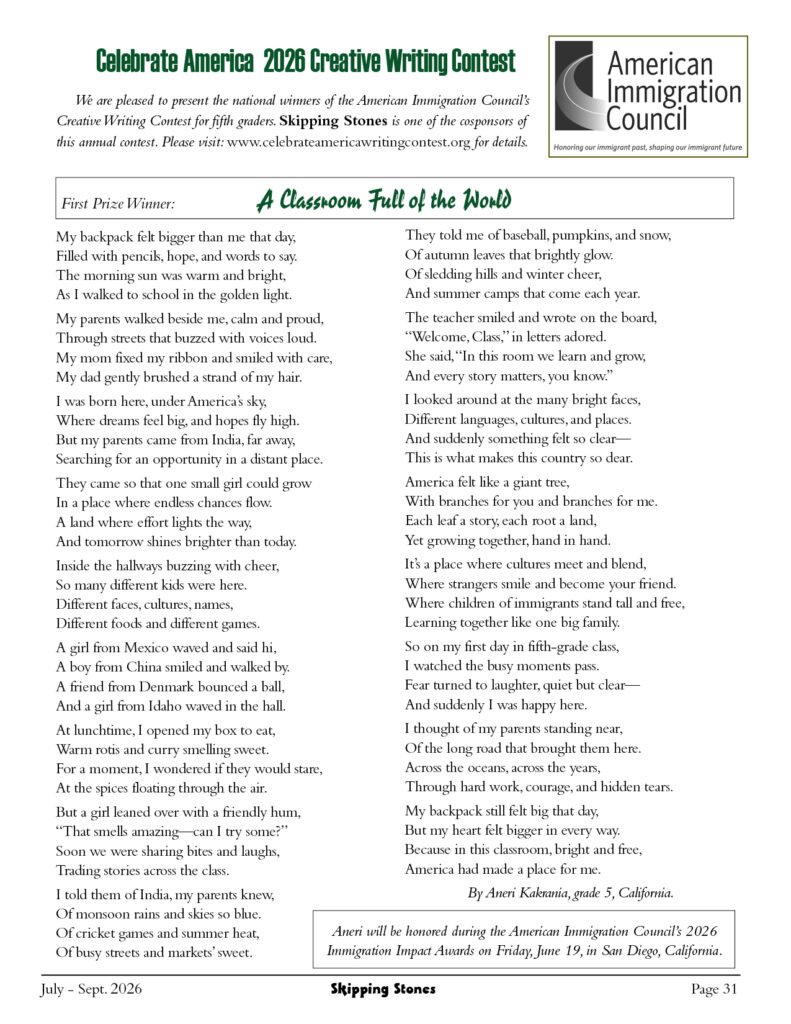
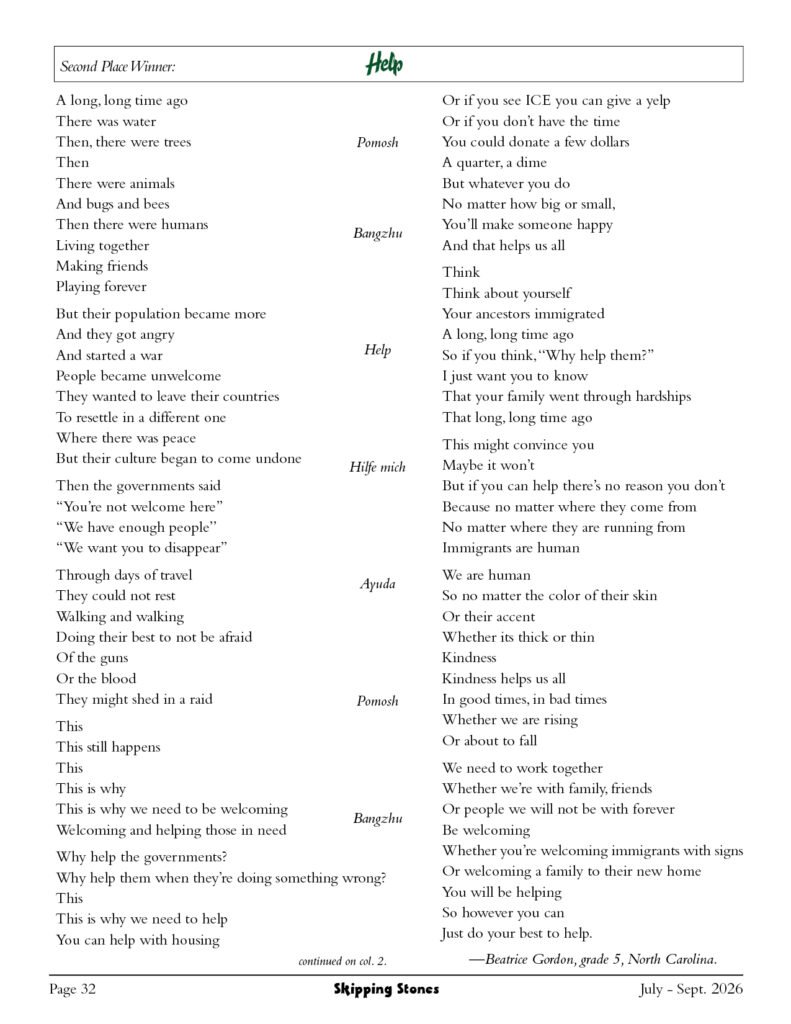
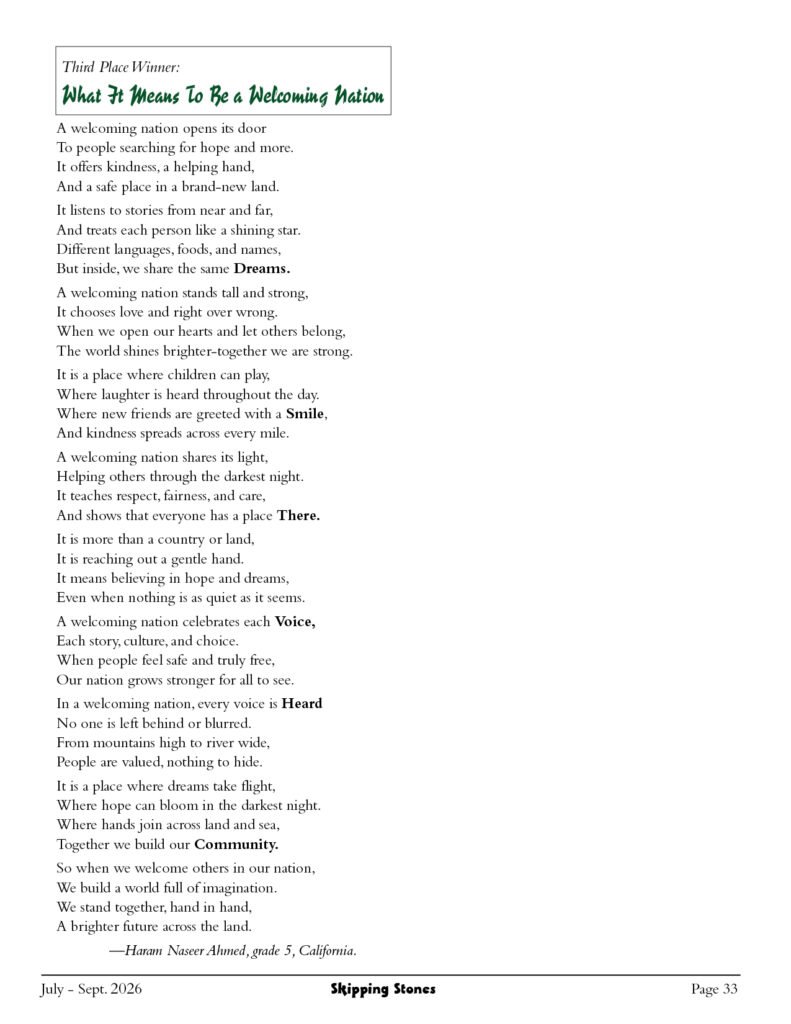
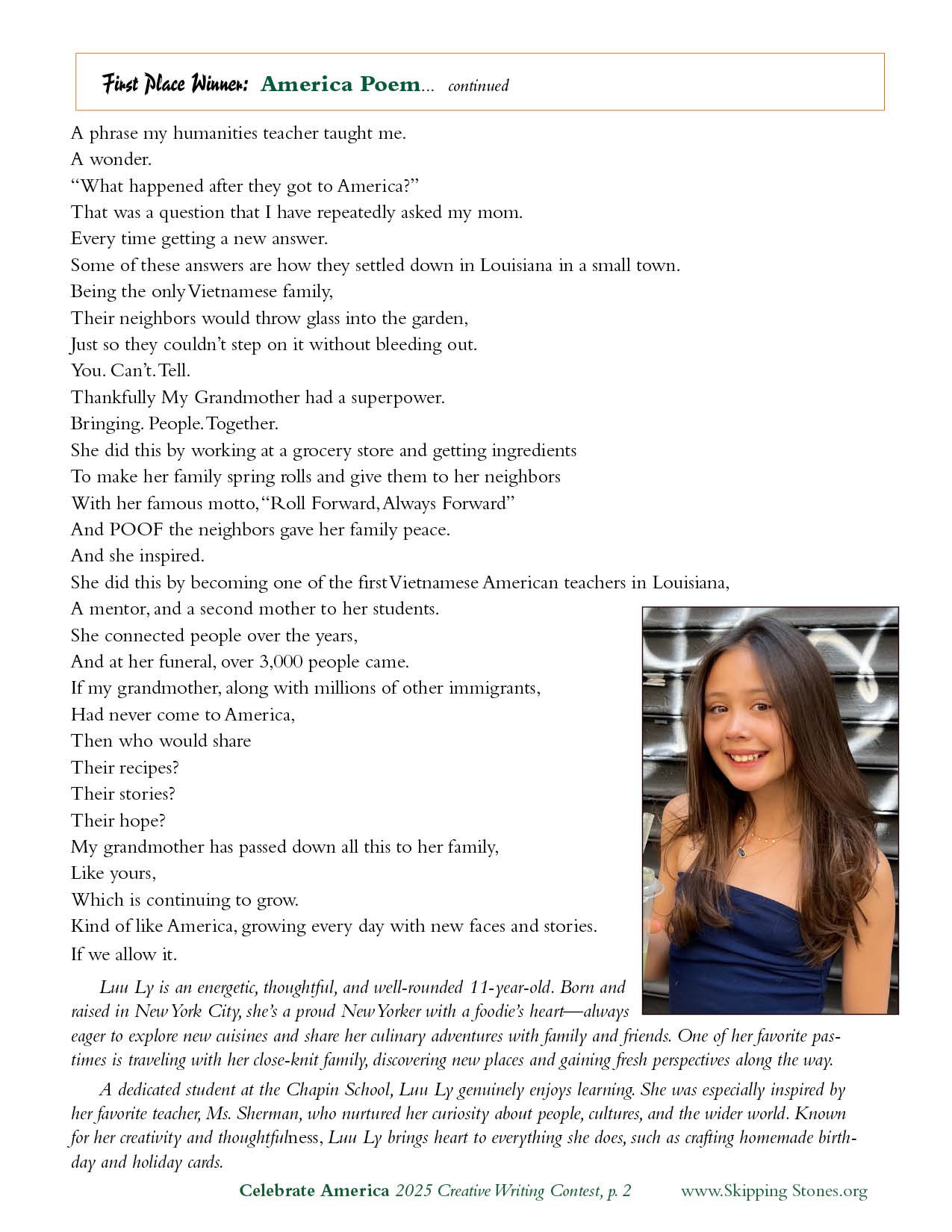
The Celebrate America Creative Writing Contest winners for 2026 have just been announced. The winning entries will be also published in our next Issue (to be available in July). The award winners will be recognized at the Immigration Impact Awards ceremony in San Diego, California being organized by the American Immigration Council (AIC) and American Immigration Lawyers Association (AILA) on June 19th evening. We are pleased to share with you the three winning entries below. (You can also download the file by clicking here):


Celebrate America Creative Writing Contest
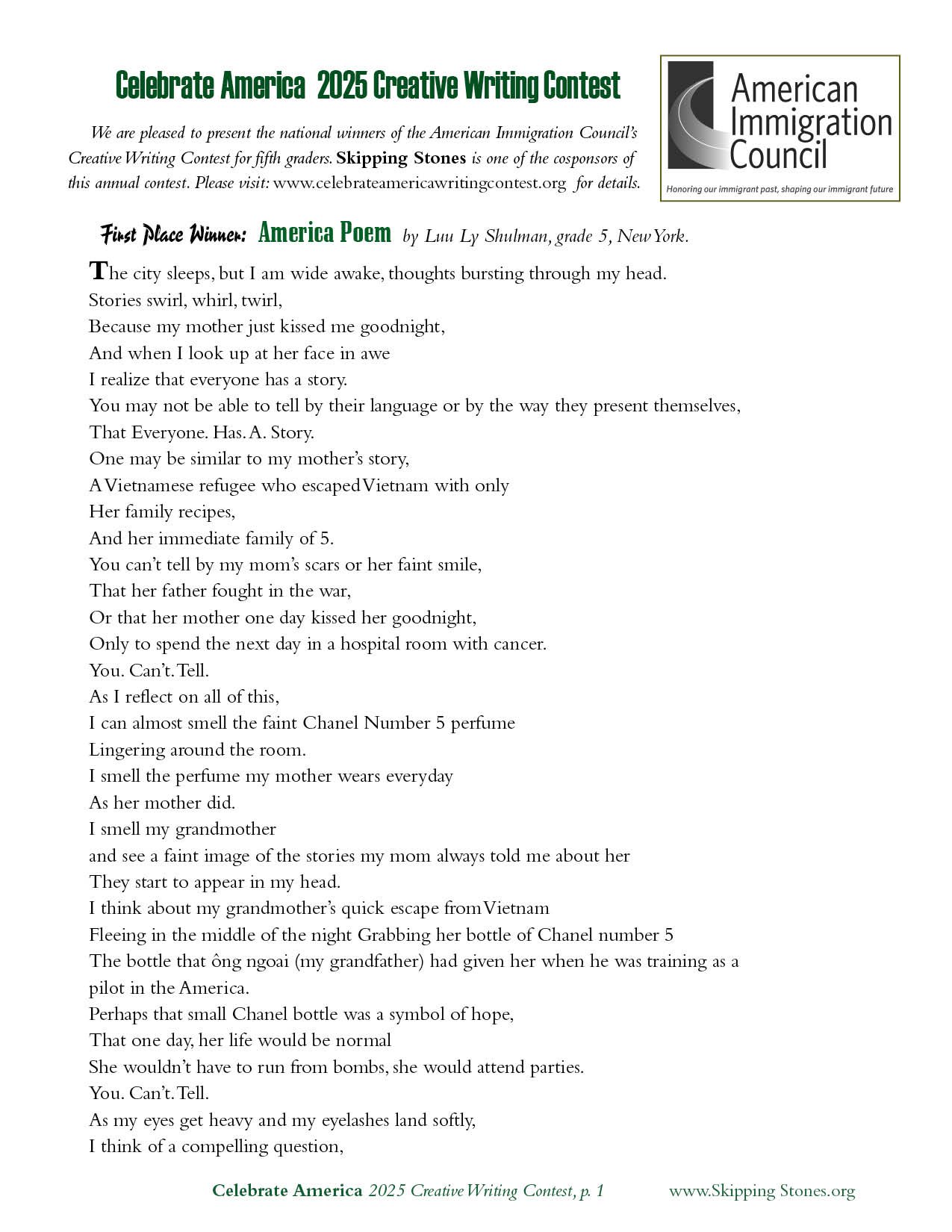
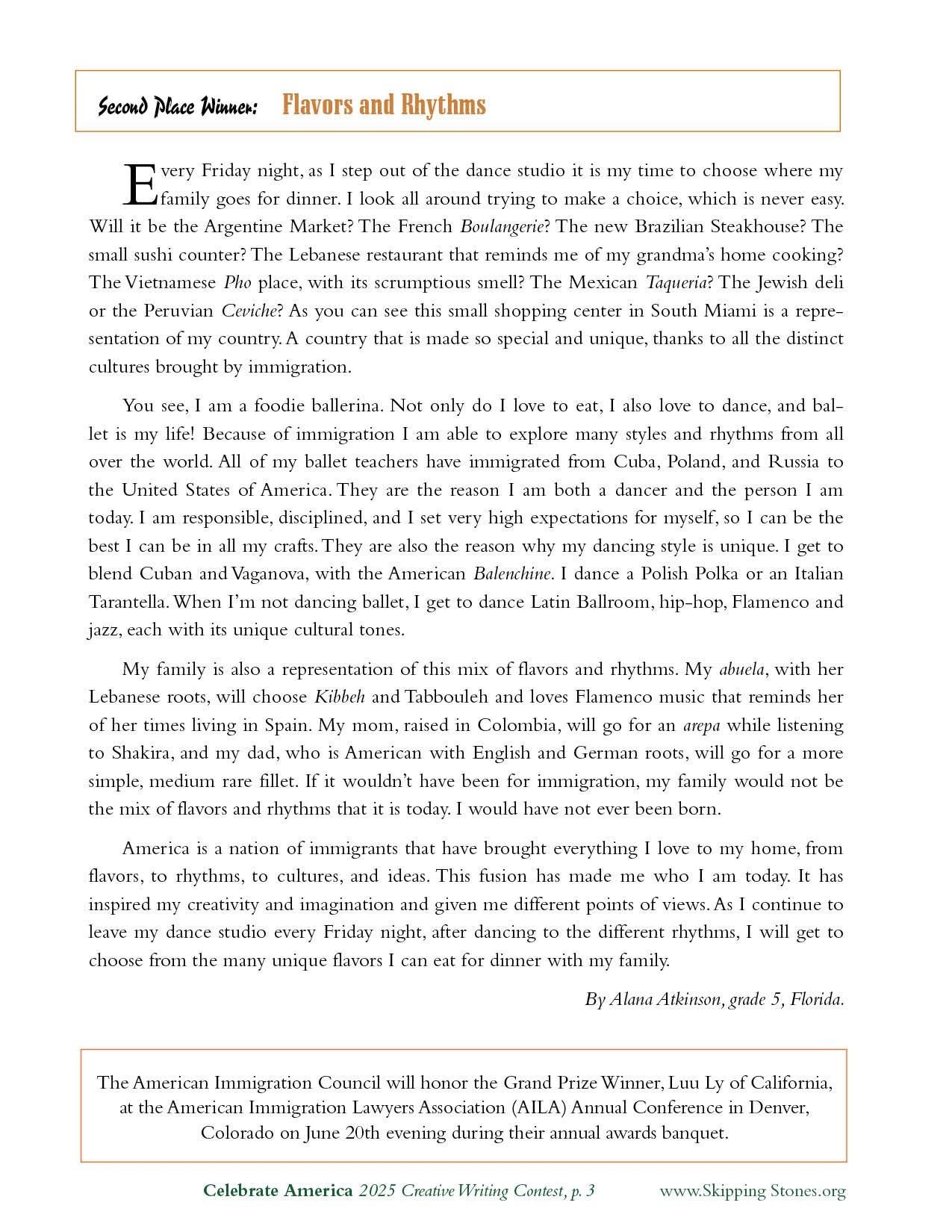
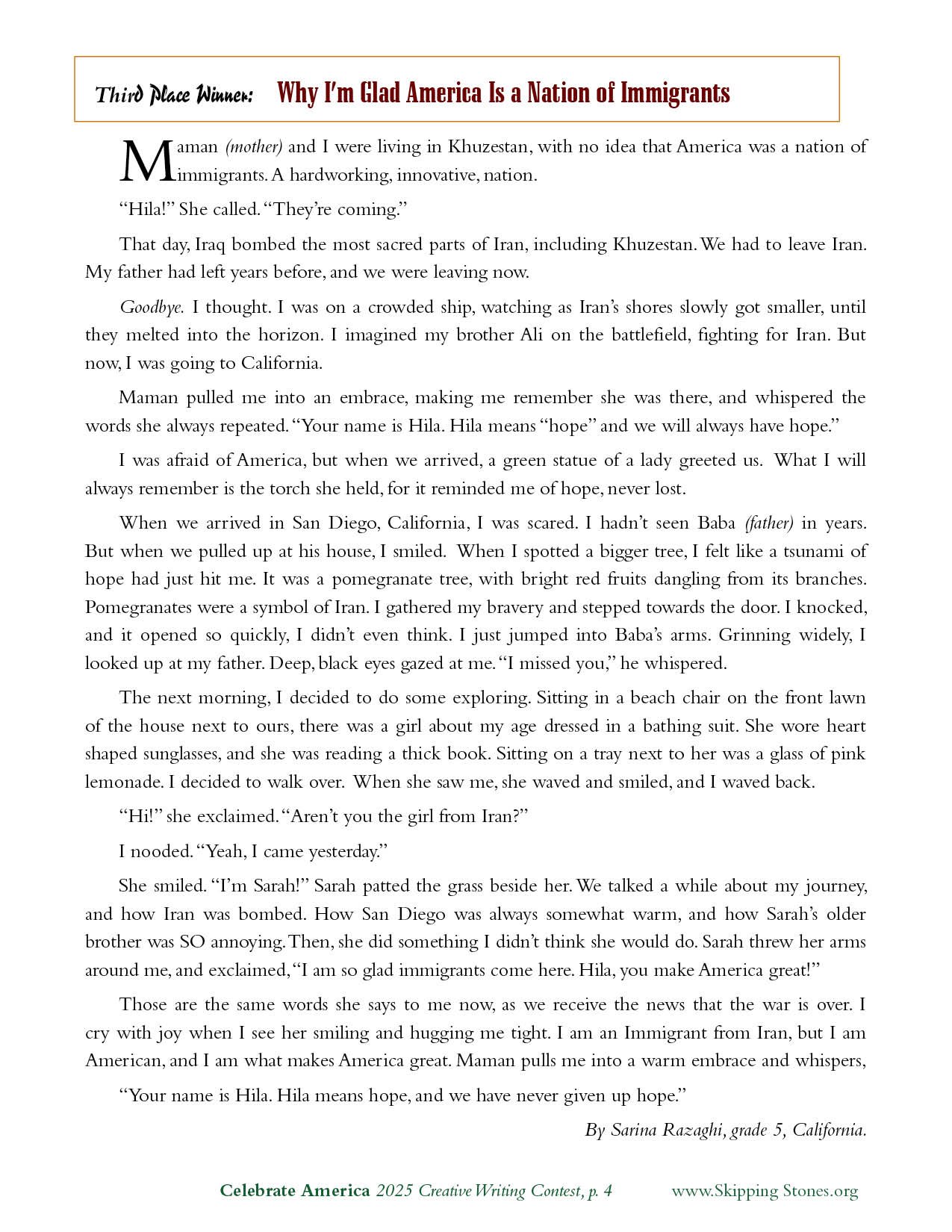
The Celebrate America Creative Writing Contest winners for 2025 have just been announced. The winning entries will be also published in our Awards Issue (to be available in late August). The award winners will be recognized at the Immigration Impact Awards ceremony in Denver, Colorado being organized by the American Immigration Council (AIC) and American Immigration Lawyers Association (AILA) on June 20th evening. We are pleased to share with you the three winning entries below. (You can also download the file by clicking here):


The 2024 Winners were announced on June 14th, 2024. They are:
First Place Winner: Stories of Us
I sit
By the windowsill
Gazing outside.
Down, on the street, so many heads,
Each is unique.
Amidst the traffic and frantic honking,
I sense the presence of
Millions of others,
Just like me.
I contemplate
The journeys. Each of us—All of us have a story.
When mothers and fathers
Ventured far across the world,
Their sense of adventure leads
Them in search of a new life.
Then I think
About all the diverse people,
And a myriad of languages,
Some foreign to one, but familiar to another.
When I open my window,
I hear those languages harmonizing,
Merging together to form a chorus.
But not just any choir.
The symphony of every single person’s story,
A song where every note counts.
I think about the stories
That father would tell me.
About my father’s mother and
His migratory voyage.
My father’s trip to America,
With only 300 dollars in his suitcase,
And a brain.
I ponder about each and every one
of the people in my neighborhood
And I wonder
Why Father would be willing
To relinquish everything
To speak in a foreign tongue.
I think about his pride
In having dual nationalities.
About being able to keep his
traditions close to heart,
and embracing a new part of himself.
American.
Then my thoughts drift to school.
All of the different students,
Each of us with our own stories.
The accounts of our ancestors,
And all that they sacrificed.
For us.
For each and every one of us,
To be here.
At this moment.
Right now.
To be present,
Someone had to work hard.
Someone had to shed tears of exhaustion,
Leaving behind familiar joy and wonder,
Leaving behind family and friends,
To create new memories and stories
In one country,
Forming one grand story.
But this story
Isn’t just any story.
It is the story of us.
The U. S.
The story of the United States of America.
—Angela Du, grade 5, New York.
Second Place: Sugar and Milk
I wake up to the sounds of unfamiliar voices in different languages. I raise the blinds and look out the window. I see people wearing bright clothes and intricate patterns. They stand out against the dull brick apartment building, like fall leaves against a gray sky. My mom comes in and abruptly says, “Don’t bother with them. We were here first.” I sit silently on my bed pondering about what she said.
Weeks pass. Curious, I go over to their apartment building and find a girl watering a tomato plant. I shyly say, “Hi. I’m from the apartment across the street. My name is Sula.” She quietly responds, “My name is Aminah.” She reaches towards the tomato plant and offers a tomato. I smile and put it in my pocket. Aminah waves goodbye and runs inside.
I run back home to give the tomato to my mom. She says, “Thank you,” and takes a bite. “This is the best tomato I’ve ever had. Where did you get this?” I hesitated a bit, then I said, “From Aminah.” “Who is Aminah?” She asks. Anxiously I say, “The new kid from across the street.” Before my Mom can say anything, I run upstairs.
Aminah and I start playing together over the summer. I think Mom is still unsure of Aminah and her family.
Tonight I wake up to loud sounds. I am scared. Mom comes running into my room and we run to the basement. The next morning, my mom says that there is a war going on and the safest place for us is right across the border in our neighboring country. We pack our clothes and hurry into a truck packed full of people. As we settle down, I see Aminah and her family in the corner. After a long and tough ride, we end up in a camp full of tents.
Mom and I are going from place to place in search of food and a job. A week later Mom finds a job at a small bakery owned by a family. The job doesn’t pay a lot, but enough to get food for both of us. Later that month, the family invites us for dinner at their house. It is a small house with two rooms and seven kids. I am eager to have a proper meal. My Mom thanks them for sharing the food they have, especially when we come from a different country. Then the host shares a Parsi legend that she had heard from her elders. She begins,
“In the seventh century, when Parsis emigrated to India, they were brought before local ruler, Rana, who presented them with a vessel “brimful” of milk to signify that the surrounding lands could not possibly accommodate any more people. The Parsi head responded by slipping some sugar into the milk to signify how the strangers would enrich the local community and dissolve into life like sugar dissolves in the milk, sweetening the society but not unsettling it.”
Mom bursts into tears.
—Ananya Siddabathuni, grade 5, Minnesota.
Third Place: I See America
Through crashing waves and rocking ships,
I carry big wishes and high hopes for this new nation.
I see America, welcoming me with arms wide open,
Filling me with faith and showing me appreciation.
Leaving the green, white, and saffron flag waving in the breeze,
The concrete roof that once was over my head.
Still holding onto my traditions and beliefs,
While adapting to a different culture instead.
I am welcomed by classmates,
Welcomed by neighbors and teachers.
I soon feel connected with my community,
Regardless of my different nationality and different facial features.
When I get pushed down from inequity,
I get back up and stand strong.
I see America as a place of opportunity,
A place of liberty, and a place where nobody’s background
is wrong.
I will carry on our vows, generation to generation,
Longing for our customs to carry on, and never fade.
I hope that the new ages to come will learn that our heritage is something to be proud of,
And realize the righteous impact on America that
we immigrants have made.
For I am an immigrant from over the seas,
Proud of my heritage and values, I hold near and dear.
I am holder of two nationalities, first generation to see America,
And I hope to spread the joy of our culture here.
—Caroline Keslinke, grade 5, Illinois.
The 2025 Creative Writing Contest
The American Immigration Lawyers Association holds this annual contest to challenge fifth graders across the country to reflect on and write about one of two themes: “Why I Am Glad America Is a Nation of Immigrants” or “What Does it Mean to be a Welcoming Nation?” Visit: www.celebrateamericawritingcontest.org
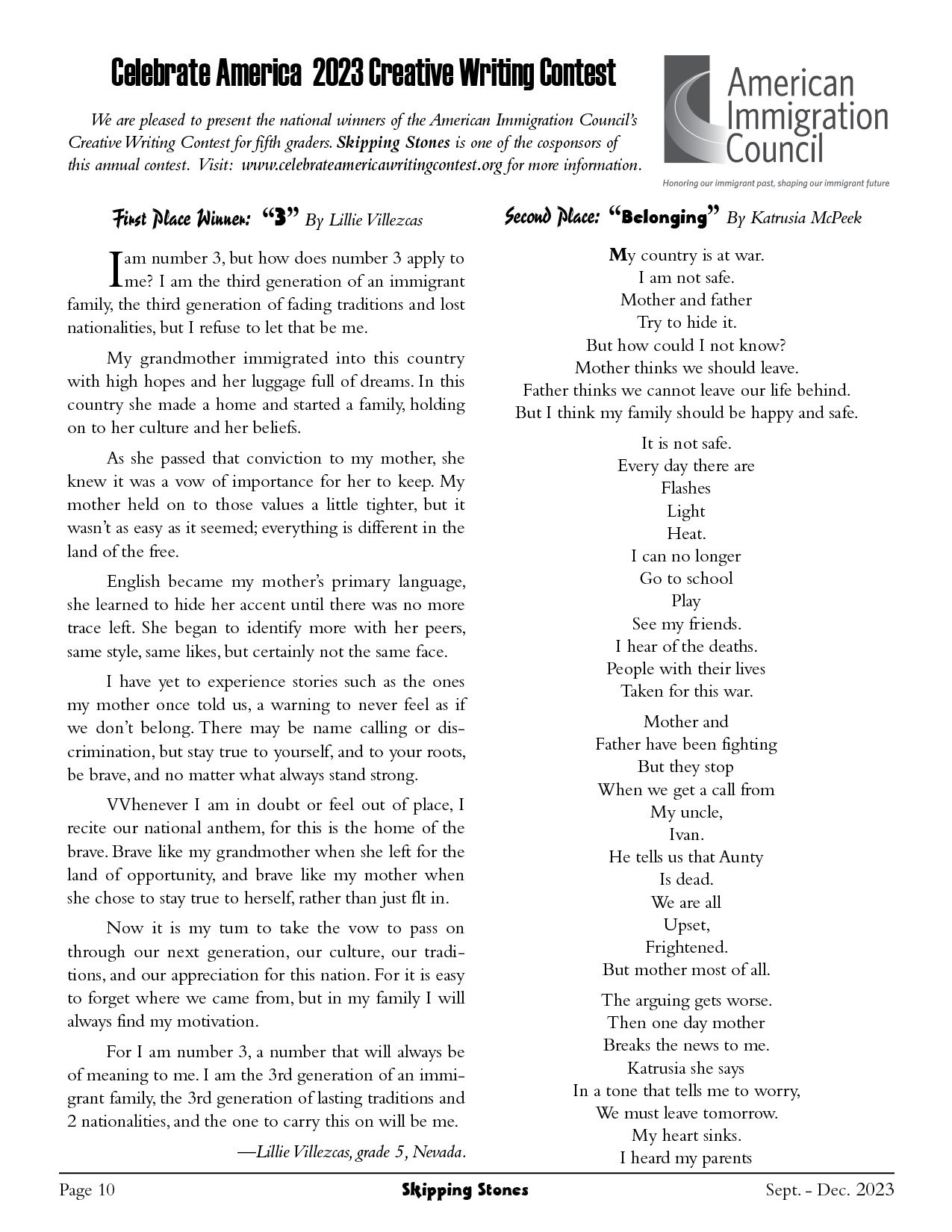
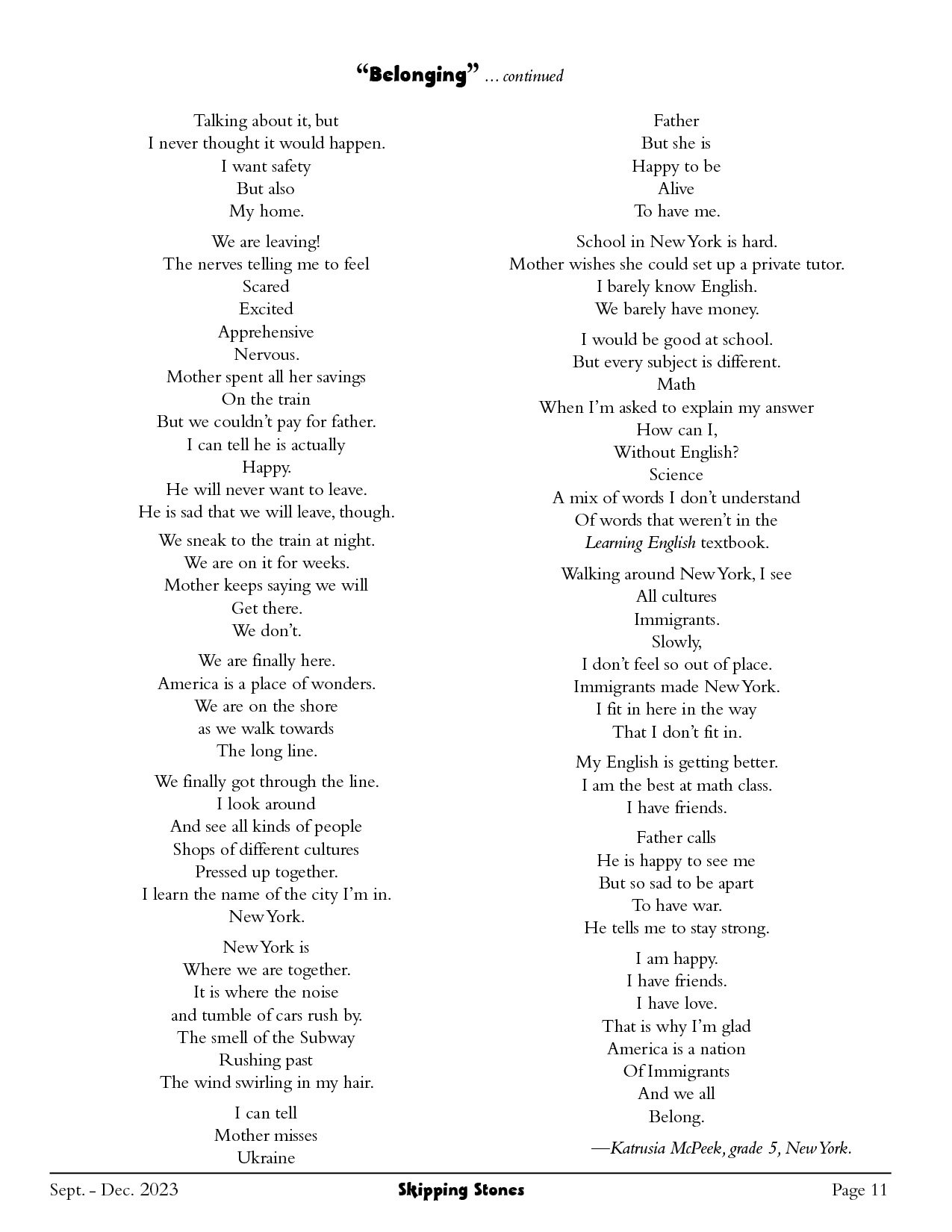
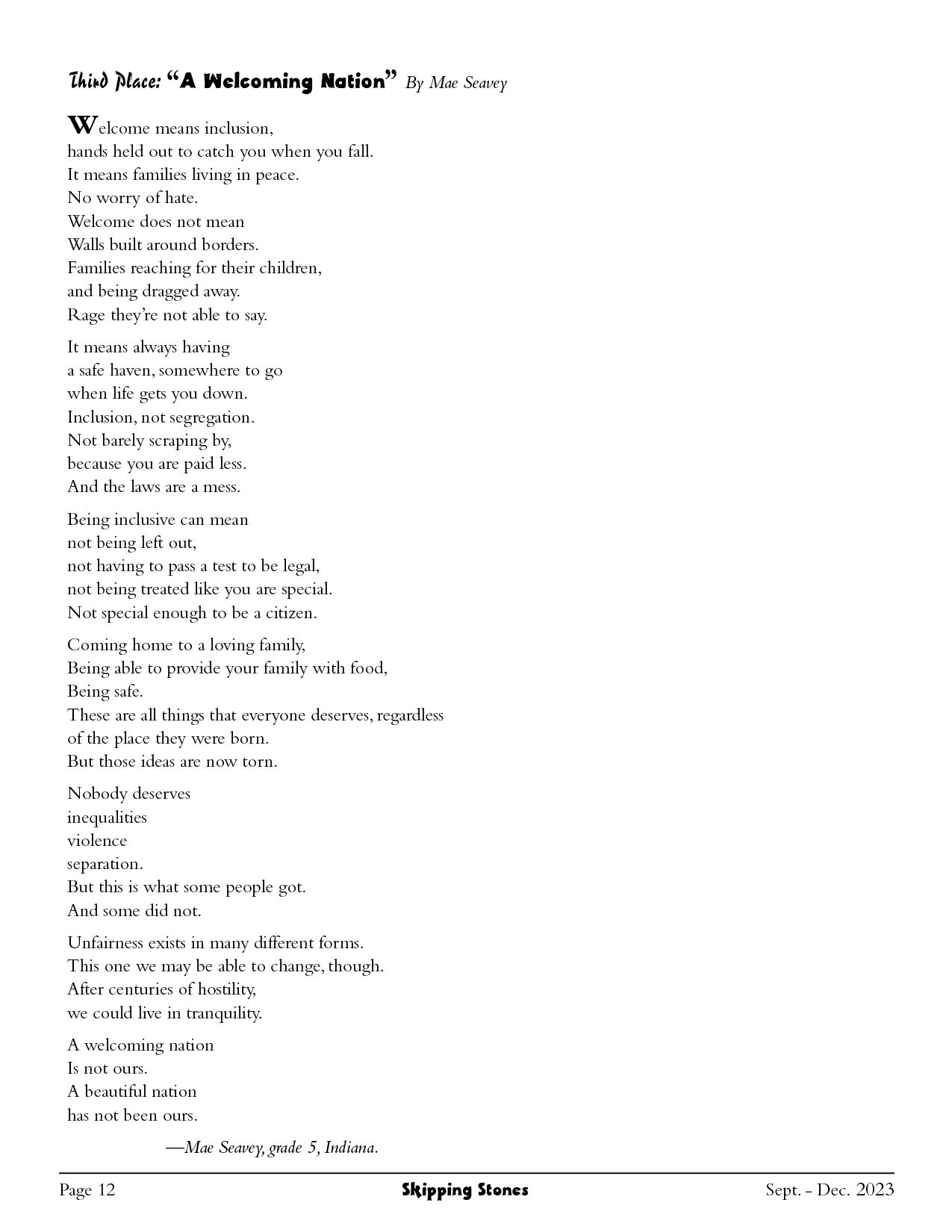
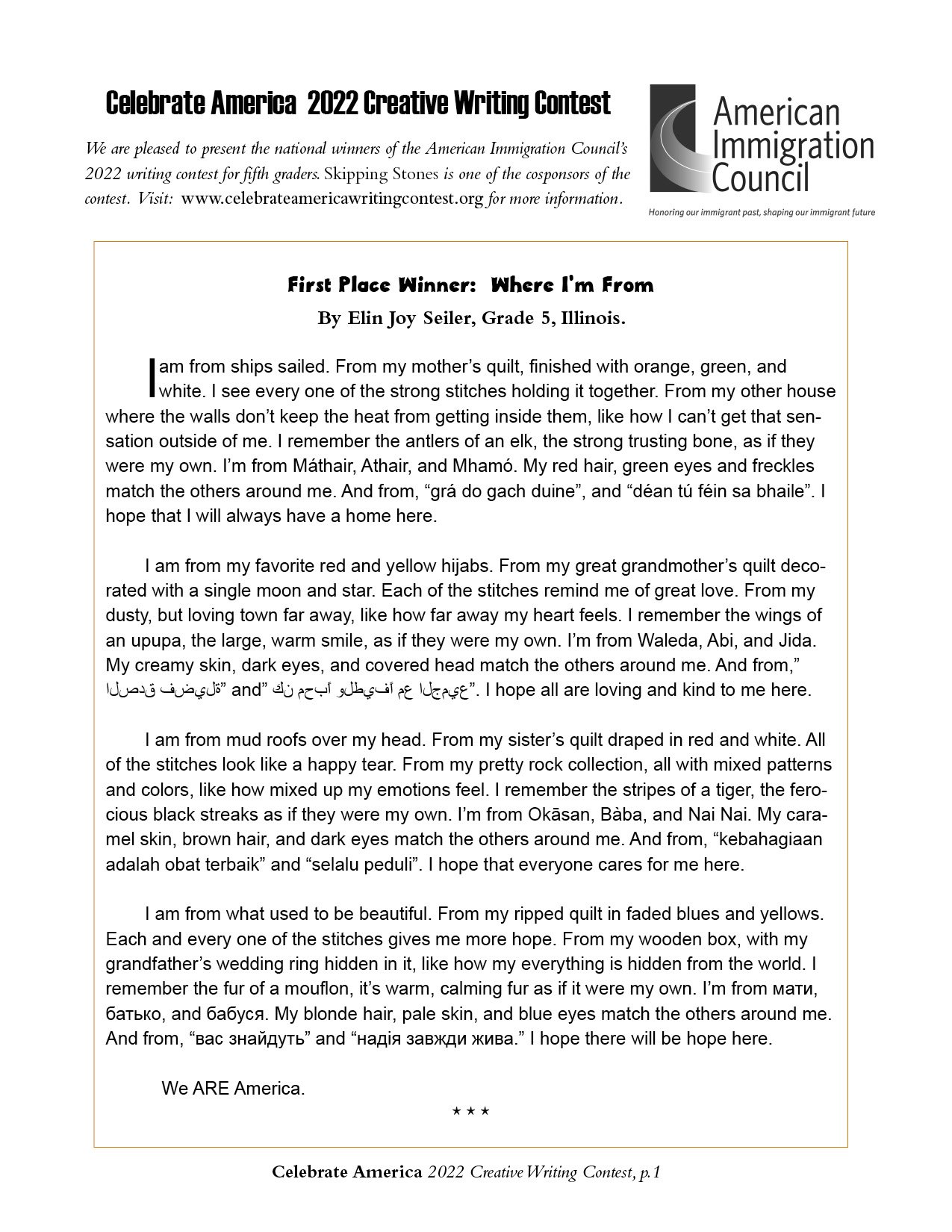
The Celebrate America Creative Writing Contest winners for 2023 were announced last week. They will be also published in our Awards Issue. You can download the three winning entries here.
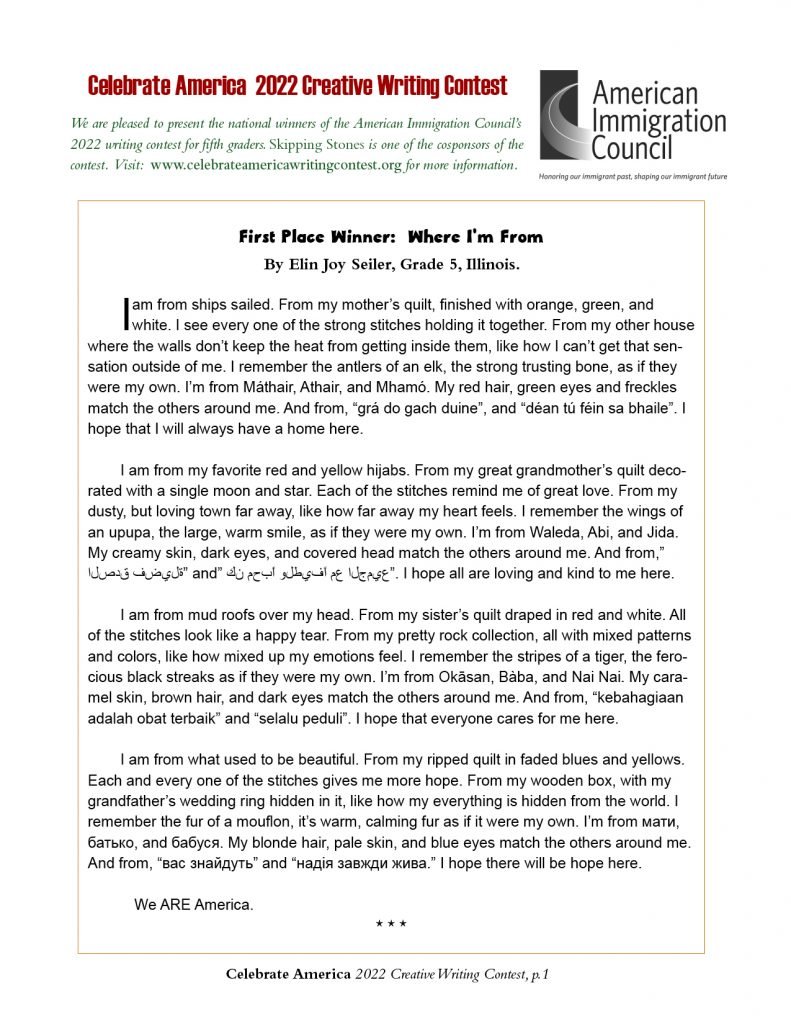
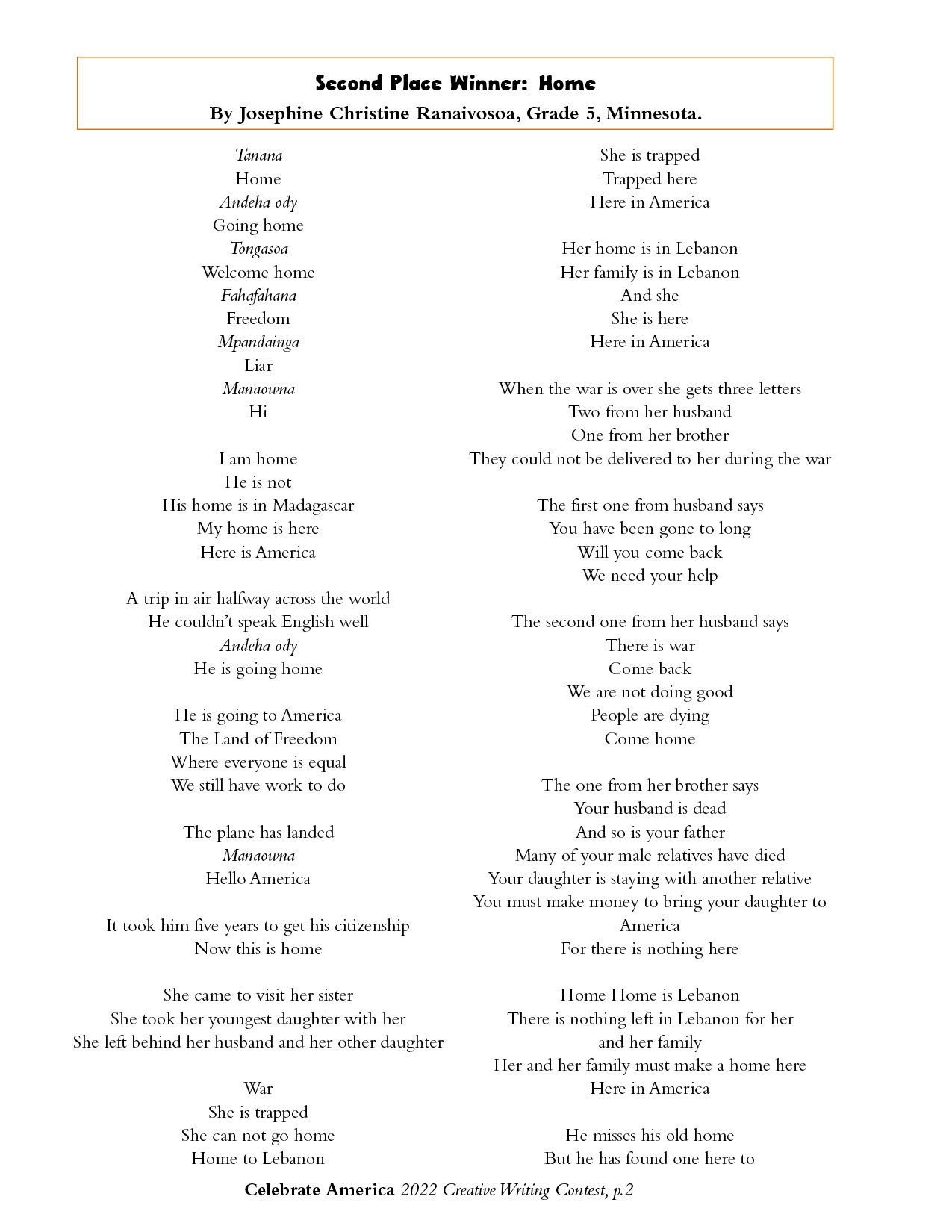
The Celebrate America Creative Writing Contest winners for 2022 have been published in our Awards Issue. You can download the winning entries here.

The 2022 Young Poet Awards
The 2022 Young Poet Awards was organized by Camille S. Campbell in partnership with us. A teen author herself, Camille knows the importance of encouraging young writers through showcasing their work. The contest encouraged youth to write poems and empowered them to express themselves through the visual arts. After seeing the impact of her book, Her Poems: Women Poets Who Changed the World, Camille felt inspired to give back to her local community and throughout the country by hosting the Young Poet Awards contest.
We’re very grateful to all students (and also their teachers and parents) who entered their creative works. Our heartfelt congratulations to the winners of the contest this year: Carina Araujo (4th grade winner) and Nova Macknik-Conde (5th grade winner). The two Young Poets will receive a cash prize, Skipping Stones Magazine subscription and recent issues, signed copies of Camille’s book, and four books donated by Skipping Stones Magazine.
4th Grade Winner: Carina Araujo, Maryland.
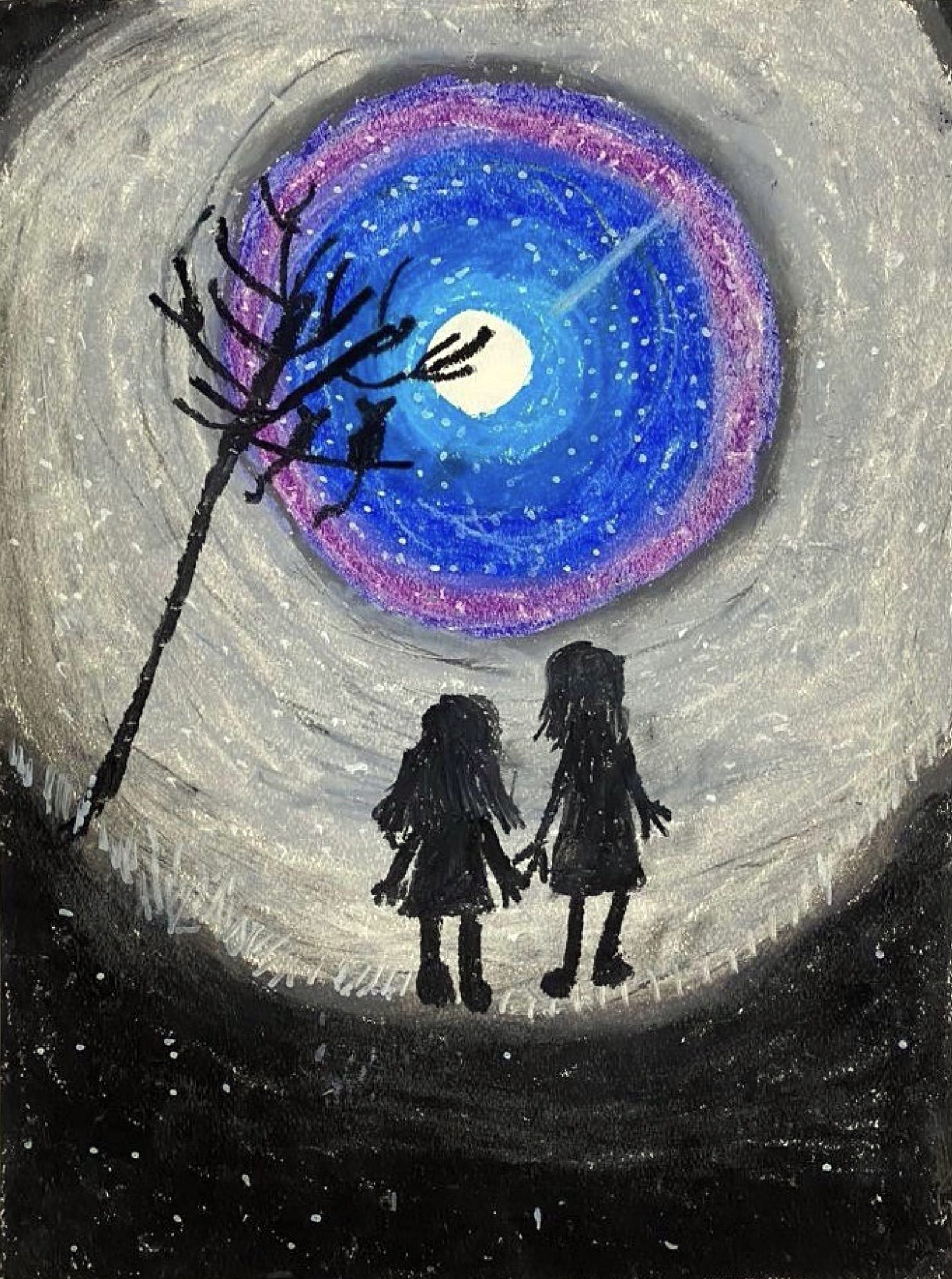
My Love for my Mom
Art and poem by Carina Araujo, grade 4, Maryland.
My love for you is bigger than the sky
You and me in this beautiful warm night
Staring at the moonlight
Together, you and me
Looking at the big blue bright sky
There are infinite stars above us
Shining in the sky
Holding hands together we stand
Peace all around
In our land
Carina Araujo, grade 4, Maryland (above).
5th Grade Winner: Nova Macknik-Conde, New York.
Winter In My Bed
Glittering white powder covers my home like a frosted cake
The silent fall of snow lulls me to sleep
Icicles lining the roof
The chance of snowmen when I wake up
Cold harsh weather surrounds my home
But it cannot penetrate the warm soft blankets that cover me
Like a hatchling in her nest
Winter in my bed
A full moon glows lighting up my face
My family sleeping warm
Through the frosty night
Me, listening to the sounds of night and family
Slowly drifting to sleep
In my snuggly, lovely, cuddly bed
My pen lingers over the page,
Cobalt ink waiting in the depths,
I imagine, and I ponder, and I muse.
But still the thief steals my well of words,
Cheats me of my cascading thoughts,
And takes my waterfalls of compositions.
The vague scent of ink on a fresh sheet of paper,
The articulation of inspiration,
The quiet bliss of the flowing verse.
The thief deprives me of the joy of invention,
The dexterity of novels, poems, and short stories,
And the rushing streams of world building.
So idea-less
That the only method of elusion
Is to pen
The meaningless things that enter my mind,
Or write about my writer’s block alone.
By Nova Macknik-Conde, grade 5, New York.
The Sweetest Treat
The Sweetest Treat
By Jacob Lockett, emerging author, Pennsylvania.
Roshni finished making her costume at five o’clock on Halloween night. Happy with her work, she ran downstairs.
“What do you think, Mama?” she asked. “I’m a khargosh.”
Mama turned from the stove, where she was cooking. “Wow!” she said. “You’re such a cute little bunny!”
Roshni giggled. “A cute little bunny that can jump really high!” she said, hopping around the room on spring shoes she had made herself.
Mama handed Roshni a pumpkin-shaped bucket. “Ready to trick-or-treat at school tonight?”
“Yep,” Roshni said. “I love getting candy!”
“Remember, you have time to go trick-or-treating at just one or two houses before going to school,” Mama said. “And I want you back by dinner.”
Roshni nodded excitedly.
Mama hugged her. “Get hopping. Halloween comes only once a year!”
With a spring in her step, Roshni bounced out the door and into the cool night air, her large bunny ears flopping this way and that. Kids ran around the street, dressed in fun costumes.
As Roshni hopped to school, she looked around her neighborhood, deciding which house to go trick-or-treating. A house with a ramp and a brightly lit pumpkin by the door caught her eyes. She remembered Mama telling her that a new family had moved in recently.
Curious to see what her new neighbors were like, she went over to the house and rang the bell.
The door opened.
“Trick or treat!” Roshni shouted.
A boy in a wheelchair appeared, a candy bowl sitting in his lap.
Roshni recognized him. He was DeAndre Lewis, the new kid at her school. He was in a different grade than Roshni, but she sometimes saw him in the hallway. He always seemed… lonely.
She waved. “Do you remember me from school? I’m Roshni.”
“Sure. I do remember,” DeAndre said, smiling. He rummaged around in the bowl, giving Roshni a Nougat Rocket Bar. “Super costume!”
Roshni blushed. “Thanks! I’m a khargosh—that’s the Hindi word for bunny.”
“That’s really cool,” he said.
“So, are you trick-or-treating?” Roshni asked.
DeAndre shook his head sadly. “My mom’s too sick with a cold to take me out tonight.”
Roshni gasped. She couldn’t imagine not going trick-or-treating. She looked at DeAndre’s sad face, and Mama’s words came back to her: Halloween comes only once a year…
“I can take you trick-or-treating,” she offered.
DeAndre’s eyes shone with hope. “Really? That would be wonderful! I’ll go ask Mom.”
DeAndre returned to the door with Mrs. Lewis. “You must be Roshni,” she said, sniffling. “Your mother told me so much about you at the store last week. DeAndre said you want to take him trick-or-treating with you.”
Roshni explained about their school’s Trick-or-Treat Fair and how there would be lots of treats, games, and contests for DeAndre to enjoy.
“Sounds like a good time!” Mrs. Lewis said. She turned to DeAndre. “Get your costume, honey. You can go have some Halloween fun with Roshni tonight.”
DeAndre’s face lit up just like the jack-o’-lantern that sat outside his door. He turned around and disappeared. He soon came outside wearing a superhero’s mask and a long cape.
“DeAndre, I want you back by seven,” Mrs. Lewis said. “Now, go have fun.”
The kharagosh and the superhero went off into the moonlit night. In no time at all, they arrived outside the school, which was covered with Halloween decorations. After DeAndre wheeled himself up the long entrance ramp, he and Roshni entered the cafeteria to the sound of spooky music and laughter.
They went around to different booths, collecting delicious treats from their teachers.
As Mrs. Garcia handed the kids each a pack of Licorice Lassos, DeAndre asked Roshni, “What are your favorite sweets?”
“I have so many!” she replied. “But I think my favorite would have to be galub jamuns. I make them with Mama for special occasions. They’re kinda like spongy—”
“Donut holes!” DeAndre finished.
“How did you know?” Roshni asked, surprised.
“I had one during Multicultural Day at my old school,” DeAndre explained. “It was one of the best things I’ve ever tasted. I make them with my mom now, too!”
They laughed, high-fiving.
After they were done trick-or-treating, Roshni entered the costume contest. After Roshni and the other contestants had displayed their outfits for the judges, Principal Jackson cleared his throat near the microphone. “And, the first prize goes to Roshni Kaur with her homemade bunny costume! Come on up!”
“Way to go!” DeAndre cheered loudly from the audience as Roshni hopped on stage to receive her blue ribbon.
DeAndre pointed at the haunted house in the corner of the cafeteria. “Let’s go in there.”
Roshni shivered. “I don’t know…”
“Have no fear!” DeAndre shouted, striking a pose. “I’ll protect you!”
“Ok,” Roshni said. “As long as you protect me, I won’t get scared.”
They went into the haunted house. Kids dressed as monsters jumped out from the shadows to try to frighten them. But every time they did, DeAndre would boom, “Back, you villains!” in his superhero voice. Roshni couldn’t stop smiling. Because of DeAndre, she didn’t get scared, not even once.
After they bobbed for apples, they sat at the snack table and drank pumpkin punch and talked about their favorite scary movies. All of Roshni’s favorites were DeAndre’s favorites, too!
Soon, Roshni checked her watch. She felt her heart drop. “It’s almost seven,” she said glumly. “Time for us to go home.”
“Aw,” DeAndre moaned, shaking his head sadly. “Do we have to?”
DeAndre guided his wheelchair down the school’s ramp and onto the sidewalk. He looked up at Roshni. “Thanks for taking me. I had a blast!”
“Sure,” she replied, swinging her bucket of candy as she hopped. “Halloween comes only once a year!”
“Do you… want to trade candy tomorrow?” he asked.
“Yes, we can do it at my house,” Roshni replied. “You can help me make gulab jamuns when we’re done at my home. Mama would love it.”
DeAndre giggled. “Great. But… don’t you only make gulab jamuns for special occasions?”
Roshni blushed. “I do,” she replied. “But you’re the special occasion.”
Now DeAndre was blushing, too!
On that Halloween night, Roshni had collected many sweet treats. But the sweetest one she had received was a new friend, DeAndre.
By Jacob Lockett, emerging author, Pennsylvania.

Nature Is This and This Is I
I am this and this is nature.
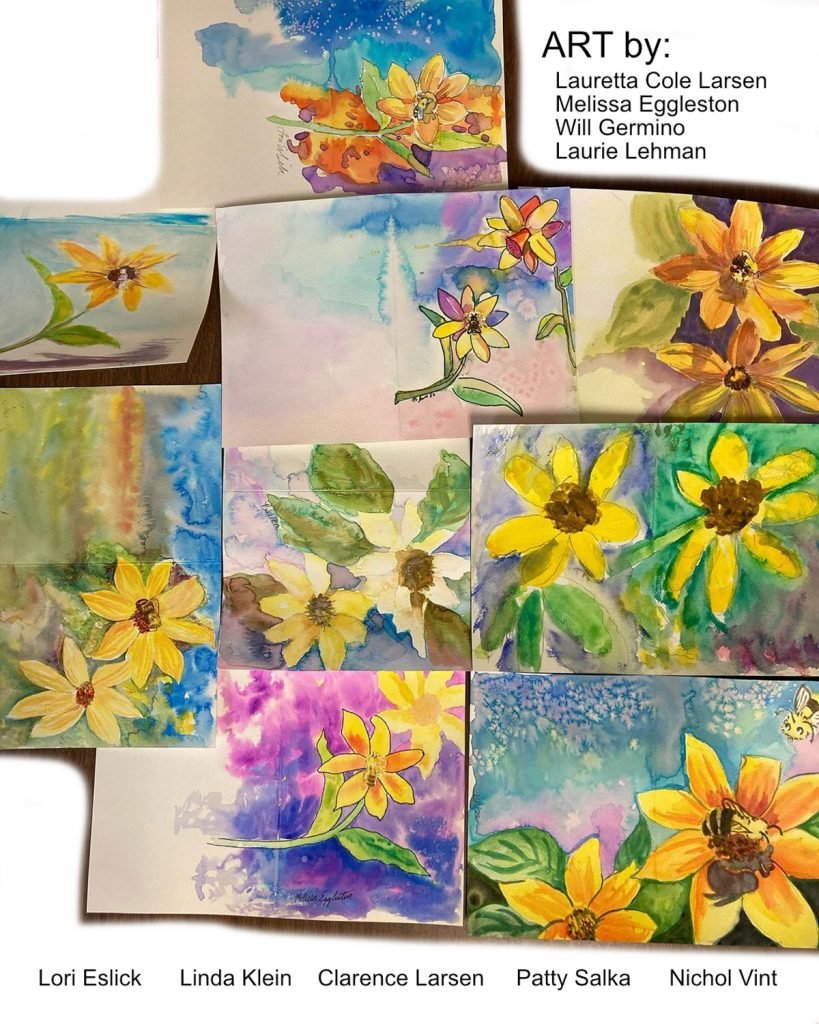
Sunflowers and Thoughts of Ukraine

“Our sunflowers were done as our way of warming up to paint, but so much more: we painted and in our quiet moments of feeling the paint to paper, the qualities of our painting we silently thought of others in our world facing difficulties of war. The sunniness of our flowers and the blue sky behind them resembling the Ukraine flag, and how this is a hopeful sign to all. Especially a room of artists quietly painting and meditating while doing so.”
—Lori Eslick, Children’s Book Illustrator/Author. www.EslickART.com. The art was done by participants in a “Children’s Book Illustration” class conducted this month by Ms. Eslick in Lowell, Michigan.
Letter to the Editor: On Mental Health
Letter to the Editor
Re: The Talk: Bridging the Gap Between Parents and Teens – Skipping Stones
Mental health is a real issue that a lot of people talk about and donate money to. If nothing is done to solve the problem; a minor problem can turn into a big one.
Here is what we can do: Be proactive, and catch teens just before they go into a deep stage of depression. Check in on them every so often. Parents can be more aware of their child’s emotions, and they can have intimate one-on-one sessions with them. Acceptance is the key to the solution.
In my experience, my parents didn’t pay attention to mental health. They cared about success, and behavior (what parents should be caring about, but should not be so concerned with only that). Parents need to empathize with the children, because they have gone through the same things.
Kids need an outlet like a sport such as soccer, basketball, or baseball; a creative hobby like painting, drawing, theater, writing, reading. They need someone to talk to; to express their feelings.
Let’s hope the new generation will grow up understanding the importance of mental health and what it can do to a person, so that they can treat their own kids with acceptance.
—Mahima Pai, age 15, New Jersey.
Truly
“Truly”
By Isabelle Tee, age 15, New Jersey.
“She doesn’t want you to join us,” she said, “you are too loud.”
For most of my elementary school years, I’ve never had an actual friend that I’ve felt comfortable enough to just be myself. Many of the people I’ve talked to were mainly acquaintances so that I didn’t look like a loner. Because when you’re on a field filled with kids who don’t think before they talk, the last thing you want to be is alone.
So I tried to befriend a group of girls that I’ve only distantly known from second grade. Whenever they talked to me, I just nodded. I had no clue what they were actually talking about. During recess, I just follow along and pretend to be the bad guy when we play games. During class, I’m the one giving them answers for worksheets. And during lunch? That’s another story.
My mom packed me fried rice that day, which—in my opinion—was better than the soggy dino nuggets. I sat down at the lunch table with my “friends” and ate my food. One girl starts to sniff the air and looks around. Then she goes, “What’s that smell?” She looks at me. All I could do at that moment was put on a fake smile. How can you be friends with someone who can’t accept who you are?
The following day at recess, I joined the girls at the corner of the field. Only two of the girls were standing there. I asked them what game they were playing, and they awkwardly looked at me back. They told me that the others didn’t want to play with me anymore, apparently, I was too loud for them.
I pleaded with them, promising I wouldn’t scream loudly and lower my voice. They looked at me and told me to wait. One of them ran over to the other girls and whispered something into their ears. When she came back, she allowed me into the group again. I kept my word and didn’t speak much. I didn’t want to go back home crying to my mom again.
I realized then that, from the beginning, they never truly accepted me. They were never true friends.
By Isabelle Tee, age 15, Asian American, New Jersey.
Discrimination Against Asians in the United States
By Fanny Wong, Chinese American author, New York.
In May, we celebrate the resilience, legacy and culture of Asians, Native Hawaiian, and Pacific Islanders in the United States. As you may know, the last few years have been very difficult for Asian Americans. We were aghast at the March 2021 mass murder of eight people in Atlanta, Georgia. Six of the victims were Korean women. Asian Americans were already targeted for being “Asian” since the beginning of Covid-19 pandemic. Between March 2020 and February 2021, almost 4,000 anti-Asian hate incidents were reported throughout the country. Verbal abuse and physical attacks were recorded on surveillance cameras. Violence could be spitting, hitting, and shoving that led to injuries. In February 2021, an 84-year-old Thai man died after he was shoved to the ground in Oakland’s Chinatown in California.
Since the arrival of Chinese immigrants in the 1850s, the United States has had a long history of viewing Asians as “The Other.” The early immigrants worked in gold mines and helped build railroads in the American West. They sent their hard-earned money to China to support their families, and repaid loans of their passage to America. They had little choice but to work for whatever wages they could. American laborers generally could bargain for higher wages, but they feared being squeezed out of their jobs by the Chinese immigrants.
As with most immigrants, the Chinese settled in their own neighborhoods. The stories of crime and decadence in Chinatowns, some of which were true, so alarmed the public that the Chinese were called the Yellow Peril.
The Chinese Massacre of 1871 was the first in a series of riots and killings in California. Los Angeles was a small town then. The 200 Chinese men who lived there were farmers, laundry workers, laborers and vegetable vendors. This small population lived in a segregated area called Calles de los Negros, a very rough neighborhood where no one wanted to live. That was where the Chinese could afford to live.
On October 24, 1871, a dispute between two Chinese factions led to the accidental killing of a white bystander. People ran around saying the Chinese were killing White people. A mob of 500 white men descended on Chinatown killing 18, some of them by hanging. At the time, Chinese people were not permitted to testify against white people. Even so, a few of the perpetrators were tried and convicted. But they were released on a technicality. No one served a prison sentence, no one was held accountable.
In 1885, Chinese miners in Rock Spring, Wyoming, did not join a strike by white miners. This enraged the white miners so much that they stormed Chinatown, killing 28 Asians and injuring 15 more. Again, no one was held accountable. When news of the massacre spread, many people condemned the violence, but it also resulted in Chinese immigrants being driven away from some communities.
By then, Congress had already passed the Chinese Exclusion Act of 1882, which suspended the immigration of Chinese immigrants for ten years. This Act was the first in American history to place broad restrictions on immigration based on nationality. In 1892, Congress voted to renew the exclusion for another ten years, expanding the restriction to cover Hawaii and the Philippines as well. This Act was not repealed until the year 1943, when a law passed set a quota of 105 per year. The Immigration and Nationality Act of 1965 finally abolished the National Origins Formula.
During WWII, some 120,000 Japanese Americans were sent to ten Internment Camps (see my recent article on this topic) in the Western United States. German and Italian Americans were not interned, even though Germany and Italy were also fighting American soldiers in Europe.
Whenever there is economic hardship, someone becomes a scapegoat. In 1982, Vincent Chin, a 27-year-old Chinese young man, was mistaken for being Japanese. Japanese cars were selling very well, and many workers in American auto plants had lost their jobs. Vincent was bludgeoned to death by a laid-off autoworker and his stepfather, also a Detroit autoworker. His murderers never spent a day in jail. In this case as well, justice was not served. It was almost as if an Asian life was not worth anything.
But Asians, just like everyone else, are worthy. They have contributed greatly in music, performing arts, science, sports, literature, and politics as well as all other fields. Duke Kahananmoku, Hawaiian American, popularized surfing in the 1920s. Dalip Singh Saund was the first Indian American to be elected in 1956 to the House of Representatives. Yuji Ichioka, Japanese American, was a historian and civil rights advocate. Jerry Yang, Taiwanese American co-founded Yahoo. Tammy Ducksworth, Thai American, is a disabled Veteran and a senator. Sandra Oh, Korean American actress plays roles that are not stereotypes. Sunisa Lee, Hmong American gymnast, won a gold medal in the 2022 Olympics. The list goes on and on.
It is encouraging that movies made by Asians about Asians Americans are gaining popularity in the United States. The award-winning film “Minari” by Korean director Lee Isaac Chung tells the story of an American Korean family’s struggles and aspirations in rural Arkansas. Disputes between husband and wife, health issues of a child, generational differences and financial difficulties are familiar to those of white families. The more realistic Asian stories are told, the less they will be perceived as “The Other.”
In the past, Asians have survived racism by keeping their heads down. The younger generation is coming together and standing up for their parents and elders. It no longer believes that a nail that sticks out gets hammered down. ‘Head down and mouth shut’ is no longer an option. It is important to speak up about and work against injustices of racism.
Different languages as well as cultural traditions among the many different Asian communities in the nation can make it difficult for them to unite for Asian advocacy. But it is important that we unite and be active for the cause.
Let’s hope that as we celebrate the Asian American and Pacific Islander Month this May, we witness great strides being made to end racism in our nation.
By Fanny Wong, Chinese American author, New York.
El Musico
EL MUSICO
By Denisse Gonzalez-Amador, age 14, Texas.
My fingers were tired from strumming the guitar
they rested on the small table I sat at
while I ate the freshly made quesadillas
the little money I owned was put into something I loved the most,
being a musician like the ones on billboards
but I was different
I performed at restaurants that gave me breakfast, lunch, and dinner
I cherished the small things
the flowers were thrown onto the small stage where I had poured my feelings into a loving song
the walls had my name painted, to come and watch me do the thing I love most
I have sung and played all the instruments to each song
As the customers eat their food while listening to the songs I handcraft
the luminosity in their eyes push me to continue my job
It doesn’t matter if my apartment is falling apart
whether my clothes have tears and stains in them
I will continue to showcase my one true talent
This is what I am, el músico.
By Denisse Gonzalez-Amador, Texas.
Denisse adds: “I am a 14-year-old student at Meyerland Performing and Visual Arts. I’m a part of the creative writing magnet program. My cultural background is Hispanic culture, where we celebrate Quincenera (a celebration associated with turning 15 year old), Dia de los Muertos (a festival that celebrates our ancestors and loved ones that we have lost), and the Three Kings Day (The three wise men who came to see baby Jesus). I speak English and a small portion of Spanish. What is important to me is my life and family. My dreams and visions for the future are: becoming a businesswoman, a popular artist, and a poet. What inspired me to create my submission is the thought of my work being read and being published. I want people to see the work I create.”