Category Archives: Travel

Peace in Ukraine

Peace in Ukraine

Could we find a peaceful resolution to this conflict based on the Swiss model?

Recently I was on a Christian retreat in Switzerland with a group of young people. We were in a room overlooking Lake Geneva and the majestic Alps, yet everyone was worried about war in Ukraine. One of the young people present, a Swiss woman named Anne-Marie, appeared very sad to see so much suffering in Ukraine. “Ordinary families in their thousands are losing their homes and becoming refugees,” she said.

“The Americans fought wars in Vietnam, in Iraq and in Afghanistan. What did they achieve? Nothing!” another woman, Christèle, said. “What hope is there for the Russians and the Ukrainians to find any solution by killing one another?  This is so stupid! In the end they have to find a solution by negotiation. If they are going to talk and negotiate after so much killing and so much destruction why don’t they do that before those killings and before all that suffering?” 

“This is common sense, but common sense is no longer common!” came from the back of the room. It was a man called Michael who spoke. He added: “Of course in the end they have to find common ground and some common interest through negotiations. The Ukrainians and the Russians have to live next to each other. They are neighbours. They cannot change their  geography and their location!”

Anne-Marie answered: “Ukraine is a small country living beside a nuclear-armed Russia. Therefore Ukraine should not give Russia any excuse for aggression. Ukraine could and should follow the Swiss model.”  I was intrigued by this, so I asked her what she meant. She said: “Our country is not a member of NATO. We are not in the European Union. We are not in the Eurozone. We have our own currency. Yet we are able to trade with Europe as well as with the rest of the world. Why can’t Ukrainians do the same? Our country was neutral in the first world war and the second world war. Why can’t Ukrainians remain neutral and friendly with all countries? Switzerland has no enemies. All countries are our friends! That is what I call the Swiss model.”

“But hasn’t there been a long-standing dispute between the central government of Ukraine and its Russian-speaking population of the east and the south?” I asked. “Hasn’t there been an ongoing civil war between the Ukrainian-speaking and the Russian-speaking parts of the country? How do you bring reconciliation between them?”

Anne-Marie said: “Again they need to follow the Swiss model. We have four national languages – German, French, Italian and Romansh. They are all official Swiss languages. Ukraine could make Ukrainian and Russian two equally important official languages. Linguistic diversity should be celebrated. Multiple languages bring cultural richness. In Switzerland a large proportion of administrative functions are decentralised. We have 22 self-governing cantons. Each one of them has a great deal of autonomy. Many national issues are settled by referendum. Our prime ministers or presidents are not so important. Do you know who the president or prime minister of Switzerland is?”

“No, I don’t,” I replied.

“Why should you know?” responded Anne-Marie. “This is the Swiss model. Our constitution doesn’t give a huge amount of power to the central government. We live peacefully within our country and peacefully with our neighbours. Why can’t Ukraine do the same? War is not a solution.”

“But the Ukrainians say that this is ‘Putin’s war’,” I said. “The US and European governments, as well as much of the western media, believe that this is Putin’s war. What do you say to them?”

“It takes two to tango!” Anne-Marie replied. “The Russians blame the Ukrainians, and the Ukrainians blame the Russians. We have to rise above the blame game if we want peace. Both parties need to compromise! The word ‘compromise’ is misunderstood. In fact it is a positive concept. It means ‘promising together’. When two warring sides come together, they must stand on the middle ground and find their common interest and agree together, and then it is a true compromise.”

Anne-Marie took a deep breath. After a moment’s pause, she said: “I want to see the children of Ukraine united with their parents. I want to see millions of refugees going back to their homes. I want to see the old and the sick being taken care of. War is futile. No one will win. Everyone will lose. What is the point?” 

I was impressed by Anne-Marie’s account of the Swiss achievement in creating a peaceful, multilingual and multicultural country. I thought that this could be the way to peace not only in Ukraine, but in the whole world. 

We looked out at Lake Geneva and the amazing Alps. They were totally at peace! And in their subtle ways they too were calling for peace. 
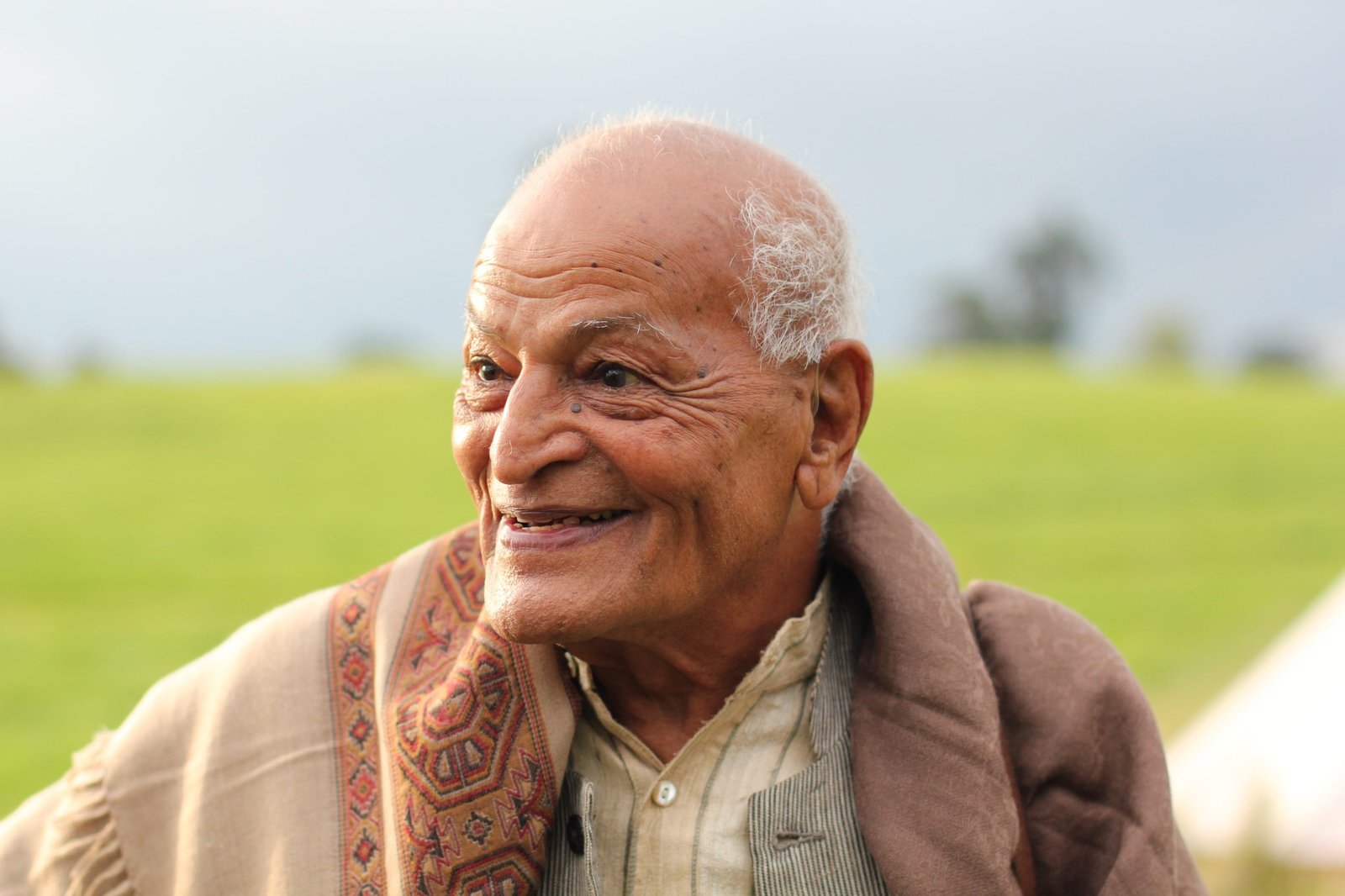
—Satish Kumar is the Editor Emeritus of Resurgence Magazine, published from United Kingdom. He is the author of Pilgrimage for Peace, available from www.resurgence.org/shop Photo of Satish Kumar by Daniel Elkan. This article has been reproduced with permission from Resurgence & Ecologist Magazine, Issue #335.
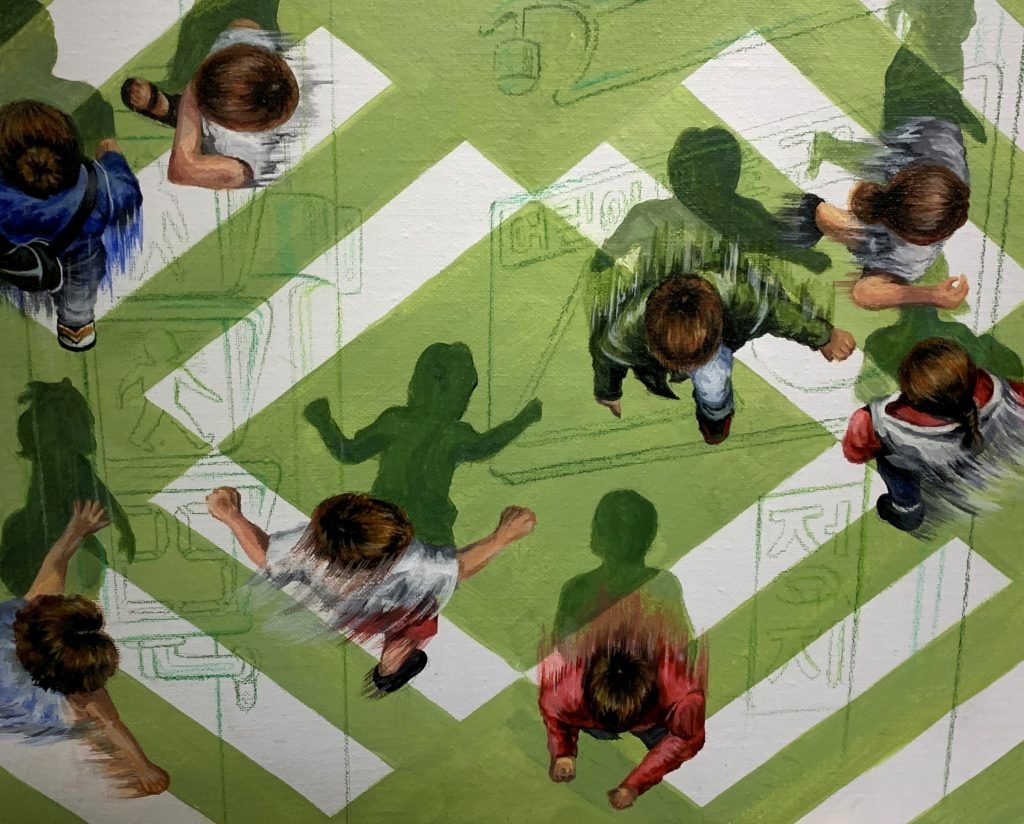
 

Art Essay by Jaeyeon Kim

Life is a journey.
“Standing at the many crossroads of life, my decisions would add up, changing my life and being. Fortunately, my friends and family have often been on hand to support and guide me through the toughest decisions and transitions. When it comes to art, I draw upon memories for inspiration and create with a strong sense of appreciation for the significant others and cross-cultural influences in my life. In this sense, my works are a collection of nostalgic thoughts, emotions, and experiences, as I look back on my life and hone in on influential fragments of time and space that have come together to define me as a human being.”
Jaeyeon is a fine artist who works to claim spaces for the public to engage with art without difficulty. Her work often revolves around detailed paintings, installation art and sculptures, which become a place for social engagement and visual communication.
—Jaeyeon Kim, 19, was born in South Korea, and came to the U.S. as an international student at the age of 15. She currently studies at the Parsons School of Design in New York. 

1. CrossRoad Korea

Seoul, where I was born, is a big city. There are many cars and people at the crosswalk. When I saw a crosswalk, its ‘X’ shape reminded me of our society. Our community is connected like the shape of ‘X’ and also has a system like a red/green light. Also, everyone has a different destination in life.

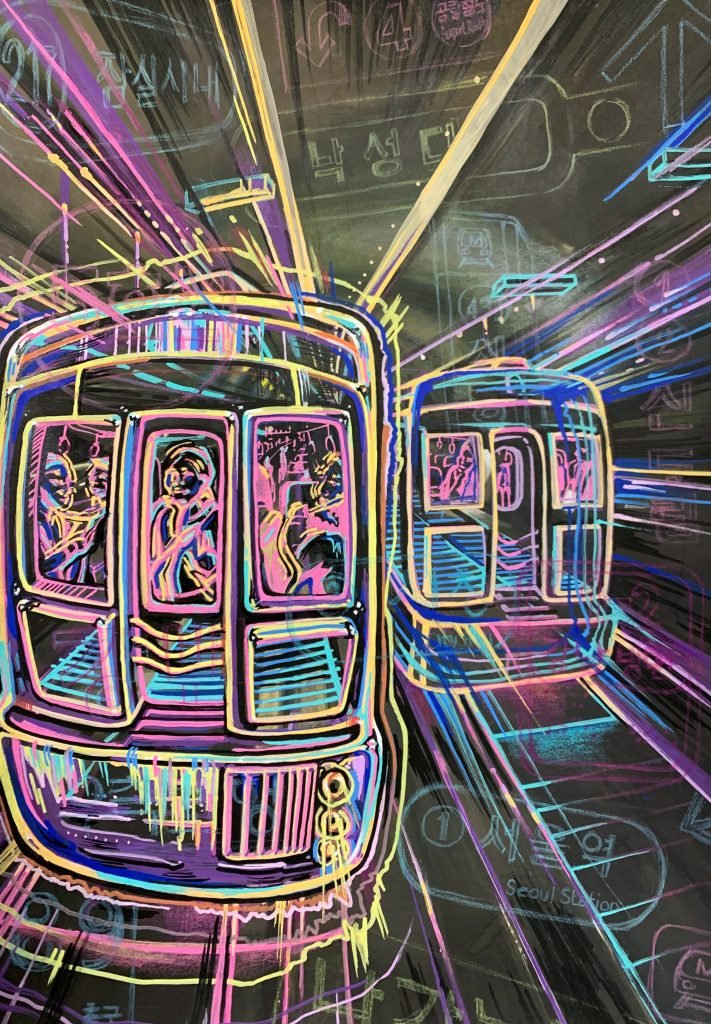
2. Subway Korea

In Korea, the subway is the lifeblood of the city, as in other countries. Many people go to the heart of the city by subway, and it is always crowded. Koreans liken these crowds to the appearance of ‘beansprouts’ which have to grow in a dense environment and survive well in it. I capture a scene of the subway and its passengers. People in the subway have various backgrounds–different ages, genders, occupations, attires, and emotions. Most people feel tired but, well, there is a will to live today.  

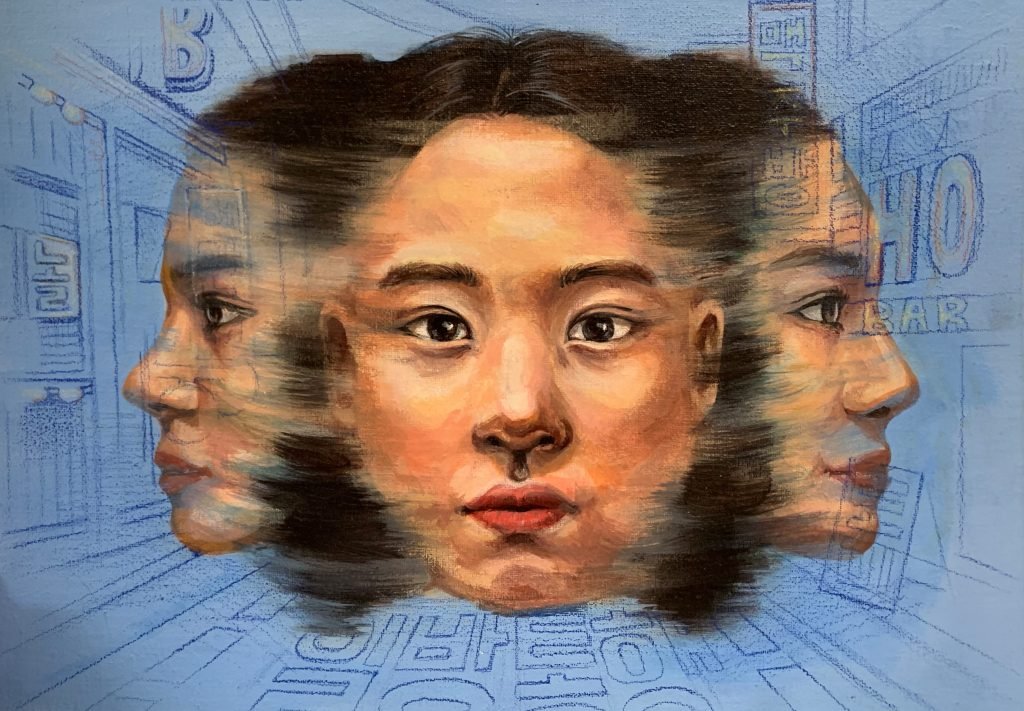
3.  Identities

There are many identities within us. Regardless of age, from a girl to a lady, there are various images of women in one person, based on the situation and culture.

—Art and writing by Jaeyeon Kim, 19, was born in South Korea, and came to the U.S. as an international student at the age of 15. She currently studies at the Parsons School of Design in New York. 

It was Good to be Back

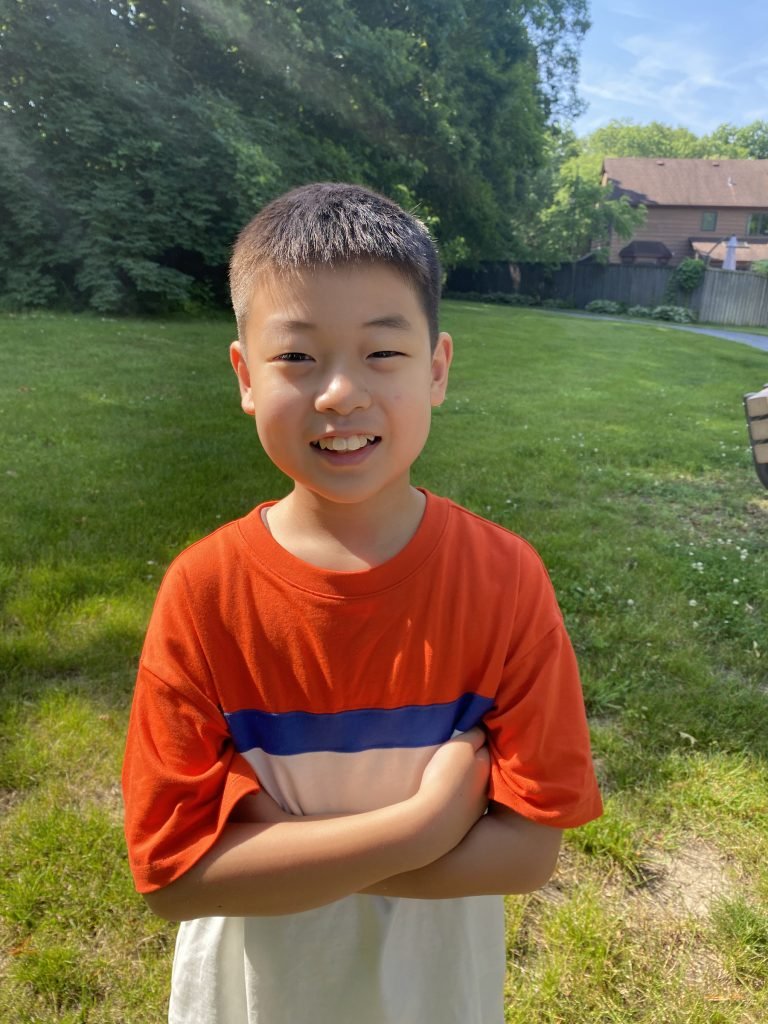
By Benjamin Kwack, age 9, Illinois.

Hi. My name is Billy and my family was visiting Seoul which is in Korea and I loved everything about it. As soon as I heard that we were staying here for the entire summer vacation plus three months into the school year, I was so excited. Partially because I was going to not have three months of school. But anyway. I was going to be in Seoul because ever since the Korean war started and the fighting began, America had sided with South Korea. My father, who actually had joined the army 15 years ago, had to stay in South Korea to help, just in case the Northern part of Korea attacked again. I hoped I would enjoy my time, especially on the holidays. In America, holidays were still fun but this was a whole new country with different traditions so I couldn’t wait to be in Seoul.

The first holiday I witnessed was the New Year. Everyone stayed up really late until after midnight and in the wee hours of the morning. I was sleepy but tried to stay awake just to see what happens. I saw a big bell that was right next to a street and people had gathered around, cheering as they jumped out of their houses running to it. The only light was the light from thousands of cellphones, and they glowed brightly in the dark. The night was silent until somebody started talking into the mic. I felt a little nervous. The person with the mic stopped talking as someone rang the gigantic bell with a mallet that was hooked onto a chain. The big shouts of celebration filled the air, and children ran around with big smiles on their faces. I heard noises like, “It’s the New Year already!” and “See you next year!” The bell rang 33 times before it stopped. The sound of the heavy gong filled my head even after it ended but I was too excited, so it actually didn’t really matter.

Finally, everyone went back into their houses and went to sleep. When we woke up in the morning, my mom realized something. She said that we should have gotten a traditional food, called Tteokguk (It is a soup with sliced rice cakes inside it). I walked up to my mom and said that we had to try some of the soup because if this was a tradition, then I wanted to try it. She said, “Of course Billy. Why not?” So that was the reason why we rode to the supermarket in a taxi. The supermarket wasn’t crowded because everyone already had Tteokguk prepared a few days before. Luckily for us, one container of Tteokguk was still there sitting on the shelves. We quickly bought it. The cashier said, “Annyeong.” We said that we didn’t speak Korean so it was kind of difficult talking to the cashier but we finally managed to understand each other.

After we were done, I skipped out of the supermarket, and we rode another taxi home. It was a while for us to get back there but we unloaded the food and started cooking. I drooled. We waited and it was finally cooked thoroughly. The soup had a natural taste that felt rich as I rolled the pieces of sliced rice cakes around in my mouth. The soup warmed me inside and made me feel calm after all the excitement. I was thinking about the New Year. I tried some more, and it felt plain but at the same time, strong. I saved some for later; I didn’t want to eat all the Tteokguk in one meal.

Then, I watched as people came back out onto the streets again. But this time, a lot of older people also walked onto the streets. I followed them with my mom and my dad. The children bowed to their elders saying, “Saehae Bok mani badeuseyo!” and the elders smiled back, and they gave the children a little money. This went on for a while and when the last coins rattled, I held my breath with a little disappointment because I thought everything was done.

It wasn’t. There was one other thing. It must have been really meaningful because everyone went to visit their grandfathers and grandmothers or their ancestors who had passed away by going to their ancestor’s graveyards. Their family members who had lived in other cities also came and joined them. They laid food by the graveside and prayed for them. The family members chatted for a while and ate some of the food together and waved to each other for a long time before finally leaving. I was struck with a little confusion because this was a new thing for me, and I only knew a little of what was happening. That’s why everything made me feel awestruck and amazed. I actually liked the Korean way of celebrating the New Year. It soon became dark, and I went to bed and gazed up at the ceiling smiling waiting for the next holiday.

“What?!!!!!” I yelled waking up the next morning. My dad had announced that he had received an early retirement. It was such an honor to turn it down. Plus, my dad had been wanting to go back to America as soon as possible. I just sat there on my bed and scowled, but there was nothing I could do.

I gloomily walked to the airport with the family, boarded the plane and looked out the window. I had actually begun to like Korea and didn’t want to leave. Helplessly, I just flew back to America and cried to myself.

20 years later…

Billy had been in the army for four years. He had been sent to Korea to serve there. The happy smiles and laughs struck him and he smiled. It was good to be back!

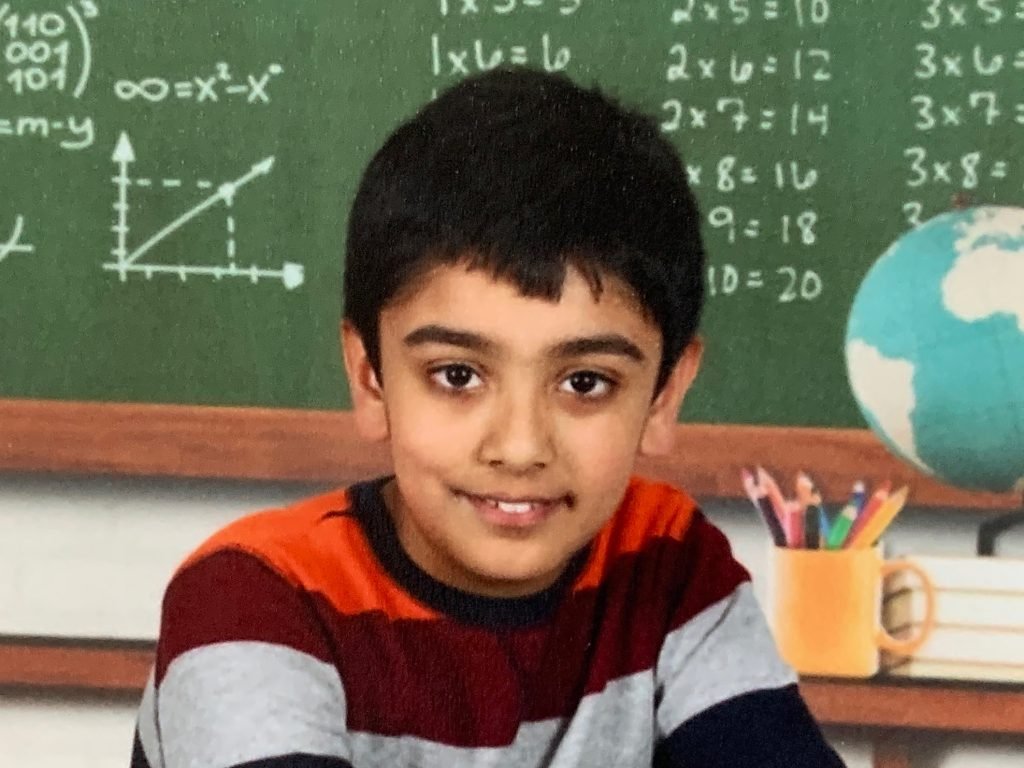
“My name is Benjamin Kwack. I am 9 years old and I really like to draw, to do math and most of all, I like to write. I like to write fantasy, fiction and I really enjoyed reading informational books in class this school year.

In my story, ‘It was Good to be Back ,’ the main character, Billy, is a boy from America and his dad was in the army for 15 years. His dad was sent to South Korea to serve the army. Billy enjoyed the Korean New Year celebration because this was a new country with a new culture and traditions for him.

I wrote most of the story from Billy’s point of view except for the last two lines. I thought that way, it would seem special and more like a real story.”

Nice Rice

By Gloria Lauris, Ontario, Canada.

Allow me to take you on a quick rice journey through several culinary dishes and countries.

I grew up in British Columbia, Canada, to second-generation Ukrainian parents who were raised on farms in the prairies, so our dinner was typically bread, meat, and potatoes. We rarely had rice, and it was usually parboiled or instant. It was cooked occasionally as part of something like stuffing in cabbage rolls or in a casserole or pudding. Little did my younger self realize that my travels, especially to Africa and Southeast Asia, would drastically change how I viewed food, especially rice. Just as wheat is a staple in a grain-growing country like Canada, so is rice a cultural way of life in rice-growing countries and is the main cereal crop for over half of humanity.

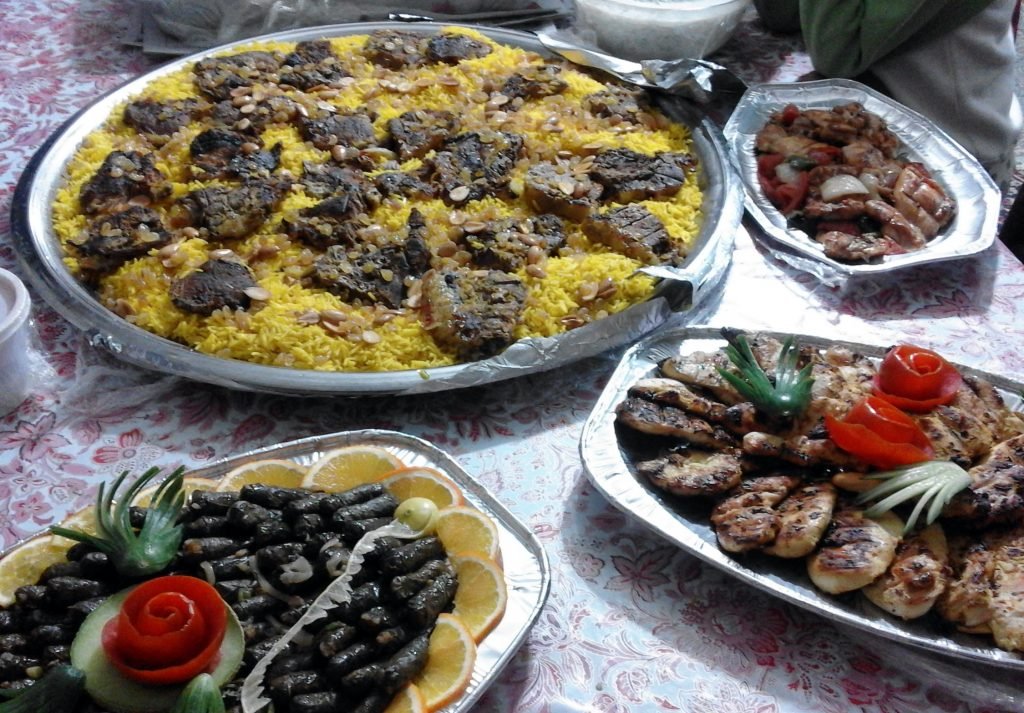
Fast-forward several years to when I visited Egypt with my Canadian Egyptian husband, I remember seeing large pots of warm, freshly cooked white rice in their kitchens. Sitting on the floor with Egyptian women relatives, we would laugh, smile, and chat speaking broken English or Arabic, taking turns picking up limp pieces of steamed cabbage to fill with a mixture of short grain rice and seasoning to make mashe karumb (cabbage leaves filled with rice). This is a mini-version of the more common Western-style cabbage roll, halupki, which my mother made as a throwback to our Ukrainian heritage. Eastern Europeans make cabbage rolls large and smother them with tomato sauce. But in Egypt they are finely rolled, and just a little sauce is used, as they are mainly steamed in chicken stock and are delicious finger snacks. Egyptians also fill other tasty vegetables with rice, such as peppers, grape leaves, eggplants, and zucchini.

Another exotic rice dish was chicken baked on a bed of Egyptian rice, with nuts and vermicelli. Sometimes yellow or red saffron was added, although that was popular mainly in Middle Eastern countries like Saudi Arabia and Lebanon, where people could more readily afford this expensive spice. Sometimes pine nuts and caraway seeds were added for flavour.

Egyptian Rice Dishes. Photo by Gloria Lauris, Canada.

Koshary, believed to be the national dish of Egypt, uses rice. A flavorful mix of lentils, rice and macaroni is topped with a tomato-chili sauce, garbanzo beans and fried onions. It is served in just about every Egyptian restaurant, in most homes, and on many street corner stalls. It makes a hearty, delicious, and affordable meal.

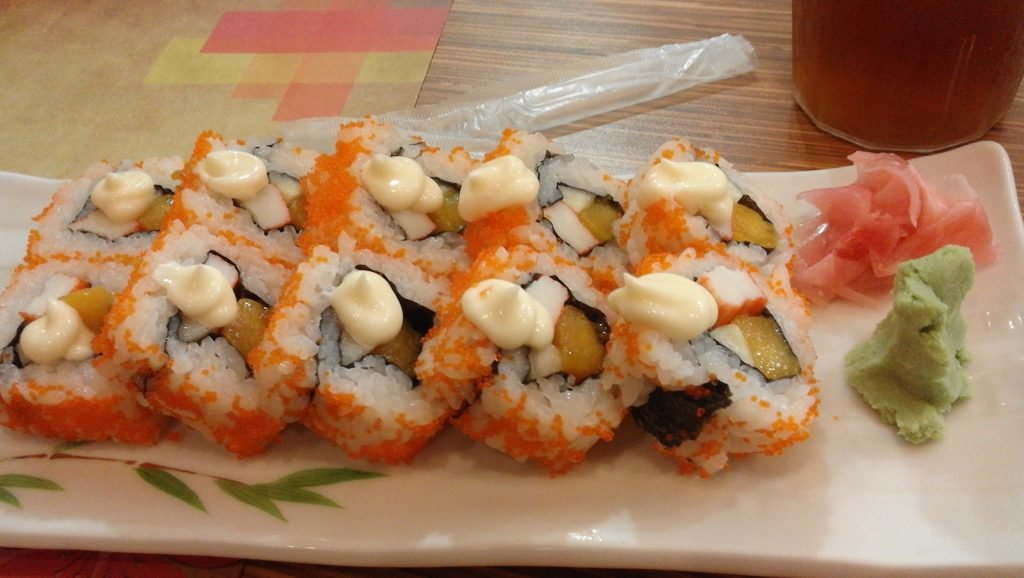
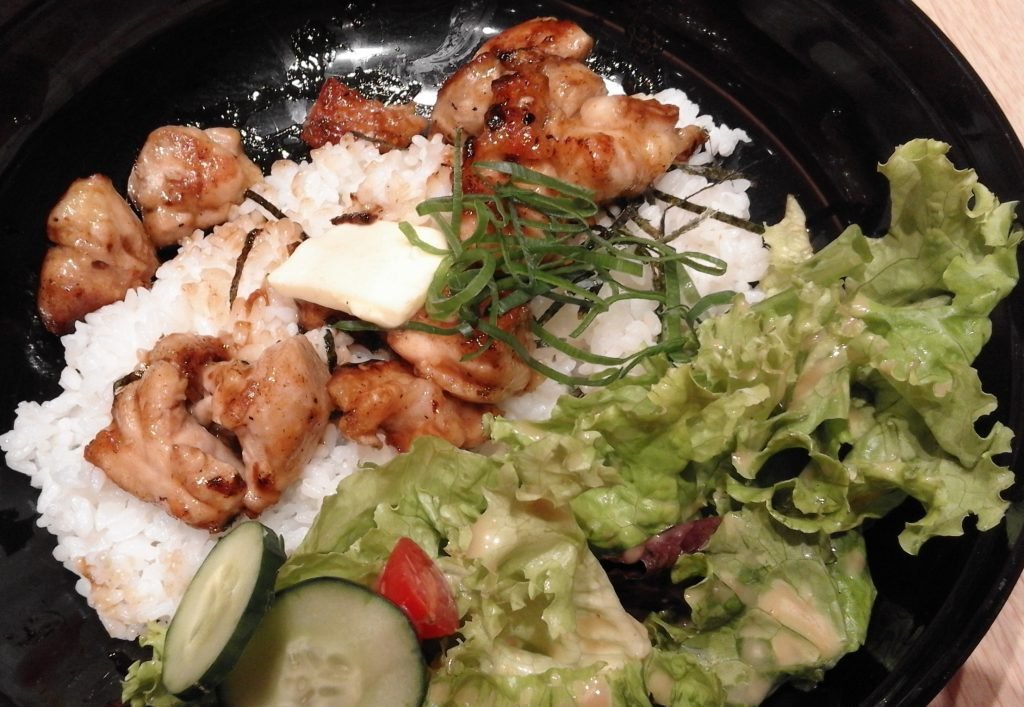
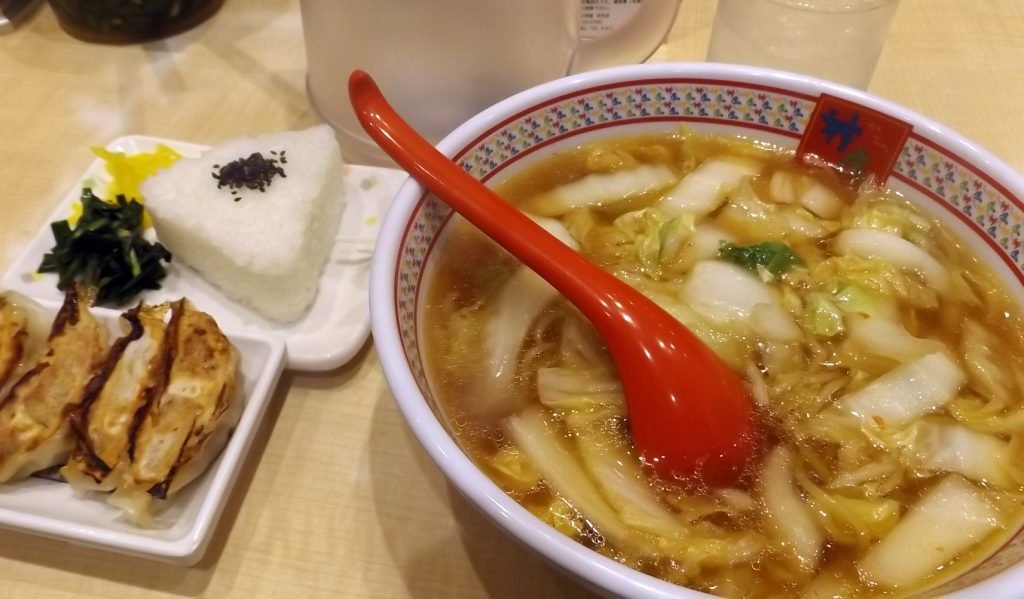
Later, I visited my son who was living in Japan for a while. I found almost all foods included rice; snacks, bento boxes, and sushi and sashimi all came with rice. There was the right way to cook and eat rice: white, steaming, and fresh to be scooped up with chopsticks. To put soy sauce on this essential but bland food was blasphemous to rice purists!  When we ate sushi, we were always amazed how perfectly the rice was cooked. Yet it was sticky enough to be held together with Nori (a seaweed) and veggies to make rolled shapes. We were so impressed with the art of making excellent rice that we bought a Japanese rice cooker in Canada to create perfect rice, every time. The pot somehow senses the right temperature and humidity to produce a quality product consistently.

Now, let’s go to the Southeast Asian country of the Philippines. Rice is grown in many of these islands with their tropical climate, and they export a lot of rice. Some Filipino agricultural institutes even offer a PhD in rice cultivation!

While living in the Philippines, I remember my Dad, who had re-married a Filipina, remarking how the Filipinos love their rice. They have it not only with every meal, but even the desserts were usually made with rice. It was perplexing to a man raised in the prairies to be served a daily diet of rice and fish! He lost a lot of weight during his time there, whereas many Filipinos gained weight due to the regular intake of this starchy food.

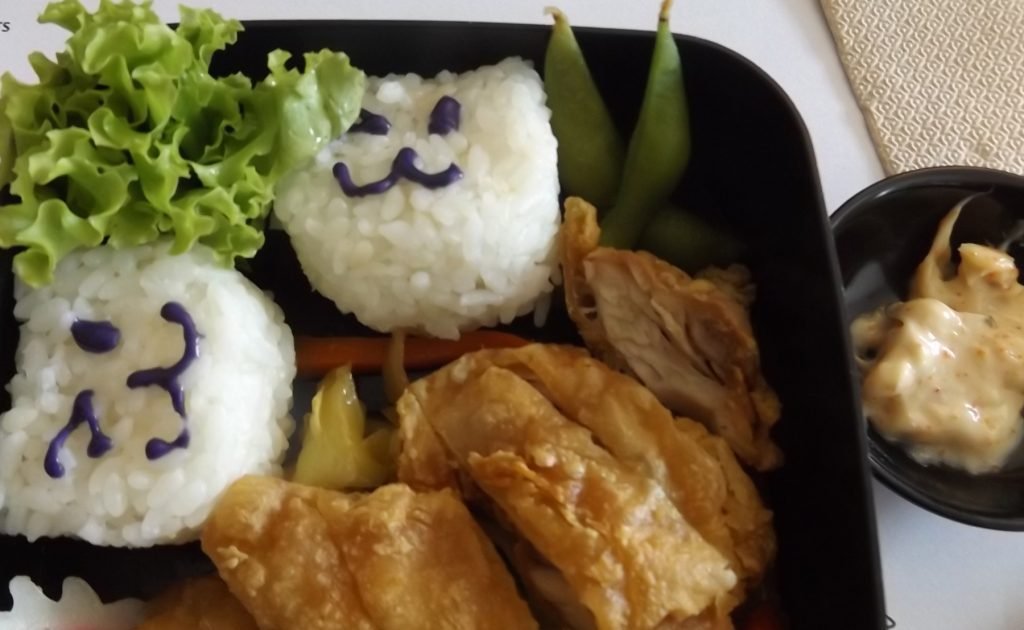
In the Philippines, my personal favourite became Dona Maria Jasponica white rice, a type of hybrid Filipino and Japanese jasmine scented rice, famous for its fragrance, soft texture, and pleasant taste. However, jasmine rice is not good for a risotto as the starch count is not high enough. The Philippines Miponica brand is fluffier and stickier, making it good for risottos, paellas, and congees. Indian basmati rice is a long grain rice which is soft and fluffy when cooked, and it is served with Indian dishes such as biryani, or spicy dishes like butter chicken, chicken tikka and various curries. Filipino Harvester Dirorado rice is naturally fragrant and fluffy in texture and is used in Asian cuisines and in most Filipino dishes such as with chicken inasal, kare-kare and sinigang. At a cat café in Manila, Philippines, I remember being served decorative rice cat cut-outs, their eyes and whiskers being decorated with bits of sauce. Perhaps a sticky rice was used for this?

Affordable and filling, rice is a staple food for many. It is used in Asian (e.g., Chinese, Indian, Filipino, etc.), Middle Eastern, and Mediterranean cuisine. But different types of rice are used for different dishes. Did you know that brown rice is unpolished so it contains selenium and has fibre and B vitamins? It is mineral rich, thus keeping a person full longer than with white rice. However, it takes much longer to cook, and so it is less commonly used, and it is more expensive to buy.

My favourite rice recipe? Although I am a converted fan of Egyptian rice and the delicious Mediterranean style food produced in and around the Nile Valley, my favourite is probably a coconut-flavoured rice, made from jasmine fragrant rice like Jasponica and adding a Thai twist to it. As taught by my kitchen helper in the Philippines, you rinse the rice thoroughly to get rid of any dust and foreign objects in the rice before cooking. Then you add some young coconut milk (buko) to water (liquid to rice ratio is 1:1) to make this delicious rice dish. I have had coconut-flavoured rice in Thai restaurants, and it is a delightful accompaniment to chicken dishes, like peanut chicken satay sticks. Another satisfying dish for me is Egyptian mashe (filled) vegetables, as it brings back happy memories of hearty, flavourful Egyptian meals made by friendly extended relatives, a world away.

International travel and overseas living have opened my culinary taste buds to elevate what I once considered lowly rice. I have come a long way, and not just figuratively, from cooking instant rice once a month in my meat-and-potato youth!

Do you have a favourite rice recipe too?

By Gloria Lauris, Ottawa, Ontario, Canada. Gloria is an emerging Canadian writer. She has visited over 50 countries, and lived in three of them (in the Middle East and SE Asia). She is a long-time animal welfare promoter. She loves to cook.

Life Aboard an Iceberg

By Carla Sabotta, Olympia, Washington.

An Iceberg in the Antarctic Region. Photo by Carla Sabotta, Washington.

From jellyfish to harbor seals, a variety of animals thrive in and around icebergs. The animals find food and shelter, and some of them nest, on these floating chunks of ice.

Icebergs break off from glaciers and ice shelves and bob in the sea. An ice shelf appears where a glacier flows down to a coastline. Icebergs stay afloat even though they weigh many hundreds of thousands of tons. They float for the same reason ice cubes do in a glass of water—ice is lighter than water.

Icebergs the size of houses and large buildings form each year in the Arctic at the North Pole and in Antarctica at the South Pole. Table-shaped icebergs have steep sides and flat tops. Other shapes of icebergs have domes and spires.

Algae and phytoplankton grow on and around all shapes and sizes of icebergs. Algae are like plants and make food from sunlight. Phytoplankton are tiny living things and include plants and animals. Inch-long, shrimp-like creatures called krill eat the algae and phytoplankton. Thousands of krill mill about together and make up the largest part of the diet of many animals.

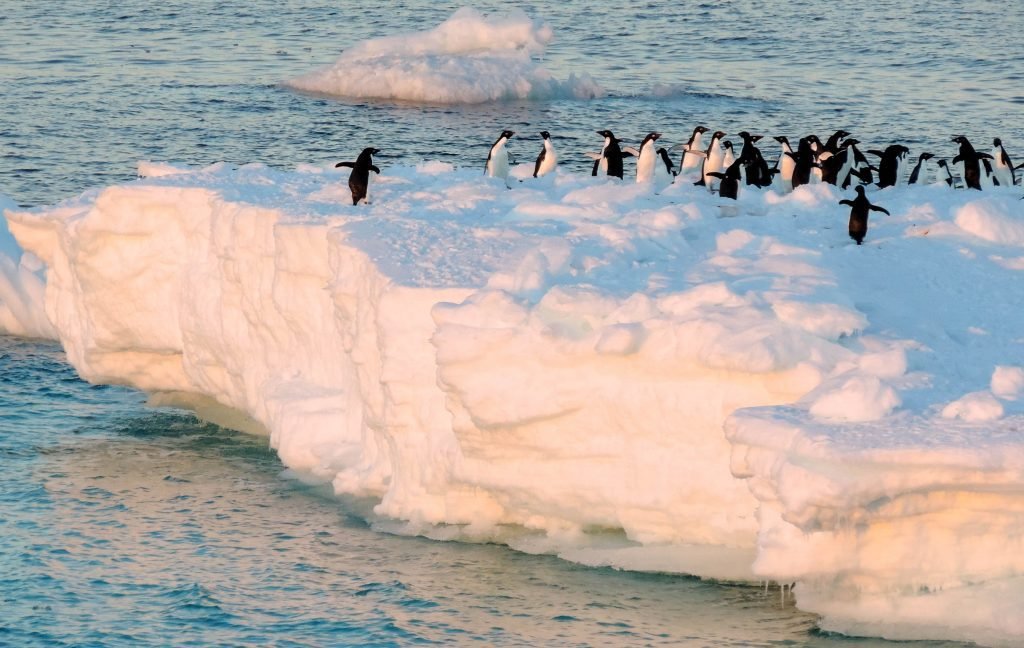
Invertebrates such as jellyfish come to the icebergs to feed on krill. Invertebrates lack backbones. Larger animals such as fish, squid and penguins also like krill. Penguins catch the slippery creatures with their spiny tongues and powerful jaws, while keeping a look out for seals and whales.

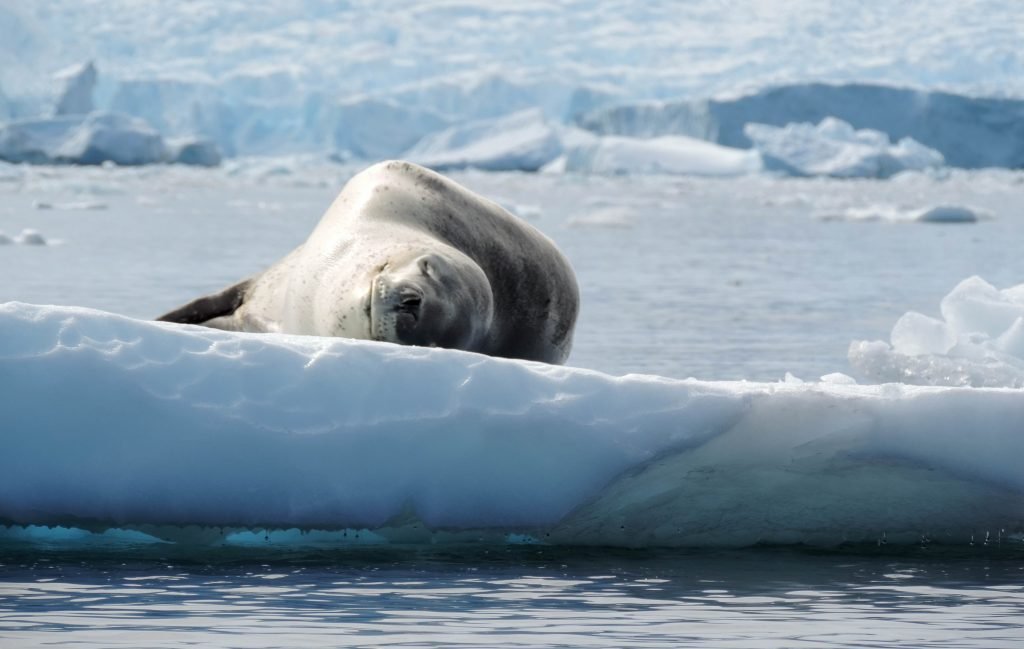
Leopard seals and killer whales seek out icebergs to hunt the penguins. Squawking flocks of petrels and other flying seabirds circle overhead looking for food. The seals also like to sleep on pieces of sea ice floating in the shadows of the icebergs, to get protection from high winds.

A Leopard Seal on a Small Iceberg. Photo by Carla Sabotta, Washington.

In addition to supplying food, icebergs also give protection and a place to raise pups. Young icefish dart into small holes to hide from animals hunting them. These pale-looking fish have clear blood because they lack red blood cells and hemoglobin. Groups of harbor seals haul out onto icebergs to escape killer whales, sharks and polar bears. They rest on the ice with their heads and rear flippers lifted up in a banana-like pose.

During the spring, female harbor seals give birth to pups on icebergs. Groups of mother seals raise their pups on the ice to protect themselves from predators. When they’re not swimming and diving, the seal pups rest on the ice. Out of the water the pups use little energy to stay warm. They can instead use the energy from their mother’s milk to grow and put on the blubber they will need to survive the winter.

Are icebergs becoming home to new animals? Possibly. Scientists recently reported for the first time seeing a colony of ivory gulls and chicks nesting on a rock-covered iceberg. The iceberg drifted in open water near Northeast Greenland. These gleaming white gulls usually build their nests on cliff ledges or distant islands near coasts. Scientists think the gulls may have chosen an iceberg to avoid Arctic foxes and polar bears, and to stay close to their favorite food—small fish and krill.

Adelie Penguins on an Iceberg. Photo by Carla Sabotta

Carla adds, “I was inspired to write this article after learning about icebergs on a trip to Antarctica.”

A Gift

By Chad Glang, Ph.D., Colorado.

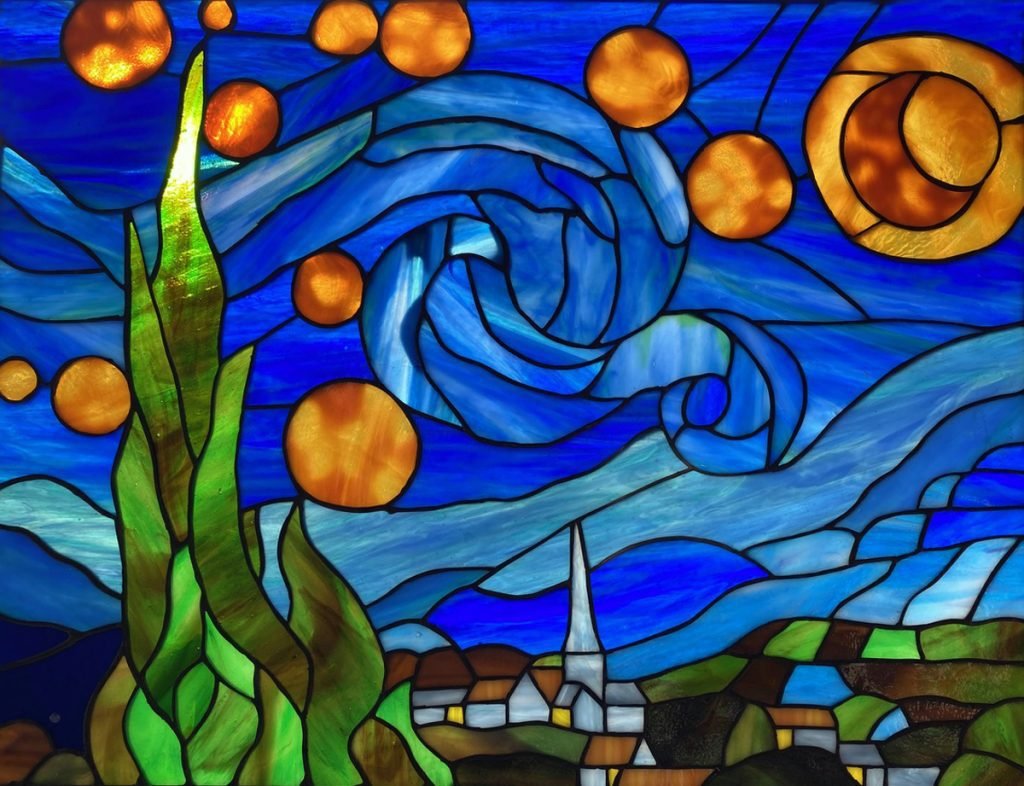
Stained Glass Art by Chad Glang, Colorado.

Someone asked me recently when was it that I first awakened to the spiritual side of life.
 
I have a vivid memory from my time as a student in France. I was 19, and several of us were invited to be companions to kids at a nearby orphanage. In several visits, I connected with a boy of eight. In our final afternoon together he went to his bureau—container of all his worldly possessions. 

He brought out a rare, treasured postage stamp and handed it to me: Un cadeau pour toi, “A gift for you.” 

I was so touched. I pulled out my wallet and found a memento I prized. “Great! We’ll trade,” I said.

His was crestfallen, his eyes filled with tears. “No, not a trade… it’s a gift. I want to give it to you.” I stopped breathing. Oh… I had denied him the experience of giving. In my discomfort with the vulnerability of being the receiver, I’d reflexively moved to equalize the relationship. Unaware, acting out of my own feelings, I’d walked on his feelings… and his dignity. 

More than fifty years later, I am still brought to stillness by this memory. I denied the gift of the stamp; I could not deny the gift of the learning. There’s something more going on here… it’s not just about what my limited, if well intentioned, ego can comprehend.

I didn’t have words for that experience at the time, which was part of its power. Now, the Sanskrit greeting Namaste comes to mind: “The place in me of love and truth and light greets the place in you of love and truth and light.” 

At a given moment, we may be wearing particular hats, like server and served, but we are all in this together…and deep down we are all the same.

—Chad Glang, Ph.D., lives a retired life in Colorado. He works with stained glass, hikes, bikes and camps. He practiced counseling psychology for 40 years. 

Ibn Battuta: The Marco Polo of Islam


By Sahil Prasad, Indian American, Grade 4, Maryland.
 

Wasn’t Marco Polo an amazing explorer? If you agree, you’ll be excited to learn about his Islamic counterpart, the 14th century explorer Ibn Battuta, who traveled 75,000 miles on foot from Timbuktu, Mali to Guangzhou, China (with that distance, you could circumnavigate the globe three times). Impressive, isn’t it, considering that’s how many miles some cars travel in their entire lifetime!

Ibn Battuta was an Islamic explorer whose mission was to travel to every Muslim city in the known world at the time.[1] His legendary taste for adventure started when he took the Hajj (a pilgrimage that Muslims take to Mecca, Saudi Arabia) because after he finished, he really wanted to explore more. Ibn Battuta was born on February 24, 1304 in Tangier, Morocco and he died in 1377[2] in Marrakesh, Morocco after 24 years of exploration! This extraordinary explorer met many fascinating people in his travels like:  a mad sultan in India who tried to kill him, mystics who ate their snakes’ heads of, or jumped in fires to try to put them out, and he met many different followers of Islam, mainly in Asia. He traveled all over the world through continents like Africa, Oceana, and Europe (North and South America were not discovered yet). When he visited some Islamic cities in Europe, the rulers there flooded him with gold and camels because they had a liking for travelers. That’s how Ibn Battuta supported himself on his travels.

Ibn Battuta chronicled his travels in a book called Rilah (The Travels, in English) and because of that, we know so much about Islamic cultures of his time. He gave so much information in his autobiography that it feels like you’re living in an Islamic world of the 14th century.

Marco Polo was a Venetian explorer who traveled all around the Mongol empire under the supervision of the ruler Kublai Khan. Marco Polo was born on September 15, 1254 and he died on January 8, 1324. Kublai Khan developed a very big liking for him and he sent Marco Polo on a series of diplomatic missions throughout the Mongol Empire.

I decided to compare Marco Polo and Ibn Battuta because they have a lot of similarities. Both explorers’ journeys were completely unexpected. For example, Marco Polo just wanted to travel to the Mongol Empire with his father and uncle because they wanted to trade European goods for Asian ones. Who knew that the same young Marco Polo would travel across Asia on tons of missions. Ibn Battuta had a similar series of events that led him to travel.

Ibn Battuta went on the Hajj (the pilgrimage to Mecca) because it was one of the Five Pillars of Islam—five duties that Muslims have to perform during their lifetime, and he was a devout Muslim. That one pilgrimage led to 50 other adventures all around Asia, Europe, and Oceana! That’s the last thing one would expect, isn’t it? Given that the Age of Exploration—where Europeans began to make voyages into the Americas—started a hundred years later.

Another similarity is that both explorers suffered some hard times on their travels. Ibn Battuta crossed a lot of dangerous areas. For example, in Africa, Ibn Battuta had to cross the Mamluks’ [3] territory and they were one of the most feared warriors at the time. Also, Ibn Battuta got sick with fever numerous times, and he had to often take breaks from his travels because of that. Marco Polo also encountered some problems in the desert on the way to the Mongol Empire. For example, he couldn’t find any modes of transportation so he just had to walk the whole way. Marco Polo was robbed by bandits and lost a lot of essential supplies including his diary, which was very important to him.

Lastly, both explorers traveled very long distances. Marco Polo traveled almost everywhere in the Mongol Empire which spanned almost the whole length of Asia! The Mongol Empire was the largest empire in history, so while traveling all over that big empire, he must have covered a very long distance. Ibn Battuta traveled very long distances as well. He traveled more than half of the known world at that time, covering over fifty thousand miles. Also, Ibn Battuta’s average miles per year were 3,000. So if you multiply that by the 24 years of his travels, you get 72,000 miles (his total miles were actually around 75,000)! Didn’t he travel a whole lot?

Ibn Battuta might seem like a superhuman, but like us, he was just an ordinary person. If we dedicate ourselves to a goal with determination and perseverance, we too can be successful like him.

Bibliography

1. David Angus Great Explorers, Naxos Audiobooks, 2003

2. The Adventures of Ibn Battuta: A Muslim Traveler of the 14th century by Ross E. Dunn, University of California Press, 1989

3. Ibn Battuta: The Journey of a Medieval Muslim by Edoardo Albert, Kube Publishing, 2019

4. Extra History by Daniel Floyd, 2008


[1] There are more Islamic cities currently in the world than at the time of Ibn Battuta.

[2] His death day and month are unknown.

[3] A group of slave warriors who lived between the 9th and 19th century in the Islamic world.