
Minding my own business, I looked for the exit sign in the store since COVID-19 precautions had limited the number of usable doors at Target. As I made my way to the familiar red exit, a middle-aged white man approached me.
“Because of you, I have to wear this mask. Your kind started this whole pandemic.”
As an Asian American, I have always experienced racism, but I’ve never spoken up about it because not many people like me have. Oftentimes, I find that the Asian community keeps quiet and internalizes the racism we endure. However, after my trip to Target, a message shouts clearer to me than ever: The unrecognized racism that Asian Americans face has been shut down for far too long, and it is time to bring awareness to this prejudice.
Asian Americans have actually faced racism for over a century. In 1882, Congress passed the Chinese Exclusion Act. “For the first time, Federal law proscribed entry of an ethnic working group on the premise that it endangered the good order of certain localities.” In other words, the Chinese Exclusion Act was the first law to ban immigration based on race, demonstrating how Asian Americans have long been subject to racial discrimination.
But more urgent are the recent violent attacks that thousands of Asian Americans have suffered. As the number of COVID-19 cases have increased, so have the number of hate crimes towards Asian Americans. NBC News reported at least 3,800 hate crimes against Asian Americans in the past year, mainly against Asian women. From random strangers shouting, “go back to China,” “Chinese virus,” and “Kung flu” to mass shootings such as the one in Atlanta, countless Asians have recently experienced these horrifying acts of racism.
But why aren’t more people talking about all the lives lost due to this prejudice? The answer is simple. Asians are seen as the “model minority,” so we – apparently – don’t experience racism since all of us are so opulent. However, the model minority myth is very problematic. This myth originated in the 1960s when the 1965 Immigration Act reversed the previous restrictions on Asian immigration. But this act still limited which Asians could enter the U.S. because only highly educated professionals were allowed in. Because of the background of these skilled workers, they were able to pursue specific careers with higher income, resulting in the development of the model minority myth. However, this overgeneralization of Asian Americans masks the struggles of those who aren’t as fortunate. In 2018, the Pew Research Center found that Asian Americans have the largest wealth gap in the U.S., proving the inaccuracy of this harmful stereotype. Additionally, this myth places a racial wedge between Asian Americans and other people of color. Rather than uniting to fight the issue of white supremacy together, racial minorities are divided against each other because of the model minority myth, which hinders progress towards racial equality. Even though our society has made several steps in the right direction in terms of anti-racism, there is still a long way to go. We must continue to fight for racial justice so that all people of color can finally have an equal playing field.

By Lily Fu, 17, Asian American, Texas.
Please visit Lily’s website: https://asianamericanawareness.blogspot.com/ She created it for her youth advocacy organization that focuses on Asian American Awareness.
By Ryan Kim, age 16, Seoul, South Korea.
The rampant spread of COVID-19 caught even the experts by surprise. Without even direct contact, by simply being in the same room together, many became helplessly vulnerable to the pandemic. In order to mitigate the spread of the virus, we all had to adapt to a new norm. As the lockdown dragged on, we became more dependent on video conferencing platforms than ever before. Applications such as Zoom have boomed over the last year, providing an alternative solution for activities that once require face-to-face interactions. Many expect that these platforms can replace the traditional interaction where physical presence was once required. Despite all the positive aspects of Zoom and similar platforms, we need to understand that these platforms are viable alternatives we have only in the context of the pandemic. They should not and can not permanently replace the traditional human-to-human interaction.
Despite the Zoom overload, the term “Zoom fatigue” is not familiar to many. In February of this year, Stanford University researchers uncovered a new phenomenon called “Zoom fatigue.” The unnatural close-ups of the face and the simultaneous view of others and self are unnatural to the human brain causing psychological overload and fatigue. Because of how Zoom became the new normal of our life, we have been inconspicuous of how dominant and fatiguing the effects are to us. Many are unaware of the feelings of exhaustion after repeated exposure to video-conferencing apps.
In this new reality, as students are Zoom’s dominant users, they are the ones that are significantly burdened with Zoom fatigue. In virtual school, every day seems quotidian and senseless, slowly yet rapidly draining the most pivotal time of our lives. The small chatter among friends before class, walking down the hallway in between classes, and even the three-dimensional experience of being surrounded by other peers seem trivial and inconsequential until they are removed. They are a big part of the mental and psychological breaks available to students as we engage in learning.
Institutions expecting students to follow along in the virtual setting with the same effectiveness and focus as the offline is similar to expecting a runner to run the same distance and pace while carrying a weight on his back. In these challenging times, there are no perfect solutions. I am not bashing platforms such as Zoom, nor am I suggesting that we should not have virtual classes. However, we do need to be aware and mindful of the new challenges we face in these alternatives. We must treasure the little things we did not notice until they became no longer available to us. Virtual interactions should not replace physical interactions. And most importantly, Zoom fatigue is not an excuse.
By Ryan Kim, age 16, Seoul, South Korea. He entered this article for the 2021 Youth Honor Awards program.
Work Cited:
University, Stanford. “Four Causes for ‘Zoom Fatigue’ and Their Solutions.” Stanford News, 1 Mar. 2021, news.stanford.edu/2021/02/23/four-causes-zoom-fatigue-solutions/.
Singer, Natasha. “Online Schools Are Here to Stay, Even After the Pandemic.” The New York Times, The New York Times, 11 Apr. 2021, www.nytimes.com/2021/04/11/technology/remote-learning-online-school.html?searchResultPosition=6.
Darkness and suffering
Sadness and fear live in the streets
Some of my own never get an opportunity
To be scientists
To reach the planets
But light lies ahead
It surrounds us
Sometimes physically around a neighborhood
Dry to those who cannot see
But full of soul and dreams
On the inside I am
Strong Super-cali-frigi-listic Sophie
On the inside I am the
Brave beautiful Believer
On the inside I am one
Respectful Resilient Rodriguez
On the inside I am a
Passionate Peaceful Protester
On the inside I am a
Caring Creative Kind Community
On the inside I am the
Heavenly Hopeful Huasteca
On the inside I am the
Meritorious Motivated Mexica
A Mindful Marvel Miracle
Who are you on the inside?
By Sophie Rodriguez, age 9, Huasteca and Mexican American, Illinois. The poems were entered for the 2021 Youth Awards Program.
James was lying on the back seat of the car with his feet outstretched. He looked at his mother through the rearview mirror to see if she was watching, and then he peeked through the zipper on his bag to check on his phone. The phone was at seven percent–James was pleased that his tactics had worked. He had set his screen brightness to the maximum and turned on his mobile flashlight when he had gotten into the car at school.
“Mom, my phone died already. It was like fifty percent when I got in the car!”
“Give me the phone.” James’ mom snatched it from his hands and inspected it. “How did the battery die so quickly?”
“I don’t know! Why can’t you just buy me a new phone?”
“I bought this for you a week ago and you’re telling me you already need a new one? We’ll deal with this later; for now, let’s just get going.”
“But Mom, I need my phone for school tomorrow and all the Apple shops close at seven.”
“I can always buy you a flip phone or give you your dad’s old one.”
“But Mom, I need…”
“Not now, James.”
Impatiently, James tossed his phone onto the seat beside him. The real reason he wanted a new phone was that it had gotten scratched in his bag, but now he might be stuck with his dad’s old phone.
Instead of turning the car back on, James’ mom pulled the key out of the ignition.
“Why’d we stop?”
“The streets are too narrow. We’ll get out here, travel by foot. The apartment is over there,” she said.
James looked around. Unlike downtown Seoul, the streets were dark and the sidewalks were empty. The usually smooth pavement in the road was severely cracked and gray.
“Mom, why aren’t we going home?” he asked.
“I already told you. Weren’t you listening? We’re going to look at a few homes and hopefully make a deposit on one.”
“We already have a home. Why are we buying a house in this filthy neighborhood?”
James already knew exactly why his mom was trying to buy a house. He was only hoping that she would realize how ridiculous the whole idea sounded. She had explained how Korea’s taxes were unreasonably high but that because of a loophole, families could save a little bit on their taxes by adding a second address and pretending to live separately.
With an irritated sigh, James got out of the car and dragged his feet through the streets. A sudden movement caught him by surprise. On the other side of the tall gate he was passing through, he saw a young boy staring right back at him. James took a few steps back. The boy was wearing sandals and two t-shirts in the middle of a cold winter afternoon.
“Hello,” said the boy quietly. He awkwardly scratched his left ear and continued staring.
James had never engaged in a conversation with someone so poor. He was unsure what to say, so he remained silent. After a few seconds, James turned away and ran to catch up with his mom.
Entering the building, the first thing he noticed was the lack of an elevator. Wasn’t this apartment supposed to be on the third floor? As he pulled himself up the stairs with a scowl on his face, James could smell a different odor on every floor. A strong smell of cats on one floor, then burnt plastics on the next.
The stairs opened directly onto the roof. All there was to see up here were a few empty flower pots and a greasy grill.
“Why are we on the roof? Where’s the third floor?”
“This is it. This is our home.”
“The roof? The roof is our home?”
“There it is over there. Isn’t it cute?”
James looked doubtfully at his mom’s face, checking to see if she was cracking a joke, but she seemed to be completely serious. Was she delusional? Then James noticed the small shack in the center of the roof. He walked over to it and cranked open the rusty door that had drooped and embedded itself into the floor. Inside, there was barely enough room for a mattress and a sink. Behind it was a separate, even tinier room with a toilet and a showerhead attached above.
“How do you expect anyone to live here?”
“Well, we won’t really be living here. We’re just here to see what we’re buying.”
Right as James was about to exit the shack, he accidentally kicked a can of cola. The can was nearly empty and only a few drops spilled out.
“Do people live here?” he asked.
“This has been a home to many people. The most recent people living here were a couple, and they were fine.”
James tried to imagine how people in his neighborhood could endure living in such a small and wretched home. He remembered the foul smells coming from the floors below and wondered what the conditions were like on those levels. The buildings to the right and left–an entire landscape of old, deteriorating apartments–were all homes to people without the chance to enjoy anything that he had.
After not even four minutes in their new home, James and his mom decided to stroll back to the car. After all, there wasn’t much to look at. When he reached the car, he paused and looked over his shoulder. He had hoped the boy from earlier would still be there, but he seemed to have gone back inside to avoid the cold weather. After taking off his goose-fur jacket, James gently hung it over the boy’s fence.
James’ mom was focused on her phone screen. “Hurry, Apple stores close at seven!” she said.
“What?”
“Didn’t you say you needed a new phone?”
“No, my phone’s working again,” James said as he shivered and stepped back into the car.
By Ace Yeom, age 15, Seoul, South Korea. This was selected as one of the Noteworthy Entries in our 2021 Youth Honor Awards program.
By Isaac Choi, 16, Oregon.
As one critic of social media observed, “There are only two industries that call their customers ‘users‘: illegal drugs and software,” said Edward Tufte, a computer scientist in The Social Dilemma. According to a 2018 Pew Research Center survey of 750 teens, 97 percent used social media and 45 percent were addicted to it. I was one of those teens. I first tasted the social media world on my 12th birthday. I had nagged my mother for months, and now it was in my grasp. I quickly became absorbed by the features and abilities that social media possessed. In my first few days, social media consumed my mind. I thought about it during school, at dinner, and even in my sleep. Its presence stalked me like a tiger in a forest and lingered like a ghost at night. I fell into an abyss of likes, followers, and posts. From the moment my eyes landed on the scrolling screen, a habit instantly formed, beginning the intoxication of my mind.
About a year after developing my profile, I developed a daily routine. After school, I would seize my phone to browse social media apps. It was supposed to be a positive way to connect to the outside world and join the online community. But that was not the case. Instead, I became obsessed with how many followers and likes I had. It separated me from reality and presented me with a false identity. I had become a salesman and an addict; I thought of ways to appeal to people to follow me, just as a CEO would handle marketing. For example, if I took photos from my chin up, my insights showed deflation in followers, whereas if I took pictures from a head to heel angle, I would experience inflation. I would try to recreate the bios and profile pictures they had. It made me feel invincible, numbing my mind with ecstasy. This kid who never touched social media before was now living the high life.
By the end of next year, I was a living disaster. I was consumed by social media. Instead of spending time with family on holidays, I sneaked into my account, and I scrolled through posts, instead of completing schoolwork. Consequently, my life was full of procrastination and constant fights with my family. I was stressed by the pressure of trying to support my “perfect” reality online. But thankfully, this cycle came to a sudden halt.
It was around seven or eight p.m. on a Saturday when my mother called me to the living room. She wanted to show me a documentary on Netflix. My mother is not a lukewarm parent; instead, she is the total opposite- a “tiger” mom. With that being said, my mother watched my social media addiction with an eagle eye. She saw that I was not able to live with both social media and school, and realized that I needed change; not by a minor fix through small talk but by a dramatic metamorphosis. At first, I had no idea what it was about, but I just stayed until I saw the title.
As soon as I saw the words, The Social Dilemma, sweat droplets rose from my palms and my back. I had heard from a blog that the documentary could turn the lives of addicts completely around. It motivated people to delete their social media apps and renew their lives. But I did not want to be a part of that. I detested the thought of quitting social media and giving up my “perfect” reality. But, my mother insisted that I just watch and listen. So to avoid any conflict, I stayed, but the sweat slowly rolling down my back added to my uneasiness.
The Social Dilemma resurrected me from the gorges of temptation and deceit. As I watched former employees of tech companies like Facebook and Google give their testimonies on how the industry managed social media, everything they said was an explanation for my addiction. One employee said that the companies looked at people’s views on posts and recommended similar content. This led to addiction. Another employee said that companies would send notifications to attract users. This led to distraction. From that point on, I told myself that I would not be brainwashed by money-loving trolls who took advantage of the vulnerable, which led me to believe that social media was not an app, but a drug.
After the documentary ended, my mother asked me how I felt about it. I hid my true feelings and said that it was boring because I still had the desire for social media within me. But suddenly, my mother wanted me to make a decision: either choose social media or my life. I did not want to do this, so conflict was the only alternative. While I was resting my hoarse voice, a calm rushed over me. Instead of resuming the conflict, I suddenly wished for a newer life, full of meaning and purpose. That was when I made the choice that changed my life, one that would influence my future. With that, I quit and deleted all my social media apps and accounts.
The aftermath of this decision led to so many great results. I started a successful club at my school, became number one in my class, and started a new sport. What began as a tumultuous odyssey to becoming an addict eventually evolved into a tour of reflection. I had no sense of reality and most importantly, I was intoxicated by false illusions of perfectness. But I found a light that shines my true self, revealing my potential and purpose.
The first step to any recovery is seeking help. The Substance Abuse and Mental Health Services Administration (SAMHSA) helpline combats addictions from drugs to social media. For more information, visit: samhsa.gov. Thus, will you linger intoxicated or refresh into a successful life? Your choice will direct your path in life. Social media may get dopamine rushing all over the body, but there are many other highs in life which we can all embrace.
By Isaac Choi, age 16, Oregon. This was selected as one of the Noteworthy Entries in our 2021 Youth Honor Awards program.
By Sonia Mehta, age 17, Russian-Indian heritage, Ohio.
“Excuse me. Is this seat taken?”
Anika glances up to see pleading eyes.
“Sorry,” Anika says, looking past the girl. “Our friend asked us to save the seat.” She resumes her lunch.
The newcomer leaves. From the corner of her eye, Anika watches the new girl navigate through the crowded cafeteria. Two noisy upper classmates jostle her to the side. Anika clenches her fork. They keep walking as though the girl is invisible. The newcomer chooses an unoccupied table in the corner and sits. Anika’s chest tightens. She takes a deep breath. No relief.
“Anika, you’re mean,” Cynthia says.
“Her name’s Darsha,” Meghan adds from across the table.
“Who?” Anika feigns.
“The new student,” Cynthia replies.
“Oh, I don’t know her.”
Meghan pushes her thick glasses to the top of her broad freckled nose. “Is she from the same part of India as you?” She tugs at her thin red hair.
“No. Different region.”
“She looks a little like you, Anika. But darker.” Cynthia twists her wavy chestnut hair around her plump index finger.
Anika feels a guilty pleasure hearing these words. The desire for lighter complexions in parts of India is a poorly kept secret. The classified section of the India Today newspaper is filled with matrimonial ads. Prospective brides are described as having ‘wheatish’ or ‘cream’ complexions. The defining characteristic of men is ‘successful.’
“I feel bad for her,” Meghan says.
“Someone should talk to her,” Cynthia adds.
Anika knows this means someone else. The friends look at Darsha. She is short and thin. Her long black hair glistens with coconut oil. It is pulled back into a messy ponytail, exaggerating the roundness of her face. She wears denim pants that are a size too large and a dull green t-shirt. Darsha stares at her plate, playing with uneaten food.
Anika rakes her fingers through her freshly straightened caramel-tinted hair. It accentuates her heart-shaped face. She tugs on the collar of her cropped Brandy Melville shirt.
“We can’t associate,” Meghan says, “or we’ll be losers too.”
Anika considers protesting but does not. She has ascended the school hierarchy to the level of blending in. She can live with that.
Three years ago a girl from India entered a classroom. She prepared for life in the States by watching every movie available to her in Surat, India. She expected to be introduced to the class by her new teacher. Such was the custom in her country. Instead, she was directed to an empty seat.
Within minutes, an American girl raised her nose and sniffed loudly. Other students mimicked the action: a pack of hyenas catching the scent of a prey. They soon triangulated the smell to the backpack under the newcomer’s desk. Disapproving looks followed. Her mother’s khichdi sat in the plastic container. It was the least spicy and malodorous dish she knew to pack for lunch.
After class, she rushed to the restroom and dumped the lentil dish. Next period she made the mistake of answering a question about Alexander Hamilton. She did not know that her thick accent sounded like marbles had been placed on her tongue, “Hamilton was a veddy (very) important patriot. He reeelly (really) cared about a strong federal government.”
A boy jeered, ”Did he reeelly?”
Snickers followed. She never volunteered another answer.
The worst introduction happened in the cafeteria. The room, the size of a football field, buzzed with a slow-moving current of American teens. Each table pre-filled with students laughing and gossiping. Their backs turned to her–a phalanx of shields. She found a corner table and sat alone. She stared relentlessly at her watch, willing the minute hand to move faster.
From her left, sunlight came through a window and separated into a rainbow on the wall. She pretended the colors were a palette of paint. She imagined dipping her brush in the red and produced her grandmother’s beet pickle. The cinnamon-anise smell touched her nostrils. A smear of green brought her Auntie’s fried elephant leaf paatra. Was that the scent of coriander? With a dash of orange, her mouth watered with the sweet cardamom-flavored jalebi.
She felt better looking at the rainbow. It was her color palette . Colors were a part of her life. She used to toss the powdered dyes at her cousins during the Holi Festival every year. The colors transformed them into living canvases.
“Earth to Anika,” Meghan says.
“What?” she mumbles, coming back to the present.
“I said, time for fifth period.”
Anika glances at Darsha’s now vacant seat. She tries imagining the new girl leaving alone. Instead. Anika sees a girl from Surat who once filled the emptiness in her heart with colors dancing on a wall. Anika has recognized the aching loneliness in another but has chosen silence. She leaves with her friends.
The next day, Anika joins her two friends at their usual table.
“Did you hear about Darsha?” Cynthia asks.
Anika looks up from her phone.
“She dropped out,” Cynthia continues.
“So soon?” Meghan says.
Anika’s stomach knots. She stares at the seat Darsha was in yesterday. Empty. That deserted table used to be hers. Her eyes drift to the window. It’s sunny outside, and a rainbow flickers through. My color palette , Anika remembers.
“Does anyone know why she quit?” she asks.
“Probably hated being a loser,” Cynthia answers.
“Where did she go?”
“I guess where she came from. Where was that again?”
“Somewhere else,” Anika whispers.
I wish you had stayed, Darsha. I should have shared my color palette. I could have. She looks again at the rainbow. It flickers merrily, unmoved by her thoughts.
A single cloud rolls in. Its shadow obscures the colors.

The Perfect Family
By Zsuzsanna Juhasz, age 15, Maryland.
The father figure stands above,
No one can compare, just because.
Goes to work, and brings home the money,
While the rest stay at home, and wait for daddy.
We eat when he does, we smile when he looks,
We do what he says, or we get into trouble.
His word above ours. That’s how it has always been,
Because a change in tradition goes against everything he says.
The mother of the house doesn’t leave,
She’s not a human, she’s property.
When they wed, the maiden names goes too,
That’s the way it’s been, what should we do?
She cooks, she cleans, she obeys every word,
No speaking out, or she gets hurt.
She’s the uplifting spirit that we all need,
Unless she’s hushed, she just washes and feeds.
The eldest daughter, the pride and joy,
The one to go on and have kids of her own.
She must leave college, to marry a man,
She must do what she’s told, because she’s a woman.
Soon she will learn, what she must do,
It’s her “honor,” it’s her “duty” to be told what to do.
She takes the abuse, she holds it all in,
A sound out of her, would ruin the perfect image.
The youngest son, who learns from the father,
Does anything he says, and learns from his lectures.
He takes careful notes, so he knows what to do,
Like how to sit on the couch and work a grill too.
Looking at girls, poking at skirts,
Blaming their impulses on simply being a flirt.
Growing older, carrying his father’s beliefs,
One day he’ll become who his father turned out to be.
Men go to work, and women just stay at home,
Why change now? That’s the way it’s always been!
“Stop nagging and speaking, and clean the house!”
It’s written in cold blood to be as quiet as a mouse.
Nothing will really change, it’s all an illusion,
To make you grow up to be just like your father.
“What do you mean you don’t like it? That’s how it’s always been!
One day you’ll know when you’re married and have three kids.”
By Zsuzsanna Juhasz, age 15, Maryland. She adds: “My inspiration for this poem was the study of family norms in history, during the 50s and 60s. I’m currently enrolled in AP United States History, and when I wrote the poem, we were learning about how the average middle class family lived, and what life was like for the typical family. I thought it was incredibly interesting topic, especially when learning about Betty Friedan and how she challenged this observation, eventually publishing her own novel, The Feminie Mystique.
“I am Hungarian; I was born in the capitol, Budapest. My parents are from there, and my family and I moved here when I was just one year old.”

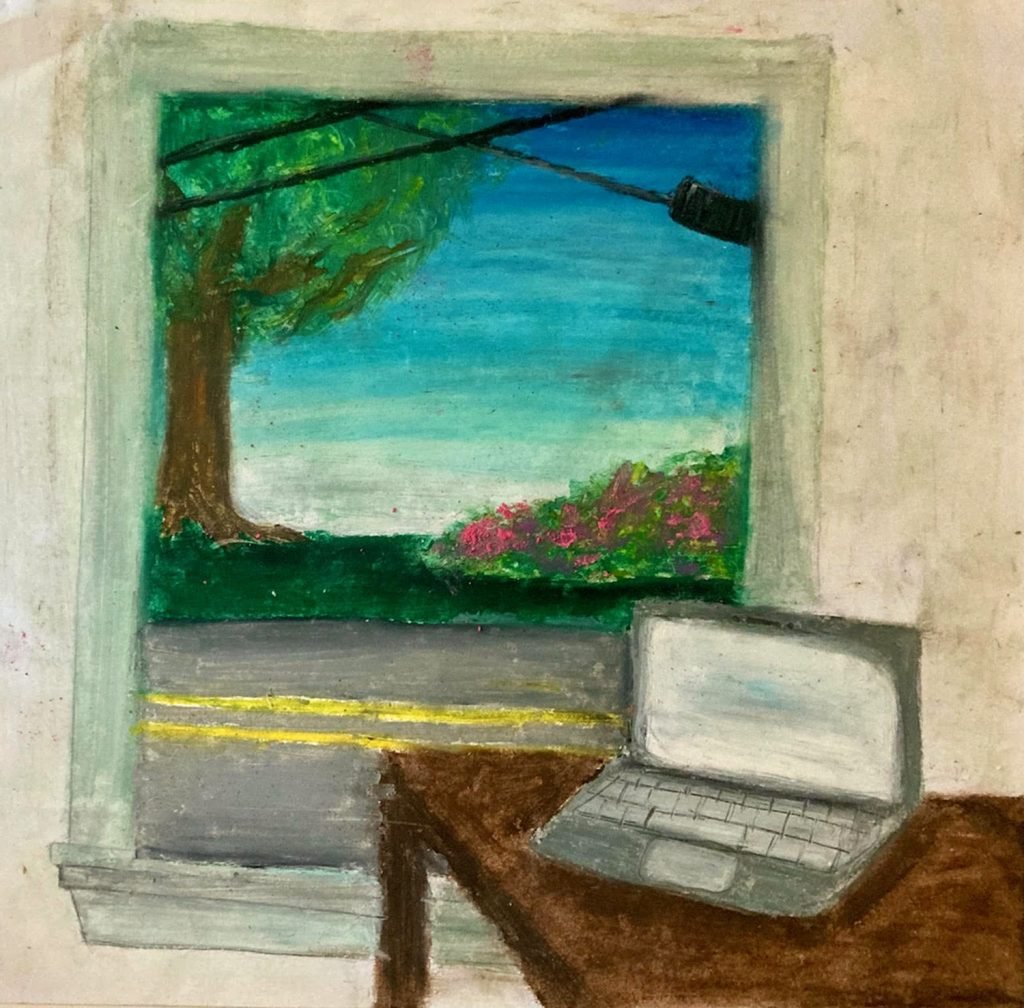
 My View
 By Julia Dun Rappaport, grade 9, Massachusetts.

 I like to gaze out my window, the thick black telephone
 Wires criss-crossing my
 View.
 A bare tree shoots up from the Earth of the
 Yard. I wait for it to bloom. I eagerly await the leafy greenness to fill the pane. Two
 Blue jays are perched on a nearby branch.
 I see the ruffle of the sunbathed brush, and picture Wind
 Combing my hair with her
 Gentle fingers.
 The sky is a pale hue of
 Pastel azure. Swollen clouds dot its rounded edges. A faint tune from wind chimes
 Dances on the air.
 It rained yesterday, and the petrichor lingers still, the scent
 Grasping the atmosphere. I can nearly taste the sweetness of the
 Fresh world. I
 Imagine the earthy, crisp pleasantness on my
 Tongue.
 But I taste nothing but the staleness of the room. I see
 Nothing but the blankness of my computer
 Screen.
 I hear nothing but the clacking of my keys and the soft
 Whirring of technology around me.
 Surrounded in this modern world.
 Trapped.
Julia is a writer, poet, and artist. Her designs and paintings have won several art contests. She adds:
“This year has changed many things about me. From my lengthening golden-brown hair to my taller height, many noticeable things about me are different now than they were before the pandemic. Other things have changed, too. My life used to be riddled with insecurities, worries, and slight, nagging doubts. I am not saying that everything is gone now, but the virus has brought more than just sorrow. COVID-19 is a horrific thing, and it has terrorized our world. But, as my teachers waved to me through a screen, I realized that my life has forever changed. I no longer need to be validated through praise of others. This leads me to today. I am inspired to submit to Skipping Stones because I would like to prove to myself that I am a creative, intelligent individual who deserves a spot in Skipping Stones. I have learned to be a writer, to see and think differently. I am still learning. I am a young writer, and I would like to thank you for this opportunity. This is a chance to see myself as more than some kid. This could be a representation of progress. I am not saying that I need to be accepted; the simple act of submitting my work is proof of growth. All in all, I am inspired to submit to Skipping Stones because quarantine has helped me learn and grow, and I am ready to share that growth with you.”