Category Archives: Social issues

Reflection

Reflection


“RUN” she said to her child, before her voice drowned out.

There was a moment of silence, before another shot fired

The little boy crouched behind a rock and waited

For he longed to return home, but knew he couldn’t 


Amidst the chaos, the bloodshed, the violence and the terrors

He remained calm, as calm as can be

He stared into a puddle filled with muddy red water

And it showed him the world; our world, of uncertainty 


Screams of horror echoed through the alleys

The dead lay scattered on the roads

There was aggression, there was unimaginable loss 

There was fear, but no signs of remorse 


But the shrieks were deafened and the wallows silenced

By his plea for justice, and his cries for help 

For the little boy of tender seven (or eight perhaps)

Merely longed to be anywhere else 


He might have been you, he might have been me 

Leaving everything behind, being forced to flee 

To seek asylum in a place unknown to him 

To escape his home, become a refugee 


But the little boy stood

Stood firm, like a boulder

He had found courage, even when the darkness reflected before him

He held on tight to his reality, for he knew if he didn’t 

He’d find himself slip into a world much colder  

—Aliya S., age 13, grade 8, Mumbai, India.

Remembering Kwanzza

Remembering Kwanzza

I announced,  “Happy Kwanzza!”

Out of a genuine gesture

Of brotherhood

Without doubting whether I should

To a fellow stranger

Who was not in my brown

Skin

He was filled with wonder when

The words spilled out of my mouth

And asked, “Are you talking to me?”

Of course I am, I replied

It IS about unity and building

Relationships

“Oh!” he said with a startled look

Passing along the surprise in his

Eyes to the multi-heritage child

Whose hand he held

“Happy Kwanzza!” she erupted

Breaking the quiet stillness in 

The check-out line

Barely old enough to speak or

Understand

—maggie d., African American poet, Washington.

Making Peace in Corona

Making Peace in Corona

During 2020, when Corona struck and classes were split into pods and cast outdoors, where were you and what were you studying? 

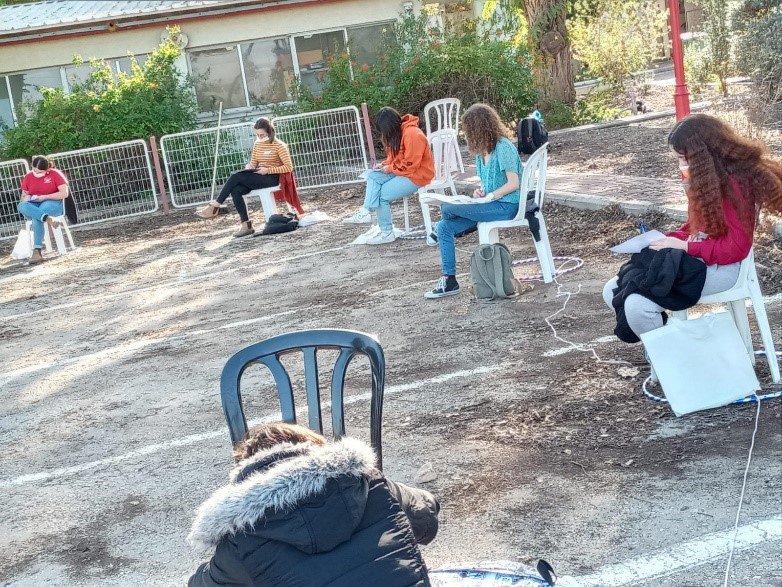
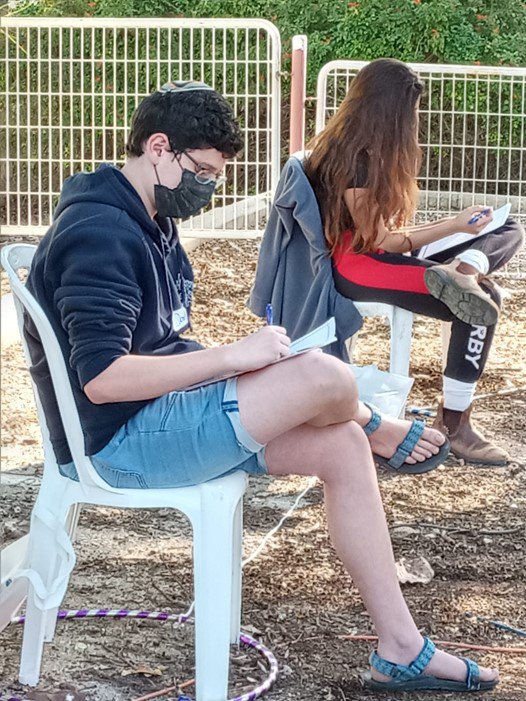
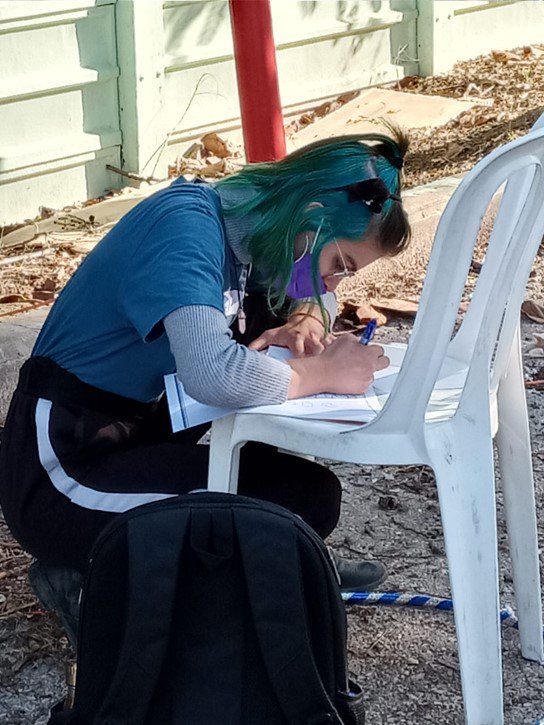
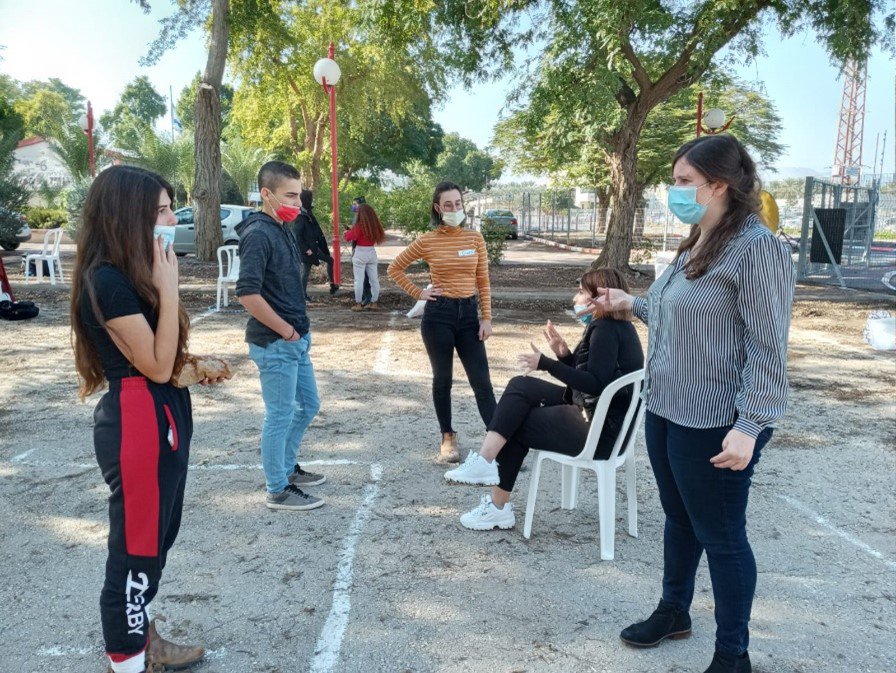
One group of students on a kibbutz in Northern Israel was learning how to make peace. Facilitated by the Jerusalem Peace Builders, fifteen teenagers with varying degrees of piercings, torn jeans and loud colors in their hair, sat in an enormous circle in the old staff parking-lot-turned-makeshift-classroom adapted for the pandemic. 

Jerusalem Peace Builders (JPB) is an interfaith organization that brings together youth from different backgrounds, from Jerusalem, Israel, Palestine, and the United States, to create meaningful encounters. The first session is held separately at each school so students can start to build important dialogue skills such as active listening and empathy before meeting each other. 

This workshop began by exploring personal identity. They asked questions like, ‘Who are you?’ ‘What makes you unique?’ Important questions for teens who are about to get to know kids seemingly so different from themselves.


Just before the lunch break, the group played a game. Sarah, one of the facilitators, a quiet, young woman with silky, dark hair and skin, and deep brown eyes, sat inside the circle. The other facilitator, Yardena, taller and chattier, asked the questions and recorded the answers on a portable white board.

Where was Sarah from? What languages did she speak? How much education did she have? What did she study? Was she married? Did she have kids? 

What kind of assumptions do we make about people upon meeting them?

At first glance, it was hard to peg Sarah. She was most definitely from the Middle East, but nothing about her appearance, her accent, or even her name, indicated whether she was more likely to be Arab or Jewish. 

As Yardena posed the questions, students’ answers spanned the spectrum. She was from Egypt, from France, from Jerusalem, or maybe Ashkelon. She spoke English, Hebrew, and maybe Arabic. Perhaps Italian. She was a teacher, a lawyer, or a social worker. 

Michael had been a student the year before in the ninth grade English-speakers club. Wild haired with thick glasses and fiercely competitive, English came easily to Michael and he was used to winning. When he attended his first Model UN last year, he walked away with second prize. “It’s easy,” he said after with a wink and a dismissive wave of his hands. “You just need to speak a lot and pretend you know what you’re talking about.”

Michael was sure he had this game. He pulled his teacher aside. “She’s Arab, right?” It made sense since it was a coexistence workshop and Yardena, Sarah’s partner, was clearly Jewish.

Still, Michael fell into all the traps: If she was Arab, she must be poorly educated. But she was so articulate, so she must be wealthy and worldly, with some foreign Arab Passport. Jordan? Egypt? Certainly not Palestinian.

When Sarah shared that she was in fact Palestinian, Michael’s face twisted. He didn’t always take kindly to being corrected, but there was no denying who she was. As it turned out, she was from East Jerusalem, and had no passport at all. 

“Well, that’s a choice,” Michael shot back. “East Jerusalem Palestinians don’t WANT Israeli passports because they don’t accept the State of Israel.”

“There are Palestinians like that,” Sarah conceded, “But many people like me want them so we can live a normal life. Unfortunately, the passports are not easy to get. After we apply for a passport, it can take years to receive an answer from the government, and then fewer than half of the requests are even approved. Without a passport, I’m not a citizen of any country. I’m not free to travel anywhere in the world.” 

Michael’s second assumption was also shattered. “Palestinians are the most educated Arab population in the world. Especially the women,” Sarah said.

“Really?” Michael raised his thick eyebrows till they reached his fluffy mop of hair.

Sarah’s smile was more conciliatory than cynical. “Well sure. We can’t travel and there aren’t so many jobs. What else do we have to do with our lives? So, we study.”

Michael didn’t speak again as Sarah answered the rest of their questions. She wasn’t married, no kids. She’d been studying physics, but when she got involved with JPB, she decided to dedicate her life to helping promote co-existence. She loved traveling to schools and meeting students with such different backgrounds than hers and sharing her story. 

During the break, several students stayed to chat with Sarah, foregoing their lunch and only free time. She patiently answered their questions and asked some of her own. The rest of the day the students continued to explore identity. They were asked to map out all the things that made them who they were and highlight those that defined them best. As they discovered, how they define themselves—dancer, student, good friend—changed depending on the day or the situation, or their stage of life. 

At the end of the session, students were asked to share something they were taking away from the day. When it came to Michael’s turn, the other kids stepped in close, eyebrows raised in anticipation of his witty, cynical remarks.

Michael glanced down and then looked at Sarah. He smiled and joined his hands together in a rare gesture of gratitude. “Today I learned that I don’t know everything, and that’s okay.”

The next day, three ninth graders were diagnosed with Corona and the whole school went home for what would be the next eight months. To the great dismay of both teachers and students, their first JPB workshop was their last. 

But Covid has taught us at least two important things. First, we’re all in this together. Second, we must constantly adapt to an ever-changing world. 

Sarah gave up her whole career path to pursue peace. And Michael was able in one day to rethink everything he believed about people. What have you learned in Covid? And how do you plan to use it to change the world?

       —Emily Singer, Israel. She adds: “I am a writer and English teacher in Northern Israel, where I have a special passion for bringing students together from different ethnic, religious and cultural backgrounds to help them appreciate diversity and develop important negotiation and peace-making skills… In 2018, I published my first children’s novel, “Gilgul I: Re-Dedication.”  

What Peace Is to Me

What Peace Is to Me by Paulette Ansari, Georgia.
 
Peace within is so many different things to each of us.
 
Peace is being able to sit in the grass reading a good book and not be devoured by insects.
 
Peace is being able to speak passionately about one’s life and not be labeled “angry black woman”.
 
Peace is being able to go to any public place in the U.S. (in the world even) and not have to worry about being treated badly or unfairly because you are a different race, creed, or religion or because you happen to be a woman.
 
Peace is having enough time to read a great book, knowing you won’t be disturbed.
 
Peace is knowing all is well with the people you love.
 
Peace is being able to laugh with others at yourself.
 
Peace is knowing God’s will for your life and walking in it.
 

The Sweetest Treat

The Sweetest Treat

By Jacob Lockett, emerging author, Pennsylvania.

Roshni finished making her costume at five o’clock on Halloween night. Happy with her work, she ran downstairs.

“What do you think, Mama?” she asked. “I’m a khargosh.”

Mama turned from the stove, where she was cooking. “Wow!” she said. “You’re such a cute little bunny!”

Roshni giggled. “A cute little bunny that can jump really high!” she said, hopping around the room on spring shoes she had made herself.

Mama handed Roshni a pumpkin-shaped bucket. “Ready to trick-or-treat at school tonight?”

“Yep,” Roshni said. “I love getting candy!”

“Remember, you have time to go trick-or-treating at just one or two houses before going to school,” Mama said. “And I want you back by dinner.”

Roshni nodded excitedly.

Mama hugged her. “Get hopping. Halloween comes only once a year!”

With a spring in her step, Roshni bounced out the door and into the cool night air, her large bunny ears flopping this way and that. Kids ran around the street, dressed in fun costumes.

As Roshni hopped to school, she looked around her neighborhood, deciding which house to go trick-or-treating. A house with a ramp and a brightly lit pumpkin by the door caught her eyes. She remembered Mama telling her that a new family had moved in recently.

Curious to see what her new neighbors were like, she went over to the house and rang the bell.

The door opened.

“Trick or treat!” Roshni shouted.

A boy in a wheelchair appeared, a candy bowl sitting in his lap.

Roshni recognized him. He was DeAndre Lewis, the new kid at her school. He was in a different grade than Roshni, but she sometimes saw him in the hallway. He always seemed… lonely.

She waved. “Do you remember me from school? I’m Roshni.”

“Sure. I do remember,” DeAndre said, smiling. He rummaged around in the bowl, giving Roshni a Nougat Rocket Bar. “Super costume!”

Roshni blushed. “Thanks! I’m a khargosh—that’s the Hindi word for bunny.”

“That’s really cool,” he said.

“So, are you trick-or-treating?” Roshni asked.

DeAndre shook his head sadly. “My mom’s too sick with a cold to take me out tonight.”

Roshni gasped. She couldn’t imagine not going trick-or-treating. She looked at DeAndre’s sad face, and Mama’s words came back to her: Halloween comes only once a year…

“I can take you trick-or-treating,” she offered.

DeAndre’s eyes shone with hope. “Really? That would be wonderful! I’ll go ask Mom.”

DeAndre returned to the door with Mrs. Lewis. “You must be Roshni,” she said, sniffling. “Your mother told me so much about you at the store last week. DeAndre said you want to take him trick-or-treating with you.”

Roshni explained about their school’s Trick-or-Treat Fair and how there would be lots of treats, games, and contests for DeAndre to enjoy.

“Sounds like a good time!” Mrs. Lewis said. She turned to DeAndre. “Get your costume, honey. You can go have some Halloween fun with Roshni tonight.”

DeAndre’s face lit up just like the jack-o’-lantern that sat outside his door. He turned around and disappeared. He soon came outside wearing a superhero’s mask and a long cape.

“DeAndre, I want you back by seven,” Mrs. Lewis said. “Now, go have fun.”

The kharagosh and the superhero went off into the moonlit night. In no time at all, they arrived outside the school, which was covered with Halloween decorations. After DeAndre wheeled himself up the long entrance ramp, he and Roshni entered the cafeteria to the sound of spooky music and laughter.

They went around to different booths, collecting delicious treats from their teachers.

As Mrs. Garcia handed the kids each a pack of Licorice Lassos, DeAndre asked Roshni, “What are your favorite sweets?”

“I have so many!” she replied. “But I think my favorite would have to be galub jamuns. I make them with Mama for special occasions. They’re kinda like spongy—”

“Donut holes!” DeAndre finished.

“How did you know?” Roshni asked, surprised.

“I had one during Multicultural Day at my old school,” DeAndre explained. “It was one of the best things I’ve ever tasted. I make them with my mom now, too!”

They laughed, high-fiving.

After they were done trick-or-treating, Roshni entered the costume contest. After Roshni and the other contestants had displayed their outfits for the judges, Principal Jackson cleared his throat near the microphone. “And, the first prize goes to Roshni Kaur with her homemade bunny costume! Come on up!”

“Way to go!” DeAndre cheered loudly from the audience as Roshni hopped on stage to receive her blue ribbon.

DeAndre pointed at the haunted house in the corner of the cafeteria. “Let’s go in there.”

Roshni shivered. “I don’t know…”

“Have no fear!” DeAndre shouted, striking a pose. “I’ll protect you!”

“Ok,” Roshni said. “As long as you protect me, I won’t get scared.”

They went into the haunted house. Kids dressed as monsters jumped out from the shadows to try to frighten them. But every time they did, DeAndre would boom, “Back, you villains!” in his superhero voice. Roshni couldn’t stop smiling. Because of DeAndre, she didn’t get scared, not even once.

After they bobbed for apples, they sat at the snack table and drank pumpkin punch and talked about their favorite scary movies. All of Roshni’s favorites were DeAndre’s favorites, too!

Soon, Roshni checked her watch. She felt her heart drop. “It’s almost seven,” she said glumly. “Time for us to go home.”

“Aw,” DeAndre moaned, shaking his head sadly. “Do we have to?”

DeAndre guided his wheelchair down the school’s ramp and onto the sidewalk. He looked up at Roshni. “Thanks for taking me. I had a blast!”

“Sure,” she replied, swinging her bucket of candy as she hopped. “Halloween comes only once a year!”

“Do you… want to trade candy tomorrow?” he asked.

“Yes, we can do it at my house,” Roshni replied. “You can help me make gulab jamuns when we’re done at my home. Mama would love it.”

DeAndre giggled. “Great. But… don’t you only make gulab jamuns for special occasions?”

Roshni blushed. “I do,” she replied. “But you’re the special occasion.”

Now DeAndre was blushing, too!

On that Halloween night, Roshni had collected many sweet treats. But the sweetest one she had received was a new friend, DeAndre.

By Jacob Lockett, emerging author, Pennsylvania.

Letter to the Editor: On Mental Health

Letter to the Editor

Re: The Talk: Bridging the Gap Between Parents and Teens – Skipping Stones

Mental health is a real issue that a lot of people talk about and donate money to. If nothing is done to solve the problem; a minor problem can turn into a big one.

Here is what we can do: Be proactive, and catch teens just before they go into a deep stage of depression. Check in on them every so often. Parents can be more aware of their child’s emotions, and they can have intimate one-on-one sessions with them. Acceptance is the key to the solution.

In my experience, my parents didn’t pay attention to mental health. They cared about success, and behavior (what parents should be caring about, but should not be so concerned with only that). Parents need to empathize with the children, because they have gone through the same things.

Kids need an outlet like a sport such as soccer, basketball, or baseball; a creative hobby like painting, drawing, theater, writing, reading. They need someone to talk to; to express their feelings.

Let’s hope the new generation will grow up understanding the importance of mental health and what it can do to a person, so that they can treat their own kids with acceptance.

—Mahima Pai, age 15, New Jersey.

Truly

“Truly”

By Isabelle Tee, age 15, New Jersey.

She doesn’t want you to join us,” she said, “you are too loud.”

For most of my elementary school years, I’ve never had an actual friend that I’ve felt comfortable enough to just be myself. Many of the people I’ve talked to were mainly acquaintances so that I didn’t look like a loner. Because when you’re on a field filled with kids who don’t think before they talk, the last thing you want to be is alone.

So I tried to befriend a group of girls that I’ve only distantly known from second grade. Whenever they talked to me, I just nodded. I had no clue what they were actually talking about. During recess, I just follow along and pretend to be the bad guy when we play games. During class, I’m the one giving them answers for worksheets. And during lunch? That’s another story.

My mom packed me fried rice that day, which—in my opinion—was better than the soggy dino nuggets. I sat down at the lunch table with my “friends” and ate my food. One girl starts to sniff the air and looks around. Then she goes, “What’s that smell?” She looks at me. All I could do at that moment was put on a fake smile. How can you be friends with someone who can’t accept who you are?

The following day at recess, I joined the girls at the corner of the field. Only two of the girls were standing there. I asked them what game they were playing, and they awkwardly looked at me back. They told me that the others didn’t want to play with me anymore, apparently, I was too loud for them.

I pleaded with them, promising I wouldn’t scream loudly and lower my voice. They looked at me and told me to wait. One of them ran over to the other girls and whispered something into their ears. When she came back, she allowed me into the group again. I kept my word and didn’t speak much. I didn’t want to go back home crying to my mom again.

I realized then that, from the beginning, they never truly accepted me. They were never true friends.

By Isabelle Tee, age 15, Asian American, New Jersey.

Discrimination Against Asians in the United States

Discrimination Against Asians in the United States

By Fanny Wong, Chinese American author, New York.

In May, we celebrate the resilience, legacy and culture of Asians, Native Hawaiian, and Pacific Islanders in the United States. As you may know, the last few years have been very difficult for Asian Americans. We were aghast at the March 2021 mass murder of eight people in Atlanta, Georgia. Six of the victims were Korean women. Asian Americans were already targeted for being “Asian” since the beginning of Covid-19 pandemic. Between March 2020 and February 2021, almost 4,000 anti-Asian hate incidents were reported throughout the country. Verbal abuse and physical attacks were recorded on surveillance cameras. Violence could be spitting, hitting, and shoving that led to injuries. In February 2021, an 84-year-old Thai man died after he was shoved to the ground in Oakland’s Chinatown in California. 

Since the arrival of Chinese immigrants in the 1850s, the United States has had a long history of viewing Asians as “The Other.” The early immigrants worked in gold mines and helped build railroads in the American West. They sent their hard-earned money to China to support their families, and repaid loans of their passage to America. They had little choice but to work for whatever wages they could. American laborers generally could bargain for higher wages, but they feared being squeezed out of their jobs by the Chinese immigrants. 

As with most immigrants, the Chinese settled in their own neighborhoods. The stories of crime and decadence in Chinatowns, some of which were true, so alarmed the public that the Chinese were called the Yellow Peril. 

The Chinese Massacre of 1871 was the first in a series of riots and killings in California. Los Angeles was a small town then. The 200 Chinese men who lived there were farmers, laundry workers, laborers and vegetable vendors. This small population lived in a segregated area called Calles de los Negros, a very rough neighborhood where no one wanted to live. That was where the Chinese could afford to live. 

On October 24, 1871, a dispute between two Chinese factions led to the accidental killing of a white bystander. People ran around saying the Chinese were killing White people. A mob of 500 white men descended on Chinatown killing 18, some of them by hanging. At the time, Chinese people were not permitted to testify against white people. Even so, a few of the perpetrators were tried and convicted. But they were released on a technicality. No one served a prison sentence, no one was held accountable.

In 1885, Chinese miners in Rock Spring, Wyoming, did not join a strike by white miners. This enraged the white miners so much that they stormed Chinatown, killing 28 Asians and injuring 15 more. Again, no one was held accountable. When news of the massacre spread, many people condemned the violence, but it also resulted in Chinese immigrants being driven away from some communities. 

By then, Congress had already passed the Chinese Exclusion Act of 1882, which suspended the immigration of Chinese immigrants for ten years. This Act was the first in American history to place broad restrictions on immigration based on nationality. In 1892, Congress voted to renew the exclusion for another ten years, expanding the restriction to cover Hawaii and the Philippines as well. This Act was not repealed until the year 1943, when a law passed set a quota of 105 per year. The Immigration and Nationality Act of 1965 finally abolished the National Origins Formula.

During WWII, some 120,000 Japanese Americans were sent to ten Internment Camps (see my recent article on this topic) in the Western United States. German and Italian Americans were not interned, even though Germany and Italy were also fighting American soldiers in Europe. 

Whenever there is economic hardship, someone becomes a scapegoat. In 1982, Vincent Chin, a 27-year-old Chinese young man, was mistaken for being Japanese. Japanese cars were selling very well, and many workers in American auto plants had lost their jobs. Vincent was bludgeoned to death by a laid-off autoworker and his stepfather, also a Detroit autoworker. His murderers never spent a day in jail. In this case as well, justice was not served. It was almost as if an Asian life was not worth anything. 

But Asians, just like everyone else, are worthy. They have contributed greatly in music, performing arts, science, sports, literature, and politics as well as all other fields. Duke Kahananmoku, Hawaiian American, popularized surfing in the 1920s. Dalip Singh Saund was the first Indian American to be elected in 1956 to the House of Representatives. Yuji Ichioka, Japanese American, was a historian and civil rights advocate. Jerry Yang, Taiwanese American co-founded Yahoo. Tammy Ducksworth, Thai American, is a disabled Veteran and a senator. Sandra Oh, Korean American actress plays roles that are not stereotypes. Sunisa Lee, Hmong American gymnast, won a gold medal in the 2022 Olympics. The list goes on and on. 

It is encouraging that movies made by Asians about Asians Americans are gaining popularity in the United States. The award-winning film “Minari” by Korean director Lee Isaac Chung tells the story of an American Korean family’s struggles and aspirations in rural Arkansas. Disputes between husband and wife, health issues of a child, generational differences and financial difficulties are familiar to those of white families. The more realistic Asian stories are told, the less they will be perceived as “The Other.” 

 In the past, Asians have survived racism by keeping their heads down. The younger generation is coming together and standing up for their parents and elders. It no longer believes that a nail that sticks out gets hammered down. ‘Head down and mouth shut’ is no longer an option. It is important to speak up about and work against injustices of racism. 

Different languages as well as cultural traditions among the many different Asian communities in the nation can make it difficult for them to unite for Asian advocacy. But it is important that we unite and be active for the cause. 

Let’s hope that as we celebrate the Asian American and Pacific Islander Month this May, we witness great strides being made to end racism in our nation.

By Fanny Wong, Chinese American author, New York.

The Internment of Japanese Americans During WWII

The Internment of Japanese Americans During WWII

By Fanny Wong, Chinese American author, New York.

The United States is a nation of immigrants. Japanese immigrants started to arrive on the Hawaiian Islands in the 1860s to work in the sugarcane fields. Later, many moved to the West Coast of the U.S. mainland to work as farmers and fishermen. By 1911, over 400,000 Japanese men and women had immigrated to the U.S. 

At the beginning of the 20th century, the Japanese were portrayed as the enemy of the American worker, just as Chinese immigrants were decades before. The Japanese farmers were the envy of white farmers who did not use as many labor-intensive methods and were less productive.

On December 7, 1941, the Japanese planes attacked Pearl Harbor. Navy ships were destroyed and many American servicemen died. On the West Coast, the government immediately began rounding up Japanese newspaper editors, community leaders and labor organizers. Their families were not told the reason or where the men were taken.  

The entire Japanese American population within 100 miles of the West Coast and Hawaii was considered dangerous, possibly spying for Japan. An 8 p.m. curfew and a five-mile travel limit were imposed on all persons of Japanese origin. On February 19, 1942, President Franklin Roosevelt signed Executive Order 9066, sending the Japanese and Japanese Americans to ten hastily built internment camps in Arizona, Arkansas, California, Colorado, Idaho, Texas, Utah, and Wyoming.   

The Japanese were shocked beyond belief. Two-thirds of the 120,000 internees were American citizens, born in the U.S. They were forced to sell or abandon most of their possessions, houses, cars, boats and land. Their possessions, including precious farmland, were sold at a bargain to white farmers. They had only a few days to pack and could bring only what they could carry. 

The camps were located where the weather was very hot in the summer and cold in the winter. The barracks were shoddily built, covered with tarpaper on the outside. Only canvas cots, a light bulb and a potbelly stove for winter warmth were supplied. Each family had to build its own plain furniture such as a table, chairs and shelves. There was no insulation. Dust and wind blew in through the cracks of wood that had not aged properly and shrank. Four families in small rooms shared one barrack. Within each room, blankets and sheets could be hung to provide some privacy. 

There was no way to escape these prisons. Barbed wires surrounded the camps. Armed guards surveyed from watchtowers. Life was regimented.There were lines for meals, the shower, the toilets and the laundry in communal buildings.  

In the beginning years, the food was American, such as hot dogs, stew, potatoes, liver and cow tongue, which the Japanese were not used to. Later, they grew their vegetables and even made tofu, soy sauce and noodles. Rice was added to the menu. The government spent only thirty cents a day per person on food.  

The internees were put to work with very low wages, from $8 to $19 a month. The camps needed cooks, office and field workers, food servers and construction workers. But many were bored. To relieve boredom, the internees organized outdoor sports for adults and youngsters. Baseball was a favorite pastime for spectators as well. Primitive baseball fields were leveled, rocks and stones removed. There were a variety of other activities, including movies, talent shows and holiday celebrations. 

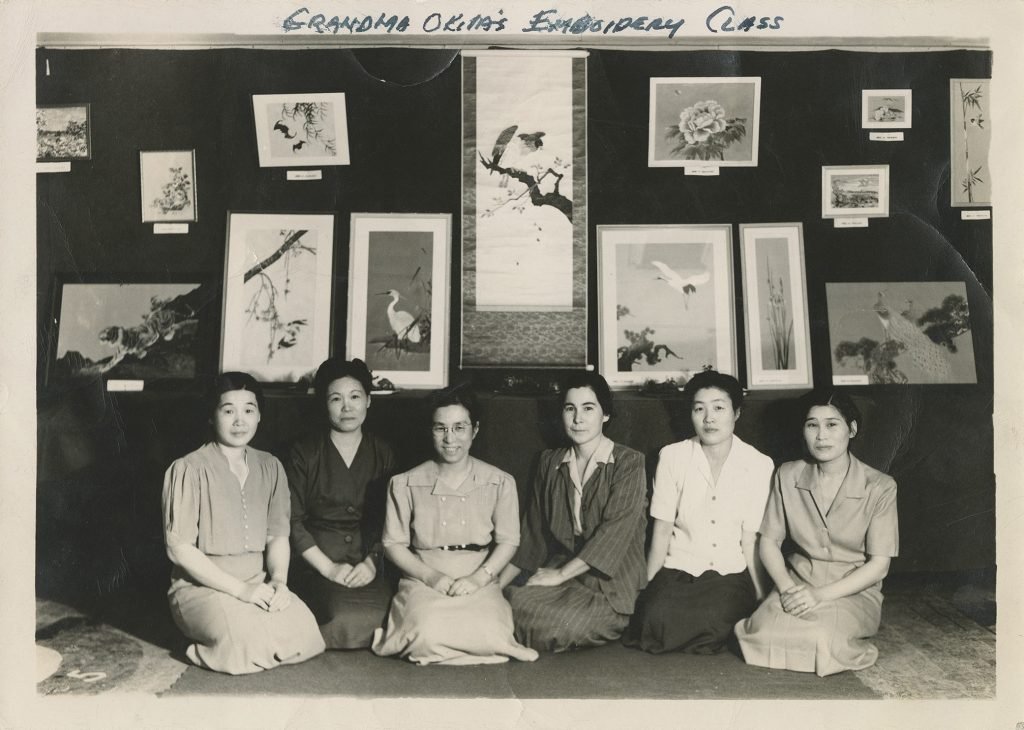
Grandma Okita’s Embroidery Class, Minidoka Concentration Camp. Photo: Courtesy of Japanese American Museum of Oregon, Portland, Oregon. Permission from JAMO required for further reproduction.

The internees were stoic about the experience, often repeating “Shikata ga nai” meaning you can’t change it. They tried to make their lives as pleasant as possible. They ordered fabric from catalogs to make curtains and tablecloths. Paper flowers decorated the rooms. They created tiny gardens in front of the barracks and even small ponds to make their bleak surroundings acceptable. They created handicrafts from dead trees, wood and material found around the camps. Painters, both professional and amateur, recorded the daily activities of the camp in their artwork. Art lifted the spirits of the internees. Their acts of beautifying their surroundings were something the government and the prison guards could not take away from them.  

Some 17,000 children under the age of ten were among the internees and more were born in the camps. Schools were organized for the children from kindergarten to high school. Used textbooks were sent from nearby schools. Most of the teachers were Japanese, although there were some white teachers who had better living quarters. 

In some households, family closeness was a casualty. Children witnessed their parents’ loss of control in their lives. The parents lamented that the children would rather eat with their friends at the mess halls. Teenagers became more rebellious as many of their peers did in the outside world. But in their abnormal lives, the strain was more severe.

Still, the internees were patriotic. They made camouflage nets, bandages for the war, donated money for the Red Cross, and collected metal for recycling.

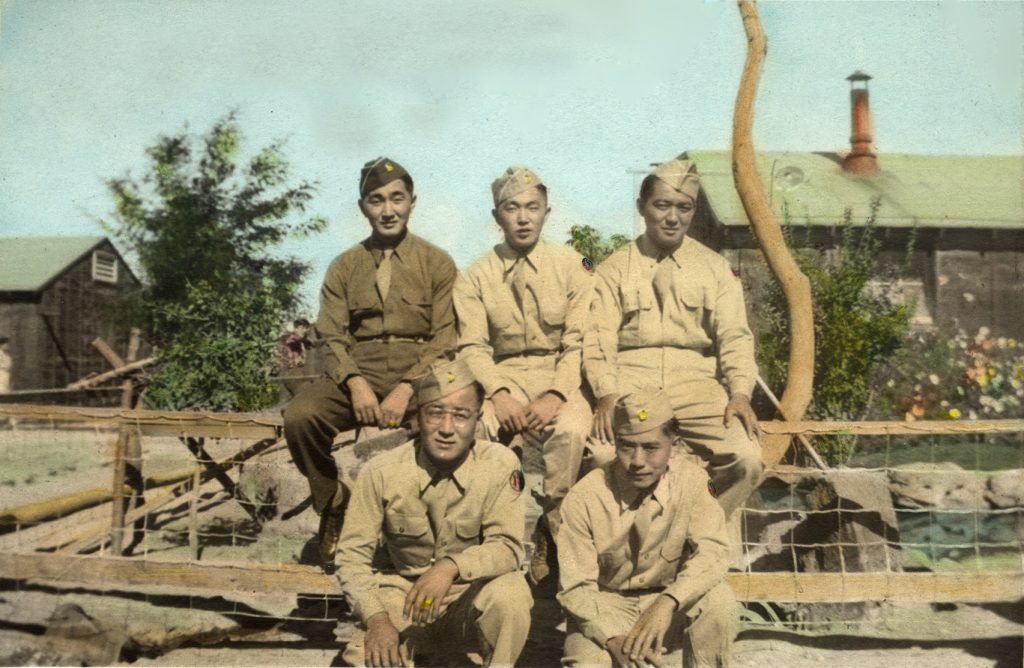
Nisei Veterans of the 442nd RCT, Minidoka Concentration Camp. Photo: Courtesy of Japanese American Museum of Oregon, Portland, Oregon. Permission from JAMO required for further reproduction.

Beginning in February 1943, citizens of Japanese descent were permitted to enlist in the Army and Navy. Many young men joined the 442nd Regimental Combat Team (RCT) that was comprised of all Japanese American soldiers and fought valiantly in Europe. This regiment was the most decorated unit in the army. They operated in some of the most dangerous battles, and therefore, had the highest casualty rates (9,000 dead or wounded). They put their life in danger for the country even though their parents and relatives were in the internment camps. When the soldiers were wounded, when they were released after treatment, they would be sent right back to the internment camps. 

Towards the end of war, the government began releasing large numbers of the internees. The internment camps were empty by the end of 1945, and the last one closed in March 1946. Most Japanese Americans did not return to their hometowns because there was nothing to return to. Those that did return had a difficult time finding work and accommodations. A small number chose to go back to Japan. Each released person was given just $25 and a bus ticket to start their new life.

At the end of the war, no American Japanese were found to be spying for Japan. Later research proved that some American officials were guilty of falsifying reports that were used as the basis for the government’s internment decision.

In 1988, President Ronald Reagan signed a legislation apologizing for the internment on behalf of the U.S. government. In 1990, the first letters of apology signed by President George Bush were mailed. Surviving interned Americans and their heirs received $20,000 compensation for each individual. For many, the apology and the check came too late—they had lived a very difficult life, and many of them had already died. 

After the 9-11 attack by Muslim terrorists, fear mongering and Islamophobia depicted Muslim as dangerous to Americans just as the Japanese were demonized after the Pearl Harbor attack. The anti-Muslim sentiments being expressed in the country led the Japanese American community to publicly state that the horrible injustice done to them in WWII must not be repeated. It continues to raise its voice whenever an ethnic group is unjustifiably targeted. 

By Fanny Wong, Chinese American author, New York.

Editor’s Note: May is celebrated as the Asian American and Pacific Islander Heritage Month in the country. 

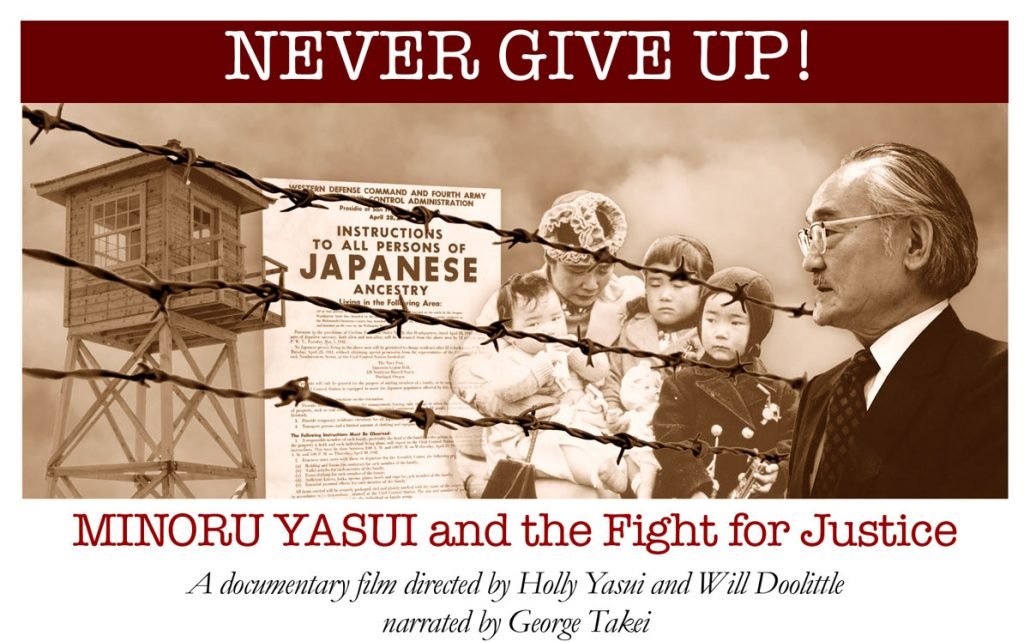
Never Give Up is an award-winning documentary that teaches about the discrimination faced by the Japanese American community and the issues described in the above article. You can get details from the website: www.minoruyasuifilm.org

The Most Precious Gift

By Yarynka Yarosh, age 15, grade 9, Kyiv, Ukraine.

Standing near the window in her room, Christine cried quietly. She had long ago learned to wail silently so that no one would hear. Especially Mom. Or maybe she had just spent all her loud tears. Sometimes, after a series of such noiseless sobs, her pillow was too wet to sleep upon. Now those silent, salty streams were there once more, flowing down her cheeks, sprinkling her favorite violet raglan. 

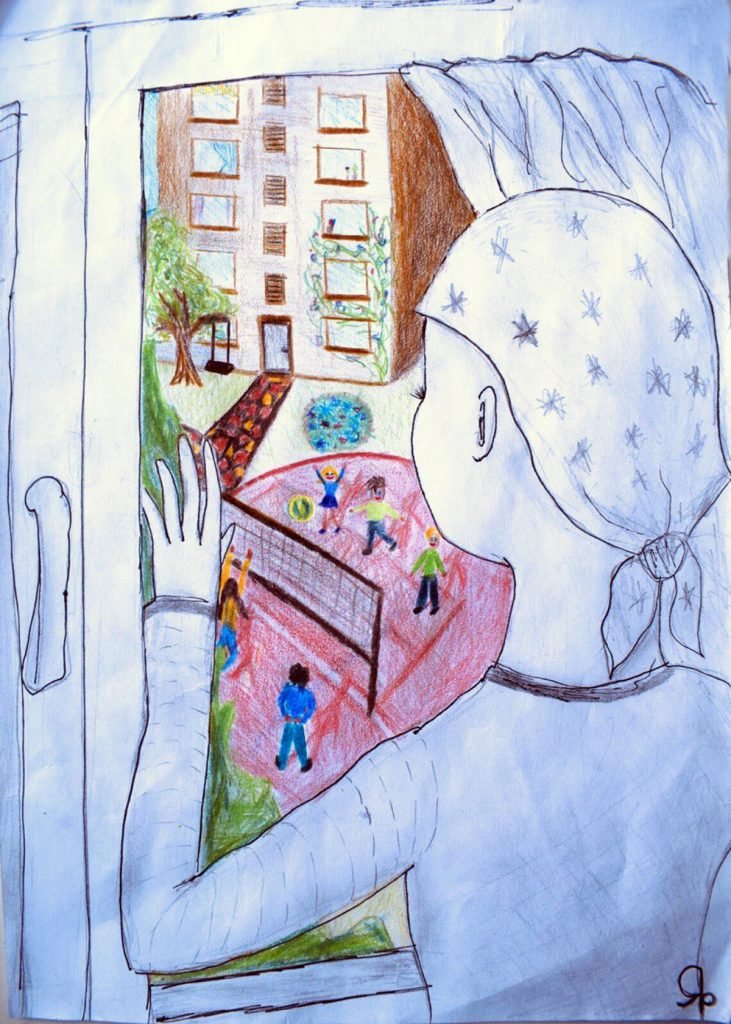
Down there, in the yard, her friends are playing volleyball. Olenka serves the ball to Max, he hurls it over the net at Slavko, but Slavko palms the ball back skillfully. Twins Marusya and Oles` back him up closely. The whole team was there, except Christine!

The last time, they had played together was at the start of November, before the first snow. Then came that long and cold winter when Christine fell ill. Now, all the danger was past her, but she still couldn’t play. So every single day she just stood at her window, hidden behind the curtain and watched the exciting game. Her friends shouted for her every time they went out, but she rejected all invitations. She had no difficulty running. No, there was another reason—she just couldn’t confide in them. 

Christine sighed and sat on her bed, burying her head into her hands. Not a single hair under her fingers.

Last year had changed Christine’s life radically, ruining plans, dreams. The hospital room, IV`s, doctors, that awful laser lamp, endless chemos were again flickering before her eyes. Christine had no wish to replay all those dreadful months in her head, so she shook her head like she used to do before all that when she still had her beautiful hair. Oh, she was so proud of it! She had the longest hair in her year! And now she has nothing, but plenty of unpleasant thoughts scurrying in her head, like a scattered jigsaw puzzle. Christine was so full of self-pity that she started to cry again. After all this, she had learned to bear physical pain, but not the absence of her chestnut curls.

Oh, how she wanted to run with the “Volley Sixth” again, but…

Christine didn’t want her friends to see her without hair—anything but that! Her pals still had no idea that she was now bald—her parents bought her a wig so that no one would ever know.

Illustration by Yarynka Yarosh, age 15, grade 9, Kyiv, Ukraine

Christine got up and returned to the window. The field was now ringing with laughter—Slavko had just returned the ball in an unusual manner, locking his fingers in a weird knot. Christine poked her head out of her hidey-hole behind a curtain and imagined herself running over the field with her friends. There she is, taking a pass from Slavko, then feeding the ball out to Olenka and running for it just in time to catch a master shoot from Oles`, and then…

Everybody at the field was suddenly staring at her, at her window. Five confused faces. Absent-mindedly Christine scratched her head and suddenly the chills went up her spine… She had forgotten to put her wig on! She usually went about the flat without her fake hair and watched the game from behind the curtain. Today, however, she got so carried away she completely forgot to mind the “danger zone”.

Realizing that her friends saw her baldness the girl yelped and hid her face in her hands. Then she darted away from the window, fell on her bed, and burst into tears. Tomorrow’s her birthday and all the members of “Volley Sixth” were planning to visit—that was the most tragic thing of all!

Her Mom came into the room, alarmed.

“I`m the only bald person in my class! No, in the whole school, in the whole city!” cried Christine loudly, like the moment she was told about her diagnosis. “I don’t want any party on my birthday!” 

Mom hugged her tenderly. “But your hair will grow back, for sure, my skylark,” she soothed. 

“I can’t speak to them normally, knowing they saw me bald!” 

“If they are really and truly your friends, that should mean nothing to them,” she responded. 

But does she really have… true friends?

That night Christine had a beautiful dream. 

“Come on, Christine, serve it! That’s my girl!” shouted Slavko. 

“It’s so good to play volleyball with my friends!” Christine was rejoicing, serving the ball on the other half of the field. Suddenly, she saw it hurtling towards her. She wanted to break it, but her knees quaked and felt like cotton…

Somebody touched her shoulder very softly. Christine opened her eyes and instantly squeezed them tightly shut, hiding from the tickling morning light… Mom and Dad were standing near her bed, smiling and holding a present. So she had only dreamt about the game, how sad!

“Ding-dong,” rang the entry phone in a while. Christine quickly slipped her wig on. 

And there they were! Olenka, Slavko, Maxim, Oles` and Marusya. They had come empty-handed, and for some reason, were all wearing hats. 

 “Well, as agreed! On the count of three,” cried Slavko. “One, two, three!”

“Happy birthday!” And they swept off their hats as one.

They all had clean-shaven their heads! 

And they hugged the birthday girl, all at once.

That was the best birthday party Christine ever had! 

After the birthday treats, “Volley Sixth,” now fully complete, went to the sports ground before Christine`s window. Now Christine had difficulty identifying her friends on the field, she still hadn’t got over their new hairstyles. 

Then she remembered her dream. Now she couldn’t recall whether she had her curls there or not. Not that it had any importance now. She was quite happy without her hair now, for she had true friends.

By Yarynka Yarosh, age 15, studies in grade 9, Kyiv, Ukraine.

Yarynka writes, “I like painting, playing piano, reading, speaking with my family about anything, writing poetry, and stories, of course. I’m from Ukraine, and I want peace in the whole world, and for ourselves.

“On the 9th of March, we were forced to leave our home city, beautiful Kyiv (because of the Russian invasion)… Now my family and I are in a safe place, and I’m so thankful to God that we are still alive! But my grandparents are still in Kyiv. Please, pray for them!

“I was really surprised, when I read your email (of acceptance). I’m thankful for your positive response. You made me happy and gave me more confidence and hope 🙂 Ukraine needs your prayers, we feel your emotional support.”