Category Archives: Family and Community

Sri Lankan (Sinhalese) New Year

Sri Lankan (Sinhalese) New Year

By Seja Kularatna, Age 10, Wisconsin.

Hi my name is Seja. I am 10 years old, I live in Wisconsin, and my parents are originally from Sri Lanka. I will tell you about the Sri Lankan New Year. Sinhalese New Year, called Aluth Avurudda in Sri Lanka, is celebrated on April 13th or 14th each year.

Sri Lanka is an island country that is just south of India. The temperature is always warm in Sri Lanka.

This year, the Sri Lankan New Year is on April 14th. Before this special day, people make preparations that include cleaning and redecorating our houses, making of Kevum (our traditional sweets) and Kiribath (milk rice) and engaging in religious observances.

Every year, here in the United States, we have a Sri Lankan New Year Celebration with friends and family. We have lots of yummy dishes, games, and entertainment.

Ladies wear Sarees and the girls wear Lama Sarees. Lama means kids in Sinhalese, so they wear kid’s versions of the Sarees. The men and boys wear traditional clothing. They have long sleeved shirts and sarongs. Sarongs are like long skirts for boys and men. The kids wear their white clothing to sing the Sri Lankan National Anthem.

For the New Year celebration, the kids perform dances or sing Sinhalese songs. Our parents begin training us a few months prior to the celebration. Usually, we do group dances with other kids, so we go to each other’s homes to practice. The parents make our dance costumes.

On the Sri Lankan New Year, there are different types of food. Lots of people like to make something at home and bring it to share. We usually eat rice with other side dishes, and when we’re done, we eat sweets.

The adults plan games for the kids. We usually play games like Tug of War, Draw the Eye on the Donkey, Musical Chairs, and more.

The Sri Lankan New Year is an occasion to pay homage to our elders and receive their blessings, to renew our relations with friends and relatives. It is time for great fun and enjoyment for the kids. My favorite part is practicing the dances with our costumes and props.

By Seja Kularatna, Age 10, Wisconsin.

Early Bilingual Education

Taking it One Baby Step at a Time:  Why We Need Early Bilingual Education

By Michelle Lo, 17, New York.

If you’re like any typical American high school student, this is how your language-learning journey will go: you spend three years blazing through vocabulary and learning all of the tenses, grammar, and tones of the language, only to forget everything that you’ve learned by the time you’ve graduated (except for maybe how to ask to use the bathroom or where the library is).

Meanwhile, with the rise of globalization over the last century, bilingualism and multilingualism have become some of the most important skills to have as an individual. Some of the many benefits to bilingualism include a communication advantage in the world’s competitive job market, the ability to communicate and connect with people from a variety of social settings, and a wider global perspective. So, if being bilingual or multilingual is that important, how might we improve the way we teach language such that our students can actually become fluent in them?

The solution, as simple as it may be, is to have our students start early.

One of the clearest benefits to learning a new language early is that the younger you are, the easier it is to pick up the language. In a linguistic study done by a research team from Boston-based universities, researchers aimed to pinpoint the age at which our ability to learn a new language disappears through a short online grammar quiz. Individuals were asked about their age, language proficiency, and time studying English. The study concluded that children up to the age of 18 are proficient at learning a new language, while children up to the age of 10 can achieve the level of grammatical fluency of a native speaker. There are many reasons why children generally have an easier time learning a new language. Younger children are less fearful of making mistakes than adults and teenagers, a hurdle that one must overcome in learning a new language. Certain brain structures in children also make this process of language learning easier. One study conducted by researchers at UCLA observed rapid growth in the parts of the brain that are responsible for developing language skills between the ages 6 and 13, but a sharp decline in growth after age 13.

Contrary to what some may believe about bilingualism, learning a second language during a person’s most formative years will not affect their ability to speak their primary one nor will it confuse a child. As a matter of fact, numerous scientific studies have concluded that being multilingual can offer numerous cognitive and intellectual benefits for children. A 2004 study by psychologists Ellen Bialystok and Michelle Martin-Rhee found that the brains of bilingual children had better executive functioning than those of their monolingual peers. This meant that bilingual children were better at planning, solving problems, etc., which stemmed from their ability to switch from one language to the other. Various studies have also proven that bilingualism can lead to higher intellectual performance and higher creativity.

Yet, despite the overwhelming evidence supporting early language learning, the U.S. is falling significantly behind other countries in foreign language learning. As the American Councils for International Education reported in 2017, out of all 50 states and the District of Columbia, only 20% of K-12 students are enrolled in foreign language classes, compared to the European median average of 92% thanks to the national-level mandates for foreign language education. In addition, many European students begin to take foreign language classes from the ages 6 to 9, whereas most American students begin in their high school years. Unlike many European nations, many states lack requirements regarding foreign language education or the age at which students should start in place, causing more lag for American students.

In order to make up for this lag, we need to start taking steps in emphasizing foreign language education, beginning in early childhood. That could mean implementing a more standardized system in the state where all students can begin to get some exposure to foreign languages from kindergarten. We could also expand dual language programs, one of the many great ways early childhood foreign language education can tap into a child’s language learning potential. Although dual language programs vary in form, most are designed to teach students in two languages in order to foster bilingualism and biliteracy. Usually, one half of the instructional day is taught in a foreign language and the other half in English. Many of these dual language classes are immersive. For example, children are encouraged to learn through play, song, and social interactions with their peers, which, over time, can help to foster their interests in learning the language and culture. These programs are great for English-learners and native English-speakers alike. For English-learning students, a bilingual classroom allows them to build friendships with their native English-speaking peers, a relationship that would not have been possible if it wasn’t for their mutual understanding of each other’s languages. For native English speakers, sharing the classroom with non-native speakers and immigrant students will help normalize the diversity in languages and cultures in the classroom.

If we expect our coming generations to build a future that is diverse and multicultural, we need to first construct the foundation: an improved and earlier foreign language education system for all students. Students, teachers, administrators, families, and change-makers of any form can all contribute to this cause by recognizing this need and advocating for better early bilingual education, whether that be writing to your local representatives or spreading awareness within your community. That way, we’ll just be one baby step closer to a truly globalized future.

—Michelle Lo, 16, New York. She adds: “I’m an American-born-Chinese, or ABC, that has always been interested in language and culture. Growing up, I spoke only Chinese as a young child but after rigorously studying only English during my childhood years, I lost my ability to speak Chinese. This is something that I deeply regret as I felt that it created a barrier between me and my culture. As a result, I hope to spread awareness about the importance of bilingualism in our multicultural society to prevent cases like mine from happening.”

Sources:

American Councils for International Education, 2017, The National K-12 Foreign Language Enrollment Survey Report, www.americancouncils.org/sites/default/files/FLE-report-June17.pdf.

“Benefits of Learning a Second Language at an Early Age: Ertheo Education & Sport.” Benefits of Learning a Second Language as a Child | Ertheo Education & Sport, 10 June 2020, www.ertheo.com/blog/en/learning-a-second-language/.

Bhattacharjee, Yudhijit. “Why Bilinguals Are Smarter.” The New York Times, The New York Times, 17 Mar. 2012, www.nytimes.com/2012/03/18/opinion/sunday/the-benefits-of-bilingualism.html.

Devlin, Kat. “Most European Students Are Learning a Foreign Language in School While Americans Lag.” Pew Research Center, Pew Research Center, 6 Aug. 2018, www.pewresearch.org/fact-tank/2018/08/06/most-european-students-are-learning-a-foreign-language-in-school-while-americans-lag/.

Smith, Dana G. “At What Age Does Our Ability to Learn a New Language Like a Native Speaker Disappear?” Scientific American, Scientific American, 4 May 2018, www.scientificamerican.com/article/at-what-age-does-our-ability-to-learn-a-new-language-like-a-native-speaker-disappear/.

Talukder, Gargi, et al. “Brain Development Study May Provide Some Help for Educators.” Brain Connection, 9 Dec. 2016, brainconnection.brainhq.com/2000/09/20/brain-development-study-may-provide-some-hel

Umama, Khujista. Personal Interview. 18 Dec. 2020.

Zhang, Jingyu. Personal Interview. 16 Dec. 2020.

What’s it Like to Be a Teen with Social Anxiety

By Mehek Azra, age 15, New York.

When you’re a teenager, you may find yourself worrying about how others perceive you. You are pressured to fit into several norms. There is always a right and a wrong thing to do if you want to make friends or be liked by your teachers. And all of these expectations can be extremely overwhelming, especially to a kid. But many teens grow into having social anxiety. Social anxiety is a response to trauma. And I know that the word “trauma” gets thrown around a lot but regardless of how “small” or ”big” it is, but it is still a trauma.

Some of the experiences (trauma) that often lead to social anxiety are: being bullied, being humiliated in a social situation, or being pressured to participate in class. But the sad reality is, that society acts blind when it comes to teenage mental health. Teens with mental illness are being neglected because they are too “young” to be facing any issue.

Teachers or parents don’t really notice when a student has social anxiety because they think they are “shy.” Being shy and having social anxiety are not the same. Shy kids can gradually come out of their shell at one point but those with social anxiety don’t. They have a constant fear of being judged harshly by others. So when they are told, “Don’t be shy! We are all here to help,” it doesn’t necessarily help.

I was generally a very quiet kid who did not speak much in school. You can also call me an introvert because that’s what I am. Being an introvert is already a stressful factor about myself that makes every day things hard, such as school. And having social anxiety, on top of that makes it even more horrifying. Since I have extreme social anxiety, I will mention some of the things that trigger my anxiety, and if you can relate to these, you may also have social anxiety.

  • 1. When a teacher randomly picks on you to read out loud, you sit there in silence and you panic. You’d rather get a zero than participate because you are afraid your classmates will secretly laugh at you.
  • 2. You’re at the mall and a group of teenagers walk by and they start laughing, and you think they are making fun of your outfit.
  • 3. Your mom asked you to make an order at McDonald’s, and you start to sweat. You plan out the conversation in your head multiple times before you actually speak because you’re scared they will judge you.
  • 4. You constantly avoid going out with people because you’re not sure they will like you.

I will share one of my own personal stories. When I was in 4th grade, one of my teachers would often call out on me during class in front of my classmates, either to read something out loud or just to participate. According to her, she was just trying to help me speak up. But she didn’t realize that she was promoting quite the opposite. It made my social anxiety worse. One time in my freshman year of high school, we had a project that we were then required to present. I kept getting anxious about it way before the due date. When it was finally my turn to present, my hands turned cold, sweating excessively. My heart was beating so fast, it seemed like it could burst out of my ribcage anytime. Although the presentation seemingly went well, it was dreadful. And that is just one of the many terrifying experiences.

If you have social anxiety, you may feel more comfortable expressing yourself through writing. You may prefer text over calls. No matter how much you love them, you are not going to respond to that FaceTime call. It gets to the edge in school, or at least it did for me. The madness about constant group work and participation made me despise school. Though classes are all online now, social anxiety does not go away. You may still be afraid to unmute yourself to answer so you just don’t join your classes anymore.

Many suggest therapy to overcome social anxiety. But not everyone has that option. So what can you do? First of all, know that nothing is wrong with you! You are not alone. Social anxiety is not always recognized or spotted easily by others. So that kid in your class who you think is confident, not afraid to speak, and answers questions effortlessly, might have a fear of social judgment. You can’t tell. Some are just better at hiding it.

One of the methods that seemed to help me with my social anxiety is self-talk. Since I am afraid to let anyone know about my issue, I became my own therapist. Talk to yourself the way you wish others would talk to you. Never disrespect yourself. Remind yourself that as much as you may think others are judging you, most of the time they are just busy with themselves. The teenagers in the mall laughed because one of their friends made a joke. That one girl laughed when you were reading out loud because she and her friend were making inside jokes that did not involve you. We stress too much about how others see us. But you need to see yourself for who you are. Be aware of your triggers. Avoid situations that will make your anxiety eat you up. You do not need to do things to please others. Use your preferred way to share your thoughts and let others know about your issue. Please pay attention to yourself!

I want to let teens like me know that they are not “weird.” They don’t need to “fit in.” I am speaking up on behalf of those who struggle to express their thoughts. And I also want teachers to be mindful of how their students are and not pressure them to do presentations. They should offer alternatives in which the students can contribute their ideas without increasing their social anxiety. I shared my thoughts but will you take them into consideration?

By Mehek Azra, 15, high school sophomore, New York. She is Bengali (from Southeast Asia).

The Codependency between ‘Peace’ and ‘Trust’


By Aliya S., grade 7, INDIA

The literal definition of peace would mean a state of calm, quiet and serenity. But the human race is far more complex, so we would refer to peace as a time of truce—no wars, no violence and no issues that need to be resolved, whereas trust is considered to be the belief of sincerity, either thought or expressed by a person. While the concepts of peace and trust are commonly misidentified as each other, in reality, they are interdependent in order to create a long-lasting, somewhat fantasized period of harmony. 

Obtaining peace is no easy feat, as it has to be mastered from within. Only a person at peace with themselves and their surroundings can achieve peace as society. There is only one path to peace, and that requires change. Change of thought, change of expression and changing actions to words, which believe it or not, has been proven (occasionally) to be more powerful than actions. Currently, peace is a fictional concept, because it requires something most of us lack-a sense of mutual trust. 

(Indian) Farmers have left their homes and have chosen to raise their voices even in the harsh circumstances they now face, because they do not trust the government and ITS corporate policies THAT they fear. Our deterministic chaos is but one pesky gnat that prevents us from living peacefully, whereas the lack of trust and therefore, communication, acts as a barrier instead. Farmers, the souls of our very nation, just wish to come to a mutual agreement with the government to ensure that they receive at least a minimum support price (MSP) for the crop they grow, harvest and sell. Instead, they sit out in the cold, protesting because they fear the new farm laws. The people who spoke up for them, who were supposed to be encouraged, were punished instead. This brings us back to the notion of change, and how the mere thought of change in our society can lead to drastic measures taken just to prevent it. 

The lack of communication has caused a rift between two sides, which can only be solved with the government delivering practical solutions through dialogue, which will reinforce trust-leading to peace.

By Aliya S., grade 7, INDIA.

Beneath the Surface

By Riley Ball, age 14, grade 8, Missouri. 
 Maybe I don’t look like a model.
 Maybe I’m taller than a lot of girls.
 Maybe I don’t wear makeup,
 but I am still beautiful.
  
 I know I acquire pimples
 and blemishes,
 but does that not make me myself?
 When I smile and laugh, 
 do I not look healthy and happy?
  
 When my eyes sparkle,
 after I laugh,
 does my face not show its natural beauty?
  
 Why do looks have to matter, anyway?
 Is what’s inside of you not special?
 Are looks more important than kindness?
  
 Have we dropped so low that we no longer
 care how God looks at us?
  
 Why care what people think of me?
 This is my life.
 Am I expected to live my life on
 Other’s opinions?
  
 God created us in his likeness and image.
 If God thinks I’m beautiful inside and out,
 then why care about what our society thinks?
  
 Before we humans jump to conclusions
 that we are not beautiful,
 maybe we should look in the mirror
 and examine ourselves.
  
 Because sometimes what we
 find is beautiful—
 we surely need to
 look beneath the surface.
Riley adds: “I wrote this poem to help myself get through the struggles every teenage girl goes through. 
I have always looked at myself in the mirror and never really liked how I looked. This poem was to help 
other struggling young women and men get over some of the hard times in their lives.”

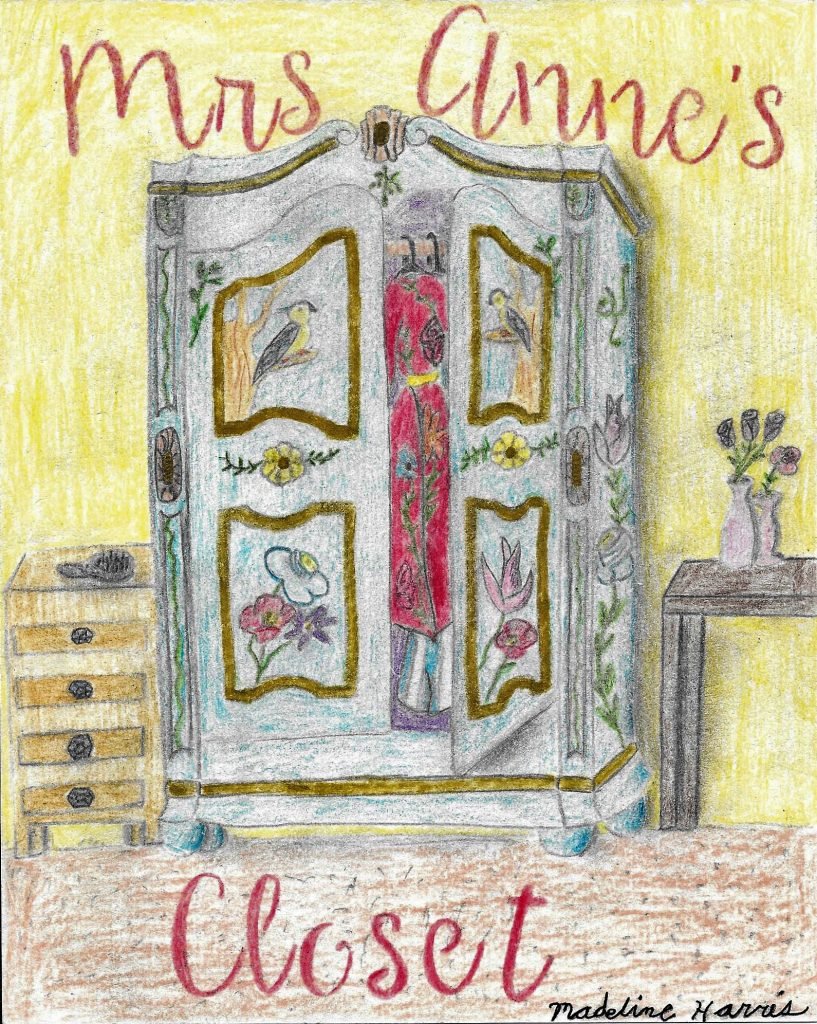
Mrs. Anne’s Closet


By Melissa Harris, Illinois. Illustration by her daughter, Madeline Harris, age 11.

Mrs. Anne’s home was like a museum. Everything I would pick up had a story. “Where did you get this hairbrush from, Mrs. Anne?” I’d ask. 

“That was Big Mom’s, my mother, and it sat on her dresser when I was a girl,” my grandma would say. 

“And now I’m the girl,” I’d add to the story, gliding my finger across the brush that was a shade between blue and gray. 

Sometimes my grandma would let me play dress up in her closet. It was a place for dreaming with your eyes wide open. “Every dress, hat, and handbag has a past, Maddie,” she’d say. “And when the time is right, they’ll be yours to own.” She opened the door to a world of fantasy held in an armoire. 

A striped aquamarine and white dress that looked like it was made for a princess. A black dress as skinny as a water hose hung next to a red kimono, draped over other hidden treasures I couldn’t wait to discover. “I know what you’re eye’n.” Mrs. Anne observed with a smirk. I ran to yank the kimono off of the satin hanger. As Mrs. Anne helped to put it on, the phone rang. She left me to the rest and took the call in the next room. 

The kimono was so oversized that it wrapped around me twice and then some. I could hear what she’d say if she was still in the room, “Maddie, you’re swallowed in memories and love.” I beamed with honor, and recalled the stories she had told me of our heritage. Mrs. Anne was Chinese and African-American. Her mom was from Arkansas, and her dad was from Hong Kong. Somehow their paths crossed in St. Louis where they fell in love. She’d tell me stories of how I descended from two groups of people who were the first to leave genetic footprints on the world, Africa and Asia. “Being the first doesn’t prevent cruelty,” she’d say, “for both countries experienced invasion and mistreatment.” My thoughts of their story swirled in chaos, so fast that my head started to ache, twisting and turning ideas into knots. My string of thoughts collided, and when they crashed, I was no longer in Mrs. Anne’s closet. I was standing at the edge of a mountain that had to be over a thousand feet high.

I was too scared to look down at first, so I slowly stepped back until my heart no longer tried to jump out of my chest. Where was Mrs. Anne? Where was I? I needed to find a trace of something familiar. I got the nerve to look past my immediate surroundings without moving a single limb. Down below was a harbor and fishing boats with the most vivid red sails. Colors blended together like a rainbow, and I couldn’t make out the body of water in front of me. A black and blue butterfly with stripes like the royal dress in Mrs. Anne’s closet fluttered by. I followed. It led to a path that curved around the mountain, probably used like an elevator to take you up or down. I crossed over to an enormous white house in the distance. Maybe someone there could help me get back to my grandma. 

Several arched windows lined the white home. A girl who looked about my age sat under a cotton tree with a book. She didn’t move when I walked towards her, just stared like a frozen sculpture. She had eyes like my grandmother with hair cut straight as a line to her shoulders. I knelt beside her and blurted, “hi.” She hesitated, then exhaled a sigh. I extended my finger towards the house. “Do you live there?” “Lin,” she said pointing to herself. “Maddie,” I responded, imitating her movements. 

Just then, a man in a navy-blue uniform slammed the side door to exit. He didn’t look like Lin. He had red hair and skin as pale as the house he exited. After a few steps, he yelled, barmy bloke! A man in a white apron, the kind a cook wears hurried out, bowing to the soldier’s black boots. The soldier’s tirade was like the howling of a wolf, and though I couldn’t see the details of his face, I was sure it wore a glare. The same as the medals pinned to his uniform from the blazing sun. He backed the cook against the wall. When he was close enough to hover over him with a raised fist, Lin screamed, ting! Her words may have stopped the cook from harm, but the soldier’s anger turned towards us. I didn’t understand their language, but I could infer the cook’s meaning when he yelled, pao! Lin ran towards the trolley path, and I followed. In the distance I could see Lin’s destination; a trolley stopped on the side of the road to pick up passengers headed to the lower peak. Lin ran faster than anyone I had ever seen, and I couldn’t catch up. So, I stopped. I felt a tug at my left ponytail and fell back towards the force. It was the soldier. Before I could think of a plan to escape, my bottom scuffed the ground and my head followed. My thoughts began to spin again, and my eyes opened to a different setting. I was at Mrs. Anne’s. 

“You alright honey? I heard a hard thud, like you fell.” I could see the concern in Mrs. Anne’s eyes because she saw the fear in mine. I was still shaken up from the soldier and the distant land with people who seemed familiar to me.

“Did your daddy have a sister? I asked, smearing tears across my face.

“He did. Her name was Lin.” 

“I think I met her in my dream.” 

“I’m sure you did,” Mrs. Anne laughed. I didn’t care if she believed me. I was just grateful to be in her arms, swallowed in memories and love. 

Glossary:

Blue Tiger Butterfly/Tirumala limniace is found in South Asia and Southeast Asia. Its wings are black with blue markings.

Pao: (頓契, 獵契, 텝, 쒔檀, 굴텝, 텝꼍) run

Tíng: (界) stop

Victoria Peak: A hill on the western half of Hong Kong Island that rises 1,810 feet. 

Victoria Harbor: A natural landform harbor separating Hong Kong Island in the south from the Kowloon Peninsula to the north.

By Melissa Harris, multiracial (Chinese, Irish, and African American), English teacher, Illinois.

Illustration by Melissa’s daughter, Madeline Harris, a budding artist, age 11.

.

A Gift

By Chad Glang, Ph.D., Colorado.

Stained Glass Art by Chad Glang, Colorado.

Someone asked me recently when was it that I first awakened to the spiritual side of life.
 
I have a vivid memory from my time as a student in France. I was 19, and several of us were invited to be companions to kids at a nearby orphanage. In several visits, I connected with a boy of eight. In our final afternoon together he went to his bureau—container of all his worldly possessions. 

He brought out a rare, treasured postage stamp and handed it to me: Un cadeau pour toi, “A gift for you.” 

I was so touched. I pulled out my wallet and found a memento I prized. “Great! We’ll trade,” I said.

His was crestfallen, his eyes filled with tears. “No, not a trade… it’s a gift. I want to give it to you.” I stopped breathing. Oh… I had denied him the experience of giving. In my discomfort with the vulnerability of being the receiver, I’d reflexively moved to equalize the relationship. Unaware, acting out of my own feelings, I’d walked on his feelings… and his dignity. 

More than fifty years later, I am still brought to stillness by this memory. I denied the gift of the stamp; I could not deny the gift of the learning. There’s something more going on here… it’s not just about what my limited, if well intentioned, ego can comprehend.

I didn’t have words for that experience at the time, which was part of its power. Now, the Sanskrit greeting Namaste comes to mind: “The place in me of love and truth and light greets the place in you of love and truth and light.” 

At a given moment, we may be wearing particular hats, like server and served, but we are all in this together…and deep down we are all the same.

—Chad Glang, Ph.D., lives a retired life in Colorado. He works with stained glass, hikes, bikes and camps. He practiced counseling psychology for 40 years. 

When my Grandfather Holds my Grandmother

 When my grandfather holds my grandmother,
 Saigon still smolders on the ashes of April.
  
 When my grandfather holds my grandmother,
 he lowers his head, the way the hunted have always
 bent over their own reflection to drink.
  
 When my grandfather holds my grandmother,
 his schoolboy arms trace etymologies over her waist,
 how the Vietnamese word for “remember” and “miss” are the same
 while his nose relearns a scent, he relearns a year—
 as if to walk through the kitchen window you’d still see
 paper milk-flowers bursting into flames while
 the stars gape like the sky’s bullet wounds;
 and where my grandfather holds her,
 smoke soldiers, also, dig ghost claws in her wrist,
 chanting bạn có nhớ tôi không?
  
 My grandfather holds my grandmother 
 in a history never ended, as if somewhere 
 between his hands, the city smolders on. 

By Samantha Liu, 16, New Jersey. She adds: “As for myself, I am a fifteen year-old aspiring writer in New Jersey. I’ve been trying so hard to relearn and revisit my Asian heritage recently – part Mandarin Chinese, part Vietnamese. My grandparents from both sides are children of war, of Mao, of Tet. The bloodshed of the twentieth century, much of it perpetuated by America itself, is etched in my family history. Much of it is cruel. Much of it is turbulent. Much of it inspires bouts of PTSD while I, nine and unknowing, huddle in a corner. But some of it, as I tried to write in “When my grandfather holds my grandmother,” is light. It is how my grandfather and grandmother fell in love, in the ardent and all-consuming way of people who might not see another day. To me, this is the legacy of Vietnam—not politicking, not ideology, but humanity. I have inherited a war, and I will continue to unravel it.”

Mother’s Daughter

“The way you cut your meat reflects the way you live.”  –Confucius

If Confucius was right, then my mother lived delicately, treading a tightrope as thin as the slices of her twice cooked pork.

When she ate her first American hamburger, she had complained.“Ai ya. Why is the meat so big? With a hulking piece of meat like this no wonder they all in debt. Americans cannot save.”

She told me this while I minced the pork for our dumplings and she rolled the dough. “Thinner, Jian Yang. We are not the barbaric Americans.”

She didn’t intend it, but with those words, the knife I held slashed across my life like the cuts across the pork. In that moment I told myself I am not a barbaric American because I am not an American. My narrative became a relic of my mother’s, two sides of the same page, her side’s ink still impressed on mine.

For five years after that, I remained scared of knives, and my mother cut my meat for me.

“You are what you eat.” –American proverb

“Is that dog food?”

“It can’t be, because Ling Ling doesn’t feed dogs, she eats them.”

That day I went home in tears and asked my mother to pack me a sandwich. I showed her what the pale kids kept inside of their princess lunchboxes—spongy white bread around ham and cheese, a cereal bar, an apple.

“Ah yes, I make for you.”

The next day I found a pork bun in my backpack. I held the baked dough and took a bite. I tasted pork marinated with soy sauce and chives. As I chewed, I hoped the hujiaobing could pass off as a hamburger.

“Ling Ling is eating dog food again.”

“Does that make Ling Ling a dog?”

The day after, there was steamed bun inside my backpack with barbecue pork and black pepper. I looked once at the pearl knot before throwing out the chasiubao. I didn’t eat my lunch the day after, or the day after.

If you are what you eat, I thought, I don’t want to eat Chinese anymore.

And so my transformation began. Everyday at lunch I’d throw out the delicacy my mother had packed. Everyday at dinner I’d pick at my rice while staring at the woman across from me, pockmarked yellow on her cheeks and creased valleys in her forehead. My greatest wish was not to turn out like her.

I thought I had actualized my wish when my skin began to turn translucent from skipping meals. I thought I was becoming white. I started eating nothing altogether, and I became nothing.

Once my mother scolded me for not eating. “Jian Yang, you look like ghost. Eat your noodles and you become yellow again.”

I can’t remember most of what happened next. I remember my tongue, poised like a knife, uttering some ugly sounding words I barely understood. I remember wanting to make her bleed with my words, one cut for each bite of dog food I had endured. I remember pretending she could seep out red on a cutting board, bleeding until we were left colorless.“Chink.”

“He who takes medicine and neglects diet wastes the skills of the physician.” —Chinese adage

My mother doesn’t cook anymore. Instead, she lays on a red-blanketed bamboo mat in a room brimming verdant. On her desk, an incongruous collection of terracotta cups, holding qi-rectifying rhubarb and shen-calming wolfberry.

The doctor said her condition is too fragile to eat. Strong flavors could disturb her gut, and I should instead blend basic nutrients for her to drink. I promptly replied that he was a fool.

The first time I cooked for her, she was coming back from the hospital. When I saw her, face of mountains reduced to ash, I dropped the plate. She asked what was wrong with me. I told her that my greatest wish was never to turn out like her. She told me that she had shared the same wish.

“You must turn out better than me,” she said.

We ate my meal, pork buns ribbed in ginger, in silence.

“Fashion is in Europe, living is in America, but eating is in China.”  —Chinese adage

I saw this scribbled against a dusty window to a grocery store in Chinatown. I don’t know why they say living is in America, because this country killed my mother. She died four months after the pork bun meal—inevitable, the doctor said. The nail salon she labored nine hours a day at had used illegally toxic polishes for years. While she scrubbed counters and coughed chemicals, her liver simply gave out. It was a miracle that she lived as long as she did.

My mother was a failure of an immigrant in most aspects. She stood at the Angel Island bridge seeking freedom, yet each day she beat herself an ocean back, until her vision became a mirage on the horizon. By imagining walls of white supremacy and shadowy businessmen, she trapped herself in a prison of her own making. She never found freedom because she never made it off that bridge.

I live in America, though. For lunch I go out for drinks with my roommates. We catch up on Grey’s Anatomy and someone invites me to a frat party later, which I only pretend to consider.

For dinner I stay home and cut my own meat, a piece for Brooklyn, a piece for Chinatown, for eating, for living. One piece for Jane Young, amateur journalist and cup-pong champion, one piece for Jian Yang, aspiring princess haunted by the paleness of memory. They are the decussations of a third-person America, carved apart by my mother into island pieces long before I realized that action had shattered me.

And so, I reassemble. I take the pieces, toss in a million chili peppers, and sauté in an ocean of soy sauce until they become one and the same.

By Samantha Liu, 16, New Jersey. She adds:“Mother’s Daughter” parallels my two clashing heritages. Having been raised speaking and reading Mandarin Chinese, I was expected to fulfill all the Confucius-esque dreams of my Chinese immigrant mother, whom I ended up resenting more than anything. Through the symbol of food, my story explores my struggle to reconcile these beliefs as I learned to define myself—as Chinese-American, as heterogeneous as food itself.”

Xiāng Xiāng

By Jessica Wang, 16, New York.

I have two names. One I use everyday while the other I keep stowed inside me, locked behind the bars of my lips and the breath of my tongue.

My caged name is actually quite pretty. It means aroma. Not a smelly one, but a homey, warm odor, like the scent of fresh laundry or the steam that bubbles off chicken soup. 

Sometimes I say my name to myself, just to see if it’s still there. It’s strangely pronounced and forces my tongue to touch the roof of my mouth and oftentimes I stumble over the loopy syllables. I only say it in the dark; face mushed between two pillows and huddled under layers of blankets, just in case it tries to make a run for it.

I’m afraid of my name.

It’s odd because you’re not supposed to fear a name. Can you imagine if every Tim, Tom, and Harry were afraid of his name? That would be a strange world indeed.

I’m afraid of my name because it’s cursed. It doesn’t belong here, on this soil or in this strange body that I try to call “American”. If I were to let my name go from its cage, past my lips, people would stare and know that I too don’t belong here. They would ask me what my name means and I would explain that directly translated it means “nice smell”. And then they would laugh at the absurdness and wonder what the silly Chinese were thinking. Naming a child after a smell? What would be next? A girl named after the taste of a lemon?

If I said my name, it would betray me, reveal me as an outsider. It had done it before and would do it again. So I betray my name first. I betray it by wearing colored contact lenses and trying to look Caucasian. I betray it by buying creams to hide the yellowness of my skin. I betray it by waking up every day and wishing my name wasn’t there, that instead of two names I only had one, one free name.

I dye my hair blonde one day, just to see what it would be like to have yellow curls and pretty hair. The dye stung my scalp and smelled like bleach and acid and nothing homey or warm at all. I am not an outsider. I tell myself as I brush my new beautiful hair.  I am not an outsider. I am not an outsider. I am not an outsider. The words taste funny on my tongue. 

My mother no longer calls me by my caged name. She used to, back when I didn’t understand what the word “foreigner” meant and my worst fear was getting an apple instead of cookies during snack time. I remember she used to say it in a certain way, curling her pink tongue and rolling the syllables off neatly. But she stopped after I asked her what the word “slit-eyes” meant. Now she calls me “Je-ssi-ca,” the name neatly printed on my birth certificate, my official name, the free name. She named me after the actor Jessica Simpson because she’s pretty and Caucasian and has blonde hair. The name is easy to pronounce and flows off the tongue smoothly, the American tongue that is.

My second name “Je-ssi-ca” does wonders. It helps me chain up my foreign name and even add a couple more locks, determined to snuff it out. And it works. I can no longer hold chopsticks properly or handle the spices of traditional dishes. When I try to speak the language my ancestors once spoke, my thick American accent pokes through and slurs together the vowels and syllables. It’s American-Chinese my grandma would murmur and shake her head at how far her heritage has fallen. I am no longer the little girl who listened to her stories about the immortal monkey king and his magical staff. She does not know who I am. I am foreign to her.

I have successfully locked up my name.

But even without saying my name, it still betrays me. People still look at me like I’m an outsider even though I was born here, even though I speak English perfectly, even though I betray a part of myself everyday just to please them.

And no matter how much cream I scrub into my skin, no matter how much I try to hide the dark brown in my eyes, they keep staring. 

But I like my caged name. I think it’s pretty, even prettier than light hair and blue contact lenses. It reminds me of steamed dumplings and curved mandarin letters and red paper lanterns with gold embroidered on the edges. And when I say my chicken soup-fresh laundry-oddly pronounced-laughable name. I feel good. The syllables punctuate the air daringly and challenge the world around. When I whisper the letters, my name is free and so am I.

It’s true that my caged name doesn’t quite fit me. I can’t write or read mandarin and my pronunciation is terrible. But it’s still a piece of me, just like my skin and my eyes. I can’t just scrub it off, mask it, or even lock it up. At  the end of the day my caged name is mine. All its dents, curves, and ridges are mine. It’s oddly pronounced, and it’s mine. It is me, and I am mine. My culture. My ethnicity. Me.

 I don’t want to lock myself up anymore.

By Jessica Wang,16, New York, United States.

“My piece is about the period in my life when I went through a lot of self-hatred because of the way I looked. I hated being Chinese because it meant that I looked very different from my peers. I remember sometimes I would even buy whitening creams and dye my hair in order to try and fit in. I should have realized that instead of trying to please others I should have learned to accept myself for who I am.”