Category Archives: Family and Community

It Never Rains in California

It Never Rains in California

By Jada Ying King, grade 11, California


“There is no chance of rain. Zero, zip, zilch. Don’t worry!”

—Jada King, White Stag patrol counselor (PC) to the Tunde patrol. Afternoon of June 22, 2022. Approximately… two hours away from regretting those words.

4:30 P.M.
Light cloud cover hung over the sky. To anyone anywhere except the dry valley that is Piney Creek, Monterey, that signified rain coming. But as I, my nine fellow PCs, and the rest of middle to southern California knew, it does not rain in California in the summer.

Confident in my knowledge, I turned back to look at my seven sweaty little lieges. “Faster we make it up this hill, faster you can get cooking!”

Immediately, all the boys perked up, picking up their pace with shouts of, “Aw yeah!” and “Great!”

We remained ignorant of the coming storm.

5:45 P.M.
“Don’t the clouds look pretty dark?”

Ethan, a particularly persnickety 13-year-old camper, pointed up to prove his point. “The sky’s weirdly yellow. And I think I heard a grumble.”

“Where are we?” I chuckled. But more seriously, I added, “I talked with Tim. He said, and I quote, ‘In the past thirty years, it hasn’t ever rained here in the summer.’ We’ll be fine.”

At that exact moment, a BOOM echoed through the valley below, followed by the quiet patter of raindrops. My heart rate rocketed—we youth counselors planned for basically every situation except rain.

Mind whirring, I barked, “Get out the tarps and take cover; stay low as much as possible! Cover your packs and the cooking equipment if you can.” I took a deep breath, telling myself to remain calm. I trained for these moments; I was the PC here. I had control over the situation. So maybe the second leg of our hike was going to be delayed. But once the rain died down, we’d head for our outpost.

Thunder filled the sky. I shivered again.

9:30 P.M.
The rain continued to pour, although the barrage of lightning had stopped earlier. Unfortunately by then, the sun had already set.

“You sure you’re good with going down first?” asked Ethan, PC of the Attila patrol. The adult staff had called an emergency PC meeting, and because the Tunde patrol was stationed the closest to the route to the outpost, I nominated myself as the forerunner.

I rolled my shoulders and shook out my dripping, stringy hair. Although I wore my water-resistant staff jacket, I was soaked to the bone and freezing cold after standing around in the downpour for half an hour. “Not a problem,” I said. “Plus, it’s only gonna get darker from here on out.”

I trudged up the hill to the Tunde patrol. “Pack up, guys, we’re going down to outpost!” I said, maintaining my energetic facade to lighten up the situation.

But when I brought my seven kids to the pitch-dark, rocky, near-vertical slope down to outpost, my fake cheer faltered. No, I told myself. I could not let myself fall to self-doubt in this sort of situation. Behind me, my patrol whispered uncertainties to each other.

I turned around, my heart running a million miles an hour. “Okay, kiddos. I bet this is going to be the most difficult night of your week.” Murmurs of agreement. “But hey, we’re going to make it down, we’re going to finish this hike, and we’re going to do this together. So get out your flashlights!”

The trip down the hill was terrifying, to say the least. Quite a few times, my shoes slid and skidded on the muddy rocks. I caught one of my kids from falling over once, and figuring out where their patrol site was in the dark and the rain was an entirely different challenge, even with flashlights.

But by 11 P.M., in the utter darkness of the Monterey wilds, in the biting wind and my sopping clothes, I managed to get my patrol in bed, free of injuries, and now with an exciting story to tell to their parents.

Of course, the fact that the staff site was overgrown with poison oak was something we never told our kids. Nor did we tell them that we youth staff only crawled into our sleeping bags at 2 A.M. because we looked for somewhere to sleep for two hours. We just magically showed up at our patrols the next morning with as much energy as we did before, ready to make more enchanting outdoor memories for them.

After all, as a PC, I was there to give them the experience of a lifetime. And isn’t it more fun at summer camp when your counselor’s always giving everything their 110 percent?

Author’s Note:
I am a Chinese-American 11th grader at Palo Alto High School who enjoys drawing, writing, and hiking—which is why in 2022, I served as a youth counselor for the White Stag Leadership Academy, an accredited outdoors summer program dedicated to enriching youth from the ages of 11 to 17 in outdoorsmanship and leadership.

Our program is entirely youth-led. From September to May, youth counselors train in first aid, outdoors skills, and effective leadership, as well as plan a full week of summer camp for incoming White Stag candidates. Unfortunately, the one thing we didn’t plan for was rain!

I hope that my true story can both inspire individuals to go outside and experience the great outdoors, but also not feel disappointed when nature rains on us. Sometimes the most inconvenient situations that the sky throws at us lead to the most inspiring personal growth—and the most entertaining stories!”

Jada Ying King, grade 11, California.

The Abscission of Perennial Petals

The Abscission of Perennial Petals

By Aniket Dewangen, grade 10, India.


The bougainvillea flowers whistled with the wind. Each of them withered away as two stayed by the coarse and flaky mahogany tree.

My childhood

The image of the god was pleasant and heartwarming. He held a brass flute adorned with a flower and a bead. The arched legs crossed against the drapery of the Dhoti1 and his lips touched the edge of the flute. His gaze was drawn downward to the majestic instrument. Its amygdaloid-like face and beaten-blue complexion were elegant and defined by a sharp jaw. A majestic peacock flower hung above the satiny hair at the crown of his head. The ace-shaped, indigo-colored splotch in the middle was covered by a flurry of green strands that flowed in a rhythm. The Lord Krishna stood there elegantly, displaying a natural aura of benevolence. Next to the defined blue edges was the goddess of devotion and tenderness, Radha. The two gods stood serenely in the centre of the ashram.2 The terracotta figures seemed to be emphasized in the minds of the people standing before me. Two Pandits3 walked towards the idols. They were wearing angharkas (a short coat-like scarf around the stomach). They marched around and began to proceed with the pooja.4 I looked back and scanned the long queue. The line’s shape curled almost like a racetrack. We all soon congregated, pushing forward to get a greater view of the two idols in the spotlight. I couldn’t see much. I just saw the shoulders of men who were agitated. My father, who limped through the crowd was in front. He had polio, and an orthotic device was attached to his legs. He began to walk in discomfort without any space left.

“Are you okay?” My father looked at me. He looked in agony, yet he powered through the line, which was like a Dandi march.5 Paa (father) was a kindhearted man, or at least I thought so, for the majority of my life. Soon the line began to compress, and I could sense the aroma of Rabri and Malpua.6 The glistening white substance dazzled with a pinch of cardamom on top. It was my favorite. My mother standing behind me kept her soft hands on my shoulders as we moved slowly through the long queue. The brass-plated bell rang at a fast tempo and the procession began. The chimes cut the air and rang through my ears. Soon I started to sense that we had come to the beginning of the line. My mother took me in her arms, and I could finally have a better view of the luminescent and vibrant colors. Both the terracotta figures were covered in tinsel. The pandits approached the idols and began to swerve a copper plate that contained an incandescent flame in one of the lamps. The intricate and mesmerizing designs on the bell and the plate were astonishing. The Pandits began to pour a white substance over lord Krishna. The idols were soaked in the thin badam milk.8 The low-pitched sound began to omit and amplify in the chamber. The Chappan Bhog9 had begun. The Chappan Bhog was a tradition during the festival of Janmashtami10 where the graceful gods were lavishly fed. The Pandits sang a harmonious tune and began to pour different things over the idols. I never understood why this happened. My mother told me that the gods were never fed, and this festival would fulfill them. The myriad of assorted foods made my mouth water.

“Now beta,11 ask for what you want most and fold your hands looking up at the terracotta idol,” my mother said in a haste. My hands joined together and pressed against the warm surface of my palms. I closed my eyes. The one wish and the one thing that I sought the most was barely even related to me. “Dear god, since you have had a wonderful meal, it wouldn’t be rude to ask you this small request. Please keep my parents happy, they seem to fight a lot. I want them to be happy and complement each other.” My eyes slowly opened and a hue of blue covered my vision. The voices that were once muffled began to ring in my ears. The same flame came close to me by the copper plate. The Pandit approached me. I leaned forward and raised my hands underneath the fire that rippled diagonally in the presence of oxygen. The Pandit then smiled and took a red-colored pigment mixed with water. He dipped his thumb in the color and put the tilak12 on the center of my forehead as I pulled my hair back. The Pandit took a few rice grains and stuck it at the same red line. Soon after, my focus quickly shifted from the pooja to the prasad.13 The prasad was a small token that was a blessing from the gods. Taking it from one hand was disrespectful, so I layered them both underneath. A green powder-like brittle was poured into my hand. It looked like earthy soil in my hand with other assorted colors sprouting. I dumped it all in my mouth, and the sweet powder dissolved.

We exited the ashram and my father smiled at me. I hugged them both, yet they had some repulsion against each other, like two magnetic poles. I noticed it instantly, but I didn’t understand what caused this tension.

Vexed – pandora’s box

I climbed up the staircase; drops of sweat poured down my body and made my hair oily. I removed my socks and speckles of grass rained down on the entrance mat. I realized a deafening noise was coming from the inside. The voice was stentorian, like the roar of a lion. I looked down at the marbled tiles aligned next to each other like a tessellation. I stepped inside, and the voice was even louder. In the kitchen, there were the sounds of a pressure cooker that emitted a blaze of steam and gas. In the other room was the sound of my mother, whose voice quickly changed from loud to timid. She began to pule and cry querulously. I quietly put my heavy bag in the room and decided not to make her aware of my arrival. I sat by the curb of my bed and silently listened to the conversation. They began to spit out insults in Hindi and the very blunt manner made me cover my ears. The walls became thin like paper, almost turning into the translucent matter. I pulled my kambal,14 over my head. I couldn’t bear to hear my mother sob and weep over the phone. Instantly I began to connect the pieces and realized who she was talking to.

I spent the entire day sitting on the bed. The call had stopped, and she had begun to snivel. I imagined her facial expression and the tone of his voice. “What could have made her cry so much?” I thought in my head as I concentrated on a single point on my cupboard. The scenarios flooded my brain. I began to become more and more anxious about finding out the mere truth. The teary-eyed face emerged from the aperture in the wall. She was perplexed and baffled by my sudden appearance and sat beside me.

“It will all be okay.” The vague statement did not assure me that she was doing fine. Instead, I began to get even more worried. As Maa left my room, I pulled out my drawer and began to nibble on a childhood snack. The packet of sweets besides my belongings would usually be saved after dinner. But at that moment I needed something to relieve the inexpressible pain. I put the hard candy, shaped like a mango in my mouth. The explosion of flavour tingled my mouth with a stiff numbness. The sour hard candy shifted its position from left to right in my mouth, coating it with the orange dye. I leaned on the headboard of the bed and didn’t do anything for the next few minutes.

Paa opened the door. I heard the creak and began to peek from the edge to see his face with a rictus. It emitted a smoldering look that was bold and quite masculine. He put his belongings by the sofa in the hall and called out my name. A sudden sense of anxiety penetrated my skull. I came out, put my hands behind my hips, and sat down on the greyish-white sofa. The conversation started normally and then was weighed down by emotions. I had not anticipated this moment, and I had begun to link the fact that money was a problem at home. Yet this was not even close to my prediction. Instead, I had learned of the disunion of the two pillars in my life. My world collapsed into a black void, and I sat there still in a vegetative manner for the next few minutes. The Pandora’s box had been opened, and I became enraged at this classified information which was unraveled.

The second petal beside the pinker one, began to hold on to the stem with a thread. Almost beginning to detach.

The contrasting white chair

It was PTM (Parent-Teacher Meeting) day. I walked by the person who made me ripe for the harvest. We both stepped inside the room where Mr. Girinath, my math teacher, welcomed us. He wore a checkered T-shirt and had a Vandyke beard with sleek metallic glasses. The three seats were next to each other. I wasn’t nervous about meeting my teachers, but I was bothered by one thing. It lingered in the back of my mind. My sore eyes were filled with gunk. While walking to the meeting, I was tired and pretended to be elated. The teacher began to lecture me about my poor attention span and my slipping grades in class. It didn’t matter to me. At that point, I just looked at the corresponding chair. The virgin white appalled me with its emptiness. I began to stare at it. My skin flaked like the scales of a viper. Soon my focus was disrupted by a concerned look on my mother’s face. She was quite upset with my academic performance. I was then continually lectured about my grades. I didn’t seem to care. I stepped out of the room. My attention was diverted to the other children. Their faces were lit up with ecstatic expressions. I noticed that both their pillars helped in upholding the integrity of their life. That one other pillar that was supposed to be upholding me had vanished. My mother’s sari15 revealed my face, and its fabric emitted a powerful aura. I was beholden to her and grateful because she raised me even when everything seemed to collapse. I hugged her tightly, grasping her back as a tear rolled down my cheeks.

            “I love you Maa,16” I murmured softly.

The mahogany tree stood there alone. The singular petal tarried in like an anchor.

By Aniket Dewangen, grade 10, India. He adds: “My roots have stemmed from the streets of Haryana, and I speak Hindi at home despite being born in the United states. Yet apart from this, I actively enjoy photography and art. I like capturing numerous moments, people and cultures through my Camera, and explore my artistic capabilities with the help of a brush and canvas. A large part of my childhood was seemingly rough and I went through many hardships, but my hobbies and passions made up and brought me relaxation even in distress. This all taught me one thing to stay stronger and push through anything that was to come my way.”

Foot Notes:

1 Dhoti: A white cloth garment with a border, worn in an Indian traditional manner

2 Ashram: A hermitage

3 Pandit: A Hindu scholar

4 pooja: A Hindu ritual of worshipping god

5 Dandi march: Mahatma Gandhi’s famous Salt March—nonviolent civil disobedience in 1930 during the British Colonial Indian rule

6 Rabri and Malpua: Traditional Indian sweet dish made with milk, sugar and condiments

7 Aarthi: A ritual ceremony of waving a lighted lamp during prayers

8 Badam : Almond

9 Chappan Bhog: Offering of 56 food items to Lord Krishna on his birthday (Janmashtami)

10 Janmashtami: Lord Krishna’s birthday festival, usually in August or September

11 Beta: Endearing term for son in the Hindi language

12 Tilak: A mark worn by Hindus on their forehead, especially during festivals

13 prasad: Food that is offered to gods

14 Kambal: A blanket or comforter

15 Sari: A traditional garment worn by women in India; it’s a long, colorful cloth decorated with various designs.

16. Maa: Mother.


The Paralyzing Fear of Gun Violence

The Paralyzing Fear of Gun Violence*

A National Pandemic of The 21st Century

By Beatriz Lindemann, age 16, Florida

When I first heard the shrieks, I was in line to buy a set of pajamas at Victoria’s Secret with my nanny and godmother, Lizette. Then, suddenly, a stampede of people ran through the store.

“Get down!” someone screamed.

“We heard gunshots!” a woman yelled.

I dropped to the floor and grabbed Lizette’s hand. “¿Qué está pasando?” (“What is happening?”) I asked her. My heart was beating out of my chest.

She did not answer. We were both panicked. I wondered if the shooter was in the store.

An employee ran to a door in the back of the store. We followed her into a gray room filled with lockers and chairs. I stared at the door, waiting for someone to walk in. Was the shooter still in the mall? There was nowhere to go. Surely, if someone tried, they could get through the door. The employees listened to updates on their radios. My whole body began to shake as I processed what was going on.

Ten minutes later, the employees told us that the gates had shut in front of the store and that the police were beginning to search the mall. Relief.

Those were the scariest ten minutes of my life. I thought that I was going to die; I mentally prepared myself to have a gun pointed at me. Those ten minutes changed me.

We stayed in that back room for two hours as the police searched the mall. I was cold and shaking. I kept updating my phone until an hour and a half after the initial incident when the news reported that the shooter had gotten into an argument with someone he knew and shot three people in that mall—Aventura Mall in Miami. The report stated that the shooter had left immediately but did not report that thousands of people hid for hours.

This wasn’t my first experience with gun violence. When I was in the fifth grade, there was a mass shooting not too far from where I live in Miami at Marjory Stoneman Douglas High School in Parkland. Fourteen students and three teachers died at that school, a place where we should all be safe.

I had trouble imagining that fear and understanding that threat before that incident. In elementary school, lockdowns were a time to whisper and giggle with friends. After the Parkland shooting, though, no one spoke during lockdown drills. To this day, the air during these drills is tense and petrifying. No one is laughing. The threat is real. Too real.

After the shooting in the mall, I had panic attacks for weeks. I felt unsafe in public and did not want to be in large, commercial spaces. I was not in control, and that was difficult to accept. My experience did not compare to many others’ experiences with gun violence, yet I was rattled. I was 14, and I felt helpless.

Then, the Robb Elementary shooting in Uvalde, Texas, happened, and my resentment reached an all-time high. My stomach flipped when I read that Uvalde was the deadliest school shooting in a decade; 19 children and two teachers were killed. My heart ached as I thought of the parents who dropped their children off at school one morning and never got to see them again. They will never hug their babies again.

The more I read, the angrier I became. I shut my computer and screamed into my hands. When was it going to be enough? When was there going to be enough pain to cause change? How can politicians look in the mirror?

For the next couple of weeks, as more news came out about the shooting, my panic attacks continued. Parents and children who lost their friends that day were on the news. I felt their pain. Eleven-year-old Miah Cerillo covered herself in her dead friend’s blood to avoid being shot. She called 911 from her dead teacher’s phone. In what world is this acceptable?

I read articles that included the statements of politicians after the shooting. A Texan politician caught my attention. He did not offer solutions for protecting children but rather took the press opportunity to politicize the situation. He shared his opinion, which was that it was essential for Americans to have access to firearms. These politicians claim to be “pro-life,” advocating for the unborn but not the children already on Earth.

I have read the Constitution and the Bill of Rights in school. I understand why upholding the Constitution is necessary for our nation’s success and a well-functioning government. Still, I do not understand how a document written centuries ago can prohibit gun control for public safety. Banning all guns may not be the solution, but changing our policies has to be. We need to focus on who has access to firearms. Purchasing a gun in America is too easy. Pulling a trigger is too easy. Proper training is needed, as are background checks and mental health evaluations.

When will we depoliticize this human rights issue? Our country is divided, but to fix this, we must unite. This isn’t Democrats versus Republicans. It must be Americans against gun violence.

—Beatriz Lindemann, 16, Florida. Her stories have been published across various literary platforms, from Girls Write the World to the Women’s Media Center. She is a varsity rower and hopes to study journalism, political science, or law at university. Her unorthodox upbringing, raised by two gay dads, impacted her perception of the world and the power of writing.

*This essay by Beatriz was originally published by the Women’s Media Center on the WMC FBomb.

A Music Room of Our Own

A Music Room of Our Own

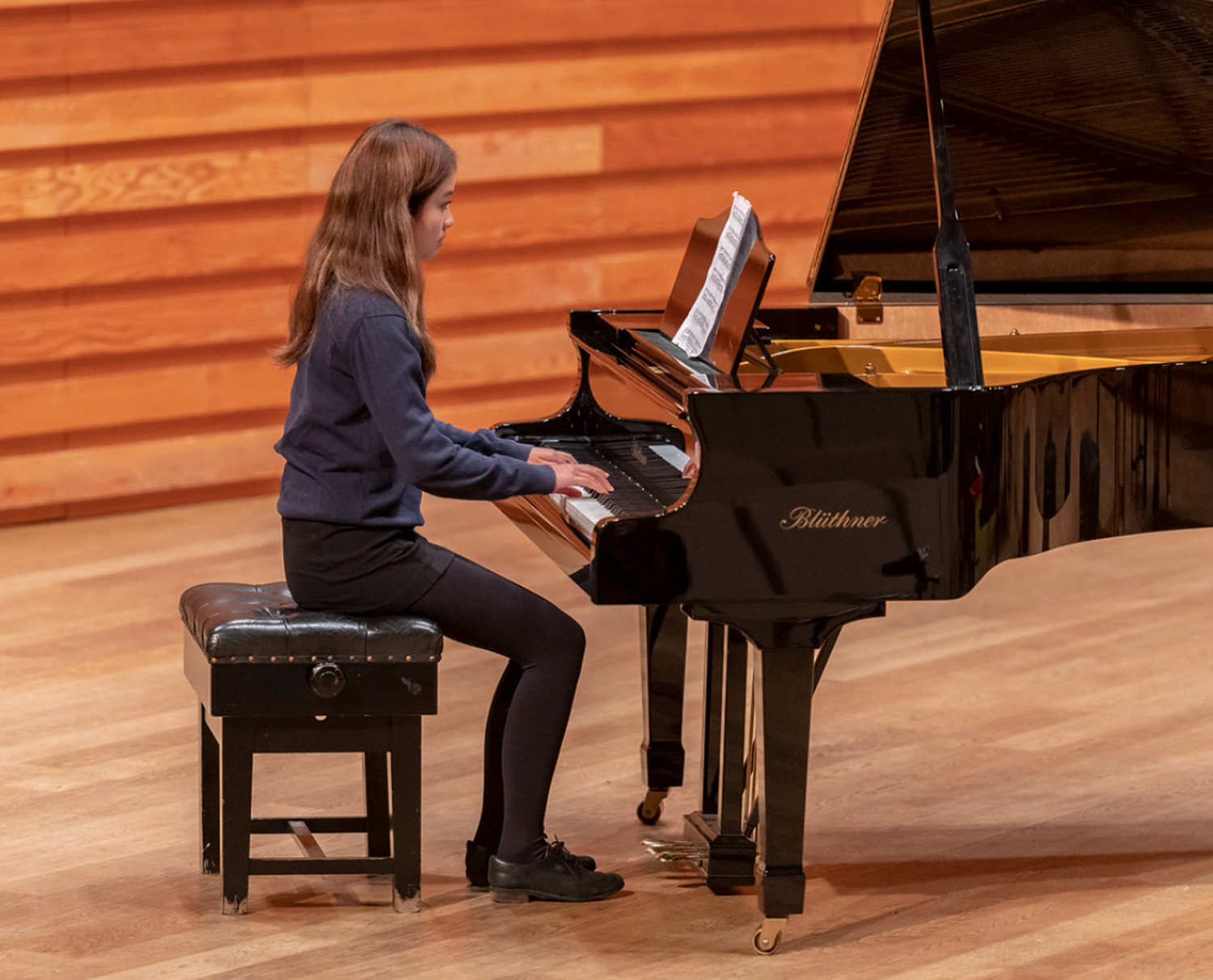
By Niki Zhang, 17, (photographed above) United Kingdom

Four years ago, as we sat in the practice room in which I had spent countless hours, my piano teacher, Ms. Li, handed me a thick navy volume. “The Well-Tempered Clavier” was written on its cover; beneath, in bold letters, “J.S. BACH”—a giant of Baroque music, progenitor of twenty-odd children, and, of course, a man.

I had no doubt about the brilliance of Bach’s music, but still I was not particularly happy about the assignment. Forcing a smile, I politely asked, careful not to offend, “Could I, perhaps, play anything other than Bach, Mozart and Chopin?” What surprised me was my teacher’s pause; the air in the room was tight and it was clear that Ms. Li was slightly taken aback by my comment.

“Not a problem,” she finally said. “What about Debussy? He was the father of impressionist music. Impressionism is quite feminine… I think you would like it.”

With slight indignation, I asked, “Why are there no female composers?” I was certain women impressionists existed, but I was disturbed to realize that I could not name a single one. To my surprise, Ms. Li seemed excited by my question, as if she had been waiting for it to be asked, and had many ideas ready for me. First, she gave me “D’un Jardin Clair” by Lili Boulanger, an elegantly dream-like yet stimulating piece. Then “Six Petite Pièces” by Charlotte Sohy. Then “Rêverie” by Germain Tailleferre. Why had I never heard of this wonderful music? Why has not the average concertgoer, or even the average pianist? The problem, I began to realize, was not the lack of women composers but the lack of recognition. I was determined to build a repertoire of the beautiful but neglected works of these forgotten composers.

I had only raised the question after playing the piano for eight years. In retrospect, I am surprised that as a woman it had not occurred to me earlier. Prior to that, I was ignorant about the subordinate or even absent position of women in the classical canon. Do not blame yourself if you cannot name any female composers, because historically there have been vanishingly few: only 2.2% of historical works were composed by women, according to the Donne Foundation.1

Even today, pieces by Beethoven and Brahms alone are performed about as often, worldwide, as pieces by all women composers combined.2

If women account for around half of the population, how could this possibly be? About a hundred years ago, author Virginia Woolf tried to answer much the same question in A Room of One’s Own.Though her subject was literature, not music, her arguments seem even more relevant to music. “A woman must have money and a room of her own if she is to write fiction,” Woolf famously wrote. Her insight is staggeringly simple—but like gender inequality in classical music, even simple things are not always obvious.

Woolf explains that, “Nothing is known about women before the eighteenth century.”Up to Woolf’s time, but particularly in the more distant past, role models, as we now call them, were few and far between, for writers or composers or really creative people of any type. The woman’s place was clearly in the domestic sphere; education was denied her, and her energies were allowed to be spent only on housework, not artwork. Lack of support and community would have made writing difficult. But imagine how much more impossible composition must have seemed, with the years of specialized training it required, followed by the large, expensive groups required to perform it. “Any woman born with a great gift in the sixteenth century would have certainly gone crazed, shot herself, or ended her days,”Woolf writes during her hypothetical discussion of “Judith Shakespeare,”William Shakespeare’s imaginary (and impossible) sister. Imagine how much truer that statement would be for Judith Byrd, Jennifer Gibbons, or Greta Handel.

The core of Woolf’s insight is materialist: creativity requires privacy, and privacy requires resources. Woolf emphasizes the need for material conditions in pursuing artistic desires, but these were “Out of question” for a woman “Unless her parents were exceptionally rich or very noble.”But it was not equality of opportunity and access to financial resources that was lacking, it was equality in having the liberty to be different, to express individuality, and to diverge from the standard of “greatness” which was defined in terms of the achievements by male composers.

In classical music, symphonies are traditionally equated with “greatness.” Smaller works are “minor.” If we had to illustrate what a “great” composer would look like, we would end up with dozens of portraits of high-status, European men. That is not to say that no efforts were made to change societal attitudes towards independence for women.

If Virginia Woolf wanted to consider the endeavours of a female composer to be recognised, she would not have had to look further than her close friend Dame Ethel Smyth. Smyth, who was about twenty years older than Woolf, fell in love with the writer, who described the experience as “Like being caught by a giant crab.”Smyth was a pioneer in the women’s suffrage movement, which became what was known as the first wave of feminism at the end of the nineteenth century. She met Woolf through the movement.

Smyth was the first female composer to have music performed at The Metropolitan Opera in New York. She fought alongside suffragette Emmeline Pankhurst in the “Votes for Women” campaign and wrote the official anthem of the Women’s Social and Political Union (WSPU).She often wrote music as E.M. Smyth to prevent her success from being hindered by patriarchal expectations. Smyth’s career was filled with operas, concertos and symphonies;10 she was not only a real influence on the suffrage movement but also inspired women and other underrepresented groups within classical music as a whole.

Woolf emphasises that women’s financial and educational disadvantages inhibited their creativity, and for musical composition, that is even more true. Classical music, more than literature or drama, requires extensive practical training and collaboration. It also requires a different kind of creativity, one that defies the traditional divisions, often mapped onto the genders, between sentiment and rationality—dramatised so effectively in Mr. and Mrs. Ramsay in Woolf’s To The Lighthouse. As Leah Broad explains in Quartet: How Four Women Changed the Musical World, making music in a male-dominated musical scene was different to more directly representative arts like painting and writing. Composing requires the “Ability to think both logically and emotionally… It was a talent considered beyond women’s reach.”11

Smyth rebelled against the roles that had been assigned to women in music. She demanded that her compositions be judged equally and in terms of merit, rather than of gender.12 She wanted to change the standard of “great” music, revise the image of the “great” composer and, by extension, subvert the default subordinate position of women. She broke societal standards of music by driving its political potential to the fullest, composing “The March of the Women.”13 It was later performed by suffragettes everywhere—at rallies, at meetings, and even in prisons.14 However, this came at a reputational cost. Smyth was aware that people saw her as difficult and uncompromising, and said, perhaps with a grin or perhaps with a sigh, that “The faults of people you are fond of are as precious as their virtues.”15 Broad argues that it is only because Smyth had these faults, especially her belligerence, that she was able to study music, let alone build a musical career.

However, Smyth is, like Woolf herself, an exception to the experience of most women in the late nineteenth and early twentieth centuries. She did not have the burden of raising a family, which would have been a significant obstacle. Even though her father was unsupportive of a career in composition, Smyth was fortunate to be born into a wealthy military family who supported her pursuit of music for leisure by performing in concert halls or for household entertainment.16

When women in Woolf’s day were encouraged to participate in music, it was often a way to elevate social status. The piano’s versatile nature and rapidly growing repertoire provided a perfect opportunity for women to make music, yet all too often, mastery of the instrument was merely seen as a way to render a woman a better housewife. Even for the women who had the leisure and resources to develop serious skills, becoming a professional was often not an option, even if they possessed a gift in composing or playing.

Publishing houses were similarly paternal, often refusing to publish women’s work.17 Composers therefore had two options: to copy their work by hand or to get it printed at their own expense. With many carrying the burdens of raising families, talented young women did not consider a career in classical music due to the discouraging climate in composition. Fanny Mendelssohn was discouraged by her brother, Felix Mendelssohn, from publishing her work because “She regulates her house, and neither thinks of the public nor of the musical world, nor even of music at all until her first duties are fulfilled.”18 In Woolf’s day, although the suffrage movement had allowed for women’s voices to be heard politically, they still struggled to be heard in concert halls. It is therefore probably not an accident that most successful female composers were raised in a musical environment where they could access and learn how to pursue music. Smyth, for example, was brought up as an Anglican and was exposed to music through singing hymns.19

Prejudiced attitudes have literally been built into the infrastructure of music. Even piano keyboards were designed in a way that did not accommodate women who, on average, have smaller hands.20 Though there is roughly a 50/50 split in gender in the world, the manufacturers continue to design instruments for the average male hand. This perpetuates the idea that one-size-fits-men applies to every single person, especially if the object is meant to be gender-neutral.

In my decade of playing the piano, it had never occurred to me that one of the reasons I had had to find alternative fingerings, use broken chords, or miss notes was simply because the piano I was playing (let alone the pieces themselves) had not been made for people like me. Female pianists experience gender bias not just in the concert hall, but literally when they touch the keyboard.

Smyth was composing and Woolf was writing in the 1920s. Since then, classical music has progressed from one “great” man to the next. In recent years, many more female composers as well as soloists and conductors have emerged. According to the 2022 Orchestra Repertoire Report conducted by the Institute for Composer Diversity (ISD), concerts featuring music by women composers and composers of color increased from 4.5% of all concerts in 2015 to 22.5% in 2022.21 But still too little of that music gets performed. More opportunities need to be on offer to allow people to learn, teach, and perform compositions by women. The question now, in a world that often congratulates itself for its progress, is no longer, “What has changed?” Rather, it’s important to ask, “What has not changed?”

Changing material conditions should, ideally, lead to changes in attitudes. Woolf understood though that the former always precedes the latter—that we cannot start talking about attitudes until the resources are there: people need to buy tickets, music needs to be commissioned and programmed and of course performed. Supporting female composers is not enough; institutions need to make an effort to stimulate an appreciation for their music. It would not hurt, either, if more women were appointed as administrators and board members.

In “The Pandora Guide to Women Composers,”22 Sophie Fuller writes, “Remembering and acknowledging (female composers’) many achievements can only enrich our understanding and bring us a clearer picture of the past.” The reason why music composed by women is not performed is not because they are not up to the standard but because only now are we discovering them. As we go forward, we need to make sure that independence and equality are distributed not just among elite white women. The Donne Foundation finds that of the 20,400 compositions scheduled by orchestras worldwide in the 2021-2022 season, only 7.7% of the works were written by women and, remarkably, 5.5%, or almost two-thirds, were by white women.23

Classical music is one of the only professions which actively discriminates against the living in favour of the dead; as such, it remains one of the purest bastions of the patriarchy left in our society, which, though not perfect, has changed appreciably since Woolf’s and Smyth’s day.24 There are thankfully many more women composers in the conversation today, from Jennifer Higdon to Joan Tower to Kaija Saariaho. This is progress. But it has taken a long time and we are still far from equality in terms of prestige, airtime, and frankly, ticket sales.

Four years after my encounter with Ms. Li, I performed “The March of the Women” in a school concert. Though a simple and straightforward piece, it brought on a flood of emotions, from hope to pride and the triumphant thrill of victory. I was in the position to take the powerful anthem sung behind bars, by a chorus of suffragettes whom Smyth conducted with a toothbrush, into my own hands on a grand piano in a recital hall with a supportive audience. It is a sign of how far we have yet to go that Smyth’s piece, once an anthem for political change, now feels like a call for change in the concert hall. “Scorned, spurned, naught have ye cared, / Raising your eyes to a wider morrow,” the anthem intones in a text by Cicely Hamilton. “March, March, many as one, / Shoulder to shoulder and friend to friend!”25 Solidarity among women and decisive, organized efforts to diversify repertoires and syllabuses will allow for more awareness of the involvement of women in music history, and ultimately fuller enfranchisement of women in the musical community.

—Niki Zhang, age 17, from Hong Kong, is a high school senior in the United Kingdom. She speaks English, Cantonese and Mandarin.

Niki adds: “This essay is really important to me because classical music (flute, piano, harp) has been a large part of my life since I was five, and like many other kids, was a hobby planted by my parents. As I grew older, I gained cultural awareness through the music I was playing, learning about the history and social changes in the environments I was stepping foot in, such as Ethyl Smyth, a composer and pioneer of the British Suffrage movement, and this is something I do not take for granted. I am deeply intrigued by the area of sociology and to be able to combine it with history and music in this essay, I could see the music world from a whole other perspective—much more than just playing notes on a keyboard but delving into the historical contributions and challenges women, in particular, faced as a result of fighting for recognition. My dream in the future is to continue playing diverse composers and spark these conversations, because only recently have we begun discovering and talking about them.” 


Foot Notes:

  1. Di Laccio, G. Equality & Diversity in Global Repertoire – Donne, Women in Music (2022), p.5.
    Available at: https://donne-uk.org/wp-content/uploads/2021/03/Donne-Report-2022.pdf
  1. Di Laccio, G. Equality & Diversity in Global Repertoire – Donne, Women in Music (2022), p.5.
    Available at: https://donne-uk.org/wp-content/uploads/2021/03/Donne-Report-2022.pdf
  1. Woolf, Virginia. 2014. A Room of One’s Own, 4
  2. Woolf, Virginia. 2014. A Room of One’s Own, 38
  3. Woolf, Virginia. 2014. A Room of One’s Own, 41
  4. Woolf, Virginia. 2014. A Room of One’s Own, 39
  5. Woolf, Virginia. 2014. A Room of One’s Own, 44
  6. Lumsden, R. (2015). “The Music Between Us”: Ethel Smyth, Emmeline Pankhurst, and “Possession.” Feminist Studies, 41(2), 335–370. https://doi.org/10.15767/feministstudies.41.2.335
  1. Millar, A. (2022) Critiqued, arrested, knighted: Knowing Dame Ethel Smyth, Museum of London.
    Available at: https://www.museumoflondon.org.uk/discover/dame-ethel-smyth-suffragette-music-composer-activist (Accessed: 02 July 2023).
  1. Walsh, K. (2022) Ethel Smyth’s Influence on the Women’s Suffrage Movement, The Classic Journal.
    Available at: https://theclassicjournal.uga.edu/index.php/2022/04/14/ethel-smyths-influence-on-the-womens-suffrage-movement/#_fn2 (Accessed: 02 July 2023).
  1. Broad, L. (2023) Quartet: How four women changed the musical world. London: Faber & Faber, p4
  2. Broad, L. (2023) Quartet: How four women changed the musical world. London: Faber & Faber, p5
  3. Smyth, Ethel. The March of the Women. The Woman’s Press, 1911.
  4. Broad, L. (2023) Quartet: How four women changed the musical world. London: Faber & Faber, 2
  5. Broad, L. (2023) Quartet: How four women changed the musical world. London: Faber & Faber
  6. Walsh, Keelin. “Ethel Smyth’s Influence on the Women’s Suffrage Movement | The Classic Journal.” The Classic Journal| a Journal of Undergraduate Writing and Research, from WIP at UGA, 14 Apr. 2022
  7. Broad, L. (2023) Quartet: How four women changed the musical world. London: Faber & Faber, p38
  8. Fanny Mendelssohn Hensel (2019) American Ballet Theatre. Available at: https://www.abt.org/people/fanny-mendelssohn-hensel/ (Accessed: 03 July 2023).
  9. Broad, L. (2023) Quartet: How four women changed the musical world. London: Faber & Faber.
  10. Perez, C.C. (2019) INVISIBLE WOMEN: Data bias in a world designed for men. Abrams Press.
  11. Deemer, R. and Meals, C. (2022) 2022 Orchestra Repertoire Report, ICD Repertoire Analysis. Available at: https://static1.squarespace.com/static/5b9ee971fcf7fd7add652207/t/62960a5d2a1998349128b94d/16540
  12. Fuller, S. (1995) The Pandora Guide to Women Composers: Britain and the United States, 1629-present. London: Pandora. 00223744/ICD_2022_ORCH_REPORT_MAY31.pdf.
  13. Di Laccio, G. Equality & Diversity in Global Repertoire – Donne, Women in Music (2022), p.5. Available at: https://donne-uk.org/wp-content/uploads/2021/03/Donne-Report-2022.pdf
  14. Fairouz, M. (2017) Women are great composers too, why aren’t they being heard?, NPR. Available at: https://www.npr.org/sections/deceptivecadence/2017/05/01/525930036/women-composers-not-being-heard
  15. Smyth, Ethel. The March of the Women. The Woman’s Press, 1911.


Works Cited

Broad, Leah. Quartet. Faber & Faber, 2023.

Di Laccio, Gabriella. “Equality & Diversity in Global Repertoire.” Donne, Women in Music, Sept. 2022, https://donne-uk.org/wp-content/uploads/2021/03/Donne-Report-2022.pdf.

Deemer, Rob, and Cory Meals. “Repertoire Analysis.” Institute for Composer Diversity, Institute for Composer Diversity, June 2022, https://www.composerdiversity.com/analysis.

Fairouz, Mohammed. “Women Are Great Composers Too, Why Aren’t They Being Heard?” NPR Music, NPR, 1 May 2017. https://www.npr.org/sections/deceptivecadence/2017/05/01/525930036/women-composers-not-being-heard.

Fuller, Sophie. The Pandora Guide to Women Composers. Harper San Francisco, 1994.

Laccio, Gabriella Di. “Ethel Smyth—a Firecracker in Munich—Donne, Women in Music.” Donne, Women in Music; https://www.facebook.com/DonneUK, 28 June 2021. https://donne-uk.org/ethel-smyth-a-firecracker-in-munich/.

Millar, Andrew. “Critiqued, Arrested, Knighted: Knowing Dame Ethel Smyth | Museum of London.” Museum of London, Museum of London, 21 June 2022, https://www.museumoflondon.org.uk/discover/dame-ethel-smyth-suffragette-music-composer-activist.

Scott, Britain, and Christiane Harrassowitz. “Beyond Beethoven and the Boyz: Women’s Music in Relation to History and Culture.” Music Educators Journal, no. 4, SAGE Publications, Mar. 2004, pp. 50–56. Cross-ref, doi:10.2307/3399999.

Staveley, Alice. “Marketing Virginia Woolf: Women, War, and Public Relations in ‘Three Guineas.’” Book History, Vol. 12, The Johns Hopkins University Press, pp. 295–339, doi:10.2307/40930548. Accessed 3 July 2023.

Walsh, Keelin. “Ethel Smyth’s Influence on the Women’s Suffrage Movement | The Classic Journal.” The Classic Journal | a Journal of Undergraduate Writing and Research, from WIP at UGA, 14 Apr. 2022, https://theclassicjournal.uga.edu/index.php/2022/04/14/ethel-smyths-influence-on-the-womens-suffrage-movement/#_fn2.

Smyth, Ethel. The March of the Women. The Woman’s Press, 1911.

The King of Maragor

The King of Maragor

Based on a Jataka Tale

By Christina G. Waldman, New York

The Lord of Jataka strode pensively up and down his marble-floored chamber, stroking his short, stubby beard. Any minute now Sahbasad, his most trusted advisor, would come through the curtained doorway. Perhaps then his troubled mind would find relief.

He had not been Lord of Jataka long. Indeed, it had only been six months since his father had sent him to this far-away city to try to restore it to its former prosperity. True, six months was not long, but there was much reason for despair.

He had wanted to make Jataka the shining star of all his father’s cities. Yet, he feared, it was nothing more than a laughingstock.

“My Lord.” Sahbasad peered through the velvet curtain.

“Sahbasad.” The king’s face brightened at the sight of his friend. “Come, sit here beside me and dispel the gloom from this room. Tell me, have you made your way among the common folk as I asked you to do these past weeks?”

“Yes, my Lord.”

“Good. And what have you learned?”

Sahbasad took a deep breath. “Your Highness, I fear you will not like what I have to say.”

“Out with it, Sahbasad. I must know.”

“Very well, then. None of your plans for improvement are being carried out. The libraries and museums you have commissioned to be built exist only on paper. The lovely gardens you and I designed have no gardeners to tend them. The statues of great men and women you ordered to be carved sit unformed in blocks of marble. Oh, my Lord, it is indeed pitiful!”

“And what do the people do, then?” cried the Lord. “The farmers—surely they must be harvesting their crops so there will be food for the winter?”

“My Lord, I’m afraid no crops were planted,” said Sahbasad.

The Lord grew alarmed. “This is worse than I thought. What is this evil that has paralyzed my people?”

“No one will speak of it.”

The king’s sharp glance pierced Sahbasad. “But you must speak of it. We grew up together, before fate called us to different roles. I trust no one as much as I trust you. Now tell me, what is it the people fear so?”

Sahbasad began boldly but ended in a whisper: “Though none dare say his name, it is the—the—King of Maragor.”

“The King of Maragor!” exclaimed the Lord. “What do you know of him?”

“It is said he is very evil, a king of darkness, who will bring to naught any good the people try to accomplish. Instead of venturing out to work for their bread, they cling to the little they have, scraping their grain barrels for one last measure of porridge. They fear that Maragor will send his villainous horsemen to trample any field they plant.”

The Lord fumed. “Sahbasad, I want you to take whatever men, horses, and provisions you need, and travel to the Kingdom of Maragor. Find out all you can about him: how he lives, what he eats, what music he likes, whom he trusts—everything! Take one hundred witnesses with you. When you find him, tell him that I, the Lord of Jataka, am not afraid to say his name.”

Sahbasad trembled. “Must I, Lord?” Knowing the answer, he rose and was gone.

Ten years passed. The Lord of Jataka’s people had not prospered. More and more, the Lord shut himself up in his palace, for it hurt him to see how they suffered. Though children were hungry, most farmers still refused to till the soil, for why plant what Maragor’s horsemen would only destroy?

Finally, one day, as the Lord strode up and down with worry, a visitor was announced.

“Sahbasad! At last you have returned, my friend. We are both grizzled and gray. Come, sit here beside me. Tell me about Maragor.”

“My Lord,” Sahbasad began reluctantly. “What I have to say will surprise you. I hope it will not anger you.”

“What is it, Sahbasad?”

Sahbasad bowed his head. “I have not found him.”

“What!” cried the Lord.

“It is true. My men and I have searched for ten long years, but we never found him. In fact, I am certain he does not even exist.”

“Oh! Perhaps you found his villainous horsemen?”

“Not a trace.”

“Then, my people have been deceived.”

“It appears so, my Lord,” said Sahbasad.

The Lord’s brow furrowed in thought. Then he slowly smiled. “Sahbasad, were you afraid to undertake this mission?”

“Oh, yes.” Sahbasad shuddered.

“But, now you have learned that what you feared was not real.”

“It appears so, my Lord,” said Sahbasad, with a slight smile.

The Lord jumped to his feet excitedly. “Sahbasad, would you swear to what you’ve just told me?”

Sahbasad handed the king a parchment scroll. “I, and a thousand witnesses have done so.”

“A thousand!”

“Yes, they are all standing in your courtyard,” said Sahbasad.

The Lord hastened to his window. Sure enough, his courtyard was filled with people.

“Sahbasad,” said the Lord, “take up pen and parchment. Write these words to my people:

“My Beloved People:
It has been sworn to me by a thousand witnesses that
THERE IS NO KING OF MARAGOR.
For many years, we have let fear of this imaginary king paralyze us.
Our enemy was not Maragor, but our fear.
Signed,
The Lord of Jataka.”

“Make copies of this proclamation and post them on every pillar in the land. But first, my faithful friend, kneel before me.”

Sahbasad knelt, amazed. The Lord touched his shoulder and knighted him, saying, “No, Sahbasad, you have not failed. By your valor and devotion, you have succeeded. You have proven this fearsome phantom-king to be made of thin air. You have thrown back the veil of darkness and opened the door to a sunlit garden of possibility. From now on we are truly brothers. Go.”

With tears in his eyes, Sahbasad rose, embraced his king, and set out to proclaim his message of hope.

—Christie Waldman grew up in a small town in Illinois. She first wanted to be a published writer when she was seven years old. Her short story for children, “Something to Look Forward To,” can be read online at Ember: A Journal of Luminous Things (Oct. 2021). 

https://read.emberjournal.org/christina-g-waldman/something-to-look-forward-to/

Author’s Note:

The source for this story was Josephine Saint-Hilaire,  “Parable of the King of Maragor,” first published in English in her book, On Eastern Crossroads: Legends and Prophecies of Asia (New York: Frederick A. Stokes Co., 1930). © The Agni Yoga Society, New York.

 http://agniyoga.org/ay_en/On-Eastern-Crossroads.php


A Joyous Celebration

A Joyous Celebration

By Janelle Tang, age 17, United Kingdom

As children, our mother instilled in my brother and me the value of acquiring life skills. “It sets you apart,” she would say. While my brother chose the path of mastering musical instruments, I gravitated towards the realm of languages. Growing up in a multilingual household where Mandarin, Cantonese, and English intermingled, it felt natural to continue exploring new linguistic possibilities.

Languages fascinated me. I was captivated by the way words gracefully rolled off tongues, the enchanting melodies embedded within different accents, and how each language seemed to unlock a door to an entirely new world, no matter how challenging they were to learn.

Eager to venture beyond Asian languages, it was my mother who suggested French as a suitable starting point. The elegance and poetic charm of the language quickly mesmerized me. The melodic flow and the way the words effortlessly danced off my tongue evoked a thrilling sensation, fuelling my desire to delve deeper into its intricacies. Interestingly, despite my passion and aptitude for it, French proved to be the language that took the longest to fully grasp. Nevertheless, I persisted with unwavering determination to expand my linguistic repertoire.

After realizing that Spanish wasn’t the right fit for me, I found myself immersed in the fascinating world of German. Its harsh and dynamic phonetics stood in stark contrast to French, yet it intrigued me on a profound level. Being enrolled in a German-speaking school accelerated my progress, and within two years, my command of German surpassed my years of studying French. As time passed, I added Latin, Ancient Greek, and Japanese to my linguistic arsenal. Collecting foreign books became a cherished ritual, serving as stepping stones towards mastery of these languages, even if they held little practical use in everyday conversation. Opening those books and facing new words to memorize was often the most challenging part of my week, and I confronted frustration and annoyance regularly. Yet, I learned to embrace these moments as an integral part of the learning process.

While claiming mastery of these languages would be premature, I am confidently navigating the path toward proficiency. Learning languages has opened a realm of possibilities for me. It has enabled me to connect with individuals from diverse backgrounds, bridging cultural gaps through the power of communication.

By reading literature in its original form, I savour the subtleties and nuances that can be lost in translation. Traveling to different countries, I navigate unfamiliar territories with familiarity, immersing myself in local customs and traditions. Language has transcended being merely a skill or a means of communication—it has shaped my worldview. It has allowed me to perceive things through different lenses, appreciate the beauty of diversity, and comprehend that language is not just a tool, but a gateway to empathy and understanding.

In essence, speaking multiple languages is not a mere accomplishment; it is a joyous celebration of the rich tapestry of human expression. For me, it serves as a powerful tool to forge connections with others on a profound level, where humanity unites in a shared pursuit of compassion, harmony, and mutual respect.

By Janelle Tang, age 17, United Kingdom. She is a rising senior at Wycombe Abbey School in England. In addition to languages and writing, she is also interested in arts and is the Head of History of Art Society at her school. Her two paintings will be added to in the ART BY YOUTH section.

Polly Bemis: A Pioneer Chinese Woman in the Northwest

Polly Bemis

Pioneer Chinese Woman in the Northwest

By Fanny Wong, New York

In 1872, on a pier in Portland, Oregon, an eighteen-year-old Chinese girl waited. She had been smuggled to America, far away from her village in China.

My father was so poor he sold me for two bags of seeds for the next planting!

The girl closed her eyes and saw the image of bamboo that grew near her old home.

I am like a bamboo. A bamboo bends in the wind. I will bend but not break.

“Gong Heng!” A Chinese man called out.

The girl’s eyes flew open.

“I’m taking you to your master in Warren, Idaho,” said the man.

For nine days, the man led the pack train of mules on mountainous trails to the mining town. For nine days, Gong Heng gazed in wonder at the majestic Northwest wilderness. It helped soothe her worries.

What’s going to happen to me?

In Warren, the mules plodded down a rutted street to a saloon. A stranger hoisted the girl from the mule and announced to the people around, “This is Polly.”

Gong Heng wondered who they were talking about. Soon, she realized that Polly was her new name in this strange new land.

I was born in the year of the ox. I am stubborn and hard working. I will survive and I will go home.

Polly’s owner was an old Chinese man.He put her to work in the saloon. Men came to gawk at the one Chinese girl in town, and stayed to drink and play cards. She served drinks, cleaned tables, and swept floors. Her presence made her master’s saloon different from the others in town, including the one next door, owned by kind Charlie Bemis.

Sometimes Charlie heard trouble brewing in her master’s saloon. He would march over to break up a fight and stay to talk to the cheerful young girl who worked so hard and always had a smile on her face.

Soon Polly, a fast learner, could understand and speak some English.

One night, Polly swept the saloon after the last customer had left. Something on the floor caught her eye. It glittered. It gleamed. It was a gold nugget. She slipped it into her pocket.

A miner must have dropped it when he paid for his drinks with gold dust or a nugget.I may find some more.

On rare nights, she did spy gold dust, flakes and even nuggets. Even though she knew it would take years to scrounge enough gold to buy her freedom, there was hope on the saloon floor.

Month after month passed. Polly was always doing something to save money to buy her freedom. Charlie taught her how to work with gold. Polly made trinkets out of nuggets and sold them. She learned to make bread, stew, sauerkraut, fruit preserves, and other foods the miners liked.

“I learn right along,” she said to Charlie, pointing to her head.

Then everything changed. Polly’s master died. The girl who had been sold for two bags of seeds was now a free woman.

What’s going to happen to me?

 Polly had a big decision to make.

Should I buy passage back to China with my money? A Chinese friend wrote letters for me but I haven’t received any answer from my parents. Have they forgotten me? Where do I belong?

Even though there was a lot of discrimination against Chinese people in America, life in China for a young woman from a poor family was even worse. Polly made up her mind to stay. But what would she do? Where would she live?

At that time, a Chinese person could not buy property. Charlie could, with Polly’s money. He bought a boarding house for her. Before long, Polly’s boarding house was a popular place for people who passed through or miners who stayed longer. She was a good listener to their tales of woe and troubles.

Soon, Polly had woes of her own. Mining towns were violent places. Charlie got shot in the cheek.

“Will he make it?” Polly’s voice shook.

“I’m sorry, Polly. I’ve done all I could,” the doctor said. “Just make him comfortable till the end.”

It was then that Polly realized Charlie meant more to her than just a friend.

“Charlie won’t die. You see, I take care of him.”

Week after week, Polly nursed Charlie back to health. She packed herbs over the wound. She made nutritious soups to help him get strong. With Charlie’s recovery, Polly gained respect from the community for her loyalty and nursing skill.

Everyone in Warren knew Polly. Women were few and they were generally not respected. But this Chinese woman was trustworthy, kind and cheerful.

Charlie and Polly were married after his recovery. Soon after, Charlie took her by boat eighteen miles up the Salmon River. The land Charlie wanted to buy at the bottom of the canyon was flat enough to make a homestead.

“Well, what do you think?” Charlie asked.

“I love this wild place,” Polly said. “Need hard work.”

With her blessing, Polly and Charlie became the first to settle by the Salmon River. They kept chickens, a dog, a cow, and a few horses. Using farming skills learned from her childhood in China, she nurtured the soil and coaxed cabbage, beans, corn, and fruit trees to grow strong and bountiful.

Polly hauled water from the river. She fed the animals. She chopped wood. Although life was not easy on this rugged patch of land, she was content. The babble of the river and the wildlife around her soothed her.

Charlie and Polly lived an isolated life until Peter Klinkhammer and Charlie Shepp settled across the river. The new neighbors became best friends. They took Polly’s produce as well as their own to Warren to sell and buy necessities, such as coffee, soap, thread and fishing gear.

She made friends with prospectors who passed her homestead. “I feed you a good meal.”

This five-foot tall Chinese pioneer, brown and wrinkled from the sun and age, became a folk legend. Journalists and visitors traveled to see this feisty woman who told them her improbable life story.

One day, in the summer of her 28th year on their homestead, Polly was fishing on the banks of the river.

Fire! She saw smoke licking out the upstairs window of the room where Charlie was bedridden. Her heart raced as fast as her feet to save Charlie.

“Hurry, Peter!” she shouted to her neighbor as he crossed the river on a boat. Peter and Polly carried Charlie down the stairs through the smoke.

After the fire, Charlie and Polly stayed with the neighbors. Sadly, Charlie died several months later. Lost in grief, Polly again wondered. What’s going to happen to me?

She closed her eyes and saw the image of the bamboo that grew in her village.

I am like a bamboo. A bamboo is strong and it bends in the wind. I will bend but not break!

“Can you build me a small cabin right where the old one was?” Polly asked her neighbors.

“American soil in my fingernails; here to stay.”

Polly’s neighbors built her a small cabin on the same spot of the burned home. She lived there alone for ten years, a pioneer to the end.

Polly had found her place in the world in the wilderness of the Northwest. A girl who was sold for two bags of seeds became a pioneer woman!

Author’s Note:

Gong Heng was born in China in 1853. Her farming family was rich enough that Gong Heng’s feet were bound. At that time, foot binding was still practiced in China. Women with small feet were thought be feminine. Girls as young as five or six, from well-to-do families, had bindings on their feet to prevent them from growing. It was a painful process and the feet became grossly deformed.

When Gong Heng’s family fell into hard times, her mother released the binding so the girl could help in farming. Her feet were already deformed and never grew to full size. As a result, her gait was an unusual rolling one.

During the late 19thcentury, many Chinese women were brought to the United States, mostly against their will. Gong Heng was one of them. When she was a young teenager, a prolonged drought ruined the harvests, and the countryside was overrun by bandits. In desperation, her family sold her to a group of bandits for two bags of seeds for the next planting. She was their slave until she was sold to a woman who smuggled her to the United States.

A Chinese man in Warren, Idaho, probably bought Gong Heng sight unseen through a middleman. Now known as Polly in Warren, she was very resourceful and hard working. She learned the cooking styles and customs of White folks. She was renowned for her kindness and nursing skills. To the White residents and miners of Warren, Polly was an eyeopener. They were accustomed to the poor Chinese miners who lived in shacks in another part of the town. Polly was feisty, cheerful and intelligent. Unlike the dancing girls in the saloons, she was a woman they respected.

Still, America didn’t seem like home to her until her husband, Charlie Bemis, bought a small piece of land by the Salmon River in 1922. It was there that Polly became a pioneer woman, living off the land and making it a home.

At the age of 80, Polly suffered a stroke. Her neighbors took her to a hospital in Grangeville 87 miles away. But she died and was buried in Grangeville. Fifty-four years later, her remains were exhumed and reburied next to her home on the Salmon River.

Polly never could become a citizen of the United States, even by marriage. In 1943, ten years after her death, the law that denied naturalization to Chinese immigrants was repealed.

At the time of her death, she was well-known in Idaho. Journalists wrote about her. Polly’s restored cabin is now listed in the National Register of Historic Places, and she was inducted into the Idaho Hall of Fame in 1996. Her belongings are displayed in the Idaho State Museum. Polly had become a legend.

Bibliography

Elsensohn, M. Alfreda, Idaho Chinese Lore, Idaho Corporation Of Benedictine Sisters Cottonwood, Idaho. 1993

Wegars, Priscilla, Polly Bemis, Caxton Press, Caldwell, Idaho. 2020

http://americansall.org/legacy-story-individual/polly-bemis (accessed 2-9-2021)


A City of Thieves

A City of Thieves

“What we call casual poetry—verses written on kitchen napkins, often forgotten—reminds us that poems are a natural part of human expression… or at least, they should be. My hope is to capture the antagonistic nature of humanity in the 21st century. How does one capture such corruption on paper? The ethics of industries and modern work culture are major topics of debate. What good is individualism if it leads to the downfall of one’s well-being? Each poem is a cry from humanity. The pieces explore the lives of various people and their environments. Both a billionaire oil company CEO and a burned-out office worker have a connection to their environments. My hope is to preserve the fleeting present. Each poem follows how industrial, political, and economic changes have influenced humanity as a whole. The poems are meant to bring attention to the peculiarities… or struggles of various people.”

—Suprya Sarkar, 16, Connecticut.


It is May and I’m still jobless.

I thought this city was meant to give birth to dreams.

What dreams, they can only devise schemes.


I would rent out a place

But penny tosses and angry bosses consume my day.

I wonder if they truly hold up to their promises of Agony… obliteration. 


The pencil taps

Or the ticking of my twelve-dollar watch

Has room for little patience in their world.

I fantasize about what to say.


Like a parakeet reciting words to catch bait,

I revise my questions.
For how many times,

Who is to say?


They close the door on the poor man in white.

Goddammit,

A university degree

And I’m just as broke as that streety?  


My friends from home don’t bother to pick up the Phone.

Ring, Ring, oh shoot,

My phone bill is laying on the floor.


Why bother trying to restore the old?

A long-neglected Porsche,

Yeah, I think that’s who I am.


What is all this brooding for?

I am writing home

As if even my own mother remembers my name.

Don’t worry they say,

“You’ll get your own place someday!”

—Suprya Sarkar, age 16, originally from Bangladesh, now lives in Connecticut.

Mr. Liberation Theology

Mr. Liberation Theology


The house of sand you built at last.

Tell me, friend, do you think it will withstand a world so vast?


You wrecked sandcastles just to build signs seeking justice.

Children sleep out in the cold.

Oh heavens watching above, is this justice?


The blanket the child holds onto is an oasis.

Its warmth mimics that of a home so far away.

The desert was his home; a long-forgotten friend.

Every wind feeds him the false promise of freedom.


What do they know?

What do they know of the sun’s kiran* when mother would feed us šāy.*


USA!

Is that how they play?

The warplanes outnumber the birds.

Children close your eyes, they are fighting for pay.


You can not hide in this world.

You are solely bare, exposed, naked even!

What man was born with cloth? Point me to him and then I will abandon my home.


And though you can drink your coffee

So black, filling up the glass

That same coffee will stare you back.

Black is the oil you pull from a land so boundless.


Who is brave enough to claim the desert as his own?

You can not rule. You fool!

Many tried and failed to seize this land.

For centuries it stands, unbroken by your nuclear adornments.

For the Desert is a lion, no simple house cat.


He who dares to challenge shall be left broken in the end.

The pools of oil have all dried up;

Your thirst can never be quenched.


* Kiran: ray;    šāy: thick creamy top layer on boiled milk

By Suprya Sarkar, age 16, originally from Bangladesh, now lives in Connecticut. She adds:

“What we call casual poetry—verses written on kitchen napkins, often forgotten—reminds us that poems are a natural part of human expression… or at least, they should be. My hope is to capture the antagonistic nature of humanity in the 21st century. How does one capture such corruption on paper? The ethics of industries and modern work culture are major topics of debate. What good is individualism if it leads to the downfall of one’s well-being? Each poem is a cry from humanity. The pieces explore the lives of various people and their environments. Both a billionaire oil company CEO and a burned-out office worker have a connection to their environments. My hope is to preserve the fleeting present. Each poem follows how industrial, political, and economic changes have influenced humanity as a whole. The poems are meant to bring attention to the peculiarities… or struggles of various people.”


While the World was Fixated on the Folly of Billionaires

While the World was Fixated on the Folly of Billionaires

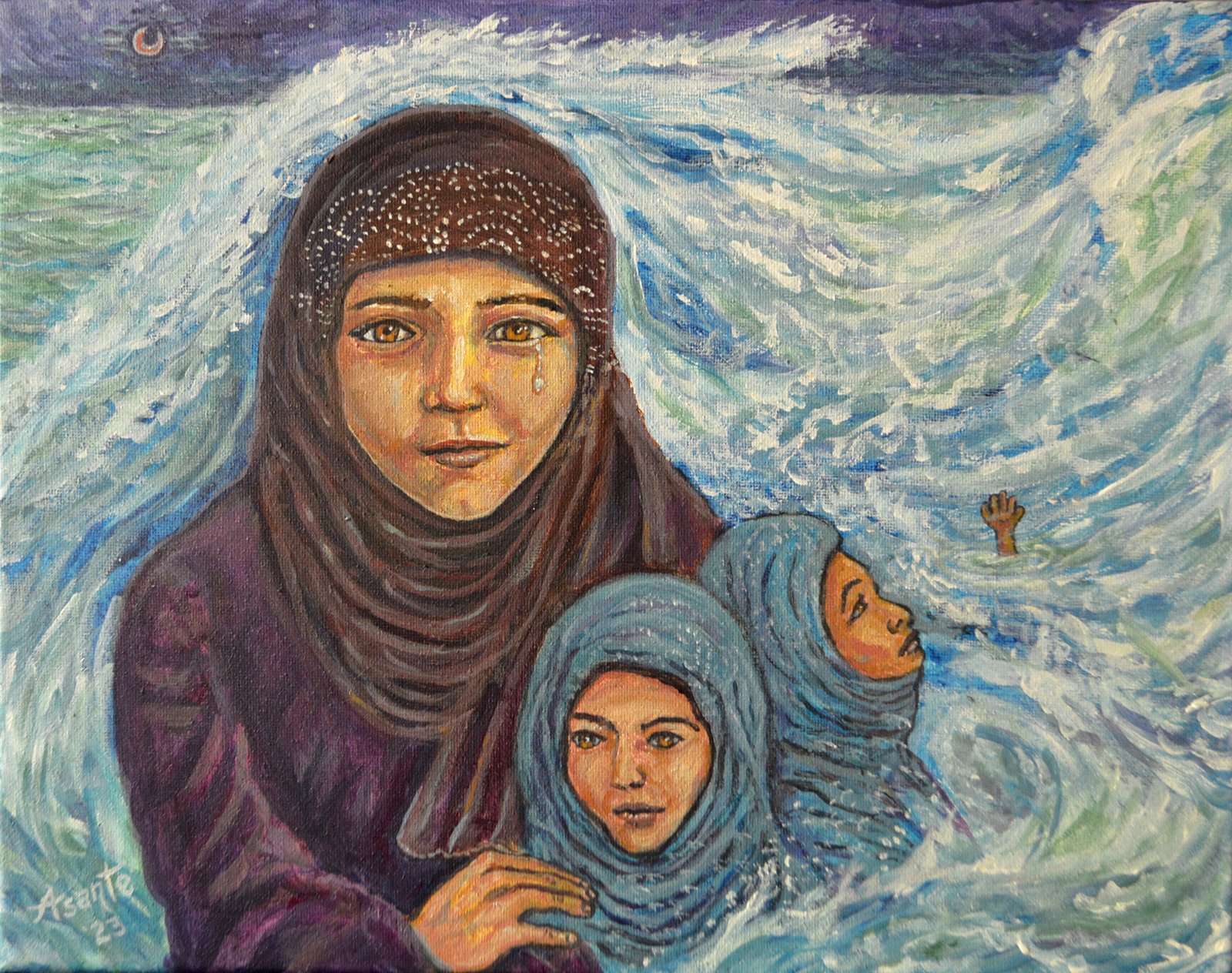
So many of us are mesmerized by the plight of billionaire folly, yet our society is turning a blind eye to the very real horrors of the world’s refugees, seeking survival. While the billionaire submersible was imploding last month reminding us all of the power of our oceans’ depths, and an oft-absent respect for the power of nature, a ship crowded with refugees sunk near the coast of Greece and as many as 700 women and children drowned. The officials in boats did nothing to help, they simply watched in the as the refugees drowned. So much of this world’s politics and cruelty are so reprehensible… so much cruelty when there could be compassionate sharing and life saving help! This new painting insisted on coming into the world. I cannot and art will not be silent on the insanity of this all!!!

You can read an insightful article by Amy Goodman & Denis Moynihan in Democracy Now! https://www.democracynow.org/2023/6/23/greece_migrant_shipwreck_media_coverage

Art and words by Asante Riverwind, artist, Eugene, Oregon.