Category Archives: Asian American

A Straight Line: Simply Nonexistent

A Straight Line: Simply Nonexistent
By Sahil Prasad, grade 7, Maryland.

We cannot argue with reality. We cannot argue with science. Therefore, we simply cannot argue with the fact that there are no straight lines in the universe.

Let’s start with science. The science of a straight line falls under the subject of physics. It might seem like a complicated topic, but the theory behind it is pretty simple. Let’s say you are driving a car on a “straight road.” Your first thought is that you are moving in a straight line. But, in reality, the vehicle is traveling on a slight curve. Why? The Earth is a gigantic sphere, so whenever you think you are driving straight, you are actually driving along the slightest of curves as there are no straight lineson the circumference of a circle. If you start rowing in a boat from one place and keep sailing, the concept of the curved Earth will take you in a circle and you will end up where you started. The brain formulates the concept of a straight line to simplify what you see in nature. Consider it a tool for the mind to decipher reality.

Even light, an entity so fast that we might think it travels in a straight line, truly does not follow a straightforward path (See figure below). The concept of gravitational lensing can prove this fact. When you look at an astronomical object through a telescope, it might seem like you are looking at the object right in front of you. However, in reality it is likely to be in a different location entirely. Perhaps even billions of miles apart from your “straight” view. The gravitational influence of the bodies scattered across the universe can bend light rays so much that you will see a completely different object than the one in front of you. The gravity of massive objects can bend light to the point that it will curve backward into itself. This is a characteristic of a black hole! The universe is curved and continuously expanding. Thus, if a light ray were to travel in a “straight” pathway, it will ultimately return to the same place where it began its journey, similar to the rowing the boat example mentioned above.

Figure 1: The effect of gravitational lensing on the path of light. The orange lines show how light bends from the object to the earth.

Another field that is preoccupied with lines is architecture. The famous architect Antoni Gaudi pointed out that straight lines don’t exist. He said, “There are no straight lines or sharp corners in nature. Therefore, buildings must have no straight lines or sharp corners.” Gaudi states that buildings with “straight walls” are human interpretationsof nature. Gaudi’s buildings follow nature’s rules, as shown by the elegant curves of the Casa Batllo in Spain, his home country. The fact that Antoni Gaudi lived 100 years ago and that his buildings continue to inspire many across the world shows that something that abides by nature’s laws—with no straight lines—is likely to be an inspiration for years to come. As Ian Malcolm, the mathematician in the movie Jurassic Park put it “Nature always finds a way” (emphasis on nature, not humanity).

The concept of straight lines was controversial and heavily influenced the politics and society of Europe from the 15th to the 17th century. Hellenistic thinkers and scholars like Aristotle in the 5th century already proved that the Earth was spherical, but many Europeans did not believe in this idea! However, some Europeans during the Age of Exploration refuted this belief. Just as the famous Italian scientist Galileo Galilei was persecuted for advocating a heliocentric model of the solar system, many thinkers like Giordano Bruno were shamed for believing that the Earth was round. Many of these rebellious thinkers were executed and burned at the stake. Not even the rich and powerful European kingdoms could agree with reality.

Well, my friends, let’s move on to life. The concept of nothing going in a straight line can be associated with life as much as it relates to science and architecture. Whenever you do something, it never turns out to play out exactly as planned. I especially know that as a thirteen-year-old! Life is a bumpy road–every time you go forward, it is followed by two steps back or to the side. Just like how science explains it, life is a curvy path full of unexpected twists, turns, and adventures that nobody can ever predict. The fact that life isn’t a straight line is reflected even in the history of the Bible. The Bible was first preserved in the First Temple of Jerusalem, which was destroyed, and then the scattered remains were placed in the Second Temple—also destroyed by invaders. We can learn that even religion doesn’t proceed in a straightforward path—let alone human beings like us.

Who are we to argue with reality?

###

By Sahil Prasad, Grade 7, Maryland.


Patbingsu With A Twist

Patbingsu With A Twist

By Nina Choi Zaldivar, age 14, Illinois

“I am a fourteen year old high school freshman living in Chicago, Illinois. Half Korean and half Argentinian, I love connecting to the cuisines of both of my cultures. I wrote the attached piece, Patbingsu, inspired by my desire to explore my cultural identity through food, specifically, delicious desserts!”

During middle school, my cousin Audrey and I figure skated at a suburban North Shore camp where most of the coaches and skaters were white. We slept over at our Korean grandparents’ house for a shorter commute to camp, where our grandparents cherished every moment with us, their lovely granddaughters. My grandmother expressed her love through her Korean cooking: kalguksu (noodles with beef broth), bulgogi(sweetened beef), fishcakes, chapchae (sweet sesame glass noodles), chapssaltteok (rice cake with sweet red bean paste), and my favorite, patbingsu.

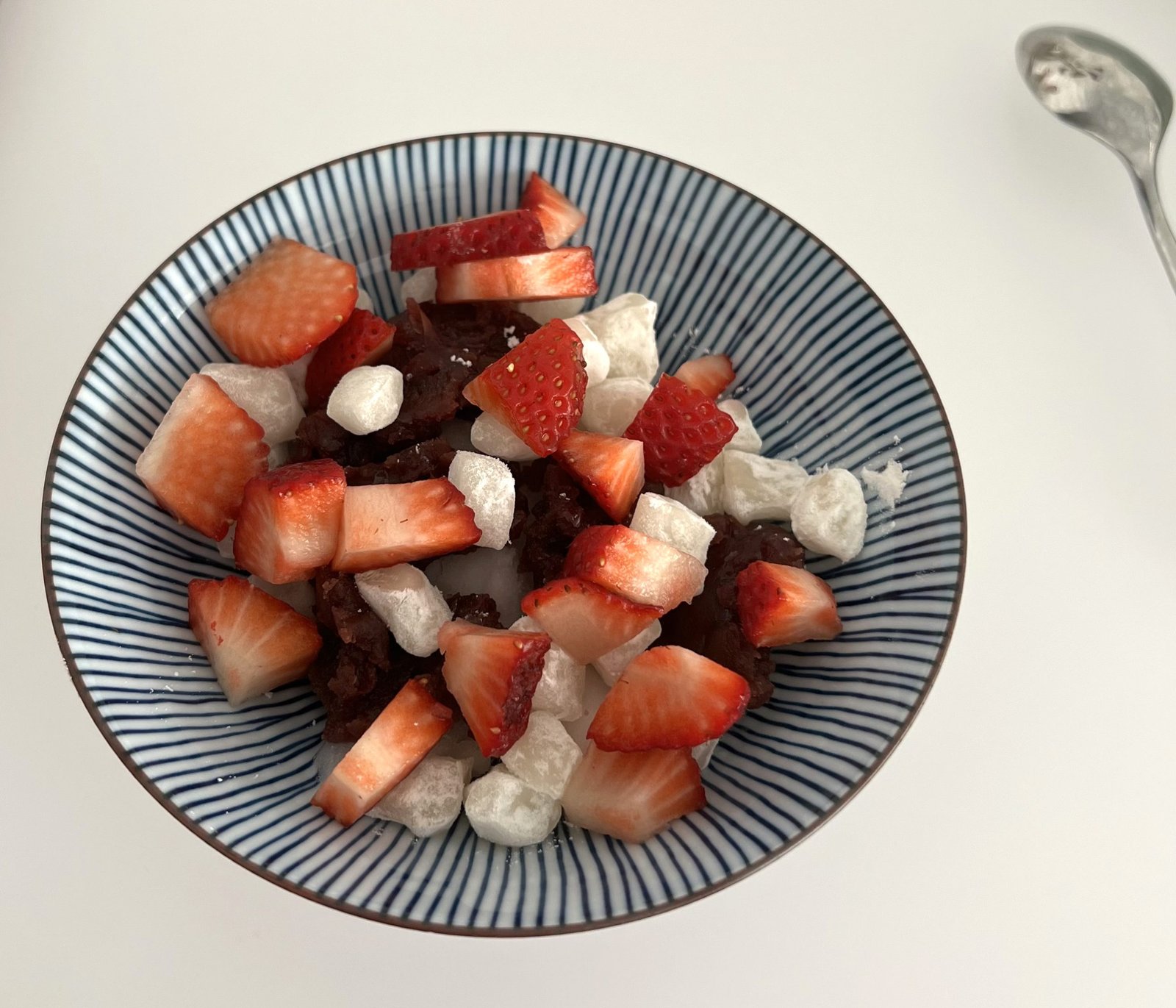
Patbingsu, pronounced pot-bing-soo, is a summertime red bean shaved ice dessert. “Pat” means red bean in Korean, and “bingsu” is the shaved ice part. Most bingsusare made with shaved ice, but my grandparents introduced an American touch of lemon-flavored Italian ice, which adds a light, citrusy note. On top of the ice, you layer a sweet, earthy, and creamy red bean paste and a variety of fruits—my favorite are grapes and strawberries, which add a crunchy texture. Finally, you sprinkle soft, chewy mini rainbow mochi among the fruit on top. The harmony of lemon ice melting with the red bean paste turns into a symphony with a bite of strawberry and mochi.

Every morning our grandparents fed us a Korean breakfast and our grandpa drove us to the skating rink, our Korean lunches wrapped securely in our rolling ice skating bags, where we were met by a chilly blast of air. During lunch, our friends pulled out peanut butter and jelly sandwiches with a Capri Sun, while I opened my bulgogialong with rice and gim (dried seaweed).

The pungent smell traveled across the table, the conversation skipping a beat while my friends noticed the difference. I felt humiliated, and then guilty about my embarrassment because I was betraying my Korean-ness. Ashamed of feeling ashamed, I quietly ate my bulgogi and rejoined the conversation about Taylor Swift’s Reputation Tour.

At the end of each day of skating, I’d collapse at my grandparents’ kitchen counter where my grandmother greeted me in her floral blouse with faded pastel slippers, having lovingly prepared chopped fruit for patbingsu. “Muhguh chigoom!” she’d command—Eat now!—as she handed me a clear, square floral bowl full of freshly assembled patbingsu.Relieved to be home, I’d take the cold treat to the backyard where I’d devour the tangy and sweet patbingsu. My devoted grandmother never denied my request for a second serving, even though it was always smaller than the first.

My life consists of two worlds: the traditional Korean world, and the mainstream American one. Whenever I taste patbingsu, I am transported to the summers of my middle school, smelling the sweetness of the breeze in my grandparents’ backyard, enjoying the flavors of the lemon Italian ice melting into the red bean paste. Patbingsu is my place of comfort and security where I can be unconditionally accepted as both Korean and American.

Recipe for Patbingsu with Italian Ice (makes 1-2 servings)

This refreshing patbingsu recipe with lemon italian ice is courtesy of the Choi grandparents. For the fruit, I recommend fruits that are ripe and in season. I prefer using a variety: grapes, strawberries, watermelon, kiwi, and blueberries.

Ingredients:

⅓ cup lemon Italian Ice
¼ cup sweetened red bean paste
¼ cup fresh fruit
1 ½ tablespoon mini mochi (sweet rice cake)

Instructions:

  1. Add the Italian Ice then red bean paste into a bowl.
  2. Cut up fresh fruit into bite size cubes then add to the bowl.
  3. Add the mochi and serve.

Peace Through Awareness

Peace Through Awareness

“I am not a virus.” That was the message on many of the signs to call out anti-Asian hate. Asian hate crimes during Corona have rocked our country back and forth, but even before Corona pandemic came into our world, Anti-Asian hate crimes existed. We’re living in a time of change, with black people getting killed, Corona virus, Asian hate, and to top that all off, Russia’s war in Ukraine. Peace is hard to come by these days.

Back when Corona started, my mom talked to me about Asian hate crimes. She said that President Donald Trump called the virus “the China virus.” It was basically his way of saying, “Oh, this pandemic is all because of Chinese people.” That made me feel sad, but at that time I felt that there wasn’t really anything I could do.   

Unlike me, other people were already doing rallies, and a few people had formed an organization called Stop AAPI Hate. News spread even faster than Corona virus. A few months later, my family went to an Anti-Asian Hate support rally in Fort Lee, and we heard people speak about the hate crimes. My parents had heard about it from our friend. It was on a field, with a big “Be Fort Lee” sign. The supporters were crowded around a table, and the speakers spoke in a microphone. People brought their families with them, including their kids. They made signs to show their support. The signs said things like “Love,” and some even used drawings. One sign I remember clearly was a person with a mask, and the artist used rather dark colors to show their pain and fear.         

I may not have understood then how painful the attacks were, because I hadn’t even made a sign. But the rally encouraged some other people.  Recently, my mom and her coworkers started a podcast. It focused on the Asian Americans living in Queens, NY. I loved listening and learning the stories of these Asian American people, but the podcast also helped me understand the depth of Asian hate in the country. The podcasters would give some snippets of the attacks on Asians such as GuiYing Ma, a 62-year-old lady that was hit on the head with a rock by a stranger. She was sweeping the sidewalk outside her Jackson Heights home on Nov. 26th when a man ambushed her, smashing a large rock against the left side of her head just inches from her eye.

Mrs. Ma woke up in a hospital after a coma and even waved to her husband, though her brain was damaged. For a while everything seemed like it was going to be okay. But then she died. When I heard that, I was shocked. How could someone just kill her, when she didn’t even do anything wrong? What if this had been someone close to me? What if it had been someone in my family?
Then I started speaking up.

“Does anyone else want to share?” My teacher at school asked. It was a few days before Dr. Martin Luther King Jr. Day, and my class was talking about equal rights and what movement we would like to stand up for.

“Noah?”

“I’m Asian, so I want to stand up against Asian hate. There are attacks going on, and many people have gotten hurt.”

I wasn’t the only one speaking about this. Several of my other friends pitched in, and talked about the attacks, and one almost made the teacher cry with her answer, which was more like a speech. Now I finally felt like I was part of this. Not a really big part, but enough that some people at least know about it. Who knows, they could spread the word, and more and more people will hear about it and speak up against the hate crimes. I might not be some famous speaker that would win the Nobel Peace Prize, but I did something to bring a little, just a little, more peace in our world.

By Noah Xia, age 9, Asian American, New York. She adds: “I like to write, read, play piano, and draw. I write poems, short stories and essays. I enjoy playing with my brother and riding my bike along the Hudson River. Even if I don’t have a piece of paper nearby, I make up stories in my head. In fact, one of my greatest stories (according to my brother) was completely improvised! My submission talks about the hate crime attacks against Asians and how they affected me. At first, I didn’t think I could do anything about the attacks, but I ended up actually bringing a little more peace in our world. I believe that world peace is possible, but we’re just not quite there yet…”

A Scallion Pancake Recipe Inspired by French and Asian Cuisines

A Scallion Pancake Recipe Inspired by French and Asian Cuisines

By Owen Lu, age 16, California

Introduction:

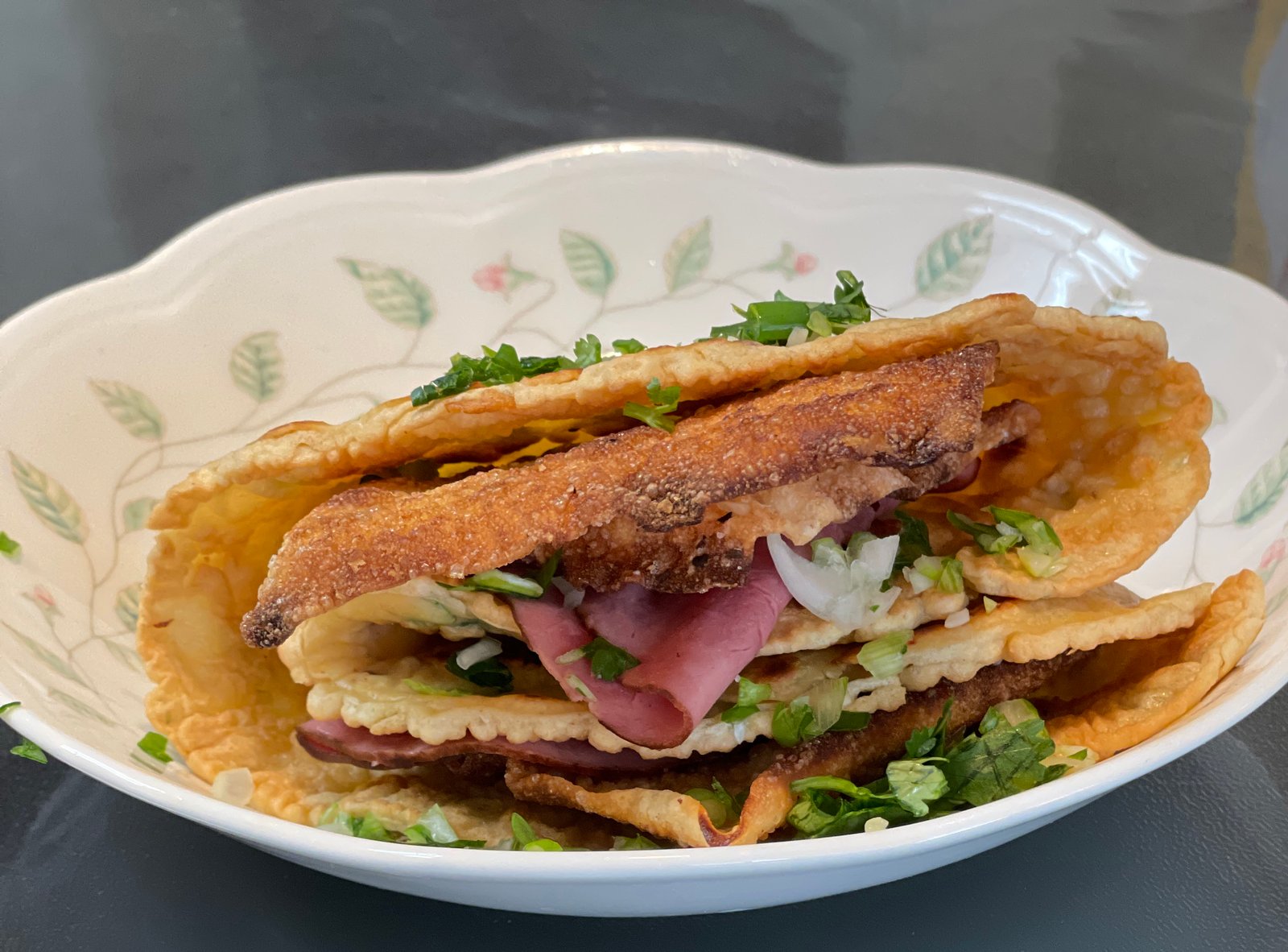
This pancake recipe is surprisingly simple and versatile, allowing for many variations by adjusting the portion size or adding other ingredients of your choice. The batter in the recipe resembles that of crepes, the traditional French pancakes. Chinese cuisine also contains many similar versions of this recipe, like Jian Bing(煎饼)and scallion pancakes. The dish I present here combines elements from these two cuisines.

The original pancake recipe (without additional ingredients) was passed on from my grandmother. The recipe stemmed from the hope to create an easier version of scallion pancakes; scallion pancakes are much more complicated to make as you have to carefully layer the dough to create a crisp exterior but maintain a soft interior. This pancake recipe produces a dish with similar ingredients but in a much simpler way.

I fused my dish with Chinese Jian Bing, which often contains crisps inside that provide a texture contrast. After some research, I found that the crisps can be easily made by shallow-frying, pre-made wonton wrappers.

I hope you have fun experimenting with this quick but tasty recipe!

Ingredients: You will need:

  • Wheat flour (type of flour doesn’t matter too much), 3 cups
  • Eggs, 2
  • Water, 3 cups
  • Green onions (finely chopped), ½ cup
  • Cilantro (finely chopped) ¼ cup
  • Salt
  • Pepper
  • Olive oil (type of oil doesn’t matter too much)
  • Chili Oil, Fermented Bean Curd (optional)
  • Wonton wrappers
  • Any other toppings / additions of your choice to wrap inside the pancake

DirectionsThis recipe produces around 5 servings.

  1. Add 3 cups of flour to a bowl.
  2. Crack 2 eggs into the bowl
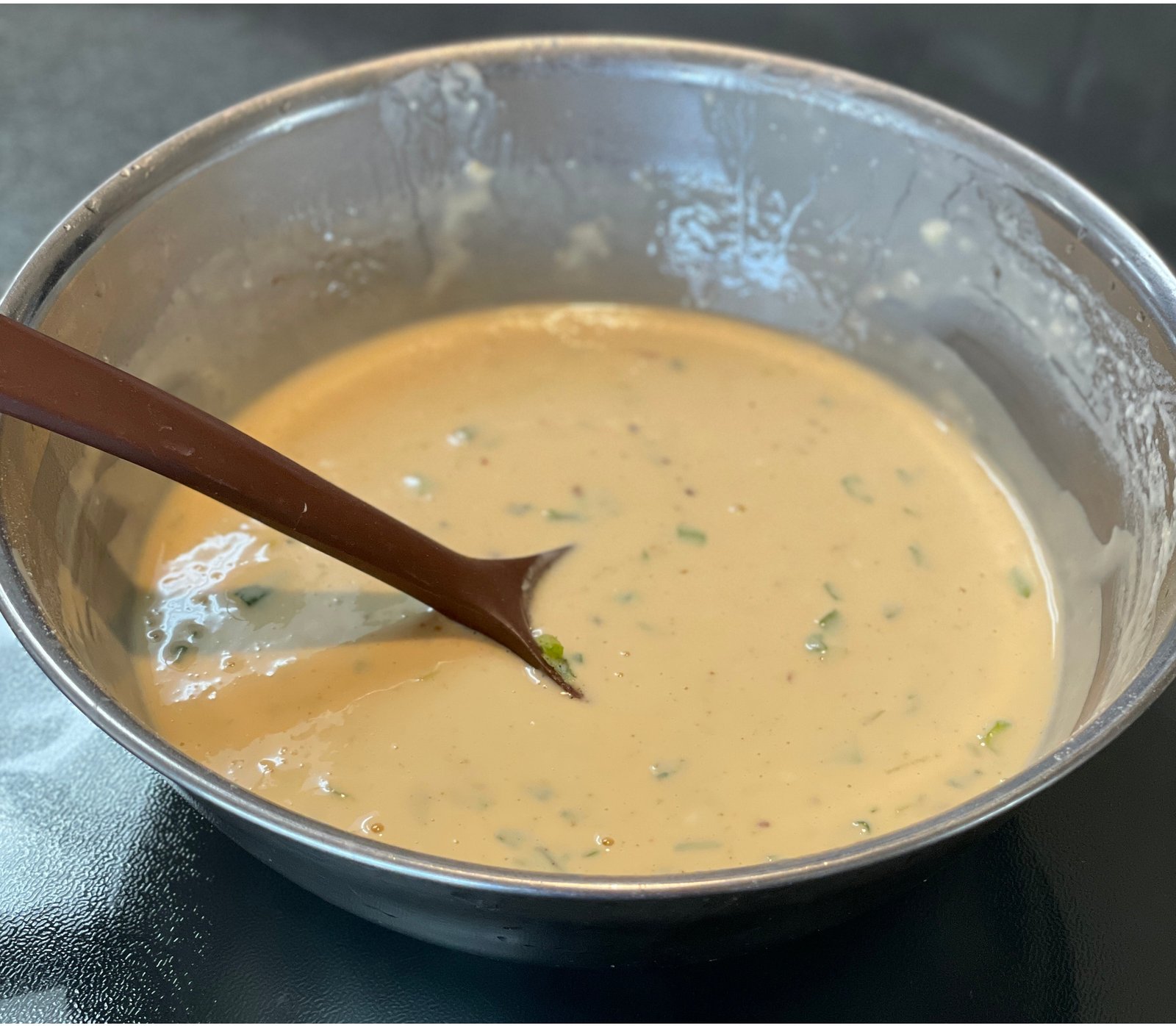
  3. Add cold water slowly into the bowl by keeping the faucet barely open and taking the bowl out every 10 seconds or so to mix.
    1. Mix thoroughly—at first, as you add more water, you may notice “clumps” forming in the mixture. Be sure to continue stirring until these clumps mostly disappear.
    2. The purpose of adding the water slowly is to prevent these clumps from growing larger—it is hard to dissolve the clumps if you add too much water at once
    3. The consistency we are looking for at the end is in between the dough and soup. The exact amount of water needed for this recipe is hard to measure because we are adding it incrementally.
  4. Chop green onions and cilantro relatively finely and add them to the mixture. Chopping them too big may prevent them from properly incorporating into the batter. Chopping them too small may make them burn before the pancake is fully cooked yet.
  5. Add salt and any additional spices you wish to include. I often like to include a bit of spice, so I mixed chili oil and fermented bean curd and added this mixture to the batter. You may instead want to add additional ingredients, like onion, peppers, etc.
  6. After adding all the ingredients, be sure to mix thoroughly one last time.


To cook the pancakes: 

  1. Add oil to a nonstick pan on medium-low heat. Medium low heat guarantees that the pancake will not solidify before you finish spreading out the batter into a circular shape.
  2. Add a few spoons of the batter to the center of the pan and spread the batter out until it more or less fills up the pan and forms a circle.
  3. Turn the heat slightly up to medium or medium high so that the pancake can form a nice color on the outside.
  4. Flip the pancake when the other side develops a brown color; be careful! This process only takes around 1-2 minutes. If needed, flip the pancake around a few more times to fully cook it.
  5. Repeat steps 1-4 until you use up all your batter, making sure to adjust the heat according to the instructions. You may also need to add more oil before you begin cooking each pancake.

If you want to, you can stop here. However, if you want to add a few extra ingredients, please follow the steps below: 

  1. Take out your wonton wrappers and bring them to room temperature—if needed, you can defrost them using the microwave.
  2. Season the wonton wrappers with a touch of salt and pepper to give them some flavor
  3. Turn the heat up to medium-high
  4. In the same oil that you used to cook the pancakes (which should have developed some flavor by this point), place the wonton wrappers in.
  5. Carefully monitor the wonton wrappers and flip them over when the other side turns brown. With medium-high heat, this process takes only 15-25 seconds. I find it easiest to flip them over with a pair of chopsticks.
  6. Take the crisps out and let them dry on a towel.

About the author: Owen Lu, age 16, California, is currently a high school junior and is particularly interested in STEM subjects like physics and computer science. When he’s not solving problems, he enjoys playing the violin, sailing, and cooking.

Pumpkin Cakes: A Traditional Chinese Breakfast

Traditional Chinese Pumpkin Pies (Cakes) Make a Perfect Chinese Breakfast (and a Delicious Dessert too).

To make the traditional Chinese breakfast of pumpkin cakes, you will need:

1/4 pumpkin, 2 tbsp sugar, 200g rice flour, red bean paste (optional), and white sesame seeds (optional). 

You will need to prepare the pumpkin first.

  1. Get rid of pumping seed and it’s inside fiber.
  2. Peel off pumpkin skin. 
  3. Slice into thin pieces ~3mm. Thinner pumpkin slices will reduce the time it takes to be cooked. 
  4. Boil the Water first and Steam it in a bowl for 10 min.
  5. After steaming, pour out water from the bowl if any.
  6. Will need to add 2 tbsp sugar and smash it until there are no pumpkin lumps left. 

Making the dough

  1. Add in 50g of the rice flour, and mix evenly. Repeat 4 times. Do not add-in all the flour at once.
  2. What we want is a rather soft dough. (If you have reach this texture, you don’t need to add exactly the same flour amount as I did; different pumpkin and flour will perform differently).

Making the pumpkin pie 

  1. Take approximately half a hand fist of dough. 
  2. And rub into a ball shape, then press over the dough making a round cake shape. 
  3. If you have red bean paste you can take a scoop of it and place it on the pie shaped dough and close it up and repeat step 2. If you are adding the paste make sure your pie shaped dough is thinner and bigger. Don’t add too much of the paste. 
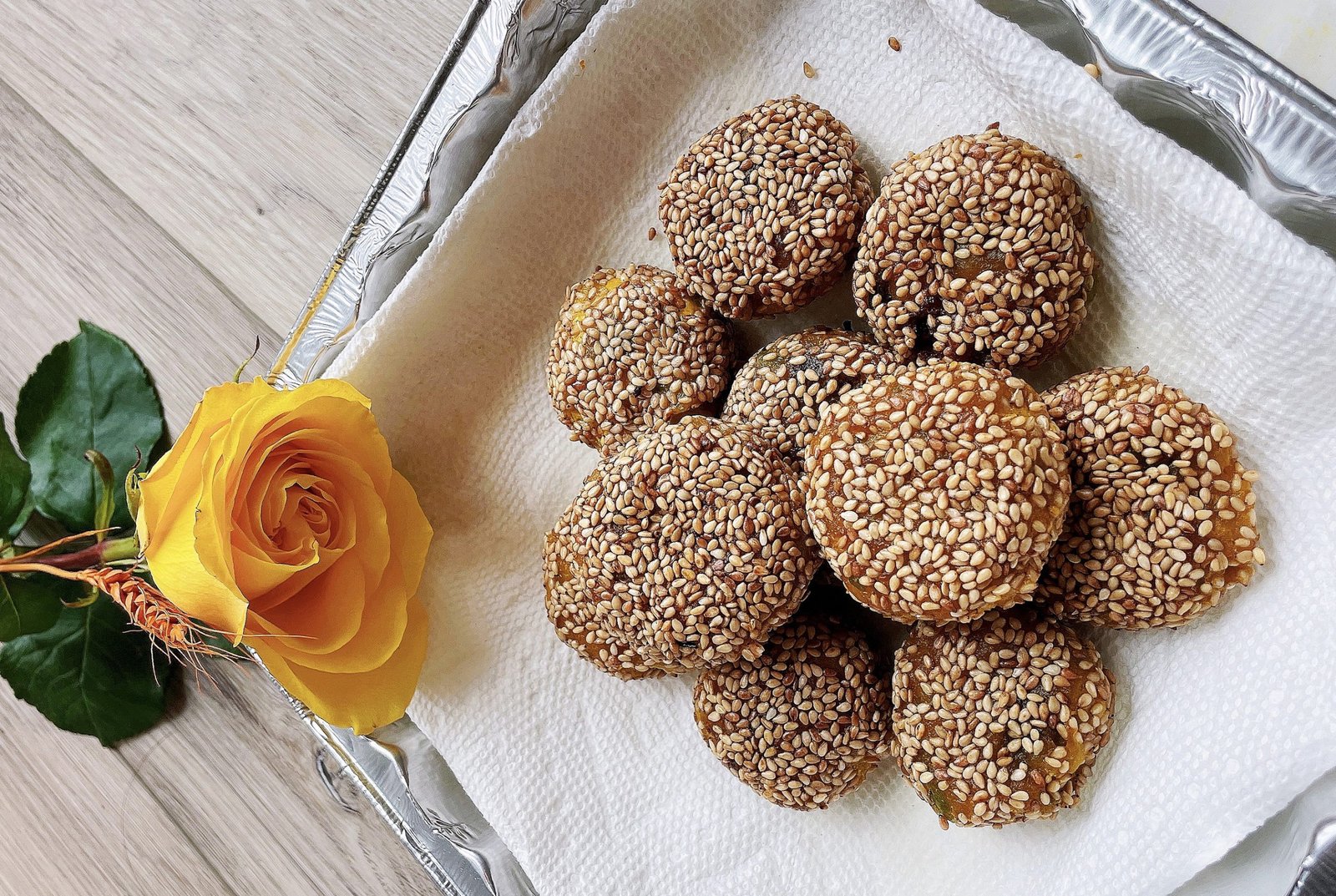
  4. If you have a plate of white sesame, run both sides of the finished pie in the plate, you can press upon the pie softly allowing sesame to stick to the surface of the pie. 

Cooking the pie 

  1. Preheat the frying pan.
  2. Put in enough oil to cover the bottom of the frying pan.
  3. Add in the pie when oil is hot enough. 
  4. Cook the cakes on low medium heat. 
  5. After every one minute, flip the cake(s) over to the other side. Prevent overcooking on one side. 
  6. To test if it’s cooked. You press upon the pie (cake) and if its shape returns quickly it means it’s cooked. Normally it takes 2-4 minutes.

Pumpkin pie is full of nutrients and is very delicious. Chinese often have pumpkin pie as a dessert or breakfast. Pumpkin pie has the best taste the day it’s made, so please enjoy and finish them quickly after made. This recipe makes 5 to 8 pies; you can adjust the recipe proportionally for your family size!

Wendy Mou, age 16, California. Wendy is an active student who enjoys creative outlets including food. For example, baking is her preferred way to relax after school work and family chores. Since her childhood, she has always held respect for the natural ingredients that go into her food. Currently, she is in the process of starting a food science club at her school. She looks up to those unique recipe makers, and hopes to become one someday. 

Nature Is This and This Is I

I, I, I, I am nature.
Nature is this and this is I,
I, I, I, I am nature,
Nature needs love and care, so do I.
I am this and this is nature,
I need food and water.
Nature is this and this is I,
Nature grows over time, so do I.
I am this and this is nature.
I like to be in the sun.
Nature is this and this is I.
I, I, I, I am nature.
 
By Arya Khan, age 8, Asian American, Illinois. Arya adds: “…nature and we are alike. Living in the city, nature is hard to find. I wish I could find nature like in my backyard or in a fairy tale. So I hope this (my poem) will help people plant trees and help the Earth a little bit more. I am also doing a project called Save the planet…”

Letter to the Editor: On Mental Health

Letter to the Editor

Re: The Talk: Bridging the Gap Between Parents and Teens – Skipping Stones

Mental health is a real issue that a lot of people talk about and donate money to. If nothing is done to solve the problem; a minor problem can turn into a big one.

Here is what we can do: Be proactive, and catch teens just before they go into a deep stage of depression. Check in on them every so often. Parents can be more aware of their child’s emotions, and they can have intimate one-on-one sessions with them. Acceptance is the key to the solution.

In my experience, my parents didn’t pay attention to mental health. They cared about success, and behavior (what parents should be caring about, but should not be so concerned with only that). Parents need to empathize with the children, because they have gone through the same things.

Kids need an outlet like a sport such as soccer, basketball, or baseball; a creative hobby like painting, drawing, theater, writing, reading. They need someone to talk to; to express their feelings.

Let’s hope the new generation will grow up understanding the importance of mental health and what it can do to a person, so that they can treat their own kids with acceptance.

—Mahima Pai, age 15, New Jersey.

Truly

“Truly”

By Isabelle Tee, age 15, New Jersey.

She doesn’t want you to join us,” she said, “you are too loud.”

For most of my elementary school years, I’ve never had an actual friend that I’ve felt comfortable enough to just be myself. Many of the people I’ve talked to were mainly acquaintances so that I didn’t look like a loner. Because when you’re on a field filled with kids who don’t think before they talk, the last thing you want to be is alone.

So I tried to befriend a group of girls that I’ve only distantly known from second grade. Whenever they talked to me, I just nodded. I had no clue what they were actually talking about. During recess, I just follow along and pretend to be the bad guy when we play games. During class, I’m the one giving them answers for worksheets. And during lunch? That’s another story.

My mom packed me fried rice that day, which—in my opinion—was better than the soggy dino nuggets. I sat down at the lunch table with my “friends” and ate my food. One girl starts to sniff the air and looks around. Then she goes, “What’s that smell?” She looks at me. All I could do at that moment was put on a fake smile. How can you be friends with someone who can’t accept who you are?

The following day at recess, I joined the girls at the corner of the field. Only two of the girls were standing there. I asked them what game they were playing, and they awkwardly looked at me back. They told me that the others didn’t want to play with me anymore, apparently, I was too loud for them.

I pleaded with them, promising I wouldn’t scream loudly and lower my voice. They looked at me and told me to wait. One of them ran over to the other girls and whispered something into their ears. When she came back, she allowed me into the group again. I kept my word and didn’t speak much. I didn’t want to go back home crying to my mom again.

I realized then that, from the beginning, they never truly accepted me. They were never true friends.

By Isabelle Tee, age 15, Asian American, New Jersey.

Discrimination Against Asians in the United States

Discrimination Against Asians in the United States

By Fanny Wong, Chinese American author, New York.

In May, we celebrate the resilience, legacy and culture of Asians, Native Hawaiian, and Pacific Islanders in the United States. As you may know, the last few years have been very difficult for Asian Americans. We were aghast at the March 2021 mass murder of eight people in Atlanta, Georgia. Six of the victims were Korean women. Asian Americans were already targeted for being “Asian” since the beginning of Covid-19 pandemic. Between March 2020 and February 2021, almost 4,000 anti-Asian hate incidents were reported throughout the country. Verbal abuse and physical attacks were recorded on surveillance cameras. Violence could be spitting, hitting, and shoving that led to injuries. In February 2021, an 84-year-old Thai man died after he was shoved to the ground in Oakland’s Chinatown in California. 

Since the arrival of Chinese immigrants in the 1850s, the United States has had a long history of viewing Asians as “The Other.” The early immigrants worked in gold mines and helped build railroads in the American West. They sent their hard-earned money to China to support their families, and repaid loans of their passage to America. They had little choice but to work for whatever wages they could. American laborers generally could bargain for higher wages, but they feared being squeezed out of their jobs by the Chinese immigrants. 

As with most immigrants, the Chinese settled in their own neighborhoods. The stories of crime and decadence in Chinatowns, some of which were true, so alarmed the public that the Chinese were called the Yellow Peril. 

The Chinese Massacre of 1871 was the first in a series of riots and killings in California. Los Angeles was a small town then. The 200 Chinese men who lived there were farmers, laundry workers, laborers and vegetable vendors. This small population lived in a segregated area called Calles de los Negros, a very rough neighborhood where no one wanted to live. That was where the Chinese could afford to live. 

On October 24, 1871, a dispute between two Chinese factions led to the accidental killing of a white bystander. People ran around saying the Chinese were killing White people. A mob of 500 white men descended on Chinatown killing 18, some of them by hanging. At the time, Chinese people were not permitted to testify against white people. Even so, a few of the perpetrators were tried and convicted. But they were released on a technicality. No one served a prison sentence, no one was held accountable.

In 1885, Chinese miners in Rock Spring, Wyoming, did not join a strike by white miners. This enraged the white miners so much that they stormed Chinatown, killing 28 Asians and injuring 15 more. Again, no one was held accountable. When news of the massacre spread, many people condemned the violence, but it also resulted in Chinese immigrants being driven away from some communities. 

By then, Congress had already passed the Chinese Exclusion Act of 1882, which suspended the immigration of Chinese immigrants for ten years. This Act was the first in American history to place broad restrictions on immigration based on nationality. In 1892, Congress voted to renew the exclusion for another ten years, expanding the restriction to cover Hawaii and the Philippines as well. This Act was not repealed until the year 1943, when a law passed set a quota of 105 per year. The Immigration and Nationality Act of 1965 finally abolished the National Origins Formula.

During WWII, some 120,000 Japanese Americans were sent to ten Internment Camps (see my recent article on this topic) in the Western United States. German and Italian Americans were not interned, even though Germany and Italy were also fighting American soldiers in Europe. 

Whenever there is economic hardship, someone becomes a scapegoat. In 1982, Vincent Chin, a 27-year-old Chinese young man, was mistaken for being Japanese. Japanese cars were selling very well, and many workers in American auto plants had lost their jobs. Vincent was bludgeoned to death by a laid-off autoworker and his stepfather, also a Detroit autoworker. His murderers never spent a day in jail. In this case as well, justice was not served. It was almost as if an Asian life was not worth anything. 

But Asians, just like everyone else, are worthy. They have contributed greatly in music, performing arts, science, sports, literature, and politics as well as all other fields. Duke Kahananmoku, Hawaiian American, popularized surfing in the 1920s. Dalip Singh Saund was the first Indian American to be elected in 1956 to the House of Representatives. Yuji Ichioka, Japanese American, was a historian and civil rights advocate. Jerry Yang, Taiwanese American co-founded Yahoo. Tammy Ducksworth, Thai American, is a disabled Veteran and a senator. Sandra Oh, Korean American actress plays roles that are not stereotypes. Sunisa Lee, Hmong American gymnast, won a gold medal in the 2022 Olympics. The list goes on and on. 

It is encouraging that movies made by Asians about Asians Americans are gaining popularity in the United States. The award-winning film “Minari” by Korean director Lee Isaac Chung tells the story of an American Korean family’s struggles and aspirations in rural Arkansas. Disputes between husband and wife, health issues of a child, generational differences and financial difficulties are familiar to those of white families. The more realistic Asian stories are told, the less they will be perceived as “The Other.” 

 In the past, Asians have survived racism by keeping their heads down. The younger generation is coming together and standing up for their parents and elders. It no longer believes that a nail that sticks out gets hammered down. ‘Head down and mouth shut’ is no longer an option. It is important to speak up about and work against injustices of racism. 

Different languages as well as cultural traditions among the many different Asian communities in the nation can make it difficult for them to unite for Asian advocacy. But it is important that we unite and be active for the cause. 

Let’s hope that as we celebrate the Asian American and Pacific Islander Month this May, we witness great strides being made to end racism in our nation.

By Fanny Wong, Chinese American author, New York.

The Internment of Japanese Americans During WWII

The Internment of Japanese Americans During WWII

By Fanny Wong, Chinese American author, New York.

The United States is a nation of immigrants. Japanese immigrants started to arrive on the Hawaiian Islands in the 1860s to work in the sugarcane fields. Later, many moved to the West Coast of the U.S. mainland to work as farmers and fishermen. By 1911, over 400,000 Japanese men and women had immigrated to the U.S. 

At the beginning of the 20th century, the Japanese were portrayed as the enemy of the American worker, just as Chinese immigrants were decades before. The Japanese farmers were the envy of white farmers who did not use as many labor-intensive methods and were less productive.

On December 7, 1941, the Japanese planes attacked Pearl Harbor. Navy ships were destroyed and many American servicemen died. On the West Coast, the government immediately began rounding up Japanese newspaper editors, community leaders and labor organizers. Their families were not told the reason or where the men were taken.  

The entire Japanese American population within 100 miles of the West Coast and Hawaii was considered dangerous, possibly spying for Japan. An 8 p.m. curfew and a five-mile travel limit were imposed on all persons of Japanese origin. On February 19, 1942, President Franklin Roosevelt signed Executive Order 9066, sending the Japanese and Japanese Americans to ten hastily built internment camps in Arizona, Arkansas, California, Colorado, Idaho, Texas, Utah, and Wyoming.   

The Japanese were shocked beyond belief. Two-thirds of the 120,000 internees were American citizens, born in the U.S. They were forced to sell or abandon most of their possessions, houses, cars, boats and land. Their possessions, including precious farmland, were sold at a bargain to white farmers. They had only a few days to pack and could bring only what they could carry. 

The camps were located where the weather was very hot in the summer and cold in the winter. The barracks were shoddily built, covered with tarpaper on the outside. Only canvas cots, a light bulb and a potbelly stove for winter warmth were supplied. Each family had to build its own plain furniture such as a table, chairs and shelves. There was no insulation. Dust and wind blew in through the cracks of wood that had not aged properly and shrank. Four families in small rooms shared one barrack. Within each room, blankets and sheets could be hung to provide some privacy. 

There was no way to escape these prisons. Barbed wires surrounded the camps. Armed guards surveyed from watchtowers. Life was regimented.There were lines for meals, the shower, the toilets and the laundry in communal buildings.  

In the beginning years, the food was American, such as hot dogs, stew, potatoes, liver and cow tongue, which the Japanese were not used to. Later, they grew their vegetables and even made tofu, soy sauce and noodles. Rice was added to the menu. The government spent only thirty cents a day per person on food.  

The internees were put to work with very low wages, from $8 to $19 a month. The camps needed cooks, office and field workers, food servers and construction workers. But many were bored. To relieve boredom, the internees organized outdoor sports for adults and youngsters. Baseball was a favorite pastime for spectators as well. Primitive baseball fields were leveled, rocks and stones removed. There were a variety of other activities, including movies, talent shows and holiday celebrations. 
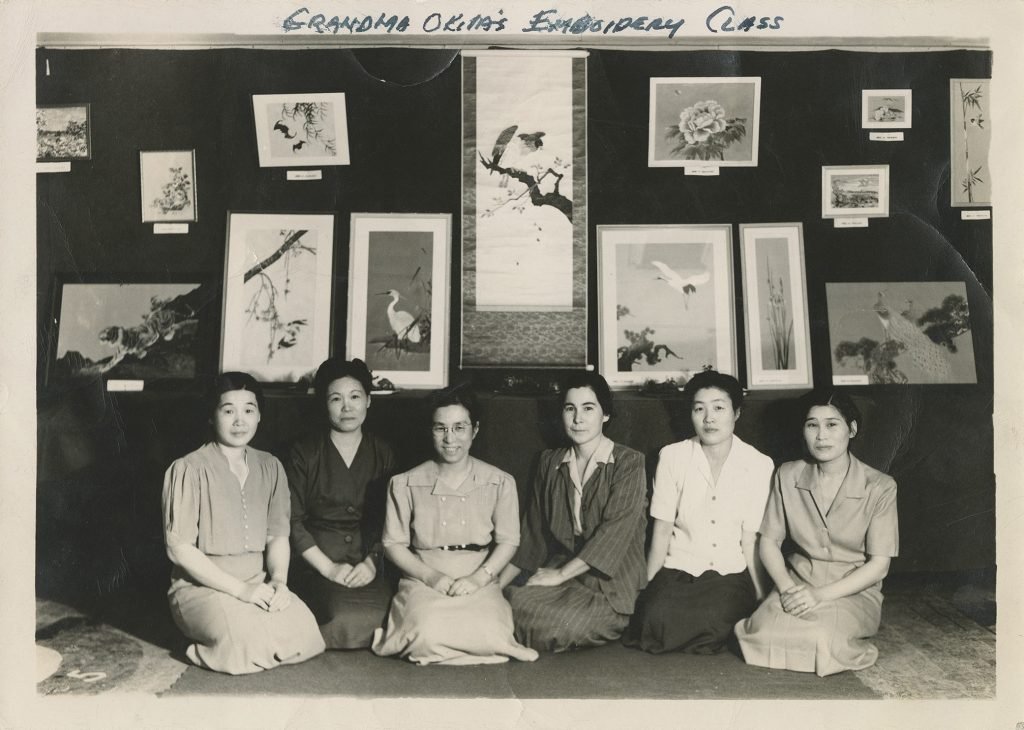
Grandma Okita’s Embroidery Class, Minidoka Concentration Camp. Photo: Courtesy of Japanese American Museum of Oregon, Portland, Oregon. Permission from JAMO required for further reproduction.

The internees were stoic about the experience, often repeating “Shikata ga nai” meaning you can’t change it. They tried to make their lives as pleasant as possible. They ordered fabric from catalogs to make curtains and tablecloths. Paper flowers decorated the rooms. They created tiny gardens in front of the barracks and even small ponds to make their bleak surroundings acceptable. They created handicrafts from dead trees, wood and material found around the camps. Painters, both professional and amateur, recorded the daily activities of the camp in their artwork. Art lifted the spirits of the internees. Their acts of beautifying their surroundings were something the government and the prison guards could not take away from them.  

Some 17,000 children under the age of ten were among the internees and more were born in the camps. Schools were organized for the children from kindergarten to high school. Used textbooks were sent from nearby schools. Most of the teachers were Japanese, although there were some white teachers who had better living quarters. 

In some households, family closeness was a casualty. Children witnessed their parents’ loss of control in their lives. The parents lamented that the children would rather eat with their friends at the mess halls. Teenagers became more rebellious as many of their peers did in the outside world. But in their abnormal lives, the strain was more severe.

Still, the internees were patriotic. They made camouflage nets, bandages for the war, donated money for the Red Cross, and collected metal for recycling.
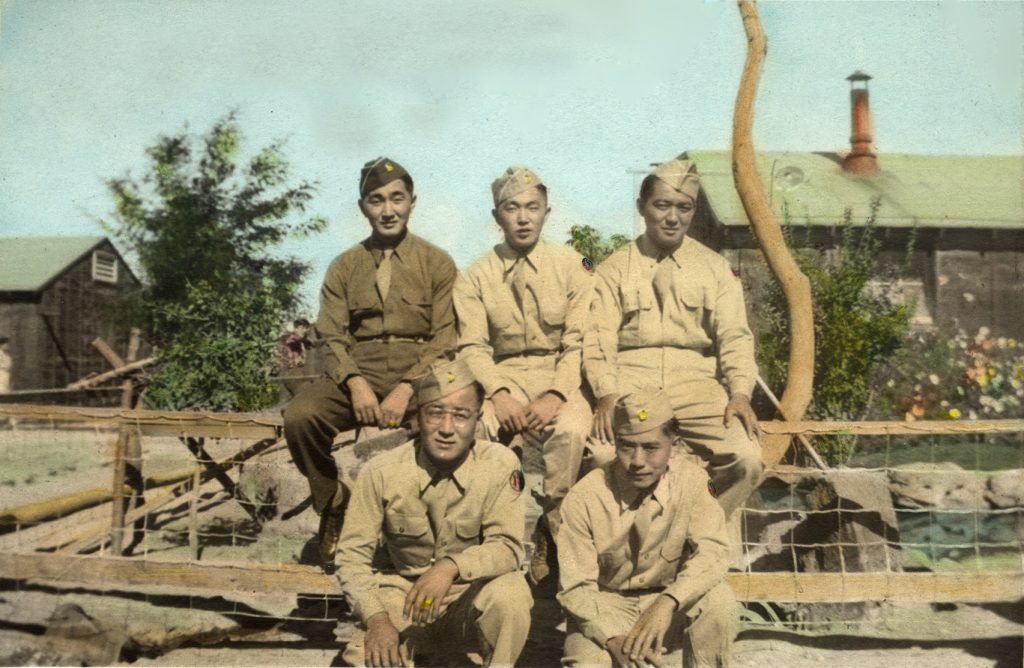
Nisei Veterans of the 442nd RCT, Minidoka Concentration Camp. Photo: Courtesy of Japanese American Museum of Oregon, Portland, Oregon. Permission from JAMO required for further reproduction.

Beginning in February 1943, citizens of Japanese descent were permitted to enlist in the Army and Navy. Many young men joined the 442nd Regimental Combat Team (RCT) that was comprised of all Japanese American soldiers and fought valiantly in Europe. This regiment was the most decorated unit in the army. They operated in some of the most dangerous battles, and therefore, had the highest casualty rates (9,000 dead or wounded). They put their life in danger for the country even though their parents and relatives were in the internment camps. When the soldiers were wounded, when they were released after treatment, they would be sent right back to the internment camps. 

Towards the end of war, the government began releasing large numbers of the internees. The internment camps were empty by the end of 1945, and the last one closed in March 1946. Most Japanese Americans did not return to their hometowns because there was nothing to return to. Those that did return had a difficult time finding work and accommodations. A small number chose to go back to Japan. Each released person was given just $25 and a bus ticket to start their new life.

At the end of the war, no American Japanese were found to be spying for Japan. Later research proved that some American officials were guilty of falsifying reports that were used as the basis for the government’s internment decision.

In 1988, President Ronald Reagan signed a legislation apologizing for the internment on behalf of the U.S. government. In 1990, the first letters of apology signed by President George Bush were mailed. Surviving interned Americans and their heirs received $20,000 compensation for each individual. For many, the apology and the check came too late—they had lived a very difficult life, and many of them had already died. 

After the 9-11 attack by Muslim terrorists, fear mongering and Islamophobia depicted Muslim as dangerous to Americans just as the Japanese were demonized after the Pearl Harbor attack. The anti-Muslim sentiments being expressed in the country led the Japanese American community to publicly state that the horrible injustice done to them in WWII must not be repeated. It continues to raise its voice whenever an ethnic group is unjustifiably targeted. 

By Fanny Wong, Chinese American author, New York.

Editor’s Note: May is celebrated as the Asian American and Pacific Islander Heritage Month in the country. 
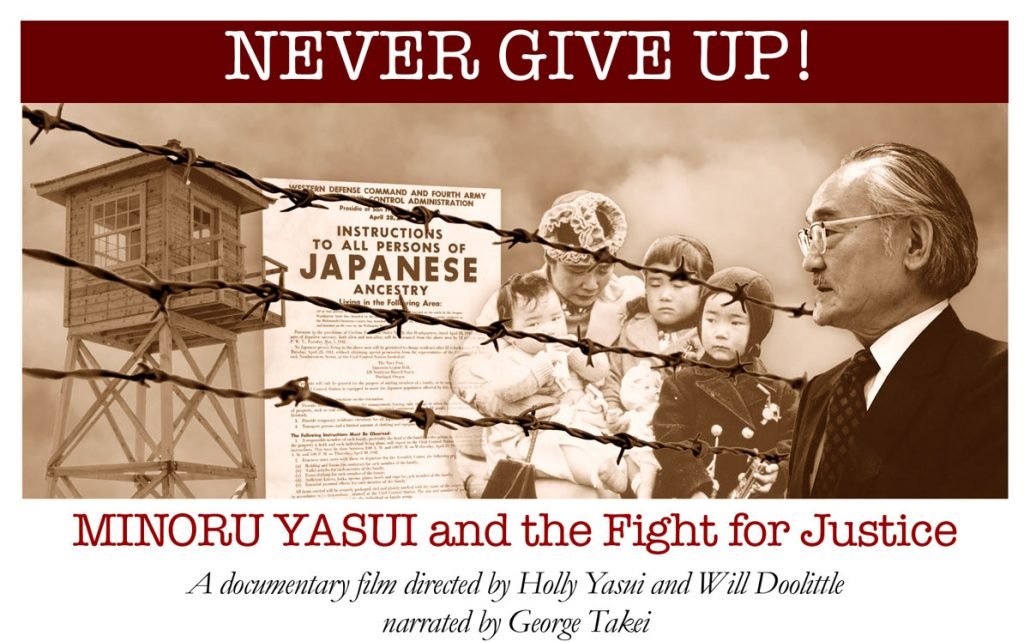
Never Give Up is an award-winning documentary that teaches about the discrimination faced by the Japanese American community and the issues described in the above article. You can get details from the website: www.minoruyasuifilm.org