it dresses the earth in wailing white and grassy green
it gives us life
but we take away from its own
the sky is filled with fire
the ground bathed in garbage
after all that it has done to us
we must save it from ourselves
we must protect our world, our home
our beginning
nature
By Jaslene Kwack, age 11, Illinois.
Jaslene writes: “I like writing, art and music. I play the piano, clarinet and I started bassoon a while ago. In my free time, I like to write stories and poems. I try to be creative using metaphors and verbs that aren’t cliche. I enjoy drawing realistic and abstract pieces of art. When I grow up, I want to be a person who combines art and writing in a creative way to entertain or help people.
“I wrote [this] poem about nature and how we are polluting and killing our environment. I want to recognize the beauty of nature and how it formed us in the first place. Sometimes, people don’t give nature as much credit as it should deserve. Without it, our world would be empty and barren. In my poem, I also talk about parts of nature all around us everyday. The wind blowing, the leaves falling from trees. Technology which is represented in my poem as “the city’s lights and sounds” is taking over our world slowly by every hour. I think because of all these new inventions and ways of life we are making for ourselves, a lot of us forget about how important nature is and how it is humanity’s origin. We should recognize nature and be grateful for this world around us. I think we should all strive to be better and protect the earth so that we can keep our world clean and healthy.”
Lanterns bloom like flowers, the light and colour of crowded city streets.
Folded paper, a slinky of patterns,
Dancing as the candle flame flickers a pattern silhouette.
There are plastic lanterns these days, thick and rubbery with a strange smell,
Lit up with a mini LED bulb.
They come in all shapes and sizes, pop culture and cartoon designs.
Mickey Mouse, Power Rangers, Doraemon.
I remember my cousin had an Elsa once, a matching pair with her Anna-toting sister.
We met with mooncakes under a full moon,
Lotus paste sticky sweet, salted egg yolk seawater respite.
Our ancestors looked up at the same moon, and now we stand in their light—
A product of their mistakes and triumphs.
We stand tall, a proud new generation,
Eager to take on the world outside our Hong Kong,
Not knowing how much our bubble would change in the years that watched us grow.
I was fourteen when I left on a fifteen hour flight to the United States,
Creating a half-globe’s distance within my heart.
I write this at sixteen, a full lifetime for so many before me, a full lifetime for still too many.
Arkansas is American Southern, dry and green and different and not a bad place to be—
And yet I remain a daughter of the Asian East—
My bones do not feel like they belong.
I sat under the ever-present moon last Mid-Autumn, my second in the States,
Eating mooncakes gifted by my art teacher, the only other Chinese person I know in the area.
I look up to the sky, to the stars my cousins do not see, the stars drowned by neon light—
I look up to the sky, to the moon my family looked at thirteen hours ago, the moon my ancestors saw a woman’s story in.
The moon keeps me close to home. By Chiu-yi Rachel Ngai, 16, Arkansas. She adds: "I grew up in the bustling streets of Hong Kong. I moved to the U.S.when I was fourteen in order to get a better education. I am fluent in English and Cantonese. I can understand Mandarin/ Putonghua better than I can speak it. I am working on overcoming my internalized racism towards myself for being Chinese, and I decided to submit to Skipping Stones as part of my journey towards accepting myself and finding pride and joy in my cultural identity."
Minding my own business, I looked for the exit sign in the store since COVID-19 precautions had limited the number of usable doors at Target. As I made my way to the familiar red exit, a middle-aged white man approached me.
“Because of you, I have to wear this mask. Your kind started this whole pandemic.”
As an Asian American, I have always experienced racism, but I’ve never spoken up about it because not many people like me have. Oftentimes, I find that the Asian community keeps quiet and internalizes the racism we endure. However, after my trip to Target, a message shouts clearer to me than ever: The unrecognized racism that Asian Americans face has been shut down for far too long, and it is time to bring awareness to this prejudice.
Asian Americans have actually faced racism for over a century. In 1882, Congress passed the Chinese Exclusion Act. “For the first time, Federal law proscribed entry of an ethnic working group on the premise that it endangered the good order of certain localities.” In other words, the Chinese Exclusion Act was the first law to ban immigration based on race, demonstrating how Asian Americans have long been subject to racial discrimination.
But more urgent are the recent violent attacks that thousands of Asian Americans have suffered. As the number of COVID-19 cases have increased, so have the number of hate crimes towards Asian Americans. NBC News reported at least 3,800 hate crimes against Asian Americans in the past year, mainly against Asian women. From random strangers shouting, “go back to China,” “Chinese virus,” and “Kung flu” to mass shootings such as the one in Atlanta, countless Asians have recently experienced these horrifying acts of racism.
But why aren’t more people talking about all the lives lost due to this prejudice? The answer is simple. Asians are seen as the “model minority,” so we – apparently – don’t experience racism since all of us are so opulent. However, the model minority myth is very problematic. This myth originated in the 1960s when the 1965 Immigration Act reversed the previous restrictions on Asian immigration. But this act still limited which Asians could enter the U.S. because only highly educated professionals were allowed in. Because of the background of these skilled workers, they were able to pursue specific careers with higher income, resulting in the development of the model minority myth. However, this overgeneralization of Asian Americans masks the struggles of those who aren’t as fortunate. In 2018, the Pew Research Center found that Asian Americans have the largest wealth gap in the U.S., proving the inaccuracy of this harmful stereotype. Additionally, this myth places a racial wedge between Asian Americans and other people of color. Rather than uniting to fight the issue of white supremacy together, racial minorities are divided against each other because of the model minority myth, which hinders progress towards racial equality. Even though our society has made several steps in the right direction in terms of anti-racism, there is still a long way to go. We must continue to fight for racial justice so that all people of color can finally have an equal playing field.
By Camille Chen, age 10, Asian American, California.
I eat, sleep, and speak Taiwanese culture every day. Not a day goes by without my speaking Taiwanese or eating Asian food. My parents moved from Taiwan to America before they had me. Their childhoods were very different though, because my dad had to travel with his family because of his dad’s job. My mom experienced the art of Asian foods, and learned how to cook Asian food from her mom, her grandma, and other elder family members.
I think that to be in an Asian family, it is a necessity to be able to at least cook some egg-fried rice. There are so many people out there that make such simple things the wrong way. You wouldn’t know how many videos are on YouTube with Asians looking at other people cooking Asian food and correcting them. Also, I think that Asian food allows you to really freestyle/improvise. For example, one of the dishes that my mom makes is Udon. Even though Udon is a Japanese type of noodle dish, you can cook it on the pan and mix it with pork and vegetables, and it is so enjoyable!
Taiwanese food is very unique compared toEuropean food. You need a lot of effort to make it, and learn about it. For instance, egg-fried rice can be extremely easy to make, but if you want someone to taste it and immediately love it, you need wok hay to make the flavor scrumptious when you are chewing the rice. The wok hay gives the rice a special flavor as if it’s cooked right under charcoal with a big fire underneath it. I consider the Wok as one of the wonders of Asian culture! It is so special and when you use it to cook anything, you can sense the heat and unique smells. The garnish adds even more flavors and makes it even better. But, you also need the correct garnishing. Egg-fried rice garnished with green onions is a classic, and adding cabbage with it is nice, but you don’t want a salad-like vegetable to go with your rice! The tiny details make Taiwanese food extremely difficult, but if you trust the process, it is all worth it in the end. However, egg-fried rice is just square one. Taiwanese food also includes soups with strong flavors or soups that can actually help your health!
One soup that’s healthy and delicious is ginger soup. Usually, my mother adds cooked chicken to make the soup less boring. My mother also adds rice to make it more child-friendly. The real stuff about it is the special cooking wine. And a pinch of garlic. That makes the whole house smell like heaven. When I taste the soup, first I detect the rice. The rice has no flavor on it’s own, but since it’s been in the soup for some time, it tastes like the soup. Its texture is sort of al dente and the chicken is no different. When I eat the chicken, it has the flavor of the soup and tastes wonderful. The garlic is so soft that you can eat it without thinking it tastes weird. You won’t even notice you’ve eaten garlic. Underneath the base of the soup, I taste the ginger combined with the cooking wine, but it isn’t overpowering. Soy sauce is added as well. The rice, chicken, and the stock together make a wonderful homey ginger soup. The best thing is that each quantity is about equal, so you won’t have to waste anything. Once it’s on the table, we finish it all and stay full for a long time.
Taiwanese food is important to me because I feel it brings culture and tradition. For example, dumplings, a very common and well-liked dish, are shaped so that they look like bars of gold; so when Chinese New Year comes along, people make or buy dumplings to eat in hopes of getting more money in the new year! The dumplings are a symbol of wealth.
Zong Zhe, another very popular Asian food, also has a long history behind it. Once, a man named Chu Yuan was hired as an advisor of the King. After a long time, he became an extremely wise advisor and everyone saw him as a good person. But then, one day when Chu Yuan was giving the king advice, the King disagreed with him. This made Chu Yuan so sad that he thought he was unfit to serve. So, he drowned himself in a lake. Everyone felt sad that such a good person would die, so they wrapped up the rice in leaves to prevent all the fish and shrimp from eating up Chu Yuan’s body. This rice wrapped in leaves soon became known as Zong Zhe. Nowadays, people eat Zong Zhe at the Dragon Festival. I feel like this is an important and somewhat heartwarming story. It’s pretty entertaining to see others’ reactions to the story of Zong Zhe.
When my grandpa was young, his family didn’t have much money. He didn’t have shoes to wear, no toys to play with, and they rarely had meat on the table. But when Chinese New Year came along, his family mixed flour and water together to make a certain type of dough and pinched it into shapes of butterflies and flowers. The point is, just because my grandpa’s family was poor, his mom still did her best to keep the tradition going on, and also wanted the kids to have =>p.17 Taiwanese Food continued from p. 16
fun moments in their childhood. So when he was in the hospital, he remembered all of these fun moments and savored them.
Taiwanese culture and food are very important to me. I know many of these stories by heart; they were told to me by my family. I hope that one day I will be able to cook our traditional food and share our culture and history with the next generation. My family keeps the Taiwanese traditions going.
ByCamille Chen, age 10, Asian American, California.This was selected as a Noteworthy Entry in our 2021 Youth Honor Awards program.
As one critic of social media observed, “There are only two industries that call their customers ‘users‘: illegal drugs and software,” said Edward Tufte, a computer scientist in The Social Dilemma. According to a 2018 Pew Research Center survey of 750 teens, 97 percent used social media and 45 percent were addicted to it. I was one of those teens. I first tasted the social media world on my 12th birthday. I had nagged my mother for months, and now it was in my grasp. I quickly became absorbed by the features and abilities that social media possessed. In my first few days, social media consumed my mind. I thought about it during school, at dinner, and even in my sleep. Its presence stalked me like a tiger in a forest and lingered like a ghost at night. I fell into an abyss of likes, followers, and posts. From the moment my eyes landed on the scrolling screen, a habit instantly formed, beginning the intoxication of my mind.
About a year after developing my profile, I developed a daily routine. After school, I would seize my phone to browse social media apps. It was supposed to be a positive way to connect to the outside world and join the online community. But that was not the case. Instead, I became obsessed with how many followers and likes I had. It separated me from reality and presented me with a false identity. I had become a salesman and an addict; I thought of ways to appeal to people to follow me, just as a CEO would handle marketing. For example, if I took photos from my chin up, my insights showed deflation in followers, whereas if I took pictures from a head to heel angle, I would experience inflation. I would try to recreate the bios and profile pictures they had. It made me feel invincible, numbing my mind with ecstasy. This kid who never touched social media before was now living the high life.
By the end of next year, I was a living disaster. I was consumed by social media. Instead of spending time with family on holidays, I sneaked into my account, and I scrolled through posts, instead of completing schoolwork. Consequently, my life was full of procrastination and constant fights with my family. I was stressed by the pressure of trying to support my “perfect” reality online. But thankfully, this cycle came to a sudden halt.
It was around seven or eight p.m. on a Saturday when my mother called me to the living room. She wanted to show me a documentary on Netflix. My mother is not a lukewarm parent; instead, she is the total opposite- a “tiger” mom. With that being said, my mother watched my social media addiction with an eagle eye. She saw that I was not able to live with both social media and school, and realized that I needed change; not by a minor fix through small talk but by a dramatic metamorphosis. At first, I had no idea what it was about, but I just stayed until I saw the title.
As soon as I saw the words, The Social Dilemma, sweat droplets rose from my palms and my back. I had heard from a blog that the documentary could turn the lives of addicts completely around. It motivated people to delete their social media apps and renew their lives. But I did not want to be a part of that. I detested the thought of quitting social media and giving up my “perfect” reality. But, my mother insisted that I just watch and listen. So to avoid any conflict, I stayed, but the sweat slowly rolling down my back added to my uneasiness.
The Social Dilemma resurrected me from the gorges of temptation and deceit. As I watched former employees of tech companies like Facebook and Google give their testimonies on how the industry managed social media, everything they said was an explanation for my addiction. One employee said that the companies looked at people’s views on posts and recommended similar content. This led to addiction. Another employee said that companies would send notifications to attract users. This led to distraction. From that point on, I told myself that I would not be brainwashed by money-loving trolls who took advantage of the vulnerable, which led me to believe that social media was not an app, but a drug.
After the documentary ended, my mother asked me how I felt about it. I hid my true feelings and said that it was boring because I still had the desire for social media within me. But suddenly, my mother wanted me to make a decision: either choose social media or my life. I did not want to do this, so conflict was the only alternative. While I was resting my hoarse voice, a calm rushed over me. Instead of resuming the conflict, I suddenly wished for a newer life, full of meaning and purpose. That was when I made the choice that changed my life, one that would influence my future. With that, I quit and deleted all my social media apps and accounts.
The aftermath of this decision led to so many great results. I started a successful club at my school, became number one in my class, and started a new sport. What began as a tumultuous odyssey to becoming an addict eventually evolved into a tour of reflection. I had no sense of reality and most importantly, I was intoxicated by false illusions of perfectness. But I found a light that shines my true self, revealing my potential and purpose.
The first step to any recovery is seeking help. The Substance Abuse and Mental Health Services Administration (SAMHSA) helpline combats addictions from drugs to social media. For more information, visit: samhsa.gov. Thus, will you linger intoxicated or refresh into a successful life? Your choice will direct your path in life. Social media may get dopamine rushing all over the body, but there are many other highs in life which we can all embrace.
By Isaac Choi, age 16, Oregon.This was selected as one of the Noteworthy Entries in our 2021 Youth Honor Awards program.
BySonia Mehta, age 17, Russian-Indian heritage, Ohio.
“Excuse me. Is this seat taken?”
Anika glances up to see pleading eyes.
“Sorry,” Anika says, looking past the girl. “Our friend asked us to save the seat.” She resumes her lunch.
The newcomer leaves. From the corner of her eye, Anika watches the new girl navigate through the crowded cafeteria. Two noisy upper classmates jostle her to the side. Anika clenches her fork. They keep walking as though the girl is invisible. The newcomer chooses an unoccupied table in the corner and sits. Anika’s chest tightens. She takes a deep breath. No relief.
“Anika, you’re mean,” Cynthia says.
“Her name’s Darsha,” Meghan adds from across the table.
“Who?” Anika feigns.
“The new student,” Cynthia replies.
“Oh, I don’t know her.”
Meghan pushes her thick glasses to the top of her broad freckled nose. “Is she from the same part of India as you?” She tugs at her thin red hair.
“No. Different region.”
“She looks a little like you, Anika. But darker.” Cynthia twists her wavy chestnut hair around her plump index finger.
Anika feels a guilty pleasure hearing these words. The desire for lighter complexions in parts of India is a poorly kept secret. The classified section of the India Today newspaper is filled with matrimonial ads. Prospective brides are described as having ‘wheatish’ or ‘cream’ complexions. The defining characteristic of men is ‘successful.’
“I feel bad for her,” Meghan says.
“Someone should talk to her,” Cynthia adds.
Anika knows this means someone else. The friends look at Darsha. She is short and thin. Her long black hair glistens with coconut oil. It is pulled back into a messy ponytail, exaggerating the roundness of her face. She wears denim pants that are a size too large and a dull green t-shirt. Darsha stares at her plate, playing with uneaten food.
Anika rakes her fingers through her freshly straightened caramel-tinted hair. It accentuates her heart-shaped face. She tugs on the collar of her cropped Brandy Melville shirt.
“We can’t associate,” Meghan says, “or we’ll be losers too.”
Anika considers protesting but does not. She has ascended the school hierarchy to the level of blending in. She can live with that.
Three years ago a girl from India entered a classroom. She prepared for life in the States by watching every movie available to her in Surat, India. She expected to be introduced to the class by her new teacher. Such was the custom in her country. Instead, she was directed to an empty seat.
Within minutes, an American girl raised her nose and sniffed loudly. Other students mimicked the action: a pack of hyenas catching the scent of a prey. They soon triangulated the smell to the backpack under the newcomer’s desk. Disapproving looks followed. Her mother’s khichdi sat in the plastic container. It was the least spicy and malodorous dish she knew to pack for lunch.
After class, she rushed to the restroom and dumped the lentil dish. Next period she made the mistake of answering a question about Alexander Hamilton. She did not know that her thick accent sounded like marbles had been placed on her tongue, “Hamilton was a veddy (very) important patriot. He reeelly (really) cared about a strong federal government.”
A boy jeered, ”Did he reeelly?”
Snickers followed. She never volunteered another answer.
The worst introduction happened in the cafeteria. The room, the size of a football field, buzzed with a slow-moving current of American teens. Each table pre-filled with students laughing and gossiping. Their backs turned to her–a phalanx of shields. She found a corner table and sat alone. She stared relentlessly at her watch, willing the minute hand to move faster.
From her left, sunlight came through a window and separated into a rainbow on the wall. She pretended the colors were a palette of paint. She imagined dipping her brush in the red and produced her grandmother’s beet pickle. The cinnamon-anise smell touched her nostrils. A smear of green brought her Auntie’s fried elephant leaf paatra. Was that the scent of coriander? With a dash of orange, her mouth watered with the sweet cardamom-flavored jalebi.
She felt better looking at the rainbow. It was her color palette . Colors were a part of her life. She used to toss the powdered dyes at her cousins during the Holi Festival every year. The colors transformed them into living canvases.
“Earth to Anika,” Meghan says.
“What?” she mumbles, coming back to the present.
“I said, time for fifth period.”
Anika glances at Darsha’s now vacant seat. She tries imagining the new girl leaving alone. Instead. Anika sees a girl from Surat who once filled the emptiness in her heart with colors dancing on a wall. Anika has recognized the aching loneliness in another but has chosen silence. She leaves with her friends.
The next day, Anika joins her two friends at their usual table.
“Did you hear about Darsha?” Cynthia asks.
Anika looks up from her phone.
“She dropped out,” Cynthia continues.
“So soon?” Meghan says.
Anika’s stomach knots. She stares at the seat Darsha was in yesterday. Empty. That deserted table used to be hers. Her eyes drift to the window. It’s sunny outside, and a rainbow flickers through. My color palette , Anika remembers.
“Does anyone know why she quit?” she asks.
“Probably hated being a loser,” Cynthia answers.
“Where did she go?”
“I guess where she came from. Where was that again?”
“Somewhere else,” Anika whispers.
I wish you had stayed, Darsha. I should have shared my color palette. I could have. She looks again at the rainbow. It flickers merrily, unmoved by her thoughts.
A single cloud rolls in. Its shadow obscures the colors.
—Sonia Mehta, age 17, Russian Indian heritage, Ohio.The story is being published as one of the Noteworthy Entries of our 2021 Youth Honor Awards program.The story was also published by Telling Room earlier this summer.
How do you survive reality? That is a question that had me pondering for years. Every individual has his/her own coping mechanism. Mine is reading. And that may sound strange but I would not survive in a world with no books. Ever since I could read, I did. Although I wasn’t much of a reader when I was younger. I mostly read the books that were required for my class. My first ever book series that I read was the Harry Potter series, which is why it will always have a special place in my heart. But it’s not just that. The Harry Potter series had introduced me to the fantasy world. It showed me a way to shift to another reality. I can never stop recommending it to others, even if fantasy isn’t their favorite genre. (Which is a sure sign of madness if you ask me.)
I don’t read classics or any educational books unless I’m required to. I mostly read fantasy. Fantasy has a lot of world building in it and I want to read books that are less likely connected to the real world. So that is an assumption people make about me when they find out that I’m a reader: I am a nerd and a gifted student. That is a misconception and a truly great one. Encountering with someone who has his or her face buried in a book may give you the wrong impression sometimes. I read for fun, not necessarily for knowledge. The knowledge I get is a bonus. If I don’t enjoy reading a book, I will most likely put it down because there are many other books that will pique my interest.
I love reading. But I never exactly understood why before. Everyone reads for a reason; whether it is for school or for personal enjoyment. If you are a reader, ask yourself what is it that you love about reading and why? Here are a few reasons that make reading fun:
It is a form of escapism
“Reading gives us someplace to go when we have to stay where we are” —Mason Cooley
When my life gets too overwhelming and insolvable, I just open a book. I let the words consume me and make me forget about reality. I love the feeling that I get when I’m so lost in a fictional world that nothing outside of it matters or makes any sense. It leaves my head in the clouds. Avoiding conflict and life problems may not be the best idea but sometimes you need to divert your mind for some temporary peace of mind. Books become my therapy, my consolation. When I read, I feel at home.
2. Problem solving skills
“The trouble with fiction is that it makes too much sense. Reality never makes sense.”—Unknown
Reading fantasy broadens my imagination. It increased my capacity of showing empathy to others. I can easily put myself in others shoes to try to understand their point of view. I became more creative for problem solving in real life. Think about it. Suppose you finish reading a murder/mystery books, you are going to grasp some concept related to conspiracy. It will then allow you to apply that in real life and maybe even solve a case. For me, it had mostly to do with how I perceive things around me. I think about all the possible solutions while I’m faced with a problem. And I am open to different ideas and I always have a hope that anything is possible.
3. Discovering yourself
“Always keep a book in case of an emergency; like a social gathering.” —Unknown
Have you ever read a book with a story that completely devoured you? Have you read a book that changed your perspective and mindset? I definitely have. In a fiction/fantasy book, we get introduced to a lot of diverse characters. Each character has different goals in life, an interesting life story and distinct personality. You may not be able to resonate with them all but sometimes you get to learn new things about yourself. I go for books with characters that are wholly different from me but sometimes I find myself discovering new passions and hobbies after reading about a character that I loved.
4. Increases vocabulary
“A writer only begins a book. A reader finishes it.” —Samuel Johnson
As mentioned earlier, the knowledge I get from reading is truly a bonus. However, reading has improved my writing skills by a lot. Not only can I write better, but also I can speak more fluently than I did before. Like reading, writing is also one of my hobbies. Every author has a different writing style. Some are very descriptive, some are poetic and some are more like freestyle. After reading a lot of books, I realized what kind of writing I enjoy reading the most. And that is poetic. I like it when authors use a lot of metaphors and other figurative language. I also enjoy descriptive ones. But when it comes to writing, I write mostly nonfiction prose, which is freestyle.
5. Fictional characters become my consolation
“You know you’ve read a good book when you turn the last page and feel a little as if you have lost a friend.” —Paul Sweeney
As a person who has only a few friends, I can easily confide in fictional characters. They may be fictional but they feel real to me. Whenever I finish reading a book and put it down, I go through the “mourning” phrase. Occasionally, our brain can’t tell the difference between real and fictional people because we get so attached to them and we refuse to believe that they are imaginary. That would explain why we sometimes get the book “hangover.” We struggle to pick up another book and start reading it because our mind is still lingering in the book we just finished. The feeling of having one or more comfort characters is phenomenal. Nonetheless, the moment I realize that my love for them is trapped between pages and won’t be real, it will honestly put me in a reading slump—a book hangover.
Reading decreases stress levels and can overall make a person happy. It’s not just a lot of words clustered on a piece of paper. You will enter a whole different world. You can start dreaming again and be more compassionate. If you say you’re not a reader, you just haven’t found the right book yet.
By Mehek Azra, 15, high school sophomore, New York. She is Bengali (from Southeast Asia).
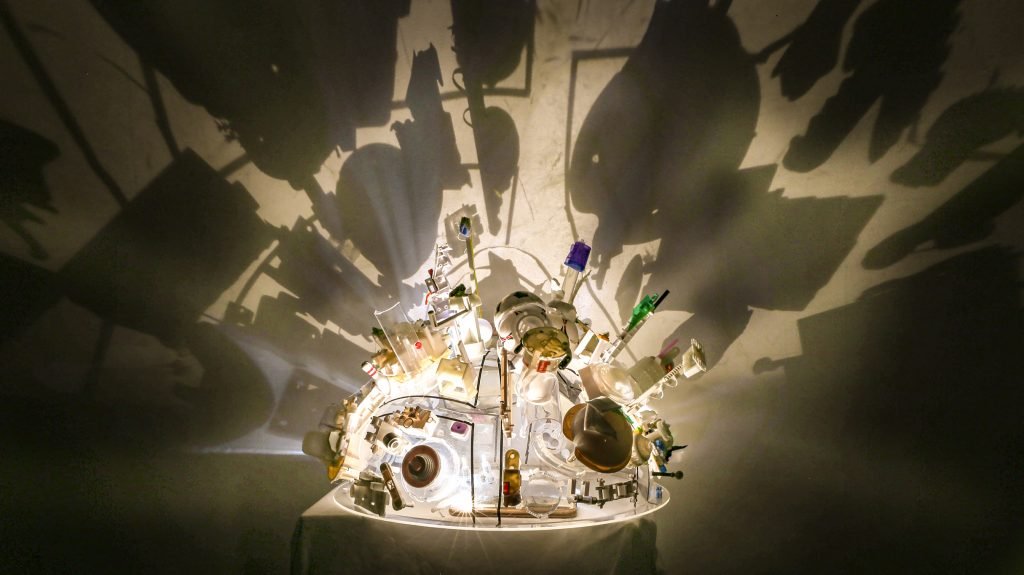
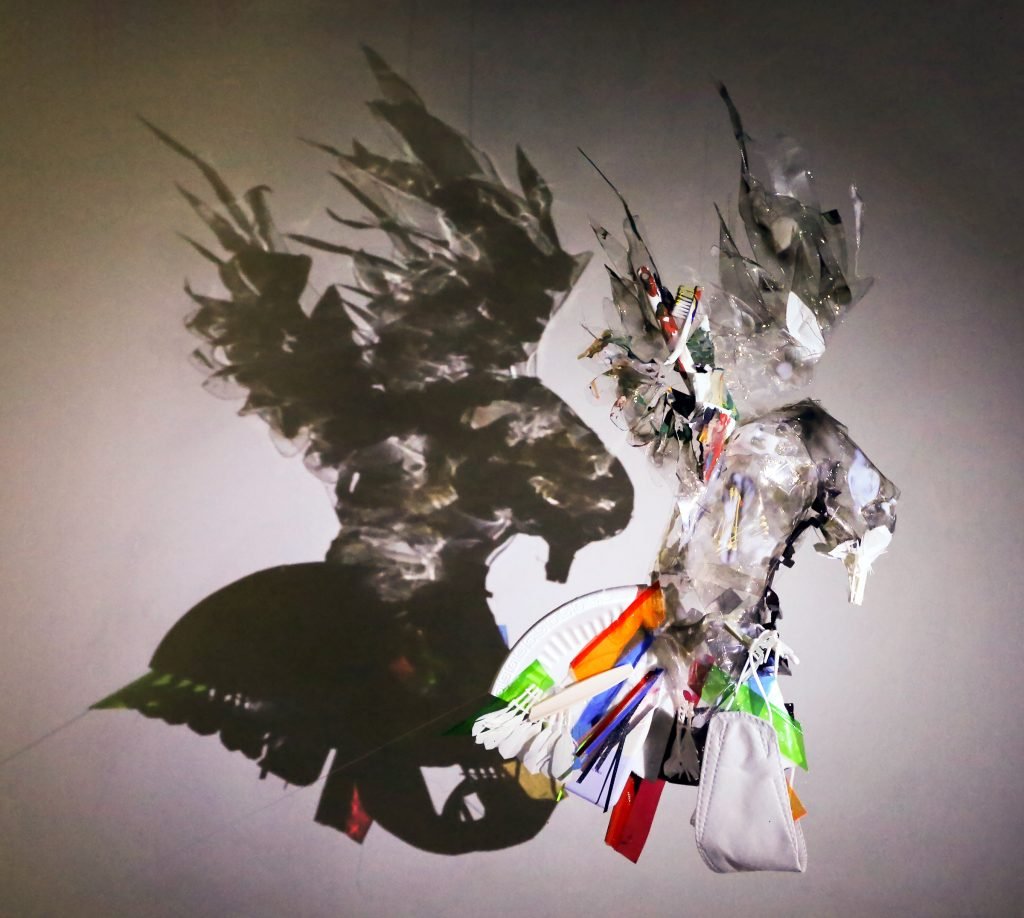
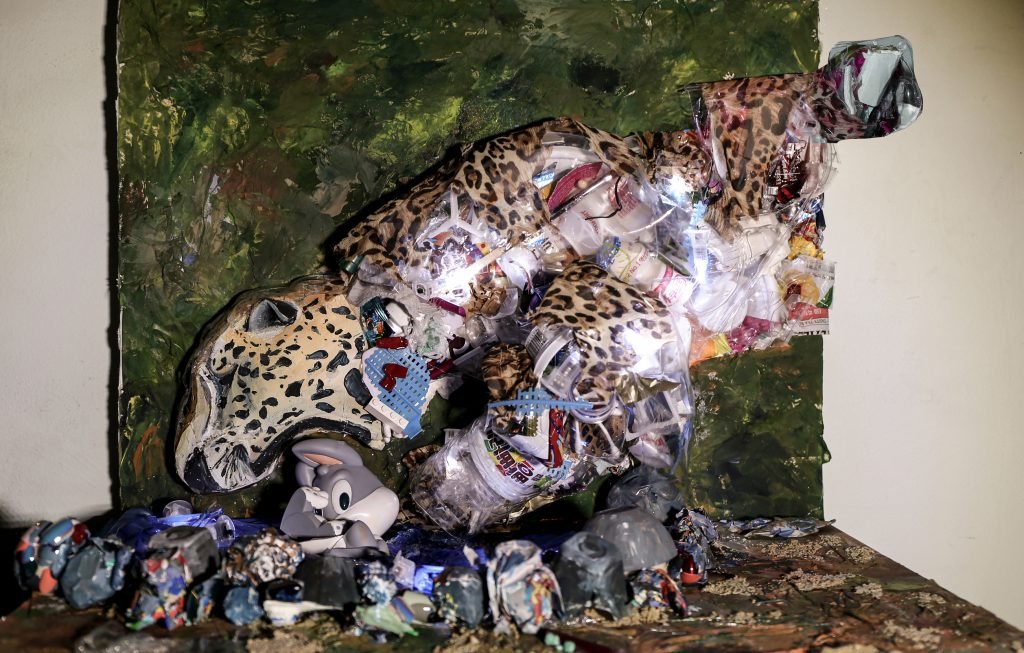
City by Eileen Kim, age 17, South KoreaBird by Eileen Kim, age 17, South KoreaCheetah by Eileen Kim, age 17, South Korea
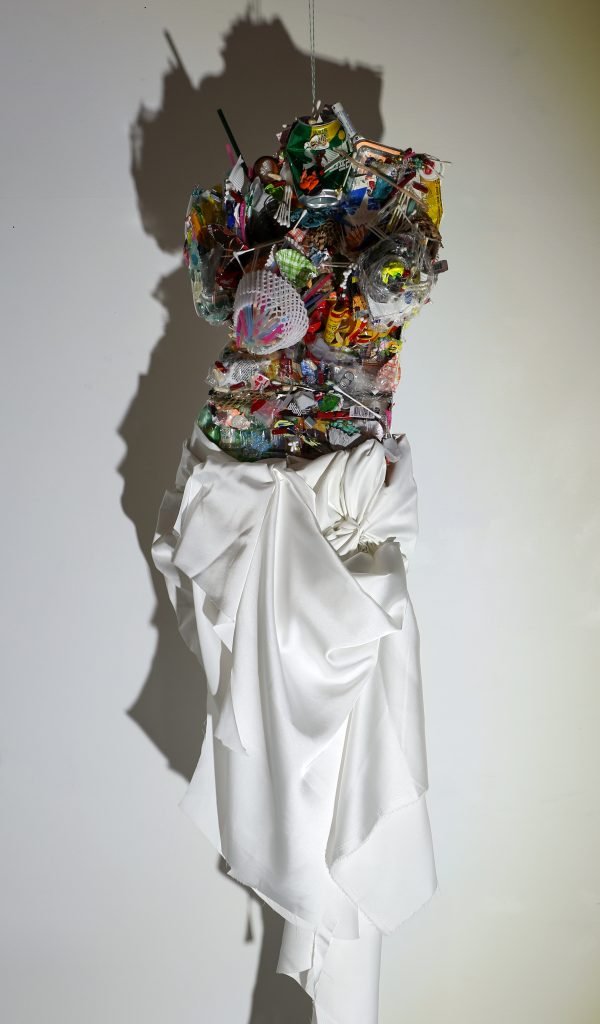
Venus by Eileen Kim, age 17, South Korea
Eileen Kim, age 17, Seoul, South Korea
A Journey Behind Walls
In recent years, the search for graffiti has taken up a big portion of my time. Within the monotony of my school routine, finding tags and art hidden in building corners or behind walls was akin to a treasure hunt. I have often taken pictures of the latest artworks I found and saved them in my photo album as if they were pieces of a collection. As an artist, I feel inspired to create my own signature style and to learn more about the interesting world of graffiti.
But, growing up in South Korea has reminded me of the impermanence of the culture here. I’ve often observed buildings being demolished and supplanted by newer, shinier structures. Stores I would visit frequently would suddenly close down, and the art that I once cherished would no longer exist. It’s unfortunate that we are so busy moving forward at a fast pace that we can’t appreciate the creations around us. Society doesn’t provide ideal conditions for graffiti in terms of conservation.
On top of the ever-changing nature of Korean street art, COVID-19 has made it even more challenging to explore as frequently as I had in the past. However, last month, I found the perfect opportunity to revisit the childlike wonder I have felt while observing graffiti. While browsing the internet, I came across tickets for URBAN BREAK Art Asia, a three-day fair showcasing street artists.
At the fair, it was almost as if time suspended, and the pandemic didn’t exist. I was surprised to see that people from all walks of life came to see the show, from teenagers donning denim bucket hats to older professionals in their weekend attire. Despite everyone wearing masks, the individuality was compelling and echoed Korean life exactly as it is—one of constant sounds, smells, and colors intermingling. The exhibit echoed the cacophony that citizens experience in their daily routine. I distinctly remember one artist playing the piano in his booth, surrounded by paintings of traditional Korean houses. Meanwhile, an underground rapper signed autographs for his fans a few booths down.
There were numerous exhilarating artists that caught my attention, but the one who stood out the most to me, personally, was a female artist named Junkhouse. Toward the end of the show, I recognized a familiar artwork hers that I’ve seen numerous times on a building during my walks home from school. Luckily, I was able to contact Junkhouse after the show, and she was more than happy to share her thought processes with me.
As Junkhouse compared graffiti in Korea to that in foreign countries, she confirmed that South Korea’s tendency of getting rid of old buildings rapidly prevents street artists from experimenting with their artwork and freely using the city as their own sketchbooks. Furthermore, with the law being strict in terms of interfering with property, young artists move further away from the traditional street art culture. Younger generation artists would rather choose social media as a way of presenting their work and connecting to the greater public.
As she spoke of her free-spirited artistic process, where she draws organic shapes onto existing structures, my mind kept going back to a recurring thought: there is always room for freedom within constraint. There exists a certain, and often justified, stereotype of Korean art as being highly elite and institutionalized. Proprietary gallery owners are often part of a closeted establishment that promote lucrative art forms, such as porcelain from the Goryeo Dynasty or paintings by artists within their inner circles. But unlike traditional art galleries holding the key to the next generation of artists, some people are ready to break the mold and directly communicate with the audience themselves—even teenagers like me.
As I reflected on my own conversation with Junkhouse and on the vibrancy of the works at the art fair, I felt encouraged to challenge my own perceptions. In a rapidly modernizing country like Korea, what would finally allow graffiti art to soar to its highest potential? As for me, what are some preconceived notions and existing barriers that prevent me from reaching my maximum potential?
The answers to both questions are yet to be found, but I am slowly on my way to discovering them. In the meantime, I have added forty new pieces of art to my virtual graffiti collection, which I can browse freely from home. These pieces serve as a reminder to seek freedom even amidst the busy days that lie ahead.
By Eileen Kim, age 17, high school junior in Seoul, South Korea. She adds:
“I am an active artist and writer who enjoys learning about the intersection of culture and the environment. Born in the United States but raised in Korea, I am a bilingual Korean and English speaker with the privilege of examining different perspectives. My interest in environmental conservation, particularly in reducing the use of plastic, has led me on many exciting journeys. Recently, using my art skills, knowledge, and love for the environment, I designed environmentally friendly, reusable masks. My ultimate goal is to create a sustainable system for the future in populated cities, such as Seoul and New York.
As an artist, I am also highly invested in the emergence of street art. In search of works from creative peers my age, I came across your magazine and felt the courage to submit some of my works. “A Journey Behind the Walls” details the street art culture in South Korea and how our strict society has led to a creative underground movement. Though street art is forced to take on a more limited form in Korea compared to other cities like New York or London, it is surprisingly pervasive and thought provoking.
I have also attached my original artworks, “Bird,” “City,’ “Cheetah,” and “Venus.” The recurring theme of these works is the impact of the climate crisis on the ecosystem, from animals and humans to the environment itself. My essay and art attempts to relate to the universal longing of community, freedom and change.”
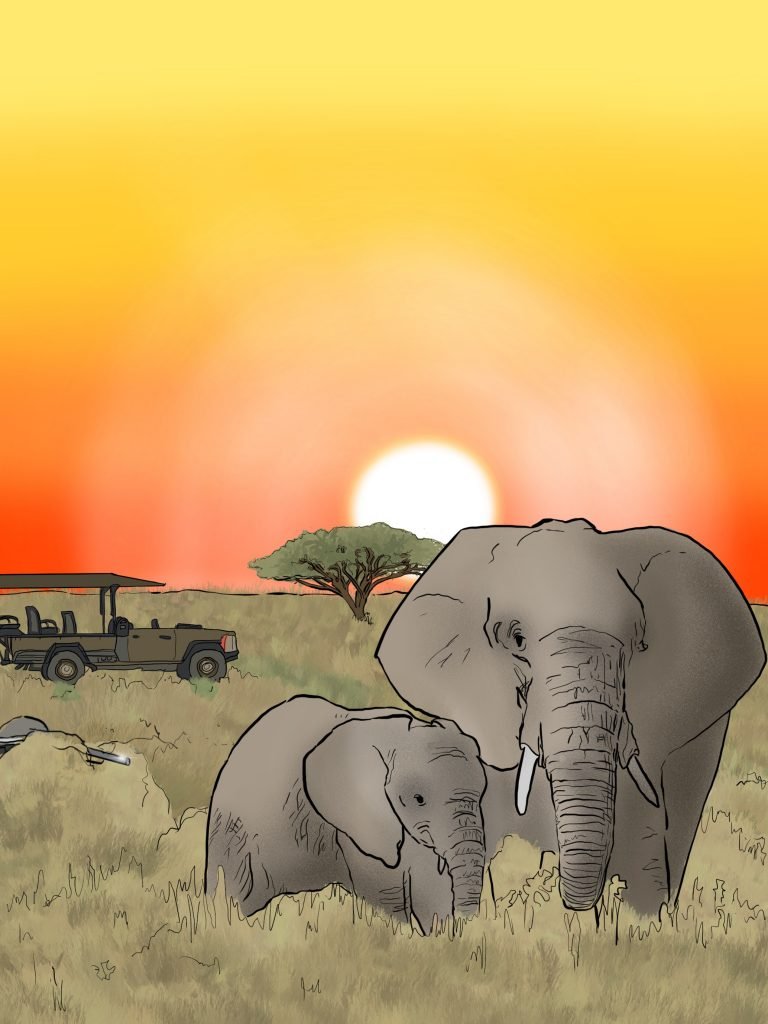
Illustration and flash fiction by Alina Yuan, 17, California.
This season, it is unusually hot. The heat of the African savanna radiates off the parched land and burns my feet with each step while the sun glares down upon us, sneering at our misfortunes. I slowly drag my feet through the dirt, feeling not soreness but numbness. Small fissures have appeared across the arid landscape. I flick my tail to shoo away pesky flies. A slight breeze blows through the landscape, flinging dust into my eyes and nostrils. But I am too tired to shake off the dust. I have gone days without food or water. My eyelids droop as a hazy feeling overpowers my senses and a dull buzzing noise echoes in my head. One of our pack buddies collapses ahead of me, breathing heavily and closing his eyes. Immediately, mosquitos start to swarm him until he takes his shaky, final breath. At this rate, I will die soon, too.
Our pack shuffles sluggishly towards a large puddle left over from the rainy season. Everyone gulps the water greedily. It is the dry season and we must keep ourselves hydrated during the drought. After drinking water, I use my trunk to pull off the leaves and twigs of an uprooted tree, and I eat with Mother and my cousins. The rest of my family stays close by, eating and keeping watch for predators. We continue our journey and trudge towards a patch of trees. After a while, I look up. The sun is starting to set, and I can sense the temperature dropping quickly.
I hear a slight rustle behind the bushes. I see a head, a human. It is carrying a long stick in its hands. It points it at our pack slowly and waits. We immediately become silent, and I turn to Mother.
“What is it doing?”
“Hush,” she says quietly, her voice trembling.
She pushes me roughly into the middle of the pack and blocks me from the human’s sight with her body.
“Is this what killed Father before I was born?” I whisper. “I’m scared.”
Mother turns to me. Her eyes soften, but I can still see her pupils shaking. She caresses my face with her trunk.
“It’s going to be alright.”
The human stands up slowly, making sure to barely make a sound. I see a piece of tusk hanging from a strand around its neck. Sheer fright envelopes me. It moves its finger.
A deafening noise startles me, and I freeze in terror. My pack scatters, frantically trying to escape. One of them falls, but I don’t know who. The human puts something back into the stick and aims again. Another blast. I turn around and run as fast as I can. More fall. My vision blurs, and I search frantically for Mother, turning in circles, bugling in panic. The screams of my brethren are muffled and drowned out by my violent heartbeat. The human appears in front of me, shooting at my relatives beside me. I scream and turn around to face the body of my dead Mother.
By Alina Yuan, 17, California. She adds: “I enjoy writing flash fiction and short stories, as well as drawing comics. At home, I love playing with my dog, a Shiba Inu, and collecting an eclectic array of stickers.
I am of Chinese cultural background, but I always enjoy learning about other cultures and issues around the world. One day, while scrolling through social media, I stumbled upon a picture of poachers hunting elephants for the illegal ivory trade. I was so appalled by that image that it stuck with me and prompted me to create art and writing revolving around this topic. Learning about cultures requires you to put yourself in other people’s shoes, and the same can be said for learning about world issues. Remove yourself from the perspective of a human being and put yourself in the shoes of the oppressed in order to learn more and practice empathy. That is how the world can progress and rid itself of evil.”