
For easy viewing, click mouse once inside viewing frame. Then use mouse scroller to move up and down inside PDF document.
Skip to PDF contentCategory Archives: Art
Sketching and Painting a Horse
Sketching and Painting a Horse
By Janelle Tang, High School Senior, England, United Kingdom.
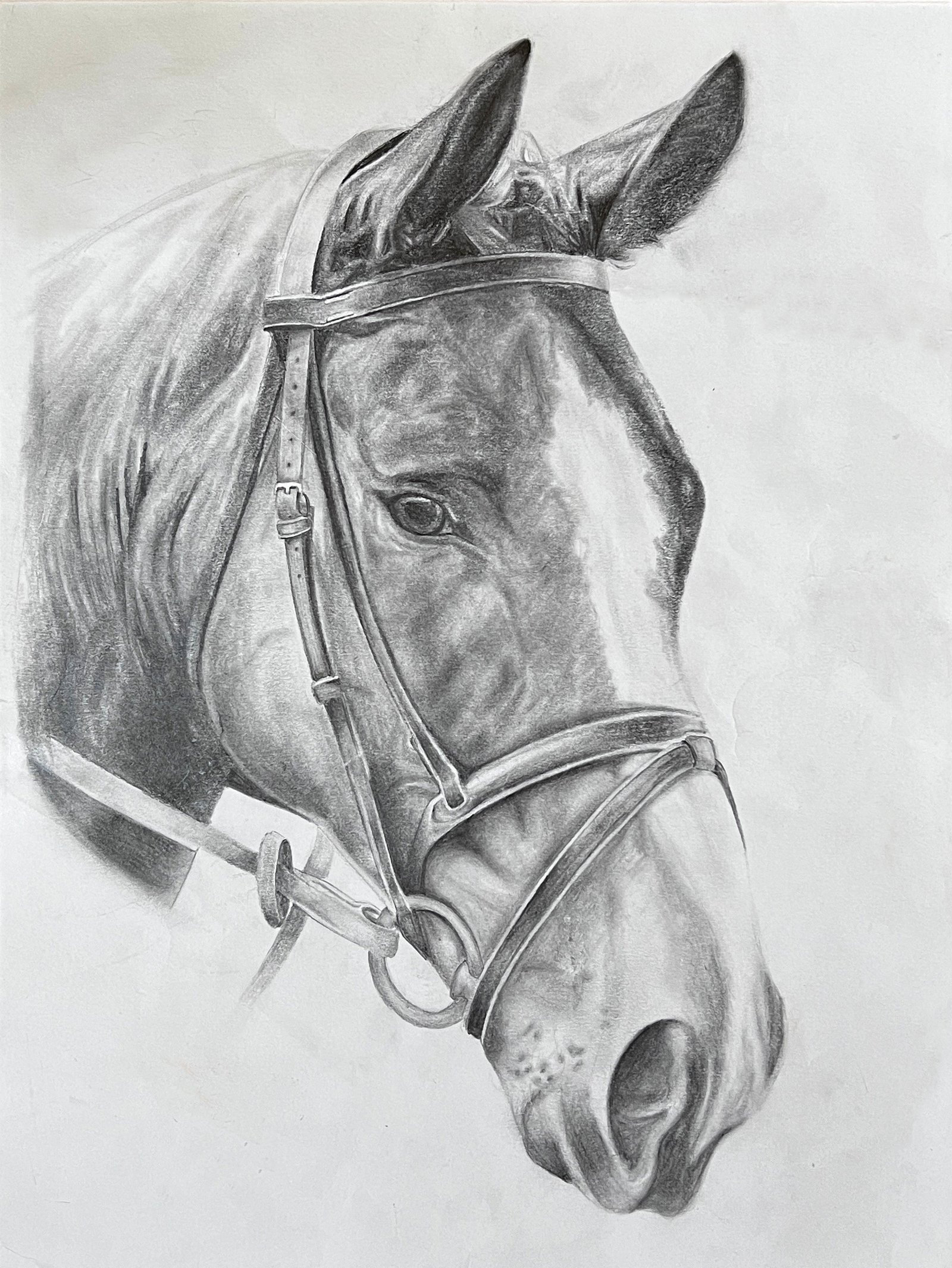
Horse Sketch: This was originally the planning sketch for a painted piece following a photo shoot (capturing the vitality and movement of horses). But while sketching it from a picture, I realised that there was much more to the muscles and twitches in the musculature of the horse than I had initially thought. Hoping to learn more about the facial structure and how the animal uses each muscle, I started sketching it out in more detail, finding tiny veins in the photograph that I had looked past originally. Eventually, the pencil sketch turned into a detailed pencil drawing of the horse. This not only allowed me to finesse my pencil skills, but also it led to a more detailed understanding of a horse’s musculature, which was later applied to another painting.
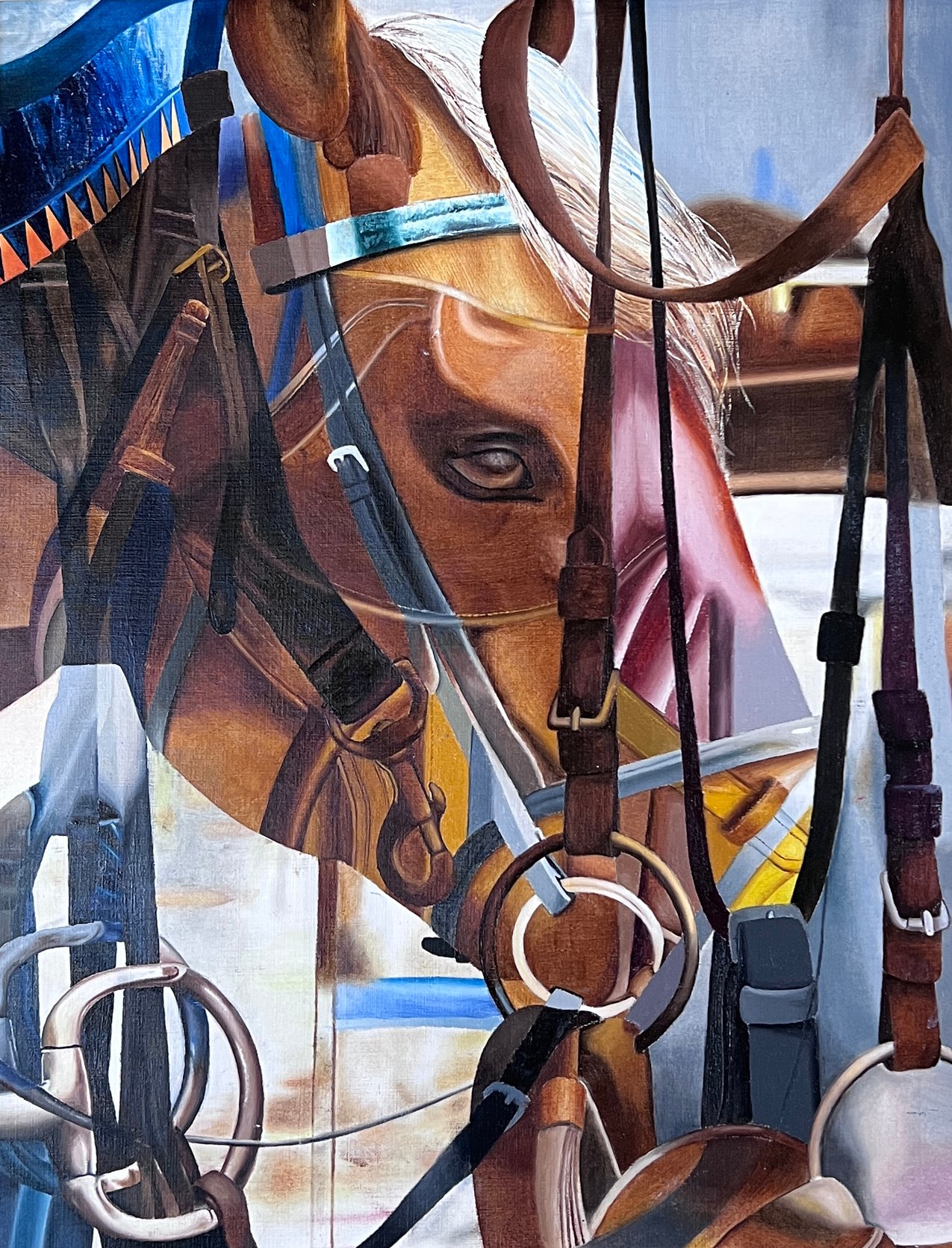 Horse Painting:
This painting was created after a photo shoot to capture horses’ vitality and movement and my curiosity to explore digital tools like Photoshop. I layered multiple pictures of horses, saddles and reigns together, and juggled with the formats, colouring and opacity of each image, and used different filters on each to highlight multiple areas on each image. This allowed me to focus on fine details I was interested in each image, treating each of them differently and associating colours and tone with each image, while still capturing the likeness of the horse. The medium of oil paint allowed me to create details in the image, changing the opacity as well through thinning the paint down in different areas, finally creating a cohesive painting that blends and flows throughout using optical mixing.
About the Artist:
Janelle Tang is a rising senior at Wycombe Abbey School in England. With a passion for art that ignited during her early years, Janelle has been painting since she was a young girl. As she grew, her curiosity led her to explore the captivating worlds of ceramics and textiles. With an adventurous spirit, Janelle delved into the realms of oil painting and hand-building pottery, and her artistic horizons expanded exponentially.
Janelle’s artistic interests encompass a deep fascination with the Romanticism period of art, as well as the captivating allure of Oriental styles, such as Ukiyo-e prints. Diving into these subjects, she has written essays and conducted extensive research, delving into the techniques and styles of these art forms. This process has not only enriched her knowledge but has also ignited an even greater passion for the world of art.
As the Head of History of Art Society at her school, Janelle strives to inspire her peers and create a thriving artistic community. Her artistic journey has been one of growth, exploration, and unwavering dedication to the arts. With her unquenchable thirst for knowledge and her desire to generate unique ideas and solutions, Janelle hopes to leave an indelible mark on the canvas of artistic expression and beyond.
Mona Lisa Memories
Mona Lisa Memories
By Katacha Díaz, Oregon
During my childhood years of growing up in Peru, as the first-born grandchild in the family, I spent a great deal of time with my loving and nurturing paternal grandparents. Papapa and Mamama patiently indulged me with clever age-appropriate answers to my many questions. I was intrigued by my grandparents’ art collection—serene landscapes and stormy seascapes kept me entertained, but I was most fascinated by the formal portraits of our family members and predecessors. Little did I realize we had such illustrious relatives in our family tree, for the family to commission portraits from popular artists of the time.
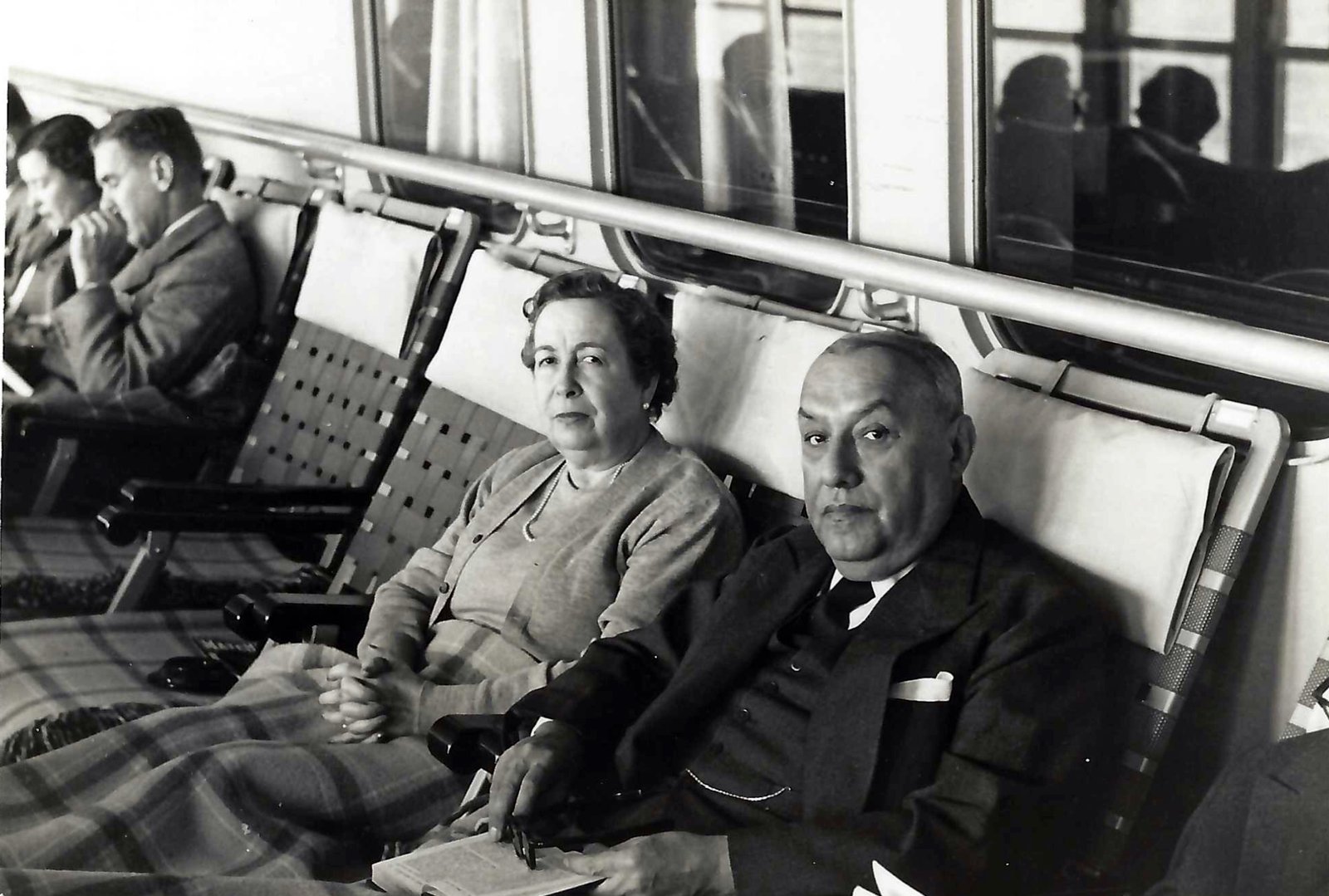
My Mamama and Papapa on their Return Voyage from Europe, 1953
Recently I spent time organizing my own family memorabilia, collected over the years, and found myself transported back in time to childhood days at my grandparents’ sprawling house in Miraflores, a suburb of Lima, Peru (see below). The family had gathered at Sunday luncheon to celebrate my grandparents’ return home from Paris. Papapa had served four years as Peru’s ambassador to France.
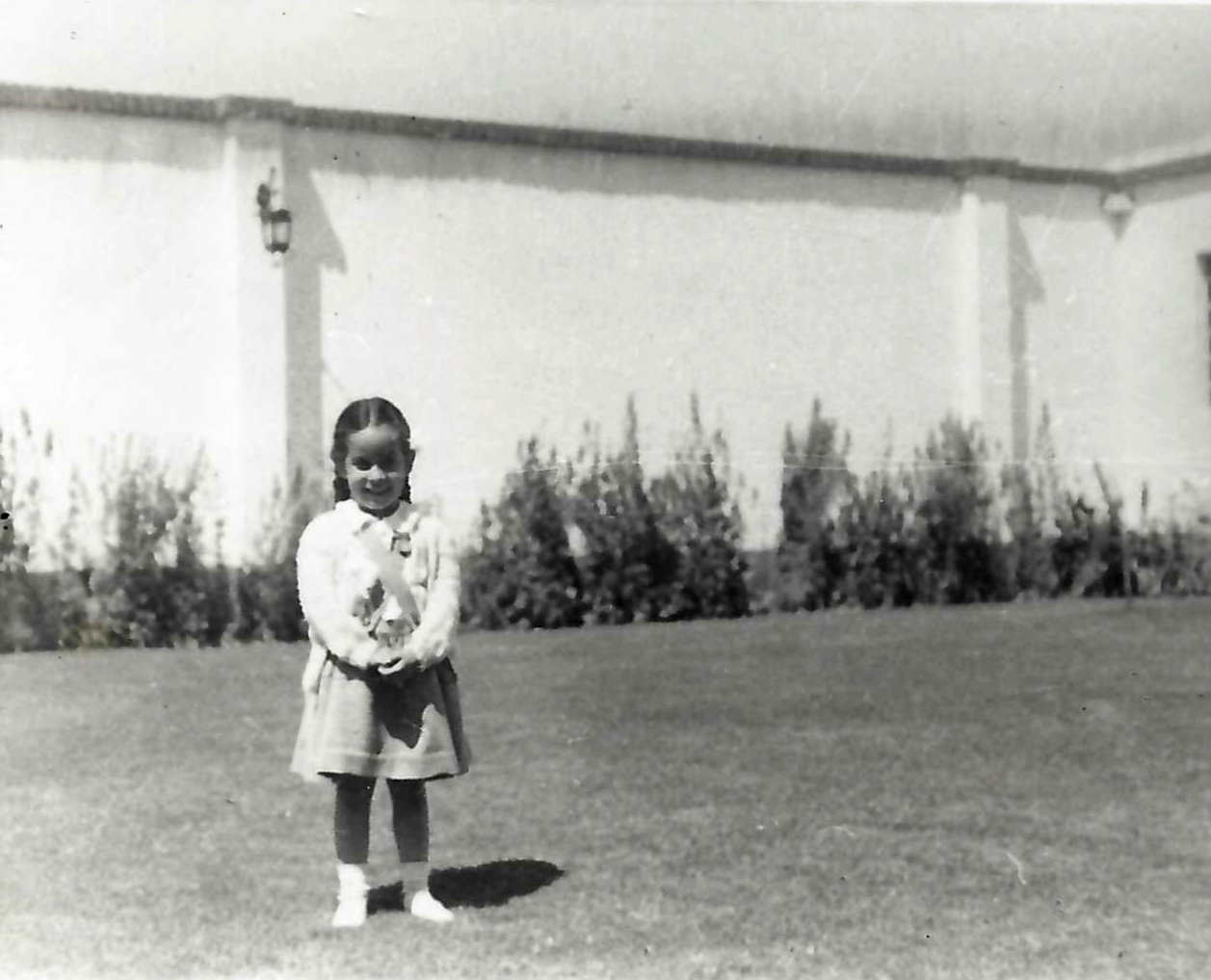
The Author as a child at her Grandparents home in Miraflores, Lima, Peru. 1948.
This particular day is etched in my memory. Papapa stood beside me while I gazed wide-eyed at the painting of a smiling beautiful young woman. “Is she another of our famous relatives, I asked him?” Papapa shook his head and smiled. “This is a copy of the world famous painting by Leonardo da Vinci, the Mona Lisa. Mamama and I saw the original painted on wood, at the Louvre Museum in France. We found our oil-on-canvas copy at an art gallery, during an evening stroll along the Ponte Vecchio in Florence (Italy).”
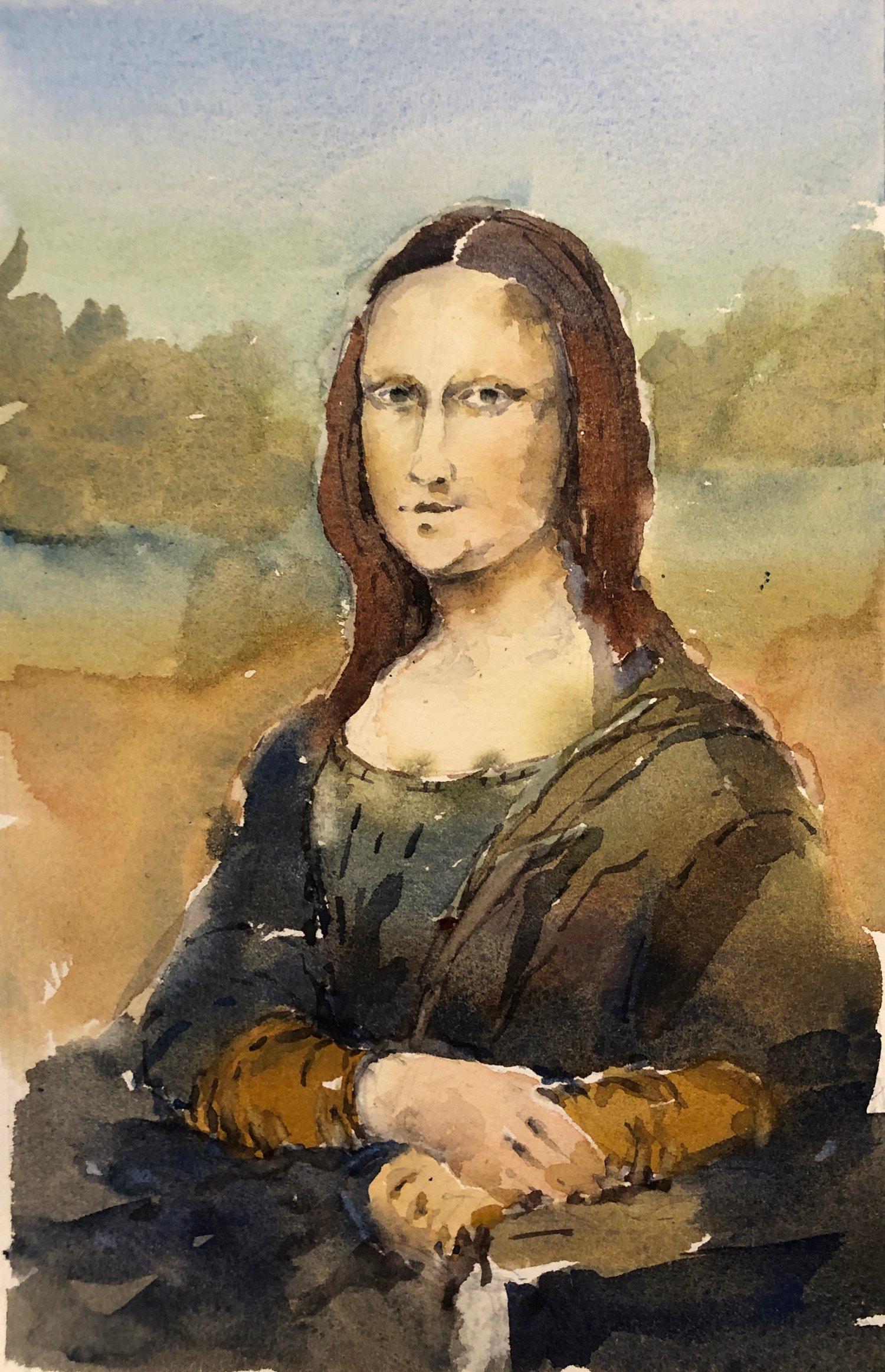
“Mona Lisa” Replica. Illustration by Daemion Lee. Oregon.
Papapa and Mamama showed me photo albums and art books collected during their European travels. These were filled with photographs of renowned paintings and illustrations with captions, along with artist biographies and exhibition notes. I learned the difference between an original piece of art and a reproduction, like the one in my grandparents’ house. Later, we stood by the floor globe in Papapa’s study and charted the voyage of the replica Mona Lisa. Our Mona Lisa had traveled inside a wooden crate from Europe across the Atlantic Ocean and through the Panama Canal to reach Peru!
Growing up in the exotic land of the Incas, I was impressed by my grandparents’ eclectic art and stamp collections, the leather-bound books, and encyclopedias lining the walls of the library where my grandfather spent hours reading and writing. Mamama and Papapa’s home opened a whole new world to explore and study during my sleep-over adventures. Five decades ago, following in my grandparents’ footsteps, I visited la bella Firenze, walking across the beloved 16th century Ponte Vecchio, peering into the windows of the art galleries, goldsmith shops, and souvenir sellers. And I imagined Papapa and Mamama enjoying a romantic afternoon stroll along the picturesque bridge, the only one in Florence that was spared from destruction during the Second World War. I was transported back in time and reconnecting with my dear Papapa and Mamama missing their presence in my life.
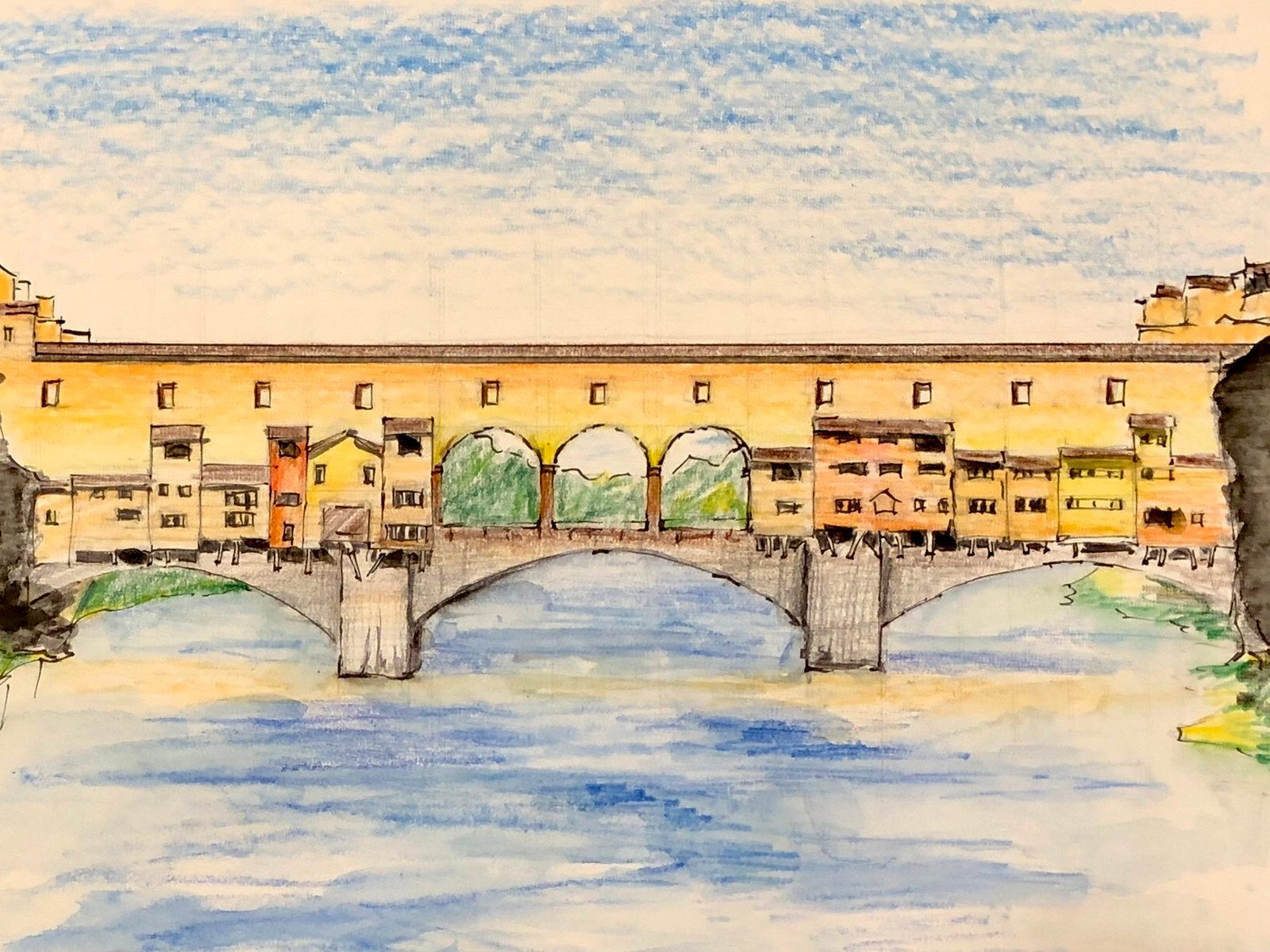
Ponte Vecchio, Florence, Italy. Illustration by Daemion Lee, Oregon.
All these years later, I am grateful for my childhood memories of Peru, and the way that a painting or a photograph can keep my grandparents in my life, even today. In my kitchen I keep a watercolor painting of sunflowers in a Tuscan (Italy) field, which I found along the Ponte Vecchio. It keeps the memories alive and is good for my soul. Who could ask for more?”
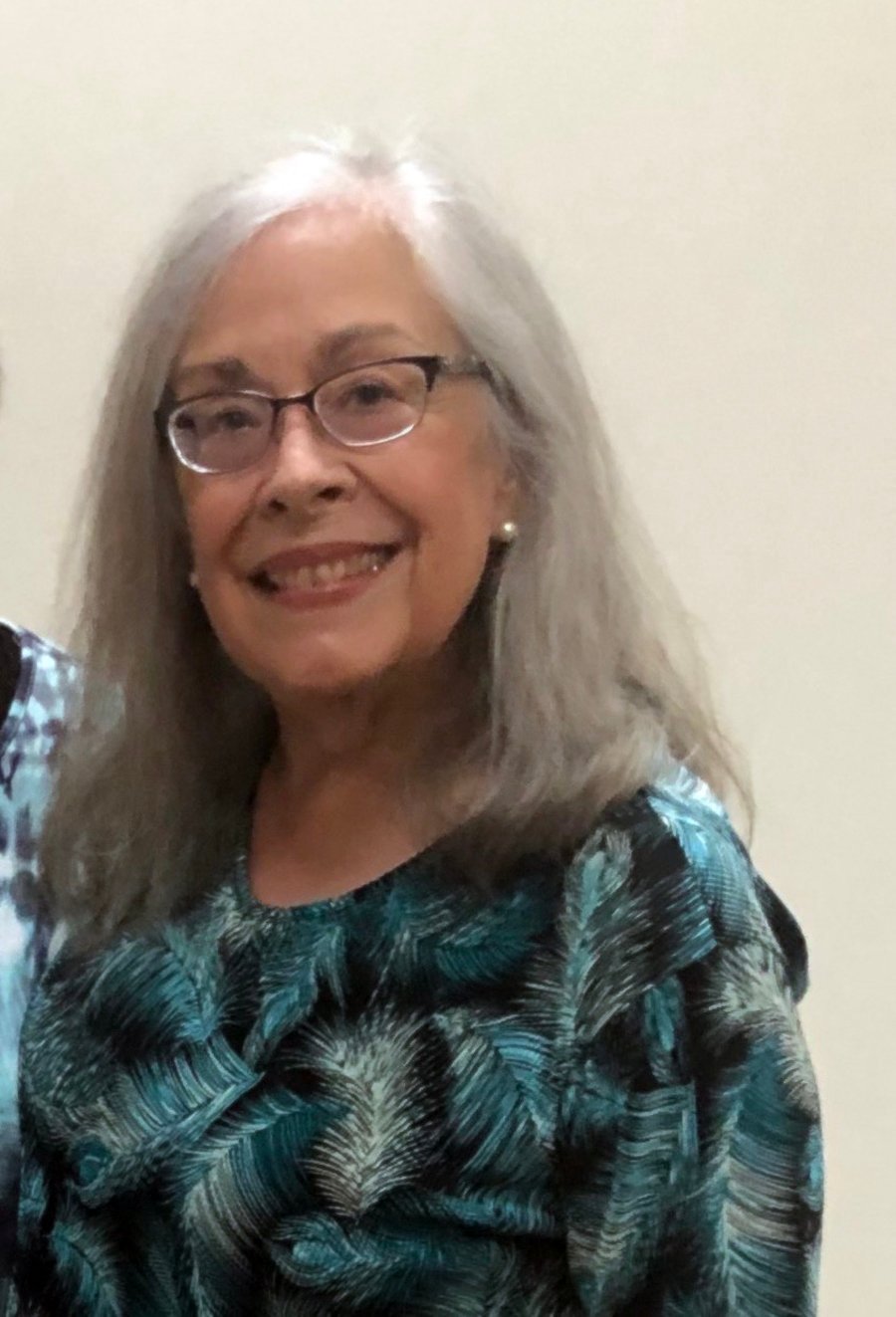 Katacha Díaz is a Peruvian American writer and author. Wanderlust and love of travel have taken her all over the world to gather material for her stories. She has been published in many outlets, including in several issues of Skipping Stones. Katacha lives in the Pacific Northwest, near the mouth of the Columbia River, USA.
A Music Room of Our Own
A Music Room of Our Own
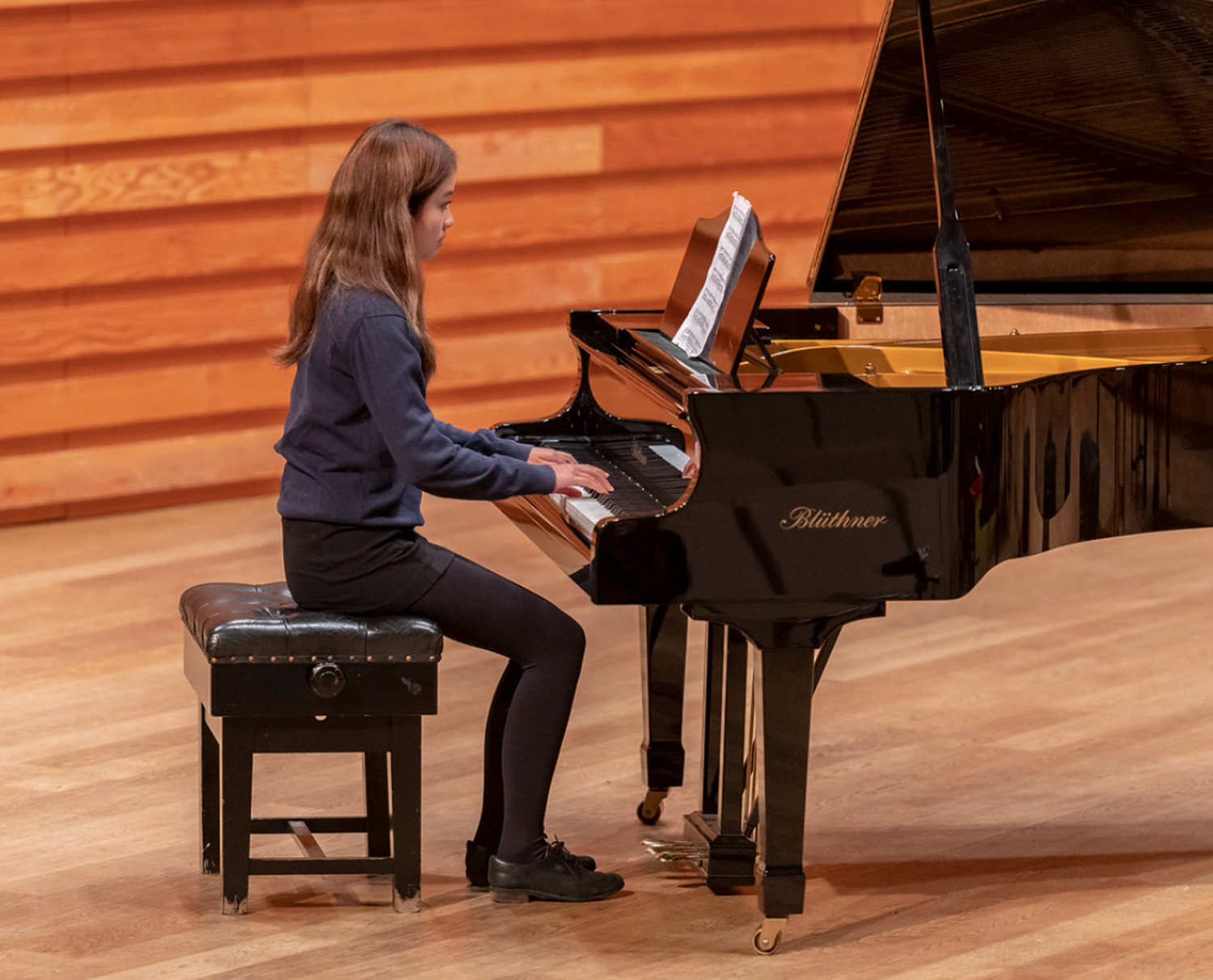
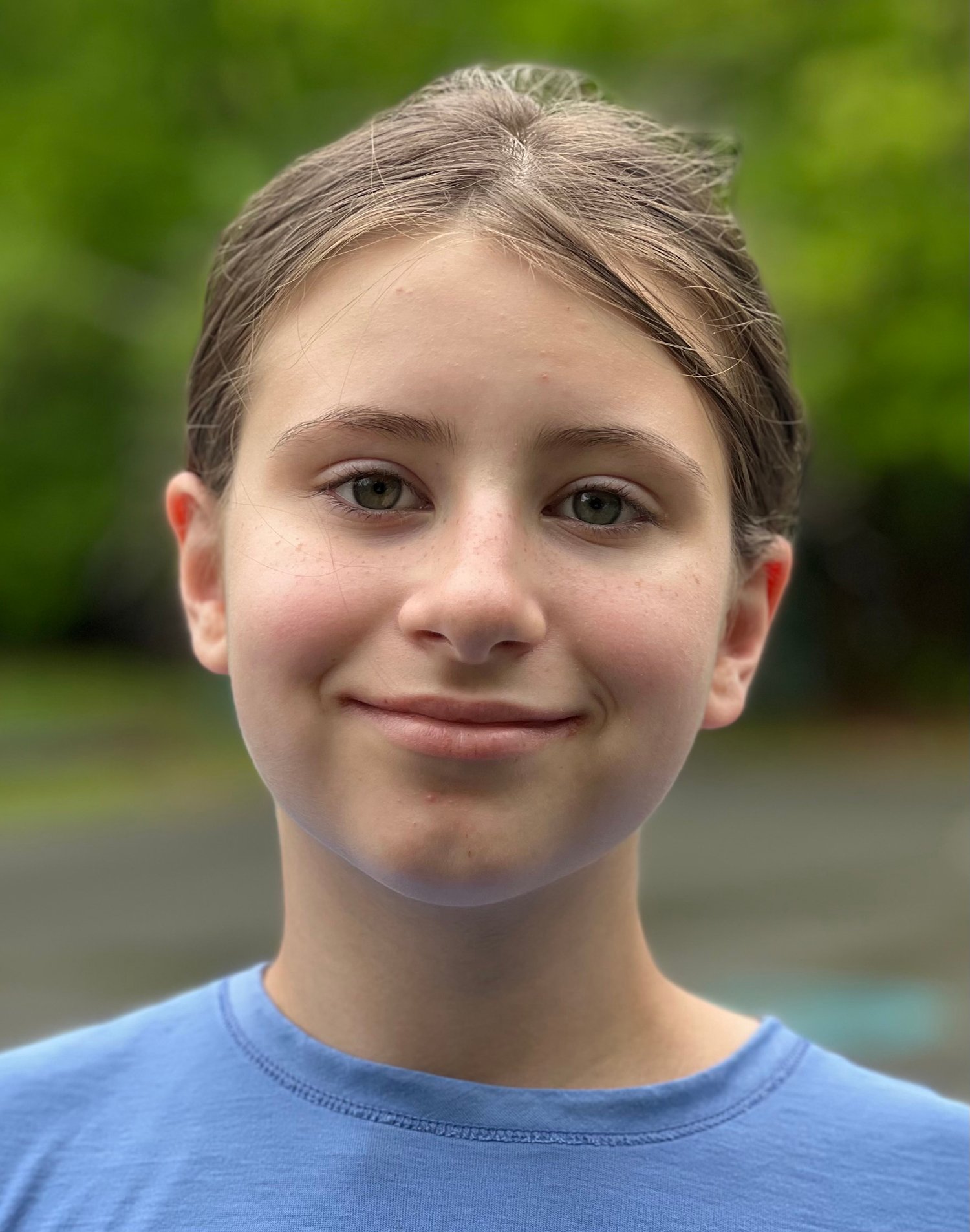
By Niki Zhang, 17, (photographed above) United Kingdom
Four years ago, as we sat in the practice room in which I had spent countless hours, my piano teacher, Ms. Li, handed me a thick navy volume. “The Well-Tempered Clavier” was written on its cover; beneath, in bold letters, “J.S. BACH”—a giant of Baroque music, progenitor of twenty-odd children, and, of course, a man.
I had no doubt about the brilliance of Bach’s music, but still I was not particularly happy about the assignment. Forcing a smile, I politely asked, careful not to offend, “Could I, perhaps, play anything other than Bach, Mozart and Chopin?” What surprised me was my teacher’s pause; the air in the room was tight and it was clear that Ms. Li was slightly taken aback by my comment.
“Not a problem,” she finally said. “What about Debussy? He was the father of impressionist music. Impressionism is quite feminine… I think you would like it.”
With slight indignation, I asked, “Why are there no female composers?” I was certain women impressionists existed, but I was disturbed to realize that I could not name a single one. To my surprise, Ms. Li seemed excited by my question, as if she had been waiting for it to be asked, and had many ideas ready for me. First, she gave me “D’un Jardin Clair” by Lili Boulanger, an elegantly dream-like yet stimulating piece. Then “Six Petite Pièces” by Charlotte Sohy. Then “Rêverie” by Germain Tailleferre. Why had I never heard of this wonderful music? Why has not the average concertgoer, or even the average pianist? The problem, I began to realize, was not the lack of women composers but the lack of recognition. I was determined to build a repertoire of the beautiful but neglected works of these forgotten composers.
I had only raised the question after playing the piano for eight years. In retrospect, I am surprised that as a woman it had not occurred to me earlier. Prior to that, I was ignorant about the subordinate or even absent position of women in the classical canon. Do not blame yourself if you cannot name any female composers, because historically there have been vanishingly few: only 2.2% of historical works were composed by women, according to the Donne Foundation.1
Even today, pieces by Beethoven and Brahms alone are performed about as often, worldwide, as pieces by all women composers combined.2
If women account for around half of the population, how could this possibly be? About a hundred years ago, author Virginia Woolf tried to answer much the same question in A Room of One’s Own.3 Though her subject was literature, not music, her arguments seem even more relevant to music. “A woman must have money and a room of her own if she is to write fiction,” Woolf famously wrote. Her insight is staggeringly simple—but like gender inequality in classical music, even simple things are not always obvious.
Woolf explains that, “Nothing is known about women before the eighteenth century.”4 Up to Woolf’s time, but particularly in the more distant past, role models, as we now call them, were few and far between, for writers or composers or really creative people of any type. The woman’s place was clearly in the domestic sphere; education was denied her, and her energies were allowed to be spent only on housework, not artwork. Lack of support and community would have made writing difficult. But imagine how much more impossible composition must have seemed, with the years of specialized training it required, followed by the large, expensive groups required to perform it. “Any woman born with a great gift in the sixteenth century would have certainly gone crazed, shot herself, or ended her days,”5 Woolf writes during her hypothetical discussion of “Judith Shakespeare,”6 William Shakespeare’s imaginary (and impossible) sister. Imagine how much truer that statement would be for Judith Byrd, Jennifer Gibbons, or Greta Handel.
The core of Woolf’s insight is materialist: creativity requires privacy, and privacy requires resources. Woolf emphasizes the need for material conditions in pursuing artistic desires, but these were “Out of question” for a woman “Unless her parents were exceptionally rich or very noble.”7 But it was not equality of opportunity and access to financial resources that was lacking, it was equality in having the liberty to be different, to express individuality, and to diverge from the standard of “greatness” which was defined in terms of the achievements by male composers.
In classical music, symphonies are traditionally equated with “greatness.” Smaller works are “minor.” If we had to illustrate what a “great” composer would look like, we would end up with dozens of portraits of high-status, European men. That is not to say that no efforts were made to change societal attitudes towards independence for women.
If Virginia Woolf wanted to consider the endeavours of a female composer to be recognised, she would not have had to look further than her close friend Dame Ethel Smyth. Smyth, who was about twenty years older than Woolf, fell in love with the writer, who described the experience as “Like being caught by a giant crab.”8 Smyth was a pioneer in the women’s suffrage movement, which became what was known as the first wave of feminism at the end of the nineteenth century. She met Woolf through the movement.
Smyth was the first female composer to have music performed at The Metropolitan Opera in New York. She fought alongside suffragette Emmeline Pankhurst in the “Votes for Women” campaign and wrote the official anthem of the Women’s Social and Political Union (WSPU).9 She often wrote music as E.M. Smyth to prevent her success from being hindered by patriarchal expectations. Smyth’s career was filled with operas, concertos and symphonies;10 she was not only a real influence on the suffrage movement but also inspired women and other underrepresented groups within classical music as a whole.
Woolf emphasises that women’s financial and educational disadvantages inhibited their creativity, and for musical composition, that is even more true. Classical music, more than literature or drama, requires extensive practical training and collaboration. It also requires a different kind of creativity, one that defies the traditional divisions, often mapped onto the genders, between sentiment and rationality—dramatised so effectively in Mr. and Mrs. Ramsay in Woolf’s To The Lighthouse. As Leah Broad explains in Quartet: How Four Women Changed the Musical World, making music in a male-dominated musical scene was different to more directly representative arts like painting and writing. Composing requires the “Ability to think both logically and emotionally… It was a talent considered beyond women’s reach.”11
Smyth rebelled against the roles that had been assigned to women in music. She demanded that her compositions be judged equally and in terms of merit, rather than of gender.12 She wanted to change the standard of “great” music, revise the image of the “great” composer and, by extension, subvert the default subordinate position of women. She broke societal standards of music by driving its political potential to the fullest, composing “The March of the Women.”13 It was later performed by suffragettes everywhere—at rallies, at meetings, and even in prisons.14 However, this came at a reputational cost. Smyth was aware that people saw her as difficult and uncompromising, and said, perhaps with a grin or perhaps with a sigh, that “The faults of people you are fond of are as precious as their virtues.”15 Broad argues that it is only because Smyth had these faults, especially her belligerence, that she was able to study music, let alone build a musical career.
However, Smyth is, like Woolf herself, an exception to the experience of most women in the late nineteenth and early twentieth centuries. She did not have the burden of raising a family, which would have been a significant obstacle. Even though her father was unsupportive of a career in composition, Smyth was fortunate to be born into a wealthy military family who supported her pursuit of music for leisure by performing in concert halls or for household entertainment.16
When women in Woolf’s day were encouraged to participate in music, it was often a way to elevate social status. The piano’s versatile nature and rapidly growing repertoire provided a perfect opportunity for women to make music, yet all too often, mastery of the instrument was merely seen as a way to render a woman a better housewife. Even for the women who had the leisure and resources to develop serious skills, becoming a professional was often not an option, even if they possessed a gift in composing or playing.
Publishing houses were similarly paternal, often refusing to publish women’s work.17 Composers therefore had two options: to copy their work by hand or to get it printed at their own expense. With many carrying the burdens of raising families, talented young women did not consider a career in classical music due to the discouraging climate in composition. Fanny Mendelssohn was discouraged by her brother, Felix Mendelssohn, from publishing her work because “She regulates her house, and neither thinks of the public nor of the musical world, nor even of music at all until her first duties are fulfilled.”18 In Woolf’s day, although the suffrage movement had allowed for women’s voices to be heard politically, they still struggled to be heard in concert halls. It is therefore probably not an accident that most successful female composers were raised in a musical environment where they could access and learn how to pursue music. Smyth, for example, was brought up as an Anglican and was exposed to music through singing hymns.19
Prejudiced attitudes have literally been built into the infrastructure of music. Even piano keyboards were designed in a way that did not accommodate women who, on average, have smaller hands.20 Though there is roughly a 50/50 split in gender in the world, the manufacturers continue to design instruments for the average male hand. This perpetuates the idea that one-size-fits-men applies to every single person, especially if the object is meant to be gender-neutral.
In my decade of playing the piano, it had never occurred to me that one of the reasons I had had to find alternative fingerings, use broken chords, or miss notes was simply because the piano I was playing (let alone the pieces themselves) had not been made for people like me. Female pianists experience gender bias not just in the concert hall, but literally when they touch the keyboard.
Smyth was composing and Woolf was writing in the 1920s. Since then, classical music has progressed from one “great” man to the next. In recent years, many more female composers as well as soloists and conductors have emerged. According to the 2022 Orchestra Repertoire Report conducted by the Institute for Composer Diversity (ISD), concerts featuring music by women composers and composers of color increased from 4.5% of all concerts in 2015 to 22.5% in 2022.21 But still too little of that music gets performed. More opportunities need to be on offer to allow people to learn, teach, and perform compositions by women. The question now, in a world that often congratulates itself for its progress, is no longer, “What has changed?” Rather, it’s important to ask, “What has not changed?”
Changing material conditions should, ideally, lead to changes in attitudes. Woolf understood though that the former always precedes the latter—that we cannot start talking about attitudes until the resources are there: people need to buy tickets, music needs to be commissioned and programmed and of course performed. Supporting female composers is not enough; institutions need to make an effort to stimulate an appreciation for their music. It would not hurt, either, if more women were appointed as administrators and board members.
In “The Pandora Guide to Women Composers,”22 Sophie Fuller writes, “Remembering and acknowledging (female composers’) many achievements can only enrich our understanding and bring us a clearer picture of the past.” The reason why music composed by women is not performed is not because they are not up to the standard but because only now are we discovering them. As we go forward, we need to make sure that independence and equality are distributed not just among elite white women. The Donne Foundation finds that of the 20,400 compositions scheduled by orchestras worldwide in the 2021-2022 season, only 7.7% of the works were written by women and, remarkably, 5.5%, or almost two-thirds, were by white women.23
Classical music is one of the only professions which actively discriminates against the living in favour of the dead; as such, it remains one of the purest bastions of the patriarchy left in our society, which, though not perfect, has changed appreciably since Woolf’s and Smyth’s day.24 There are thankfully many more women composers in the conversation today, from Jennifer Higdon to Joan Tower to Kaija Saariaho. This is progress. But it has taken a long time and we are still far from equality in terms of prestige, airtime, and frankly, ticket sales.
Four years after my encounter with Ms. Li, I performed “The March of the Women” in a school concert. Though a simple and straightforward piece, it brought on a flood of emotions, from hope to pride and the triumphant thrill of victory. I was in the position to take the powerful anthem sung behind bars, by a chorus of suffragettes whom Smyth conducted with a toothbrush, into my own hands on a grand piano in a recital hall with a supportive audience. It is a sign of how far we have yet to go that Smyth’s piece, once an anthem for political change, now feels like a call for change in the concert hall. “Scorned, spurned, naught have ye cared, / Raising your eyes to a wider morrow,” the anthem intones in a text by Cicely Hamilton. “March, March, many as one, / Shoulder to shoulder and friend to friend!”25 Solidarity among women and decisive, organized efforts to diversify repertoires and syllabuses will allow for more awareness of the involvement of women in music history, and ultimately fuller enfranchisement of women in the musical community.
—Niki Zhang, age 17, from Hong Kong, is a high school senior in the United Kingdom. She speaks English, Cantonese and Mandarin.
Niki adds: “This essay is really important to me because classical music (flute, piano, harp) has been a large part of my life since I was five, and like many other kids, was a hobby planted by my parents. As I grew older, I gained cultural awareness through the music I was playing, learning about the history and social changes in the environments I was stepping foot in, such as Ethyl Smyth, a composer and pioneer of the British Suffrage movement, and this is something I do not take for granted. I am deeply intrigued by the area of sociology and to be able to combine it with history and music in this essay, I could see the music world from a whole other perspective—much more than just playing notes on a keyboard but delving into the historical contributions and challenges women, in particular, faced as a result of fighting for recognition. My dream in the future is to continue playing diverse composers and spark these conversations, because only recently have we begun discovering and talking about them.”
Foot Notes:
- Di Laccio, G. Equality & Diversity in Global Repertoire – Donne, Women in Music (2022), p.5.
Available at: https://donne-uk.org/wp-content/uploads/2021/03/Donne-Report-2022.pdf
- Di Laccio, G. Equality & Diversity in Global Repertoire – Donne, Women in Music (2022), p.5.
Available at: https://donne-uk.org/wp-content/uploads/2021/03/Donne-Report-2022.pdf
- Woolf, Virginia. 2014. A Room of One’s Own, 4
- Woolf, Virginia. 2014. A Room of One’s Own, 38
- Woolf, Virginia. 2014. A Room of One’s Own, 41
- Woolf, Virginia. 2014. A Room of One’s Own, 39
- Woolf, Virginia. 2014. A Room of One’s Own, 44
- Lumsden, R. (2015). “The Music Between Us”: Ethel Smyth, Emmeline Pankhurst, and “Possession.” Feminist Studies, 41(2), 335–370. https://doi.org/10.15767/feministstudies.41.2.335
- Millar, A. (2022) Critiqued, arrested, knighted: Knowing Dame Ethel Smyth, Museum of London.
Available at: https://www.museumoflondon.org.uk/discover/dame-ethel-smyth-suffragette-music-composer-activist (Accessed: 02 July 2023).
- Walsh, K. (2022) Ethel Smyth’s Influence on the Women’s Suffrage Movement, The Classic Journal.
Available at: https://theclassicjournal.uga.edu/index.php/2022/04/14/ethel-smyths-influence-on-the-womens-suffrage-movement/#_fn2 (Accessed: 02 July 2023).
- Broad, L. (2023) Quartet: How four women changed the musical world. London: Faber & Faber, p4
- Broad, L. (2023) Quartet: How four women changed the musical world. London: Faber & Faber, p5
- Smyth, Ethel. The March of the Women. The Woman’s Press, 1911.
- Broad, L. (2023) Quartet: How four women changed the musical world. London: Faber & Faber, 2
- Broad, L. (2023) Quartet: How four women changed the musical world. London: Faber & Faber
- Walsh, Keelin. “Ethel Smyth’s Influence on the Women’s Suffrage Movement | The Classic Journal.” The Classic Journal| a Journal of Undergraduate Writing and Research, from WIP at UGA, 14 Apr. 2022
- Broad, L. (2023) Quartet: How four women changed the musical world. London: Faber & Faber, p38
- Fanny Mendelssohn Hensel (2019) American Ballet Theatre. Available at: https://www.abt.org/people/fanny-mendelssohn-hensel/ (Accessed: 03 July 2023).
- Broad, L. (2023) Quartet: How four women changed the musical world. London: Faber & Faber.
- Perez, C.C. (2019) INVISIBLE WOMEN: Data bias in a world designed for men. Abrams Press.
- Deemer, R. and Meals, C. (2022) 2022 Orchestra Repertoire Report, ICD Repertoire Analysis. Available at: https://static1.squarespace.com/static/5b9ee971fcf7fd7add652207/t/62960a5d2a1998349128b94d/16540
- Fuller, S. (1995) The Pandora Guide to Women Composers: Britain and the United States, 1629-present. London: Pandora. 00223744/ICD_2022_ORCH_REPORT_MAY31.pdf.
- Di Laccio, G. Equality & Diversity in Global Repertoire – Donne, Women in Music (2022), p.5. Available at: https://donne-uk.org/wp-content/uploads/2021/03/Donne-Report-2022.pdf
- Fairouz, M. (2017) Women are great composers too, why aren’t they being heard?, NPR. Available at: https://www.npr.org/sections/deceptivecadence/2017/05/01/525930036/women-composers-not-being-heard
- Smyth, Ethel. The March of the Women. The Woman’s Press, 1911.
Works Cited
Broad, Leah. Quartet. Faber & Faber, 2023.
Di Laccio, Gabriella. “Equality & Diversity in Global Repertoire.” Donne, Women in Music, Sept. 2022, https://donne-uk.org/wp-content/uploads/2021/03/Donne-Report-2022.pdf.
Deemer, Rob, and Cory Meals. “Repertoire Analysis.” Institute for Composer Diversity, Institute for Composer Diversity, June 2022, https://www.composerdiversity.com/analysis.
Fairouz, Mohammed. “Women Are Great Composers Too, Why Aren’t They Being Heard?” NPR Music, NPR, 1 May 2017. https://www.npr.org/sections/deceptivecadence/2017/05/01/525930036/women-composers-not-being-heard.
Fuller, Sophie. The Pandora Guide to Women Composers. Harper San Francisco, 1994.
Laccio, Gabriella Di. “Ethel Smyth—a Firecracker in Munich—Donne, Women in Music.” Donne, Women in Music; https://www.facebook.com/DonneUK, 28 June 2021. https://donne-uk.org/ethel-smyth-a-firecracker-in-munich/.
Millar, Andrew. “Critiqued, Arrested, Knighted: Knowing Dame Ethel Smyth | Museum of London.” Museum of London, Museum of London, 21 June 2022, https://www.museumoflondon.org.uk/discover/dame-ethel-smyth-suffragette-music-composer-activist.
Scott, Britain, and Christiane Harrassowitz. “Beyond Beethoven and the Boyz: Women’s Music in Relation to History and Culture.” Music Educators Journal, no. 4, SAGE Publications, Mar. 2004, pp. 50–56. Cross-ref, doi:10.2307/3399999.
Staveley, Alice. “Marketing Virginia Woolf: Women, War, and Public Relations in ‘Three Guineas.’” Book History, Vol. 12, The Johns Hopkins University Press, pp. 295–339, doi:10.2307/40930548. Accessed 3 July 2023.
Walsh, Keelin. “Ethel Smyth’s Influence on the Women’s Suffrage Movement | The Classic Journal.” The Classic Journal | a Journal of Undergraduate Writing and Research, from WIP at UGA, 14 Apr. 2022, https://theclassicjournal.uga.edu/index.php/2022/04/14/ethel-smyths-influence-on-the-womens-suffrage-movement/#_fn2.
Smyth, Ethel. The March of the Women. The Woman’s Press, 1911.
While the World was Fixated on the Folly of Billionaires
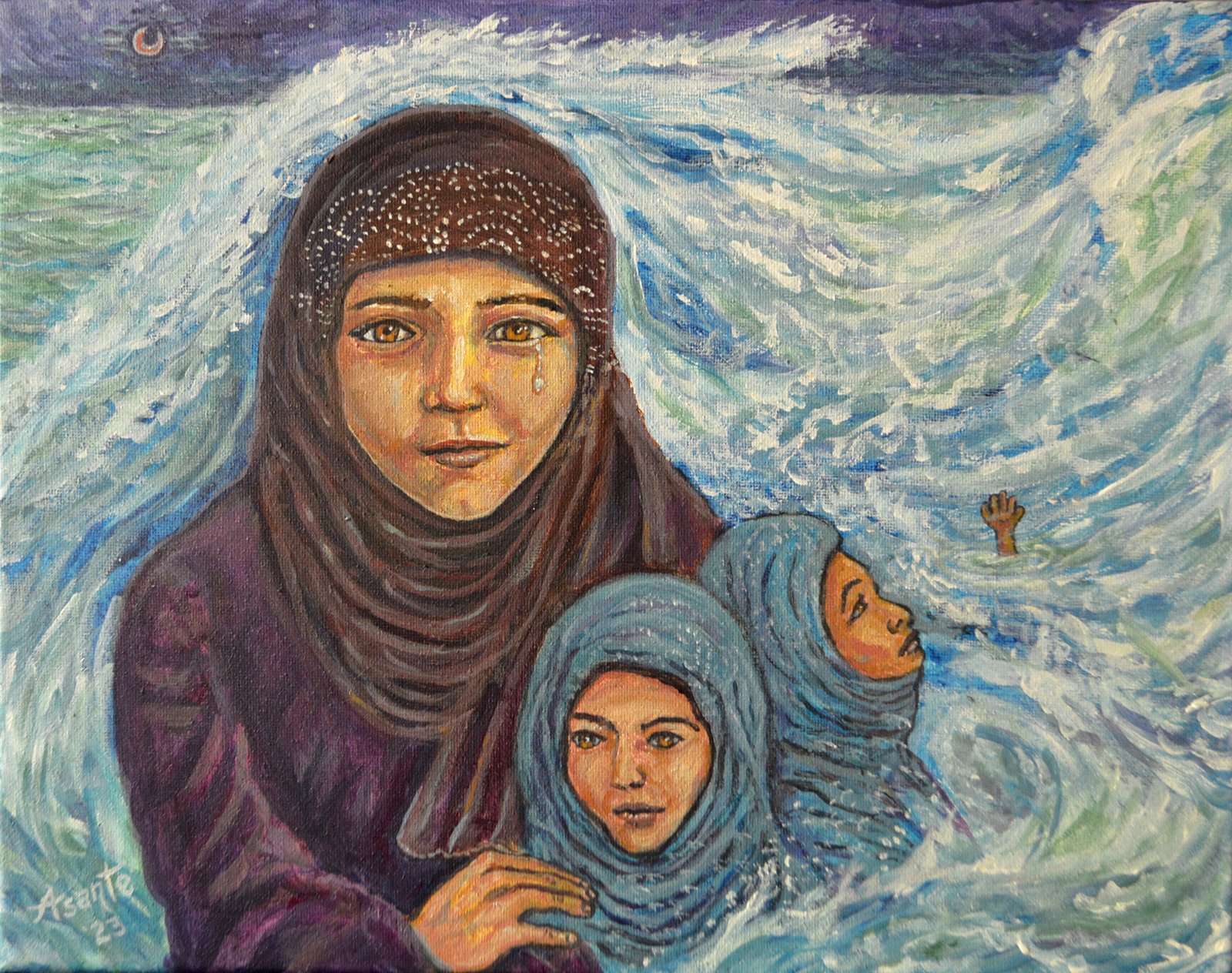
While the World was Fixated on the Folly of Billionaires…
So many of us are mesmerized by the plight of billionaire folly, yet our society is turning a blind eye to the very real horrors of the world’s refugees, seeking survival. While the billionaire submersible was imploding last month reminding us all of the power of our oceans’ depths, and an oft-absent respect for the power of nature, a ship crowded with refugees sunk near the coast of Greece and as many as 700 women and children drowned. The officials in boats did nothing to help, they simply watched in the as the refugees drowned. So much of this world’s politics and cruelty are so reprehensible… so much cruelty when there could be compassionate sharing and life saving help! This new painting insisted on coming into the world. I cannot and art will not be silent on the insanity of this all!!!
You can read an insightful article by Amy Goodman & Denis Moynihan in Democracy Now! https://www.democracynow.org/2023/6/23/greece_migrant_shipwreck_media_coverage
Art and words by Asante Riverwind, artist, Eugene, Oregon.
Color Me!
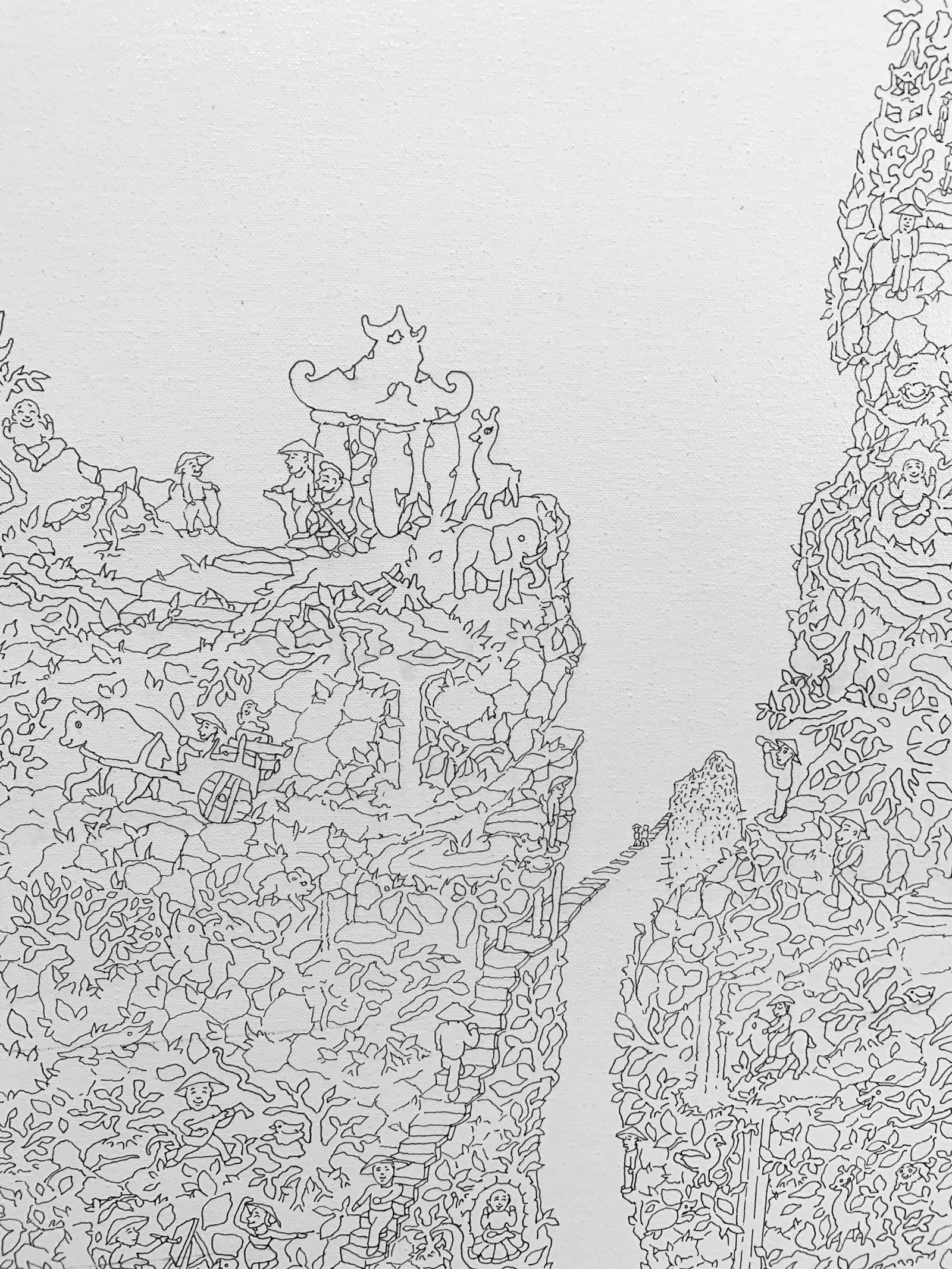
Happy Earth Day 2023!
Our friend, artist Jon Bush of Massachusetts, invites the artist in you to color this landscape to your liking. Get out your crayons or color pencils and pens to bring to life the landscape in living color of your choice. What different things do you seen in this scene? As you begin to color, you may find many things that you may have missed in your first look. You will need to print out the image before you begin to color. Try different schemes. Have fun. —Editor

The 2022 Young Poet Awards
The 2022 Young Poet Awards was organized by Camille S. Campbell in partnership with us. A teen author herself, Camille knows the importance of encouraging young writers through showcasing their work. The contest encouraged youth to write poems and empowered them to express themselves through the visual arts. After seeing the impact of her book, Her Poems: Women Poets Who Changed the World, Camille felt inspired to give back to her local community and throughout the country by hosting the Young Poet Awards contest.
We’re very grateful to all students (and also their teachers and parents) who entered their creative works. Our heartfelt congratulations to the winners of the contest this year: Carina Araujo (4th grade winner) and Nova Macknik-Conde (5th grade winner). The two Young Poets will receive a cash prize, Skipping Stones Magazine subscription and recent issues, signed copies of Camille’s book, and four books donated by Skipping Stones Magazine.
4th Grade Winner: Carina Araujo, Maryland.
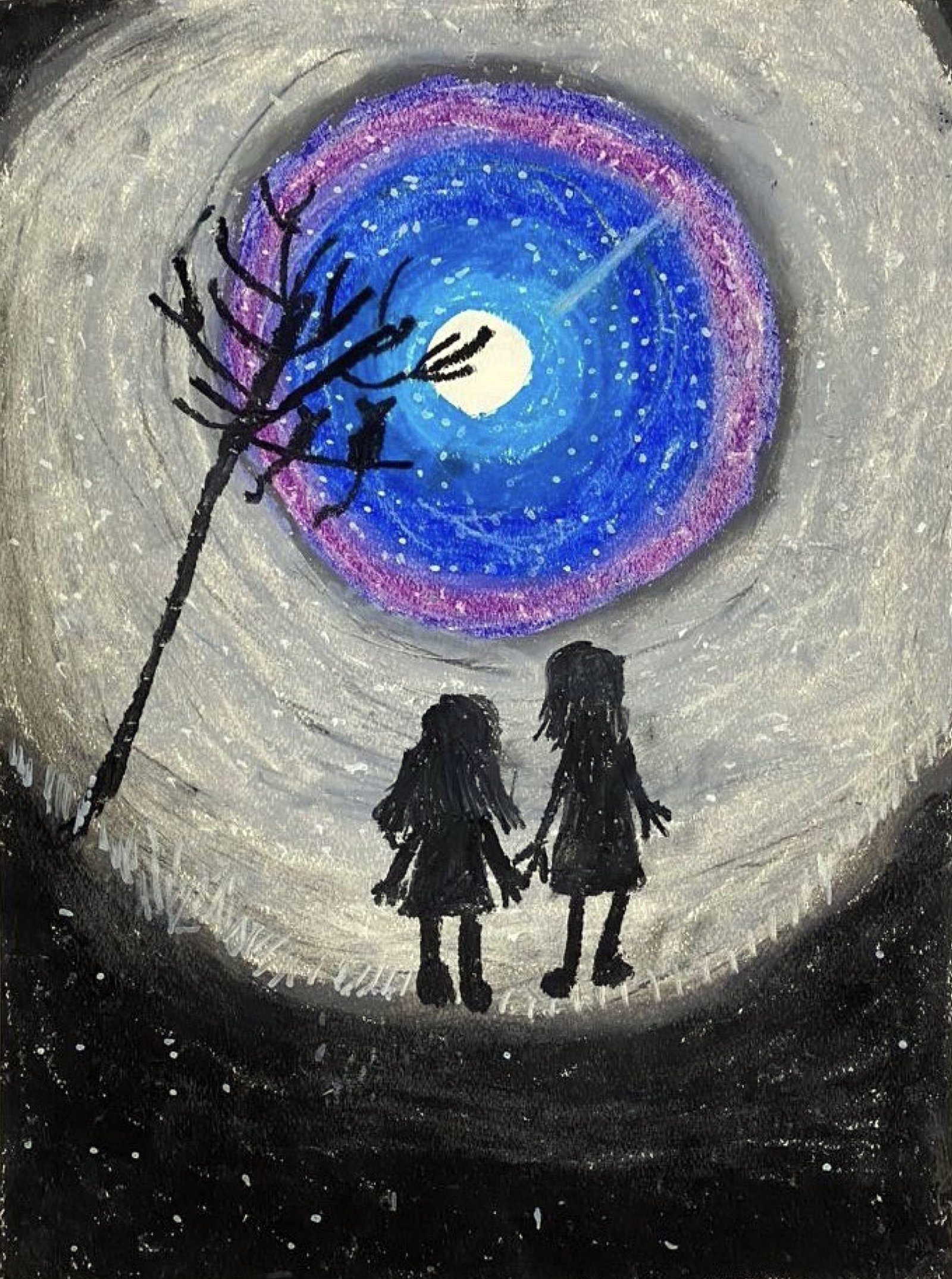
My Love for my Mom
Art and poem by Carina Araujo, grade 4, Maryland.
My love for you is bigger than the sky
You and me in this beautiful warm night
Staring at the moonlight
Together, you and me
Looking at the big blue bright sky
There are infinite stars above us
Shining in the sky
Holding hands together we stand
Peace all around
In our land
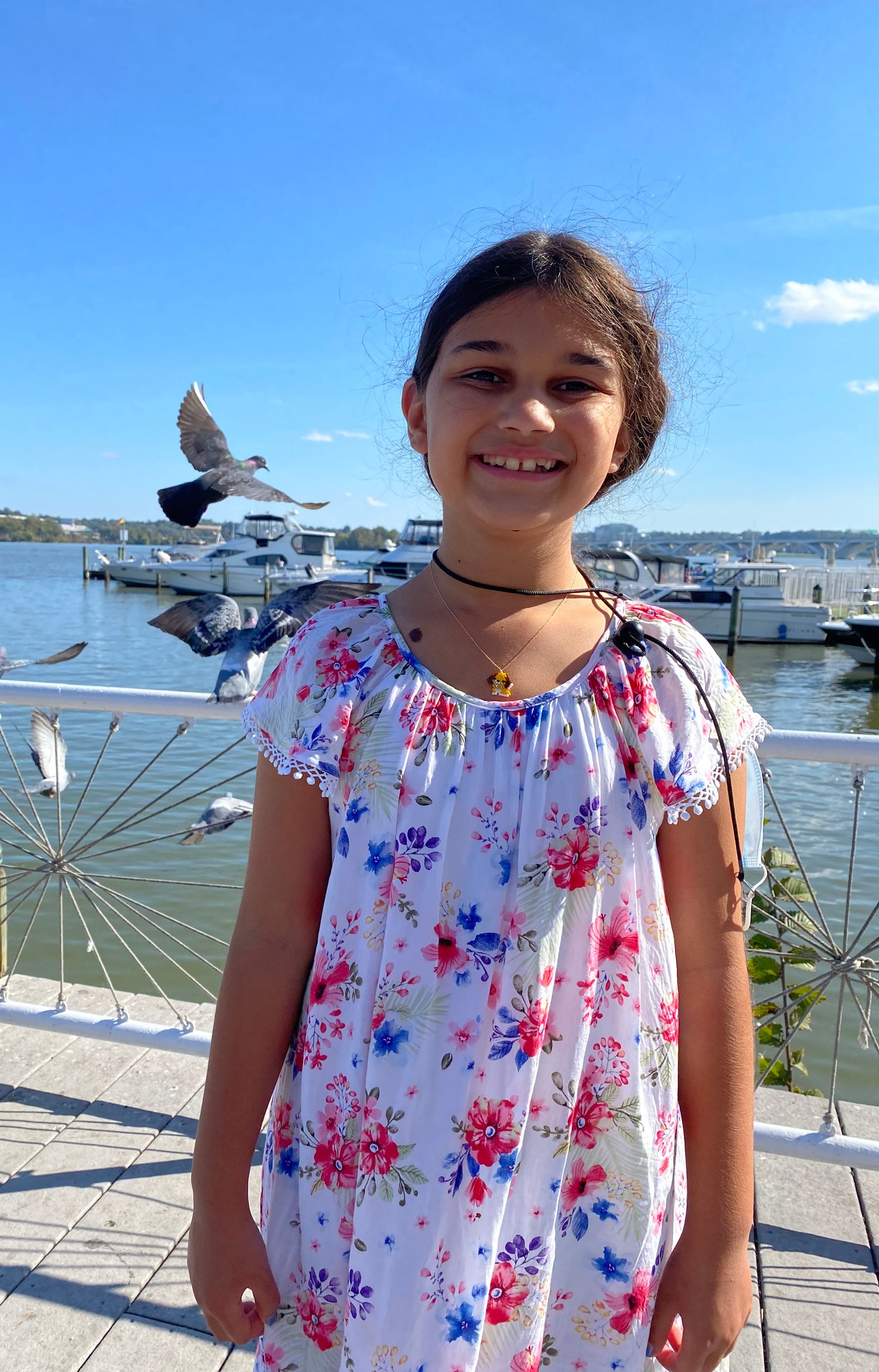
Carina Araujo, grade 4, Maryland (above).
5th Grade Winner: Nova Macknik-Conde, New York.
Winter In My Bed
Glittering white powder covers my home like a frosted cake
The silent fall of snow lulls me to sleep
Icicles lining the roof
The chance of snowmen when I wake up
Cold harsh weather surrounds my home
But it cannot penetrate the warm soft blankets that cover me
Like a hatchling in her nest
Winter in my bed
A full moon glows lighting up my face
My family sleeping warm
Through the frosty night
Me, listening to the sounds of night and family
Slowly drifting to sleep
In my snuggly, lovely, cuddly bed
By Nova Macknik-Conde, grade 5, New York.
Writer’s Block
My pen lingers over the page,
Cobalt ink waiting in the depths,
I imagine, and I ponder, and I muse.
But still the thief steals my well of words,
Cheats me of my cascading thoughts,
And takes my waterfalls of compositions.
The vague scent of ink on a fresh sheet of paper,
The articulation of inspiration,
The quiet bliss of the flowing verse.
The thief deprives me of the joy of invention,
The dexterity of novels, poems, and short stories,
And the rushing streams of world building.
So idea-less
That the only method of elusion
Is to pen
The meaningless things that enter my mind,
Or write about my writer’s block alone.
By Nova Macknik-Conde, grade 5, New York.
Sunflowers and Thoughts of Ukraine
Sunflowers and Thoughts of Ukraine
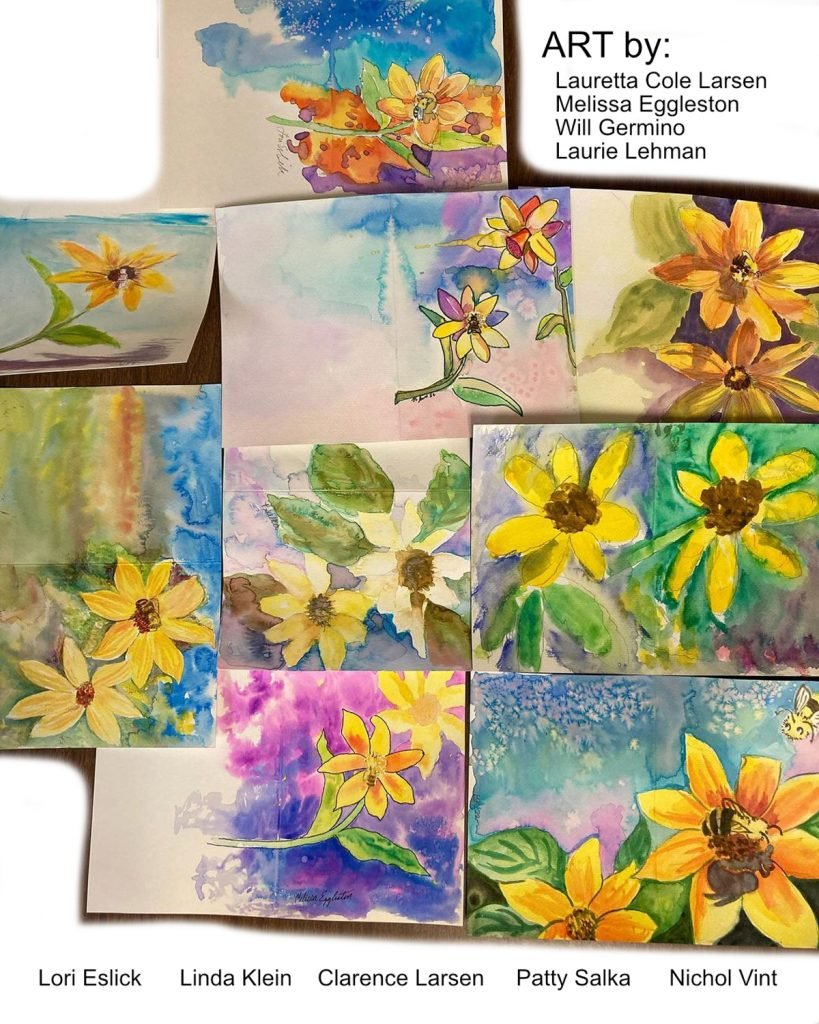
“Our sunflowers were done as our way of warming up to paint, but so much more: we painted and in our quiet moments of feeling the paint to paper, the qualities of our painting we silently thought of others in our world facing difficulties of war. The sunniness of our flowers and the blue sky behind them resembling the Ukraine flag, and how this is a hopeful sign to all. Especially a room of artists quietly painting and meditating while doing so.”
—Lori Eslick, Children’s Book Illustrator/Author. www.EslickART.com. The art was done by participants in a “Children’s Book Illustration” class conducted this month by Ms. Eslick in Lowell, Michigan.
Kaleidoscope of Freedom
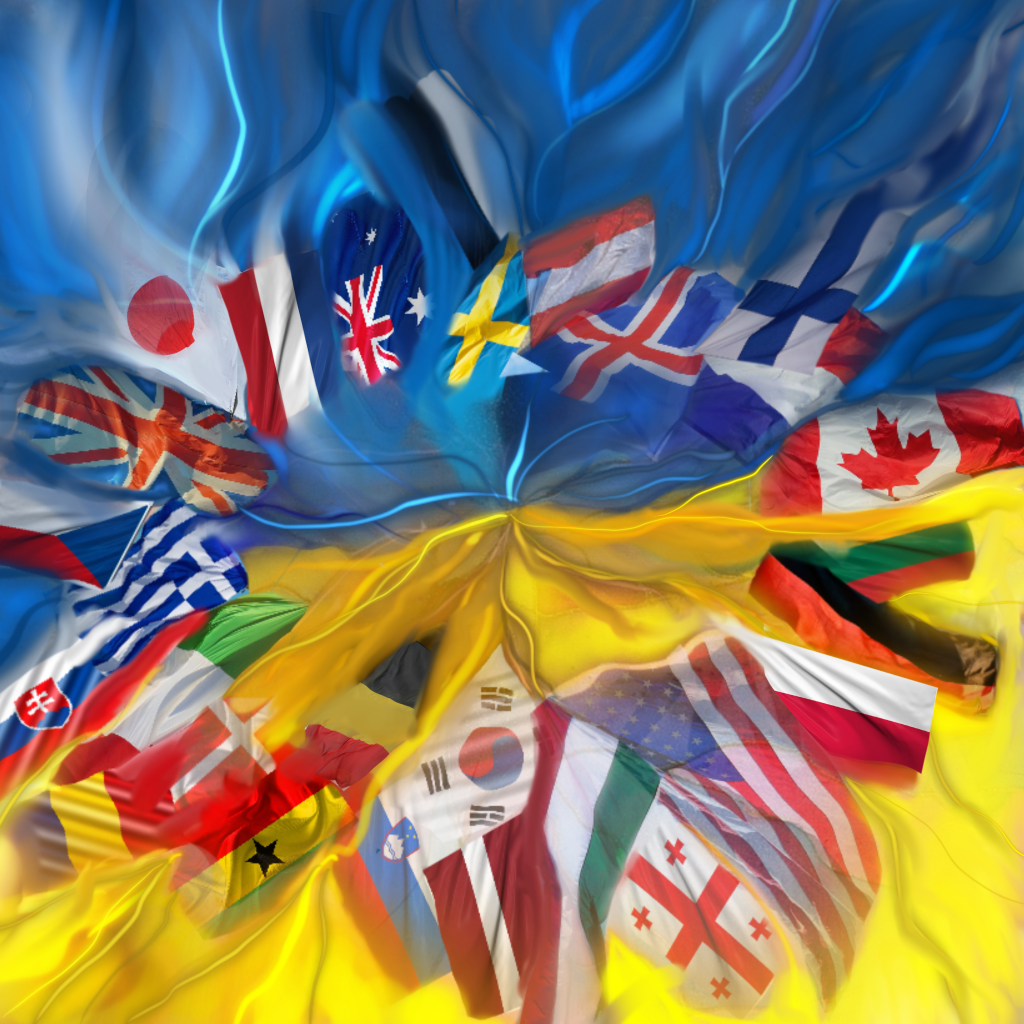
“After learning about the war in Ukraine, I was immediately worried about my grandfather and his wife, who live in Ukraine. At first, I felt that there was little I could do to help the Ukrainian people. But then I realized how art can be an important tool to show support for Ukraine during their fight to protect their land and homes from invaders. In my digital artwork ‘Kaleidoscope of Freedom,’ the center is the Ukrainian flag surrounded by the flags of countries that stand with Ukraine. It expresses the message that the people of Ukraine are not alone in the fight for their land and freedom.”
By Camille Campbell, Age 17, Arizona. Also see Camille’s poem COLORS OF UKRAINE and art published earlier on this website. She adds: “I’ve printed over 5,000 stickers with my art for rallies in Arizona, California and New York. The digital art is based on my silk art (the Ukrainian painting technique) and conveys the message that many countries of the world support Ukraine.” The donations that people make at these rallies support the Ukraine cause.
The Most Precious Gift
By Yarynka Yarosh, age 15, grade 9, Kyiv, Ukraine.
Standing near the window in her room, Christine cried quietly. She had long ago learned to wail silently so that no one would hear. Especially Mom. Or maybe she had just spent all her loud tears. Sometimes, after a series of such noiseless sobs, her pillow was too wet to sleep upon. Now those silent, salty streams were there once more, flowing down her cheeks, sprinkling her favorite violet raglan.
Down there, in the yard, her friends are playing volleyball. Olenka serves the ball to Max, he hurls it over the net at Slavko, but Slavko palms the ball back skillfully. Twins Marusya and Oles` back him up closely. The whole team was there, except Christine!
The last time, they had played together was at the start of November, before the first snow. Then came that long and cold winter when Christine fell ill. Now, all the danger was past her, but she still couldn’t play. So every single day she just stood at her window, hidden behind the curtain and watched the exciting game. Her friends shouted for her every time they went out, but she rejected all invitations. She had no difficulty running. No, there was another reason—she just couldn’t confide in them.
Christine sighed and sat on her bed, burying her head into her hands. Not a single hair under her fingers.
Last year had changed Christine’s life radically, ruining plans, dreams. The hospital room, IV`s, doctors, that awful laser lamp, endless chemos were again flickering before her eyes. Christine had no wish to replay all those dreadful months in her head, so she shook her head like she used to do before all that when she still had her beautiful hair. Oh, she was so proud of it! She had the longest hair in her year! And now she has nothing, but plenty of unpleasant thoughts scurrying in her head, like a scattered jigsaw puzzle. Christine was so full of self-pity that she started to cry again. After all this, she had learned to bear physical pain, but not the absence of her chestnut curls.
Oh, how she wanted to run with the “Volley Sixth” again, but…
Christine didn’t want her friends to see her without hair—anything but that! Her pals still had no idea that she was now bald—her parents bought her a wig so that no one would ever know.
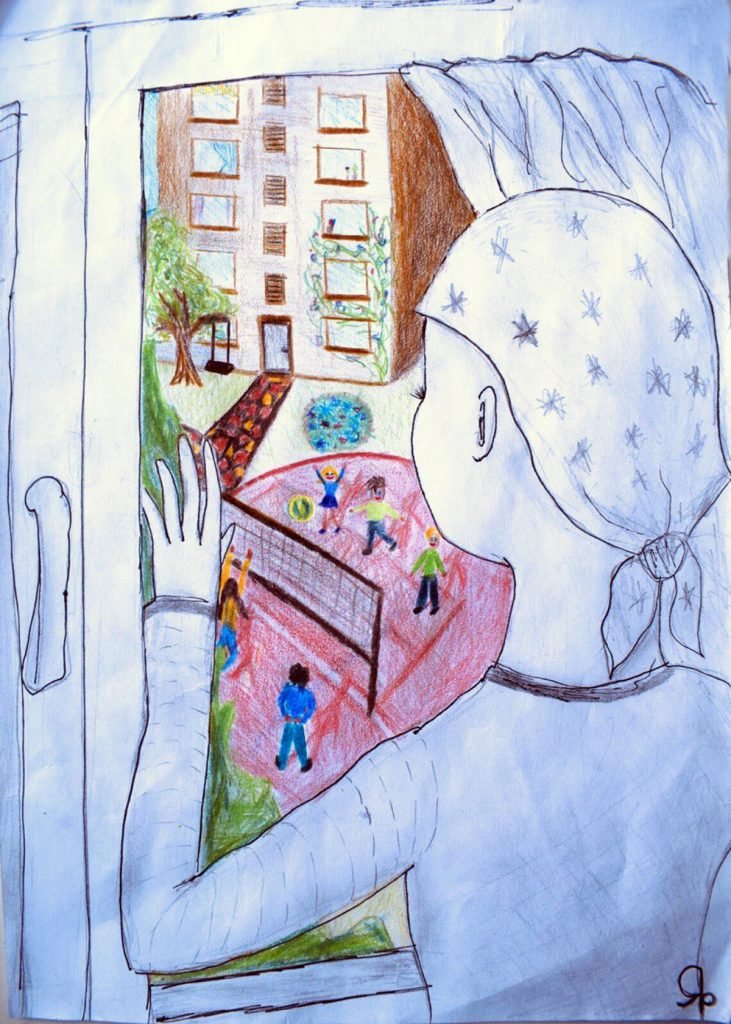
Christine got up and returned to the window. The field was now ringing with laughter—Slavko had just returned the ball in an unusual manner, locking his fingers in a weird knot. Christine poked her head out of her hidey-hole behind a curtain and imagined herself running over the field with her friends. There she is, taking a pass from Slavko, then feeding the ball out to Olenka and running for it just in time to catch a master shoot from Oles`, and then…
Everybody at the field was suddenly staring at her, at her window. Five confused faces. Absent-mindedly Christine scratched her head and suddenly the chills went up her spine… She had forgotten to put her wig on! She usually went about the flat without her fake hair and watched the game from behind the curtain. Today, however, she got so carried away she completely forgot to mind the “danger zone”.
Realizing that her friends saw her baldness the girl yelped and hid her face in her hands. Then she darted away from the window, fell on her bed, and burst into tears. Tomorrow’s her birthday and all the members of “Volley Sixth” were planning to visit—that was the most tragic thing of all!
Her Mom came into the room, alarmed.
“I`m the only bald person in my class! No, in the whole school, in the whole city!” cried Christine loudly, like the moment she was told about her diagnosis. “I don’t want any party on my birthday!”
Mom hugged her tenderly. “But your hair will grow back, for sure, my skylark,” she soothed.
“I can’t speak to them normally, knowing they saw me bald!”
“If they are really and truly your friends, that should mean nothing to them,” she responded.
But does she really have… true friends?
That night Christine had a beautiful dream.
“Come on, Christine, serve it! That’s my girl!” shouted Slavko.
“It’s so good to play volleyball with my friends!” Christine was rejoicing, serving the ball on the other half of the field. Suddenly, she saw it hurtling towards her. She wanted to break it, but her knees quaked and felt like cotton…
Somebody touched her shoulder very softly. Christine opened her eyes and instantly squeezed them tightly shut, hiding from the tickling morning light… Mom and Dad were standing near her bed, smiling and holding a present. So she had only dreamt about the game, how sad!
“Ding-dong,” rang the entry phone in a while. Christine quickly slipped her wig on.
And there they were! Olenka, Slavko, Maxim, Oles` and Marusya. They had come empty-handed, and for some reason, were all wearing hats.
“Well, as agreed! On the count of three,” cried Slavko. “One, two, three!”
“Happy birthday!” And they swept off their hats as one.
They all had clean-shaven their heads!
And they hugged the birthday girl, all at once.
That was the best birthday party Christine ever had!
After the birthday treats, “Volley Sixth,” now fully complete, went to the sports ground before Christine`s window. Now Christine had difficulty identifying her friends on the field, she still hadn’t got over their new hairstyles.
Then she remembered her dream. Now she couldn’t recall whether she had her curls there or not. Not that it had any importance now. She was quite happy without her hair now, for she had true friends.
By Yarynka Yarosh, age 15, studies in grade 9, Kyiv, Ukraine.
Yarynka writes, “I like painting, playing piano, reading, speaking with my family about anything, writing poetry, and stories, of course. I’m from Ukraine, and I want peace in the whole world, and for ourselves.
“On the 9th of March, we were forced to leave our home city, beautiful Kyiv (because of the Russian invasion)… Now my family and I are in a safe place, and I’m so thankful to God that we are still alive! But my grandparents are still in Kyiv. Please, pray for them!
“I was really surprised, when I read your email (of acceptance). I’m thankful for your positive response. You made me happy and gave me more confidence and hope 🙂 Ukraine needs your prayers, we feel your emotional support.”