Author Archives:

The Harvesters & Escaping Hunger Pangs

The Harvesters & Escaping Hunger Pangs

By maggie d., poet and retired educator, Washington

1. The Harvesters

“Be at peace with your
Enemy” our ancestors
Preached
But what if they were
Police
The authorities who
Handcuffed and
Hunted you down like
An animal
That gave you no relief
When you sought to live
Freely in America
Continually we battled
Our poverty hunger strife
In our native land
At one time the fields
And orchards offered a
Way to excel
It was a place where hope
Dwelled
And Cesar Chavez’s Spirit
Existed

2. Escaping Hunger Pangs

Stealing food heals
My momentary hunger
Making me wonder
About the noises
In my stomach
They sound louder than
Thunder as they rumble
Inside
But I relentlessly search
For slumber and shade in
The city sun
Oblivious to places too
Obvious for rest
I recall how nice the
Beans and rice
Are when I realize I can
Get caught someday
Living life on the streets
I savor solutions to stay
Alive without needing to
Hide

—maggie d., African American poet and retired educator, Washington.


ADHD: Hunter in a Farmer’s World

Why School Breaks the ADHD Hunter’s Spirit

By Thom Hartmann, author, educator and commentator

The modern school system wasn’t built with the hunter in mind. But that doesn’t mean we have to keep using it.

Every September, countless ADHD kids return to school full of promise, only to feel like failures by October. It’s not because they’re lazy, stupid, or broken. It’s because the system was never designed for them in the first place.

We built our modern education system during the Industrial Revolution. Its purpose wasn’t to foster creativity or honor individual strengths—it was to create obedient factory workers and good soldiers. Schools emphasized conformity, repetition, and hierarchy. Sit still. Follow the rules. Memorize and repeat. Don’t ask too many questions.

For kids with ADHD—what I call Hunter brains in a Farmer’s world—this is a death sentence for the spirit.

The Classroom as a Factory

Think about it: A standard classroom requires kids to sit still for long periods, absorb abstract information, and stay quiet unless called on. That’s not how Hunters are wired. A Hunter scans their environment, reacts quickly to movement, explores, wanders. Their learning is active, kinetic, sensory.

Now imagine putting that child in a chair under fluorescent lights for six hours a day. Penalize them when their minds wander. Shame them for blurting out brilliant but untimely observations. Force them to repeat tasks that bore them to tears. That’s not education—that’s imprisonment.

The Myth of the Lazy Kid

One of the most insidious myths about ADHD kids is that they “just need to try harder.” But ADHD isn’t about willpower. It’s about neurological wiring. The hunter brain isn’t motivated by future rewards; it responds to immediate stimuli. It craves novelty, intensity, and challenge. Long-term projects, repetitive drills, or quiet reading time simply don’t register as important. It’s not a choice. It’s chemistry.

This leads to an avalanche of negative feedback: low grades, constant reprimands, damaged self-esteem. The message they internalize is clear: you’re not good enough. And so they begin to disengage, act out, or give up altogether.

Rebellion Is Not a Flaw

We treat rebelliousness in children as a character defect. But sometimes it’s wisdom. Hunter kids resist systems that don’t serve them. That resistance, if nurtured, becomes the same trait that leads adults to become inventors, artists, entrepreneurs, and change-makers.

But too often we crush it early. We reward conformity. We punish curiosity. We drug children into silence.

This isn’t just a tragedy. It’s a massive loss of potential. How many future Einsteins and Edisons have we labeled as disruptive? How many future innovators dropped out to escape systems that refused to see their genius?

Real Learning Happens in Motion

Look at how young children naturally learn: by touching, exploring, imitating, asking questions. That’s a Hunter’s learning style. The farther we move from that model, the more we lose those kids.

Project-based learning, outdoor education, apprenticeships—these approaches work brilliantly for ADHD brains. They restore meaning to the learning process. They offer feedback in real-time. They respect movement, engagement, and challenge.

Why do so many ADHD kids come alive in summer camp, theater, robotics, or sports? Because such environments match their wiring.

What Can We Do?

First, we stop blaming the child.

Then we fight to reform the system. Advocate for alternative learning models that honor multiple intelligences. Support teachers who think outside the box. Push back against standardized testing regimes that reduce learning to a number.

And at home, we tell our Hunter kids the truth: You’re not broken. You’re different. And in many ways, you’re better suited to thrive in a world that desperately needs new thinking.

The modern school system wasn’t built with the hunter in mind. But that doesn’t mean we have to keep using it.

Let’s rebuild it. Let’s build schools where Hunters can run. 

—Thom Hartmann, educator and commentator, is the author of a highly respected book, ADHD: Hunter in a Farmer’s World. Reprinted with permission from ADHD: Hunter in a Farmer’s World with Thom Hartmann. To receive new posts you can become a free or paid subscriber of this reader-supported publication.

Making Wontons

Making Wontons

By Drew Choy, age 12, grade 6, California.

The cold water welcomed my fingertips as I dipped them into the bowl. I gently lathered the water onto the wrapper so I wouldn’t rip it. The meat inside of the wrapper felt like a golf ball—smooth, spherical and heavy for its small size. I connected the two opposite corners of the wrapper and folded the wonton* into an envelope.

I’m a third generation American and making wontons is something that connects me to my culture. My parents are pretty good at it, but I’m just starting, so sometimes I make small mistakes. We make them at random times. Sometimes I get home from soccer practice and the wontons are waiting for me, and other times, I get to make a couple of them, too.

Chinese cuisine is a lot different than many other cuisines in that you rarely ever get to eat the dish you ordered. Most of the time, you share all of the food with everyone at the table, even if you only ordered one item. When I share these meals with my parents, it helps me bond with them.

I set the wonton down on the platter where many of the wontons my parents had previously made were sitting. Journey (the music band) played in the background. My mom, who was preparing the vegetables for dinner, said something to my dad in Chinese which I didn’t understand.

As my dad pulled the first batch of wontons out of the pot, the aroma filled the room, and my mouth watered.

I refocused on my task, but I was having trouble closing the wrappers tight. So I dropped the wonton onto the plate, sat back in my chair, and crossed my arms.

My dad got up from his chair and crouched down next to me. He then calmly walked me through how to find the right amount of meat and how to seal the wrappers well.

When I visit China, I’m the only person in my family who doesn’t speak any Chinese. Whenever we’re shopping at street markets, vendors are shouting out items in Chinese, and at restaurants the menus are all written in Chinese. This makes me feel separated from my culture because I can’t do the basic things that Chinese people can do. But when we’re back home in California, making Chinese food is one of the only things that makes me feel Chinese.

“It’s okay,” my dad tells me. “Everyone makes mistakes.”

My mom, still standing over the boiling pot of water, says, “Yeah, as a kid, I didn’t understand how to make wontons right away. It takes time to learn new things.”

A smile crept onto my face. When the wontons were finished boiling, I made a sauce containing soy sauce, sesame sauce and rice vinegar. I bit into the first wonton and the juice from the meat burst inside my mouth in a flavorful explosion.

Immersing in Chinese culture isn’t just about speaking the language. Food and my parents are equally important things that connect me to it. In China, I may have felt awkward being around a lot of the people, but through participating in small cultural practices here in the U.S., I hope to fill the gap between Chinese culture and me.

* Wonton is a Chinese dumpling that is commonly found across many regional cuisines of China.

—Drew Choy, age 12, grade 6, California. Drew writes, “I’m Chinese-American, and I am the second generation of my family born in the U.S. I only speak English right now, but I used to be fluent in Chinese. The most important thing to me is my parents. They are the ones that support you and guide you through all aspects of your lifetime. My parents are my best friends and I wouldn’t be who I am without them. In the future, my dream is to become a professional soccer player. I am a very athletic kid, and sports are something that always cheer me up.”

Adam Bobrow, the Voice of Table Tennis

Adam Bobrow, the Voice of Table Tennis*

By Viraj Ajgaonkar, age 12, grade 8, Mumbai, India.

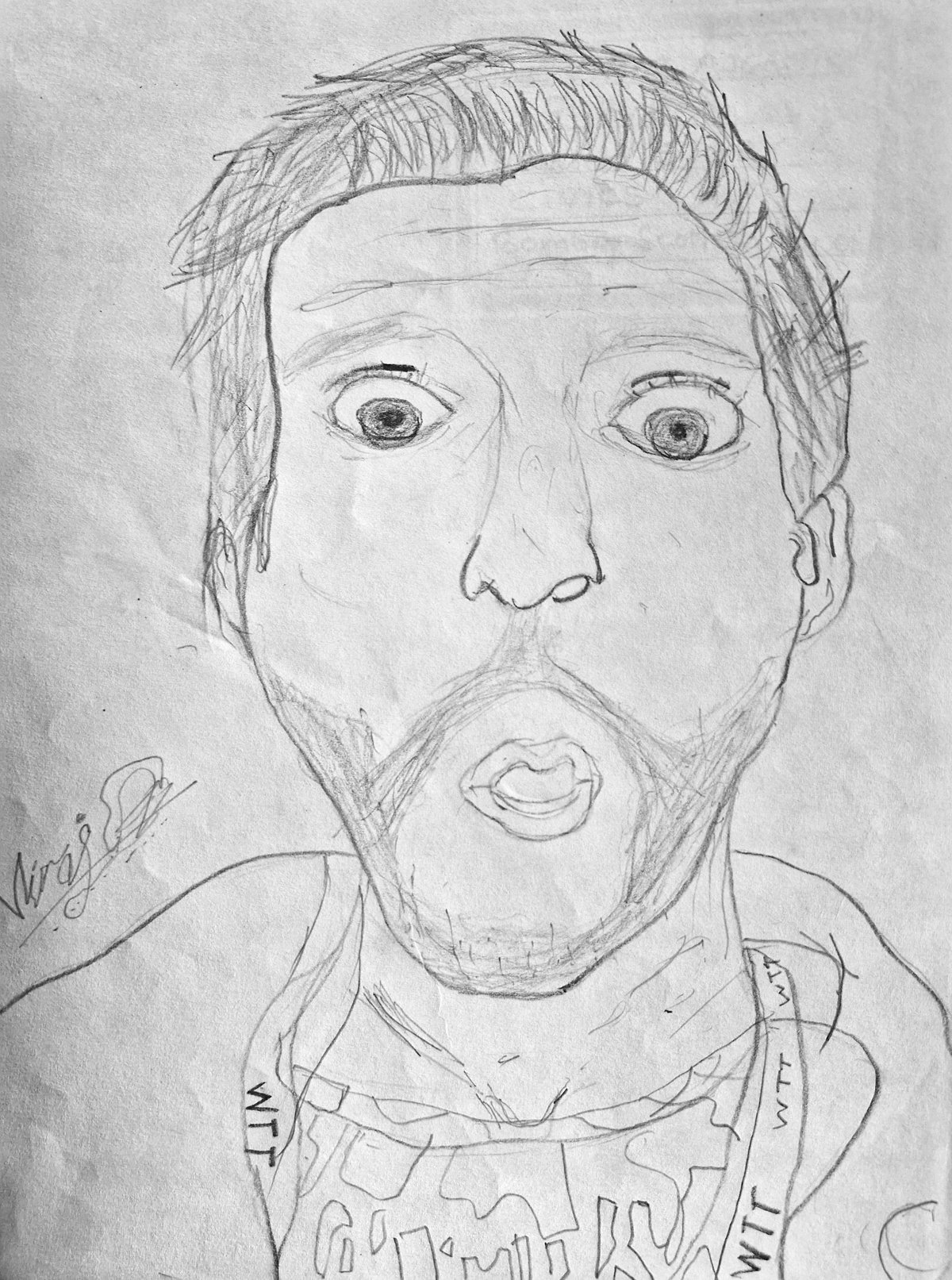
Adam Bobrow sketch by Viraj Ajgaonkar.

I am an emerging professional table tennis player, and I do my best to actively compete at Mumbai’s city level table tennis tournaments. There are multiple players whom I greatly adore and I always try to imbibe their techniques that help me to improve my game.

But there’s this guy who is quite unique, and he has created a meritorious place for himself as an official table tennis commentator in the UTT and WTT tournaments. When he was a professional player, he was popular for his signature snake serves and hitting the ball across the table.

Yes, you guessed it right. He is our very own the “Voice of table tennis,” Mr. Adam Bobrow!

He is also a successful YouTuber wherein he battles out professional players—from China’s Ma Long and Fan Zhendong to France’s Lebrun brothers or Brazil’s Hugo Calderano, right up to India’s Sharath Kamal or even USA’s Kanak Zha.

His humorous style of talking in his typical American accent, his colourful t-shirts and shorts, and his strong command over the language makes him very unique. He is truly fun-loving and seems to enjoy traveling to diverse places. For a recent Doha tournament, he traveled light—with just one backpack!

He has had played a pivotal role in spreading the passion for table tennis (ping pong) by challenging even the enthusiastic non-players of various age groups across the world through the solid platform of PingPod.

You will notice that he is a keen observer when you see him play against professional players in the challenge games. He tries to study their strengths and other technical aspects of backhand/ forehand strokes, chop, block, etc. He then effectively blends it especially in his English commentary. He often gives nicknames to many players—like Xuperman to Xu Xin or The Golden Girl to Manika Batra.

I’d like to take an opportunity through this article to invite you, Mr. Bobrow, to our city of Mumbai at Shivaji Park Gymkhana and Park Club. Mr. Bobrow, do come and challenge me and my other senior buddies, and let’s have a blast over here to create some unforgettable moments!                     

         By Viraj Ajgaonkar, Age 12, Grade 8, Bombay Scottish School, Mumbai, India.

* Table Tennis is known as Ping Pong in many countries of the world.

Battle on the Board

Battle on the Board

By Elaine Elizabeth Jinto, age 14, Karnataka, India.

Why did the ancient kings of India even bother to invent a game like chess? I mean, take Babur*, Akbar, or any other king for that matter; they seem to have spent their whole life in mortal combat, so why also have a war on the board? If I were one of those ancient rulers, I would have banned chess in my kingdom. As chess was a game from ancient Indian history, everyone here in India seems to play the game. Everyone just wants to be the next world champion, unlike me, who is forced to play the game so I can follow my real dreams.

But then, why was I sitting at a chessboard waiting for the Karnataka Chess Championship to start? And, why was Karnataka State Champion Sindhuri Patil sitting exactly opposite to me?

Yes, my dear reader, I, Elaine Elizabeth Jinto (with No FIDE** Rating), was about to play with one of the greatest chess players of India. Now you will be like, “Whoa, hang on, wasn’t she saying that chess was a useless game ten seconds ago?” Yes, I was saying that, but I need a FIDE rating to get into ISRO’s space camp. I was on the Top Board, the spot coveted by all chess players. But I didn’t want to be there. It was just because of FIDE’s weird pairing mechanisms. The game was available live on Lichess.org, and as I looked around, I saw the spectators sitting outside the tournament hall, everyone looking at their cellphones. I felt even more nervous, so I took a deep breath and imagined myself at the Space Camp. That did not help me, though. It made me more desperate to play well!

I wondered what the spectators were thinking. Were they hoping for an interesting match worth watching? Or were they judging the little girl sitting opposite the champion, nervously twiddling the pieces around? Or were they sympathizing with the girl who had to play a very tough match for no particular reason?

As we waited for the match to start, I took a good look at my opponent. With the T-shirt she wore when she last represented India, hair in a thick, tight braid, glasses, a nose ring, and a very, very serious, slightly mocking expression on her face, she was the scariest opponent I had ever played. Or maybe it was the difference between our FIDE ratings that scared me. Or both. I don’t know.

So, there I was, sitting in the tournament hall, about to play for the first time with a digital board and clock. An A/C and a reclining chair were provided for my comfort. But far from being comfortable, I was shaking nervously and was already thinking of ways to resign without appearing too cowardly. I kept pressing the buttons on the timer absentmindedly until Sindhuri told me to stop changing the time controls!

The bell sounded, and the match started. Sindhuri made the first move, and I could taste the aggression in the air. Playing safe, I opted for a defensive move. I mean, a move that wouldn’t lead to an immediate loss. She glared at me, and her pieces charged towards mine. Within seconds, the enemy had broken through the castle walls and annexed the treasury. With two men dead on the field, I was forced to retreat. Sindhuri ordered more pieces out, and in that calm bit (the only calm bit in the whole war—too bad it was short-lived), I attempted to reconstruct the castle walls. This resulted in the sad death of my beloved elephant and knight; may God bless their souls.

I felt dozens of eyes on me as piece after piece was either captured or trapped where I couldn’t use it. I took a deep breath and tried to tell myself that the gleaming gold cup, displayed on the stage, wasn’t my ultimate goal. It didn’t work, though. As I chewed my lip, trying to think of at least one move that would prevent the impending destruction, I realized that even though I found chess boring, I wanted to win. Losing was bad. And even though I pretended not to care, I did. My thoughts raced: Should I just save the knight? Should I castle to stop getting checkmated? Or could I just resign? Losing track of everything, I tried to save my last man on the field, and the king was trapped. “Checkmate,” Sindhuri yelled triumphantly.

The bell sounded, and the match ended. So, there you are, my dear reader, a brief description of the destruction of my poor kingdom and the victory of a WFM against an ordinary fourteen-year-old. I left the tournament hall clutching my score sheet with tears in my eyes, feeling that chess was more useless than ever. Anyway, before I leave to sob in peace, I must answer my question in the beginning. The answer came to me as I took one last look at my destroyed kingdom. The ancient kings likely wanted to practice their battle strategy.

By Elaine Elizabeth Jinto, age 14, Karnataka, India. She has been published in Skipping Stones multiple times.

Editor’s Note:
* Babur is known as the founder of the Mughal Empire in India. Akbar was the third in line of Mughal emperors (who died in Oct. 1605 CE) and his son, Jahangir, followed as the next emperor.
**
FIDE stands for Fédération Internationale des Échecs (in the French language) meaning the International Chess Federation.
NPR (National Public Radio, USA) reported on June 08, 2025 that the game of chess is very popular in India; and that there are even online chess schools to train serious chess players in the country. Currently, there are 85 Chess Grandmasters in India. In 2024, at the World Chess Championship in Singapore, 18-year-old Gukesh Dommaraju, from Tamil Nadu, India became the youngest-ever world champion.

Our Personal Food Choices Affect Our Community

Our Personal Food Choices Affect our Community

By Hope Bohanec, Oregon.

The current tumultuous political climate has left many in our community feeling powerless and vulnerable. Amidst immediate concerns like climate disasters, declining health and well-being, and rampant injustices, we are now confronted with the reality that relying on government or legislation to effect positive change in the near future is likely futile. However, there are choices we can make and daily actions we can take to alleviate suffering, support the planet, and nurture our bodies. Eugene has been a hub for community-led action and we have been at the forefront of embracing vegetarianism, veganism, and eco-conscious lifestyles. It’s vital that we collectively work to amplify this progress on a grassroots level to effect the necessary changes for our survival on planet Earth. Personal choices hold immense power, and one of the most significant choices we can make every day, that impacts numerous aspects of our lives, is the food we choose to buy, cook, share, and eat.

Many people agree that our food system is broken and that it harms workers, animals, and the environment. As more people wake up to animal exploitation, the epidemic of degenerative disease, the climate crisis, and other negative impacts of animal derived foods, veganism offers a solution. At its core, vegan living is an economic boycott of a cruel, unsustainable, and harmful industry. However, vegan philosophy transcends this to also encompass a social justice strategy for a just, global food system as well as a profound appeal for nonviolence and compassion for all animals with whom we share this planet. Vegan living helps to considerably reduce one’s climate footprint, promotes fairness for those lacking access to healthy foods, and can help us potentially avert the next pandemic—just by extending our compassion to all sentient beings. Veganism reminds us just how political food is.

The damage that is being done to our planet is an imminent threat to our collective survival. Scientific research overwhelmingly demonstrates that producing food from animals has a significantly greater environmental impact compared to producing food from plants with equivalent dietary value. These studies consistently show that, regardless of the production method or product label, plant-based foods repeatedly require less water, energy, and fossil fuels and generate substantially fewer greenhouse gas emissions than comparable calories of meat, dairy, and eggs. We are experiencing this damaging effect in Eastern Oregon with nitrate-laden drinking water caused primarily by animal agriculture. Eating plant-based is eating planet-based.

Experts agree that we need both systemic and individual behavior change to support a global transition to plant-based diets to mitigate climate disasters and alleviate numerous other impacts of animal agribusiness. While working to create systemic change is crucial—it’s incredibly challenging and agonizingly slow. Individual actions that support and demand these larger shifts can happen now, today, with your next meal.

Having been vegan for 35 years, I have witnessed the remarkable progress we’ve made in a relatively short period of time. In just a couple of decades, we have seen plant-based milks become common at coffee shops, most every restaurant menu offering vegan options, and countless cruelty-free products in grocery stores. This progress was made because of individuals standing up against injustice and making compassionate choices. Every day, I am inspired to reclaim our agency and harness the collective power of our plates, palates and pockets. Together, we can continue to dismantle oppressive dairy, poultry, and meat production and marketing systems of violence and alleviate immense suffering.

Plant-based is the global future of food, and it starts locally. About 1,500 people came together for the first ever Eugene VeganFest on Sunday, May the 4th. This celebration of compassionate community in Eugene, Oregon featured 45 vendor booths offering a wide variety of non-animal focused offerings like delicious plant-based foods, animal sanctuaries for rescued animals in need, and eco-forward products that help heal our planet. Fifteen speakers gave well-attended presentations on various topics revealing the ethical and environmental reasons to be vegan as well as focusing on the health and nutritional advantages of a plant-based diet. Everyone was welcome—veg-curious, pre-vegans, heck-no-I-could-never-be-vegans, and vegans alike! People came and learned how much power we have to help make our community a more sustainable, healthier, and kinder place for all.

Encouraged by the success of this event, we’re already preparing for the Second Annual Eugene VeganFest on Sunday, May 3rd, 2026.

About the Author:
Hope Bohanec is the organizer of the Eugene VeganFest (www.EugeneVeganFest.org) and the Executive Director of Compassionate Living. (www.compassionate-living.org)

Resources:
https://www.science.org/doi/10.1126/science.aba7357

https://www.newsweek.com/even-one-persons-food-choices-effect-whole-planet-opinion-2030211

https://www.opb.org/article/2025/01/27/oregon-bill-would-ban-new-livestock-farms-in-states-most-polluted-areas/

The Girl who Saved the American Pilot

The Girl who Saved the American Pilot

By Fanny Wong, Chinese American author, New York.


On February 11, 1941, Ah Ying watched a parachute float down from the sky. It draped the roof and the side of a small building in their village of Shatin, in the outskirts of Hong Kong.

The adults of the village were frightened and ran off. Ah Ying was nervous too, but she was more curious than frightened. She walked closer and saw a White pilot. She was relieved the pilot was not a Japanese. The Japanese had occupied Hong Kong and she was used to seeing them strutting around, sometimes on horseback.

His leg was hurt. He was limping. Could she trust him?

The pilot showed a Chinese flag sewn on the inside of his jacket. Ah Ying breathed a sigh of relief.

It was all right. He was not an enemy. He was working with the Chinese against the Japanese invaders. She must hide him from the Japanese soldiers.

Ah Ying led the pilot from the village to the cow pastures on a small path. As they climbed the steep path, he could hardly follow her with his hurt leg and a burned arm. They went up a steep path, Ah Ying pulling him by the good right hand.

There was no way of avoiding a Japanese sentry post below. They hurried as fast as they could. But the Japanese spotted them.

Crack! Wheeeee! Crack! Two Japanese soldiers fired shots and others were running toward them. They raced up a hill and down the other side. The pilot could not follow fast enough and Ah Ying lost sight of him. The Japanese soldiers were quite a distance away when she reached the top of a hill and raced down the other side. She looked back once and saw the pilot half hidden by a boulder surrounded by scrawny weeds.

For the next few hours, until the sun set, Ah Ying dared not look for the pilot. The Japanese soldiers were still searching for him on the hillside. She had to help him somehow. Her parents were against her going back to help.

“The Japanese is our enemy, not the pilot. If he’s caught, the Japanese will treat him cruelly,” she said to her parents, who knew too well the cruelty of the soldiers.  

As Ah Ying searched the hillside, she sang a folk song to let the pilot know she was looking for him. He emerged from behind the boulder. She led him through bushes and grass to a tall shrubbery on another hillside. She pulled the shrubbery aside and shoved the pilot down a foot or two onto a straw floor in a hole about eight feet in diameter.

Ah Ying turned on a flashlight. The hole was underground. It must have been used as an oven for burning charcoal. The past fire had baked the walls into hardness and sealed off dampness. She pounded two nails into the rock at the entrance and hung a blanket to block the light from inside the cave.

The next morning, Ah Ying brought food. It was plain rice with pickled cabbage. She watched him scoop them into his mouth hungrily with the chopsticks.
 The pilot wiped his mouth with the back of his good hand and pointed to his chest to introduced himself, “Donald Kerr.”

Ah Ying introduced herself he same way. She motioned with her palm that he should stay there and left.

It was too dangerous to visit the pilot in daytime. The next night, Ah Ying brought hard boiled eggs, boiled sweet potatoes, and a thermos of hot water. She pointed toward the outside and brought in an old man dressed in dark clothes and western hat.

Peering at the pilot through thick glasses, the old man said, “Good morning, sir. I am happy to know you. I am Y.T.”

“My name is Donald Kerr. I’m glad we can talk in English”

The children did not understand what the two men discussed in English. When the discussion was over, Ah Ying left with Y.T.

During the three days that Kerr hid in the cave, Ah Ying supplied him with food. On the fourth day, she brought along a young Chinese woman.

“Friend, friend,” the woman whispered, while removing the bushes and crawled in.

“My name is Miss Li,” she said. “I speak some English. Someone will come for you in a few days.”

She left with Ah Ying.      

Several nights later, Y.T., the woman, and Ah Ying arrived with more food.

“Eat fast. We go to another place,” he said.

They hiked in silence up a long slope. At the top of the hill, water shimmered in the distance.

“Now you go with Ah Ying,” Y.T. said and disappeared with Miss Li into the darkness.

They walked and walked, up and down hills, on large paths and tiny trails. It was rough going. There were rocky patches and narrow gullies.

At the bottom of a hill was a town with dim lights. Ah Ying left him on the hill to sleep among the weeds, with his rolled-up coat for a pillow.

The weather was sunny the next day. After dark, Ah Ying came back to the waiting pilot with a note in English, “I bring you home now.”

They traveled silently into another valley and reached a long Chinese house. A wooden door opened a little to let them in. A room was full of people, young and old men and Miss Li.

“Who are all these people?’ Kerr asked.

“Guerillas,” Miss Li said. “We’ll keep you safe. The Japanese are only a few miles away. Sleep here until we are ready to leave.”      

Around midnight, Miss Li woke the pilot sleeping on a bamboo bed. “We take you to China by boat.”

Miss Li and Ah Ying shook hands with the pilot.

“Thank you for saving my life,” Kerr said.

The pilot was taken to his base in Guilin, China. Back home in Shatin, Ah Ying never forgot the pilot and her courageous story became proud lore of her family.  

By Fanny Wong, Chinese American author, New York. Ms. Wong has been a frequent contributor to Skipping Stones Magazine.

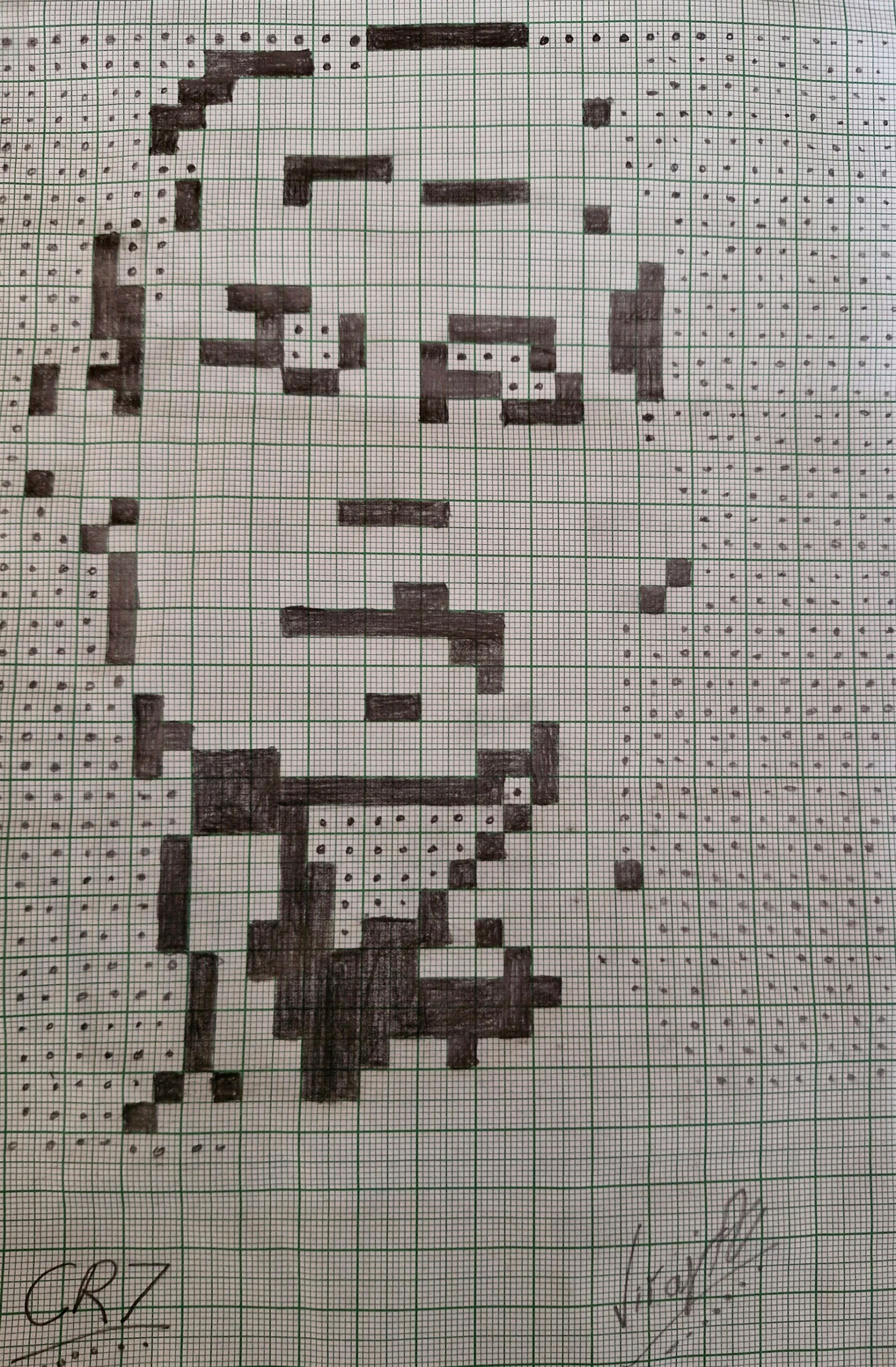
Christiano Ronaldo, the Great Soccer Player

About the Pixel Sketch of Christiano Ronaldo

Football (called soccer, in America) is one of my favorite sports; I am very passionate about it. I play soccer with my school buddies during our school break time, although I don’t play it on a professional basis.

All football players have their own unique styles and techniques of playing. Amongst them, Christiano Ronaldo, popularly known as CR7, is a legendary player from Lisbon, Portugal who started his career with FC Sporting, then MUN and many others. At present he’s with Al Nassr.

He is an iconic figure to me, especially when it comes to his bicycle kick, his headers, and his remarkable vertical leap which I think nobody has surpassed. He has come a long way from being a poverty-stricken boy to the most successful and elegant player in the football history.

I adore him mostly for his sheer faith in his physique and fitness (which is outstanding), and the respect that he gives to his fellow players. Yes, he doesn’t even promote commercials of carbonated drinks; he says they are harmful for health!

The deep affection that he has for his mother is clearly seen when he said that his mother is his refuge, and that he’ll take care of her until his last breath! I remember one occasion when he failed to convert a penalty into a goal but later succeeded in making a goal for his team in the same Euro Cup match. He apologized to his fans and his mom, and later, he silenced the crowd that was supporting his opponent team through his gesture (a finger over his mouth).

More than anything, his signature style of ‘Suiiiiiiiiiiiiii……..’ will always be remembered by all football fans like me. He is indeed a true inspiration for all youngsters. He has repeatedly excelled with his dedication, hard work and mental toughness.

So Mr. CR7, wherever you are, this is a form of respect that I would like to pay you through my very first attempt of drawing a pixel sketch of yours on a graph paper! (Do look at it from different angles to get the best glimpse).

By Viraj Ajgaonkar, Grade 7, Bombay Scottish School, Mumbai, India.

American Born Taiwanese

American Born Taiwanese

By Alyssa Huang, age 15, freshman, California

I have two identities, as reflected in my name. My first name originates from the West and contains Greek, English, and Irish roots. It means “rational thinker” and “prospering flower.” By contrast, my last name comes from the Far East. It means “yellow” in Mandarin—an imperial color that symbolizes beauty and balance. When pronounced in Mandarin, my last name flows off the tongue, like a gentle breeze blowing over green meadows in warm sunlight. However, in America, its symbolism and beauty become completely lost. The Phonetic English pronunciation of my last name, “Hawaaaang”, steam rolls over its naturally melodious tone and sounds like a rusty bell, jarring and dissonant.

Crunch. Textured rocks smash across the Earth’s pavement. Every second graders’ hands enthusiastically create “skin colored paints” from chocolate brown and cream-colored rocks. All but mine. I squint and scrutinize the creek bed, searching desperately for tan-yellow rocks that match my skin color. None exist, so I settle on a cocoa-colored rock and forcefully grind it into paint to fulfill the mandatory assignment: a self portrait made using “rock paint.” Later that afternoon, classmates bustle around the classroom taping up their masterpieces. I find myself encircled by a perfectly-matching array of smiling, white-faced portraits. After struggling to find a space on the wall, I hide my solemn-faced, dark-skinned image in the corner. That summer, I avoid the sun, duck behind shadows, and slather on thick white sunscreen to protect my delicate, thin skin. But my complexion remains yellow and tanned. Nothing changes.

For two years, I coexist with my school classmates as a foreigner. When fourth grade finally ends, I feel relieved and ready for my anticipated summer vacation— visiting my grandparents in Washington DC. “Nai Nai!” I shout as I run into Grandma’s warm, outstretched arms. As she envelopes me in her unconditional love, a calm peace washes over my small frame. I tilt my head back to admire Nai Nai’s dark brown, almond-shaped eyes. They appear kind and gentle, strong and wise. I notice my own reflection in her eyes, sigh deeply, and entwine my fingers with Nai Nai’s, creating a seamless blend of golden-brown. Later that day, Nai Nai ushers me to visit her friends. “Let me introduce you to my Garden Group,” she says. We approach an elderly circle of Taiwanese ladies who peer at me curiously and ask, “Ni shi shei?” (Who are you?)  Nai Nai responds, “Wo de sun nu.” (My granddaughter). I survey the wise elders, who share my ancestry and heritage, and feel emboldened. Having spent the year learning Mandarin as my World Language, I prepare to show off. ”Knee howe, woe jiow Huwang Leeshawn,” I enunciate slowly, trying to capture the correct tones. The women’s happy, squinting eyes grow big and round. “Ta bu jiang guo yu?” (She doesn’t speak Mandarin?), Nai Nai rescues me and responds in fluent Mandarin, “Ta shi mei guo shen de.” (She is American-born). The women nod politely, but look away to conceal their disappointment. To them, I am an American foreigner. Not Taiwanese enough.

In the fall of sixth grade, Social Emotional Learning class begins to address the previously taboo topics of race and ethnicity. At my table, two Minority students describe hateful words and years of feeling like outcasts. I empathize with their pain and begin sharing my own story, but they cut me off. “You don’t know anything about racism!” they exclaim. A statement, not a question. “You’re Asian, so you’ve never experienced discrimination in your life!” My jaw drops, but no words emerge. I feel so paralyzed that I cannot muster a response. “Asian racism doesn’t exist,” they announce, then walk away, leaving me isolated yet again. Later that afternoon, I greet a new Asian classmate before entering my advisory. She complains about her “Asian Tiger Mother’s tough expectations.” “My mom can be tough, too,” I comment, trying to empathize. The Asian classmate suddenly steps away from me. “What do you mean? You’re not….” she hesitates before pursing her lips. “I’m not what?” I ask. “Well,” she stammers, “You’re not really…. Never mind, you don’t get it.” We stand side-by-side in awkward silence. My classmate never completes her sentence aloud, but her facial expression is clairvoyant, for I have encountered this scenario before. My classmate speaks Mandarin at home, whereas I speak English. In her eyes, I am a fake Asian, or a “Twinkie”—someone who is yellow (Asian) on the outside but intrinsically white (American) on the inside. I pull my hoodie over my head and walk towards the carpool circle.

Eighth grade ends, and summer finally arrives. For the first time since COVID, I attend summer camp—a week-long Taiwanese cultural camp called Taiwanese American Next Generation (TANG). While unpacking my clothes in my dormitory room, I hear a hollow knock at the wooden entryway. The door swings open, and my assigned roommate steps into our shared space. My eyes widen because it feels like I am staring at a mirror. Like me, she dons an NBA athletic T-shirt and Nike basketball sliders ; a crooked ponytail keeps her long, black hair away from her sun-tanned face. “I’m Audrey,” she announces, then offers me a fist pump. For the next half an hour, my New Jersey-born “ABC” roommate and I speak in excited tones, sharing stories about our families as we walk towards the camp’s opening ceremony. Once at the auditorium, a speaker begins addressing all two hundred campers in Mandarin. I glance sideways at Audrey and notice her head tilt in a confused manner. Creased lines appear on both our golden-skinned foreheads. “Do you understand this?” she giggles, “Because I don’t!”

Immediately, I smile. “Me neither,” I reply.

—Alyssa Huang, age 15, freshman, California. She adds: “My name is Alyssa… I am a Taiwanese-American.

“California is typically thought of as a melting pot of cultures, but I grew up in an overwhelming homogeneous Caucasian neighborhood. When asked about my nationality, well-meaning neighbors have shockingly confused Taiwan with Thailand, or insisted that Taiwan is the same thing as China (The People’s Republic of China). (But, it’s not). 

“As a child, I felt embarrassed about my ethnicity and dark colored skin. It was a huge relief to me when middle school arrived, and new Asian students enrolled in my sixth grade classroom. However, those new students were fluent in Mandarin, and I found myself being teased for choosing to take Mandarin as my “foreign language.” 

“The first time I ever felt truly accepted was at Taiwanese American Next Generation (TANG). TANG is a week-long, multi-generational, Taiwanese cultural camp that I attend with my brother, cousins, parents, and grandparents. We engage in fun Taiwanese games, listen to Taiwanese speakers like Arthur Chu (an eleven-time Jeopardy! winner), and learn about Taiwanese culture. At TANG, we share an appreciation for Taiwanese food and also a deep value of family, relationships, and community. TANG openly welcomes non-Taiwanese (my co-campers include Indian, Haitian, European, and Korean-Americans). I love that Taiwanese culture is warm, welcoming, and inclusive.

“Nowadays, I confidently bring Taiwanese pineapple cakes to social events and gladly compare cultures with my European, Latino, Indian, and Persian friends. I recognize that building an inclusive community requires honesty, insight, and sharing. It’s important for me to listen to my peers, but also contribute my part. I’m finally able to share about myself and my background—because I’m finally proud of my Taiwanese-American heritage.”

Knowledge is Power, Hope is Healing

Knowledge is Power, Hope is Healing:
Empowering Youth to Combat Suicide

The Create Resilience Youth Art Contest for Suicide Prevention is your chance to make a difference! You can submit your creative work—an essay, poem, song, story, or something else—focused on improving youth mental health. Send your entries by August 1st, 2025. Contest winners will be announced on September 10th, which is World Suicide Prevention Day. Cash prizes for the winners! Get creative and share your voice! For more information, click here. (PS: This contest is limited to Oregon youth aged 13 to 21 only). 

By participating, you can help stop the silence, shame, and stigma around mental health. Each one of us is born unique. We are one-of-a-kind and can never be replaced. Think of everyone as a seed—when given the right care and attention, we can grow into something amazing. The gift of life is the most precious gift of all. Yet, there are those who feel so incredibly alone, hurt, without hope, and in so much pain, that they don’t want to live anymore.

Tragically, suicide is a leading cause of death, both in the U.S. and around the world. According to the Center for Disease Control and Prevention, suicide is the 11th leading cause of death in the U.S. And, in Oregon, it is the second leading cause of death for people aged 10 to 34. Having access to lethal means (like guns) greatly increases the risk of suicide. That’s why it’s important to always make sure guns are safely secured.

“Time and distance” help prevent suicide. When we are suicidal, we do not think rationally. Our thinking is all distorted. We forget the truth that there is hope and that the pain we feel will not last forever and we can and will feel better again. Reaching out for help is a sign of strength, not weakness.

Giving ourselves “time” means we do not react impulsively or make plans to end our life. Instead, we calm ourselves by doing “box breathing,” engaging in healthy distractions like listening to music, reading, making art, exercising, and more. We reach out for support by calling or texting 988 (the Suicide and Crisis Lifeline number), contacting trustworthy adults or friends, and speaking with our therapist or doctor. We can visit a nearby walk-in crisis center or go to a hospital emergency room.

We need to create “distance” from weapons, dangerous medications, substance use, and alcohol. We also need “distance” from negative and distorted thoughts. That’s why reaching out for help is important. When we are in emotional distress, we may feel like we are a “burden” to others, but that is just not true! By sharing our thoughts and feelings with people who care, we gain the clarity we need to start addressing the actual problems.

Your being alive is not the problem! You very much deserve to be alive—and—to stay alive.

We can all help prevent suicide, and knowing the warning signs that put us at risk is essential. Some of the warning signs to look out for include mood changes such as sadness, depression, irritability, anger, social isolation, change in sleep and/or appetite, loss of interest in activities, lack of pleasure, and thoughts of dying.

Asking someone if they are having thoughts about ending their life or not wanting to wake up again is not going to increase their risk of suicide. In fact, asking directly can be the first step to saving their life. It’s also important to share our concerns with a trusted adult, who can help determine the best course of action.

Resources including the 988 Lifeline, American Foundation for Suicide Prevention, and National Alliance on Mental Illness provide valuable support and help. Please take the time to check them out! Your life and the life of your loved ones will thank you.

By Diane Kaufman, MD. Diane is a poet, artist, humanism-in-medicine awardee, retired child psychiatrist, and founder/director of the Hold On Campaign for Suicide Prevention that uses the power of art to educate, connect, express, and heal. She can be reached at diane@holdoncampaign.org.