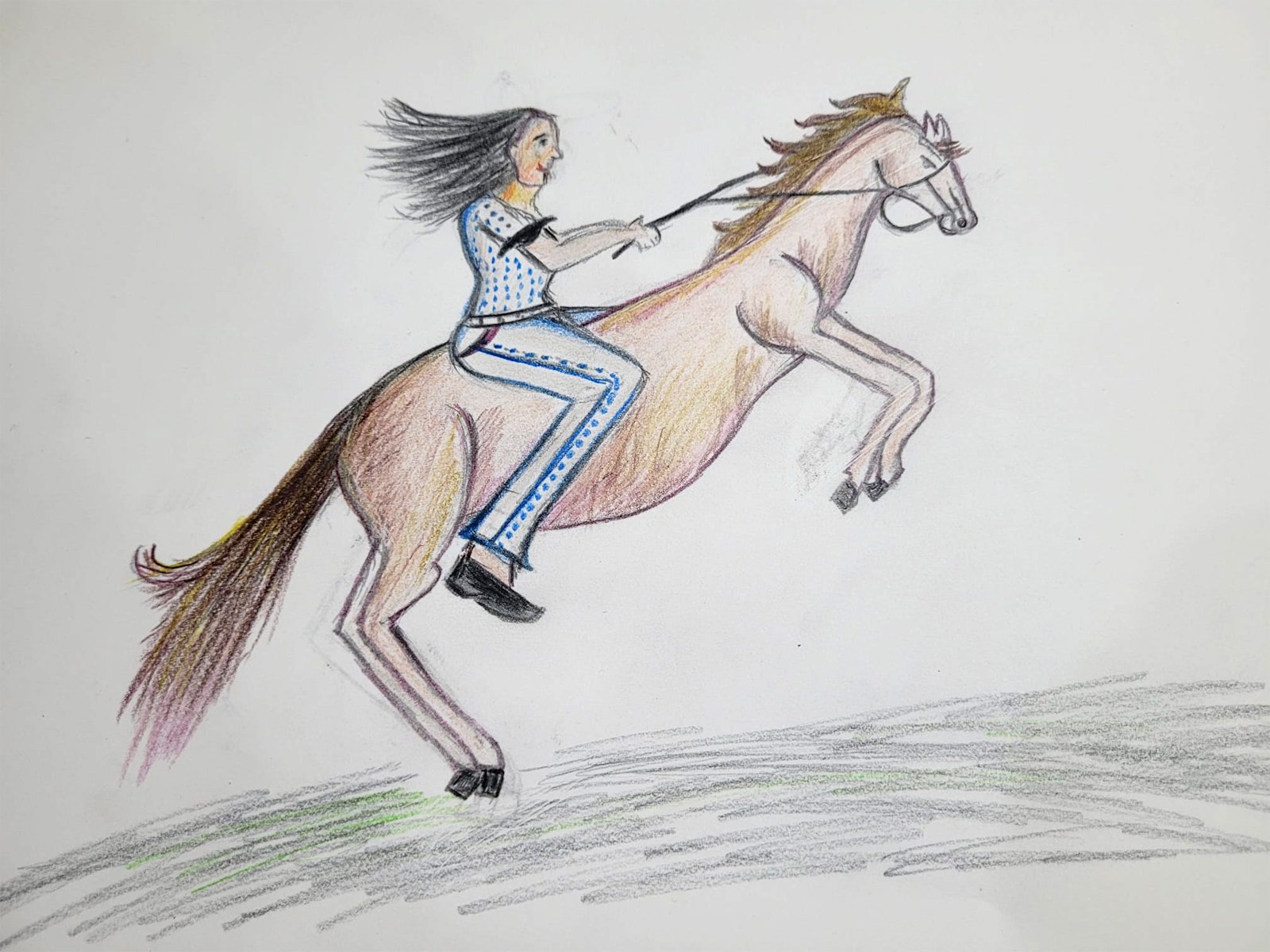
“Girl Riding A Horse” by Aadya Agarwal, age 12, New Jersey.
As the wind weaved through my black hair, Flying in the golden sunshine, A sudden gush of independence rushed at me.
On top of my slender caramel horse, I measured north to south, east to west, All painted with a rural landscape.
I was on top, on top of my mighty world, I could have done anything! Yet, riding along with my jovial spirits, I felt something. A ball of fear knotting up in my stomach.
Freedom and Independence were new, they were fresh. Alas, they did not come free! In front of me, loomed a bridge, A bridge between Protection and Freedom
While protection offers security, It’s also a locked cage. While freedom demands responsibility, You are the person you choose to be.
And then there is a balance between the two. As on my slender caramel horse, I ride free, the gentle strap safely protecting me.
—Aadya Agarwal, age 12, New Jersey. She writes: “The inspiration for my poem came from a horseback riding adventure I went on while vacationing in India this past summer. The entire experience filled me with a range of emotions of independence, confidence, fear and anxiety and my attempt to balance it all in that moment. It was truly an experience that I will never forget and something that unraveled an important question about freedom and responsibility for me.”
Tell me, friend, do you think it will withstand a world so vast?
You wrecked sandcastles just to build signs seeking justice.
Children sleep out in the cold.
Oh heavens watching above, is this justice?
The blanket the child holds onto is an oasis.
Its warmth mimics that of a home so far away.
The desert was his home; a long-forgotten friend.
Every wind feeds him the false promise of freedom.
What do they know?
What do they know of the sun’s kiran* when mother would feed us šāy.*
USA!
Is that how they play?
The warplanes outnumber the birds.
Children close your eyes, they are fighting for pay.
You can not hide in this world.
You are solely bare, exposed, naked even!
What man was born with cloth? Point me to him and then I will abandon my home.
And though you can drink your coffee
So black, filling up the glass
That same coffee will stare you back.
Black is the oil you pull from a land so boundless.
Who is brave enough to claim the desert as his own?
You can not rule. You fool!
Many tried and failed to seize this land.
For centuries it stands, unbroken by your nuclear adornments.
For the Desert is a lion, no simple house cat.
He who dares to challenge shall be left broken in the end.
The pools of oil have all dried up;
Your thirst can never be quenched.
* Kiran: ray; šāy: thick creamy top layer on boiled milk
By Suprya Sarkar, age 16, originally from Bangladesh, now lives in Connecticut. She adds:
“What we call casual poetry—verses written on kitchen napkins, often forgotten—reminds us that poems are a natural part of human expression… or at least, they should be. My hope is to capture the antagonistic nature of humanity in the 21st century. How does one capture such corruption on paper? The ethics of industries and modern work culture are major topics of debate. What good is individualism if it leads to the downfall of one’s well-being? Each poem is a cry from humanity. The pieces explore the lives of various people and their environments. Both a billionaire oil company CEO and a burned-out office worker have a connection to their environments. My hope is to preserve the fleeting present. Each poem follows how industrial, political, and economic changes have influenced humanity as a whole. The poems are meant to bring attention to the peculiarities… or struggles of various people.”
Iwish to consume every piece of media that adorns the Earth Every book, film, and song Every day I panic, thinking about how little time I have How little in my minuscule life I can truly consume I wish to cry every tear and smile every smile I wish to feel the most harrowing heartbreak and the most jovial joy I wish to travel the world I wish to play every game I wish to meet every person In all my wishing, I never seem to take action In all the endless possibilities, I take after none of them In the end, all I do is wait I wait for the right moment Just the right book Just the right film Just the right person When all I wish for is everything, I achieve nothing.
Can You Live?
The summers of New YorkYou feel the fresh tarBoilingMeltingYour feet are scorched
You lived, I livedThe harsh cold winterWhat's red and white all over?Your face stinging from the stabs of ice and snowSlush at your feetCold and wetThe consequences of the cold
You lived, I livedI survived a diseaseManifesting into our livesBecoming the new normalIt starts to become hard to breathPieces of cloth cover our mouthsPainting over our personalities
I livedMany didn’tI lived through walks in MexicoWalks at 2am in the BronxTrack meets“Extra time”Slide tacklesShots (soccer balls) to my stomachBloody nosesBroken arms
People have lived through warShots to the chestDeathPeople can live with no eyesight,no hearing, they love to liveThey survive fightsThey can move onThey can liveI can liveYou can live too
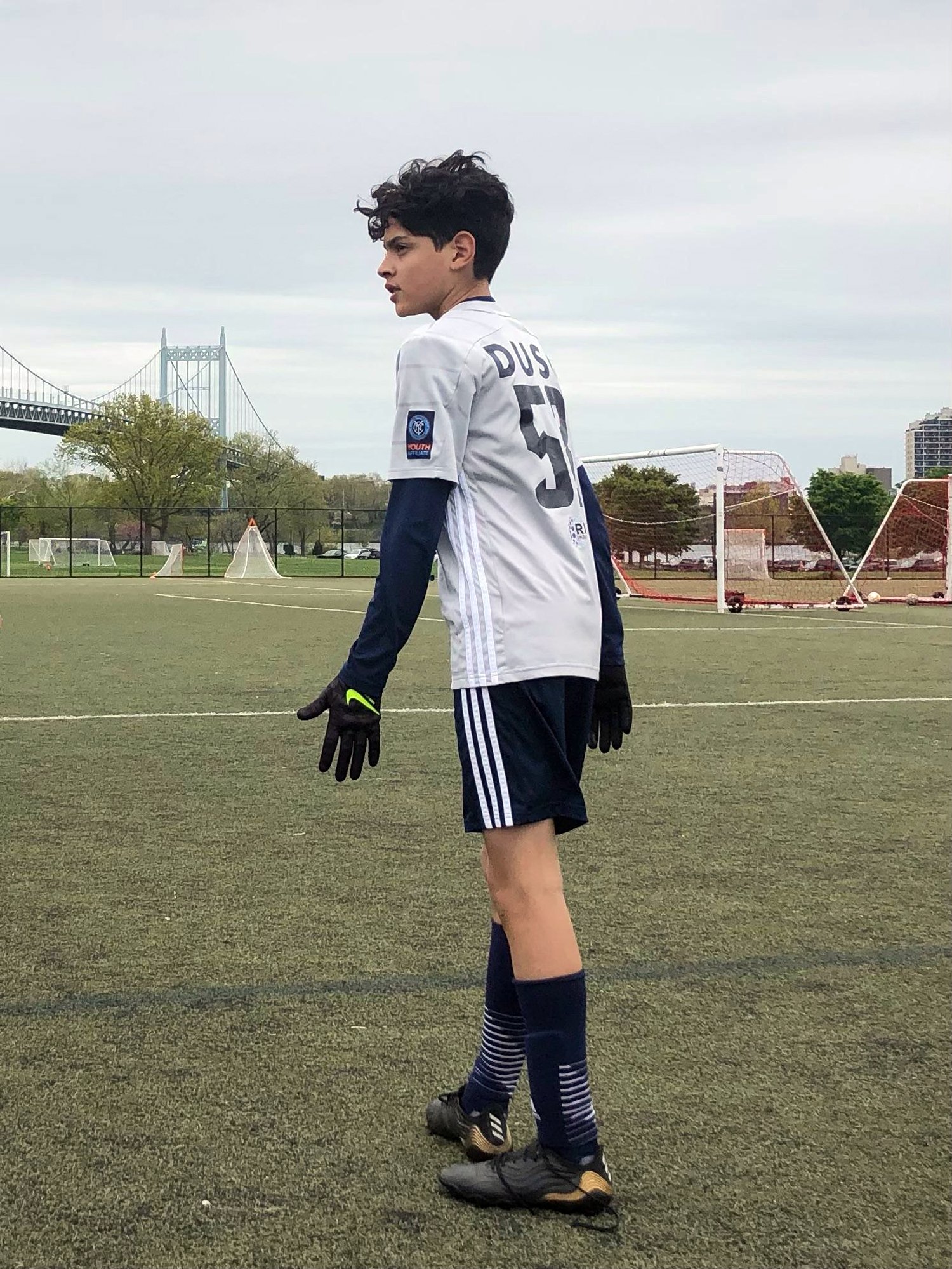
By Emiliano Dietrich-Jimenez, age 13, New York. He writes: “I speak English and Spanish, and have lived here since I was a toddler. I play soccer and guitar. I found out in my English class last year that I really like poetry.”
The 2022 Young Poet Awards was organized by Camille S. Campbell in partnership with us. A teen author herself, Camille knows the importance of encouraging young writers through showcasing their work. The contest encouraged youth to write poems and empowered them to express themselves through the visual arts. After seeing the impact of her book, Her Poems: Women Poets Who Changed the World, Camille felt inspired to give back to her local community and throughout the country by hosting the Young Poet Awards contest.
We’re very grateful to all students (and also their teachers and parents) who entered their creative works. Our heartfelt congratulations to the winners of the contest this year: Carina Araujo (4th grade winner) and Nova Macknik-Conde (5th grade winner). The two Young Poets will receive a cash prize, Skipping Stones Magazine subscription and recent issues, signed copies of Camille’s book, and four books donated by Skipping Stones Magazine.
4th Grade Winner:Carina Araujo, Maryland.
My Love for my Mom
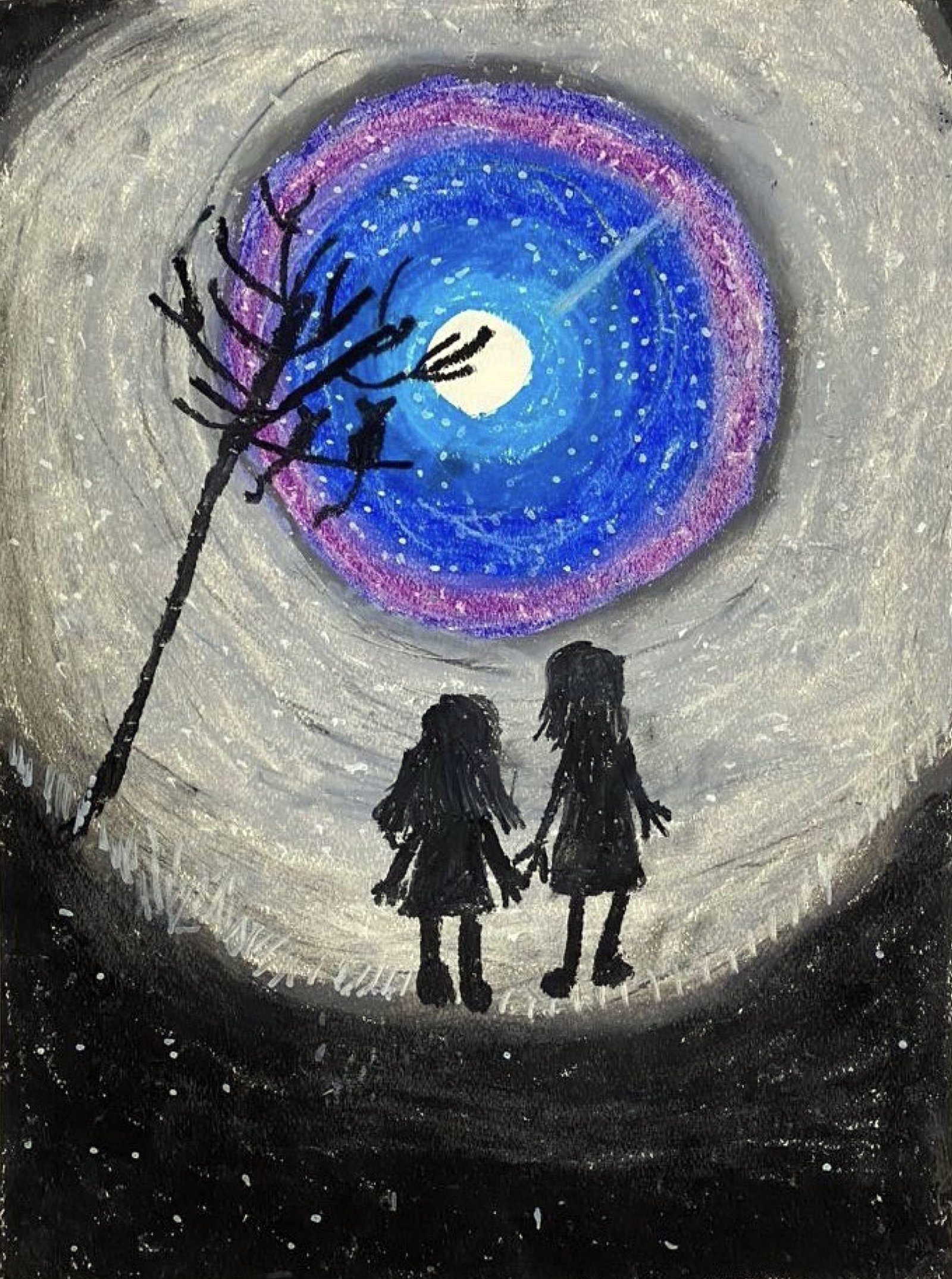
Art and poem by Carina Araujo, grade 4, Maryland.
My love for you is bigger than the sky
You and me in this beautiful warm night
Staring at the moonlight
Together, you and me
Looking at the big blue bright sky
There are infinite stars above us
Shining in the sky
Holding hands together we stand
Peace all around
In our land
Carina Araujo, grade 4, Maryland (above).
5th Grade Winner:Nova Macknik-Conde, New York.
Winter In My Bed
Glittering white powder covers my home like a frosted cake
The silent fall of snow lulls me to sleep
Icicles lining the roof
The chance of snowmen when I wake up
Cold harsh weather surrounds my home
But it cannot penetrate the warm soft blankets that cover me
Like a hatchling in her nest
Winter in my bed
A full moon glows lighting up my face
My family sleeping warm
Through the frosty night
Me, listening to the sounds of night and family
Slowly drifting to sleep
In my snuggly, lovely, cuddly bed
By Nova Macknik-Conde, grade 5, New York.
Writer’s Block
My pen lingers over the page,
Cobalt ink waiting in the depths,
I imagine, and I ponder, and I muse.
But still the thief steals my well of words,
Cheats me of my cascading thoughts,
And takes my waterfalls of compositions.
The vague scent of ink on a fresh sheet of paper,
The articulation of inspiration,
The quiet bliss of the flowing verse.
The thief deprives me of the joy of invention,
The dexterity of novels, poems, and short stories,
Nature grows over time, so do I.
I am this and this is nature.
I like to be in the sun.
Nature is this and this is I.
I, I, I, I am nature.
By Arya Khan, age 8, Asian American, Illinois. Arya adds: “…nature and we are alike. Living in the city, nature is hard to find. I wish I could find nature like in my backyard or in a fairy tale. So I hope this (my poem) will help people plant trees and help the Earth a little bit more. I am also doing a project called Save the planet…”
the little money I owned was put into something I loved the most,
being a musician like the ones on billboards
but I was different
I performed at restaurants that gave me breakfast, lunch, and dinner
I cherished the small things
the flowers were thrown onto the small stage where I had poured my feelings into a loving song
the walls had my name painted, to come and watch me do the thing I love most
I have sung and played all the instruments to each song
As the customers eat their food while listening to the songs I handcraft
the luminosity in their eyes push me to continue my job
It doesn’t matter if my apartment is falling apart
whether my clothes have tears and stains in them
I will continue to showcase my one true talent
This is what I am, el músico.
By Denisse Gonzalez-Amador, Texas. Denisse adds: “I am a 14-year-old student at Meyerland Performing and Visual Arts. I’m a part of the creative writing magnet program. My cultural background is Hispanic culture, where we celebrate Quincenera (a celebration associated with turning 15 year old), Dia de los Muertos (a festival that celebrates our ancestors and loved ones that we have lost), and the Three Kings Day (The three wise men who came to see baby Jesus). I speak English and a small portion of Spanish. What is important to me is my life and family. My dreams and visions for the future are: becoming a businesswoman, a popular artist, and a poet. What inspired me to create my submission is the thought of my work being read and being published. I want people to see the work I create.”
Threats, not peace Threats of creating what we fear most—a Third World tragedy Threats of cutting the strings that connect us all together Threats of destroying people’s land People’s territory
Forget about peace Why doesn’t peace ever show up? Why is humanity always one step from falling off the steepest cliff? Why do we sabotage ourselves and ruin others? Why does publicity break us down?
Fake news Exaggerated news REAL news This news is very real This news disrupts all peace that ever could be
So, what are we supposed to do? Fight? That’s not peace Do we cut them off from the world? And risk getting cut off too? Definitely, not peace
Why should we even save them? What have they done for us? If we throw the lifesaver to them in the deep water We could drown instead, sink straight to the bottom
But humans should save each other Give them air Bring them to the surface Save them from their greatest fears
It’s our job as human beings To let our humanity show And to try to have peace on Earth Because peace unites us all as one
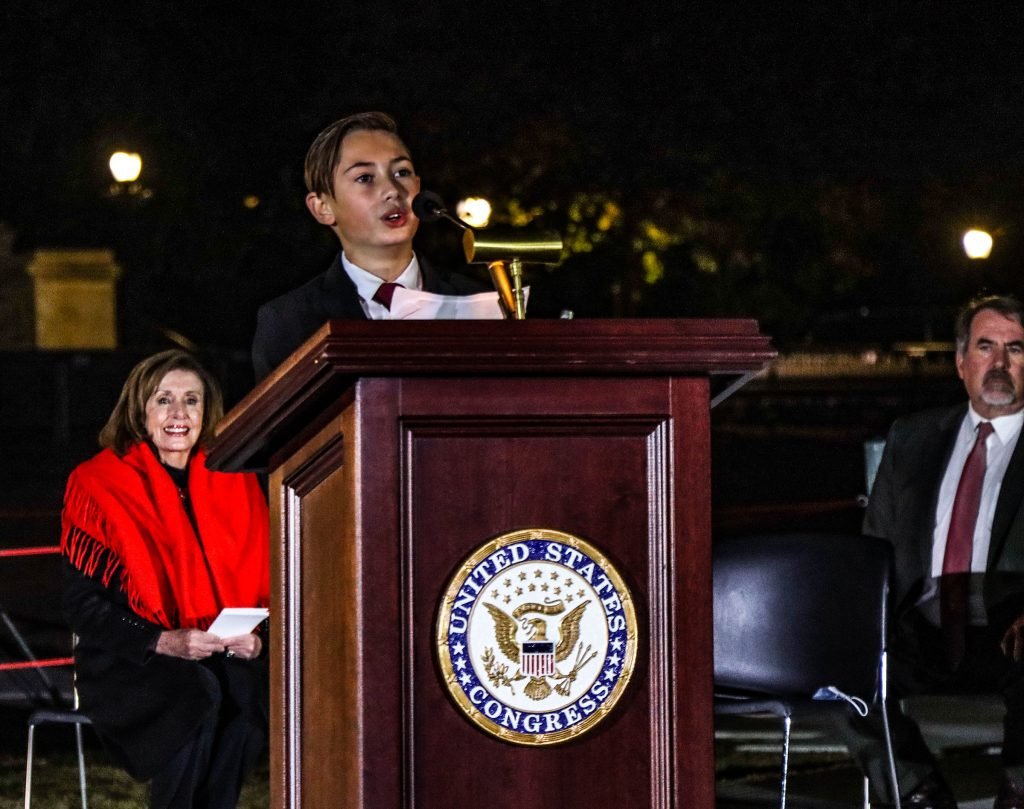
Michael Mavris, grade 5, Reading his Poem at the 2021 Capitol Christmas Tree Lighting Ceremony. Photo credit: James Edward Mills.
This year Michael Mavris, a fifth grader from Del Norte, California who won a poetry contest about the U.S. Capitol Christmas Tree, got the honors of flipping the switch that officially illuminated the tree. For over 50 years the USDA Forest Service’s Christmas gift to the nation, the U.S. Capitol Christmas Tree, has inspired the imagination of millions. Standing elegantly at the base of Capitol Hill on the West Lawn the massive tree fondly referred to as the People’s Tree is harvested from a different forest every year. This year the Six Rivers National Forest in California had the honors of delivering the 84-foot tall fir tree they named “Sugar Bear.”
The evening ceremony also included comments from the Speaker of the House of Representatives, Nancy Pelosi, and other members of the California delegation in Congress along with the new Chief of the Forest Service, Randy Moore.
We are proud to share Michael’s poem below.
Six Rivers, Many Peoples, One Tree
By Michael Mavris, grade 5, California.
What does the theme “Six Rivers, Many Peoples, One Tree” mean to me?
As I ponder the question presented here, I consider where I am living-literally in the heart of the Six Rivers National Forest.
Here, tucked deep within the Northwestern corner of California is a remote land, whose majesty comes not from achievements of humankind, but rather nature itself.
Six mighty rivers criss-cross this rugged land. From the Smith and Klamath rivers in the north, stretching over to the Eel and the Mad, meeting the Van Duzen and the Trinity in the South, all of our rivers, amongst the cleanest in the world, represent life itself.
Like the First Peoples who have lived here since time immemorial, these rivers overcome every obstacle to ultimately reach their goal of becoming one with the Pacific Ocean.
Is this done by an exhibition of power or a show of strength?
No.
It is accomplished by sheer persistence. The indominable spirit of never giving up which is representative of this land and the Peoples that live here.
From the great tribes: the Yurok, Tolowa, Karuk, Wiyot, Chimariko, Nongatl, Hupa, and Wailaki, we are taught to commune and truly be one with nature. This ethos teaches us to view rugged lands, secluded forests, and fierce weather patterns, as something genuinely beautiful.
Such is the story of the White Fir, also known as Abies Concalor, whose beginnings trace back to a single seed. From this humble seed,dropped onto Mother Earth in a remote region the process begins.Nurtured by the fertile soil, which the Six Rivers saturates throughout the year and, against all apparent odds, not only confronts the weather but embraces it. The young tree emerges proudly upward towards the shining sun.
From this great forest, we bring you the majestic White Fir, to be the Capitol Christmas tree. As the lights are strung and the ornaments placed, we, the People who live in the tree’s symbolic shadow, hope that its beauty and grandeur provide a beacon to America and a reminder on this Christmas, that all things are possible.
Michael Mavris, 5th gradestudent, Del Norte County Unified School District, California.