
Category Archives: Poetry
Read the 2023 Awards Issue of Skipping Stones
Fear of Failure
Fear of Failure
By Olivia Macy Leonard, age 15, New York.
It’s just a line
All you have to do is draw a line
A straight, plain, normal line
Nothing more
Just take your pen, pencil, marker
Doesn’t matter what you use
Doesn’t matter if it’s not perfect
Doesn’t matter what color
Doesn’t matter if it’s short or long
But you hesitate for a second
And then a minute
Then 5 minutes
Now 10 minutes
And that turns into 30 minutes
Soon it’s been an hour
5 hours pass
You realize it’s been a day
Finally, it’s a week later
And you still haven’t drawn that one line
The simple line
Why?
All because you were scared
All because you didn’t want to mess up
All because you wanted it to be perfect
All because you didn’t want to fail.
—Olivia Macy Leonard, age 15, New York.
Let it Have Meaning
Let it Have Meaning
Let it have meaning
When the thunder comes
Earth beating to the echoing drum of its beat
it will have meaning
the skies will alight
the rain will breathe life into the earth
and it will have meaning
When the fires light
Forests ravaged by the enraged flames
it will have meaning
the death will clear way for new growth
the ash will nourish the ground
and it will have meaning
When the darkness rears its head
Mind flooding with thoughts of escape
i can find no meaning
tears staining satin pillowcase
dread escaping, breathed in by those around me
there is no meaning
let sufferings occur
allow my soul and spirit to perish
my body crucified,
all i ask
let it have meaning
 —Bansi Balar, age, 17, Texas. She adds: “While studying the poem ‘Dulce et Decorum Est,’ my history teacher said something that has stuck with me ever since. With what was likely little recognition of the profound impact his next few words would have, he noted that while prose may be the language of conveying meaning, poetry is the language of emotion. Typical speech is vital as the means through which humans communicate matters of rational significance; however, poetry is arguably even more vital as the means through which humans communicate grief, joy, rage, and all of the other things that cannot be truly understood through prose. My writing journey began with a creative writing class I took in my sophomore year, and was recently enriched by the Yale Young Writers Program I attended this summer. All in all, poetry is an outlet for me, and I have dedicated myself to it by writing in nearly any free time I get.”
Stone Soup
Stone Soup
By Laurel Aronian, 16, New York
Elizabeth gave us our assignment:
“Today in class you will be making stone soup.” She held up the book for all to see.
“You want us to cook?” a bold boy asked.
“Of course,” said Elizabeth, and handed us the aprons.
We went into the kitchen in the parallel classroom,
And listened to the clink of knives and the bustle of our classmates.
Each of the grades would provide a vegetable,
And as fourth graders, we were assigned the onions.
My friend and I wondered what genius had given us this task.
The teachers only provided us with long, silver knives, intentionally dulled down.
We set to work at our stations, passing the onions and shielding our eyes.
Over time, we came up with useful solutions to protect us from the sting and fiery smell.
Some kids passed around their glasses.
Others grabbed goggles from the science cabinet.
Some even asked the teachers for a slice of bread to hold in their mouths.
We were some wimpy fourth graders.
Yet things improved when we found solutions that worked.
The goggles fared well against the fumes,
And we learned to take turns passing around the glasses.
Soon enough, we had seven big bowls filled with the slices.
We walked outside as a pack and sat on shedding tarps.
We huddled closer around the fire, shielded from air like needles,
We felt our size as we sat with the lower grades, leaders of the school.
And we watched Elizabeth take the lead and open the book once more.
The rumble turned to patter as she began to read,
As the students slowly deposited their chopped vegetables
The smell of the soup filled the air,
The bubbling pot and voices a chorus on the wind.
When it was our turn, we stood up with our bowls of onions.
Full of pride, dropping them in the sizzling soup.
We realized what Elizabeth was trying to teach us,
Standing there with our dulled knives and aprons.
If we were given the solutions to our problems,
We would never learn.
We would never create.
For the next time we made soup without assistance.
The sound of the realization was the clink of spoons,
The passing of mugs, the shatter as one fell,
The clatter of a dustpan as we swiped up the shards,
The happy chatter as well enjoyed good food.
The smell of the vegetables mingling together,
The burning wood within the fire,
The earthiness of the dirt on which we sat,
The wool of our mittens in the chilly air.
Tasting the soup was the ultimate prize,
If we hadn’t been the chefs, we wouldn’t have realized,
The distinct change the onions made to the overall aroma,
And never would’ve known to add them.
Elizabeth taught us more than numbers that day,
She taught us the impact every action makes,
Not only would we be able to make stone soup once again,
But we’d learned creativity in solving the problems at hand.
By Laurel Aronian, 16, Connecticut.
“I love to write in all genres (poetry, prose, journalism). I also enjoy taking photos and creating art. I have a passion for music and perform as a singer-songwriter and accompany on guitar. When I’m not writing or making music, I play competitive chess.
My poetry submissions highlight multicultural awareness as I am of multicultural heritage and recently celebrated Ramadan, Passover, and Easter. My pieces also reflect the awe of nature, earth stewardship, and our planet’s majesty and magic.”
A City of Thieves
A City of Thieves
“What we call casual poetry—verses written on kitchen napkins, often forgotten—reminds us that poems are a natural part of human expression… or at least, they should be. My hope is to capture the antagonistic nature of humanity in the 21st century. How does one capture such corruption on paper? The ethics of industries and modern work culture are major topics of debate. What good is individualism if it leads to the downfall of one’s well-being? Each poem is a cry from humanity. The pieces explore the lives of various people and their environments. Both a billionaire oil company CEO and a burned-out office worker have a connection to their environments. My hope is to preserve the fleeting present. Each poem follows how industrial, political, and economic changes have influenced humanity as a whole. The poems are meant to bring attention to the peculiarities… or struggles of various people.”
—Suprya Sarkar, 16, Connecticut.
It is May and I’m still jobless.
I thought this city was meant to give birth to dreams.
What dreams, they can only devise schemes.
I would rent out a place
But penny tosses and angry bosses consume my day.
I wonder if they truly hold up to their promises of Agony… obliteration.
The pencil taps
Or the ticking of my twelve-dollar watch
Has room for little patience in their world.
I fantasize about what to say.
Like a parakeet reciting words to catch bait,
I revise my questions.
For how many times,
Who is to say?
They close the door on the poor man in white.
Goddammit,
A university degree
And I’m just as broke as that streety?
My friends from home don’t bother to pick up the Phone.
Ring, Ring, oh shoot,
My phone bill is laying on the floor.
Why bother trying to restore the old?
A long-neglected Porsche,
Yeah, I think that’s who I am.
What is all this brooding for?
I am writing home
As if even my own mother remembers my name.
Don’t worry they say,
“You’ll get your own place someday!”
—Suprya Sarkar, age 16, originally from Bangladesh, now lives in Connecticut.
Mr. Liberation Theology
Mr. Liberation Theology
The house of sand you built at last.
Tell me, friend, do you think it will withstand a world so vast?
You wrecked sandcastles just to build signs seeking justice.
Children sleep out in the cold.
Oh heavens watching above, is this justice?
The blanket the child holds onto is an oasis.
Its warmth mimics that of a home so far away.
The desert was his home; a long-forgotten friend.
Every wind feeds him the false promise of freedom.
What do they know?
What do they know of the sun’s kiran* when mother would feed us šāy.*
USA!
Is that how they play?
The warplanes outnumber the birds.
Children close your eyes, they are fighting for pay.
You can not hide in this world.
You are solely bare, exposed, naked even!
What man was born with cloth? Point me to him and then I will abandon my home.
And though you can drink your coffee
So black, filling up the glass
That same coffee will stare you back.
Black is the oil you pull from a land so boundless.
Who is brave enough to claim the desert as his own?
You can not rule. You fool!
Many tried and failed to seize this land.
For centuries it stands, unbroken by your nuclear adornments.
For the Desert is a lion, no simple house cat.
He who dares to challenge shall be left broken in the end.
The pools of oil have all dried up;
Your thirst can never be quenched.
* Kiran: ray; šāy: thick creamy top layer on boiled milk
By Suprya Sarkar, age 16, originally from Bangladesh, now lives in Connecticut. She adds:
“What we call casual poetry—verses written on kitchen napkins, often forgotten—reminds us that poems are a natural part of human expression… or at least, they should be. My hope is to capture the antagonistic nature of humanity in the 21st century. How does one capture such corruption on paper? The ethics of industries and modern work culture are major topics of debate. What good is individualism if it leads to the downfall of one’s well-being? Each poem is a cry from humanity. The pieces explore the lives of various people and their environments. Both a billionaire oil company CEO and a burned-out office worker have a connection to their environments. My hope is to preserve the fleeting present. Each poem follows how industrial, political, and economic changes have influenced humanity as a whole. The poems are meant to bring attention to the peculiarities… or struggles of various people.”
Stand OUT
Stand OUT
Smart
Smarter
Smartest
That’s all they care about in this test
Your Creativity doesn’t matter
Your Hardwork doesn’t matter
the Blood sweat and tears you put in doesn’t matter
It’s all about the score in the end
This toxic cycle of making us believe
Believe this is what we have to do to fit in
Fit in with society
Fit in with the crowd
Fit into the jigsaw puzzle
When you’re your very own work of art
For how long does this go on
For how long does this cycle go on
This cycle of blending us all together as one
Until we’re broken and bleeding pieces
Working together in blurred masses
Towards a goal that was never ours
Stop
Make it all stop
Stop making us believe we’re jigsaw pieces
Stop making us believe that we’ve got no choice
No voice
That we cannot be a counterpoise
That we’re nothing more than a mere small voice
Stop making us believe we aren’t our own masterpieces
Stop making us believe that we’ve got to fit in
When we were born to stand out
Likhita Makam is a 15-year-old Indo-American high school student living in India. She has been published in youth newspapers and literary magazines. She’s an avid reader and is up for a poetry discussion at all times. She hopes to inspire people of all ages with her words.
Consumption
Consumption
By Lucy Jones, age 15, Wales, U.K.
I wish to consume every piece of media that adorns the Earth
Every book, film, and song
Every day I panic, thinking about how little time I have
How little in my minuscule life I can truly consume
I wish to cry every tear and smile every smile
I wish to feel the most harrowing heartbreak and the most jovial joy
I wish to travel the world
I wish to play every game
I wish to meet every person
In all my wishing, I never seem to take action
In all the endless possibilities, I take after none of them
In the end, all I do is wait
I wait for the right moment
Just the right book
Just the right film
Just the right person
When all I wish for is everything, I achieve nothing.
—Lucy Jones, Age 15, Wales, United Kingdom.
Beneath A Tree
Happy Earth Day to all our subscribers and readers of Skipping Stones Magazine. To Celebrate Earth Day, we share with you a short poem by our contributor Maggie d., an African American poet in Washington. Enjoy it!
Beneath A Tree
Someone planted a tree
For me
To get out of
The sun
And enjoy the fun
Of reading a book
Under a roof of pine
Scented branches
Leaving behind my
Stuffy room
And watch
Zooming birds build
Their nest
Without rest
A hardy thank-you goes out
To the person
Who planted a tree
For birds and people like me
By maggie d., African American poet, Washington. She adds:
“The poem erupted from a shade tree being cut down where I live.”
Can You Live?
Can You Live?

The summers of New York
You feel the fresh tar
Boiling
Melting
Your feet are scorched

You lived, I lived
The harsh cold winter
What's red and white all over?
Your face stinging from the stabs of ice and snow
Slush at your feet
Cold and wet
The consequences of the cold

You lived, I lived
I survived a disease
Manifesting into our lives
Becoming the new normal
It starts to become hard to breath
Pieces of cloth cover our mouths
Painting over our personalities

I lived
Many didn’t
I lived through walks in Mexico
Walks at 2am in the Bronx
Track meets
“Extra time”
Slide tackles
Shots (soccer balls) to my stomach
Bloody noses
Broken arms

People have lived through war
Shots to the chest
Death
People can live with no eyesight,
no hearing, they love to live
They survive fights
They can move on
They can live
I can live
You can live too
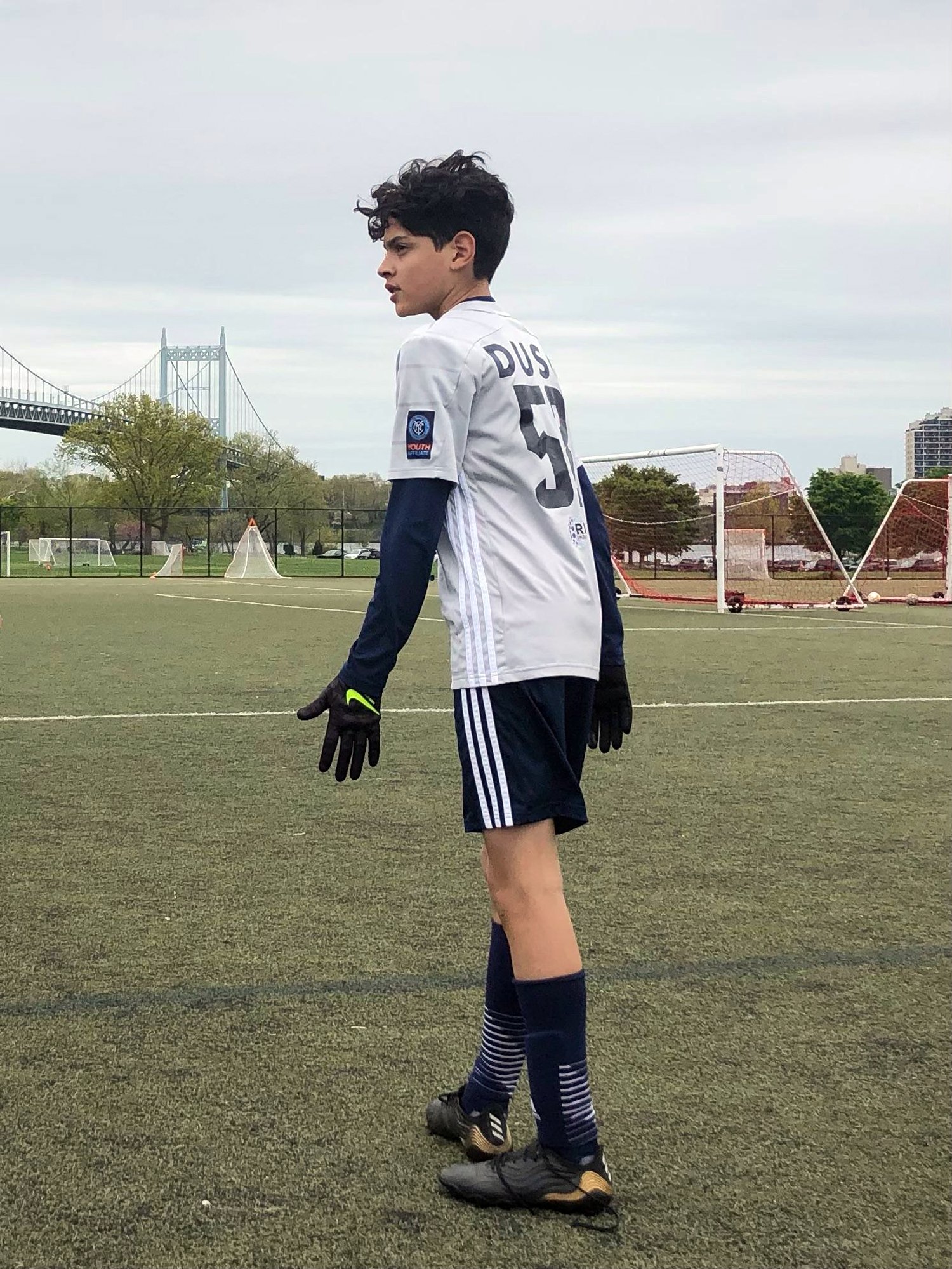
By Emiliano Dietrich-Jimenez, age 13, New York. He writes: “I speak English and Spanish, and have lived here since I was a toddler. I play soccer and guitar. I found out in my English class last year that I really like poetry.”