
Category Archives: Poetry

Unfinished Exit

Unfinished Exit

I keep thinking
about the time in high school
when you drew
me
a map of the city,
I still have it somewhere.
It was so easy
to get lost
in a place where all the trees
look the same.
And now
every time I see
a missing person’s poster
stapled to a pole,
all I can think is
that could have been me.
Missing,
disappeared.

But there are no
posters for people
who just never came back
from vacation, from college,
from life.
You haven’t killed yourself
because you’d have to commit to a
single exit.
What you wouldn’t give to be your cousin Catherine,
who you watched
twice in one weekend get strangled nude
in a bathtub onstage
by the actor who once
filled your mouth with quarters at
your mother’s funeral.
The curtains closed and opened again.
We applauded until
our hands were sore.

But you couldn’t shake the image of
her lifeless body,
the way she hung there like a
marionette with cut strings.
And now every time you try to write a poem,
it feels like a
eulogy.
A desperate attempt to
capture something that’s already
gone.
But maybe that’s why we keep writing,
keep searching for
the right words,
because in this world where everything is
temporary,
poetry is our only chance at
immortality.

So even though you haven’t
found the perfect ending yet,
you keep writing.
For Catherine, for yourself, for all the lost
souls
who never got their own
missing person’s poster.
Because as long as there are words on a page,
there is still hope for an unfinished exit
to find its proper
ending.

About the Poet:
Claudia Wysocky is a Polish poet based in New York, celebrated for her evocative creations that capture life’s essence through emotional depth and rich imagery. With over five years of experience in fiction writing, her poetry has appeared in various local newspapers and literary magazines. Wysocky believes in the transformative power of art and views writing as a vital force that inspires her daily. Her works blend personal reflections with universal themes, making them relatable to a broad audience. Actively engaging with her community on social media, she fosters a shared passion for poetry and creative expression.
 

a castle of words

a castle of words

By Kevin Zhang, age 16, Shenzhen, People’s Republic of China.

I shall gather your
words into a castle
of shards

and walk (barefoot
into it
like a king

into his final
breath) and
I shall blow life

into them and
watch as they
flutter between

me and you
like dancing
elephants

By Kevin Zhang, age 16, Shenzhen, People’s Republic of China. Kevin is a junior at BASIS International School PLH. He is an Honorary Junior Fellow of the John Locke Institute and serves on the PLATO Student Advisory Council. Kevin enjoys boating, collecting rocks, and learning about other cultures.

The Song of Saccidānanda

The Song of Saccidānanda

By Kevin Zhang, age 16, Shenzhen, People’s Republic of China.

I sing the song of forever.

I sing the gentle winds
as they brush against the cliffs
of endless time.

I sing the tireless birds
as they crowd the windswept plains
of limitless space.

I sing the hushed darkness
as it dreams the Rudra Tandava*
of boundless life.

I sing myself,
I sing the song of Saccidānanda.**

Notes: * Rudra Tandav: A divine dance of Lord Shiva, the Hindu god of destruction and transformation, with vigorous, brisk movements.

** Saccidānanda: In Hindu philosophy, the direct experience and bliss of absolute, unchanging reality.

By Kevin Zhang, age 16, Shenzhen, People’s Republic of China. Kevin is a junior at BASIS International School PLH. He is an Honorary Junior Fellow of the John Locke Institute and serves on the PLATO Student Advisory Council. Kevin enjoys boating, collecting rocks, and learning about other cultures.

“half, whole”

“half, whole”

By Alyson Henderson, age 16, Connecticut.
 
 
i have always been

two halves stitched together
half this, half that,
never wholly me
always half in, half out
not belonging to either
instead, i am two parts,
conflicting, like puzzle pieces
that don’t match,
forced together anyways
not one whole,
just bad stitching
the parts that don’t fit
hide under the paint,
cracked and chipped
not hiding much at all

they like to ask
if i am this half or that half,
but i say and, not or
and maybe they won’t understand
but i am always this half
and that half,
these halves are just me,
whole

By Alyson Henderson, age 16, high school junior, Connecticut. She adds: “I have been reading and writing for as long as I can remember, and it’s through reading and writing that I learned about other people’s cultures and identities as well as my own. My dad is white and American, and my mom is Korean and immigrated when she was young. For a long time, I’ve been exploring my own identity through writing, particularly my identity as a biracial person. I often feel like I have to choose between being Asian and being white, and I can’t identify as both. However, by ignoring either part of my identity, I am ignoring so much of my life. The way I see it, choosing one half of my identity is being dishonest with myself about who I am. My poem, “half, whole” explores the struggle of never feeling fully accepted as either “half” of myself, and how I have accepted that I don’t have to be put in one box and discard parts of myself for others’ comfort.”

Still A Student?

Still A Student?

By Emra Woldearegay, originally from Ethiopia, now teaching in Missouri.

Here I am, still a student.
Oh, why, after so many decades?
Aren’t you tired? They ask
What’s the point, they ask.
You better start earning tons
because time’s running out.
But for whom? I ask.
How could time run out when
I’ve so much to learn
about things & skills that make me more adept.
Why should that matter
When what I love is asking questions,
I am curious, like the cat.
They jump on me, snarling like an angry cat
And declare-gleefully: “Curiosity killed the cat.”
I would rather be like the cat killed for curiosity
after living nine lives, learning, and relearning eight times.
NINE lives!
What a way to go; it is the best way.

By Emra Woldearegay, originally from Ethiopia, did her graduate studies at the University of Oregon. She is now teaching journalism in Missouri.

Home

Home

By Lina Murat Mariani, age 11, New York. 

As I stand here, looking at this blank sheet of paper
Trying to describe how it felt when I looked back on the plane that day
All I remember is forgetting—
Forgetting home.
That plane was Odysseus’ ship
Sailing to a strange land,
Leaving but fading memories
A puppet in time’s grip.
Looking back and seeing all my life
Ashes for someone else’s dream to be born from
My home was but naked walls,
Perfect for someone’s paintings and trophies
All my life was a few boxes
And everyone says I should look forward to my new home
But why, if everything would be pictures of people that could be here? Windows into my melted life?

I had already moved on before,
And all that were just undone stitches now.
Why did my home had to be a comfy sweater,
One that people could just throw away?
Why was home meaningless as this sheet of paper?
This new home was my grave—
And worse, the grave of my life.
I look around, feeling like a trapped bug in the full-wall windowed room.
At least Odysseus had iron and blood to fight for his home.
All I had was my swift pen
My empty words
And this blank, meaningless sheet of paper.

—Lina Murat Mariani, age 11, from New York. Currently, she is in Brazil with her family.

Lina explains her poem, “Usually, poems are not read for the reasons they were written. Sometimes, they’re read because of the poet who writes them, but normally, it’s about more than that. Poems are read because the right poem doesn’t just paint a profound or beautiful picture. They paint you. They paint your whole existence, the doubts that consume you like a wildfire, or the hopes that lift your chin up. It’s that tangled mess of red strings and emotions that makes up your life. The right poem echoes your every thought, your every action, the treasure trove of who you are. 

“My reason to write this poem, which I call Home, may be selfish, or childish. It is because three months ago, I watched, helpless and silent, as we got onto that plane to move here, to Brazil. It’s because I have seen everything disappear in the blink of an eye, behind mountains and oceans. It’s because I long for that feeling of being in the U.S., instead of Brazil, with my friends, my teachers, my family, before it was all broken… I write about that strange and wonderful feeling of being home, like a warm blanket that hides fear, sadness, and anything else, because I know I am where I belong, and that can’t change. Until it did. And, more than all, I wrote this poem because I resent that all I can do to go back is write some words on an otherwise blank paper, and those words are just as easily ripped as the paper that binds them. I write because I am bound to this land, as words are to paper, and all I can do is watch as destiny writes my story, my cry swallowed and lost on that horrible day when I saw my entire life being packed up and dragged away.”

Love in Farsi

Love in Farsi

By Madeleine Kashkooli, age 17, California.

Love in Farsi is nazar
The amulet on the bracelet my aunt gave to me
To protect against the evil eye

Love in Farsi is taarof
The offerings of the host
And the appreciation of the guest
Taarof is steaming ghormeh sabzi, crispy tahdig, and sweet nan-e nokhodchi
It is my relatives making sure I never leave without
Seconds or thirds

Love in Farsi is azizam
The word my relatives call me
It means “my dear,” but I don’t need the translation—I understand
Just from the way they say it

Love in Farsi is jan
It has a similar translation to azizam, but it’s used
Right at the end of a name with no pause in between
When I attach jan to someone’s name, I’m saying:
You and my love for you
Are bound together, one and the same
Inseparable

—Madeleine Kashkooli, 17, high school senior, California.

Madeleine adds: “I wrote this poem in honor of my Persian family. I wanted to capture the beauty of my Persian heritage through different aspects of the culture, such as its language, food, and customs. In particular, I sought to explore how some Farsi words have direct equivalents in English while others require more explanation.”

Between Gaza and Me

Between Gaza and Me

By Nada Alaloul, age 17, from Rafa, lives in Egypt.

Between all of these
Cold bodies,
Tired faces,
Busy minds
Lost people
There is Nada como yo
Between black and white there’s me
Between sun and moon, there’s a scream
Between hell and heaven, there’re my people under the rubble
Between death and life, there’s a missile
Between war and peace, there’s a border
Between freedom and shackles, there’s the whole world
Between tanks & planes, there’s my family
Between my family & me, there’s an endless cry
Between my happiness & sadness, there’s the news of my city
Between the present and the past, there’s a genocide.
Between death here, and death there
There’s a huge price
I have one heart with
Two separated souls
And I’m a ghost
And I’m completely alone.

I was at home
Now I’m missing my home
Suddenly
I lost my home
I was here and there
But Suddenly
I’m nowhere
My home was bombed
My friend was killed
My sister was scared
And my dad was missed
And all I’m doing here
Is just avoiding to be the
Favorite dish for my sadness
Cuz actually I’m a liar
A big liar
I’m drowning in heavy clouds of sadness
Afraid to confirm
That my happiness is sad
To be with me
My happiness is scared
To be bombed with me
My happiness fooled me
But at least I know
That I couldn’t know
That I’m not happy
Without my sadness
I couldn’t realize
That I want balance
Between black and white
Between my happiness and sadness
To stop being gray
Without my sadness.

So now
I’m under a sky that
Doesn’t target its people
I walk towards the sun but I’ll never be burned
Cuz my soul has been burned once
Before when I left Gaza
Alone

What about you, dear human?
Can you bring me the warmth of the sun?
Not the one over my head
Nor the Egyptian sun which
Burns my bones like
The missiles do against
The tents of my friends
I want the warmth of my family
I’m a ghost and
I’m completely alone

I’m blue, drowning in a
Gray ocean of the fog
Gray, the favorite color of the death in my city
The color that I used to see
Whenever I roam in my ghost city
The color that I used to feel
Whenever the measure between
Death and me is just a path

I have one heart
With two separated souls
I’m a ghost and I’m completely alone
I’m here and there
And suddenly
I’m nowhere
Como Nada como Yo.

By Alaloul, age 17, from Rafa, Palestine, currently lives in Egypt.

Ms. Lauren Marshall, a playwright, musical theater librettist/lyricist, director and teaching artist based in Washington state, adds: “Nada is a remarkable girl from Gaza, now living with relatives in Cairo, Egypt. She participated in the Gaza Heartbeat, a creative writing project that was sponsored by Palestine Charity Team (PCT) in Rafah, Gaza (Palestine), in 2022.

“Nada has a positive outlook despite all that has happened to her! She was evacuated from Gaza in April, 2024. But her family is still stranded in Gaza, displaced from their home, which has been destroyed during this senseless war. Nada, like all of Gaza’s children, has missed an entire year of school as the result of the war. During this time, she has read books, written short stories and poems, taught herself Spanish, taken a business course in Cairo, and volunteered with PCT!”


Being Split

Being Split
By Preston Young, age 10, New York.

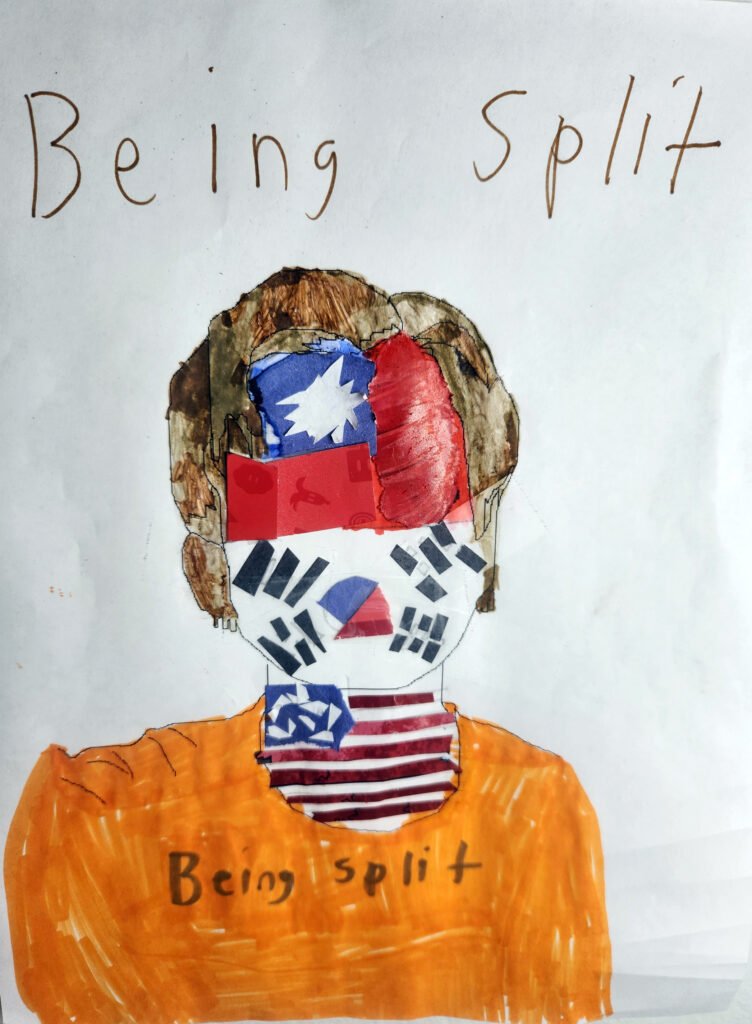
Being Split by Preston Young, age 10, New York

Illustration by Preston Young, 10, New York.

Being split,
Korean and Taiwanese,
I can’t process two different cultures,
It’s hard for me.

On Korean New Year,
I bow to elders and eat Duk Bok Ki (rice cakes).
On Chinese New Year,
I get red envelopes and eat dim sum with herbal tea.
I call my Korean grandparents Halmoni and Haraboji;
Ah ma, I call to my grandma who is Taiwanese.

The Taiwanese flag has red, white and blue.
The South Korean flag has those colors too.
The American flag has them too, oooh!

Being split,
Korean and Taiwanese,
Sometimes people don’t understand me.
When my friends talk about their one culture,
I want one of my other cultures to be unseen.

I try to tell my friends over and over;
I scream and I shout and whisper over their shoulder.
They never understand when I say,
 I am both Korean and Taiwanese!
They look confused and annoyed like fleas.

Sometimes I wonder if being Korean and Taiwanese is right for me.
I sit there and think until I can finally see,
I am special with being multicultural,
Being Korean, Taiwanese, and American,
Can all fit in my soul.

Being split,
Korean, Taiwanese, and American is hard.
But the three cultures,
Are forever in my heart!

By Preston Young, age 10, New York. Preston adds: “My mom is Korean and my dad is Taiwanese. I was born in the USA. I speak English but I am learning how to write, read and speak Korean because my friends at school can speak fluently, and I want to be able to communicate with them. My dream is to become an author and entertain kids. I was inspired to write this poem because when I am in school people always assume that I am full Korean or full Taiwanese. Sometimes people think I’m Chinese but I always correct them. I wanted to express how I feel and what that makes me feel like. I made a collage out of construction paper and some magazine clippings with markers to show my feelings about being split in three different cultures.”

A Friend That Never Was

A Friend That Never Was

By maggie d., Washington.

Except for Erica and I
The playground was empty
And our laughter could be
Heard miles away
“Not it! Not it! You are it!”
She yelled
Beginning a game of tag

Seconds later
A white car arrived to
Pick her up
The driver was someone
I never saw before
“No matter,” I whispered
With a shrug
Resting my mind on
Tomorrow’s joy

But the next day’s gladness
Did not show
Angrily she blurted
“My Mom said you are a monkey
And I do not play with
Monkey girls!”

A bucketful of tears
Streamed down my cheeks
As I stared into an
Unfamiliar face at the
End of a fence
Making me wince
When she wrapped my hand
Around her light peach
Fingers and asked
“Will you be my friend?”

—maggie d., African American poet and educator, Washington.