Category Archives: Nature

Snap Out of It

By Bella Melardi, Grade 11, Ontario, Cananda

Information is resistance. It will open our eyes. Awareness is change. The first step to solving a problem is acknowledging there is one. Let the existence of the climate crisis sink in. This is a reality check. Get out of your own heads. Snap out of it.

People’s lives are at stake. Climate change doesn’t affect everyone equally. People in power and people with privilege will not feel Mother Nature’s wrath the way minorities do. People will use their wealth and privilege as ‘band aids’ to block out destruction.

You can already see the effect that pollution is having on minorities in Canada. McGill Daily states, “In October 2020, over 250 Neskantaga residents were evacuated and transferred to a hotel in Thunder Bay after “an oily sheen was found in the Neskantaga water reservoir;” “high levels of hydrocarbons” were discovered in the water after testing.” The chemicals we created are destroying communities. They are festering in our waterways like tumors, spreading disease.

This destruction can also be seen through the construction of Line 3. Line 3 is a pipeline expansion that was just completed in September 2021. This pipeline will transport almost a million barrels of toxic tar sand oil per day from Alberta to Wisconsin. An oil spill would mean damage to coastal communities (near Lake Superior) and the wildlife, such as salmon and orca . StopLine3.org states, “Line 3 would violate the treaty rights of Anishinaabe peoples and nations in its path wild rice is a centerpiece of Anishinaabe culture, it grows in numerous watersheds Line 3 seeks to cross. It’s well past time to end the legacy of theft from and destruction of Indigenous peoples and territories.”

It is disgusting that our government allowed this pipeline to be built. They choose oil over preserving life! The people in power have to wake up! We have to find a new renewable resource. We have to act now. Researchers have found that we’ll likely cross the threshold for dangerous warming between 2027 and 2042. In 2042, I will only be 35 years old.

If you leave it up to my generation, it will be too late. We must all do better. Urge your elected officials to remove Line 3. Urge them to create a plan to invest in solar, wind or hydropower. We must switch to a renewable resource now! Increase the carbon tax. Instead of using tax dollars to invest in Line 3, the government should have used them to benefit the future of society. The Canadian government has to make stopping climate change a priority.

I want to help stop this but I feel so powerless. Corporations value making money over the future of their children. They value making money over minorities’ lives. Capitalism has caused people to become so consumed with greed. They are putting lives at stake. Mother Nature is bleeding. Humans are tearing out her skin and cutting her flesh. The earth is coughing up ash and choking on our greed. When will the earth’s heart give out?

This is my final plea to the people in power. You are selfish. You are killing us. You have already ruined the lives of countless Indigenous communities. You may not be affected by climate change right now but Indigenous people are. My generation will be. Our futures will rise up in flames. I don’t understand why you can be so selfish? Was it worth it? I hope you’re happy. You are exchanging lives for dollars. I hope it’s worth it.

We have to end the cycle of greed and suffering. Information is resistance. Open your eyes. Awareness is change. Use this awareness to get out of your own heads. Remove the shackles of greed that are binding you to your destructive choices. Think of the world around you. Here is a reality check.

Snap out of it.

Bibliography

Canada, Environment and Climate Change. “Government of Canada.” Canada.ca, Gouvernement Du Canada, 3 Mar. 2021, https://www.canada.ca/en/environment-climate-change/services/environmental-indicators/progress-towards-canada-greenhouse-gas-emissions-reduction-target.html

Board, Editorial, and Editorial Board. “Neskantaga First Nation Still Doesn’t Have Clean Water.” The McGill Daily, 22 Jan. 2021, https://www.mcgilldaily.com/2021/01/neskantaga-first-nation-still-doesnt-have-clean-water/
When Spring Comes

By Robyn Bjorkman, age 10, Michigan.

When the snow starts melt,

And the grass comes into view,

People are in a happy mood.

Day by day, the temperature will rise,

And there will be more sunshine,

More people will be out,

Enjoying the season,

For there will be many reasons.

There’s no more snow,

On the roads,

You can finally ride your bike.

Warm enough to unzip your coat,

But chilly enough when the wind blows.

Pleasant enough for when you see the birds again,

But fingertips turn cold when you aren’t wearing mittens.

When Spring comes, we get Spring Fever,

And folks don’t want it to be muddy either.

But there can be lots of great things,

Like when you (again) hear the birds sing,

And when you can ride your bike,

And get as dirty as you like.                                                                                                                                    

Poem by Robyn Bjorkman, age 10, Michigan.  Robyn like to go on adventures, write stories and create songs, and read. She hope to keep on writing.  

Six Rivers, Many Peoples, One Tree

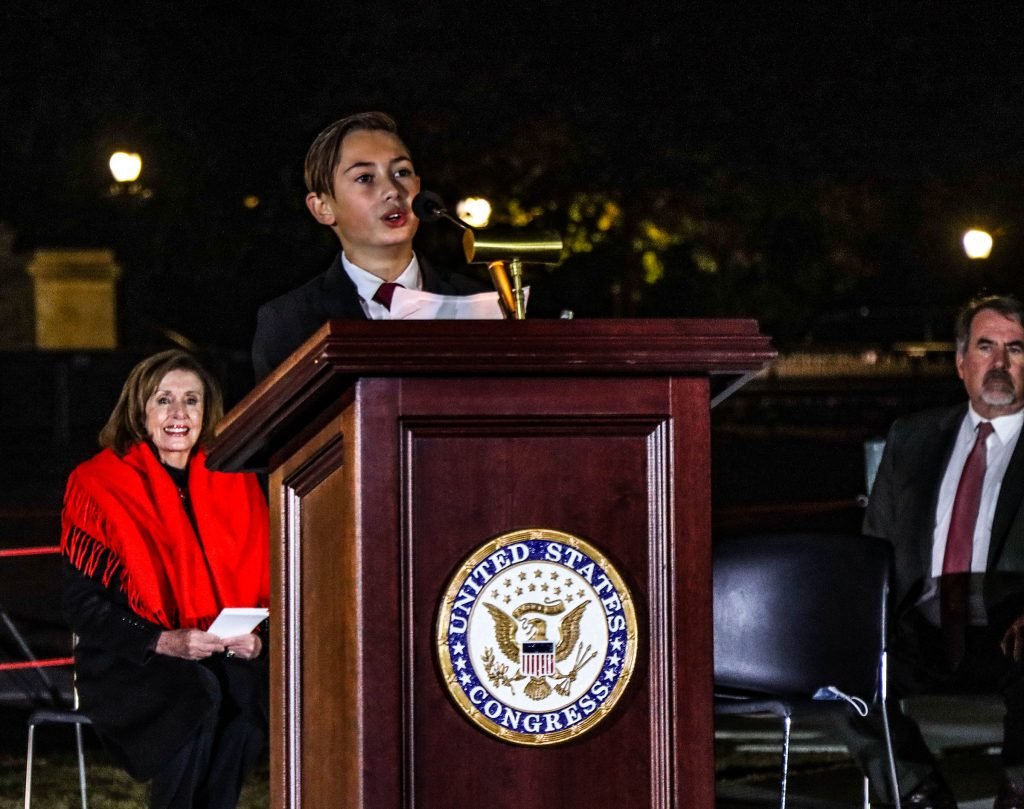
Michael Mavris, grade 5, Reading his Poem at the 2021 Capitol Christmas Tree Lighting Ceremony.
Photo credit: James Edward Mills
.

This year Michael Mavris, a fifth grader from Del Norte, California who won a poetry contest about the U.S. Capitol Christmas Tree, got the honors of flipping the switch that officially illuminated the tree. For over 50 years the USDA Forest Service’s Christmas gift to the nation, the U.S. Capitol Christmas Tree, has inspired the imagination of millions. Standing elegantly at the base of Capitol Hill on the West Lawn the massive tree fondly referred to as the People’s Tree is harvested from a different forest every year. This year the Six Rivers National Forest in California had the honors of delivering the 84-foot tall fir tree they named “Sugar Bear.”

The evening ceremony also included comments from the Speaker of the House of Representatives, Nancy Pelosi, and other members of the California delegation in Congress along with the new Chief of the Forest Service, Randy Moore.

We are proud to share Michael’s poem below.

Six Rivers, Many Peoples, One Tree

By Michael Mavris, grade 5, California.

What does the theme “Six Rivers, Many Peoples, One Tree” mean to me?

As I ponder the question presented here, I consider where I am living-literally in the heart of the Six Rivers National Forest.

Here, tucked deep within the Northwestern corner of California is a remote land, whose majesty comes not from achievements of humankind, but rather nature itself.

Six mighty rivers criss-cross this rugged land. From the Smith and Klamath rivers in the north, stretching over to the Eel and the Mad, meeting the Van Duzen and the Trinity in the South, all of our rivers, amongst the cleanest in the world, represent life itself.

Like the First Peoples who have lived here since time immemorial, these rivers overcome every obstacle to ultimately reach their goal of becoming one with the Pacific Ocean.

Is this done by an exhibition of power or a show of strength?

No.

It is accomplished by sheer persistence. The indominable spirit of never giving up which is representative of this land and the Peoples that live here.

From the great tribes: the Yurok, Tolowa, Karuk, Wiyot, Chimariko, Nongatl, Hupa, and Wailaki, we are taught to commune and truly be one with nature. This ethos teaches us to view rugged lands, secluded forests, and fierce weather patterns, as something genuinely beautiful.

Such is the story of the White Fir, also known as Abies Concalor, whose beginnings trace back to a single seed. From this humble seed,dropped onto Mother Earth in a remote region the process begins.Nurtured by the fertile soil, which the Six Rivers saturates throughout the year and, against all apparent odds, not only confronts the weather but embraces it. The young tree emerges proudly upward towards the shining sun.

From this great forest, we bring you the majestic White Fir, to be the Capitol Christmas tree. As the lights are strung and the ornaments placed, we, the People who live in the tree’s symbolic shadow, hope that its beauty and grandeur provide a beacon to America and a reminder on this Christmas, that all things are possible.

Michael Mavris, 5th grade student, Del Norte County Unified School District, California.

Wanted: Diversity in the Environmental & Earth Sciences Field

By Skipping Stones Staff

Over the past few years, there has been a growing consensus that in many western countries like the United States, the earth sciences and the environmental movement have a severe lack of diversity, both in terms of students studying these fields academically, and in the workforce. According to the National Science Foundation, African Americans, Native Americans, and Hispanics make up just about 14% of earth science undergraduate majors, even though they comprised more than 30% of the overall US population at the time of the study. This disparity continues as students enter the workforce. For example, African Americans make up 14.2% of the overall US population, but only 1.3% of geologists are black. When many people think of a geologist, they often picture an older white male roaming around the mountains. Based on Bureau of Labor statistics (74.9% of geologists are male), this image is actually often on point. Clearly these earth science related fields have a serious problem with diversity, and as a minority who worked and studied in the earth sciences for number of years, I have seen the unfortunate consequences this issue has had.

There are several reasons why it is essential to have more diversity in the earth and environmental sciences. Many environmental issues and natural hazards, from factory pollution to hurricanes, disproportionately affect minority communities. The devastation after Hurricane Katrina in 2005 is a prime example of this, when there was particular damage to black-majority neighborhoods in New Orleans. Black communities and other minority groups in the United States often live closer to large polluting chemical plants, waste treatment facilities, and other areas that are potential environmental hazards. Since people who work in environmental fields often make decisions regarding these kinds of environmental issues, it is essential to have representation from minority communities, especially if they are disproportionately affected by them.

Many teachers and professors may recognize this issue, but often approach it in the wrong way. They may think that simply showing minority students why fields like environmental science or geology are worthwhile, is enough to convince them to pursue these fields in their careers. In reality, diversifying these fields and their respective workforce takes a much more nuanced and systematic approach.

In both of my colleges and the university, all of my geology professors were white, but the larger issue was that they did not understand what is was like to be a minority student. Many professors are simply not aware of the obstacles minorities need to overcome, such racial bias in job hiring, or social exclusion in the outdoors. White, affluent professors likely have different upbringings than most minority students, and as a result, the differing perspectives may result in friction if a professor expects a minority student to learn and perform in the same way that he or she did as a student.

In reality, minority students face a multitude of obstacles, and even if they are extremely smart and hard-working, they may have different priorities than the professors did when those professors were in school. Partly because my parents did not grow up in the United States, they were not able to provide me with the same level of financial education as many other parents provide. However, when I tried to take a financial literacy class to learn these subjects myself, my academic advisor did not sign off on it, because she wanted me to focus on a geophysics class that would “be more relevant for my thesis.” She might have gotten education on financial literacy from her relatives when she grew up, because they had lived in this country for generations and knew the in’s and out’s of U.S. tax system, buying houses, etc., but I did not learn that at home. This is just another example of how many minorities— especially first generation minorities, in this case—are at a disadvantage compared to their peers.

This can be the case in many academic fields but the lack of diversity among the people teaching earth sciences stands out, because it means almost none of the professors have the same experiences as the minority students they teach. At least in other fields, like physics or computer science, there may be a more diverse faculty who understands what it is like to be a minority student.

There was even a time when one of my geology professors taught us how a mineral called orthoclase, which has a whitish-pink hue, “was the color of our skin,” because it was similar to the skin color of Caucasian people. Implying that we should refer to mineral color based on the skin color of white people creates a Caucasian-centric method of analyzing geologic features, and unfortunately many geology textbooks use these types of references.

In order to solve the diversity issue, it is essential to understand the structural factors that have historically led many minorities away from environmental sciences and even the outdoors in general. Many young people who end up studying or working in the environmental field become interested in the outdoors from an early age. Sometimes they do this by practicing sports like skiing, rock climbing, or mountain biking, to name a few. Some of these sports require a lot of out of pocket expenses. Rock climbing, for example requires harnesses, ropes, carabiners, helmets, and climbing shoes, which all add up in cost. People in lower socioeconomic classes often don’t have the extra funds to pay for this kind of gear, and many (but not all) minority groups unfortunately tend to have fewer resources. Thus being able to frequently enjoy the outdoors may be a luxury for some.

So how can we address this lack of diversity? One solution is for elementary, middle, and high schools to help kids gain an appreciation for the outdoors by taking them on field trips to nearby outdoor sites, hiking trails, etc., to ensure students from all backgrounds get to experience the outdoors and have the desire to protect these lands. True, schools often lack the funds to even fully fund their regular activities, so adding outdoor opportunities to the curriculum may be more difficult. Some private efforts exist to encourage minorities to explore the outdoors through group outings, but these efforts often have limited reach.

It seems that the best way to encourage minorities to study and work in the environmental sciences is to change the culture around these fields and the outdoors. This starts with every person who regularly enjoys the outdoors or the environmental sciences. For example, if you go on hikes regularly and have friends who haven’t had the opportunities to, maybe ask them if they want to come with you. If you’re a professor, continue to understand how your students have different backgrounds than you, and how that might shift their priorities. Small acts like these can build up in making the outdoors a more inclusive space, and doing this may have a far greater effort than just academic outreach.

—Skipping Stones Staff

References:

https://www.zippia.com/geologist-jobs/demographics/

https://www.americangeosciences.org/geoscience-currents/diversity-geosciences

Gone Bananas

By Connie Salmon, bilingual author, originally from Puerto Rico, lives in Connecticut.

You put it in your cereal. You eat it with peanut butter and bread. You eat it with ice cream in a special dish. But have you ever wondered where your banana came from?

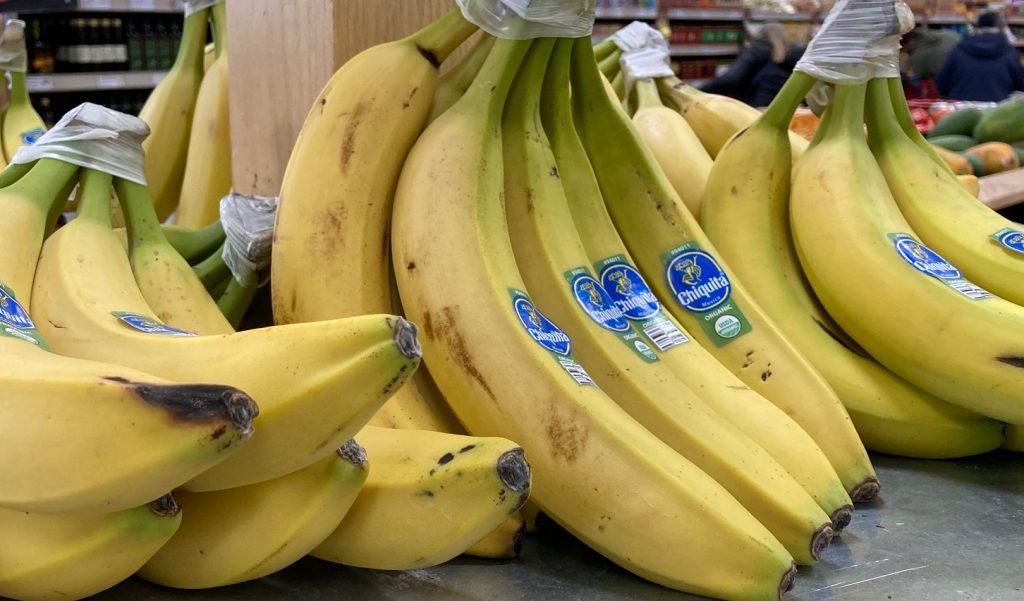
Bananas for Sale in a Grocery Store

Many people think that bananas grow on a tree. The truth is that they grow on an herbaceous (herb) plant. It’s leaves sprout from the ground and wrap around each other very tightly, forming the stem. Large purplish red buds push through the center of the stem and later form smaller purplish flowers that grow into bananas. The banana got its name from the Arabic word for finger, banan. A single banana is called a finger.

Bananas most likely came from South East Asia, about 7,000 years ago. Then they were taken to Arabia, and later to the Middle East and Africa. They were transplanted to the Canary Islands. From there, the Spanish brought bananas to the New World, after the voyages of Christopher Columbus.

Bananas grow in plantations in countries with a tropical climate. Leading exporters of bananas to the US are Columbia, Ecuador, Costa Rica, the Dominican Republic and West Africa.

The banana is America’s favorite fruit. There are 500 different types of bananas. The most popular one in the US is the Cavendish.

If the bananas are going to be harvested the traditional way, they are sprayed with pesticides (chemicals to get rid of insects) at the plantation. Then the farmers add fertilizers (artificial nutrients) to the soil to help the crop grow.

If the bananas are to be harvested organically, natural fertilizers like manure and seaweed are used. Insect predators and barriers are used to prevent pests. For example, crushed eggshells or pistachio nut shells prevent slugs and snails. The plants are weeded by hand or mulch is used to prevent weeds.

Farmers tie banana plants to long poles for support and cover them in large, plastic bags to protect them from insects and birds. The clear plastic lets light reach the leaves, allowing the fruit to mature.

Nine to twelve months after planting, the fruit is ready to be harvested. The bananas grow in large bunches. These are broken down into smaller groups. 10 to12 bananas are called a cluster, 4 to 6 are a hand, and each individual banana is a finger.

There are many steps to the harvesting (gathering) of the bananas. They are picked while still green to prevent them from spoiling while being shipped. A worker called a cutter cuts down the plant with a machete. Another worker, a backer catches the plant as it falls into a large cushion on the backer’s shoulder, to prevent the fruit from bruising. The backer attaches the bunch to one of the overhead cables that run between rows of plants. The moving cables bring the bananas to the packing shed, located in the plantation.

The bananas are washed in large tanks of cold water. The water removes most of the chemicals from the fruit. It also lowers the temperature of the bananas, which are still warm from the tropical heat in the field.

Inspectors then examine the bananas, to make sure they are of good enough quality to export. Once they pass inspection, the bananas are carefully packed into boxes, so they don’t bump against each other and bruise.

Boxes of bananas are loaded into huge, refrigerated ships or reefers, to prevent the bananas from ripening any further, putting the bananas “to sleep.”

Once the reefers arrive at their destination, they dock at food terminals. They are then inspected for insects, snakes and other tropical pests (spiders sometimes hide in banana leaves).

Then the fruit ripens in special rooms for 3 to 8 days. Ethylene gas, which is produced naturally by all fruit, is pumped through the ripening rooms to speed up the process. The temperature is lowered as days pass, so the bananas don’t over-ripen before they are loaded onto refrigerated trucks and brought to the market to sell.  

The banana has at last made its long journey to you. The next time you are in the supermarket with Mom, you can pick out a hand or a finger of bananas and tell her all about them.    

Sidebar: TOP EXPORTERS OF BANANAS TO THE UNITED STATES

The banana is the most traded fruit in the world. Bananas started to be traded internationally by the end of the 1300’s. Today they are grown in over 150 countries.

There is an organization called Banana Link in Latin American countries like Ecuador, Honduras, Columbia, Costa Rica, Guatemala and Nicaragua. It campaigns for fair and ethical trade practices for banana (and pineapple) plantation workers. In a largely hostile work environment for trade unions, there is a high level of violence and repression.

There is also a failure of health and safety standards, that causes much devastation of human health and natural environments, due to the use of toxic chemicals in banana production.

Banana Link fights for the dignity of workers (both men and women) and trade union rights. Trade unions try their best for workers to have better wages and benefits as well as better working conditions.

Bananas and plantains are a staple food in many tropical countries and play a major role in food security for many households.

TOP EXPORTERS:

ECUADOR:  US $3,68 millions in exports. Total Banana production: 6.28 million metric tons.

THE PHILIPPINES:  US $1,608 million in exports. Total production: 8.4 million metric tons

COSTA RICA:  US $1,083 million. Total Banana production: 2.27 million metric tons

COLUMBIA:  US $990 million. Total Banana production: 3.7 million metric tons

GUATEMALA:  US $956 million. Total Banana production: 3.8 million metric tons

Other smaller banana exporting nations include countries like Nicaragua, Panama, Honduras, Mexico, Dominican Republic, and Ivory Coast.

Sources for the Information:

“How bananas are Grown, Banana Link”  www.bananalink.org.uk

Encyclopedia Brittanica.com:  “Banana (Description, History, Cultivation, Nomenclature)”

By Connie Salmon, bilingual author, originally from Puerto Rico, now lives in Connecticut.

Longing to Leave

By maggie d. , African American poet, Washington.

Frost and snow puzzles me

Hailing from Sudan

Icicles and sleet

Billowing clouds holding no

Heat

Makes me weep

For sandy dust sweeping

Across tan dunes 

Never ruining my shoes

With muddy slush of melted snow

Oh

Without constant sun

Running for fun

Getting drenched by rain

Has made me aim

For returning to Wad Madani

Leaving behind winter

Without a whimper

I will laugh again with 

Sunglasses on to watch

Camels parade upon dirt roads

But I suppose it will take awhile

For Alab to say

“Goodbye Sigh-beria!”

By Maggie d., Washington.

Global Warming

By Derek Meng, age 10, California.

Glaciers melting, polar bears dying

Sea levels rising, floods occurring

Fire’s spreading, lightning’s striking

Tornadoes and tsunamis ruining houses and killing

More and more natural disasters happening

Virus spreading, people dying

Have you ever thought about who has caused this trouble?

You might say it’s nature, but do you think of us

and our broken relationship with nature?

Carbon dioxide coming out of cars

Trees going down

Thousands of dead, unwanted fish thrown overboard

Tons of unused food discarded

These are few examples of what’s happening in our world

Then how can we help nature?

If you have thought, “How can we help Earth?”

Then here are some things we can do:

Reuse, reduce, recycle

Use reusable bags

Use reusable bottles

Plant trees

Pick up trash

Save electricity by turning off lights

Use renewable energy

These are a few ways we can help

Have you ever thought what a beautiful world it would be

If we could make Earth—our home—clean?

“I am Chinese and I live in California. I am bilingual—I speak both Chinese and English fluently, I can also read and write these two languages.

My Global Warming poem was inspired by climate change. I want people to know that our world may soon be inhabitable if we do not change our ways. 

My vision of the future is the past combined with the present, all the trees should be restored to extract all that extra carbon dioxide [from the atmosphere], our houses should be ecosystem-friendly, and every vehicle should run on electricity. This is because of what I think is important, which is the world, the environment, and my family.”

—Derek Meng, age 10, California.

In the Forest within the City Park

there is a beauty that can not be muffled

by the city’s lights and sounds

it flies free with the clouds

and pushes the leaves in the air

onto the ground

to flutter like butterflies  

it holds the reins of the seasons

it dresses the earth in wailing white and grassy green

it gives us life  

but we take away from its own

the sky is filled with fire

the ground bathed in garbage

after all that it has done to us

we must save it from ourselves  

we must protect our world, our home

our beginning

nature

By Jaslene Kwack, age 11, Illinois.

Jaslene writes: “I like writing, art and music. I play the piano, clarinet and I started bassoon a while ago. In my free time, I like to write stories and poems. I try to be creative using metaphors and verbs that aren’t cliche. I enjoy drawing realistic and abstract pieces of art. When I grow up, I want to be a person who combines art and writing in a creative way to entertain or help people.

     “I wrote [this] poem about nature and how we are polluting and killing our environment. I want to recognize the beauty of nature and how it formed us in the first place. Sometimes, people don’t give nature as much credit as it should deserve. Without it, our world would be empty and barren. In my poem, I also talk about parts of nature all around us everyday. The wind blowing, the leaves falling from trees. Technology which is represented in my poem as “the city’s lights and sounds” is taking over our world slowly by every hour. I think because of all these new inventions and ways of life we are making for ourselves, a lot of us forget about how important nature is and how it is humanity’s origin. We should recognize nature and be grateful for this world around us. I think we should all strive to be better and protect the earth so that we can keep our world clean and healthy.”

Colors of Ukraine

By Camille Campbell, age 17, Arizona.

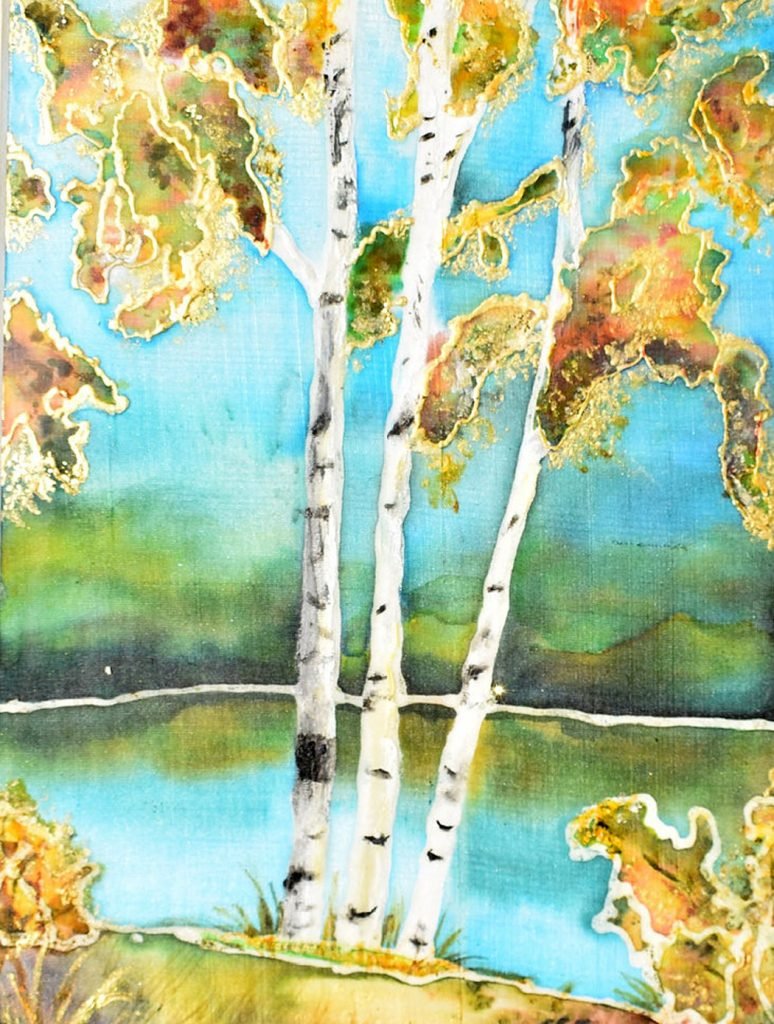
With images flashing in my mind,

I lay out the billowing silk,

and begin to paint.

I trace the lines of my ancestry,

each brushstroke forming a branch

on my family’s ancestral tree.

With golden gutta, I outline my identity,

ready to color between the lines.

I splash on the colors of Ukraine—

the teal darkness of Odessa’s Black Sea,

the sun-lit golden domes of Kyiv,

the crimson autumn of Sofiyivka gardens,

the flaxen fields of sunflowers.

I dream of living within the painting,

strolling and dancing in the silken world.

The kaleidoscope of hues connects me

to my mother’s Land of Color.

Camille writes:

In my poem, I write about the beautiful form of art called “silk painting” and how it connects me with my Ukrainian heritage. 

For years, silk painting has captivated me. My mother, who moved from Ukraine to the United States, fondly talked of the colorful silk paintings made by artistic communities in Ukraine. Disappointed that this technique was not practiced much in the United States, I decided to change that: one brushstroke at a time. As I learned the intricate and complex process, each painting felt like a tribute to my mother’s country. 

When art gallery owners expressed interest in my silk paintings, I assembled a collection of my work and was fortunate enough to receive representation by Derubeis Fine Art Gallery in Scottsdale, Arizona. With my silk paintings, I positively impacted my community by donating a few of them to the Make a Wish Foundation to raise money at their silent auctions.

When I’m doing a live art event, I always love to answer people’s questions about the process of silk painting and how it ties to my Ukrainian heritage. 

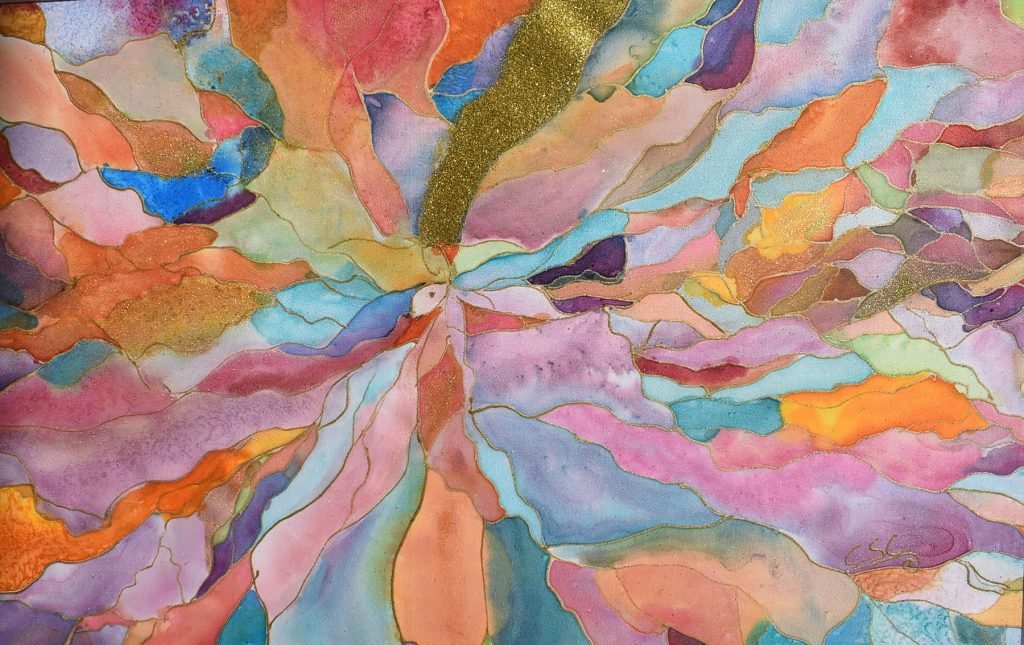
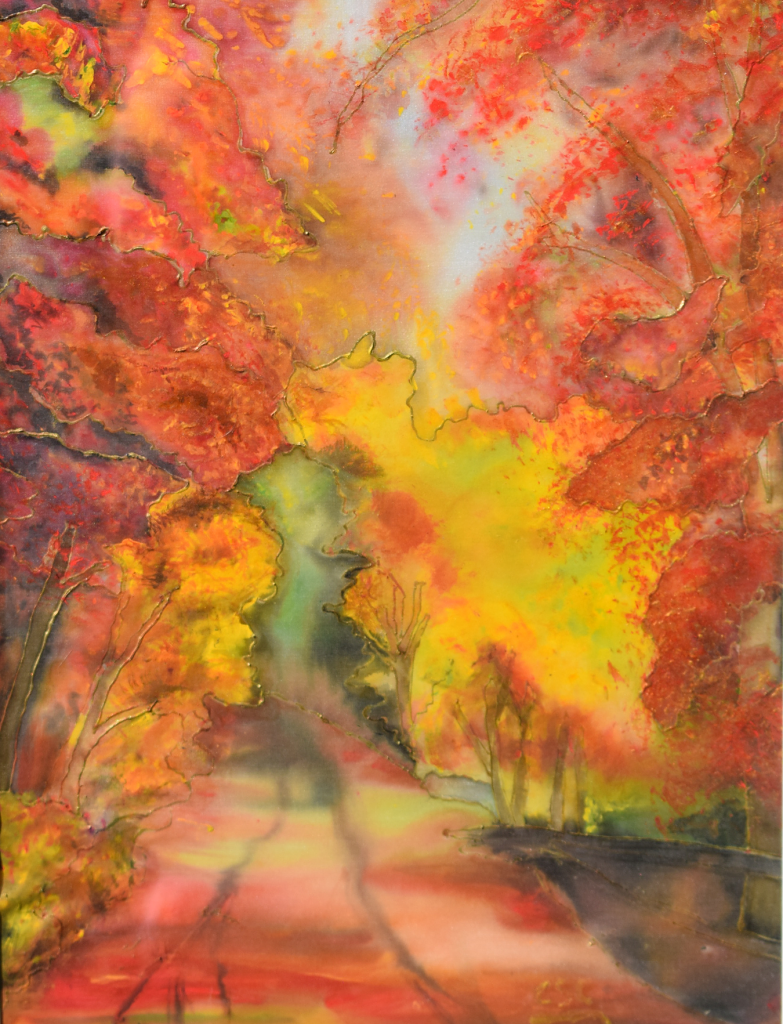
Along with my poem “Colors of Ukraine,” I have included four of my silk paintings: The Kaleidoscope of Dreams, the Vase of Joy, Flickers of Autumn and Serenity. You can see more of my art at: www.artistcamillecampbell.com