
Category Archives: Multicultural

Defiance Through Design

Defiance Through Design:
The Legacy of Filipino Art in Activism and Resistance

By Shloka Chodhari, High School Junior, New Jersey

Abstract:
Resistance against tyranny is a widely discussed topic, especially in light of current global conflicts and elections. My research reveals that Filipino art is deeply intertwined with activism and resistance against foreign rule. It demonstrates the powerful role of Filipino art in the fight to freedom. My article aims to educate readers on this connection, highlighting how indigenous art forms have served as platforms for defiance and cultural preservation for centuries.

The Philippines is a Southeast Asian archipelago consisting of 7,641 islands in the western Pacific Ocean. The country is known for its vibrant cultural tapestry woven from the traditions of its diverse indigenous communities. Prior to the arrival of Spanish colonizers in the 16th century, Filipino art was deeply rooted in animistic beliefs, nature, and mythology. Woven textiles, pottery, and wood carvings showcased motifs and told stories that were passed down through generations. This produced many vibrant patterns and designs that were not only aesthetically beautiful but also served as valuable symbols of protection and good fortune. One such design, the “Sarimanok,” was a mythical bird that frequently appeared on textiles.
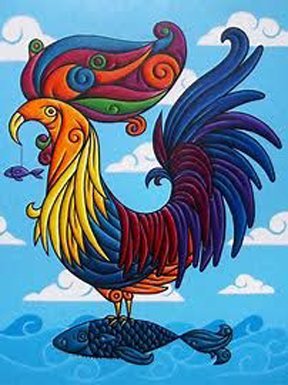
IMAGE: Majestic Sarimanok: Symbol of Prosperity and Myth / Photo courtesy by Ruben HC 2017

Pre-colonial Filipino art embodied “Kalikasan,” a term used by the indigenous people of the Philippines referring to the interconnectedness between humans and the environment. For example, the intricate ‘okir’ designs and carvings served to remind viewers of the harmonious relationship one has with the world and their ancestors. Unlike in many other indigenous societies, Kalikasan was not fulfilled through a passive or solely spiritual/ religious connection with nature but by actively caring for her physically. Thus, many Filipino art pieces serve to inspire individuals to take a hands-on approach toward preserving and respecting nature. Kalikasan is alive and well today in the Philippines. Environmental activism in the Philippines isn’t just a contemporary response to pollution or climate change but part of a long-standing tradition of actively caring for nature. This is evident in the Writ of Kalikasan within the Constitution of the Philippines, which provides the Filipino people the right to a “balanced and healthful ecology in accord with the rhythm and harmony of nature.”
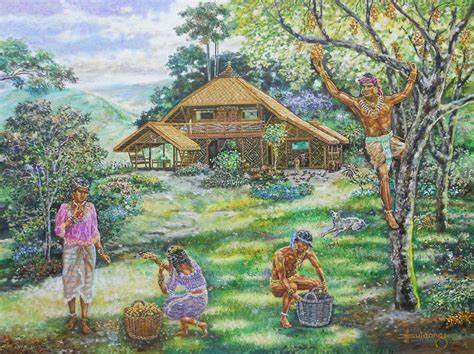
“Kalikasan: Pre-colonial Filipino art, such as intricate ‘okir’ designs, embodies the deep interconnectedness between humans and the environment.” / Photo Courtesy by J. Bulaong 2020

When Spain arrived, they aimed to Christianize Filipino society, leading to the suppression of indigenous art, which they viewed as inferior and embodying heretical values. In its place, they forced indigenous artists to produce Catholic iconography. They believed that compelling the inhabitants to create Catholic art would not only civilize them but also instill in them Christian virtues.

Despite the suppression, indigenous art persisted, serving as a form of “resistance” against colonization. During this period, the Estilo Hispano-Filipino, a fusion of Spanish and indigenous artistic styles, became prominent across architecture, painting, and sculpture. In architecture, the Estilo Hispano-Filipino style manifested in the construction of churches as well as government buildings where Spanish Baroque elements blended with indigenous architectural techniques and materials.

This fusion acted as a form of resistance to colonization by embedding indigenous culture and motifs into the very Christian imagery that the Spanish sought to supplant indigenous culture with. This led to indigenous culture becoming intertwined with Christianity, making it much more difficult to root out. The Santo Niño de Cebu best illustrates this. It was a 30 cm tall sculpture of the Christ Child holding a globe and a scepter created by Flemish artists. When the ruler of Cebu, Rajah Kulambu, and his wife were baptized, she was christened as Juana and was presented with the Santo Niño. Their baptism marked the first conversions to Christianity in Filipino history. Upon converting, Juana asked for the Santo Niño to take the place of her former idols. Afterward, Ferdinand Magellan, a Portuguese explorer who claimed the island of Cebu for Spain, left, resulting in a 40-year period in which the Santo Niño was left solely in the
hands of the indigenous Filipino people.

When the Spanish returned 44 years later, they found the Santo Niño to have its original clothes replaced with indigenous clothes made specifically for its tiny frame, and the painting from its face and nose had faded a bit. The latter was due to how in indigenous Filipino culture, body parts of religious constructs were touched to initiate the healing powers the natives believed that they possessed.
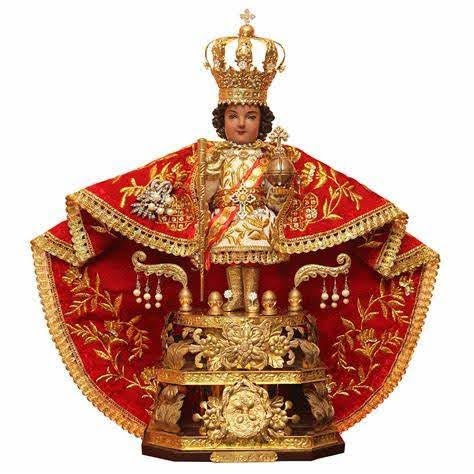
Original image of Santo Niño de Cebu: A Divine Symbol of Faith and Heritage / Source:Wikipedia

The natives gave it a new origin story with themes and motifs that were undeniably indigenous and lacked a trace of Spanish involvement. Local artists would reproduce many local variants of this sculpture, each including indigenous features, such as rounder faces, flat noses, and specifically shaped eyes. During the struggle for national independence, Filipinos chanted, “Long live the Katipunan! Viva Santo Niño!” In the minds of the Spanish, by introducing images such as the Santo Niño, they sought to rewrite Filipino culture in their own image. This backfired spectacularly when the natives leveraged the universalist pretenses of Christianity to make the Santo Niño their own, rooting their independence movement in the very ideas the Spanish sought to use to control them.

After gaining independence from the United States in 1946, indigenous art forms had a resurgence fueled by a growing sense of cultural identity. However, attitudes towards indigenous arts varied depending on the political climate. During Ferdinand Marcos’s authoritarian rule (1972-1986), many artists faced persecution for their political views, such as Bienvenido Lumbera (1932-2021). Lumbera was a renowned Filipino poet and critic known for his significant contributions to Philippine literature and his critical stance against the Marcos regime. Lumbera’s work revolved around themes of social justice as well as national identity; he was particularly known for his critiques of Marcos’s authoritarian rule. His outspoken
personality and political beliefs led to his imprisonment when Marcos declared martial law. His poems, such as “Tales of the Manuvu,” contain criticisms of the regime’s human rights record. Lumbera’s work, employing symbolism drawn from indigenous Filipino culture, resonated with the masses.

Similarly, Jose Tence Ruiz (1956-), known for his avant-garde style, created many works that criticized the Marcos regime. One of his most notable pieces was called “Brutalism,” which used abstract forms to symbolize the harshness of dictatorship. This infuriated the regime and led to efforts to suppress his works. Bienvenido Lumbera employed most of his art through poetry. The messages of these works of art formed the foundation of resistance movements. Symbolism of indigenous Filipino art through posters and murals was ubiquitous during the People Power Revolution of 1986, during which millions gathered wearing the same color in a mass protest. The themes of resilience through indigenous art allowed for unity amongst the public, leading to the collapse of the regime.
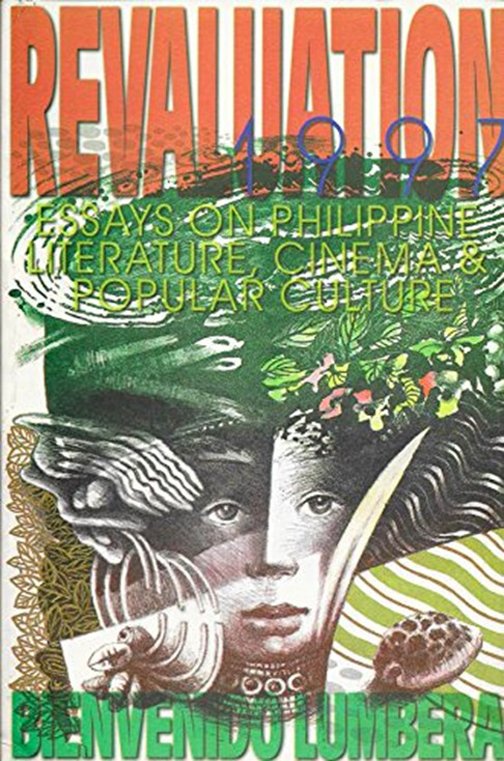
“Exploring Cultural Heritage: Bienvenido Lumbera’s Masterful Blend of Filipino History and Artistic Expression” Publisher: University of Santo Tomas Pub. House, 1997
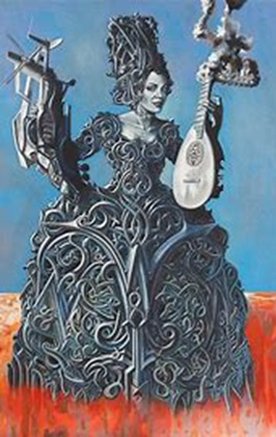
“Royal Decay: José Tence Ruiz’s ‘Granduchess’ Examines the Intersection of Power, Opulence, and Corruption” Lot 622: Jose Tence Ruiz (b. 1958)

The history of Filipino art in resisting tyranny showcases the immense power within the agency of artists. Foreign hegemonic forces often reproduce elements of the cultures they seek to dominate, aiming to legitimize their rule and pacify any aspects of it that could promote resistance. In contrast, native artists resist colonization or tyranny by intentionally incorporating symbols and motifs of their native culture into the art forms of the oppressors. This strategy undermines colonial rule by taking the universal moral
and religious pretensions of the colonizers and turning them against them, leveraging these to preserve particular forms of cultural autonomy. Over time, this autonomy outlasts the colonizers, eventually enabling national liberation.

This enduring legacy of artistic resistance underscores the vital role of cultural expression in the struggle for freedom and self-determination. The strength and adaptability of Filipino society highlight how indigenous art serves as a physical manifestation of every person’s right to freedom.
Author:
Shloka Chodhari, Arts Associate, The Lawrence CXLIII
Editor, Lawrenceville Science Reports, and High School Junior, New Jersey.

Both the author and publisher would like to thank all the artists and art sources for the five reproductions included in this article.

Sources:
Marin, M. (Ed.). (2021). *Transmission image: Visual translation and cultural agency.* Duke University Press
History of Philippine Art | Sutori
PHILIPPINE HISTORY (aboutphilippines.org)
Understanding Authoritarianism and Corruption in the Philippines | Psychology Today
Authoritarian powers are back in the Philippines, here’s how to fight them – Interviews | IPS Journal (ips-journal.eu)
A writer’s truth: The legacy of National Artist Bienvenido Lumbera – University of the Philippines (up.edu.ph)
The Relevant and Irreverent Jose Tence Ruiz—Positively Filipino | Online Magazine for Filipinos in the Diaspora
The Philippine Literature and Arts in the Post-War Era (1946-1972) (sinaunangpanahon.com)
Booklet-Guide-2022-1.pdf (santoninodecebubasilica.org)

Between Gaza and Me

Between Gaza and Me

By Nada Alaloul, age 17, from Rafa, lives in Egypt.

Between all of these
Cold bodies,
Tired faces,
Busy minds
Lost people
There is Nada como yo
Between black and white there’s me
Between sun and moon, there’s a scream
Between hell and heaven, there’re my people under the rubble
Between death and life, there’s a missile
Between war and peace, there’s a border
Between freedom and shackles, there’s the whole world
Between tanks & planes, there’s my family
Between my family & me, there’s an endless cry
Between my happiness & sadness, there’s the news of my city
Between the present and the past, there’s a genocide.
Between death here, and death there
There’s a huge price
I have one heart with
Two separated souls
And I’m a ghost
And I’m completely alone.

I was at home
Now I’m missing my home
Suddenly
I lost my home
I was here and there
But Suddenly
I’m nowhere
My home was bombed
My friend was killed
My sister was scared
And my dad was missed
And all I’m doing here
Is just avoiding to be the
Favorite dish for my sadness
Cuz actually I’m a liar
A big liar
I’m drowning in heavy clouds of sadness
Afraid to confirm
That my happiness is sad
To be with me
My happiness is scared
To be bombed with me
My happiness fooled me
But at least I know
That I couldn’t know
That I’m not happy
Without my sadness
I couldn’t realize
That I want balance
Between black and white
Between my happiness and sadness
To stop being gray
Without my sadness.

So now
I’m under a sky that
Doesn’t target its people
I walk towards the sun but I’ll never be burned
Cuz my soul has been burned once
Before when I left Gaza
Alone

What about you, dear human?
Can you bring me the warmth of the sun?
Not the one over my head
Nor the Egyptian sun which
Burns my bones like
The missiles do against
The tents of my friends
I want the warmth of my family
I’m a ghost and
I’m completely alone

I’m blue, drowning in a
Gray ocean of the fog
Gray, the favorite color of the death in my city
The color that I used to see
Whenever I roam in my ghost city
The color that I used to feel
Whenever the measure between
Death and me is just a path

I have one heart
With two separated souls
I’m a ghost and I’m completely alone
I’m here and there
And suddenly
I’m nowhere
Como Nada como Yo.

By Alaloul, age 17, from Rafa, Palestine, currently lives in Egypt.

Ms. Lauren Marshall, a playwright, musical theater librettist/lyricist, director and teaching artist based in Washington state, adds: “Nada is a remarkable girl from Gaza, now living with relatives in Cairo, Egypt. She participated in the Gaza Heartbeat, a creative writing project that was sponsored by Palestine Charity Team (PCT) in Rafah, Gaza (Palestine), in 2022.

“Nada has a positive outlook despite all that has happened to her! She was evacuated from Gaza in April, 2024. But her family is still stranded in Gaza, displaced from their home, which has been destroyed during this senseless war. Nada, like all of Gaza’s children, has missed an entire year of school as the result of the war. During this time, she has read books, written short stories and poems, taught herself Spanish, taken a business course in Cairo, and volunteered with PCT!”


Being Split

Being Split
By Preston Young, age 10, New York.

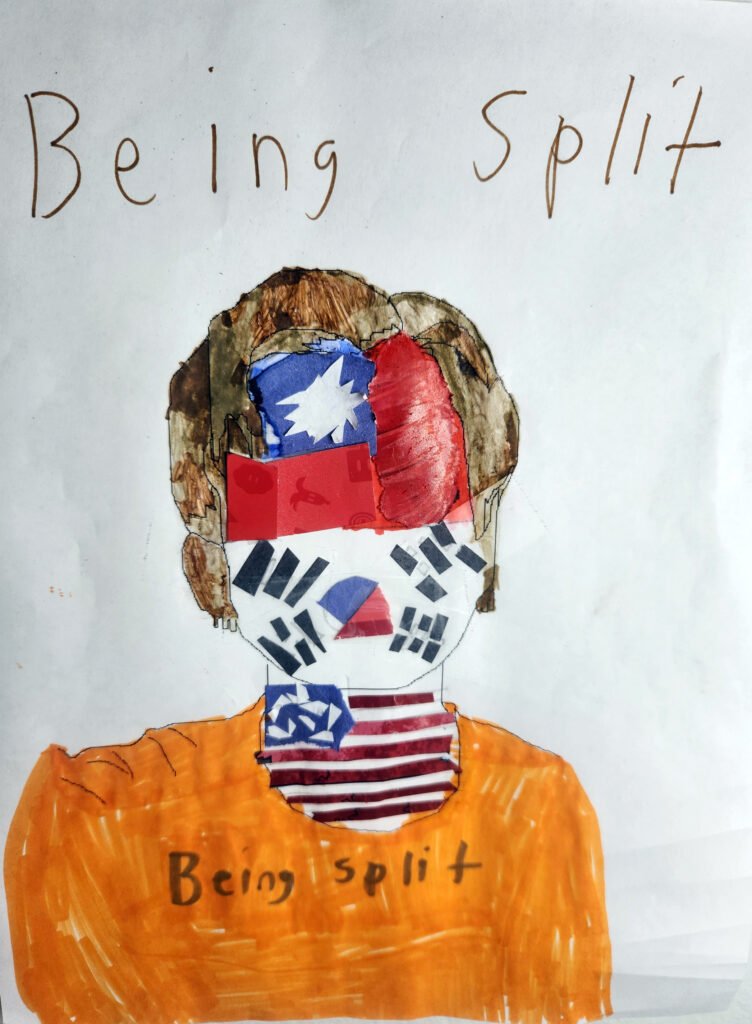
Being Split by Preston Young, age 10, New York

Illustration by Preston Young, 10, New York.

Being split,
Korean and Taiwanese,
I can’t process two different cultures,
It’s hard for me.

On Korean New Year,
I bow to elders and eat Duk Bok Ki (rice cakes).
On Chinese New Year,
I get red envelopes and eat dim sum with herbal tea.
I call my Korean grandparents Halmoni and Haraboji;
Ah ma, I call to my grandma who is Taiwanese.

The Taiwanese flag has red, white and blue.
The South Korean flag has those colors too.
The American flag has them too, oooh!

Being split,
Korean and Taiwanese,
Sometimes people don’t understand me.
When my friends talk about their one culture,
I want one of my other cultures to be unseen.

I try to tell my friends over and over;
I scream and I shout and whisper over their shoulder.
They never understand when I say,
 I am both Korean and Taiwanese!
They look confused and annoyed like fleas.

Sometimes I wonder if being Korean and Taiwanese is right for me.
I sit there and think until I can finally see,
I am special with being multicultural,
Being Korean, Taiwanese, and American,
Can all fit in my soul.

Being split,
Korean, Taiwanese, and American is hard.
But the three cultures,
Are forever in my heart!

By Preston Young, age 10, New York. Preston adds: “My mom is Korean and my dad is Taiwanese. I was born in the USA. I speak English but I am learning how to write, read and speak Korean because my friends at school can speak fluently, and I want to be able to communicate with them. My dream is to become an author and entertain kids. I was inspired to write this poem because when I am in school people always assume that I am full Korean or full Taiwanese. Sometimes people think I’m Chinese but I always correct them. I wanted to express how I feel and what that makes me feel like. I made a collage out of construction paper and some magazine clippings with markers to show my feelings about being split in three different cultures.”

“Looksmaxxing” and Toxic Beauty Standards

“Looksmaxxing” and Toxic Beauty Standards

By Colin Wu, high school junior, California.

Earlier this year, one of my close friends got very wrapped up in the looksmaxxing community, a growing online community that strives for the ideal body and flawless face. He started calling people out that he didn’t find attractive, bullying and fat-shaming them. He shunned and looked down on his peers who didn’t have the “perfect body”—6’ 0” tall, six-pack abs and huge biceps. The looksmaxxing community targets young males and females and influences their ideas about beauty in a toxic way. Looksmaxxers are part of an online community that has gotten inside our heads and inside our homes and it needs to be stopped before more people get hurt.

Social media has had a huge effect on younger people’s feelings about their appearance. In a New York Times op-ed titled, “Toxic Beauty Standards Can Be Passed Down”, Alexandra D’Amour writes, “There’s a nickname for tweens and teenagers who have been influenced by social media to get into skin care: Sephora Kids. Johanna Almstead, a fashion industry friend, tells me that in her local mothers group chat, nearly every mom had “Skincare, skincare, skincare!” on the holiday gift lists they were given—by their fifth graders.”

Younger children requesting skincare products as gifts is alarming. It suggests that they have a problem with their appearance and are using skincare to fix it. It also shows the influence social media has on the youth now, whereas, when I was in fifth grade, I wanted video games and Legos. D’Amour also says, “A recent video on TikTok that has garnered more than eight million views features a 28-year-old woman showing her “raw,” procedure-free face, meaning no Botox or fillers. As some women and girls cheered on her bravery, others were left horrified. “Praying I’ll never look like that,” one comment reads. This comment shows the ways in which social media has defined beauty for future generations. While sharing their “raw” face makes some people proud, others are disgusted by its imperfections.

Parents, who also contribute to the focus on skincare in young people, can make this situation better. D’Amour writes, “And yet, if a mother’s insecurity can fuel her daughter’s own self-loathing, a mother’s radical self-love might just protect and even heal her daughter from a toxic culture.” D’Amour believes the influence that parents can have on their children can be more positive than negative. Parents who are able to teach their kids to love their appearance may help their children stay away from bad communities. D’Amour says, “When I ask the few friends who haven’t gotten Botox why they haven’t, they tell me it’s because they love how their mothers are aging and how they embrace it. They don’t fear aging because their mothers don’t (or didn’t).” Older generations of mothers who are secure about their appearance influence younger generations by making them realize it’s best to accept and love themselves for who they are. Coming from a family in which no one had any kind of procedure, my parents and grandparents have taught me self-worth and have made me love myself for who I am.

People today are growing up in toxic cultures that lead them to accept unnatural beauty standards. D’Amour warns us that, “Gen Z-ers are being introduced to the idea of starting treatments early as preventive treatment. They are growing up in a culture of social media that promotes the endless pursuit of maintaining youth—and at home, some of them are watching their mothers reject aging with every injectable and serum they can find.” Gen Z-ers are still growing and many are still in puberty. By attempting to slow or stop the natural aging process, young people seek out treatments that could alter and change the way they look when they’re fully grown. While it can physically harm Gen Z-ers, the mental effects can also cause significant harm. They are oblivious to the ways in which buying treatments connects their self-worth to their beauty. The consequences of children being influenced by skincare culture could mirror the harm caused by previous toxic cultures. D’Amour points out that “The anti-aging craze comes with the same toxicity as diet culture does.” Diet culture influenced people to want to be skinnier. Anorexia was a large issue and resulted in many people hurting themselves to obtain the ideal body image. Similar to diet culture, the anti-aging culture puts pressure on young people to strive for unhealthy and unattainable beauty.

My friend was too invested in the looksmaxxing community. As he tried to achieve his ideal body image, his obsession led to him putting down and hurting others. While there are positive aspects of social media, these negative parts harm younger people who are vulnerable when it comes to their appearance. Even though my friend was putting others down, this community was also harming him, by ruining friendships. Some unlucky teens have to deal with crazy parents, who put their own insecurities on their children and reaffirm toxic cultures that enforce unrealistic beauty standards. Other teens can be affected in positive ways, if parents or role models teach them to accept themselves. In the future, if we want to feel good about ourselves, we must embrace our natural appearance and develop self-worth that is grounded in loving ourselves.

—Colin Wu, h.s. junior, California. Colin adds: “I am a Chinese and Burmese American, whose first language is English, and I am currently learning to speak and write Mandarin. My family, education, health, and religious beliefs are most important to me. I am very interested in environmental sciences and engineering. I was inspired to write this essay because of the harm this community has done to friends of mine.”

A Friend That Never Was

A Friend That Never Was

By maggie d., Washington.

Except for Erica and I
The playground was empty
And our laughter could be
Heard miles away
“Not it! Not it! You are it!”
She yelled
Beginning a game of tag

Seconds later
A white car arrived to
Pick her up
The driver was someone
I never saw before
“No matter,” I whispered
With a shrug
Resting my mind on
Tomorrow’s joy

But the next day’s gladness
Did not show
Angrily she blurted
“My Mom said you are a monkey
And I do not play with
Monkey girls!”

A bucketful of tears
Streamed down my cheeks
As I stared into an
Unfamiliar face at the
End of a fence
Making me wince
When she wrapped my hand
Around her light peach
Fingers and asked
“Will you be my friend?”

—maggie d., African American poet and educator, Washington.

The Presidency 

The Presidency 

There have been 45 presidents of the United States. The current one, number 46, has a similarity to all but one of his predecessors. They are all White, and all 46 are male. Asian Americans have been in the country since the 1800s, and have come nowhere close to the presidency. Could someone of Eastern Asian ethnicity ever become president of the United States?

Loyalty is an act of faith in which you do not betray or desert your cause no matter the circumstances. I believe most of the issues faced by Asian Americans are to do with loyalty. When using a search engine to research, the question, “Are Asian Americans loyal to the United States?” it distributes a plethora of discussion posts, disagreements, newspaper articles and more. For example, in a survey conducted by the Asian American Foundation of over 4,000 U.S. citizens, 32 percent agreed with: Asian Americans are more loyal to their perceived country of origin than to the U.S. I find this response disgusting and shocking. These questions and polls are not done on Irish Americans, Italian Americans, Norwegian Americans or African Americans; who whilst facing an uphill struggle in many areas, they would not be questioned if they are serving another country. Where does the questioning of  loyalty of this specific ethnic group come from? 

As an Asian American, I have not felt any urging for ongoing loyalty toward any country other than the U.S. In fact, Asian Americans have contributed to the United States as much as others. So what causes this unique form of discrimination? I believe one of these reasons is fear. For decades, the U.S. has been the world’s global superpower, with no country since the fall of the Soviet Union coming close. Over the course of recent years though, China has grown and empowered their economy, as well as modernized their military to the extent where there is a possibility of them overtaking the U.S. in a decade. Politicians, media pundits, and some American people are fearful of losing their global hegemony. I believe this fear has spilled into affecting Asian Americans citizens. The buildup of tension between China and the U.S has led to a buildup of tension against Chinese and other Eastern Asian ethnicity.

The coronavirus began November of 2019, and has only escalated this recurring issue. When the matter is brought up to classmates, all point directly to China as the one to blame. About 1.4 billion people populate the country of China, fingers pointed to every single one. During the coronavirus pandemic, the quantity of Asian American hate crimes increased rapidly. People of various Eastern Asian ethnicities were affected by this as well. The differences between Asian and American cultures itself is a leading cause, as we human beings tend to point fingers at those most different to us. For example, there is a mass of cuisine differences between Asians and Americans. Asian cuisine is based mostly on older type traditional recipes, including foods considered exotic to others. American cuisine is based highly on dishes from other ethnicities, although are home to modern dishes. 

In addition to these previous points, whilst all nations have fostered racism, The United States has had government policies introduced specifically pushing these racist policies. When schools were divided into white and black, Asian Americans found themselves questioning where they belong. Asian Americans were not mentioned in the laws themselves, as if they were forgotten and the law makers didn’t know they existed. This sense of idea of being an “other” or not being a part of the nation itself I believe still carries on to modern society.

In conclusion, I do not believe an Asian American could ever become president. As much as we as the Asian American community continue to integrate ourselves with the nation, humans will always find a way to exclude parts of our people and treat them as outsiders. Asian Americans are constantly challenged on our trustworthiness, loyalty, and dedication to this country. Attempts to prove ourselves feel disregarded by the same continuous subgroup of people. I truly hope to be proven wrong in my lifetime. 

Author’s Note:

            In the past few weeks, the political climate has changed. Vice President Kamala Harris has become the Democratic Party’s nominee for the President of the country. She is half African American, and half Indian. Despite this sudden change, I still stand by my previous assertion. My piece is focused on Eastern Asian ethnicities, and their uniquely questioned loyalty to the  nation. Kamala’s nomination is what I believe to be a step forward in our nation, due to her being female as well as a woman of color. However, due to the still-rising tensions with China, as well as the Coronavirus-19 pandemic, I still believe an East Asian American could not currently be elected the president.

—Abigail Lee, Age 12, Grade 7, Illinois. She writes: “I have a passion for writing. I enjoy reading realistic drama stories. I am socially conscious about Asian American discrimination in our country, in particular since the Coronavirus Pandemic. I am an Asian American, born as well as raised in Illinois. My essay focuses on my belief that an East Asian American could never become president due to racial discrimination.”


Embracing the Unknown

Embracing the Unknown

By Maggie D., Washington.

Her smile was as great
Big and beautiful as
A sunrise above the
Grand Canyon
Gripping the
Stars and Stripes
The Pledge of Allegiance
Was softly spoken
Without a hint of hesitation
Her human spirit
Held onto a future
Hope
Of making her free
From the tyranny
She once experienced
With a salute to her
Deepest desires of what
She was about to
Become

—Maggie D., retired educator and African American poet, Washington.

Summer Work

Summer Work

By Maggie D., Washington

Summer time is here
Gardens to tend
Money to spend
For back to school
Clothes
That are not too old
Bought at the thrift store
Some will need mending
Others will profit from
Two washes
My gosh
Summer is passing
As quick as a wink
When I think of the
Days disappearing among
The harvested corn
And winter squash

—maggie d., retired educator and African American poet, Washington. She adds: “Summer Work errupted from memories of my grandmother’s farm in Oklahoma.”

Smoky Skies

Smoky Skies

By Joyce Lazarus, Ph.D., Massachusetts.

Note: This is a fictional story, based on actual events. The names have been changed to protect the identities of the plaintiffs.

Rachel sits down on a riverbank, shaded by a giant cottonwood. Its silvery leaves turn in the breeze, shielding her from the stifling August sun. She stares at sunburnt grasslands and distant blue hills on her ranch in Montana, where her family has been ranching for generations.

Something catches her eye. She looks toward the west and sees plumes of dark smoke rising, reddening in the afternoon sun. Dark, billowing clouds are filling the sky, blotting out sunlight.

“Dad, do you see the smoke?” Rachel calls to her father.

“No. Where is it?”

Rachel starts running toward the smoke. She spots a wildfire in the distant hills, its orange flames devouring the withered forest. With no rain for the past three weeks and a severe heatwave, there is little they can do to stop wildfires from spreading. She already knows of twenty-five other fires this summer, less than fifty miles from their ranch.

How long before one of these wildfires reaches their ranch? How can they stop fires that spread so quickly, whipped up by winds?

The look on Dad’s face tells Rachel how concerned he is.

“Let’s hose down the house and barn,” he says. “We’ll bring in the cattle and horses.”

Rachel learned about climate change when she was eleven and thought it was something she could do nothing about. Now thirteen, she feels her stomach twisting into knots, panic surging. Her whole ranch could be destroyed! How can she stop something so powerful?

Every year there are more storms, droughts, wildfires, heatwaves―every kind of natural disaster. Rachel understands that burning coal and other fossil fuels are a major cause of climate change, but most people she knows do not want to admit this. They shrug their shoulders, saying, “Let nature run its course. We’ll get through this crisis like we always have.”

Many people do not see things as Rachel does. When she learned in science class that humans have only about seven years to act before irreversible harm is done to the Earth, it hit her very hard. She knows the feeling of smoke caught in her throat, of dense gray smog blocking out sunlight. She is just a teenager, but if teens don’t try to solve this climate crisis, who else will?

Rachel has nightmares about fires sweeping across her ranch. She sees herself racing to save her family, horses, cattle, and little dog, Felix. She wakes up covered in sweat.

 ***

She isn’t the only teen in Montana worried about climate change. Since joining a climate action club, Rachel has gotten to know Nora. Nora tells her that every time she hears about wildfires, it feels like getting punched in the stomach. When Nora watched Greta Thunberg on TV, speaking at the United Nations, asking world leaders, “How dare you?” it took her breath away. This was the first time someone close to her age expressed the anger and determination to do something that Nora felt.

Later that month, Nora brings her exciting news.

“There is a law firm, Rachel, “Our Children’s Trust*,” that can help us sue the State of Montana for not protecting us against climate disasters. I plan to join the lawsuit.”

“Really?”

“The state constitution says that all Montanans are entitled to a clean and healthful environment. When fossil fuel companies drill into the land, polluting the air and water, they disregard what science has been telling us for decades about dangers to the environment.”

“What do we need to do?”

“We should sign up as plaintiffs, to explain in court how climate change has harmed us, then talk about our fears for the future. We’ll tell our lawyer, Janet Olsen, what disasters might occur if we don’t act soon.”

“You’ve convinced me, Nora. I’ll join!”

“Your story is much more persuasive than mine, Rachel. Your ranch has come close to being destroyed by wildfires! Why don’t you represent our group and I’ll give interviews to the press? We’ll work together to win this case!”

Rachel, Nora, and fourteen other teens join the lawsuit against the State of Montana.

***

While Janet Olsen prepares arguments for the trial, Nora gives interviews to the press. Articles soon appear in newspapers all over the country. TV news anchors speak of “the kids who are leading the way to save the US from climate catastrophe.”

Rachel Heller gives her name to the lawsuit, “Heller v. Montana,” since her story makes the strongest case for acting quickly.

After three long years, their lawsuit makes it to court―the first time in US history that a kids-led climate lawsuit goes to trial.

***

One hot June day in Helena, Montana, the trial begins.

Teens stand up in court one after another to tell the judge how climate change is harming them.

Sara, sixteen, says that her life as a member of the Diné Tribe is completely tied to nature.

“We tell many stories to our people,” Sara says. “We can only tell a Coyote story if there is snow on the ground. But the time left to share these stories is getting shorter, with so little snow in winter. What will happen to our stories when there is no more snow?”

Lilian, from the Crow Tribe, speaks about a summer tradition, Crow Fair, with its rodeo, traditional dances, and parades. Because of intense heat, the fair was cancelled this year.

“If you miss Crow Fair, you’ve missed something that’s part of your identity,” Lilian says. “We’re taught that we have three mothers: your natural mother, your home, and Mother Earth. Taking care of all three is our responsibility.”

Rachel, Nora and others stand up and talk about the harm caused by climate change.

The judge thanks everyone for their testimony.

***

One day in July, the judge announces that she has reached a verdict. All sixteen plaintiffs file into the court and nervously sit down.

The judge reads: “We find the plaintiffs’ arguments for protecting Montana from the harmful effects of climate change to be convincing. We rule in favor of the sixteen plaintiffs.”

Loud cheers and applause greet the children as they leave the courthouse. Nora and Rachel lift their fists, crying, “We are heard! We are heard!”

Rachel later says to Nora, “We can’t save the planet by ourselves, but we took a first step. Others will follow.”                             

—Joyce Lazarus, Ph.D., Massachusetts. is a retired French professor and an author of a number of books.  A grandmother to three children, Joyce has also published several children’s stories. She adds: “I feel inspired by my three grandchildren, and am concerned about the growing climate crisis that their generation will face.  My hope is that young people, like the characters in this story, will find ways to mitigate the threat of climate change, to protect and preserve our precious Earth… My aim in writing this story is to show young people that they can help make a difference by recognizing that they are stewards of the environment.”

* Our Children’s Trust is a national nonprofit based in Eugene, Oregon. Their mission statement reads: “Our Children’s Trust is a non-profit public interest law firm that provides strategic, campaign-based legal services to youth from diverse backgrounds to secure their legal rights to a safe climate. We work to protect the Earth’s climate system for present and future generations by representing young people in global legal efforts to secure their binding and enforceable legal rights to a healthy atmosphere and stable climate, based on the best available science.
“We support our youth clients and amplify their voices before the third branch of government in a highly strategic legal campaign that includes targeted media, education, and public engagement work to support the youths’ legal actions. Our legal work—guided by constitutional, public trust, human rights laws and the laws of nature—aims to ensure systemic and science-based climate recovery planning and remedies at federal, state, and global levels.”
To learn more about them, please visit: https://www.ourchildrenstrust.org


Seven Stars to Guide Us

Illustration by AI + Dennis Rivers.

Seven Stars to Guide Us

Here are seven stars to guide us,
inspired by the Prayer of St. Francis,
and focused on the inward path of every heart:

FOR THE SAKE OF MY OWN WELL BEING
AND FOR THE SAKE OF EVERYONE’S WELL BEING…

1. This moment and this day
may I walk the path
from blind anger to calm awareness.

2. This moment and this day
may I walk the path
from obsessive resentment
to expansive forgiveness.

3. This moment and this day
may I walk the path
from paralyzing fear
to courage inspired by love.

4. This moment and this day
may I walk the path
from doubt about external security
to faith in the Power of Life within me,
the same Power that makes all things new.

5. This moment and this day
may I walk the path
from the isolation of seeing everyone as a threat,
to the community of embracing everyone as kin.

6. This moment and this day
may I walk the path,
from embarrassment and humiliation
in the eyes of others
to remembering that we are all evolving stardust,
capable of turning every mistake
into an opportunity to grow.

7.  This moment and this day
may I walk the path, from a disappointed
and wounded sense of entitlement,
to a deepening gratitude for the whole wide world,
for Breath, and Earth, and Sky and Life.

For each breath can be received
as an amazing gift from the Universe,
waiting to be transformed
through our journey into the Light
into something kind, creative and beautiful.

May we begin
with this present breath!

By Dennis Rivers. Illustration by AI + Dennis Rivers. 2024 
Public Domain ;  EarthPrayer.net/prayer-evolving/seven-stars/