Category Archives: Multicultural

Early Bilingual Education

Taking it One Baby Step at a Time:  Why We Need Early Bilingual Education

By Michelle Lo, 17, New York.

If you’re like any typical American high school student, this is how your language-learning journey will go: you spend three years blazing through vocabulary and learning all of the tenses, grammar, and tones of the language, only to forget everything that you’ve learned by the time you’ve graduated (except for maybe how to ask to use the bathroom or where the library is).

Meanwhile, with the rise of globalization over the last century, bilingualism and multilingualism have become some of the most important skills to have as an individual. Some of the many benefits to bilingualism include a communication advantage in the world’s competitive job market, the ability to communicate and connect with people from a variety of social settings, and a wider global perspective. So, if being bilingual or multilingual is that important, how might we improve the way we teach language such that our students can actually become fluent in them?

The solution, as simple as it may be, is to have our students start early.

One of the clearest benefits to learning a new language early is that the younger you are, the easier it is to pick up the language. In a linguistic study done by a research team from Boston-based universities, researchers aimed to pinpoint the age at which our ability to learn a new language disappears through a short online grammar quiz. Individuals were asked about their age, language proficiency, and time studying English. The study concluded that children up to the age of 18 are proficient at learning a new language, while children up to the age of 10 can achieve the level of grammatical fluency of a native speaker. There are many reasons why children generally have an easier time learning a new language. Younger children are less fearful of making mistakes than adults and teenagers, a hurdle that one must overcome in learning a new language. Certain brain structures in children also make this process of language learning easier. One study conducted by researchers at UCLA observed rapid growth in the parts of the brain that are responsible for developing language skills between the ages 6 and 13, but a sharp decline in growth after age 13.

Contrary to what some may believe about bilingualism, learning a second language during a person’s most formative years will not affect their ability to speak their primary one nor will it confuse a child. As a matter of fact, numerous scientific studies have concluded that being multilingual can offer numerous cognitive and intellectual benefits for children. A 2004 study by psychologists Ellen Bialystok and Michelle Martin-Rhee found that the brains of bilingual children had better executive functioning than those of their monolingual peers. This meant that bilingual children were better at planning, solving problems, etc., which stemmed from their ability to switch from one language to the other. Various studies have also proven that bilingualism can lead to higher intellectual performance and higher creativity.

Yet, despite the overwhelming evidence supporting early language learning, the U.S. is falling significantly behind other countries in foreign language learning. As the American Councils for International Education reported in 2017, out of all 50 states and the District of Columbia, only 20% of K-12 students are enrolled in foreign language classes, compared to the European median average of 92% thanks to the national-level mandates for foreign language education. In addition, many European students begin to take foreign language classes from the ages 6 to 9, whereas most American students begin in their high school years. Unlike many European nations, many states lack requirements regarding foreign language education or the age at which students should start in place, causing more lag for American students.

In order to make up for this lag, we need to start taking steps in emphasizing foreign language education, beginning in early childhood. That could mean implementing a more standardized system in the state where all students can begin to get some exposure to foreign languages from kindergarten. We could also expand dual language programs, one of the many great ways early childhood foreign language education can tap into a child’s language learning potential. Although dual language programs vary in form, most are designed to teach students in two languages in order to foster bilingualism and biliteracy. Usually, one half of the instructional day is taught in a foreign language and the other half in English. Many of these dual language classes are immersive. For example, children are encouraged to learn through play, song, and social interactions with their peers, which, over time, can help to foster their interests in learning the language and culture. These programs are great for English-learners and native English-speakers alike. For English-learning students, a bilingual classroom allows them to build friendships with their native English-speaking peers, a relationship that would not have been possible if it wasn’t for their mutual understanding of each other’s languages. For native English speakers, sharing the classroom with non-native speakers and immigrant students will help normalize the diversity in languages and cultures in the classroom.

If we expect our coming generations to build a future that is diverse and multicultural, we need to first construct the foundation: an improved and earlier foreign language education system for all students. Students, teachers, administrators, families, and change-makers of any form can all contribute to this cause by recognizing this need and advocating for better early bilingual education, whether that be writing to your local representatives or spreading awareness within your community. That way, we’ll just be one baby step closer to a truly globalized future.

—Michelle Lo, 16, New York. She adds: “I’m an American-born-Chinese, or ABC, that has always been interested in language and culture. Growing up, I spoke only Chinese as a young child but after rigorously studying only English during my childhood years, I lost my ability to speak Chinese. This is something that I deeply regret as I felt that it created a barrier between me and my culture. As a result, I hope to spread awareness about the importance of bilingualism in our multicultural society to prevent cases like mine from happening.”

Sources:

American Councils for International Education, 2017, The National K-12 Foreign Language Enrollment Survey Report, www.americancouncils.org/sites/default/files/FLE-report-June17.pdf.

“Benefits of Learning a Second Language at an Early Age: Ertheo Education & Sport.” Benefits of Learning a Second Language as a Child | Ertheo Education & Sport, 10 June 2020, www.ertheo.com/blog/en/learning-a-second-language/.

Bhattacharjee, Yudhijit. “Why Bilinguals Are Smarter.” The New York Times, The New York Times, 17 Mar. 2012, www.nytimes.com/2012/03/18/opinion/sunday/the-benefits-of-bilingualism.html.

Devlin, Kat. “Most European Students Are Learning a Foreign Language in School While Americans Lag.” Pew Research Center, Pew Research Center, 6 Aug. 2018, www.pewresearch.org/fact-tank/2018/08/06/most-european-students-are-learning-a-foreign-language-in-school-while-americans-lag/.

Smith, Dana G. “At What Age Does Our Ability to Learn a New Language Like a Native Speaker Disappear?” Scientific American, Scientific American, 4 May 2018, www.scientificamerican.com/article/at-what-age-does-our-ability-to-learn-a-new-language-like-a-native-speaker-disappear/.

Talukder, Gargi, et al. “Brain Development Study May Provide Some Help for Educators.” Brain Connection, 9 Dec. 2016, brainconnection.brainhq.com/2000/09/20/brain-development-study-may-provide-some-hel

Umama, Khujista. Personal Interview. 18 Dec. 2020.

Zhang, Jingyu. Personal Interview. 16 Dec. 2020.

What’s it Like to Be a Teen with Social Anxiety

By Mehek Azra, age 15, New York.

When you’re a teenager, you may find yourself worrying about how others perceive you. You are pressured to fit into several norms. There is always a right and a wrong thing to do if you want to make friends or be liked by your teachers. And all of these expectations can be extremely overwhelming, especially to a kid. But many teens grow into having social anxiety. Social anxiety is a response to trauma. And I know that the word “trauma” gets thrown around a lot but regardless of how “small” or ”big” it is, but it is still a trauma.

Some of the experiences (trauma) that often lead to social anxiety are: being bullied, being humiliated in a social situation, or being pressured to participate in class. But the sad reality is, that society acts blind when it comes to teenage mental health. Teens with mental illness are being neglected because they are too “young” to be facing any issue.

Teachers or parents don’t really notice when a student has social anxiety because they think they are “shy.” Being shy and having social anxiety are not the same. Shy kids can gradually come out of their shell at one point but those with social anxiety don’t. They have a constant fear of being judged harshly by others. So when they are told, “Don’t be shy! We are all here to help,” it doesn’t necessarily help.

I was generally a very quiet kid who did not speak much in school. You can also call me an introvert because that’s what I am. Being an introvert is already a stressful factor about myself that makes every day things hard, such as school. And having social anxiety, on top of that makes it even more horrifying. Since I have extreme social anxiety, I will mention some of the things that trigger my anxiety, and if you can relate to these, you may also have social anxiety.

  • 1. When a teacher randomly picks on you to read out loud, you sit there in silence and you panic. You’d rather get a zero than participate because you are afraid your classmates will secretly laugh at you.
  • 2. You’re at the mall and a group of teenagers walk by and they start laughing, and you think they are making fun of your outfit.
  • 3. Your mom asked you to make an order at McDonald’s, and you start to sweat. You plan out the conversation in your head multiple times before you actually speak because you’re scared they will judge you.
  • 4. You constantly avoid going out with people because you’re not sure they will like you.

I will share one of my own personal stories. When I was in 4th grade, one of my teachers would often call out on me during class in front of my classmates, either to read something out loud or just to participate. According to her, she was just trying to help me speak up. But she didn’t realize that she was promoting quite the opposite. It made my social anxiety worse. One time in my freshman year of high school, we had a project that we were then required to present. I kept getting anxious about it way before the due date. When it was finally my turn to present, my hands turned cold, sweating excessively. My heart was beating so fast, it seemed like it could burst out of my ribcage anytime. Although the presentation seemingly went well, it was dreadful. And that is just one of the many terrifying experiences.

If you have social anxiety, you may feel more comfortable expressing yourself through writing. You may prefer text over calls. No matter how much you love them, you are not going to respond to that FaceTime call. It gets to the edge in school, or at least it did for me. The madness about constant group work and participation made me despise school. Though classes are all online now, social anxiety does not go away. You may still be afraid to unmute yourself to answer so you just don’t join your classes anymore.

Many suggest therapy to overcome social anxiety. But not everyone has that option. So what can you do? First of all, know that nothing is wrong with you! You are not alone. Social anxiety is not always recognized or spotted easily by others. So that kid in your class who you think is confident, not afraid to speak, and answers questions effortlessly, might have a fear of social judgment. You can’t tell. Some are just better at hiding it.

One of the methods that seemed to help me with my social anxiety is self-talk. Since I am afraid to let anyone know about my issue, I became my own therapist. Talk to yourself the way you wish others would talk to you. Never disrespect yourself. Remind yourself that as much as you may think others are judging you, most of the time they are just busy with themselves. The teenagers in the mall laughed because one of their friends made a joke. That one girl laughed when you were reading out loud because she and her friend were making inside jokes that did not involve you. We stress too much about how others see us. But you need to see yourself for who you are. Be aware of your triggers. Avoid situations that will make your anxiety eat you up. You do not need to do things to please others. Use your preferred way to share your thoughts and let others know about your issue. Please pay attention to yourself!

I want to let teens like me know that they are not “weird.” They don’t need to “fit in.” I am speaking up on behalf of those who struggle to express their thoughts. And I also want teachers to be mindful of how their students are and not pressure them to do presentations. They should offer alternatives in which the students can contribute their ideas without increasing their social anxiety. I shared my thoughts but will you take them into consideration?

By Mehek Azra, 15, high school sophomore, New York. She is Bengali (from Southeast Asia).
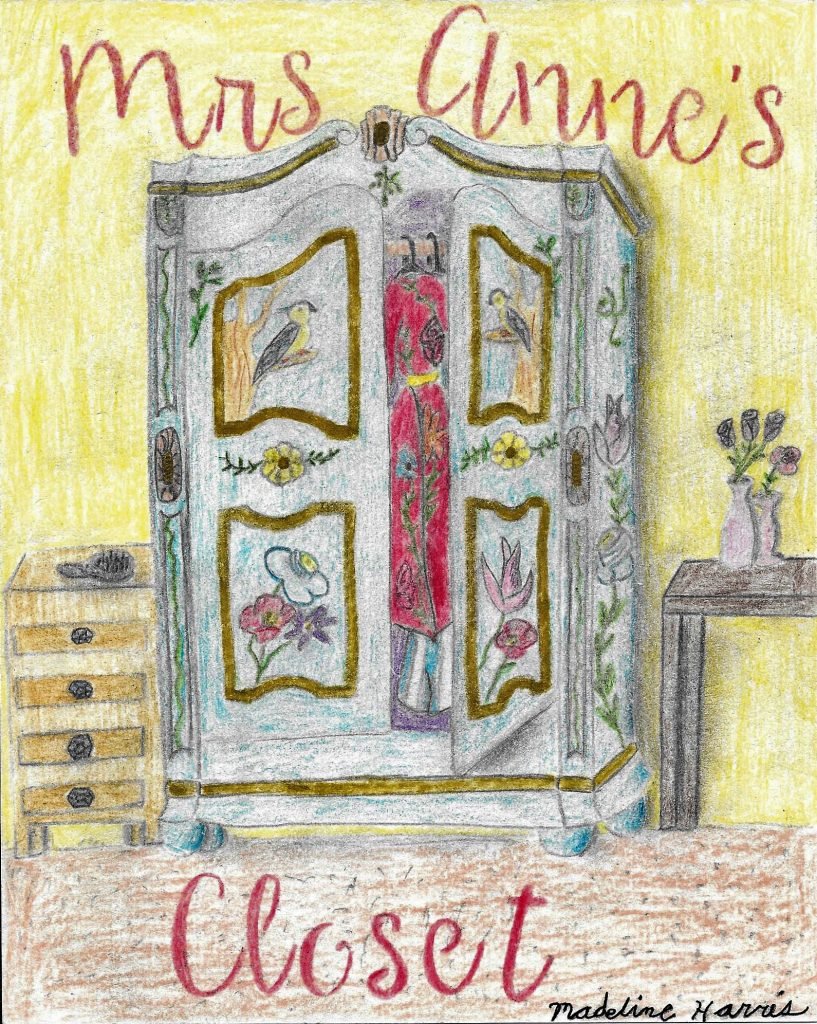
Mrs. Anne’s Closet


By Melissa Harris, Illinois. Illustration by her daughter, Madeline Harris, age 11.

Mrs. Anne’s home was like a museum. Everything I would pick up had a story. “Where did you get this hairbrush from, Mrs. Anne?” I’d ask. 

“That was Big Mom’s, my mother, and it sat on her dresser when I was a girl,” my grandma would say. 

“And now I’m the girl,” I’d add to the story, gliding my finger across the brush that was a shade between blue and gray. 

Sometimes my grandma would let me play dress up in her closet. It was a place for dreaming with your eyes wide open. “Every dress, hat, and handbag has a past, Maddie,” she’d say. “And when the time is right, they’ll be yours to own.” She opened the door to a world of fantasy held in an armoire. 

A striped aquamarine and white dress that looked like it was made for a princess. A black dress as skinny as a water hose hung next to a red kimono, draped over other hidden treasures I couldn’t wait to discover. “I know what you’re eye’n.” Mrs. Anne observed with a smirk. I ran to yank the kimono off of the satin hanger. As Mrs. Anne helped to put it on, the phone rang. She left me to the rest and took the call in the next room. 

The kimono was so oversized that it wrapped around me twice and then some. I could hear what she’d say if she was still in the room, “Maddie, you’re swallowed in memories and love.” I beamed with honor, and recalled the stories she had told me of our heritage. Mrs. Anne was Chinese and African-American. Her mom was from Arkansas, and her dad was from Hong Kong. Somehow their paths crossed in St. Louis where they fell in love. She’d tell me stories of how I descended from two groups of people who were the first to leave genetic footprints on the world, Africa and Asia. “Being the first doesn’t prevent cruelty,” she’d say, “for both countries experienced invasion and mistreatment.” My thoughts of their story swirled in chaos, so fast that my head started to ache, twisting and turning ideas into knots. My string of thoughts collided, and when they crashed, I was no longer in Mrs. Anne’s closet. I was standing at the edge of a mountain that had to be over a thousand feet high.

I was too scared to look down at first, so I slowly stepped back until my heart no longer tried to jump out of my chest. Where was Mrs. Anne? Where was I? I needed to find a trace of something familiar. I got the nerve to look past my immediate surroundings without moving a single limb. Down below was a harbor and fishing boats with the most vivid red sails. Colors blended together like a rainbow, and I couldn’t make out the body of water in front of me. A black and blue butterfly with stripes like the royal dress in Mrs. Anne’s closet fluttered by. I followed. It led to a path that curved around the mountain, probably used like an elevator to take you up or down. I crossed over to an enormous white house in the distance. Maybe someone there could help me get back to my grandma. 

Several arched windows lined the white home. A girl who looked about my age sat under a cotton tree with a book. She didn’t move when I walked towards her, just stared like a frozen sculpture. She had eyes like my grandmother with hair cut straight as a line to her shoulders. I knelt beside her and blurted, “hi.” She hesitated, then exhaled a sigh. I extended my finger towards the house. “Do you live there?” “Lin,” she said pointing to herself. “Maddie,” I responded, imitating her movements. 

Just then, a man in a navy-blue uniform slammed the side door to exit. He didn’t look like Lin. He had red hair and skin as pale as the house he exited. After a few steps, he yelled, barmy bloke! A man in a white apron, the kind a cook wears hurried out, bowing to the soldier’s black boots. The soldier’s tirade was like the howling of a wolf, and though I couldn’t see the details of his face, I was sure it wore a glare. The same as the medals pinned to his uniform from the blazing sun. He backed the cook against the wall. When he was close enough to hover over him with a raised fist, Lin screamed, ting! Her words may have stopped the cook from harm, but the soldier’s anger turned towards us. I didn’t understand their language, but I could infer the cook’s meaning when he yelled, pao! Lin ran towards the trolley path, and I followed. In the distance I could see Lin’s destination; a trolley stopped on the side of the road to pick up passengers headed to the lower peak. Lin ran faster than anyone I had ever seen, and I couldn’t catch up. So, I stopped. I felt a tug at my left ponytail and fell back towards the force. It was the soldier. Before I could think of a plan to escape, my bottom scuffed the ground and my head followed. My thoughts began to spin again, and my eyes opened to a different setting. I was at Mrs. Anne’s. 

“You alright honey? I heard a hard thud, like you fell.” I could see the concern in Mrs. Anne’s eyes because she saw the fear in mine. I was still shaken up from the soldier and the distant land with people who seemed familiar to me.

“Did your daddy have a sister? I asked, smearing tears across my face.

“He did. Her name was Lin.” 

“I think I met her in my dream.” 

“I’m sure you did,” Mrs. Anne laughed. I didn’t care if she believed me. I was just grateful to be in her arms, swallowed in memories and love. 

Glossary:

Blue Tiger Butterfly/Tirumala limniace is found in South Asia and Southeast Asia. Its wings are black with blue markings.

Pao: (頓契, 獵契, 텝, 쒔檀, 굴텝, 텝꼍) run

Tíng: (界) stop

Victoria Peak: A hill on the western half of Hong Kong Island that rises 1,810 feet. 

Victoria Harbor: A natural landform harbor separating Hong Kong Island in the south from the Kowloon Peninsula to the north.

By Melissa Harris, multiracial (Chinese, Irish, and African American), English teacher, Illinois.

Illustration by Melissa’s daughter, Madeline Harris, a budding artist, age 11.

.

Mother’s Daughter

“The way you cut your meat reflects the way you live.”  –Confucius

If Confucius was right, then my mother lived delicately, treading a tightrope as thin as the slices of her twice cooked pork.

When she ate her first American hamburger, she had complained.“Ai ya. Why is the meat so big? With a hulking piece of meat like this no wonder they all in debt. Americans cannot save.”

She told me this while I minced the pork for our dumplings and she rolled the dough. “Thinner, Jian Yang. We are not the barbaric Americans.”

She didn’t intend it, but with those words, the knife I held slashed across my life like the cuts across the pork. In that moment I told myself I am not a barbaric American because I am not an American. My narrative became a relic of my mother’s, two sides of the same page, her side’s ink still impressed on mine.

For five years after that, I remained scared of knives, and my mother cut my meat for me.

“You are what you eat.” –American proverb

“Is that dog food?”

“It can’t be, because Ling Ling doesn’t feed dogs, she eats them.”

That day I went home in tears and asked my mother to pack me a sandwich. I showed her what the pale kids kept inside of their princess lunchboxes—spongy white bread around ham and cheese, a cereal bar, an apple.

“Ah yes, I make for you.”

The next day I found a pork bun in my backpack. I held the baked dough and took a bite. I tasted pork marinated with soy sauce and chives. As I chewed, I hoped the hujiaobing could pass off as a hamburger.

“Ling Ling is eating dog food again.”

“Does that make Ling Ling a dog?”

The day after, there was steamed bun inside my backpack with barbecue pork and black pepper. I looked once at the pearl knot before throwing out the chasiubao. I didn’t eat my lunch the day after, or the day after.

If you are what you eat, I thought, I don’t want to eat Chinese anymore.

And so my transformation began. Everyday at lunch I’d throw out the delicacy my mother had packed. Everyday at dinner I’d pick at my rice while staring at the woman across from me, pockmarked yellow on her cheeks and creased valleys in her forehead. My greatest wish was not to turn out like her.

I thought I had actualized my wish when my skin began to turn translucent from skipping meals. I thought I was becoming white. I started eating nothing altogether, and I became nothing.

Once my mother scolded me for not eating. “Jian Yang, you look like ghost. Eat your noodles and you become yellow again.”

I can’t remember most of what happened next. I remember my tongue, poised like a knife, uttering some ugly sounding words I barely understood. I remember wanting to make her bleed with my words, one cut for each bite of dog food I had endured. I remember pretending she could seep out red on a cutting board, bleeding until we were left colorless.“Chink.”

“He who takes medicine and neglects diet wastes the skills of the physician.” —Chinese adage

My mother doesn’t cook anymore. Instead, she lays on a red-blanketed bamboo mat in a room brimming verdant. On her desk, an incongruous collection of terracotta cups, holding qi-rectifying rhubarb and shen-calming wolfberry.

The doctor said her condition is too fragile to eat. Strong flavors could disturb her gut, and I should instead blend basic nutrients for her to drink. I promptly replied that he was a fool.

The first time I cooked for her, she was coming back from the hospital. When I saw her, face of mountains reduced to ash, I dropped the plate. She asked what was wrong with me. I told her that my greatest wish was never to turn out like her. She told me that she had shared the same wish.

“You must turn out better than me,” she said.

We ate my meal, pork buns ribbed in ginger, in silence.

“Fashion is in Europe, living is in America, but eating is in China.”  —Chinese adage

I saw this scribbled against a dusty window to a grocery store in Chinatown. I don’t know why they say living is in America, because this country killed my mother. She died four months after the pork bun meal—inevitable, the doctor said. The nail salon she labored nine hours a day at had used illegally toxic polishes for years. While she scrubbed counters and coughed chemicals, her liver simply gave out. It was a miracle that she lived as long as she did.

My mother was a failure of an immigrant in most aspects. She stood at the Angel Island bridge seeking freedom, yet each day she beat herself an ocean back, until her vision became a mirage on the horizon. By imagining walls of white supremacy and shadowy businessmen, she trapped herself in a prison of her own making. She never found freedom because she never made it off that bridge.

I live in America, though. For lunch I go out for drinks with my roommates. We catch up on Grey’s Anatomy and someone invites me to a frat party later, which I only pretend to consider.

For dinner I stay home and cut my own meat, a piece for Brooklyn, a piece for Chinatown, for eating, for living. One piece for Jane Young, amateur journalist and cup-pong champion, one piece for Jian Yang, aspiring princess haunted by the paleness of memory. They are the decussations of a third-person America, carved apart by my mother into island pieces long before I realized that action had shattered me.

And so, I reassemble. I take the pieces, toss in a million chili peppers, and sauté in an ocean of soy sauce until they become one and the same.

By Samantha Liu, 16, New Jersey. She adds:“Mother’s Daughter” parallels my two clashing heritages. Having been raised speaking and reading Mandarin Chinese, I was expected to fulfill all the Confucius-esque dreams of my Chinese immigrant mother, whom I ended up resenting more than anything. Through the symbol of food, my story explores my struggle to reconcile these beliefs as I learned to define myself—as Chinese-American, as heterogeneous as food itself.”

Xiāng Xiāng

By Jessica Wang, 16, New York.

I have two names. One I use everyday while the other I keep stowed inside me, locked behind the bars of my lips and the breath of my tongue.

My caged name is actually quite pretty. It means aroma. Not a smelly one, but a homey, warm odor, like the scent of fresh laundry or the steam that bubbles off chicken soup. 

Sometimes I say my name to myself, just to see if it’s still there. It’s strangely pronounced and forces my tongue to touch the roof of my mouth and oftentimes I stumble over the loopy syllables. I only say it in the dark; face mushed between two pillows and huddled under layers of blankets, just in case it tries to make a run for it.

I’m afraid of my name.

It’s odd because you’re not supposed to fear a name. Can you imagine if every Tim, Tom, and Harry were afraid of his name? That would be a strange world indeed.

I’m afraid of my name because it’s cursed. It doesn’t belong here, on this soil or in this strange body that I try to call “American”. If I were to let my name go from its cage, past my lips, people would stare and know that I too don’t belong here. They would ask me what my name means and I would explain that directly translated it means “nice smell”. And then they would laugh at the absurdness and wonder what the silly Chinese were thinking. Naming a child after a smell? What would be next? A girl named after the taste of a lemon?

If I said my name, it would betray me, reveal me as an outsider. It had done it before and would do it again. So I betray my name first. I betray it by wearing colored contact lenses and trying to look Caucasian. I betray it by buying creams to hide the yellowness of my skin. I betray it by waking up every day and wishing my name wasn’t there, that instead of two names I only had one, one free name.

I dye my hair blonde one day, just to see what it would be like to have yellow curls and pretty hair. The dye stung my scalp and smelled like bleach and acid and nothing homey or warm at all. I am not an outsider. I tell myself as I brush my new beautiful hair.  I am not an outsider. I am not an outsider. I am not an outsider. The words taste funny on my tongue. 

My mother no longer calls me by my caged name. She used to, back when I didn’t understand what the word “foreigner” meant and my worst fear was getting an apple instead of cookies during snack time. I remember she used to say it in a certain way, curling her pink tongue and rolling the syllables off neatly. But she stopped after I asked her what the word “slit-eyes” meant. Now she calls me “Je-ssi-ca,” the name neatly printed on my birth certificate, my official name, the free name. She named me after the actor Jessica Simpson because she’s pretty and Caucasian and has blonde hair. The name is easy to pronounce and flows off the tongue smoothly, the American tongue that is.

My second name “Je-ssi-ca” does wonders. It helps me chain up my foreign name and even add a couple more locks, determined to snuff it out. And it works. I can no longer hold chopsticks properly or handle the spices of traditional dishes. When I try to speak the language my ancestors once spoke, my thick American accent pokes through and slurs together the vowels and syllables. It’s American-Chinese my grandma would murmur and shake her head at how far her heritage has fallen. I am no longer the little girl who listened to her stories about the immortal monkey king and his magical staff. She does not know who I am. I am foreign to her.

I have successfully locked up my name.

But even without saying my name, it still betrays me. People still look at me like I’m an outsider even though I was born here, even though I speak English perfectly, even though I betray a part of myself everyday just to please them.

And no matter how much cream I scrub into my skin, no matter how much I try to hide the dark brown in my eyes, they keep staring. 

But I like my caged name. I think it’s pretty, even prettier than light hair and blue contact lenses. It reminds me of steamed dumplings and curved mandarin letters and red paper lanterns with gold embroidered on the edges. And when I say my chicken soup-fresh laundry-oddly pronounced-laughable name. I feel good. The syllables punctuate the air daringly and challenge the world around. When I whisper the letters, my name is free and so am I.

It’s true that my caged name doesn’t quite fit me. I can’t write or read mandarin and my pronunciation is terrible. But it’s still a piece of me, just like my skin and my eyes. I can’t just scrub it off, mask it, or even lock it up. At  the end of the day my caged name is mine. All its dents, curves, and ridges are mine. It’s oddly pronounced, and it’s mine. It is me, and I am mine. My culture. My ethnicity. Me.

 I don’t want to lock myself up anymore.

By Jessica Wang,16, New York, United States.

“My piece is about the period in my life when I went through a lot of self-hatred because of the way I looked. I hated being Chinese because it meant that I looked very different from my peers. I remember sometimes I would even buy whitening creams and dye my hair in order to try and fit in. I should have realized that instead of trying to please others I should have learned to accept myself for who I am.”

Blindfolded

By Doeun (Jessica) Kim, 14, Manila, Philippines.

The streets of Gwangjin-gu (South Korea) rush past the bus window, the sun making Heejin’s eyes squint. The bus flits through the usual route of convenience stores and cafes while she plugs in her earphones, their tangled wires hanging against her chest. Classical music lingers while kids wander along the pavements, dragging themselves to after-school academies. The Ajummas Manning Street food carts with warm fish cake sticks dunked in broth as they count the crinkled bills, sweat creeping down their foreheads. A man in a suit sits beside her. His head leaning back and his eyes are shut. Teenage girls giggle in the back of the bus, their bangs twisted into hair rollers. They purse their bright red lips while taking selfies but Heejin ignores them because she thinks those were the kids who wouldn’t succeed. It’s her stop as she leaves the bus to her math academy. 

Heejin leaves the doors of her last cram-school of the day, stretching after hours of studying. She walks home, taking out a packet of red ginseng from her backpack. She drinks it and cringes from the bitter taste. Her grandmother gave her a box of this ginseng extract for Christmas. It will help you with your studying, she said. 

“Heejin-ah! Come sit, I cooked salmon,” Heejin’s mother says. She is holding a rosary, whispering prayers. Heejin drops her backpack onto her desk then sits down. Her fingers lift the metal chopsticks as she takes a piece of salmon. 

“Eat a lot, it’ll help you study better.” Heejin always ate as fast as she could so she had more time to study for her exams. She leaves to her room while still chewing her food. Organizing her textbooks across her desk, she sits down as she takes out a pencil and an eraser which corners have been flattened out. She takes notes for hours, typing and deleting on her computer, the inner corners of her eyes begin to crust. The sound of the keyboard and the scratches from her pencils repeats for days and nights, until she doesn’t know how long it’s been. 

It was all for Seoul National University. It would help Heejin with her future, allow her to have leisure for the rest of her life, at least that’s what her mother said. 

“Endless studying would all be worth it, right? Just wait for SNU, and it will be fine”. She falls asleep and wakes up to these thoughts. 

Heejin shuffles through the hallways to get to her next block. Her eyes feel heavy after the all-nighter she spent as she enters class. People’s heads are buried underneath their arms and some are sitting on their desks, complaining to their friends about their tests. Heejin sits on her desk, putting in an earbud. Behind her sits Eunjung, her pencil barely tracing on the lines of her notebook. The two were close friends since their childhood, until the rankings of the finals in junior year were posted outside the teacher’s office.

They locked arms, looking for their names on the poster. Heejin’s name was written in second place, and Eunjung’s glimmered above hers. There had been small tensions between them before, but it was the first time Eunjung had placed higher than Heejin. Heejin let go of Eunjung’s arm and said, “Maybe it’s just another sacrifice for both of us, and our future.”

After that, Heejin began to skip Saturday family reunions and church on Sundays. Instead, she always sits down and studies, letting only her classical music flow through her ears. She still goes through social media, seeing the pictures of her old friends laughing, singing karaoke and her cousins in family lunches. 

It’s the night when SNU’s acceptance letters come out. Heejin’s mother and grandmother sit behind her, each squeezing her shoulders as she powers up her computer. Her fingers hovering above her keyboard, taking a deep breath before she goes through her mail. Heejin clicks on the letter from SNU as her breath pauses while she scrolls to the bottom of the letter. She only hears the shrill of cicadas from outside as she reads the words, ‘congratulations and informing you of your acceptance to SNU.’ 

Her mother hugs her, “you made it my Heejin, you made it.” Heejin stays still in her mother’s embrace, her eyes staring at the letter. 

“Did I?” Maybe it was too good to be true. She fell silent while her mother organized a celebration dinner with the whole family. 

Heejin enters the snack bar. 

“Immo, can I get a coffee milk please,” she asks, placing coins onto the counter. She pops the seal of the carton with her straw, then sees Eunjung scrolling through her phone next to the tables. Heejin is about to ignore her and leave, like usual, until Eunjung asks, “I heard you got into SNU. Was everything worth it?” Heejin stops. She didn’t know.

She went to the school rooftop, walking up the steps with the unfamiliar feeling of skipping class. The door opens into the vicinity of Seoul, its hazy sky looming above the city. She sits on the ledge surrounding the rooftop. Her fingertips rest on the cement. They tap towards the end, her flesh pressing onto the ridge while Heejin stares at the door. Her fingers continue to move away from her, until they reach the edge, barely touching the ledge now. She feels a warm gust of wind passing through her palm as she stares back. Buildings leaning and pedestrians walking across the streets while staring at their phones. Where was the life here? The sun scorches the people as they complain while walking to work, parents forcing their children to study for the whole day. Heejin feels blindfolded, as if she spent her four years working for something that she didn’t want to do. She stands up and closes the door behind her. She rushes down the stairs and she promises herself to ignore the feelings that came up in the rooftop.

By Doeun Kim, age 14, Philippines. “As a young writer living in the Philippines, I am grateful for the opportunity to be able to send out works. I am a fourteen year old, born in South Korea and currently studying at the International School of Manila. Despite being Korean, English is my first language, before Korean. Attending an international school has opened my eyes towards the distinct culture every person brings. I hope that through my writing, I am able to inspire others to embrace their culture.”

Ibn Battuta: The Marco Polo of Islam


By Sahil Prasad, Indian American, Grade 4, Maryland.
 

Wasn’t Marco Polo an amazing explorer? If you agree, you’ll be excited to learn about his Islamic counterpart, the 14th century explorer Ibn Battuta, who traveled 75,000 miles on foot from Timbuktu, Mali to Guangzhou, China (with that distance, you could circumnavigate the globe three times). Impressive, isn’t it, considering that’s how many miles some cars travel in their entire lifetime!

Ibn Battuta was an Islamic explorer whose mission was to travel to every Muslim city in the known world at the time.[1] His legendary taste for adventure started when he took the Hajj (a pilgrimage that Muslims take to Mecca, Saudi Arabia) because after he finished, he really wanted to explore more. Ibn Battuta was born on February 24, 1304 in Tangier, Morocco and he died in 1377[2] in Marrakesh, Morocco after 24 years of exploration! This extraordinary explorer met many fascinating people in his travels like:  a mad sultan in India who tried to kill him, mystics who ate their snakes’ heads of, or jumped in fires to try to put them out, and he met many different followers of Islam, mainly in Asia. He traveled all over the world through continents like Africa, Oceana, and Europe (North and South America were not discovered yet). When he visited some Islamic cities in Europe, the rulers there flooded him with gold and camels because they had a liking for travelers. That’s how Ibn Battuta supported himself on his travels.

Ibn Battuta chronicled his travels in a book called Rilah (The Travels, in English) and because of that, we know so much about Islamic cultures of his time. He gave so much information in his autobiography that it feels like you’re living in an Islamic world of the 14th century.

Marco Polo was a Venetian explorer who traveled all around the Mongol empire under the supervision of the ruler Kublai Khan. Marco Polo was born on September 15, 1254 and he died on January 8, 1324. Kublai Khan developed a very big liking for him and he sent Marco Polo on a series of diplomatic missions throughout the Mongol Empire.

I decided to compare Marco Polo and Ibn Battuta because they have a lot of similarities. Both explorers’ journeys were completely unexpected. For example, Marco Polo just wanted to travel to the Mongol Empire with his father and uncle because they wanted to trade European goods for Asian ones. Who knew that the same young Marco Polo would travel across Asia on tons of missions. Ibn Battuta had a similar series of events that led him to travel.

Ibn Battuta went on the Hajj (the pilgrimage to Mecca) because it was one of the Five Pillars of Islam—five duties that Muslims have to perform during their lifetime, and he was a devout Muslim. That one pilgrimage led to 50 other adventures all around Asia, Europe, and Oceana! That’s the last thing one would expect, isn’t it? Given that the Age of Exploration—where Europeans began to make voyages into the Americas—started a hundred years later.

Another similarity is that both explorers suffered some hard times on their travels. Ibn Battuta crossed a lot of dangerous areas. For example, in Africa, Ibn Battuta had to cross the Mamluks’ [3] territory and they were one of the most feared warriors at the time. Also, Ibn Battuta got sick with fever numerous times, and he had to often take breaks from his travels because of that. Marco Polo also encountered some problems in the desert on the way to the Mongol Empire. For example, he couldn’t find any modes of transportation so he just had to walk the whole way. Marco Polo was robbed by bandits and lost a lot of essential supplies including his diary, which was very important to him.

Lastly, both explorers traveled very long distances. Marco Polo traveled almost everywhere in the Mongol Empire which spanned almost the whole length of Asia! The Mongol Empire was the largest empire in history, so while traveling all over that big empire, he must have covered a very long distance. Ibn Battuta traveled very long distances as well. He traveled more than half of the known world at that time, covering over fifty thousand miles. Also, Ibn Battuta’s average miles per year were 3,000. So if you multiply that by the 24 years of his travels, you get 72,000 miles (his total miles were actually around 75,000)! Didn’t he travel a whole lot?

Ibn Battuta might seem like a superhuman, but like us, he was just an ordinary person. If we dedicate ourselves to a goal with determination and perseverance, we too can be successful like him.

Bibliography

1. David Angus Great Explorers, Naxos Audiobooks, 2003

2. The Adventures of Ibn Battuta: A Muslim Traveler of the 14th century by Ross E. Dunn, University of California Press, 1989

3. Ibn Battuta: The Journey of a Medieval Muslim by Edoardo Albert, Kube Publishing, 2019

4. Extra History by Daniel Floyd, 2008


[1] There are more Islamic cities currently in the world than at the time of Ibn Battuta.

[2] His death day and month are unknown.

[3] A group of slave warriors who lived between the 9th and 19th century in the Islamic world.

The Boy who Wanted to be a Bullfighter

By Greg Evans, Tennessee.

One day at school, eight-year-old Roberto’s teacher asked each student what they wanted to be when they grew up. One student wanted to be a doctor, and another dreamt of becoming a famous soccer player. His best friend Juan wanted to grow up to be a lawyer like his father, and his neighbor Sonia wanted to sew beautiful dresses for all the princesses around the world. Then the teacher asked Roberto the same question.

“When I grow up, I want to be a famous bullfighter,” Roberto said.

“Have you ever been to a real bullfight?” His teacher asked.

“No, not yet.” Roberto said, “But I have seen pictures of matadors in the newspaper many times.”

 “I think you would be a wonderful bullfighter,” his teacher said. For the rest of the day, Roberto could think of nothing else but dressing in the fancy sparkling outfits and dodging the piercing horns of a ferocious bull.

That night at dinner he told his parents about the exercise at school and that he wanted to become a bullfighter when he grew up.

“I think you would make the family very proud,” said his father.

“I would love nothing more,” his mother said. Roberto decided that he would spend the rest of his life pursuing this dream. He wished to attend an actual bullfight but his mother told him that it would be better if he waited until he was a little bit older because bullfights were for grownups.

As the years went by Roberto never lost this desire. When he reached the age of fifteen, his father told him one day that he’d soon meet the man who would teach him how to become the greatest bullfighter. Roberto was so excited. He was finally going to get the chance to follow his lifelong dream. The only problem was that he had never actually seen a real bullfight.

“When the time is right, I will take you to watch a bullfight,” his father promised him.

The first instruction was agility and understanding how to successfully maneuver forward and backward without tangling the feet. In the days that followed Roberto worked on his footwork and practiced using a capote de brega, the red cape the matador holds. During the bullfight the bull charges toward it.

Roberto’s teacher told him that he was gifted and would achieve international fame and celebrity status. Roberto cherished the adoration from the great master.

After a few weeks, he was given a stick with a red cloth hanging from it. It’s called the muleta. It is used in the third and the final run with the bull.

Roberto’s natural technique and obvious skill were noticed and soon a crowd of townspeople showed up during his instructions with the master. Day after day more and more people showed up to watch the local boy that would bring the town great fame.

Finally, Roberto and his father arrived at the practice arena. Standing in the middle of the fenced area was an actual bull. It was a small bull but its mighty muscles rippled, and it stomped the ground with such tremendous force that Roberto could feel the vibrations at the gate. He shuddered and felt his pulse rise.

This was the moment of truth. He would finally face off against a real bull after so many years of dreaming about this very moment. And after all that hard training he had been through, he felt he was ready!

Accompanied by the master he faced off against the bull. Using extraordinary skill and maneuverability, he moved and dodged the young bull’s charges and lunges. The bull didn’t have any horns but to be struck by it could cause serious injury. Roberto was excellent and the crowd gathered cheered him with every successful action. After a while of using the cape, the master brought Roberto the muleta. He also handed him a wooden stick. “This, my boy, will be a sword in the real bullfight arena.”

“A sword?” Roberto asked, “Why do I need a sword?”

“To slay the bull, of course,” the master said. This wasn’t what Roberto had been anticipating.

“I don’t want to kill the bull,” he said.

“But that is the finale of the fight. To be a famous matador you must slay the beast to the great cheers of adoring fans.”

“No, I won’t do it.” Roberto said. His father entered the ring and pulled Roberto aside.

“My son, a big part of being a great bullfighter means finishing the fight gloriously with the kill at the end. That is what the fans expect. That is what they are there to see, a great fight.”

“To kill a bull for sport is wrong and I won’t do it,” Roberto said. His father explained to the master that they would go home and discuss the matter. This was all new to Roberto and he needed time to think about it.

That night both Roberto’s parents encouraged him and explained that bulls expect a real do or die fight. That is how it has always been. In soccer, you score goals and in a bullfight, you slay the bull. But still, Roberto refused.

Roberto refused to return to the arena to fight the bulls, much to the disappointment of his parents and the entire town.

Roberto eventually entered the veterinary school and became a very prominent veterinarian helping heal animals instead.

By Greg Evans, Mexican American, Tennessee. Greg attended a bullfight outside Mazatlan, Mexico when he was ten-years-old. It was not a memorable experience and he vowed never to return to one again. He is the Associate Director of Communications at King University in Tennessee. He is also a columnist for several newspapers.

Kindness Is Magic

By Lila Drowos, age 10, Florida.

Kindness, whether it’s you being kind to someone, or someone being kind to you, can make you happier and healthier. Even small acts of kindness can change a life and make you feel better. But can kindness also be good for you, the person you’re kind to, and even others around you? Can it keep you healthy and relaxed? What exactly are the benefits of kindness?

The good feelings you get when kindness is happening are created by endorphins, pleasure chemicals that are connected with joy and pleasure, social connection, trust, smiling, laughter, and love, which can also come from doing an act of kindness. Kindness also helps us form meaningful relationships and connections, making strong friendships and bonds with others. Being kind can reduce stress as well, which makes you healthier and calmer, and creates pride, belief and confidence in yourself, and a sense of belonging.

Kindness can also help you learn to appreciate the good things in your own life. It can help you be more grateful. It’s always good to have some gratitude for the good things in your life, rather than focusing on the bad. Kindness can also boost your creativity and help you have a better imagination and ideas which can produce better results in school. It can also reduce the effects of bullying. And there’s the ripple effect, treating others how you want to be treated. If you’re kind to someone, they could go and help someone else, spreading kindness and helping the world become better, happier, and healthier. Witnessing acts of kindness can also produce other chemicals in your body that help lower your blood pressure and improve your overall heart-health. It can also give you optimism and extra confidence, which is extra helpful when you’re anxious or shy in any situation.

Kindness strengthens your heart physically and emotionally and it can help you live longer, and prevent illness. Also, serotonin levels, the feel-good chemicals in our brains are increased in both the person being kind and the person receiving the kindness, as well as anyone who witnesses that kindness.

Kindness is a wonderful way to feel happier and healthier for everyone!

“I am a fifth grade student and I attend a religious day school where I am learning about my Judaism. Being Jewish is really important to me because it connects me to my family and community. I am also learning to speak Hebrew in my school, which is a language traditionally spoken by Jewish people. We have different values and traditions and I am really interested in learning about the history of my people, and how it has shaped our beliefs as a community. 

One of the things that are important in Judaism is our focus on Tzedakah, which is the Hebrew word for charity. Kindness is very important to me and I like to help others. Some of my favorite ways to volunteer and give charity include preparing and delivering food to people that don’t have any, collecting supplies to donate to people in need, and picking holiday presents for families that can’t get them. 

Another important value in Judaism is Tikkun Olam, which means making the world a better place. Helping the environment and protecting it is very important to me as well. I care about sea creatures that get harmed by eating plastic that blew into the ocean, as well as land creatures that may eat trash. Recycling and reducing waste are ways that anyone can help, and take care of our planet, which is very important. 

When I think about what Tzedakah and Tikkun Olam have in common, they are both rooted in kindness. Kindness is a way of achieving a better world and making the planet that we live on a better place. I wrote my essay in honor of World Kindness Day, which was on Friday, November 13th this year. To me, kindness is very connected to my Jewish values and is something I want to teach others about.”

Lila Drowos, age 10, Florida.