Category Archives: Family and Community

The First Casualties in the War Against Earth

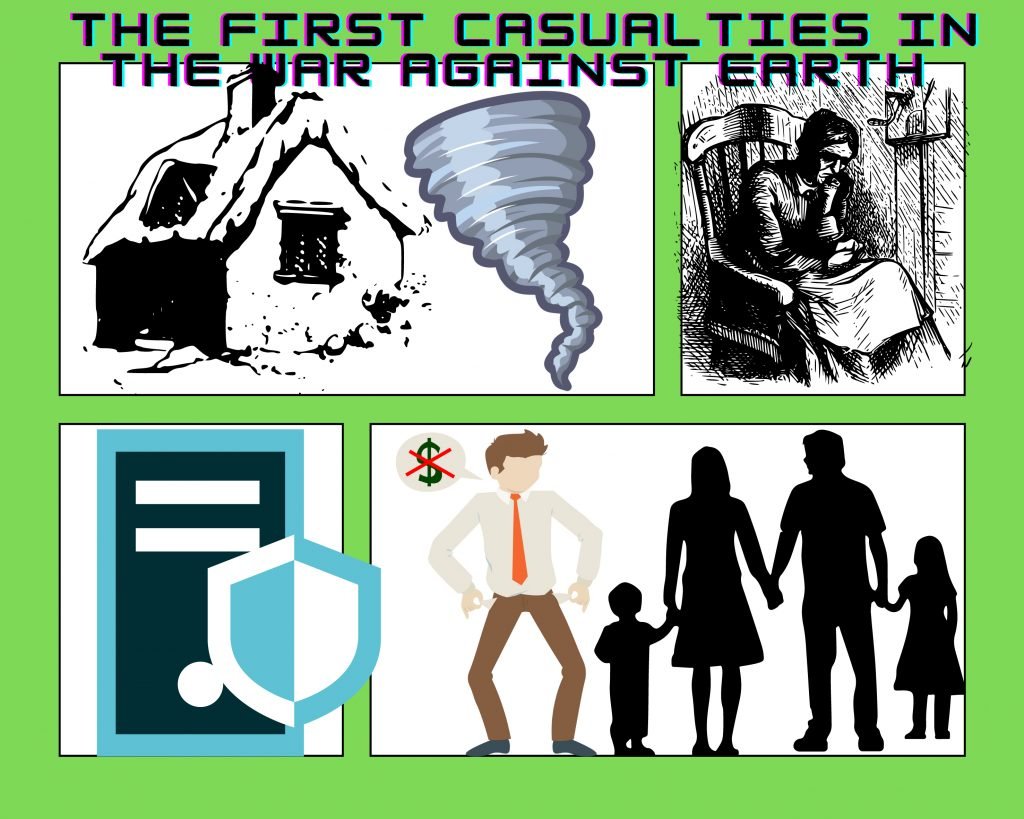
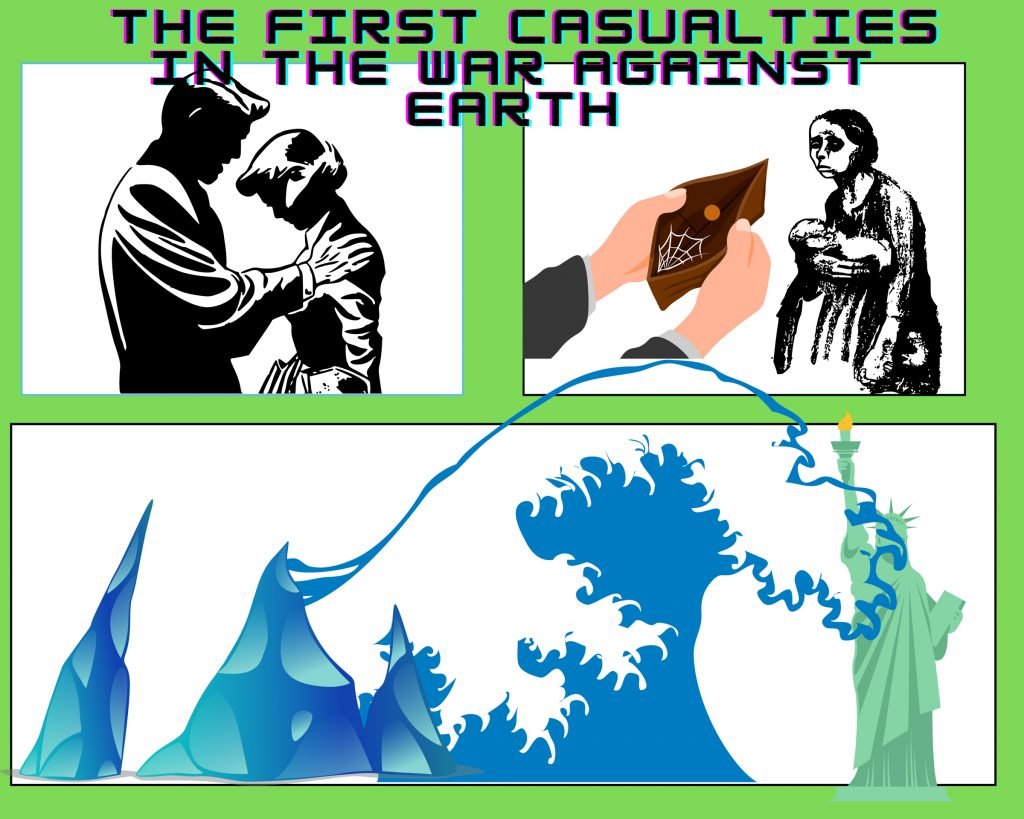
Art and poem by Daniel Liu, age 16, New York.

Wind blows from the four corners of the earth

With the roar of a thousand lions

The house stands in the aftermath

Partially caved in

The family laments their loss

Mother Nature will not be denied

Ink pens scratch on paper

Now their fate is in the hands of companies

Premiums and deductibles

The economic jargon of insurance

When it is time to cover damages

They cringe and make excuses

The desperate family feels the vicious sting of betrayal

When Insurance blacklists the entire zip code

Businessmen reassure themselves of their morality

Accepting this debt will only cause their bankruptcy

But what of

The newborn baby, still fresh from the womb

The elderly grandparents, who have worked decades to afford the house

The first casualties of the consequences of the war humans wage on the planet

How long must the injustice go on

How many icebergs must melt

The gushing stream of the Earth’s blood

Will overwhelm us if change is not forthcoming

Art and poem by Daniel Liu, age 16, New York.

Daniel Liu adds:

“I am a sixteen year old writer that lives in New York. I am very passionate about the issue of climate change, as it is an enduring issue that grows ever larger with each generation and is deserving of attention from all of society. These poems are a testament to the various consequences of climate change in every aspect of society, from agriculture to insurance. To this extent, I hope that these poems are enough to inspire a sense of alarm for the Earth’s future, but just as importantly, hope that humanity can unify in order to reverse the ecological damage that has been done. It is in times of great crisis that innovation and change are at their peak, and humanity’s resilience is shown through our uplifting moments.”

Threats, Not Peace!

By Delaney Sheldon, age 14, grade 8, Virginia


Threats, not peace
Threats of creating what we fear most—a Third World tragedy
Threats of cutting the strings that connect us all together
Threats of destroying people’s land
People’s territory

Forget about peace
Why doesn’t peace ever show up?
Why is humanity always one step from falling off the steepest cliff?
Why do we sabotage ourselves and ruin others?
Why does publicity break us down? 

Fake news
Exaggerated news
REAL news
This news is very real
This news disrupts all peace that ever could be

So, what are we supposed to do?
Fight?
That’s not peace
Do we cut them off from the world?
And risk getting cut off too?
Definitely, not peace

Why should we even save them?
What have they done for us? 
If we throw the lifesaver to them in the deep water 
We could drown instead, sink straight to the bottom

But humans should save each other
Give them air
Bring them to the surface
Save them from their greatest fears

It’s our job as human beings
To let our humanity show
And to try to have peace on Earth
Because peace unites us all as one

Should LGBTQ+ Be Taught in Schools?

By: Lucille Amato, age 11, New Jersey.

Imagine that a young girl, with a normal life, has just come out as a part of the LGBTQ+ community to her classmates. That girl’s life has just changed because she has discovered something new about herself, but the needed support from her peers is nowhere to be seen. The classmates who don’t understand, give her weird looks, the classmates that do, sit in silence. Even the teacher is confused because that teacher was never taught about what LGBTQ+ means. Because of all this, the girl who expected support from her friends is left in awkward silence, feeling like she isn’t normal. LGBTQ+ is a community of people who have a gender or sexuality that is different from what people think of as normal. Plenty of people know this but a lot are unaware. This leads us to the question, should LGBTQ+ be taught in schools? Yes, definitely! There would be less bullying and happier students that are more prepared for the real world if we teach LGBTQ+ in schools!

My first reason is that there would be less bullying if kids learn that being LGBTQ+ is normal at a young age. According to StopBullying.gov 32% of bullying is directed towards kids that are a part of the LGBTQ+ community. Kids make fun of what they don’t understand so if they already know about LGBTQ+ then much less bullying would take place. If less bullying took place, it could also lead to better student grades and attendance rates. Because of school bullying, kids get anxiety which causes a lot of stress. All this stress can lead to lower grades. Also these LGBTQ+ bullies can cause kids to fake sickness or stay home just to avoid school. School should be a safe place to learn and have fun, and a student should never have to wake up with fear of going there.

Another reason is that if we teach LGBTQ+ in schools, it helps kids come out of their shells faster which makes students feel more comfortable, not just in school, but anywhere! Many kids suffer from wondering about their genders and not knowing can cause a lot of stress. Some students know that they are not comfortable with their assigned gender from birth, but they don’t know what that means. Thoughts such as “Do I like being a he/him or should I be a she/her or a they/them or maybe none of them? I don’t understand all of these pronouns!” go through some students’ heads every day. If it was taught in school they could understand more and know that they have support from teachers and their peers. Also it could make it so much easier for a kid to come out if their peers already knew what LGBTQ+ means. A kid shouldn’t be forced to keep explaining what their pronouns mean or what their sexuality means. If kids already knew then all these questions wouldn’t have to be asked.

Lastly, LGBTQ+ should be normalized so students can be more prepared. When a kid is young they are more impressionable so it’s best to normalize the LGBTQ+ community at elementary school ages. For example, most kids grow up with “boy” and “girl” being the only two genders and only boys and girls date each other, but when they grow up into the real world, they are going to be very surprised
There are many pronouns people can use and anybody can date anybody. Schools are meant to teach students and prepare them for the real world so normalizing the community should be one of the
priorities.

Although some religions might go against the LGBTQ+ community, kids have the right to learn about it. I know certain religions state that a member of the religion cannot be a part of the LGBTQ+ community but that doesn’t mean they can’t support it. Of course schools should never force someone to do anything that goes against their religion, but learning and supporting the LGBTQ+ community doesn’t make you a part of it. Also if parents truly refuse to let their children learn about LGBTQ+ for religious reasons they can always put them in a private or religious school. Even if religion is the reason a few parents wouldn’t want their child learning about the LGBTQ+ community, that’s not an excuse not to teach it. When it’s taught you will have happier students who are bullied less and are more prepared for the real world.

This community is constantly growing and more and more people are feeling comfortable with expressing their true colors. The world is changing so, don’t you think it’s time schools changed too? Schools would benefit so much from teaching students about the LGBTQ+ . If you also believe that schools would benefit from less bullying and happier students who are more prepared for the LGBTQ+ filled world, then spread the word! LGBTQ+ should be taught in schools!

You can visit https://www.hmhco.com/blog/ways-to-support-lgbtq- students-to-feel-safe-in-school for more information.

By Lucille Amato, 11, New Jersey.

Lucille is an AFAB (Assigned Female At Birth) who identifies as non binary and uses they/them pronoun.

Celebrating Women’s History

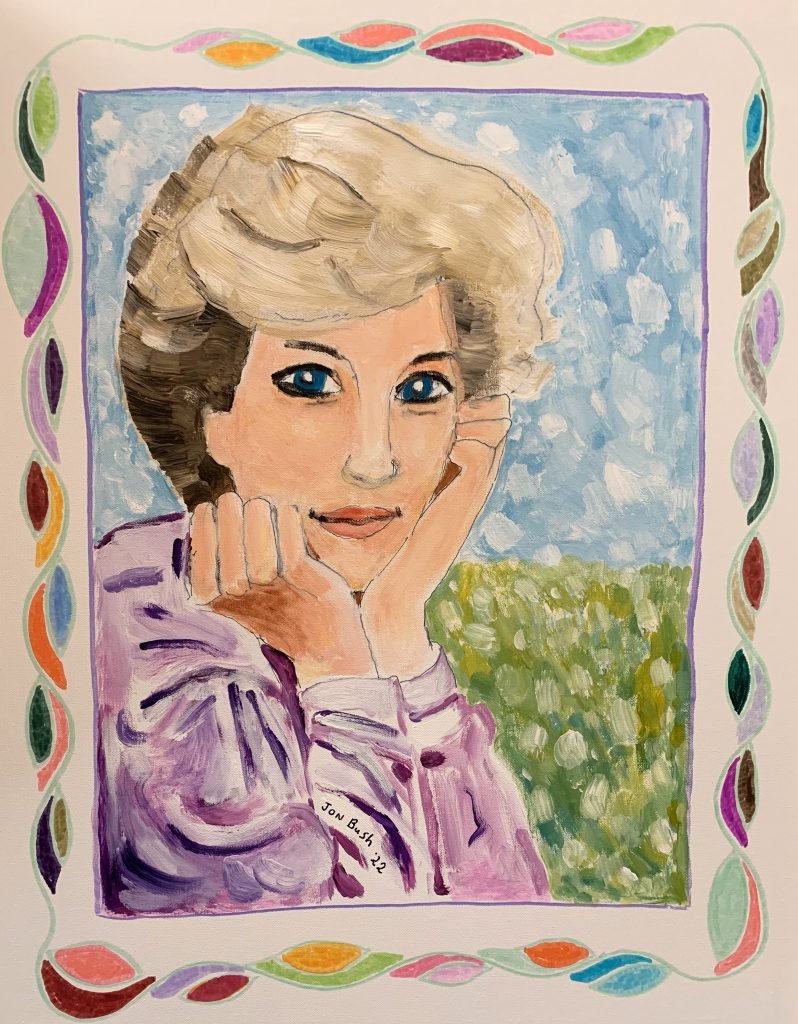
Princess Diana (1961-1997)

Princess Diana (1961-1997). Portrait by Jon Bush, Massachusetts.

“Carry out a random act of kindness, with no expectation of reward, safe in the knowledge that one day someone might do the same for you.”

—Diana, Princess of Wales (1961-1997). She was a member of the British Royal Family and mother of Prince William and Prince Harry. Her kindness, activism and position made her an international icon.


Justice Ruth Bader Ginsburg

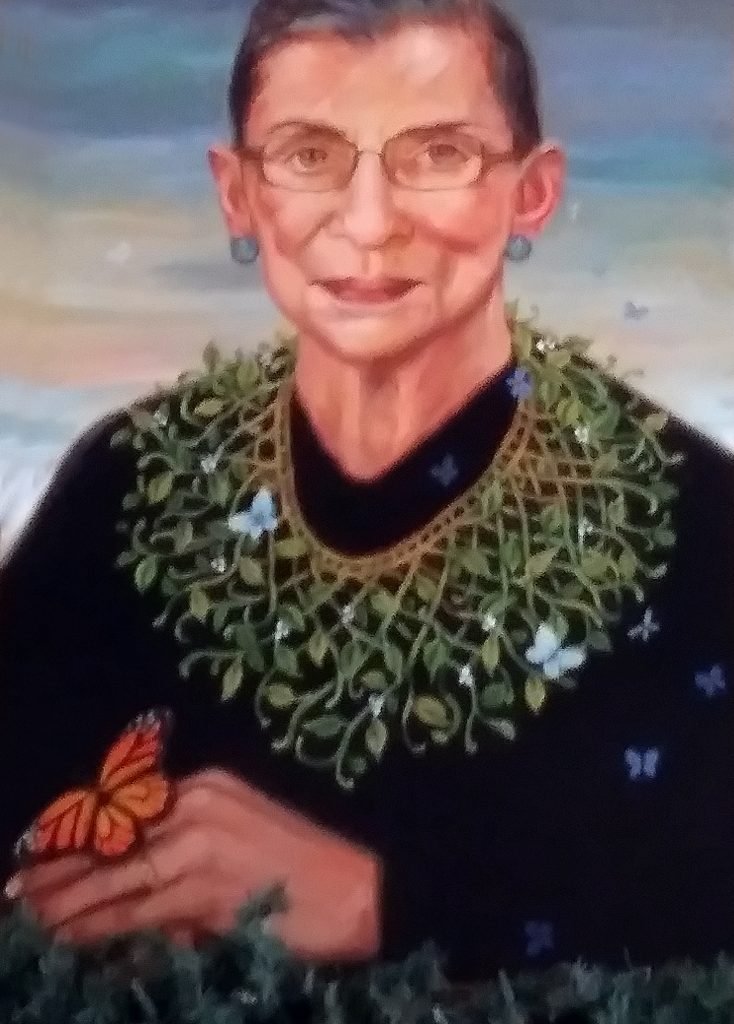
Portrait of Justice Ruth Bader Ginsberg by artist Alix Mosieur of Loraine, Oregon.
Ruth Bader Ginsburg (1933-2020) served as an associate justice of the U. S. Supreme Court for 27 years. She was appointed by President Clinton and became the second woman to serve in this important judicial capacity after Sandra Day O’Connor. Justice Ginsburg was a well-known champion of gender equality and women’s rights. She died on September 18th, 2020, at the age of 87, after her battle with pancreatic cancer. You might like to watch RBG (2018), a documentary about her life. 

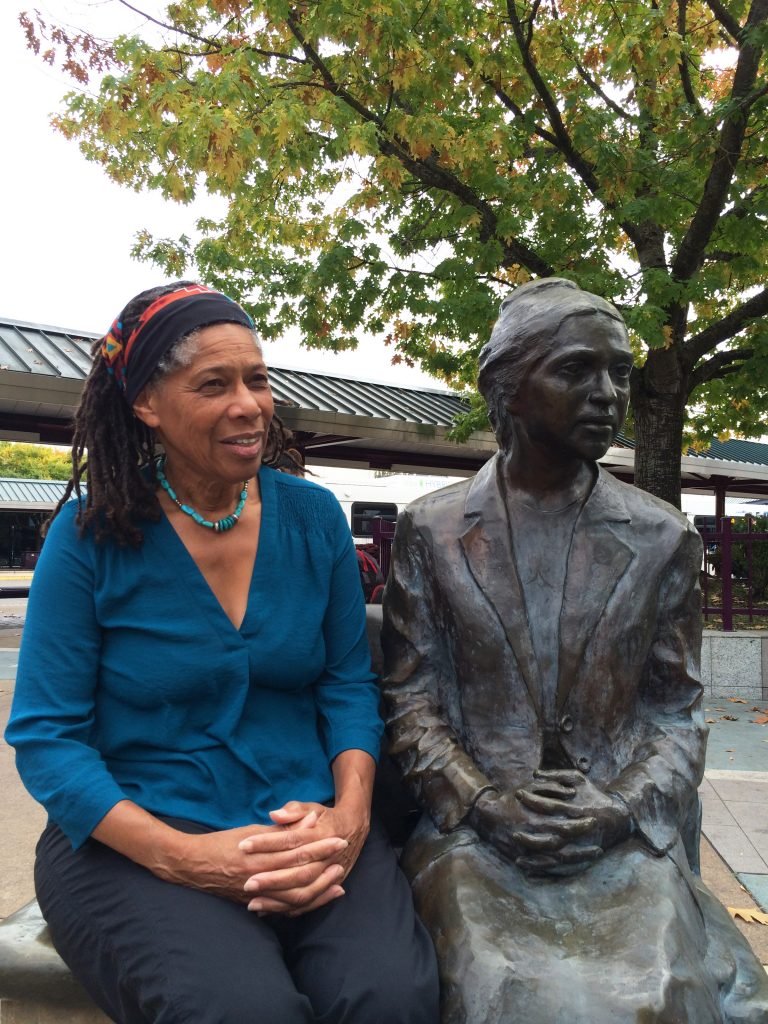
Rosa Parks (Feb. 4, 1913 – Oct. 24, 2005)

Dr. Jean Moule (sitting next to Rosa’s statue outside the Eugene LTD Bus Station, above) writes in her Skipping Stones magazine (April – May 2015) column, “Rosa Parks (Feb. 4, 1913 – Oct. 24, 2005) has become a symbol of the Civil Rights Movement and an international icon. She is an image of one lone person taking a stance that made a very big difference. She was sitting in a part of the bus that allowed Colored (African American) people unless it was needed for a White rider. When she was asked to move back to make room for a White passenger she would not. Rosa was 42 years old at the time and she was no more tired than anyone would be after a long day of work.

Rosa said, “I did not want to be mistreated, I did not want to be deprived of a seat that I had paid for. It was just time… there was opportunity for me to take a stand to express the way I felt about being treated in that manner. I had not planned to get arrested. I had plenty to do without having to end up in jail. But when I had to face that decision, I didn’t hesitate to do so because I felt that we had endured that too long. The more we gave in, the more we complied with that kind of treatment, the more oppressive it became.”

You can read Professor Jean Moule’s Nana Jean Columns in her latest book, Seeking Warmth and Light. FMI moulej@oregonstate.edu.

Multicultural Museums: Helping Make Sense of Our National Identity

By Skipping Stones Staff

Museums can provide an essential, interactive, and engaging way to learn about cultural history—both for our own culture, and the culture of other people. Without knowing our history or roots, we may not fully feel like we belong—especially if we have differences from other people in a society (ethnicity, heritage, etc.). Many museums in the United States help teach about the multicultural history of the country. Some of these museums are located in the nation’s capital—Washington, D.C. They include the National Museum of African American History and Culture, the National Museum of the American Indian, and the United States Holocaust Memorial Museum, among others. If you get the opportunity, take time to explore them!

1. National Museum of African American History and Culture

One of the newest additions to the Smithsonian family of museums is the National Museum of African American History and Culture. It shows the history of African Americans, from the first slaves brought over to the U.S., to the reconstruction era after the Civil War, and the civil rights movement of the 20th century. The museum helps visitors understand the impact of these experiences through stories, interactive exhibits, and the overall atmosphere. Many visitors say the experience is very powerful. and that it helped them better understand the history of the United States, because the history of the country has been significantly impacted by the history of African Americans.

The museum also contains exhibits and cultural items showcasing the lives of famous African Americans, from basketball player Kobe Bryant to singer Chuck Berry. It shows how these cultural icons have contributed to American culture and inspired countless people of all races, and it teaches about the racial barriers they faced in climbing to their success.

The museum also shows how African American culture is not just a unified block. There are different African American subcultures in various regions of the country. We see how geography affects the traditions, identity, and community of a group of people. Thus, African American culture in Chicago will be very different than in Birmingham, Alabama, for example.

The National Museum of African American History and Culture not only helps African Americans better understand their own history, but it also helps people of all races understand the contributions of African Americans in shaping the country’s culture and history.

Museum Website: https://nmaahc.si.edu/

Digital Resources from the Museum: https://nmaahc.si.edu/explore/nmaahc-digital-resource-guide

2. United States Holocaust Memorial Museum 

Another museum that tells the powerful story of a people is the U.S. Holocaust Memorial Museum. It offers visitors a glimpse into an event that killed six million Jews—approximately two-thirds of Jewish people in Europe, during the 1930s and ‘40s. The museum depicts some of the events leading up the Holocaust, the horrors of the genocide that occurred, and how the events of that time shaped global history and culture. The exhibits help us understand how and why the Holocaust occurred and how to ensure something like that does not happen again. To that end, there are also other exhibits that detail types of genocide occurring in the present day, in places in the world.

One floor of the museum is dedicated to understanding how the Nazi Party gained power in the 1930s. This is particularly poignant because it shows how blind hatred for a group of people can lead society to allow extremist governments into power. Obviously, it is possible for this to happen again, unless people avoid getting complacent when they see hatred swelling in a society.

Another floor is dedicated to showing the Nazi’s policies towards Jewish people, including their ostracization, relocation to concentration camps, and mass murders. The final floor covers the liberation of Jewish people from concentration camps and the events after the Holocaust. The museum depicts these eventsthrough photos, Holocaust artifacts, historical footage and commentary.

The museum also hosts conversations with Holocaust survivors to provide first-hand takes on the experience, and has special exhibits dedicated to other genocides around the world, including those occurring in Burma, Sudan, and other places. Furthermore, it has online exhibits that generate further discussion about events and people related to the Holocaust, including Anne Frank, the 1936 Olympics held in Nazi Germany, and global responses to the event.

Visitors to this museum come away with a much better appreciation for the specific details of what occurred during the Holocaust and why it is so important to be aware of what is going on in the world today, so we can avoid another atrocity like this from happening again.

General Museum Website: https://www.ushmm.org/

The online exhibits can be viewed at: https://www.ushmm.org/information/exhibitions/online-exhibitions

3. National Museum of the American Indian at the Smithsonian

Located in Washington, D.C. with a branch in New York City, the National Museum of the American Indian is also a part of the Smithsonian Institute. This museum presents a lot of information that is left out of school textbooks about the history of Native Americans, Native American treaties, how Native Americans viewed the relationship between people and nature, and more. It’s the first national museum dedicated to Native Americans and has a series of rotating exhibits that ensure during each trip you take there, you learn something new. 

As the first national museum in the country dedicated to Native Americans, it not only contains objects, photos, media, and videos about Native Americans who lived on the land that is now the United States, but it also offers exhibits about Native people from what is now northern Canada all the way to the southern tip of South America. The exhibits don’t just show people the ways of Native American life, but they also give a taste of the Native American spirit. People who have Native American heritage can learn about their ancestors and get in touch with that aspect of their culture; People who don’t have that heritage can learn about the unique traditions, perspectives, and ways of life of people who lived in this part of the world long before European settlers arrived.

Museum Website: https://americanindian.si.edu/

Online Resources: https://americanindian.si.edu/online-resources/exhibition-websites

4. Latino Museums

Additionally, a new Smithsonian museum, the National Museum of the American Latino, will be constructed in Washington, D.C. Although an opening date is not yet available, the museum will be dedicated to showcasing Latino history, art, culture, and scientific achievement. It aims to show how these contributions have influenced American culture overall.

While it won’t be ready for a while, there are many other museums around the country that you can visit and learn about Latino heritage. One of these is the Mexic-Arte Museum in Austin, Texas. This museum strives to preserve Latino and Mexican art and cultural artifacts, and it also aims to engage with the community in discussions about Latino heritage. In addition to showing the art of various Mexican and Latino artists, it conducts outreach events, cultural programs, and hosts speakers. Some of the rotating exhibits contain work by up-and-coming artists and teenagers. Others focus on showing the variety of traditions and lifestyles within the Latino community. Visitors get a much richer appreciation of the diversity of Latino culture.

Museum Website: https://mexic-artemuseum.org/

Mexic-Arte Online Exhibitions: https://mexic-artemuseum.org/online-exhibitions/

National Museum of the American Latino Museum: https://latino.si.edu/about/national-museum-american-latino


Museums can be powerful learning experiences. We often may walk out of the doors feeling solemn, as though we have learned something important, because we see in vivid images and stories how various ethnic groups have been treated or persecuted. Many ethnic groups have faced violence simply because of who they are. Visiting museums is an enriching experience, providing a detailed knowledge about the history of different cultures in a way we do not get at school.

Keeping Sane in a Digital World

By Skipping Stones Staff

In our society, we are constantly glued to our screens—phones, computers, and tablets (in addition to television). Thanks to online and remote classes, pandemic lockdowns, and restrictions against in-person social gatherings, our screentime has greatly increased during the COVID-19 pandemic. There is much research that shows how this negatively impacts peoples’ mental health, physical wellbeing, and brain development—especially for teenagers. In this era of reduced in-person contact, where our daily lives often revolve around a screen, it can be hard to stay sane and safe. But it is very much possible with some effort and support.

Screentime. One effective way to do this is to set screen limits on the amount of time we spend on our phones, computers, and social media. Some days it may be hard to do, especially if we need to finish schoolwork or have a looming deadline. However, just the act of setting limits can help us reduce our screen time, even if we are not always able to fall within those limits. The result of setting limits is often a self-imposed pressure to finish a project faster or work more efficiently, and thus help make us more productive. There are settings on your phone and apps you use to help set screen limits and keep yourself accountable. If you do this, you may find that you get work done more quickly and have more time to engage with friends, family, and the real world.

Bedtime is Not Screentime. Another way to protect against too much social media or screentime is to end each day away from your phone or computer before you go to sleep. It may be difficult at first but you will feel so much more meaning in your life if you set time to engage with the real world. For example, instead of scrolling through Tik Tok or Instagram right before you go to bed, consider reading a book, playing with your pet if you have one, drawing, or even journaling about the highlights of your day. Not only will this help you sleep better and relax your brain, but you will likely find yourself being more fulfilled because you are able to engage with the real world in some way.

TV and News. We are constantly checking for the latest news and events around the world. Since the news has been so gloomy, especially the last few years, it can be easy to let this get us down and affect our moods. However, it is important to remember that news organizations try to frame news events in ways that get their outlet the most attention, so we should always be critical of how we understand issues. See if there are exaggerations or hyperbole in what you are watching or reading. Also, if you find yourself feeling extra gloomy or consistently depressed because of the news, take a break from it. After all, you won’t be able to solve the issues in society or the world if you are not doing well yourself.

Friends and Likes on Social Media. Another reason that the Internet, particularly social media, can be a toxic place is that young people often put too much stock in how much engagement they get on their social media posts. Many base their self worth on whether they get lots of “likes” or comments on social media posts. However, it is important to not get too caught up in this, as the number of “likes” or comments you get does not reflect reality. There are a number of factors that affect who your posts will even reach, so some of your best friends might not always even see your posts. Therefore, it is not beneficial, healthy, or accurate to think people care less about you just because you don’t get as much engagement on your social media posts. Conversely, if you get a lot of attention on social media, it is important to avoid getting caught up in the hype, because it still is not real life. Just because you are popular on social media does not give you the right to be arrogant, rude, or condescending in real life. Many young people also get jealous of others based on what they see on social media. If you see someone from school posting pictures from tropical vacation trips, for example, that doesn’t mean their life is always fun and happy. They likely have their fair share of hardships, but we generally only see the fun, happy moments from people’s lives posted on social media.

Online Scams. Online scams are nothing new, but scammers are now targeting young people with sly techniques. One of these newer scams targets teenagers. Scammers might impersonate social media personality accounts, hold fake contests, or ask you to be a brand ambassador for them. They may then tell you that you won the contest, and ask for your bank account information, or for you to pay them. The best way to recognize these kinds of scams is to see if they ask you to pay upfront fees, or for sensitive information. We should always do diligent research on any communications that ask for our personal information. You might search their website yourself to see if the offer you received is real or not. Ask questions to figure out if the organization is legitimate. If they ask you for upfront fees with a promise of a prize or commission later on, you should be very wary, as it may be a scam. 

In addition to these newer scams, there are of course the older kinds, which often involve scammers sending you an email link, or unexpectedly asking you to “change a password” or otherwise provide them with personal information. You should always be wary when you get an email like this. Sometimes scammers impersonate organizations or people you know. Often, we can check the actual email address where it came from. If you get an email from a person or organization you do not recognize, do not open it and always be critical. As a rule, do not open attachments from people you do not know.

Real Life versus Virtual Life. For better or for worse, our lives are increasingly built around the Internet and digital technologies. While these technologies can help us, they can also degrade our mental health and quality of our friendships. Texting friends or seeing their Facebook messages, for example, is not the same as going for a hike with them. By setting limits on screen-time and social media use, remembering that social media is not a true depiction of your life or the lives of other people, and making time to engage with the real world, we can help maintain fulfilling lives. In addition, being critical of what you see online is very important, whether that’s from friends on social media, or messages from potential scammers.

We believe being aware of these issues and having media literacy can help you keep your personal information, money, and mental health protected.

Perhaps you might get some recommendations from a trusted adult—teacher, librarian, counselor, or a parent—about resources to learn more on this vital issue.

Snap Out of It

By Bella Melardi, Grade 11, Ontario, Cananda

Information is resistance. It will open our eyes. Awareness is change. The first step to solving a problem is acknowledging there is one. Let the existence of the climate crisis sink in. This is a reality check. Get out of your own heads. Snap out of it.

People’s lives are at stake. Climate change doesn’t affect everyone equally. People in power and people with privilege will not feel Mother Nature’s wrath the way minorities do. People will use their wealth and privilege as ‘band aids’ to block out destruction.

You can already see the effect that pollution is having on minorities in Canada. McGill Daily states, “In October 2020, over 250 Neskantaga residents were evacuated and transferred to a hotel in Thunder Bay after “an oily sheen was found in the Neskantaga water reservoir;” “high levels of hydrocarbons” were discovered in the water after testing.” The chemicals we created are destroying communities. They are festering in our waterways like tumors, spreading disease.

This destruction can also be seen through the construction of Line 3. Line 3 is a pipeline expansion that was just completed in September 2021. This pipeline will transport almost a million barrels of toxic tar sand oil per day from Alberta to Wisconsin. An oil spill would mean damage to coastal communities (near Lake Superior) and the wildlife, such as salmon and orca . StopLine3.org states, “Line 3 would violate the treaty rights of Anishinaabe peoples and nations in its path wild rice is a centerpiece of Anishinaabe culture, it grows in numerous watersheds Line 3 seeks to cross. It’s well past time to end the legacy of theft from and destruction of Indigenous peoples and territories.”

It is disgusting that our government allowed this pipeline to be built. They choose oil over preserving life! The people in power have to wake up! We have to find a new renewable resource. We have to act now. Researchers have found that we’ll likely cross the threshold for dangerous warming between 2027 and 2042. In 2042, I will only be 35 years old.

If you leave it up to my generation, it will be too late. We must all do better. Urge your elected officials to remove Line 3. Urge them to create a plan to invest in solar, wind or hydropower. We must switch to a renewable resource now! Increase the carbon tax. Instead of using tax dollars to invest in Line 3, the government should have used them to benefit the future of society. The Canadian government has to make stopping climate change a priority.

I want to help stop this but I feel so powerless. Corporations value making money over the future of their children. They value making money over minorities’ lives. Capitalism has caused people to become so consumed with greed. They are putting lives at stake. Mother Nature is bleeding. Humans are tearing out her skin and cutting her flesh. The earth is coughing up ash and choking on our greed. When will the earth’s heart give out?

This is my final plea to the people in power. You are selfish. You are killing us. You have already ruined the lives of countless Indigenous communities. You may not be affected by climate change right now but Indigenous people are. My generation will be. Our futures will rise up in flames. I don’t understand why you can be so selfish? Was it worth it? I hope you’re happy. You are exchanging lives for dollars. I hope it’s worth it.

We have to end the cycle of greed and suffering. Information is resistance. Open your eyes. Awareness is change. Use this awareness to get out of your own heads. Remove the shackles of greed that are binding you to your destructive choices. Think of the world around you. Here is a reality check.

Snap out of it.

Bibliography

Canada, Environment and Climate Change. “Government of Canada.” Canada.ca, Gouvernement Du Canada, 3 Mar. 2021, https://www.canada.ca/en/environment-climate-change/services/environmental-indicators/progress-towards-canada-greenhouse-gas-emissions-reduction-target.html

Board, Editorial, and Editorial Board. “Neskantaga First Nation Still Doesn’t Have Clean Water.” The McGill Daily, 22 Jan. 2021, https://www.mcgilldaily.com/2021/01/neskantaga-first-nation-still-doesnt-have-clean-water/

Three Things I Wish I Knew before College

Career Paths Are Often A Twisting Journey

You have probably been asked, “What do you want to be when you grow up?” quite a few times.

How many times has your answer changed over the years? 

Most of you who haven’t graduated high school yet probably haven’t been exposed to the variety of career types that you could choose, but people still expect you to answer their question. The rush to choose a career doesn’t just appear in casual conversations. It also manifests in the way our education system is set up, often forcing you to choose a career path without experiencing real world jobs. If you choose to go to college, you are often required to pick a major just a year or two in, but does this mean you are locking in your whole future career based on a few college classes you took? 

In general, the major you choose in college has a substantial impact on your future career path, but I think the idea of choosing a career before fully experiencing it is not always a recipe for satisfaction in life. While students can experience some aspects of a few careers through job shadowing or internships while they are in school, opportunities to see what different types of real-world career paths are like are limited.

Looking back on college, there are several things I wish I knew in order to better set myself up for success afterwards. You might find something useful among these things

#1. Many jobs are very different from the way in which related academic subjects are taught in school.
One thing I wish I knew is how studying a subject in school does not always prepare you to work in that field. For example, many geology majors who take non-academic jobs after college, work in the environmental consulting field, where instead of applying what they have learned about tectonics or landscape formation, they might end up analyzing chemical contamination near factories or chemical plants. This happens to be the kind of work I did after college, but unfortunately, none of my professors in college or graduate school told me how different that work would be from what I learned in school. In fact, most of the work I did for my job were things I never even came across in school.

This disparity between ‘textbook knowledge’ from studying a subject and the way real world jobs are set up is not limited to geology and environmental sciences. As an example, many math majors end up working as accountants after finishing school. While they might utilize their analytical skills to do bookkeeping or prepare financial documents, it is a far cry from the differential equations or linear algebra that brought many of them to the subject in the first place. 

Schools and colleges should spend more time not only introducing students to new academic subjects, but also showing how that knowledge could be applied in the various jobs/careers. That would be beneficial for students as future workers and also help keep them more engaged in classes because they would see the tangible utility of what is being taught. 

Of course, not everyone attends a four-year college. Some might attend community college, or go to trade or vocational schools to become electricians, plumbers, technicians, etc. Others might work in a family business or start their own business. These are all valid options; we all have different goals in life, and each option could lead to happiness and success. Those who do attend college often pick a major based on whether they like a certain academic topic. This leads to the second thing I wish I knew.

# 2. It is important to see first hand what kind of job you want to get.
Because real world jobs can be very different from academic subjects, it is important to understand where you want your college degree to take you and what kind of job you want it to lead to. If you don’t know that as a student, that is okay, but I’d suggest you try to watch a few people who work in the field in which you want to major. If you can, talk with them, ask them questions or even see what they do on a day-to-day basis. That way, you’d know what you are getting into and aren’t surprised when you get there as an actual employee. Teachers often focus on teaching purely academic subject matter, but I think it is a disservice to students to not prepare them for jobs in the real world. However, since this is the case, it is up to you to prepare yourself for what you may find. 

# 3. If you major in a certain field and later find out that it’s not what you thought it would be, or don’t want to work in that area anymore, there are ways to change your career.
You don’t always need to go back to school for additional training in order to switch career fields. You can focus on the transferable skills that you gained from the field you majored in, and use that to find jobs where those skills may be needed. For example, if you majored in physics, but later decide not to work in that area, you still have quantitative experience in handling real world data and uncertainties. These skills lend themselves to a career in finance, for example, where you could apply the same concepts but in a different way. However, this idea of transferable skills is not always emphasized in schools. 

Since educational institutions don’t always emphasize how to be happy in a job after school, it is up to you, the student, to learn the skills you need for a career that makes you feel rewarded or happy. Sometimes, the work we end up doing may not be the same as the subject we studied or the field in which we trained. We needn’t feel obligated to stay working in a field we don’t like just because we majored in it. There are always other opportunities to use the skills we learned, and use them as stepping stones to acquire new ones.

By Skipping Stones Staff

Readers Respond!

October 12, 2025
I just wanted to say how truly grateful we are—both Youtao and our family. We deeply appreciate this beautiful feature on the Skipping Stones website. Seeing his interview and paintings presented with such care means so much to us.
I’m touched by your dedication to young people around the world. Skipping Stones provides such a wonderful space for youth to connect, share, and learn from one another. It inspires passion for literature and the arts, nurtures creativity and curiosity, and reminds us of the profound power of words and art to connect and uplift the human spirit.
I’m so happy that Youtao can be part of this warm, creative family and contribute in his own small way. It means a lot to see him immersed in what he loves, growing and learning through this meaningful community.
Thank you again for all that you and your team do to encourage and nurture young voices everywhere. We’ll be sharing the feature with our friends, relatives, and Youtao’s school community. It’s a joy to know that his work will also appear in the upcoming print issue. We are really looking forward to it!
With heartfelt gratitude,
              —Jiaen Cao (Youtao Cao’s mother), Japan.


Sept. 4, 2025
This was our first week of school, and I just wanted to let you know that we have received the copies of the magazine, and everything has been distributed to students. This edition is really lovely. The students appreciate it as they enjoy reading the variety of stories, articles, and poetry. 
Thank you again for allowing children around the world to share their unique perspectives.
           —Yolanda Toni, teacher, Illinois.


March 24, 2025
Thank you for being a voice of hope, love, and compassion. My mail is full of pleas for my money and time; but never the glow I feel when I find Skipping Stones in the stack of mail. I am blessed to have met you. If there is a way I might promote your work, please do tell me. Keep it up, write on.
               —Cindy Kokis, Eugene, Oregon.


Dec. 29, 2024
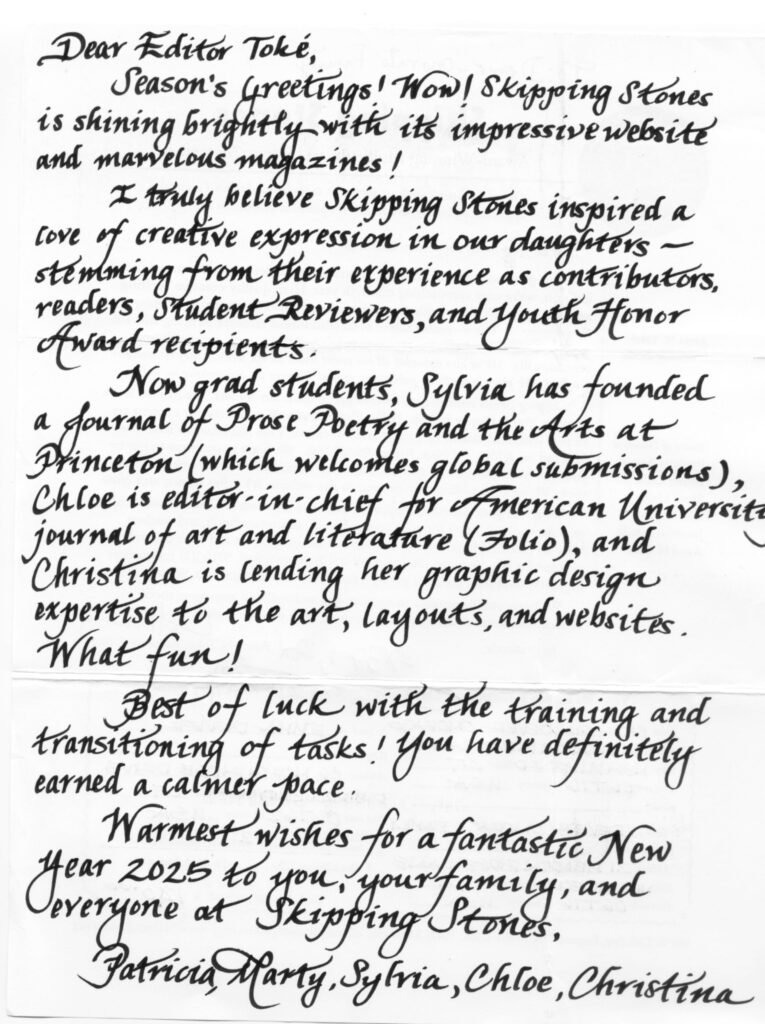
We pleased to share this letter by Mrs. Patricia Onorato of Connecticut. She adds in her email, “Skipping Stones has been—and remains—such an exciting, enjoyable part of our family’s reading over many years. We look forward to new issues and perusing your wonderful website!”


Dec. 6, 2024
Just wanted to add a note of appreciation and admiration for the last issue on 2024 Awards. Of course, I want to read each and every book, but also mention how inspiring it is to see what young people can do when they combine their hearts’ longings and experiences with their skills!! Thank you for providing this sharing place!
             —Kathy Beckwith, author and educator, Oregon.


August 30, 2024
It’s a great joy for our daughter Jessie to receive recognition from professional editors. We read through the magazine (Volume 36, issue no. 2) and felt how much endeavors you and you team devoted into it. We really love the content, seeing so many peers excel in different ways.
Great appreciation for you and your team!
             —Liping Chen (Jessie’s mom), British Columbia, Canada.


April 15, 2024
Dear Arun, what a marvelous issue of Skipping Stones (Vol. 36, no. 1). You do such an outstanding job of making known children’s perception, intelligence and amazing capacity to do good. I deeply honor you for your vision and your hard work!
              —Stephanie Tsuchida, art teacher, Oregon.


March 28, 2024

Sufyana was so happy and delighted to receive the Skipping Stones issue in the mail; thank you so much for making the effort to reach out and to send the contributor copies, they will be treasured! The array of thoughtful and beautifully written and genuine writing in Skipping Stones really impressed us!
Yesterday, Sufyana received in the mail an incredible gift of books, and she, her middle sister Aydina, and youngest sister Wilaya were overjoyed! That was such an unexpected blessing and surprise, and they began reading them right away. Thank you so much for these wonderful books!
             —Saleela S., Sufyana Johnson and family, Maryland.


March 14, 2024

Thank you so much for publishing my article (see Vol. 36, no. 1, pages 22-23), “Student Poems of Hope, Faith, and Love.”
Your publication is inspiring students, teachers, administrators, and parents across the country and around the world. There is a lot of heartfelt work, love, and dedication put into the children’s poetry and prose. The artworks—especially on the last page (p. 35), and also the back cover—are beautiful and emotionally strong and send a powerful message of courage to your readers.
And congratulations to Austin Liu for “Girl with Dukhu” front cover. I can’t say enough about the painting. This is museum quality artwork.
I’m always amazed by how much “great stuff” is packed into 36 pages. This is a credit to you and all the effort to create a fantastic magazine. After you finish reading it, you walk away feeling really good about the creativity, self-expression, and power of passionate communication.
Thanks again.
With kind regards,
            —Jeffrey Pflaum, (now retired) teacher, educator, New York.
P.S. “Peace Within, Peace in Our World.” Yes! (see Vol. 36, no. 1, page 18).


November 22, 2023
Thank you, Arun, for all the work that goes into producing this most wonderful magazine for children of the world!
            
—Cynthia Lewis-Berry, Oregon.


November 2, 2023
Thank you so much!! We are very happy to have my daughter Parnian’s first paper published in Skipping Stones. This will definitely be her life-time fuel tank to pursue her dreams one by one and use obstacles as stepping stones and jump forward like Skipping Stones!
I am honored to express my gratitude by saying that your organization has been and will be a life-changing center.
On behalf of Parnian, please thank your colleagues who made this happen. I truly believe it is an inclusively rich source of love, inspiration, and courage for anyone who visits your platform.
Good Job, Skipping Stones Team!
               —Dr. Ali Derahvasht, University of Malaya, Malaysia.


October 27, 2023
Dear Arun,
Our prayers are the best gift we can give for peace around the world. Yes, it is rather discouraging and I find that there’s only so much news I can watch on TV or hear over the radio.    
I visit your website periodically, and I am so impressed with the caliber of writing and artwork submissions posted from youngsters around the world. And it’s always a joyous occasion to receive the latest print issue in the post to hold and read. And afterwards I share the print issue with two young readers in Kodiak, Alaska. ¡Mil gracias, Arun!
With gratitude and kind regards,
            —Katacha Diaz, Peruvian American author, Oregon.


October 26, 2023
Greetings Arun,
Something I wanted to share with you; I commend you on your work with Skipping Stones. It really is a lovely venue for young writers and artists worldwide. I feel honored that I am part of it.
And as I work on reducing the stigma of mental illness, and quitting smoking, you work on creating understanding of, and between, all young people. With empathy and compassion. And there is great wisdom in all of this. We all have so much in common. In reality, each of us are branches from the same tree. And that tree is love.
So as we travel on this wandering path together, may we enjoy the simple things. And know that our children hold the hope for an even better future. I say this because my higher power—my friends and family—has given me such wonderful gifts to choose from. And there is no time for self pity. This I have learned from the children of Skipping Stones.
A slow day is a time waiting to be filled with joy. Life certainly gives us some hard lessons. Yet still we persevere. The gift is truly in the giving. And, when I give to Skipping Stones I feel happy.
Shalom,
            —Jon Bush, artist and author, Massachusetts.


Dear Arun,

If I may comment on the latest issue of Skipping stones, Vol. 35, no.1, March-August 2023:
What a spectacular display of visual and literary art! The presentations on the printed pages draws a person into reading the outstanding articles that provides one with “page turning” insights of different cultures.
           —Margaret dingus, M.A.


Dear Arun,

The Sept. – Dec. 2021 edition of Skipping Stones is the best ever. It is superb. So many of the writings brought tears to my eyes. I wish you could put out other printed editions—say once or twice a year.
Thank you for your masterful work.
           —Dr. Irwin Noparstak, Oregon.


Dear Arun,

What a joy to receive the latest print issue of Skipping Stones.  I am so grateful to be reading the Sept. – Dec. 2021 issue filled with outstanding writing, illustrations and photography from young contributors around the world.  Thank you to the editorial team!
I am pleased to make another 2021 donation in support of Skipping Stones. 
            —Katacha Diaz, Peruvian American author, Oregon.


Dear Arun,

I hope you know how much I value your work. For many years Skipping Stones has been a wonderful part of my life.
Through all of my adventures through the literary world I can honestly say I’ve never seen a magazine as open and diverse as Skipping Stones, and that is all thanks to you. It has beautiful art and intriguing stories by young people from all over the world. I have learned so much about different cultures through Skipping Stones.
Truly the children are our future. May we guide them in peace as you do. Encourage them to greatness. Support their dreams. Believe in them. What we invest now will surely be returned a thousand fold to coming generations.
When we plant the seed of hope and nourish it, that is the way to health. And when it becomes a great big tree we can say, “That was a good deed I did that day.”
Best wishes,
             —Jon Bush, artist and author, Massachusetts.