Category Archives: Children’s Art

A Journey Behind the Walls

City by Eileen Kim, age 17, South Korea
Bird by Eileen Kim, age 17, South Korea
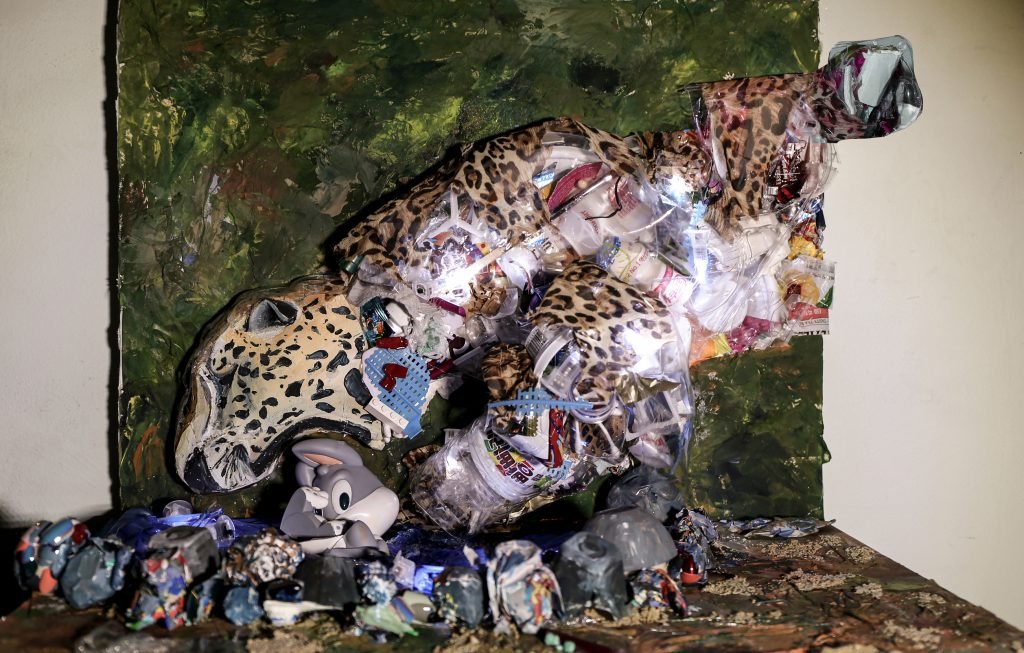
Cheetah by Eileen Kim, age 17, South Korea

A Journey Behind Walls

In recent years, the search for graffiti has taken up a big portion of my time. Within the monotony of my school routine, finding tags and art hidden in building corners or behind walls was akin to a treasure hunt. I have often taken pictures of the latest artworks I found and saved them in my photo album as if they were pieces of a collection. As an artist, I feel inspired to create my own signature style and to learn more about the interesting world of graffiti.

But, growing up in South Korea has reminded me of the impermanence of the culture here. I’ve often observed buildings being demolished and supplanted by newer, shinier structures. Stores I would visit frequently would suddenly close down, and the art that I once cherished would no longer exist. It’s unfortunate that we are so busy moving forward at a fast pace that we can’t appreciate the creations around us. Society doesn’t provide ideal conditions for graffiti in terms of conservation.

On top of the ever-changing nature of Korean street art, COVID-19 has made it even more challenging to explore as frequently as I had in the past. However, last month, I found the perfect opportunity to revisit the childlike wonder I have felt while observing graffiti. While browsing the internet, I came across tickets for URBAN BREAK Art Asia, a three-day fair showcasing street artists.

At the fair, it was almost as if time suspended, and the pandemic didn’t exist. I was surprised to see that people from all walks of life came to see the show, from teenagers donning denim bucket hats to older professionals in their weekend attire. Despite everyone wearing masks, the individuality was compelling and echoed Korean life exactly as it is—one of constant sounds, smells, and colors intermingling. The exhibit echoed the cacophony that citizens experience in their daily routine. I distinctly remember one artist playing the piano in his booth, surrounded by paintings of traditional Korean houses. Meanwhile, an underground rapper signed autographs for his fans a few booths down.

There were numerous exhilarating artists that caught my attention, but the one who stood out the most to me, personally, was a female artist named Junkhouse. Toward the end of the show, I recognized a familiar artwork hers that I’ve seen numerous times on a building during my walks home from school. Luckily, I was able to contact Junkhouse after the show, and she was more than happy to share her thought processes with me.

As Junkhouse compared graffiti in Korea to that in foreign countries, she confirmed that South Korea’s tendency of getting rid of old buildings rapidly prevents street artists from experimenting with their artwork and freely using the city as their own sketchbooks. Furthermore, with the law being strict in terms of interfering with property, young artists move further away from the traditional street art culture. Younger generation artists would rather choose social media as a way of presenting their work and connecting to the greater public.

As she spoke of her free-spirited artistic process, where she draws organic shapes onto existing structures, my mind kept going back to a recurring thought: there is always room for freedom within constraint. There exists a certain, and often justified, stereotype of Korean art as being highly elite and institutionalized. Proprietary gallery owners are often part of a closeted establishment that promote lucrative art forms, such as porcelain from the Goryeo Dynasty or paintings by artists within their inner circles. But unlike traditional art galleries holding the key to the next generation of artists, some people are ready to break the mold and directly communicate with the audience themselves—even teenagers like me.

As I reflected on my own conversation with Junkhouse and on the vibrancy of the works at the art fair, I felt encouraged to challenge my own perceptions. In a rapidly modernizing country like Korea, what would finally allow graffiti art to soar to its highest potential? As for me, what are some preconceived notions and existing barriers that prevent me from reaching my maximum potential?

The answers to both questions are yet to be found, but I am slowly on my way to discovering them. In the meantime, I have added forty new pieces of art to my virtual graffiti collection, which I can browse freely from home. These pieces serve as a reminder to seek freedom even amidst the busy days that lie ahead.

By Eileen Kim, age 17, high school junior in Seoul, South Korea. She adds:

“I am an active artist and writer who enjoys learning about the intersection of culture and the environment. Born in the United States but raised in Korea, I am a bilingual Korean and English speaker with the privilege of examining different perspectives. My interest in environmental conservation, particularly in reducing the use of plastic, has led me on many exciting journeys. Recently, using my art skills, knowledge, and love for the environment, I designed environmentally friendly, reusable masks. My ultimate goal is to create a sustainable system for the future in populated cities, such as Seoul and New York. 

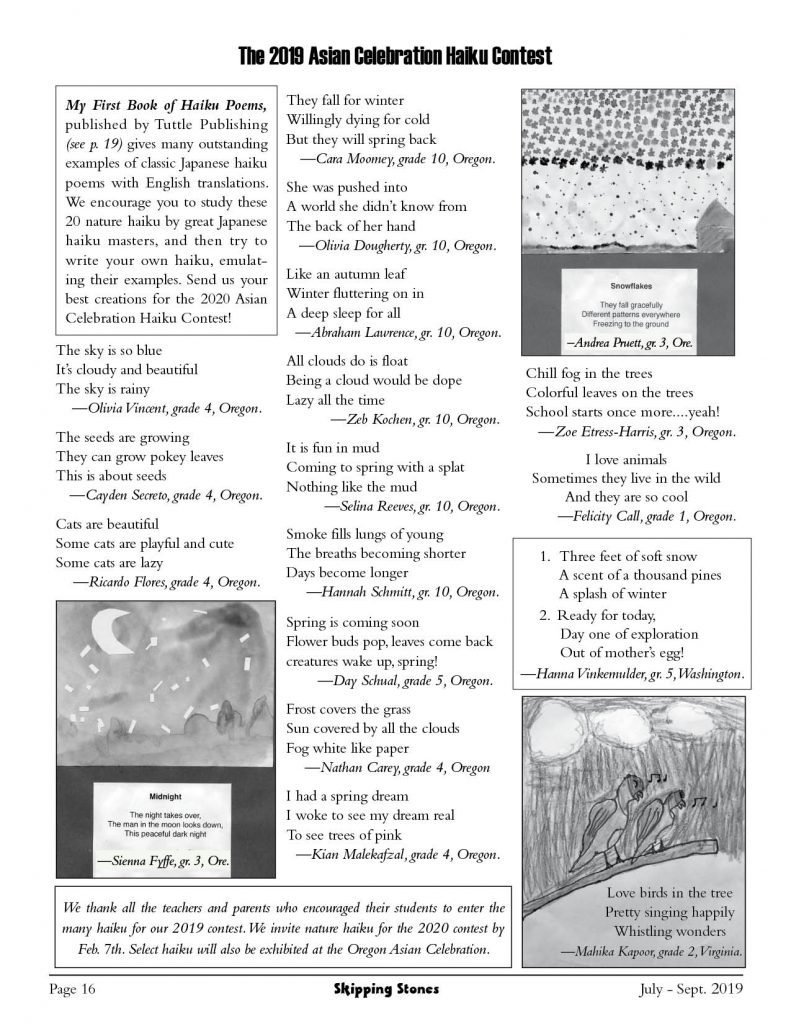
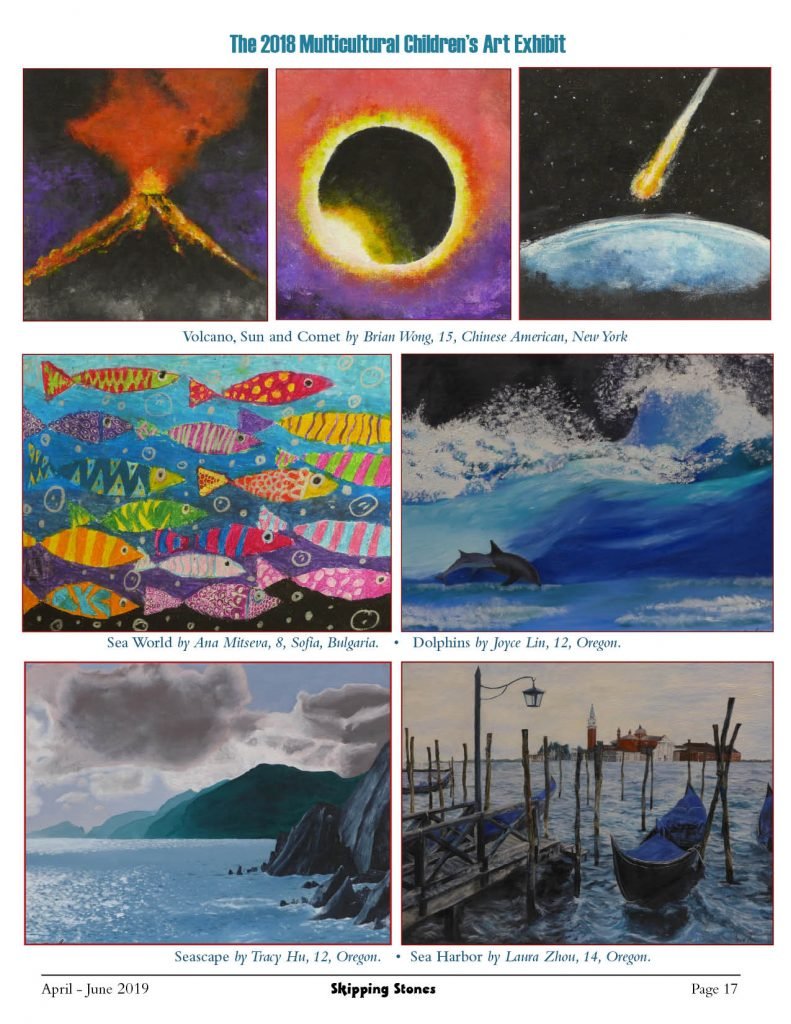
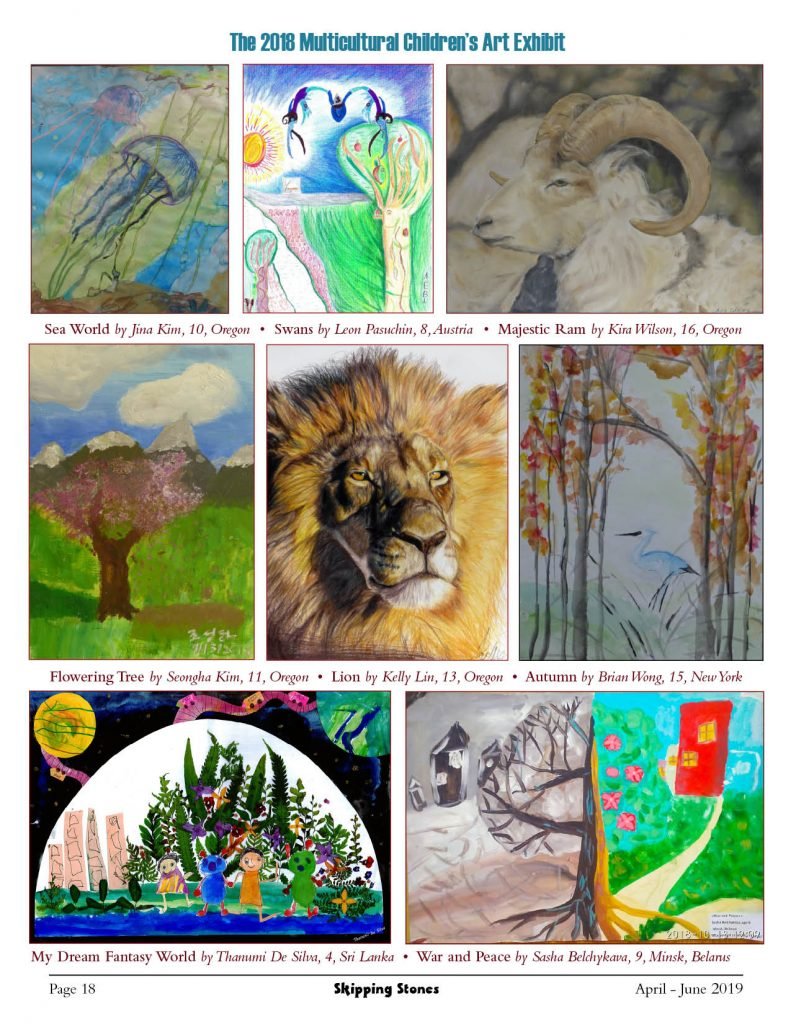
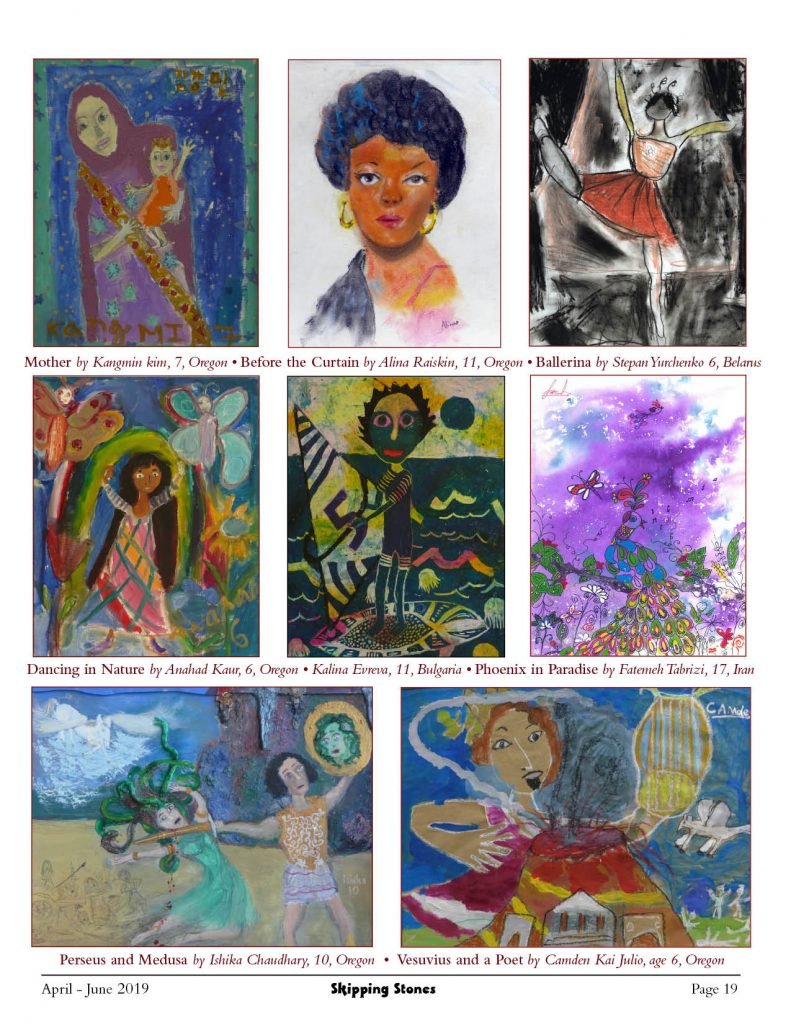
As an artist, I am also highly invested in the emergence of street art. In search of works from creative peers my age, I came across your magazine and felt the courage to submit some of my works. “A Journey Behind the Walls” details the street art culture in South Korea and how our strict society has led to a creative underground movement. Though street art is forced to take on a more limited form in Korea compared to other cities like New York or London, it is surprisingly pervasive and thought provoking.

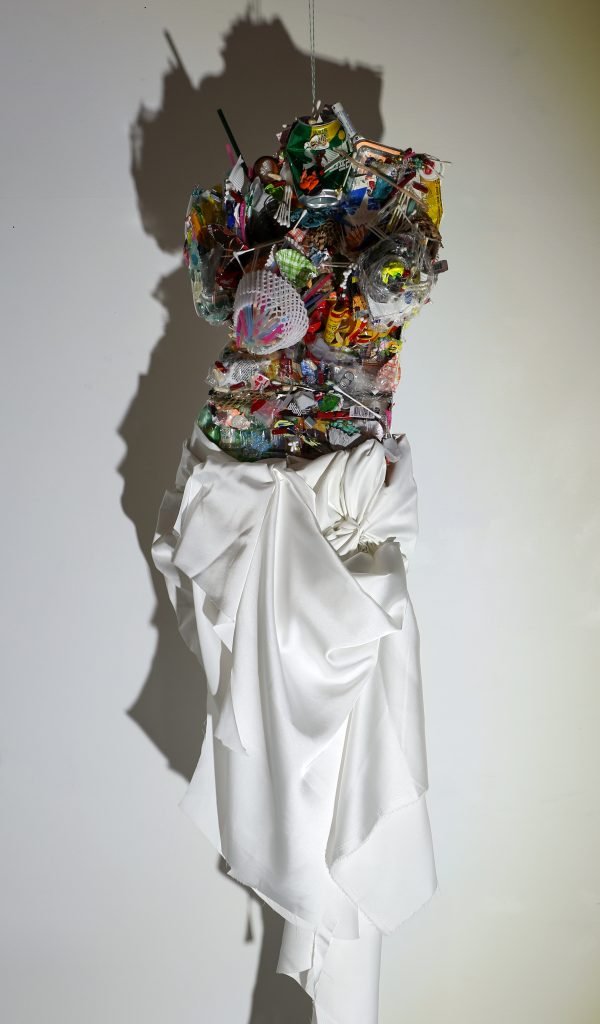
I have also attached my original artworks, “Bird,” “City,’ “Cheetah,” and “Venus.” The recurring theme of these works is the impact of the climate crisis on the ecosystem, from animals and humans to the environment itself. My essay and art attempts to relate to the universal longing of community, freedom and change.”
I’m a Young African Elephant Calf

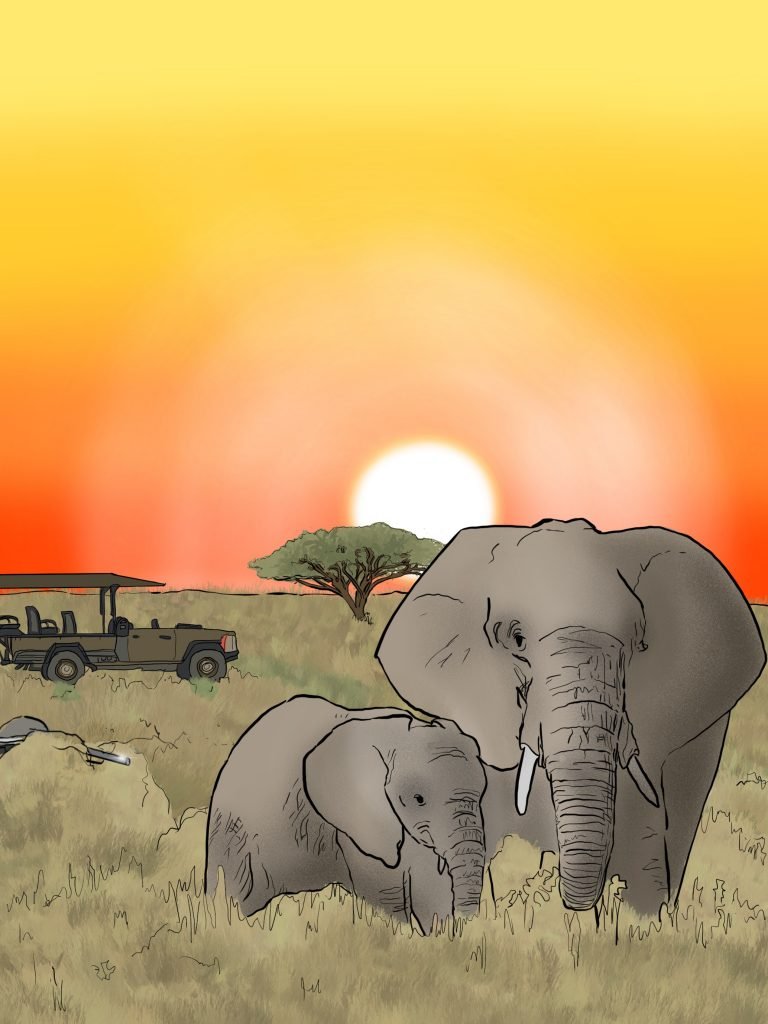
Illustration and flash fiction by Alina Yuan, 17, California.

This season, it is unusually hot. The heat of the African savanna radiates off the parched land and burns my feet with each step while the sun glares down upon us, sneering at our misfortunes. I slowly drag my feet through the dirt, feeling not soreness but numbness. Small fissures have appeared across the arid landscape. I flick my tail to shoo away pesky flies. A slight breeze blows through the landscape, flinging dust into my eyes and nostrils. But I am too tired to shake off the dust. I have gone days without food or water. My eyelids droop as a hazy feeling overpowers my senses and a dull buzzing noise echoes in my head. One of our pack buddies collapses ahead of me, breathing heavily and closing his eyes. Immediately, mosquitos start to swarm him until he takes his shaky, final breath. At this rate, I will die soon, too.

Our pack shuffles sluggishly towards a large puddle left over from the rainy season. Everyone gulps the water greedily. It is the dry season and we must keep ourselves hydrated during the drought. After drinking water, I use my trunk to pull off the leaves and twigs of an uprooted tree, and I eat with Mother and my cousins. The rest of my family stays close by, eating and keeping watch for predators. We continue our journey and trudge towards a patch of trees. After a while, I look up. The sun is starting to set, and I can sense the temperature dropping quickly.

I hear a slight rustle behind the bushes. I see a head, a human. It is carrying a long stick in its hands. It points it at our pack slowly and waits. We immediately become silent, and I turn to Mother.

“What is it doing?”

“Hush,” she says quietly, her voice trembling.

She pushes me roughly into the middle of the pack and blocks me from the human’s sight with her body.

“Is this what killed Father before I was born?” I whisper. “I’m scared.”

Mother turns to me. Her eyes soften, but I can still see her pupils shaking. She caresses my face with her trunk.

“It’s going to be alright.”

The human stands up slowly, making sure to barely make a sound. I see a piece of tusk hanging from a strand around its neck. Sheer fright envelopes me. It moves its finger.

A deafening noise startles me, and I freeze in terror. My pack scatters, frantically trying to escape. One of them falls, but I don’t know who. The human puts something back into the stick and aims again. Another blast. I turn around and run as fast as I can. More fall. My vision blurs, and I search frantically for Mother, turning in circles, bugling in panic. The screams of my brethren are muffled and drowned out by my violent heartbeat. The human appears in front of me, shooting at my relatives beside me. I scream and turn around to face the body of my dead Mother.

By Alina Yuan, 17, California. She adds: “I enjoy writing flash fiction and short stories, as well as drawing comics. At home, I love playing with my dog, a Shiba Inu, and collecting an eclectic array of stickers.

I am of Chinese cultural background, but I always enjoy learning about other cultures and issues around the world. One day, while scrolling through social media, I stumbled upon a picture of poachers hunting elephants for the illegal ivory trade. I was so appalled by that image that it stuck with me and prompted me to create art and writing revolving around this topic. Learning about cultures requires you to put yourself in other people’s shoes, and the same can be said for learning about world issues. Remove yourself from the perspective of a human being and put yourself in the shoes of the oppressed in order to learn more and practice empathy. That is how the world can progress and rid itself of evil.”

Our Buddhist Meditation Class

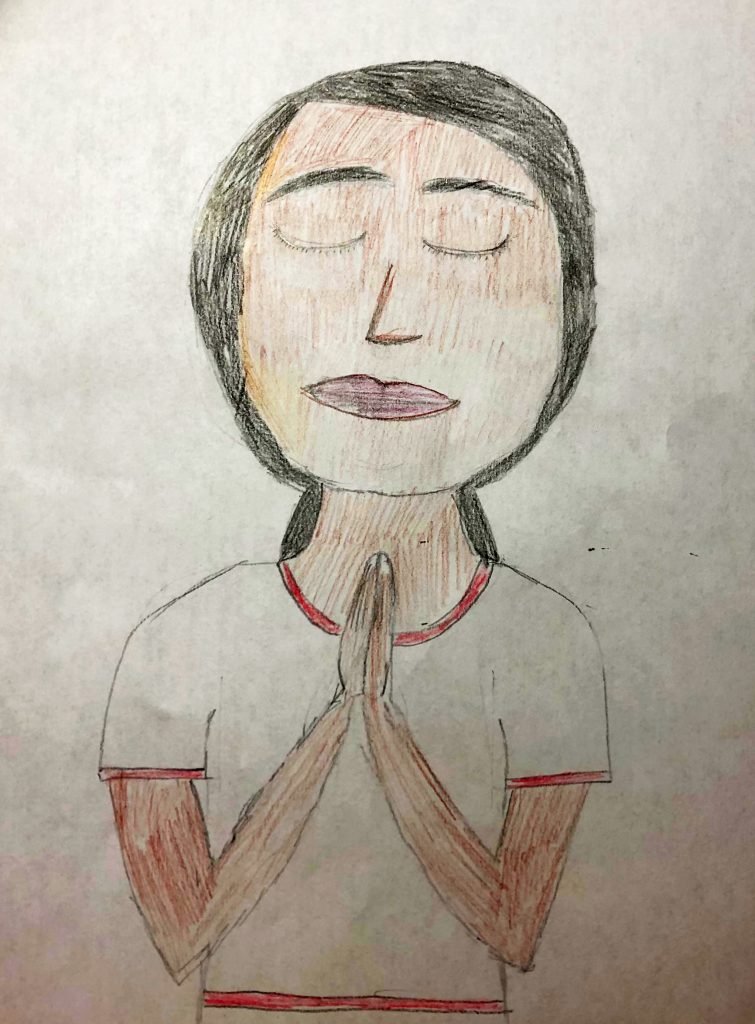
Hi my name is Seja. I am 10 years old. I live in Wisconsin, and my parents are originally from Sri Lanka. I will tell you about our meditation classes.

My meditation class is usually held once a month, on a Sunday. I get to see my family friends. The class takes place at one of the homes. A Buddhist priest comes to meditate with us and teaches us Buddha’s teachings. We call the priest a Sadhu.

When everyone arrives, we start the meditation. First, we take refuge in Buddha Dhamma Sangha. The first three lines are: “Namo Tassa Bhagavato Arahato Samma Sam Buddhassa.” And we repeat that three times.

After that we recite the five Buddhist precepts, which are:

  • I shall not kill.
  • I shall not steal.
  • I will not be greedy for worldly pleasures.
  • I shall not lie.
  • I will not take intoxicating substances.

Then we do a compassionate meditation. To begin, we say: “May I be well, happy, and peaceful. May I be free from hostilities. May I be free from afflictions. May I be free from distress. May I be capable to overcome all the difficulties in my life. May I live happily and in peace.” We start with ourselves and then wish the same for our parents, siblings, relatives, teachers, friends, and finally, for all the living beings.

After all of that I feel relaxed, calm, and happy. The priest also asks some questions. For example, he asks us to think about other kids around the world, and how hard it is for some of them to get food, clothes, go to school, and so much more. He says that we should feel fortunate for having food, clothes, a good school, etc.

I sometimes think that since I have resources that some people don’t have access to, I should take care of what I have and not waste anything. I should be grateful and not waste what I have, and also donate and help others in need whenever possible.

The priest sometimes gives us books to read. There is one he wrote that I really like. It is called, “Why Mama wasn’t worried.” It is a great story.

After we’re done with the formal part, we serve the priest Sri Lankan food. Until he is done, us kids play a little bit. When the priest is done, we eat next, and then the adults.

When everyone is done eating, the parents and the priest talk a little bit and then we all bow to the priest before he leaves.

This meditation class is very helpful to me. I learn a lot about many things. My favorite part of the class is serving the priest and doing the compassionate meditation.

Art and writing by Seja Kularatna, Age 10, Wisconsin.

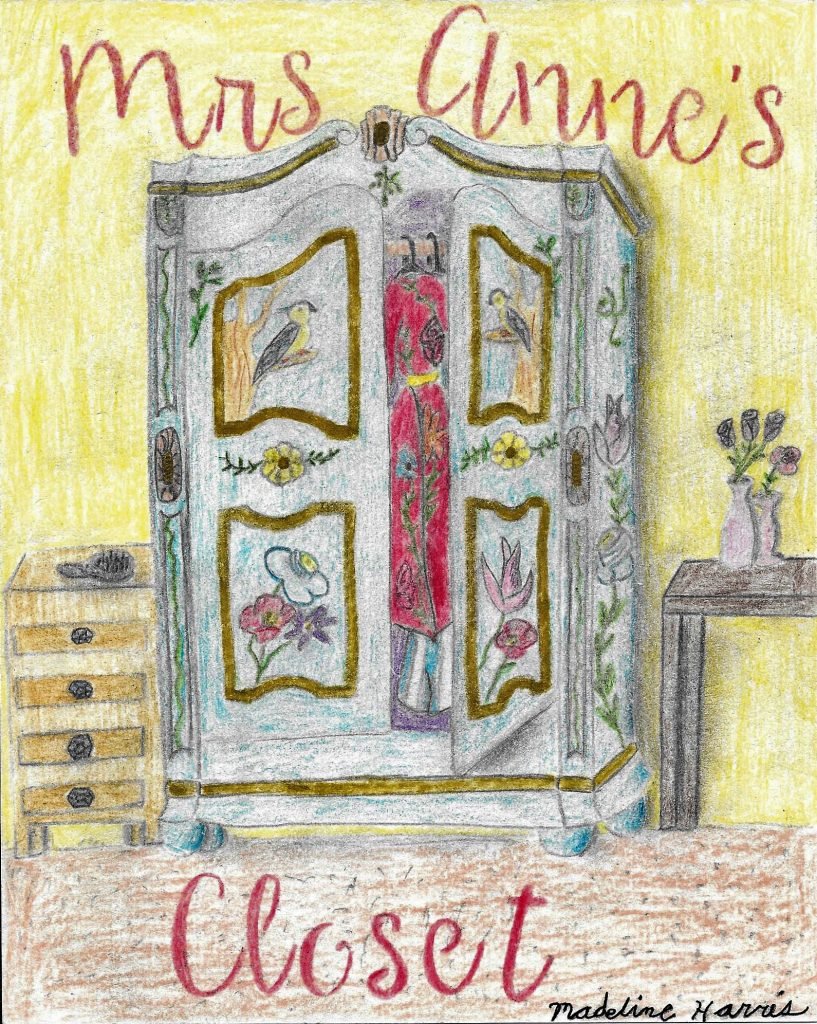
Mrs. Anne’s Closet


By Melissa Harris, Illinois. Illustration by her daughter, Madeline Harris, age 11.

Mrs. Anne’s home was like a museum. Everything I would pick up had a story. “Where did you get this hairbrush from, Mrs. Anne?” I’d ask. 

“That was Big Mom’s, my mother, and it sat on her dresser when I was a girl,” my grandma would say. 

“And now I’m the girl,” I’d add to the story, gliding my finger across the brush that was a shade between blue and gray. 

Sometimes my grandma would let me play dress up in her closet. It was a place for dreaming with your eyes wide open. “Every dress, hat, and handbag has a past, Maddie,” she’d say. “And when the time is right, they’ll be yours to own.” She opened the door to a world of fantasy held in an armoire. 

A striped aquamarine and white dress that looked like it was made for a princess. A black dress as skinny as a water hose hung next to a red kimono, draped over other hidden treasures I couldn’t wait to discover. “I know what you’re eye’n.” Mrs. Anne observed with a smirk. I ran to yank the kimono off of the satin hanger. As Mrs. Anne helped to put it on, the phone rang. She left me to the rest and took the call in the next room. 

The kimono was so oversized that it wrapped around me twice and then some. I could hear what she’d say if she was still in the room, “Maddie, you’re swallowed in memories and love.” I beamed with honor, and recalled the stories she had told me of our heritage. Mrs. Anne was Chinese and African-American. Her mom was from Arkansas, and her dad was from Hong Kong. Somehow their paths crossed in St. Louis where they fell in love. She’d tell me stories of how I descended from two groups of people who were the first to leave genetic footprints on the world, Africa and Asia. “Being the first doesn’t prevent cruelty,” she’d say, “for both countries experienced invasion and mistreatment.” My thoughts of their story swirled in chaos, so fast that my head started to ache, twisting and turning ideas into knots. My string of thoughts collided, and when they crashed, I was no longer in Mrs. Anne’s closet. I was standing at the edge of a mountain that had to be over a thousand feet high.

I was too scared to look down at first, so I slowly stepped back until my heart no longer tried to jump out of my chest. Where was Mrs. Anne? Where was I? I needed to find a trace of something familiar. I got the nerve to look past my immediate surroundings without moving a single limb. Down below was a harbor and fishing boats with the most vivid red sails. Colors blended together like a rainbow, and I couldn’t make out the body of water in front of me. A black and blue butterfly with stripes like the royal dress in Mrs. Anne’s closet fluttered by. I followed. It led to a path that curved around the mountain, probably used like an elevator to take you up or down. I crossed over to an enormous white house in the distance. Maybe someone there could help me get back to my grandma. 

Several arched windows lined the white home. A girl who looked about my age sat under a cotton tree with a book. She didn’t move when I walked towards her, just stared like a frozen sculpture. She had eyes like my grandmother with hair cut straight as a line to her shoulders. I knelt beside her and blurted, “hi.” She hesitated, then exhaled a sigh. I extended my finger towards the house. “Do you live there?” “Lin,” she said pointing to herself. “Maddie,” I responded, imitating her movements. 

Just then, a man in a navy-blue uniform slammed the side door to exit. He didn’t look like Lin. He had red hair and skin as pale as the house he exited. After a few steps, he yelled, barmy bloke! A man in a white apron, the kind a cook wears hurried out, bowing to the soldier’s black boots. The soldier’s tirade was like the howling of a wolf, and though I couldn’t see the details of his face, I was sure it wore a glare. The same as the medals pinned to his uniform from the blazing sun. He backed the cook against the wall. When he was close enough to hover over him with a raised fist, Lin screamed, ting! Her words may have stopped the cook from harm, but the soldier’s anger turned towards us. I didn’t understand their language, but I could infer the cook’s meaning when he yelled, pao! Lin ran towards the trolley path, and I followed. In the distance I could see Lin’s destination; a trolley stopped on the side of the road to pick up passengers headed to the lower peak. Lin ran faster than anyone I had ever seen, and I couldn’t catch up. So, I stopped. I felt a tug at my left ponytail and fell back towards the force. It was the soldier. Before I could think of a plan to escape, my bottom scuffed the ground and my head followed. My thoughts began to spin again, and my eyes opened to a different setting. I was at Mrs. Anne’s. 

“You alright honey? I heard a hard thud, like you fell.” I could see the concern in Mrs. Anne’s eyes because she saw the fear in mine. I was still shaken up from the soldier and the distant land with people who seemed familiar to me.

“Did your daddy have a sister? I asked, smearing tears across my face.

“He did. Her name was Lin.” 

“I think I met her in my dream.” 

“I’m sure you did,” Mrs. Anne laughed. I didn’t care if she believed me. I was just grateful to be in her arms, swallowed in memories and love. 

Glossary:

Blue Tiger Butterfly/Tirumala limniace is found in South Asia and Southeast Asia. Its wings are black with blue markings.

Pao: (頓契, 獵契, 텝, 쒔檀, 굴텝, 텝꼍) run

Tíng: (界) stop

Victoria Peak: A hill on the western half of Hong Kong Island that rises 1,810 feet. 

Victoria Harbor: A natural landform harbor separating Hong Kong Island in the south from the Kowloon Peninsula to the north.

By Melissa Harris, multiracial (Chinese, Irish, and African American), English teacher, Illinois.

Illustration by Melissa’s daughter, Madeline Harris, a budding artist, age 11.

.

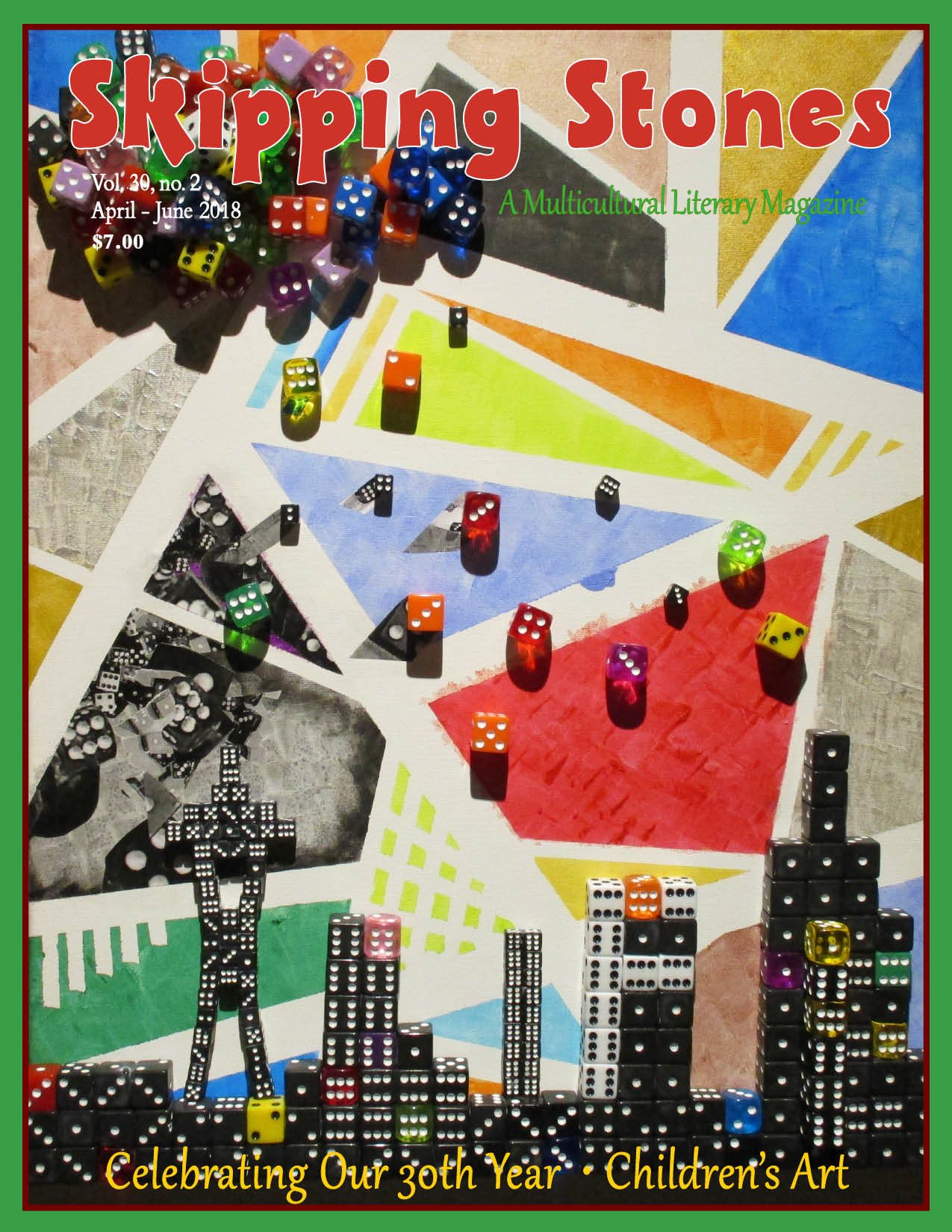
Seattle: The Cover Art

What is the color of Seattle? When you think of Seattle, you probably come up with several big-name corporations like Microsoft, Amazon, and Boeing. You might think of dark Starbucks coffee, or the rain falling from the cloudy sky. So the color of Seattle might be achromatic like gray and black.

However, the color of Seattle is a multi-layer rainbow for me. The city is very diverse, composed of various people with different cultures, foods, languages, and spiritualities. All these people have tried to accept and mingle with each other to make the real Seattle. So, I think Seattle is a well-mixed hot pot with various people’s life stories.

I decided to use the dice to depict the city of Seattle because its skyscrapers always remind me of black dice. (If you line them up, they look like black buildings with white lights.) While I mainly used black dice for buildings, I used multiple colors of dice for the clouds and rain showers, representing new and multiple cultures.

As a Korean-American who has spent half of my life in Seattle, I would like to show the city as a culturally diverse place, like the life stories of its citizens. Also, I would like to share a little secret hidden in this artwork. You might observe the hidden word “Life” depicted by the dice, if you look carefully enough. 🙂

—Chankyo (Chris) Kim,16, Washington. He believes that art is an excellent tool for self-expression as well as communication with his community. He loves experimenting with diverse media to create various forms of visual arts: paintings, mixed media, animations, and political cartoons. When he is not working on his artwork, Chris avidly builds and programs with his robotics team, plays musical instruments, and practices Taekwondo. In addition to his artistic interests, he enjoys playing video games in his spare time while watching political, preferably unbiased, news. Below: Folkart from Central India.