Author Archives:

Intoxicated: My Life with Social Media

By Isaac Choi, 16, Oregon.

As one critic of social media observed, “There are only two industries that call their customersusers‘: illegal drugs and software,” said Edward Tufte, a computer scientist in The Social Dilemma. According to a 2018 Pew Research Center survey of 750 teens, 97 percent used social media and 45 percent were addicted to it. I was one of those teens. I first tasted the social media world on my 12th birthday. I had nagged my mother for months, and now it was in my grasp. I quickly became absorbed by the features and abilities that social media possessed. In my first few days, social media consumed my mind. I thought about it during school, at dinner, and even in my sleep. Its presence stalked me like a tiger in a forest and lingered like a ghost at night. I fell into an abyss of likes, followers, and posts. From the moment my eyes landed on the scrolling screen, a habit instantly formed, beginning the intoxication of my mind.

About a year after developing my profile, I developed a daily routine. After school, I would seize my phone to browse social media apps. It was supposed to be a positive way to connect to the outside world and join the online community. But that was not the case. Instead, I became obsessed with how many followers and likes I had. It separated me from reality and presented me with a false identity. I had become a salesman and an addict; I thought of ways to appeal to people to follow me, just as a CEO would handle marketing. For example, if I took photos from my chin up, my insights showed deflation in followers, whereas if I took pictures from a head to heel angle, I would experience inflation. I would try to recreate the bios and profile pictures they had. It made me feel invincible, numbing my mind with ecstasy. This kid who never touched social media before was now living the high life.

By the end of next year, I was a living disaster. I was consumed by social media. Instead of spending time with family on holidays, I sneaked into my account, and I scrolled through posts, instead of completing schoolwork. Consequently, my life was full of procrastination and constant fights with my family. I was stressed by the pressure of trying to support my “perfect” reality online. But thankfully, this cycle came to a sudden halt. 

 It was around seven or eight p.m. on a Saturday when my mother called me to the living room. She wanted to show me a documentary on Netflix. My mother is not a lukewarm parent; instead, she is the total opposite- a “tiger” mom. With that being said, my mother watched my social media addiction with an eagle eye. She saw that I was not able to live with both social media and school, and realized that I needed change; not by a minor fix through small talk but by a dramatic metamorphosis. At first, I had no idea what it was about, but I just stayed until I saw the title. 

As soon as I saw the words, The Social Dilemma, sweat droplets rose from my palms and my back. I had heard from a blog that the documentary could turn the lives of addicts completely around. It motivated people to delete their social media apps and renew their lives. But I did not want to be a part of that. I detested the thought of quitting social media and giving up my “perfect” reality. But, my mother insisted that I just watch and listen. So to avoid any conflict, I stayed, but the sweat slowly rolling down my back added to my uneasiness.

The Social Dilemma resurrected me from the gorges of temptation and deceit. As I watched former employees of tech companies like Facebook and Google give their testimonies on how the industry managed social media, everything they said was an explanation for my addiction. One employee said that the companies looked at people’s views on posts and recommended similar content. This led to addiction. Another employee said that companies would send notifications to attract users. This led to distraction. From that point on, I told myself that I would not be brainwashed by money-loving trolls who took advantage of the vulnerable, which led me to believe that social media was not an app, but a drug.

After the documentary ended, my mother asked me how I felt about it. I hid my true feelings and said that it was boring because I still had the desire for social media within me. But suddenly, my mother wanted me to make a decision: either choose social media or my life. I did not want to do this, so conflict was the only alternative. While I was resting my hoarse voice, a calm rushed over me. Instead of resuming the conflict, I suddenly wished for a newer life, full of meaning and purpose. That was when I made the choice that changed my life, one that would influence my future. With that, I quit and deleted all my social media apps and accounts.

The aftermath of this decision led to so many great results. I started a successful club at my school, became number one in my class, and started a new sport. What began as a tumultuous odyssey to becoming an addict eventually evolved into a tour of reflection. I had no sense of reality and most importantly, I was intoxicated by false illusions of perfectness. But I found a light that shines my true self, revealing my potential and purpose.

The first step to any recovery is seeking help. The Substance Abuse and Mental Health Services Administration (SAMHSA) helpline combats addictions from drugs to social media. For more information, visit: samhsa.gov. Thus, will you linger intoxicated or refresh into a successful life? Your choice will direct your path in life. Social media may get dopamine rushing all over the body, but there are many other highs in life which we can all embrace.

By Isaac Choi, age 16, Oregon. This was selected as one of the Noteworthy Entries in our 2021 Youth Honor Awards program.

Sit by Me

By Sonia Mehta, age 17, Russian-Indian heritage, Ohio.

“Excuse me. Is this seat taken?”

Anika glances up to see pleading eyes.

“Sorry,” Anika says, looking past the girl. “Our friend asked us to save the seat.” She resumes her lunch.

The newcomer leaves. From the corner of her eye, Anika watches the new girl navigate through the crowded cafeteria. Two noisy upper classmates jostle her to the side. Anika clenches her fork. They keep walking as though the girl is invisible. The newcomer chooses an unoccupied table in the corner and sits. Anika’s chest tightens. She takes a deep breath. No relief.

“Anika, you’re mean,” Cynthia says.

“Her name’s Darsha,” Meghan adds from across the table.

“Who?” Anika feigns.

“The new student,” Cynthia replies.

“Oh, I don’t know her.”

Meghan pushes her thick glasses to the top of her broad freckled nose. “Is she from the same part of India as you?” She tugs at her thin red hair.

“No. Different region.”

“She looks a little like you, Anika. But darker.” Cynthia twists her wavy chestnut hair around her plump index finger.

Anika feels a guilty pleasure hearing these words. The desire for lighter complexions in parts of India is a poorly kept secret. The classified section of the India Today newspaper is filled with matrimonial ads. Prospective brides are described as having ‘wheatish’ or ‘cream’ complexions. The defining characteristic of men is ‘successful.’

“I feel bad for her,” Meghan says.

“Someone should talk to her,” Cynthia adds.

Anika knows this means someone else. The friends look at Darsha. She is short and thin. Her long black hair glistens with coconut oil. It is pulled back into a messy ponytail, exaggerating the roundness of her face. She wears denim pants that are a size too large and a dull green t-shirt. Darsha stares at her plate, playing with uneaten food.

Anika rakes her fingers through her freshly straightened caramel-tinted hair. It accentuates her heart-shaped face. She tugs on the collar of her cropped Brandy Melville shirt.

“We can’t associate,” Meghan says, “or we’ll be losers too.”

Anika considers protesting but does not. She has ascended the school hierarchy to the level of blending in. She can live with that.

Three years ago a girl from India entered a classroom. She prepared for life in the States by watching every movie available to her in Surat, India. She expected to be introduced to the class by her new teacher. Such was the custom in her country. Instead, she was directed to an empty seat.

Within minutes, an American girl raised her nose and sniffed loudly. Other students mimicked the action: a pack of hyenas catching the scent of a prey. They soon triangulated the smell to the backpack under the newcomer’s desk. Disapproving looks followed. Her mother’s khichdi sat in the plastic container. It was the least spicy and malodorous dish she knew to pack for lunch.

After class, she rushed to the restroom and dumped the lentil dish. Next period she made the mistake of answering a question about Alexander Hamilton. She did not know that her thick accent sounded like marbles had been placed on her tongue, “Hamilton was a veddy (very) important patriot. He reeelly (really) cared about a strong federal government.”

A boy jeered, ”Did he reeelly?”

Snickers followed. She never volunteered another answer.

The worst introduction happened in the cafeteria. The room, the size of a football field, buzzed with a slow-moving current of American teens. Each table pre-filled with students laughing and gossiping. Their backs turned to her–a phalanx of shields. She found a corner table and sat alone. She stared relentlessly at her watch, willing the minute hand to move faster.

From her left, sunlight came through a window and separated into a rainbow on the wall. She pretended the colors were a palette of paint. She imagined dipping her brush in the red and produced her grandmother’s beet pickle. The cinnamon-anise smell touched her nostrils. A smear of green brought her Auntie’s fried elephant leaf paatra. Was that the scent of coriander? With a dash of orange, her mouth watered with the sweet cardamom-flavored jalebi.

She felt better looking at the rainbow. It was her color palette . Colors were a part of her life. She used to toss the powdered dyes at her cousins during the Holi Festival every year. The colors transformed them into living canvases.

“Earth to Anika,” Meghan says.

“What?” she mumbles, coming back to the present.

“I said, time for fifth period.”

Anika glances at Darsha’s now vacant seat. She tries imagining the new girl leaving alone. Instead. Anika sees a girl from Surat who once filled the emptiness in her heart with colors dancing on a wall. Anika has recognized the aching loneliness in another but has chosen silence. She leaves with her friends.

The next day, Anika joins her two friends at their usual table.

“Did you hear about Darsha?” Cynthia asks.

Anika looks up from her phone.

“She dropped out,” Cynthia continues.

“So soon?” Meghan says.

Anika’s stomach knots. She stares at the seat Darsha was in yesterday. Empty. That deserted table used to be hers. Her eyes drift to the window. It’s sunny outside, and a rainbow flickers through. My color palette , Anika remembers.

“Does anyone know why she quit?” she asks.

“Probably hated being a loser,” Cynthia answers.

“Where did she go?”

“I guess where she came from. Where was that again?”

“Somewhere else,” Anika whispers.

I wish you had stayed, Darsha. I should have shared my color palette. I could have. She looks again at the rainbow. It flickers merrily, unmoved by her thoughts.

A single cloud rolls in. Its shadow obscures the colors.

—Sonia Mehta, age 17, Russian Indian heritage, Ohio. The story is being published as one of the Noteworthy Entries of our 2021 Youth Honor Awards program. The story was also published by Telling Room earlier this summer.
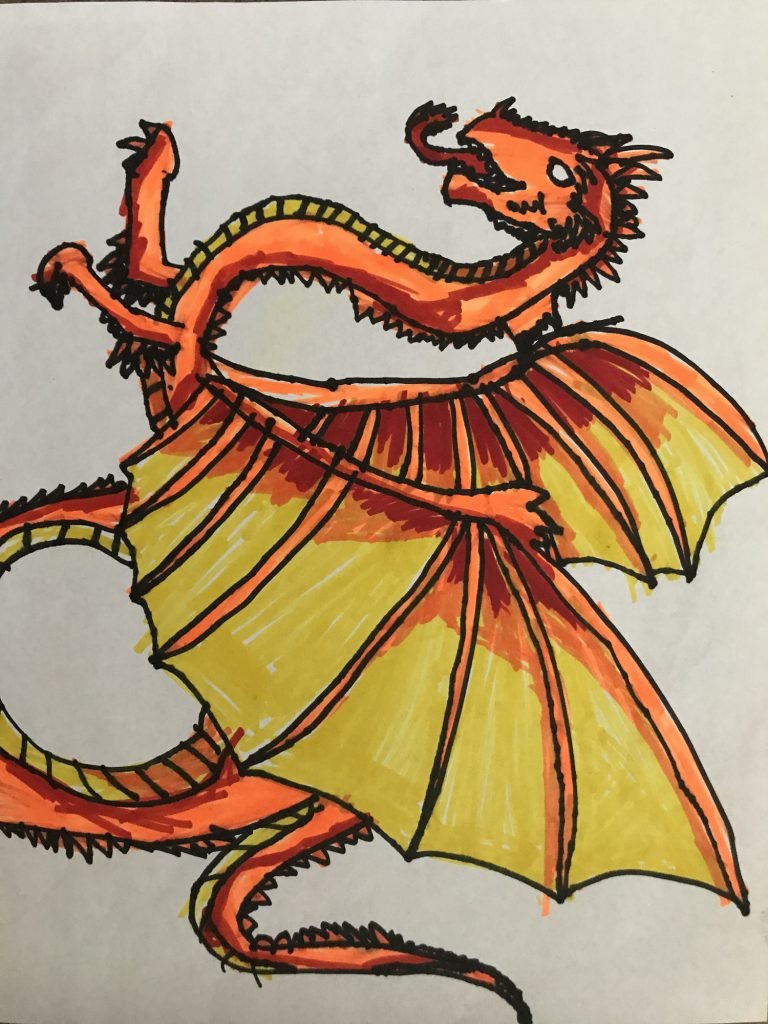
Fire Dragon

Fire Dragon by Jiacheng Yu, age 6, Florida.

Fire Dragon by Jiacheng Yu, age 6, Chinese American, Florida. This was an entry for the 2021 Youth Awards.

Love

A rose is a symbol of love

Love is something you should never shove

This fondness can be seen in someone’s eyes

Always listen to your heart; it never lies

Have some patience; it always takes time

Love is worth every dime.

By Riya Sikka, age 9. Melbourne, Australia.

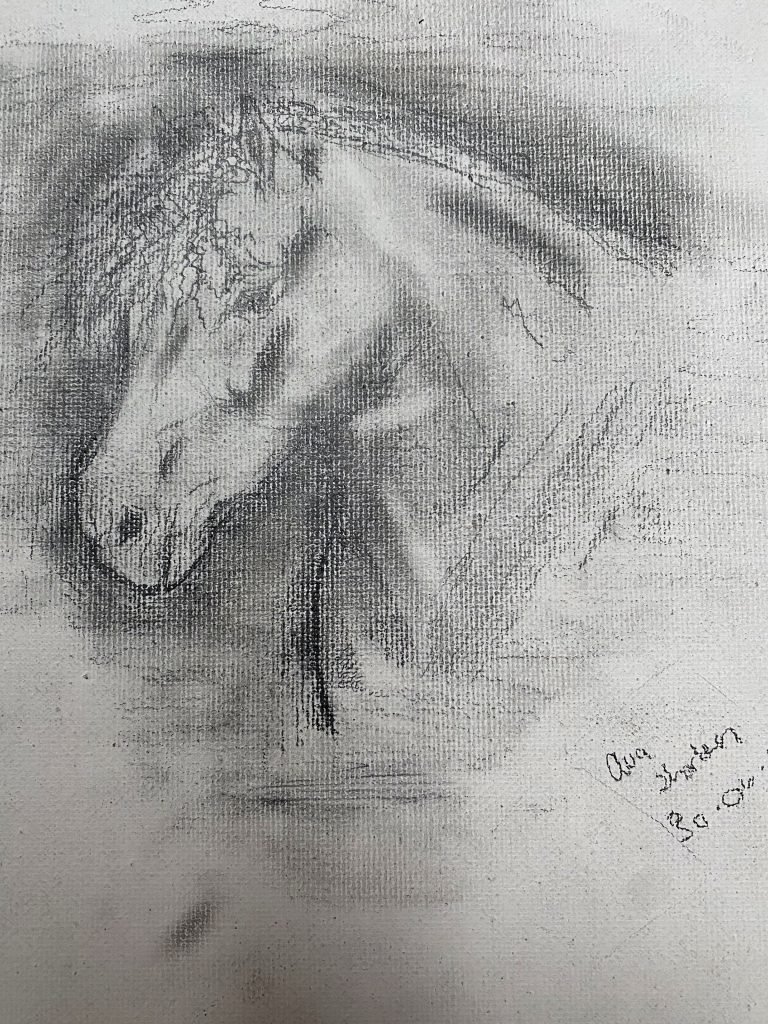
The Horse That Jumps

“This is the first drawing of mine that has really jumped off the page. I especially like drawing horses, because they are such majestic creatures, and you can display their beauty. I’ve always loved horses, and learning about them. I think, the drawing also shows my personality.”

By Ava Shorten, age 11, Cork, Ireland.

Girl Meets Belief

By Ishita Shukla, 16, India.

In 1425 CE, Joan of Arc, a 13-year-old girl, believed that she heard the voice of God telling her to drive the English out of France. Consequently, she was tried for witchcraft and heresy in 1431 CE, at the age of 19.

Crazy, right? But what if she wasn’t crazy and deeply believed in something? The greatest thinkers of the world believed in some concepts so strongly that it changed the world. Different people have faith in different things. And that’s ok; 7% of the world population are convinced Atheists. But that doesn’t mean they don’t have faith in other people, in a better world, in the mysteries of the universe. Some blindly trust a higher power, and others have faith in their morals and actions. I believe in people, and their confidence in a higher power, which makes me feel safer.

However, it is hard to develop strong credence, not just in ourselves but in the ancient and immortal God. People take years to search for their passions, the ideologies worth for them to fight for. In this complex world, with new innovations, evolving dogmas, surprising tenets, it is hard to maintain our faith in a person or thing because we don’t always get what we desire and blame it on the higher power rather than our actions. It is a constant struggle where we are never sure of the outcome.

So why is it easy for some than others? I am still searching for an answer. I believe many abandon faith when circumstances are difficult and answers are slow in coming. Learning to trust takes practice because faith isn’t maintained when we fail to see the reality behind our higher power and morals. Faith requires a vision; faith requires seeing with spiritual eyes.

“For we live by faith, not by sight.” (2 Corinthians 5:7 NIV).

And of course, it also requires the perky “p” twins, perseverance, and patience.

Ah, and this leads to a question. We have all walked through life long enough, our blissfully empty heads. But what do you believe in? What is your calling? Who do you blindly trust? What ideologies are worth fighting for?

No one has enough power to force you into believing something, but it is much harder to introspect ourselves.

By Ishita Shukla, 16, India.  She adds: “I am an aspiring writer from Hyderabad, India. I write to express myself, my views on topics that are so common that they are rarely talked about for e.g. fears, belief system, etc. My dream is to do research in economics while continuing my love for writing and reading. Writing is a very cathartic activity for me. I pour all my insecurities, my passions onto the paper.”

Haenyeo, the Sea Women of Korea

By Fanny Wong, New York.

Orange pumpkin-like buoys bob in the water off the island of Jeju, 55 miles off the tip of the South Korea peninsula. Baskets attached to them wait for their owners. The sea women, in groups of ten or more rise to the surface and make a distinctive whistle…“Hoowi, hoowi!” It’s an ancient technique to expel carbon dioxide from their lungs and to alert one another of their presence. They’ve been under water for 30 seconds or longer. It’s time to breathe. Everyone is accounted for. No accidental death today.

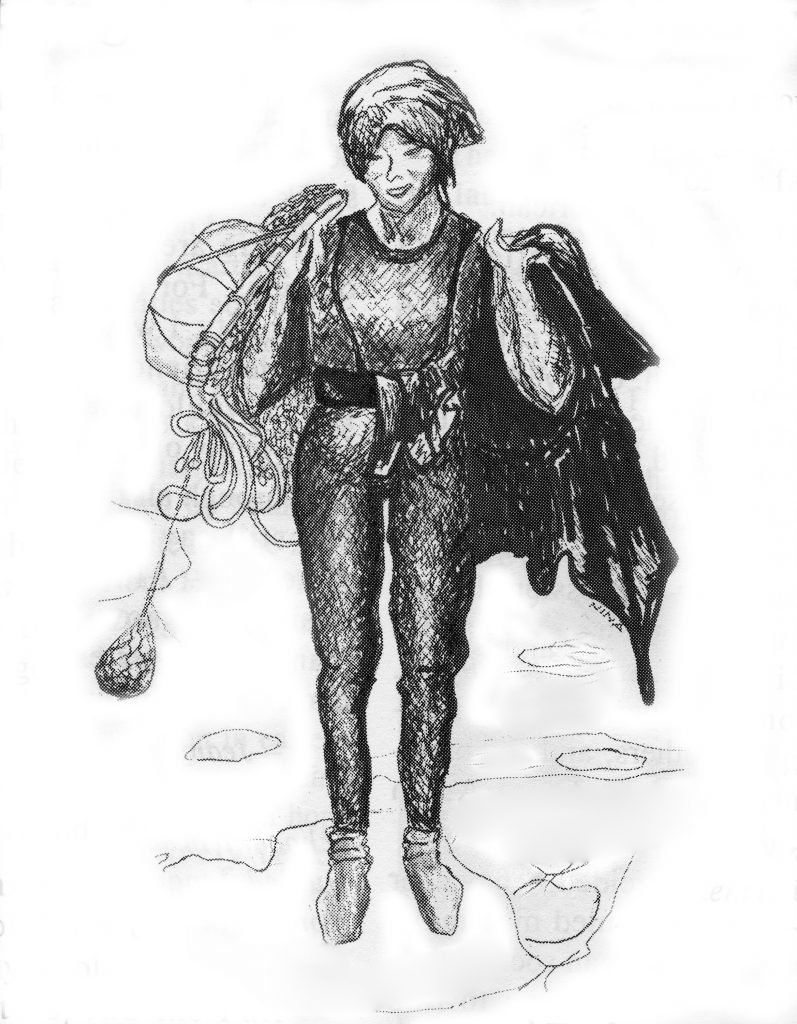
A Haenyeo Diver. Illustration by Nina A. Forsberg.

The women wade ashore or climb onto a waiting boat, hauling their baskets of the day’s underwater harvest. They take off their old-fashioned headlight-shaped scuba masks to reveal lined and weathered faces. These women are old! Who are they? What do they do underwater?

For hundreds of years, the sea women, known as the haenyeo, dive as deep as forty feet to harvest seaweed, sea urchins, sea cucumbers, octopus, shellfish and abalone from the ocean floor. They free dive without an oxygen tank, equipped only with fins, gloves, and a belt of lead weights to assist diving. They use different simple tools; such as a small harpoon for piercing fish, a sickle for collecting seaweed, a long hoe for prying abalone of rocks.

Jeju is a 700 square miles island of volcanic rock and soil, off the southwestern coast of southwest Korea. It has a beautiful coastline and is listed on UNESCO’s World Nature Heritage. Windy and rocky, there isn’t much land for productive farming, except for mandarin orange farms. But the sea provides an alternative farm.

Life of the haenyeo is hard. They harvest from five to seven hours a day, about 18 days per month, depending on the weather and tide conditions. It was only in the 1970s that the government subsidized wetsuits, which protect them from the cold water. The women used to dive in loose cotton clothing and could stay in the water up to an hour during the winter months. They had to sit by a fire to dry off before jumping back into the water. Wearing wet suits, now they can earn more by staying longer in the water, and to dive into old age.

Underwater is a dangerous place to make a living. The divers must be careful not to push too far for that prized abalone. Deprived of oxygen, a diver can suffer a heart attack. She must know when to have enough breath to come up slowly, and perhaps give up a precious find stuck under a rock. One side effect of longer dives is decompression sickness. They also contend with dangers, such as jellyfish, poor weather, big fish and even an occasional shark.

Most of the divers are old, with the oldest in their eighties, and even nineties. The average age is seventy. These elderly women learn from a young age to understand water pressure, oxygen level in their lungs and resurfacing distance. The girls as young as eleven start to learn to dive in shallow water, then in more challenging depths. Some women have dived all through pregnancy and given birth on a boat! This job used to be handed down from mother to daughter, but now, the young women prefer a more comfortable life in the island’s two cities or on the mainland. From more than 14,000 in the 1970s, there are fewer than 2500 haenyeo today. Some women abandoned the dangerous sea diving in old age. They and the ones who died were not replaced.

The haenyeo culture relies on cooperation and hierarchy. The beginners and the older women belong to the bottom level of divers, the hagun. The middle level junggun diver can hold her breath between 40 seconds to a minute. The top-level sangun diver can work the most difficult areas, dive deepest and may be able to hold her breath up to two minutes. The more experienced offer their guidance to the less experienced. It can take a new diver five years to be fully competent.

The women generally sell their catch through a fishery cooperative in each village. There are about 100 cooperatives. Each cooperative has its own regulations about the boundary of the fishing ground, qualification and catching methods. When a problem arises, the haenyeo get together in a form of town hall meeting to make decisions everyone understands and accepts. The community spirit is strong. Before and after a day’s work, they change their cloths in the traditional bulteok, an open-air circle marked by a 4 feet high stones wall, with a fire in the center. Recently built bulteoks are cement buildings with showers and heated dressing rooms. They chat about personal matters and issues related to work. The conversation is affectionate and warm.

A diver earns about the equivalent U.S. $12,500 a year. That’s not a lot of money for their hard work. A second job farming on small plots of land supplement their income. But they are proud to be their families’ providers. With no education, the women had little choice but follow their mothers’ footsteps. Now, they want their children and grandchildren to get a good education, even to go to a university.

Where are then men? Some elderly husbands wait on shore for their wives to return. They help lug the heavy loads onto land, help weigh and sort the catch. It wasn’t always this way. Men from Jeju harvested shellfish as far back as 1460, as mentioned in a court document. Why the change? One explanation is that in the 17th century, the men were taken away to fight Korea’s foreign wars. Another explanation is that women’s body fat enabled them to endure the cold water better. Diving for seafood became exclusively female and remains so today.

There is some stigma attached to their work. In modern South Korea, women are generally prized for being delicate. The divers are anything but delicate. They have grit, physical and mental stamina. They talk loudly on land because the build-up of air pressure in their ears means that noises are muffled. Not lady-like at all!

But, the haenyeo has gained respect in their efforts to protect the marine ecosystem. They are marine specialist by experience. Knowing the cycle of marine life, they do not over harvest. For example, abalone and conch are caught from October to June, sea urchins from May to July and sea slugs during the winter season. They don’t take anything under-sized. Even different seaweeds are harvested at specific times of the year. They are lauded for their eco-friendly methods and community involvement in managing their practices.

Normally in South Korea, men dominate, but not in Jeju. For centuries, they had high status and independence in their community. They are the breadwinners, take care of the children and make household decisions. In the male-dominated culture, they were modern before their time. Even today, when many elderly South Koreans over 65 are poor, these elderly women’s financial independence is remarkable.

The haenyeo’s legacy is not just economic. It’s social. It’s cultural. Every February in the lunar calendar, the haenyeo hold a ceremony in honor of the God of the wind, Yeongdeung. He visits Jeju Island on the first day of February. In mid-February, they send a small straw boat loaded with offerings out to sea to accompany him as he departs Jeju for the year. The women pray to the God, believing that he helps them hold their breath underwater and to keep them safe. They also pray at shrines.

Interest in the haenyeo has grown. In 2006, the Haenyeo Museum opened. It explains the history and culture through models of their traditional homes; displays boats, tools, masks and diving wear. Underwater photographers published books about them. In 2015, the Jeju government began to help pay for their accident and medical insurance. In 2016, UNESCO awarded the divers a Cultural Heritage of Humanity designation, recognition they long deserved.

But the haenyeo themselves are pessimistic about the future. Tourism is increasing and generates more revenue than the diving catch. With few young women willing to go into the profession, the culture will eventually die out. Moreover, they witness the effect of climate change in the ocean. Pollution is reducing the amount of and quality of edible sea life.

How can the haenyeo tradition be preserved in the age of modernity? Modifications can make life of the haenyeo easier and more attractive to the next generation, just as the wetsuits made a lot of difference. Perhaps something mechanical can help them lug the heavy baskets of wet seaweed and algae onto shore. A full basket of seaweed can weigh as much as 65 pounds. Better medical intervention can prevent and lessen the physical toil to their bodies. Some of the ailments include headaches, tinnitus, digestive problems and increased risk of strokes.

Meanwhile these tough women who ride motorcycles to get around remain graceful underwater ballerinas in the silence of the deep. They continue to be Jeju’s most valued treasures.

By Fanny Wong, Asian American author, New York.

The Unforgettable Memories of School

The Unforgettable Memories of School

 Waking up in the morning was a pain,
 Four more days to go, we’d say in our brain.
 Oh! Those long morning assemblies,
 Where we melted in summers and in winters stood numbly.
 I bet we all had a teacher who was like our worst nightmare,
 I will never forget all the gossip about her that we shared.
 Faking signatures was an inborn talent we all had,
 And making excuses was like our jam.
 In lunch breaks we shared our food,
 On one’s birthday to get two chocolates we argued.
 We passed chits around the class,
 From one end to another we would sit and laugh.
 The times before the exams were filled with anxiety and stress,
 Oh! Those dreadful sleepless nights, the misery we couldn’t express.
 We made many friends, but the true ones stayed,
 The others were good, but they eventually fade.
 For the weekend we would desperately long,
 The best two days of the week, oh! So, fast they would already be gone.
 We stuck with each other in times of laughter and in times of strife,
 Unaware of it all we made memories for life.
  
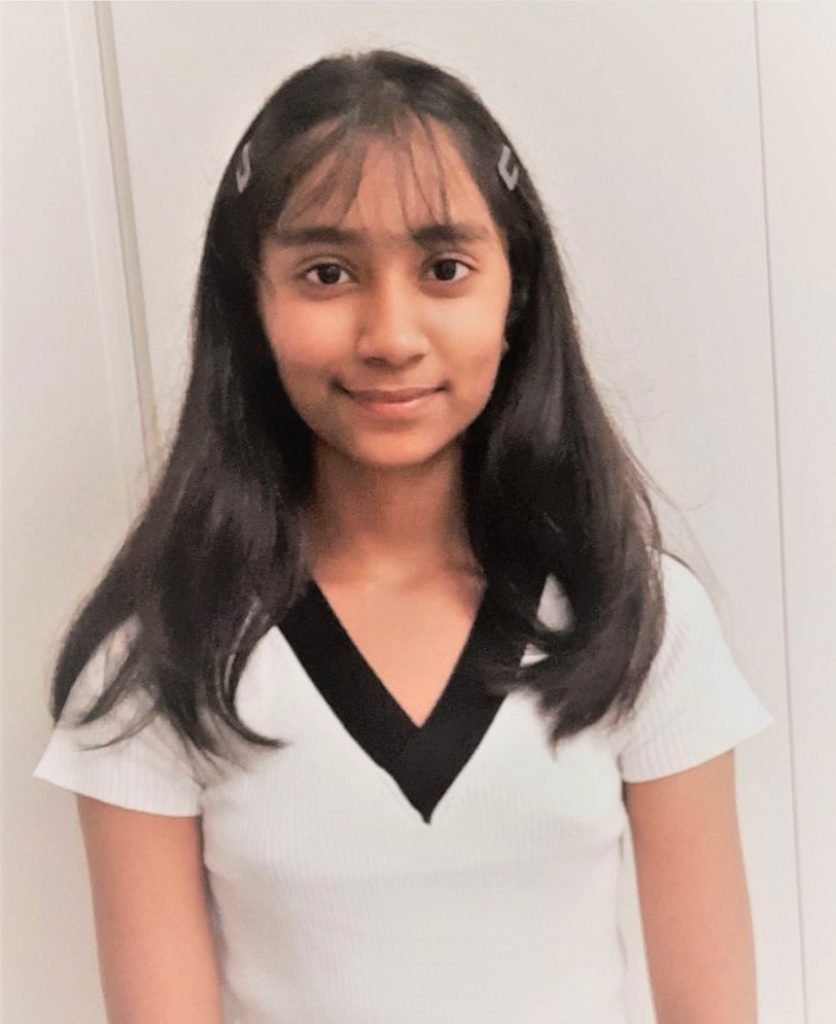
By Simerah Pinto, age 13, Dubai, U.A.E. 
Photo: Simerah Pinto, age 13, Dubai, U.A.E.

Life Aboard an Iceberg

By Carla Sabotta, Olympia, Washington.

An Iceberg in the Antarctic Region. Photo by Carla Sabotta, Washington.

From jellyfish to harbor seals, a variety of animals thrive in and around icebergs. The animals find food and shelter, and some of them nest, on these floating chunks of ice.

Icebergs break off from glaciers and ice shelves and bob in the sea. An ice shelf appears where a glacier flows down to a coastline. Icebergs stay afloat even though they weigh many hundreds of thousands of tons. They float for the same reason ice cubes do in a glass of water—ice is lighter than water.

Icebergs the size of houses and large buildings form each year in the Arctic at the North Pole and in Antarctica at the South Pole. Table-shaped icebergs have steep sides and flat tops. Other shapes of icebergs have domes and spires.

Algae and phytoplankton grow on and around all shapes and sizes of icebergs. Algae are like plants and make food from sunlight. Phytoplankton are tiny living things and include plants and animals. Inch-long, shrimp-like creatures called krill eat the algae and phytoplankton. Thousands of krill mill about together and make up the largest part of the diet of many animals.

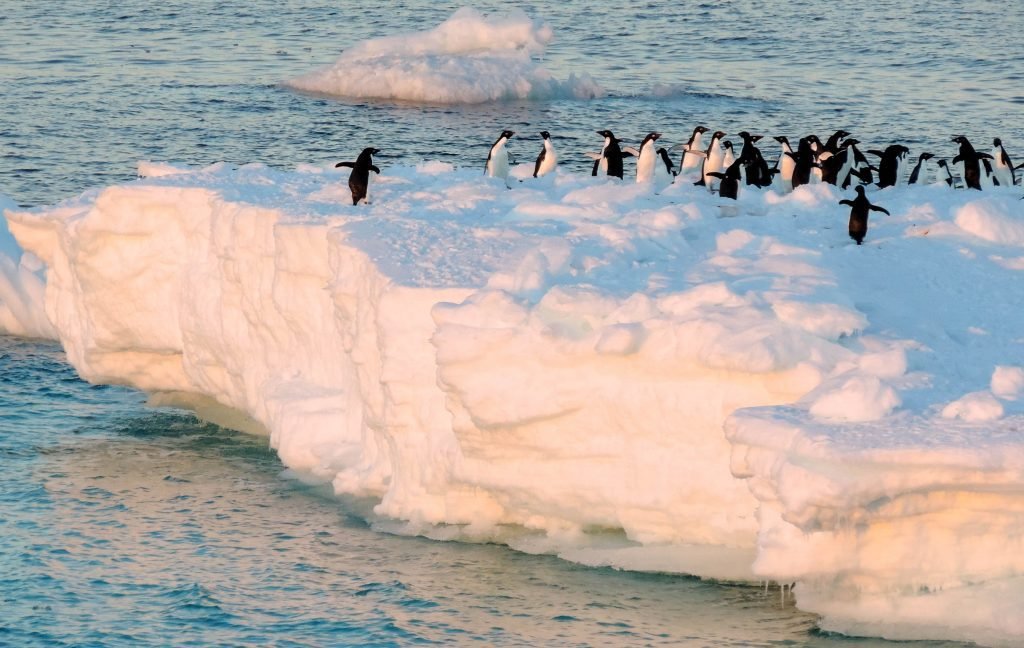
Invertebrates such as jellyfish come to the icebergs to feed on krill. Invertebrates lack backbones. Larger animals such as fish, squid and penguins also like krill. Penguins catch the slippery creatures with their spiny tongues and powerful jaws, while keeping a look out for seals and whales.

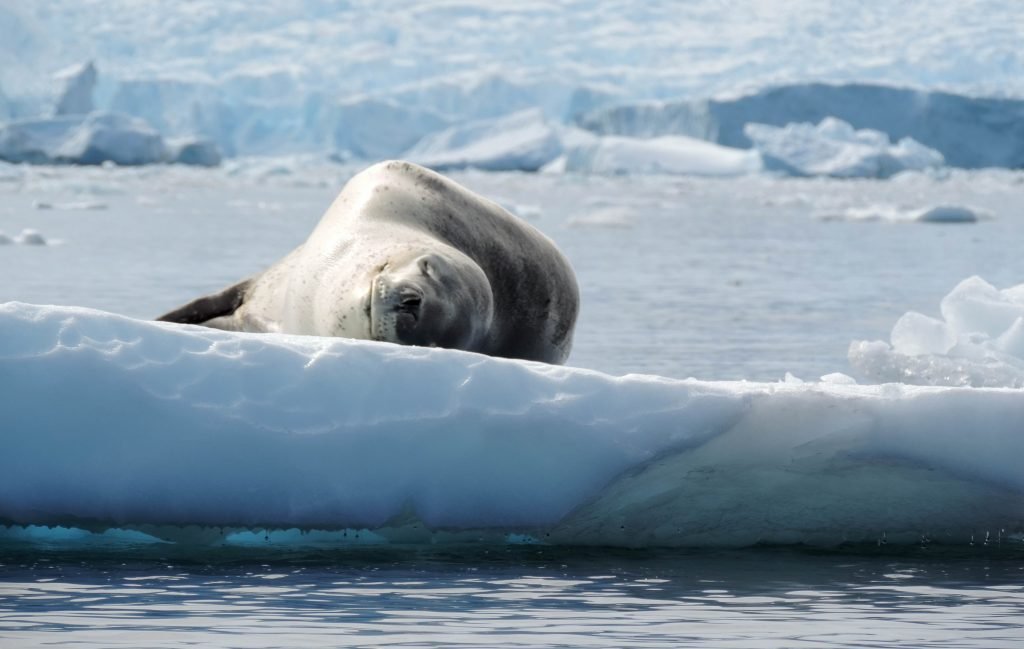
Leopard seals and killer whales seek out icebergs to hunt the penguins. Squawking flocks of petrels and other flying seabirds circle overhead looking for food. The seals also like to sleep on pieces of sea ice floating in the shadows of the icebergs, to get protection from high winds.

A Leopard Seal on a Small Iceberg. Photo by Carla Sabotta, Washington.

In addition to supplying food, icebergs also give protection and a place to raise pups. Young icefish dart into small holes to hide from animals hunting them. These pale-looking fish have clear blood because they lack red blood cells and hemoglobin. Groups of harbor seals haul out onto icebergs to escape killer whales, sharks and polar bears. They rest on the ice with their heads and rear flippers lifted up in a banana-like pose.

During the spring, female harbor seals give birth to pups on icebergs. Groups of mother seals raise their pups on the ice to protect themselves from predators. When they’re not swimming and diving, the seal pups rest on the ice. Out of the water the pups use little energy to stay warm. They can instead use the energy from their mother’s milk to grow and put on the blubber they will need to survive the winter.

Are icebergs becoming home to new animals? Possibly. Scientists recently reported for the first time seeing a colony of ivory gulls and chicks nesting on a rock-covered iceberg. The iceberg drifted in open water near Northeast Greenland. These gleaming white gulls usually build their nests on cliff ledges or distant islands near coasts. Scientists think the gulls may have chosen an iceberg to avoid Arctic foxes and polar bears, and to stay close to their favorite food—small fish and krill.

Adelie Penguins on an Iceberg. Photo by Carla Sabotta

Carla adds, “I was inspired to write this article after learning about icebergs on a trip to Antarctica.”

Fly

By Ritika Rawat, age 9, New Jersey

I wish I could fly away,

And the universe will lead me to the way.

I wish I could soar up in the sky and fly,

oh so very high.

I want to flap my wings up to the sky,

but when I’m down my heart stings.

Up, and up I go, and my journey begins,

Everything is great and we all win.

I come down from my dreams

because not everything is what it seems.

By Ritika Rawat, will enter grade 5 this fall, Indian American, New Jersey.